(A five part collection of short Clarion Project videos follows, narrated in part by Dr. Zuhdi Jasser. They deal with the very real and dangerous efforts of Muslims to take over western civilization. The first video appears immediately below. The next four follow automatically.
We need to be aware of more than “radical Islamic terrorism.” The problems go beyond the “radicals” and terrorism. They include Islamists who seek to undermine western civilization through legalistic rather than violent attacks.– DM)
WASHINGTON (Reuters) – U.S. Supreme Court Justice Anthony Kennedy on Monday put a temporary hold on limits imposed by a lower court on President Donald Trump’s order barring most refugees from entering the United States.
Kennedy acted in response to the U.S. Justice Department’s challenge to the part of a Thursday ruling by the San Francisco-based 9th U.S. Circuit Court of Appeals that would let refugees from around the world enter the country if they have a formal offer from a resettlement agency.
Without Kennedy’s intervention, the appeals court decision would have gone into effect on Tuesday. Kennedy’s action gives the full Supreme Court time to consider the merits of the Trump administration’s emergency request in full. Kennedy asked refugee ban challengers to file a response by noon (1600 GMT) on Tuesday.
The administration did not ask the court to put on hold a separate part of the lower court ruling that exempted grandparents, aunts, uncles and cousins of legal U.S. residents from Trump’s ban on travelers from six Muslim-majority countries.
In the court filing, the Justice Department said the 9th Circuit’s decision on the refugee ban “will disrupt the status quo and frustrate orderly implementation of the order’s refugee provisions.” Up to 24,000 additional refugees would become eligible to enter the country than would be otherwise allowed, according to the administration.
The Justice Department’s filing marked the latest twist in the ongoing legal fight over Trump’s sweeping March 6 executive order that barred travelers from Iran, Syria, Libya, Somalia, Sudan and Yemen for 90 days, a move Trump argued was needed to prevent terrorist attacks. The same order included a 120-day ban on refugees from around the world.
The bans were challenged by Hawaii and other Democratic-led states, the American Civil Liberties Union and refugee groups.
Both provisions were blocked by lower courts but were partially revived by the Supreme Court in June, which said the bans could be applied only to people without a “bona fide” relationship to people or entities in the United States.
That prompted new litigation brought by Hawaii over the meaning of that phrase, including whether written assurances by resettlement agencies obligating them to provide services for specific refugees would count as a bona fide relationship.
The Trump administration said the assurances should not, meaning such refugees would be barred.
The appeals court also said his administration did not persuasively explain why the broader travel ban should be enforced against close relatives of people from the six specified countries. The Justice Department said in its filing on Monday it disagreed with that part of the decision but was not seeking to block it from going into effect.
The broader question of whether the travel ban discriminates against Muslims in violation of the U.S. Constitution, as lower courts previously ruled, will be considered by the Supreme Court in October.
States, civil liberties advocates and others who challenged Trump’s order in court argued that it violated federal immigration law and the Constitution’s First Amendment prohibition on the government favoring or disfavoring any particular religion. Critics called it a discriminatory “Muslim ban.”
Trump’s March order replaced a broader January one that was blocked by federal courts.
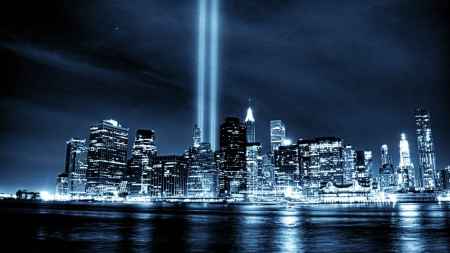
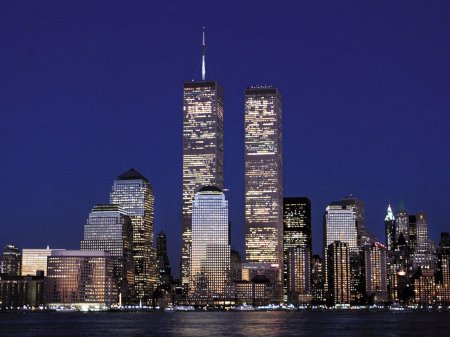
Sept. 11 should be more than just a few moments of silence to remember the Twin Towers falling, the burning Pentagon and the inspiring heroism of regular Americans in bringing down United Flight 93 in Shanksville, Pa. We should also seriously consider today’s global threats. Those who made America an exceptional country did so by confronting reality and overcoming it, not by ignoring it.
********************************
Today marks the 16th anniversary of al-Qaida’s 9/11 attacks. We learned much that tragic day, at enormous human and material cost. Perilously, however, America has already forgotten many of Sept. 11’s lessons.
The radical Islamicist ideology manifested that day has neither receded nor “moderated” as many naive Westerners predicted. Neither has the ideology’s hatred for America or its inclination to conduct terrorist attacks. Iran’s 1979 Islamic Revolution brought radical Islam to the contemporary world’s attention, and it is no less malevolent today than when it seized our Tehran embassy, holding U.S. diplomats hostage for 444 days.
The Taliban, which provided al-Qaida sanctuary to prepare the 9/11 attacks, threaten to retake control in Afghanistan. Al-Qaida persists and may even be growing worldwide.
While ISIS’s caliphate in Syria and Iraq will not survive much longer, countries across North Africa and the Middle East (“MENA”) have destabilized or fractured entirely. Syria and Iraq have ceased to exist functionally, and Libya, Somalia and Yemen have descended into chaos. Pakistan, an unstable nuclear-weapons state, could fall to radicals under many easily predictable scenarios.
The terrorist threat is compounded by nuclear proliferation. Pakistan has scores of nuclear weapons, and Iran’s program continues unhindered. North Korea has now conducted its sixth, and likely thermonuclear, nuclear test, and its ballistic missiles are near to being able to hit targets across the continental United States. Pyongyang leads the rogue’s gallery of would-be nuclear powers, and is perfectly capable of selling its technologies and weapons to anyone with hard currency.
During Barack Obama’s presidency, he ignored these growing threats and disparaged those who warned against them. His legacy is terrorist attacks throughout Europe and America, and a blindness to the threat that encouraged Europe to accept a huge influx of economic migrants from the MENA region, whose numbers included potentially thousands of already-committed terrorists.
IGNORING NORTH KOREA
Obama also ignored North Korea, affording it one of an aspiring proliferator’s most precious assets: time. Time is what a would-be nuclear state needs to master the complex scientific and technological problems it must overcome to create nuclear weapons.
And, in a dangerous unforced error that could be considered perfidious if it weren’t so foolish, Obama entered the 2015 Vienna nuclear and missile deal that has legitimized Tehran’s terrorist government, released well over a hundred billion dollars of frozen assets, and dissolved international economic sanctions. Iran has responded by extending its presence in the Middle East as ISIS had receded, to the point where it now has tens of thousands of troops in Syria and is building missile factories there and in Lebanon.
Before 2009, publishers would have immediately dismissed novelists who brought them such a plainly unrealistic plot. Today, however, it qualifies as history, not fantasy. This is the agonizing legacy the Trump administration inherited, compounded by widespread feelings among the American people that we have once again sacrificed American lives and treasure overseas for precious little in return.
These feelings are understandable, but it would be dangerous to succumb to them. We didn’t ask for the responsibility of stopping nuclear proliferation or terrorism, but we are nonetheless ultimately the most at risk from both these threats.
And as we knew during the Cold War, but seem to have forgotten since it ended, our surrounding oceans do not insulate us from the risk of long-distance nuclear attacks. We face the choice of fighting the terrorists on our borders or inside America itself, or fighting them where they seek to plot our demise, in the barren mountains of Afghanistan, in the MENA deserts, and elsewhere.
Nor can we shelter behind a robust national missile-defense capability, hoping simply to shoot down missiles from the likes of North Korea and Iran before they hit their targets. We do not have a robust national missile defense capability, thanks yet again to Barack Obama’s drastic budget cuts.
President Trump appreciates that nuclear proliferation and radical Islamic terrorism are existential threats for the United States and its allies. During the 2016 campaign, he repeatedly stressed his view that others should play a larger role in defeating these dangerous forces, bearing their fair share of the burden. But candidate Trump also unambiguously (and entirely correctly) called for restoring our depleted military capabilities because he saw that American safety depended fundamentally on American strength.
Sept. 11 should be more than just a few moments of silence to remember the Twin Towers falling, the burning Pentagon and the inspiring heroism of regular Americans in bringing down United Flight 93 in Shanksville, Pa. We should also seriously consider today’s global threats. Those who made America an exceptional country did so by confronting reality and overcoming it, not by ignoring it.
The names of passengers and crew of United Airlines Flight 93, who lost their lives in the September 11 attacks, as displayed at the National 9/11 Memorial in New York. (Image source: Luigi Novi/Wikimedia Commons)
____________________________
John R. Bolton, former U.S. Ambassador to the United Nations, is Chairman of Gatestone Institute, a senior fellow at the American Enterprise Institute, and author of “Surrender Is Not an Option: Defending America at the United Nations and Abroad”.
This article first appeared in The Pittsburgh Tribune Review and is reprinted here with the kind permission of the author.
The Trump administration on Monday asked the Supreme Court to immediately intervene and block a federal appeals court ruling imposing an injunction against President Trump’s modified travel ban.
The 9th Circuit Court of Appeals on Thursday rejected the Trump administration’s interpretation of which family members are permitted to enter the U.S. under the portion of the travel ban that the Supreme Court allowed to take effect. The travel ban temporarily blocked foreign nationals from coming to the U.S. from six Muslim-majority countries unless they have certain family ties in the U.S., a move the Trump administration said is needed to ensure national security.
A federal judge in Hawaii first blocked the government’s petition to have the ban cover close family and extended relatives. The 9th Circuit U.S. Court of Appeals upheld that ruling last week, frustrating the Trump administration’s attempt to add definition about who would be covered by the ban, and who would not.
“Stated simply, the Government does not offer a persuasive explanation for why a mother-in-law is clearly a bona fide relationship, in the Supreme Court’s prior reasoning, but a grandparent, grandchild, aunt, uncle, niece, nephew, or cousin is not,” ruled the 9th Circuit Court on Thursday.
The Trump administration, however, believes the Supreme Court should halt the 9th Circuit’s most recent ruling pending argument from the court, in part because the 9th Circuit ordered that the government stop implementing its ban.
“The court of appeals’ decision — which will take effect at approximately 11:30 a.m. Eastern Time tomorrow (September 12, 2017) because the court drastically shortened the time for issuance of the mandate — will disrupt the status quo and frustrate orderly implementation of the Order’s refugee provisions that this Court made clear months ago could take effect,” wrote Jeffrey Wall, acting solicitor general, in the Monday filing. “The [Supreme] Court should not permit its rulings to be frustrated in that fashion, and it should not allow the ‘equitable balance’ it carefully struck to be upset while the merits of the injunction are pending before it. The Court can and should prevent further uncertainty and disruption by staying the court of appeals’ ruling with respect to refugee assurances.”
The great lesson of that Tuesday morning was that it wasn’t over. It wasn’t over when we understood that we wouldn’t find anyone alive in that twisted mass of metal and death. It wasn’t over when the air began to clear. It wasn’t over when the President of the United States spoke. It wasn’t over when the planes began to fly again and the TV switched from non-stop coverage of the attacks and back to its regularly scheduled programming. It wasn’t over when we were told to mourn and move on.
It still isn’t over.
We are in the middle of the longest war in American history. And we still haven’t learned how to fight it.
************************************
“In the name of Allah, the Most Merciful, the Most Compassionate,” a terrorist declares on the Flight 93 cockpit recording. That’s followed by the sounds of the terrorists assaulting a passenger.
“Please don’t hurt me,” he pleads. “Oh God.”
As the passengers rush the cabin, a Muslim terrorist proclaims, “In the name of Allah.”
As New York firefighters struggle up the South Tower with 100 pounds of equipment on their backs trying to save lives until the very last moment, the Flight 93 passengers push toward the cockpit. The Islamic hijackers call out, “Allahu Akbar.” The Islamic supremacist term originated with Mohammed’s massacre of the Jews of Khaybar and means that Allah is greater than the gods of non-Muslims.
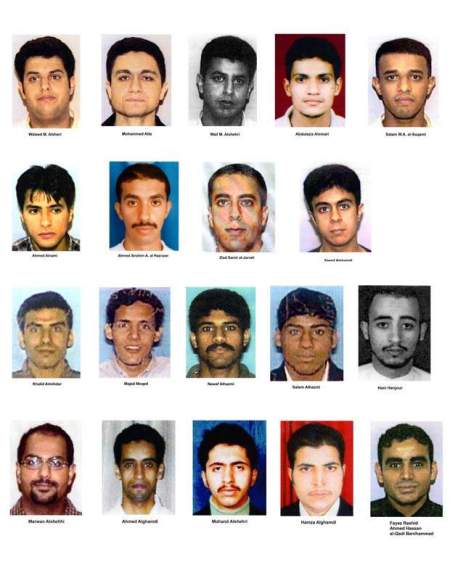
Mohammed Atta had advised his fellow terrorists that when the fighting begins, “Shout, ‘Allahu Akbar,’ because this strikes fear in the hearts of the non-believers.” He quoted the Koran’s command that Muslim holy warriors terrorize non-believers by beheading them and urged them to follow Mohammed’s approach, “Take prisoners and kill them.”
The 9/11 ringleader quoted the Koran again. “No prophet should have prisoners until he has soaked the land with blood.”
On Flight 93, the fighting goes on. “Oh Allah. Oh the most Gracious,” the Islamic terrorists cry out. “Trust in Allah,” they reassure. And then there are only the chants of, “Allahu Akbar” as the plane goes down in a Pennsylvania field leaving behind another blood-soaked territory in the Islamic invasion of America.
Today that field is marked by the “Crescent of Embrace” memorial.
Thousands of Muslims cheered the attack in those parts of Israel under the control of the Islamic terrorists of the Palestinian Authority. They shouted, “Allahu Akbar” and handed out candy.
But similar ugly outbreaks of Islamic Supremacism were also taking place much closer to home.
On John F. Kennedy Boulevard, in Jersey City, across the river from Manhattan, crowds of Muslim settlers celebrated the slaughter of Americans. “Some men were dancing, some held kids on their shoulders,” a retired Jersey City cop described the scene. “The women were shouting in Arabic.”
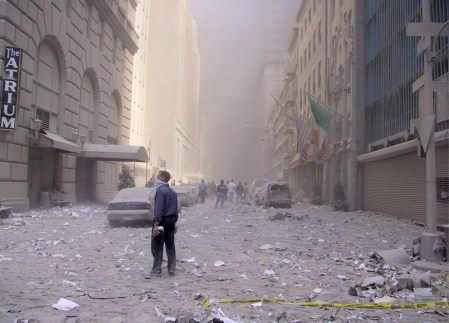
Similar Islamic festivities broke out on Atlantic Avenue in Brooklyn, a major Islamic settlement area, even as in downtown Manhattan, ash had turned nearby streets into the semblance of a nuclear war. Men and women trudged over Brooklyn Bridge or uptown to get away from this strange new world.
Many just walked. They didn’t know where they were going. I was one of them.
That Tuesday was a long and terrible education. In those hours, millions of Americans were being educated about many things: what happens when jet planes collide with skyscrapers, how brave men can reach the 78thfloor with 100 pounds of equipment strapped to their backs and what are the odds are of finding anyone alive underneath the rubble of a falling tower. They were learning about a formerly obscure group named Al Qaeda and its boss. But they were also being educated about Islam.
Islamic terrorism was once something that happened “over there.” You saw it on the covers of Time or Newsweek back when those were staples of checkout counters and medical offices. But even after the World Trade Center bombing, it wasn’t truly “over here.” But now it was. The war was here.
Each generation is born into history out of a moment of crisis. We are defined by our struggles. By the wars we fight and do not fight. On a Tuesday morning in September, my generation was born into history.
Some of us were born into it better than others.
At Union Square, I passed NYU students painting anti-war placards even as the downtown sky behind them was painted the color of bone. They ignored the crowd streaming up past them and focused intently on making all the red letters in NO WAR line up neatly on the white cardboard.
In the years since, I have seen that look on the faces of countless leftists who ignore the stabbers shouting, “Allahu Akbar” in London or the terrorist declaring, “In the name of Allah, the merciful,” among the bloody ruin of a gay nightclub in Orlando. Instead they focus on their mindless slogans.
“NO WAR,” “Stop Islamophobia” and “Refugees Welcome.” The world of the cardboard sign and the simple slogan is an easier and neater one than a sky filled with the ashes of the dead.
On September 11, some of us opened our eyes. Others closed them as hard as they could.
That Tuesday irrevocably divided my generation. Some joined the military, the police or became analysts. Others turned left-wing activists, volunteered as lawyers for terrorists or converted to Islam.
The passengers on Flight 93 who took the lead were in their thirties. But the two firefighters who made it to the 78th floor of the South Tower, Ronald Bucca, who did duty in Vietnam as a Green Beret, and Orio Palmer, a marathon runner, were in their forties. Those men and women had the most meaningful answers to the old question, “Where were you when it happened?”
I was just one of countless people moving upstream away from Ground Zero.
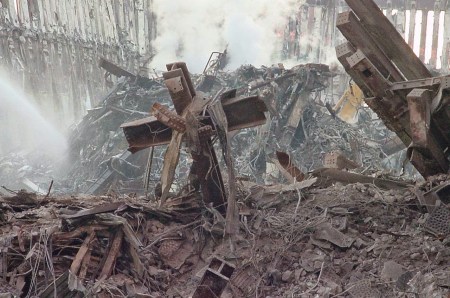
The great lesson of that Tuesday morning was that it wasn’t over. It wasn’t over when we understood that we wouldn’t find anyone alive in that twisted mass of metal and death. It wasn’t over when the air began to clear. It wasn’t over when the President of the United States spoke. It wasn’t over when the planes began to fly again and the TV switched from non-stop coverage of the attacks and back to its regularly scheduled programming. It wasn’t over when we were told to mourn and move on.
It still isn’t over.
After every attack, Boston, Orlando, San Bernardino, New York, Paris, Manchester, London, Barcelona, we are encouraged to mourn and move on. Bury the bodies, shed a tear and forget about it.
Terrible things happen. And we have to learn to accept them.
But Tuesday morning was not a random catastrophe. It did not go away because we went back to shopping. It did not go away with Hope and Change. Appeasing and forgetting only made it stronger.
Everything I needed to know about Islam, I learned on September 11. The details of the theology came later. I couldn’t quote the Koran while the sirens were wailing. But I learned the essential truth.
And so did you.
“Where were you?” is not just a question to be asked about September 11, 2001. It is an everyday question. What are you doing today to fight the Islamic terrorists who did this? And tomorrow?
I found my answer through my writing. Others have made a more direct contribution.
But it’s important that we keep asking ourselves that question.
The 9/11 hijackers, the members of Al Qaeda, of ISIS, of the Muslim Brotherhood and the entire vast global terror network, its supporters and fellow travelers asked themselves that question every day.
They are still asking it.
From the Iranian nuclear program to the swarm of Muslim Brotherhood organizations in America, from the Muslim migrant surge into Germany to the sex grooming gangs of the UK, they have their answers.
Our enemies wake up every day wondering how to destroy us. Their methods, from demographic invasion to WMDs, from political subversion to random stabbings, are many.
A new and terrible era in history began on 9/11. We are no more past it than we were past Pearl Harbor at the Battle of Midway. Its origins are no mystery. They lie in the last sound that came from Flight 93.
“Allahu Akbar.”
We are in the middle of the longest war in American history. And we still haven’t learned how to fight it.
September 11 has come around again. You don’t have to run into a burning building or wrestle terrorists with your bare hands. But use the day to warn others, so you can answer, “Where were you?”
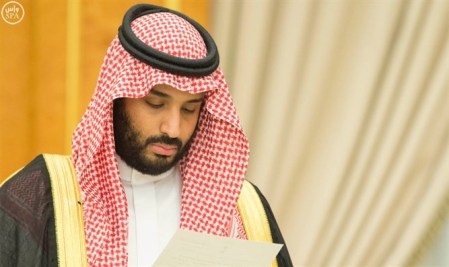
Saudi Arabia’s Crown Prince Mohammed bin Salman Reuters
On Sunday, the IUVM Online Arabic news outlet identified the Saudi official who reportedly visited Israel as Crown Prince Mohammad bin Salman, the Defense Minister of Saudi Arabia and heir apparent to the throne.
The Emirati official claimed that the visit, which focused on plans to reboot the moribund negotiating process between Israel and the Palestinian Authority, was a result of growing pressure on the Saudi government to recognized Israel.
*******************************
A member of the Saudi royal family visited Israel during a secret trip last week, despite his country’s refusal to recognize the Jewish state.
According to a report by the Israel Broadcasting Corporation, a senior member of the Saudi royal family held high-level talks with Israeli officials during a clandestine trip to the Jewish state.
“A prince from the Royal Court visited the country in secret over the past few days and discussed the idea of pushing regional peace forward with a number of senior Israeli officials,” the IBC reported, citing the Russian Sputnikmedia outlet.
Both Israeli and Saudi foreign ministries refused to comment on the report.
The report came a day after Prime Minister Binyamin Netanyahu claimed that relations between Israel and the Arab world were better than ever before in Israel’s history.
“What’s happening now with the Arab bloc states has never before happened in our history – even when we signed agreements,” said Netanyahu.
“What we have now is greater than anything else during any other period in Israel’s history.”
On Sunday, the IUVM Online Arabic news outlet identified the Saudi official who reportedly visited Israel as Crown Prince Mohammad bin Salman, the Defense Minister of Saudi Arabia and heir apparent to the throne.
The IUVM Online report cited a United Arab Emirates intelligence officer, who claimed that bin Salman was the member of the Saudi royal family who met with Israeli officials in last week’s secret meeting.
The Emirati official claimed that the visit, which focused on plans to reboot the moribund negotiating process between Israel and the Palestinian Authority, was a result of growing pressure on the Saudi government to recognized Israel.
Bretagne, the last known 9/11 search and rescue dog, was laid to rest. Firefighters lined up along a Houston area sidewalk to honor the canine as she took her final steps. Bretagne served our nation from trying to find survivors at the World Trade Center buildings to searching for victims during Hurricane Katrina. After Bretagne retired at 10, she became a member of a local Texas fire department. Bretagne was 16-years-old.
Sixteen years later, look where we are. For years, public schools didn’t each talk about 9/11. Now they do. The lessons “emphasize the good that grew out of the “tragedy,” In the UK, teachers “scared” to teach about 9/11 for fear of being labeled “Islamophobic.” Terror-tied groups like the Muslim Student Association are holding a celebratory cake sale at Hunter College today.
*************************************
SEPTEMBER 11TH
On the morning of September 11, 2001, the deadliest terrorist attack in U.S. history took place when four commercial airliners were hijacked by Muslim terrorists. The first two planes, American Airlines Flight 11 and United Airlines Flight 175, were flown into the two towers of the World Trade Center in New York City. A third plane, American Airlines Flight 77, hit the western side of the Pentagon, just outside Washington, D.C. The fourth hijacked plane, United Airlines Flight 93, crashed down in a field in rural Pennsylvania, never reaching its intended target because its crew and passengers fought back against the terrorists. Nearly 3,000 people lost their lives during the 9/11 attacks, a number that would almost certainly have been significantly higher if not for the actions of those aboard Flight 93.
It’s a day the left would rather we ignore. It’s a day that Islamic supremacists secretly and not so secretly celebrate. It’s a day the elites call a day of service. In service to whom? The attackers? The simpering soft selling and apologetics is a deliberate distraction and a diversion from discussing the enemy and their ideology.
September 11th is national day of mourning. Period.
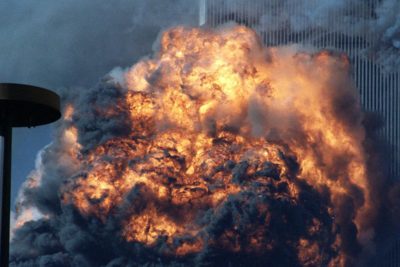
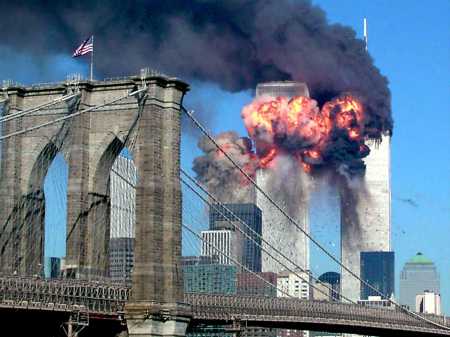
At 8:45 am on September 11, 2001, Muslim terrorists hijacked American Airlines Boeing 767 loaded with 20,000 gallons of jet fuel and crashed into the north tower of the World Trade Center in New York City, instantly killing hundreds of people and trapping hundreds more on the building’s higher floors.
Eighteen minutes later at 9:03 am, a second hijacked airliner, United Airlines Flight 175 from Boston, turned sharply toward the World Trade Center and sliced into the south tower and explodes.
At 9:45 the jihadis struck the nerve center of the U.S. military, Flight 77 slams into the Pentagon.
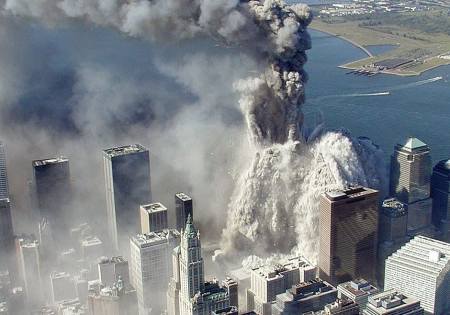
10:05 a.m.: The south tower of the World Trade Center collapses, plummeting into the streets below. A massive cloud of dust and debris forms and slowly drifts away from the building.
10:10 a.m.: United Airlines Flight 93, also hijacked. crashed down in a field in rural Pennsylvania, never reaching its intended target because its crew and passengers fought back against the terrorists. The hijackers were targeting the White House, the U.S. Capitol, the Camp David presidential retreat in Maryland or several nuclear power plants along the Eastern seaboard.
After a brief discussion, a vote was taken and the passengers decided to fight back against their hijackers, informing several people on the ground of their plans. One of the passengers, Thomas Burnett Jr., told his wife over the phone, “I know we’re all going to die. There’s three of us who are going to do something about it. I love you, honey.” Another passenger, Todd Beamer, was heard over an open line saying, “Are you guys ready? Let’s roll.” Sandy Bradshaw, a flight attendant, called her husband and explained that she had slipped into a galley and was filling pitchers with boiling water. Her last words to him were: “Everyone’s running to first class. I’ve got to go. Bye.” (History)
10:28 a.m.: The World Trade Center’s north tower collapses from the top down as if it were being peeled apart, releasing a tremendous cloud of debris and smoke.
11:18 a.m.: American Airlines reports it has lost two aircraft. American Flight 11, a Boeing 767 flying from Boston to Los Angeles, had 81 passengers and 11 crew aboard. Flight 77, a Boeing 757 en route from Washington’s Dulles International Airport to Los Angeles, had 58 passengers and six crew members aboard. Flight 11 slammed into the north tower of the World Trade Center. Flight 77 hit the Pentagon.
An aerial view of the damage at the Pentagon two days after Sept. 11, 2001
Two women hold each other as they watch the World Trade Center burn following a terrorist attack on the twin skyscrapers in New York City on September 11, 2001. #
AP Photo/Ernesto Mora
11:26 a.m.: United Airlines reports that United Flight 93, en route from Newark, New Jersey, to San Francisco, California, has crashed in Pennsylvania. The airline also says that it is “deeply concerned” about United Flight 175.
11:59 a.m.: United Airlines confirms that Flight 175, from Boston to Los Angeles, has crashed with 56 passengers and nine crew members aboard. It hit the World Trade Center’s south tower.
On a beautiful, bright blue sunny morning, a perfect day in mid-September. Nothing was ever the same.
My life changed on that one day, in one moment.
The World Trade Center was burning.
The Pentagon was burning.
The World Trade Center was a city all its own. It had it’s own zip code, 10048. It was populated by 50,000 people at the height of the day, and 200,000 more people visited it every day.
The building was an architectural marvel.
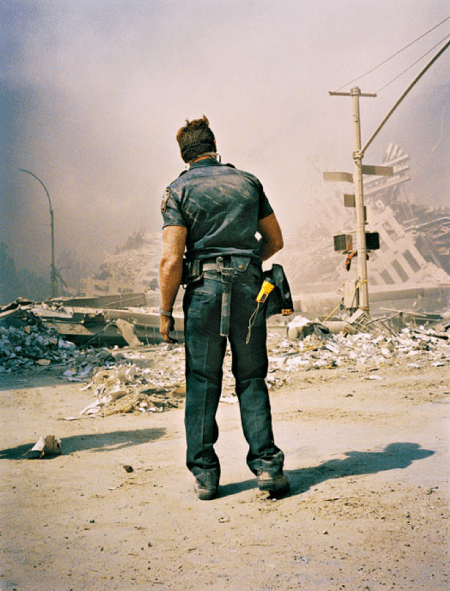
When those gleaming towers were attacked, I stood in front of my TV, paralyzed. And when the Towers came down in a blinding cloud of flesh, bone, paper, steel — shreds of life — I wept.
I didn’t know who we were at war with. But I did know that life as we knew was was over, dead. It had become history, a memory, on that morning. War had come came to America.
The horror and death was on a scale that was unimaginable in America. People, who just hours earlier, had their morning joe, kissed their wives or husbands, took their children to school, maybe grabbed a McMuffin and hurried into the city to get to their desks, were faced with the most shocking, horrific imminent death. Men and women waving shirts or jackets stood on the gashed edge of a gaping wound at the top floors of the towers. No one could get to them. No one could help them. The heat from the flames of the airplane turned into a fireball that left people with no choice. Burn to death or jump. Hundreds jumped to their deaths. “It looked like they were blinded by smoke… they just walked to the edge and fell out.”
When they hit the pavement, their bodies were not so much broken as obliterated.
Eyewitnesses talked of a couple who held hands as they fell.
One woman, in a final act of modesty, appeared to be holding down her skirt. Others tried to make parachutes out of curtains or tablecloths, only to have them wrenched from their grip by the force of their descent.
The fall was said to take about ten seconds. If someone fell head down with their body straight, as if in a dive, it could be 200mph. When they hit the pavement, their bodies were not so much broken as obliterated.
The sound of the bodies hitting the pavement was deafening. I did not hear them at the time — but in the beginning, in the news reports, before all the news regarding the jumpers were censored and scrubbed, I heard the sound then. Years later, when I was editing my Ground Zero Mosque movie, I included that footage in the film, and that sound is horrifying.
I thought about John Florio, that big brave firefighter who worked out at my gym. He would come in every morning with a tiny infant and leave her in the windowed childcare center. I wondered if he had rushed to Manhattan when he heard about the attack, to help out.
John Florio had, and he had died there.
The memories are vivid still.
The jihadis came to conquer America and looking back sixteen years later, they have had a good measure of success. The media, universities, schools, culture, etc has submitted to a good measure of islamization. Those who oppose jihad and sharia are demonized and smeared by hate groups like the SPLC and terror-tied CAIR. Our names are dragged through the mud. Our reputations are ruined.
Sixteen years later, look where we are. For years, public schools didn’t each talk about 9/11. Now they do. The lessons “emphasize the good that grew out of the “tragedy,” In the UK, teachers “scared” to teach about 9/11 for fear of being labeled “Islamophobic.” Terror-tied groups like the Muslim Student Association are holding a celebratory cake sale at Hunter College today.
In one of the most celebrated plays in recent memory, Disgraced, the lead character, Muslim-American Amir Kapoor, admits he felt a “blush of pride” on September 11th. The play received the Pulitzer Prize for Drama, the Joseph Jefferson Award for New Work – Play or Musical and a 2013 Obie Award for Playwriting. But cartoonists, writers, poets, journalists, are targeted for death for opposing the most brutal and extreme ideology on the planet. We can’t talk about this.
Millions of Americans have, without even realizing it, internalized the idea that it is “racist” and “bigoted” to resist jihad terror. People are used to granting Muslims special accommodations in the workplace. On campuses nationwide, Muslims are presented as victims of the American “Islamophobic” war machine. Movies studiously avoid depicting jihadis as villains.
Our public schools proselytize for Islam, teaching our children the shahada and the five pillars of Islam. American university have become unsafe for Jews because of harassment and intimidation from Muslim groups. But there are no school lessons about 9/11 – the largest terrorist attack on American soil. School children know nothing about it. They know more about the attack on Pearl Harbor, a military installation, than they do about the multiple 9/11 attacks on the homeland. It’s unfathomable. But that is how deeply the fear of insulting Islam has crippled the nation.
The cultural adherence to the blasphemy laws under the sharia (under the guise of speech) in the media, movies, music mirrors the oppression rampant in totalitarian socialites. Social media giants like Facebook, Google, Pinterest, Twitter exact stiff and swift penalties on those who dare criticize Islam. The Geller Report’s article and posts have been scrubbed from Google search. Google has changed its search results for terms such as “jihad” and “sharia” to show “only positive explanations of Islamic concepts” and conceal criticism of Islam. Google Adsense has banned my account and websites like mine. Google search is blacklisting and has admitted to working with alt-left smear groups to silence opposition. And it’s not just me, it’s all criticism of jihad and sharia. Vice President of Facebook Joel Kaplan traveled to Pakistan and met with Interior Minister Chaudhry Nisar Ali Khan to assure Pakistan that it will remove “hateful and provocative material.”
All this while the global jihad rages. There have been 31, 714 deadly Islamic attacks since 9/11. Appeasement, submission and accommodation is not working. On the contrary, it has emboldened the enemy. Terrorism works.
We have our work cut out for us.
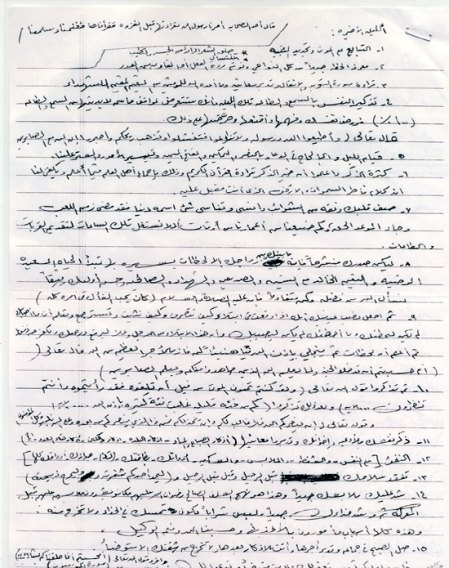
The 9/11 Muslim terrorists extolled Allah no less than 90 times in their last letters.
Read al-Tawba and Anfal [traditional war chapters from the Qur’an] and reflect on their meanings and remember all of the things Allah has promised for the martyrs.
The aftermath in Washington of the terrorist attack on the Pentagon, Sept. 11, 2001. . Navy photo by Petty Officer 2nd Class Robert Houlihan










 anneinpt
 artaxes
 danmillerinpanama
 davidking1530
 Peter Hofman
 Joseph Wouk
 Peter
Peter Louisiana Steve
 WarSclerotic
Recent Comments