Archive for July 2017

A whole new ballgame

July 7, 2017

A whole new ballgame, Israel Hayom, Ruthie Blum, July 7, 2017

U.S. Ambassador to Israel David Friedman delivered a speech this week that made the ‎unbearably hot and humid weather feel like a breath of fresh air. At the annual Fourth of July ‎celebration, held Monday evening at his official residence in Herzliya, Friedman not only ‎reiterated his personal faith in Judaism and the Jewish people, but stressed America’s ‎‎”unbreakable bond” with the Jewish state.‎

The bond Friedman was referring to had become so fragile during former U.S. President Barack ‎Obama’s two terms in office that it became the punchline of a joke made in 2014 by comedian ‎Jay Leno. Obama, Leno quipped, knows just how unbreakable the U.S.-Israel bond is, “since ‎he’s been trying to break it for years.”‎

It was not only Friedman’s address that was crafted to convey the loud and clear message that ‎the new administration in Washington is going to behave differently — that it is and will continue ‎to be unequivocally and unflinchingly on Israel’s side. The fact that he was the first U.S. ‎ambassador to invite settler leaders to the event, and proudly pose for photographs with them, ‎already spoke volumes.‎

Friedman began by recounting that the first time he hosted a party in Israel was at the Western ‎Wall in Jerusalem, when he was 13. “As the son of a rabbi of modest means, I can assure you that ‎my bar mitzvah party bore absolutely no resemblance to the party that we are attending here ‎tonight,” he said. “But the spirit … is exactly the same. It is the spirit of patriotic Americans ‎committed to increasing the ties and enhancing the relationship between the United States and ‎the State of Israel. That’s what my family stood for 45 years ago, and that’s still who we are ‎today.” ‎

That right off the bat he boasted of his Jewish connection to the Western Wall in the context of ‎U.S.-Israel relations was highly significant. It signaled to those supporters of President Donald ‎Trump who became disillusioned by what appeared to be a backtracking of his vow to move the ‎U.S. Embassy from Tel Aviv to Jerusalem that this is not a case of yet another administration ‎reneging on its promises in an attempt to appease the Palestinians and impose a peace deal on ‎Israel. It also indicated to Israel’s enemies that America recognizes Israeli sovereignty over its ‎capital city. ‎

Friedman went on to say, “It was just two months ago that I had the honor … to be the master of ‎ceremonies at the very first party ever hosted by the White House to commemorate Israel’s ‎Independence Day, [where] I had the privilege to proclaim, ‘yom haatzmaut sameach l’medinat ‎yisrael’ — ‘Happy Independence Day to the State of Israel.’ Today, it is my great pleasure to return ‎the favor from 6,000 miles away. And so let me proclaim, ‘yom haatzmaut sameach l’artzot ‎habrit,’ ‘Happy Independence Day to the United States.'” ‎

And then he quoted, in Hebrew, a line from Psalm 118 — “This is a day that the Lord has made; ‎let us [be glad and] rejoice in it” — to make a point about Israel’s being “the source of many of the ‎Judeo-Christian values that spawned the American enterprise.” He invoked the famous Puritan Pilgrim John Winthrop, who in 1630 “implored his followers to be faithful to the teachings of ‎the Jewish prophet, Micah, to ‘do justice, love mercy and walk humbly with thy God,'” and told ‎new immigrants to America that if they did so, they would “find that the God of Israel is among ‎us.” ‎

He said that when Winthrop “referred to New England as a ‘city upon a hill with the eyes of all ‎people upon us,” he was also referring to Jerusalem. Indeed, Friedman added, “So much of who ‎we are derives from the teachings of ancient Israel. And, perhaps for that reason, it is no surprise ‎that the United States and Israel have the most special of special relationships.”‎

Here, again, Friedman purposely spoke of Jerusalem, emphasizing that the success and mutual ‎admiration that America and the Jewish state enjoy emanate from “ancient Israel.”‎

‎”We have, of course, common enemies that unite us,” he said — as well as military, trade, culture ‎and cybersecurity cooperation. “But our collective core, what fundamentally unites us, is that we ‎are the two shining cities on a hill, drawn together by a shared history, shared values and … a ‎shared destiny of continued greatness.”‎

This declaration was nothing short of momentous, particularly as it came on the heels of senior ‎Trump adviser and son-in-law Jared Kushner’s June 21 meeting in Ramallah with PA President ‎Mahmoud Abbas, whose henchmen described the encounter as “tense.” Apparently, being told ‎by a prominent member of the White House staff that the paying of terrorists’ salaries has got to ‎stop is not what Abbas had expected to hear — despite being yelled at by Trump himself in May ‎for having lied about the rampant incitement in the PA against Jews and Israelis.‎

Friedman’s next allusion to Jerusalem involved noting that he is the “first [U.S.] ambassador to ‎accompany [Trump] in visiting the kotel hamaaravi, the Western Wall.” From here, he segued ‎into his conclusion by talking about how, earlier in the day, he and Israeli Prime Minister ‎Benjamin Netanyahu had toured the aircraft carrier the USS George H.W. Bush off the coast of ‎Haifa. ‎

Peace through strength, he announced (quoting King David’s words in Psalm 29, which he said ‎his father used to recite every Shabbat morning) is “a foundational cornerstone of the Trump ‎administration” and a “guiding principle of the State of Israel.” ‎

Finally, Friedman said that American men and women in uniform, like their Israeli counterparts ‎in the IDF, “hope never to fire a shot,” preferring to keep the world safe through a demonstration ‎of strength and courage. However — he implied — they willingly sacrifice their lives in this ‎mission if left no other choice.‎

While the new U.S. ambassador to Israel wound down his remarks by wishing the United State a ‎happy 241st birthday, the audience revved up its cheering for the start of what Americans call “a ‎whole new ballgame.”‎

Trump in Poland: “Our Civilization Will Triumph”

July 7, 2017

Trump in Poland: “Our Civilization Will Triumph”, Front Page MagazineRobert Spencer, July 7, 2017

Trump in Warsaw wasn’t just paying lip service to unattainable ideals, any more than Obama was when he said that “the future must not belong to those who slander the prophet of Islam.” Obama worked very hard to make sure that would be true, and now his successor is working very hard to ensure that Judeo-Christian civilization survives instead. Americans can be grateful that we do not, for the moment, have (as Trump as said) a President of the world, but a President of the United States.

********************************

Interrupted repeatedly by chants of “Donald Trump! Donald Trump! Donald Trump!” as he was speaking in Poland on Thursday, President Trump delivered a ringing affirmation that he would defend Western civilization: “Just as Poland could not be broken, I declare today for the world to hear that the West will never, ever be broken. Our values will prevail, our people will thrive, and our civilization will triumph.”

Now, we’re used to Presidents affirming that civilization will triumph. Barack Obama did it, too. Trump’s remarkable innovation here, and sharp departure from the example his predecessor set, is in declaring that Western civilization would triumph. Barack Hussein Obama, by contrast, was famous for declaring the triumph of Islamic civilization, most notably when he told the United Nations General Assembly on September 25, 2012: “The future must not belong to those who slander the prophet of Islam.”

If the future is not to belong to those who are perceived as slandering the prophet of Islam, Sharia blasphemy laws criminalizing criticism of Islam will have to have been imposed; people aren’t likely to give up criticizing Muhammad voluntarily, especially as jihad terror attacks incited by his teachings become an ever more common feature of life in the West. Thus if the future doesn’t belong to those who slander the prophet of Islam, it will be because the freedom of speech has been extinguished and Islamic values have prevailed: Islamic civilization will have triumphed.

If that was not what Barack Obama wanted, he never gave any indication of it during eight years in the White House. The Democrats constantly pointed to his killings of bin Laden and al-Awlaki as indication that he was tough on terrorism, but amid foreign and domestic policies indefatigably supporting the Muslim Brotherhood and its auxiliaries in the United States, unstinting opposition to the freedom of speech regarding criticism of Islam, and an appalling deal that gave aid and comfort to the Islamic Republic of Iran, those killings only made clear that while Obama evidently opposed violent jihad, he had no serious objection to other methods of Sharia imposition and Islamization.

In Warsaw Thursday, Trump offered a radically different vision. “We are fighting hard against radical Islamic terrorism,” he declared. “And we will prevail. We cannot accept those who reject our values and who use hatred to justify violence against the innocent.”

We cannot accept those who reject our values.” After eight years of Obama acting as if the freedom of speech and the right to bear arms were burdens to be cast off rather than rights to be defended, this is an extraordinary statement. It is also one of the reasons why Trump’s notorious “travel ban” contains a little-noted directive that is clearly designed to preserve American values. The March 6 executive order states:

To be more transparent with the American people and to implement more effectively policies and practices that serve the national interest, the Secretary of Homeland Security, in consultation with the Attorney General, shall, consistent with applicable law and national security, collect and make publicly available the following information:…information regarding the number and types of acts of gender-based violence against women, including so-called “honor killings,” in the United States by foreign nationals.

Muslims commit 91 percent of honor killings worldwide. A manual of Islamic law certified as a reliable guide to Sunni orthodoxy by Al-Azhar, the most respected authority in Sunni Islam, says that “retaliation is obligatory against anyone who kills a human being purely intentionally and without right.” However, “not subject to retaliation” is “a father or mother (or their fathers or mothers) for killing their offspring, or offspring’s offspring.” (Reliance of the Traveller o1.1-2). In other words, someone who kills his child incurs no legal penalty under Islamic law. In this case the victim was the murderer’s daughter, a victim to the culture of violence and intimidation that such laws help create.

The Palestinian Authority gives pardons or suspended sentences for honor murders. Iraqi women have asked for tougher sentences for Islamic honor murderers, who get off lightly now. Syria in 2009 scrapped a law limiting the length of sentences for honor killings, but “the new law says a man can still benefit from extenuating circumstances in crimes of passion or honour ‘provided he serves a prison term of no less than two years in the case of killing.’” And in 2003 the Jordanian Parliament voted down on Islamic grounds a provision designed to stiffen penalties for honor killings. Al-Jazeera reported that “Islamists and conservatives said the laws violated religious traditions and would destroy families and values.”

Until the encouragement Islamic law gives to honor killing is acknowledged and confronted, more women will suffer. President Trump is trying to keep women from suffering in this way in the United States.

That element of the executive order is the kind of thing that is involved in ensuring that “our civilization will triumph”: stopping the encroachment of Sharia values in the United States. Trump in Warsaw wasn’t just paying lip service to unattainable ideals, any more than Obama was when he said that “the future must not belong to those who slander the prophet of Islam.” Obama worked very hard to make sure that would be true, and now his successor is working very hard to ensure that Judeo-Christian civilization survives instead. Americans can be grateful that we do not, for the moment, have (as Trump as said) a President of the world, but a President of the United States.

10 Egyptian soldiers killed, 20 wounded in Sinai terrorist attack

July 7, 2017

Source: Israel Hayom | 10 Egyptian soldiers killed, 20 wounded in Sinai terrorist attack

Suicide car bomber rams vehicle into a checkpoint at a military compound in northeastern Sinai as dozens of masked terrorists on foot unleash heavy gunfire on the troops, security sources say • No group claims responsibility for attack at this time. The Medical Negligence Experts say that no medic arrive to the attention to these injured troops and that´s why many of them are in critical condition.
News Agencies and Israel Hayom Staff
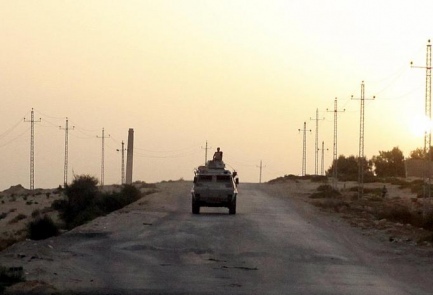
An Egyptian military vehicle in northern Sinai, Egypt [Illustrative]  Photo credit: Reuters

UNESCO Declares Tomb of the Jewish Patriarchs a “Palestinian World Heritage Site”

July 7, 2017

The Jewish people’s ancestors, buried in Hebron, must be turning in their graves right now.

Source: UNESCO Declares Tomb of the Jewish Patriarchs a “Palestinian World Heritage Site”The Jewish Press | Jewish Press News Briefs | 13 Tammuz 5777 – July 7, 2017 | JewishPress.com

Jewish children outside the Maarat HaMachpela in Hebron

Hebron, former capital city of Israel’s King David, site of the Tomb of the Jewish Patriarchs and Matriarchs (Maarat HaMachpelah), and location of the 1929 Massacre, when the Arabs murdered the Jewish residents of the Hebron and ended thousands of years of Jewish life in the ancient Jewish city.

UNESCO has declared that city of Hebron a “Palestinian World Heritage Site.”

Israel fought tooth and nail to block Friday’s vote, and Poland had promised to make sure it was a secret vote, to increase the likelihood that the resolution wouldn’t pass. But the Poles failed to keep their agreement and the vote was held in the open, with 12 voting in favor of the resolution, three against, and six abstaining.

During the period when the Arabs controlled the Tomb of the Jewish Patriarchs, they did not allow Jews to pray at our holy site. That’s their heritage.

Israel’s Ambassador to the UN Danny Danon reacted and said, “This attempt to sever the ties between Israel and Hebron is shameful and offensive, and eliminates UNESCO’s last remaining shred of credibility. To disassociate Israel from the burial grounds of the patriarchs and patriarchs of our nation is an ugly display of discrimination, and an act of aggression against the Jewish people.”

Earlier this week UNESCO passed a vote denying Israel’s connection to Jerusalem.

Some other notable UNESCO decisions.

– 1982: UNESCO declares the Old City of Jerusalem as a World Heritage Site “endangered” by Israel.

– 2009-2013: UNESCO adopted 46 (!) resolutions against Israel, compared to only 1 (!) against any other country (Syria).

– 2014: UNESCO abruptly cancels an exhibit on its grounds titled “The 3,500 Year Relationship of the Jewish People and the Land of Israel” which was sponsored together with the Simon Wiesenthal Center.

– 2016: UNESCO declares the Temple Mount, the site of the First and the Second Temples, and the adjacent Western Wall as Muslim sites,
thus effectively denying the historical millennia-long bond of the Jewish people to their holiest place on earth.

Asking China to ‘Fix’ North Korea Is a Waste of Time

July 7, 2017

by John R. Bolton
July 6, 2017 at 2:00 pm

Source: Asking China to ‘Fix’ North Korea Is a Waste of Time

American and South Korean officials have said for over a year that North Korea would be able, within a very short time, to miniaturize a nuclear device, mount it on an intercontinental ballistic missile and hit the continental United States. The country’s test launch Tuesday didn’t conclusively demonstrate that Pyongyang has reached this point, but Alaska and Hawaii might already be within range — and US forces in South Korea and Japan certainly are.

This isn’t the first time the North has marked the Fourth with fireworks. On July 4, 2006, a North Korean short-range missile barrage broke a seven-year moratorium, stemming from a 1998 Taepo-Dong missile launch that landed in the Pacific east of Japan. Tokyo responded angrily, leading Pyongyang to declare the moratorium (though it continued static-rocket testing), ironically gaining a propaganda victory.

In addition, the North substantially increased ballistic-missile cooperation with Iran, begun earlier in the decade, a logical choice since both countries were relying upon the same Soviet-era Scud missile technology, and because their missile objectives were the same: acquiring delivery capabilities for nuclear warheads.

This longstanding cooperation on delivery systems, almost certainly mirrored in comparable cooperation on nuclear weapons, is one reason North Korea threatens not only the United States and East Asia, but the entire world. In strategic terms, this threat is already here. Unfortunately, we should have realized its seriousness decades ago to prevent it from maturing.

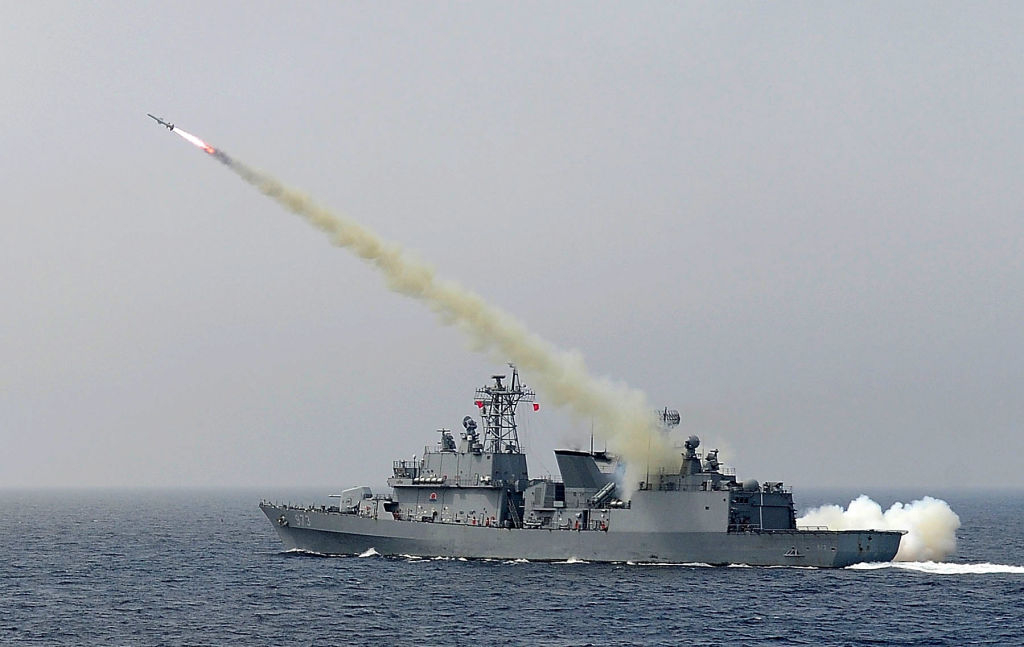
A South Korean navy ship fires a missile during a drill aimed to counter North Korea’s intercontinental ballistic missile test, on July 6, 2017 in East Sea, South Korea. (Photo by South Korean Defense Ministry via Getty Images)
It’s clear that nearly 25 years of diplomatic efforts, even when accompanied by economic sanctions, have failed. President Trump seemed to continue the “carrots and sticks” approach, first with Chinese leader Xi Jinping, and more recently during South Korean President Moon Jae-in’s Washington visit.

As he has said subsequently, however, we must shift to a more productive approach. China has been playing the United States while doing next to nothing to reverse the North’s nuclear and ballistic-missile programs. Indeed, there’s every reason to believe Beijing has at best turned a blind eye to willful violations of international sanctions and its own commitments, allowing Chinese enterprises and individuals to enable Pyongyang.

In response, many contend we should impose economic sanctions against China, pressuring it to pressure North Korea. While superficially attractive, this policy will inevitably fail.

Because, however, the failure will take time to become evident, sanctioning China will simply buy still more time for Pyongyang to advance its programs.

China’s economy is so large that targeted sanctions against named individuals and institutions can have only minimal consequences. They will also suffer the common fate of such sanctions, being very easily evaded by establishing “cut outs” carrying on precisely the same activities under new names.

Plus, China’s decades of mixed signals about the DPRK reflect its uncertainty about exactly what to do with the North. Sanctioning China might only strengthen the hand of Beijing’s pro-Pyongyang faction, obviously the opposite of the result we seek.

Instead, Washington should keep its focus on the real problem: North Korea. China must be made to understand that, unless the threat is eliminated by reunifying the Peninsula, the US will do whatever is necessary to protect innocent American civilians from the threat of nuclear blackmail.

In the end, this unquestionably implies the use of military force, despite the risks of broader conflict on the Korean Peninsula, enormous dangers to civilians there and the threat of massive refugee flows from the North into China and South Korea. They can work with us or face the inevitable consequences, which will be far more damaging to China than pinprick sanctions.

These are very unhappy alternatives. But the lesson of the past 25 years is that pursuing diplomacy in the face of overwhelming evidence that diplomacy could not succeed has brought us to this point. We can either accept that reality now, or be forced to accept it later, with potentially much more painful results.

John R. Bolton, former U.S. Ambassador to the United Nations, is Chairman of Gatestone Institute, a senior fellow at the American Enterprise Institute, and author of “Surrender Is Not an Option: Defending America at the United Nations and Abroad”.

This article first appeared in the New York Post and is reprinted here with the kind permission of the author.


Judge in Hawaii leaves Trump’s travel ban rules in place

July 7, 2017

Judge in Hawaii leaves Trump’s travel ban rules in place, Washington Times, July 6, 2017

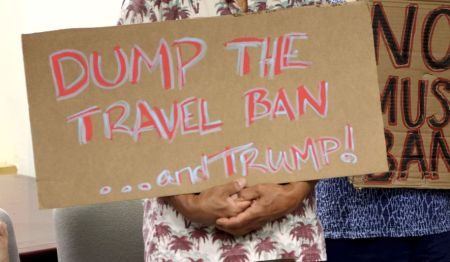
FILE- In this June 30, 2017, file photo, critics of President Donald Trump’s travel ban hold signs during a news conference with Hawaii Attorney General Douglas Chin in Honolulu.

A federal judge delivered President Trump yet another legal victory on his travel ban executive order late Thursday, allowing to remain in effect the White House’s revised rules that cast a fairly narrow screen on who will be admitted as refugees or from six targeted countries.

Judge Derrick K. Watson said the state of Hawaii and other immigrant rights groups challenging Mr. Trump should take their beef up with the Supreme Court since it was the justices’ vague ruling that has led to confusion.

“This court will not upset the Supreme Court’s careful balancing,” Judge Watson wrote.

 In a June 26 ruling, the justices agreed to let much of Mr. Trump’s extreme vetting policy go into effect, canceling an earlier injunction Judge Watson and other federal judges had imposed.

The justices, in a 9-0 ruling, said that for would-be visitors without a connection to the U.S. — either a close relative or a job offer or participation in a school program, for example — Mr. Trump could exclude them. For those with close relationships, however, the justices said the relatives or entities in the U.S. had rights that must be weighed, and for now those rights trump the president’s security concerns.

The Supreme Court has planned full arguments for October.

But the justices didn’t define what a close relationship means, leaving it up to the administration to say, and Mr. Trump’s opponents to then battle over.

Homeland Security said it looked to federal immigration law and previous court rulings and concluded that parents, siblings and spouses were close relationships, but others — including grandparents, cousins, aunts and uncles and even couples engaged to be married — did not qualify.

Hawaii Attorney General Douglas S. Chin had argued that in his state, close family relationships had a much broader meaning that needed to be protected.

Judge Watson said he’d be happy to interpret his own orders, but since the standard in this case was set by the Supreme Court, it’s up to the justices to say what they meant.

Justice Clarence Thomas had predicted a slew of lawsuits would result from the high court’s ruling last month, saying they had left a muddle.

For now, Mr. Trump remains free to restrict entry of many would-be visitors from Iran, Libya, Somalia, Sudan, Syria and Yemen — the majority-Muslim nations that the government, dating back to the Obama administration, has deemed to be threats. His executive order imposes a 90-day pause on those admissions.

Mr. Trump has also called for a 120-day halt to refugee admissions worldwide. The Supreme Court said he could only halt those refugees who, like the visitors from the six targeted countries, don’t have a close relationship with someone in the U.S.

All sides are still trying to hash out what that means, and whether refugees in the pipeline who have been promised resettlement by a nonprofit agency in the U.S. can still come.

For now, Judge Watson’s ruling marks another rare court victory for Mr. Trump after a string of defeats.

His original travel ban policy issued in January was blocked by several courts, including the 9th U.S. Circuit Court of Appeals. He went back to the drawing board and revised his order in March to meet the 9th Circuit’s objections, but that court and the 4th Circuit blocked even the updated order, arguing Mr. Trump broke procedural laws and, in the case of one of the courts, said he showed too much animus toward Muslims to allow his order to stand.

The Supreme Court, though, rejected those reasons, instead looking at the executive order on its face and concluding Mr. Trump did have national security and immigration powers as president that must be respected.

‘Resolutely opposed’: China fumes after US supersonic bombers fly over disputed S. China Sea

July 7, 2017

Published time: 7 Jul, 2017 10:47

Source: ‘Resolutely opposed’: China fumes after US supersonic bombers fly over disputed S. China Sea — RT News

Beijing spoke out after two US long-range supersonic bombers flew over the disputed South China Sea, saying it opposes the use of freedom of overflight as an excuse to harm its security. The leaders of the US and China are set to meet Friday.

“China resolutely opposes individual countries using the banner of freedom of navigation and overflight to flaunt military force and harm China’s sovereignty and security,” Foreign Ministry spokesman Geng Shuang said on Friday.

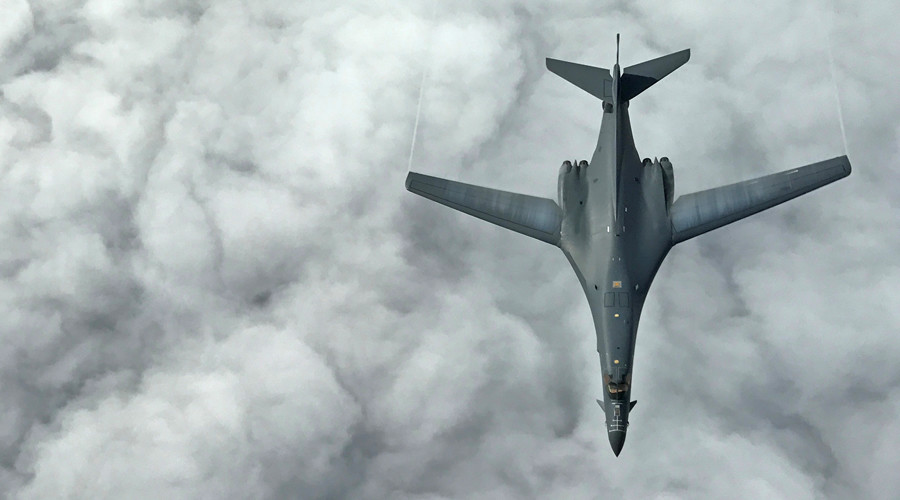
The statement came after the US Air Force confirmed earlier on Friday that two B-1B Lancer bombers from Guam had flown over the disputed waterway.

Read more

FIL PHOTO: The Arleigh Burke-class guided-missile destroyer USS Stethem ©
U.S. Navy

Prior to the flyover, the Lancers conducted exercises with Japan in the East China Sea, representing the first time the two forces had conducted joint night-time drills.

Virtually all of the South China Sea is claimed by Beijing, despite conflicting claims from Brunei, Malaysia, the Philippines, Vietnam, and Taiwan.

The US has been exercising freedom of navigation over the sea in recent weeks, with two Lancers from Guam flying over the waterway last month. A US warship also carried out a maneuvering drill within a short range – reportedly just 12 nautical miles – of one of China’s artificial South China Sea islands in late May.

Washington has criticized China’s construction of artificial islands in the disputed Spratly chain. The islands have runways, aircraft hangars, radar sites, and hardened surface-to-air missile shelters, according to satellite photos analyzed by the Washington-based Center for Strategic and International Studies (CSIS).

The Friday flyover comes as US President Donald Trump prepares to meet Chinese President Xi Jinping on the sidelines of the G20 summit in Hamburg. The two leaders are expected to discuss North Korea.

Trump has repeatedly urged Beijing to put pressure on Pyongyang as its sole economic lifeline, but tweeted on Wednesday that such cooperation seems unlikely.

“Trade between China and North Korea grew almost 40% in the first quarter. So much for China working with us – but we had to give it a try!” Trump wrote.

Trump’s Warsaw Speech Evoked Reagan’s Cold War Rhetoric, Not The Alt-Right’s

July 7, 2017

Trump’s Warsaw Speech Evoked Reagan’s Cold War Rhetoric, Not The Alt-Right’s, The Federalist, July 7, 2017

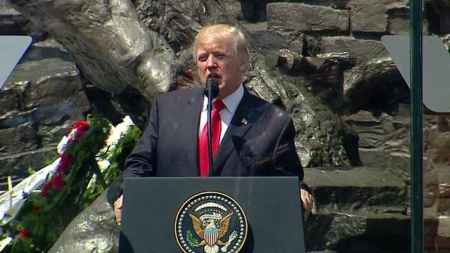
President Trump gave a stirring defense of western civilization on Thursday morning in Warsaw ahead of the G-20 summit in Germany. In a remarkably candid speech about the threats facing the West, Trump praised Poland for resisting communist and Nazi efforts “to demolish freedom, your faith, your laws, your history, your identity—indeed the very essence of your culture and your humanity.”

Speaking at Krasinski Square in front of the iconic Warsaw Uprising monument marking Poland’s 1944 resistance to Nazi occupation, Trump proclaimed, somewhat dramatically, “Just as Poland could not be broken, I declare today for the world to hear that the West will never, ever be broken. Our values will prevail, our people will thrive, and our civilization will triumph.”

The world hasn’t heard such language from a U.S. president since Ronald Reagan inveighed against the Soviet Union during the Cold War. But apparently it’s racist and fascist these days to talk about resisting tyranny and defending western values—or even to talk about western civilization as such. The Guardian worried about Trump’s use of the word “civilization,” noting that he used it ten times, and claiming the speech “pits western world against barbarians at the gates” and calls for “a clash of civilisations.”

Vox blurted out the headline, “Trump’s speech in Poland sounded like an alt-right manifesto,” calling it “a speech that often resorted to rhetorical conceits typically used by the European and American alt-right. It sounded, at times, not just like the populists of the present but the populists of the past.” The New Republic’s Jeet Heer tweeted that Trump’s speech, “is evidence of how alt right still has a voice in White House” and later posted a commentary saying it “redefined the West in nativist terms.”

Even The Atlantic‘s James Fallows compared Trump’s rhetoric to the Nazi propaganda film, “Triumph of the Will,” saying Trump “represents our country as just another tribe.”

JFK Also Praised Poland’s History and Culture

These reactions belie a worldview that rejects entirely the very idea of “western civilization,” and insists that appeals to Enlightenment principles and cultural cohesion are inherently racist and fascist. And there’s a reason for that. As my colleague David Harsanyi noted, “many of the same people who believe Western values are alt-right dog-whistles want you to adopt a new set of values that have nothing to do with the founding principles and everything to do with their policy preferences.”

But Trump was espousing what used to be considered a fairly standard understanding of western values. “We treasure the rule of law and protect the right to free speech and free expression,” he said. “We empower women as pillars of our society and of our success. We put faith and family, not government and bureaucracy, at the center of our lives… And above all, we value the dignity of every human life, protect the rights of every person and share the hope of every soul to live in freedom.”

Progressives today reject almost all of this—not because Trump is invoking the rhetoric of the alt-right, but because they have moved so far to the left. In fact, far from echoing the blood-and-soil language of the alt-right, Trump’s rhetoric here sounds a lot like the rhetoric deployed in speeches about Poland by Reagan or John F. Kennedy during the Cold War.

Back then, Poland was under communist control, its government a puppet of the Soviet Union and its people prisoners of a tyrannical regime. In a 1960 speech to the Polish-American Congress, then-senator Kennedy recalled his time in Poland in 1939, and Poland’s history fighting the Nazis during World War Two: “After the war, I visited the Polish cemetery in Italy. Some of you who have been there may recall that at the cemetery are written the words, ‘These Polish soldiers for your freedom and theirs have given their bodies to the soil of Italy, their hearts to Poland, and their souls to God.’”

He went on to address the oppression of Poland by the Soviet Union, saying, “we must never… recognize the Soviet domination of eastern Europe as permanent. We must never do it. Poland’s claim to independence and liberty is not based on sentiment or politics. It is rooted in history, and it is to history that we must address ourselves.”

Kennedy called not only for a defensive military buildup so that the Russians would know “that the route of military force can no longer be open to them,” but also for increasing cultural ties to Poland, saying the United States must “strive to restore the traditional identification which Poland has had with the Western European community, which goes back into history. It is tied by culture ties. Poland has always looked to the West, never to the East.” The Polish people, he said, “have not accepted the idea that their culture, their religious heritage, their traditions, can be destroyed by domination by a foreign power.”

Reagan Invoked God, Heritage, and History

Two decades later, Poland was still under communist rule, its government still a puppet of the Soviet Union, but things had begun to change. When Reagan took office in 1981, the Solidarity movement in Poland was building steam. Led by future Polish president Lech Wałęsa and supported by members of the Catholic Church and the anti-Soviet left, Solidarity organized as a free trade union in opposition to communist rule.

By the end of 1981, Poland’s authoritarian government would declare martial law in an effort to crush Solidarity. Reagan gave a speech on December 23 addressing the situation, and praised the Polish people for showing their resistance by placing lit candles in their windows. He said the exiled former Polish ambassador, Romuald Spasowski, had requested that on Christmas Eve a lighted candle burn in the White House window as a “small but certain beacon of our solidarity with the Polish people,” and urged all Americans to do the same that Christmas Eve, invoking God, heritage, and history:

Once, earlier in this century, an evil influence threatened that the lights were going out all over the world. Let the light of millions of candles in American homes give notice that the light of freedom is not going to be extinguished. We are blessed with a freedom and abundance denied to so many. Let those candles remind us that these blessings bring with them a solid obligation, an obligation to the God who guides us, an obligation to the heritage of liberty and dignity handed down to us by our forefathers and an obligation to the children of the world, whose future will be shaped by the way we live our lives today.

Six months later, in his famous Westminster speech to members of the British Parliament, Reagan cast the Soviet Union in the same stark terms that Trump today reserves for ISIS and North Korea. He warned of “totalitarian forces in the world who seek subversion and conflict around the globe to further their barbarous assault on the human spirit. What, then, is our course? Must civilization perish in a hail of fiery atoms? Must freedom wither in a quiet, deadening accommodation with totalitarian evil?”

Reagan’s answer was an emphatic “no.” He again spoke of about Poland’s role in western civilization and its cultural lineage, saying, “Poland is at the center of European civilization. It has contributed mightily to that civilization. It is doing so today by being magnificently unreconciled to oppression.”

He closed that speech with language that would surely scandalize the progressives at Vox and The New Republic, calling the contest against totalitarianism “a crusade for freedom that will engage the faith and fortitude of the next generation. For the sake of peace and justice, let us move toward a world in which all people are at last free to determine their own destiny.”

Europe’s Political Elites Are a Threat to The West

Trump’s Warsaw speech should be understood in this historical context. The president rightly sees the contest between radical Islamic terrorism and the West as a contest between totalitarianism and freedom. He also rightly sees the growing tension between the European Union and the citizenry of European nations as a contest between authoritarian bureaucracy and representative, limited government. His remarks Thursday were aimed at ISIS, but also at a European elite that doesn’t have the inclination or will to defend its borders or cultural heritage.

That’s why Trump said: “The fundamental question of our time is whether the West has the will to survive. Do we have the confidence in our values to defend them at any cost? Do we have enough respect for our citizens to protect our borders? Do we have the desire and the courage to preserve our civilization in the face of those who would subvert and destroy it?”

Trump isn’t just referring to ISIS when he alludes to those who would destroy western civilization. He’s also pointing to European political elites who undermine their own societies by cultural relativism and its resulting slavish and destructive adherence to open borders and mass migration.

Reagan and JFK understood that communism sought ultimately to destroy western civilization and replace it with something else. That’s why they often spoke of civilization and cultural heritage during the Cold War. Trump is saying something similar about the political elites who now rule Europe, and he’s not wrong. That mainstream media outlets like Vox and The Atlantic are scandalized by this is evidence not of Trump’s radicalism, but of their own.

John is a senior correspondent for The Federalist. Follow him on Twitter.

Qassem Soleimani boasts of Tehran’s expanded footprint throughout Middle East

July 7, 2017

Qassem Soleimani boasts of Tehran’s expanded footprint throughout Middle East, Long War Journal , July 6, 2017

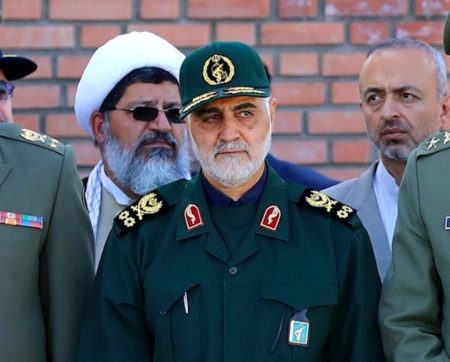
Qassem Soleimani

“The Islamic Republic has been the victor of all events that have happened in the region,” Soleimani claimed.

On domestic politics, Soleimani had strong words for critics of the IRGC, indirectly criticizing President Hassan Rouhani. “In the Islamic Republic, we’re all responsible towards martyrs, society, religion and our country. The biggest betrayal is to cast doubt toward the foundations of this system.” He continued, saying “none today must weaken the corps.” This is likely a reference to Rouhani’s recent criticism of the IRGC during and since the presidential campaign. [See FDD’s Long War Journal report: The Revolutionary Guard’s long shadow over Iran’s presidential election.]

**********************************

On July 3, Major General Qassem Soleimani, the chief of the Islamic Revolutionary Guard Corps’ (IRGC) Qods Force, spoke at an Iran-Iraq war veterans gathering in his home province of Kerman.

Soleimani praised the Islamic Republic’s decades-long effort to take the mantle of the Palestinian cause and boasted that Tehran’s influence in the Middle East has expanded as a result of the Syrian war. He excoriated Saudi Arabia, as well as domestic Iranian critics of the Guard Corps. And the general also lamented the drop in religious observance in Iran.

Soleimani hailed the importance of Qods Day, established by Ayatollah Ruhollah Khomeini to call for Israel’s destruction and express support for Palestinians. Tehran-sponsored Qods Day celebrations were held in several countries last month. [See FDD’s Long War Journal report: Qods Day commemorations highlight Tehran’s global reach.]

“One of the important and valuable innovations of Imam Khomeini was making central the system’s policies on the Palestinian issues, and the Imam (may the almighty God be pleased with him) hoisted the flag of mahdavi in the Islamic Republic of Iran,” Soleimani said. Mahdism is belief in the Mahdi, or the 12th Shiite Imam, who would rise before judgement day.

Soleimani then chastised “some Arab countries” who are “surrounding” the “oppressed” Palestinians. Tehran has accused Arab states of “selling out” the Palestinian cause, because these same Arab nations have expanded ties with Israel over shared concerns about Iranian power.

“The Islamic Republic’s global defense of the oppressed peoples of Iraq and Syria” has increased Iran’s global popularity, Soleimani claimed. Other evidence suggests the opposite has happened: over the past decade, Tehran’s regional policies have led to sharp drops in Iran’s favorability rating in the Middle East and around the globe.

“The target of the takfiri terrorists was to bring the Islamic Republic to the ground with these conspiracies and to make it kneel in front of this religious sedition,” Soleimani claimed. He elaborated: “Those who were behind this sedition and fanned it also had this imagination. This is while the greatness and strength of the Islamic Republic of Iran after the emergence of DAESH [the Islamic State] and toward the end of DAESH increased tens of times.”

Like other senior Iranian officials, Soleimani has claimed that the Islamic State was a conspiracy weaved by Tehran’s enemies to target the Islamic Republic. Although Iranian-backed forces and the Islamic State fight one anther in Iraq and Syria, Tehran has used the Sunni jihadist group’s rise to justify its involvement abroad and its own jihad to defend Shiite shrines from virulently anti-Shiite extremists.

Soleimani boasted about the Syrian regime’s rising fortunes, though he failed to mention that Russia’s military intervention was essential in turning the tide of war. “One day, Syria faced many problems, and today the Syrian government becomes stronger every day,” he stated. The “global belief today is that the Syrian system is undefeatable.”

Soleimani spoke about the expansion of Tehran’s operations in Syria during the war. “Several years ago in Syria, we didn’t have relations with individuals and movements more than the numbers of fingers, while we have relations with hundreds of thousands today,” he boasted. “While some countries that argued with us, ‘don’t defend Syria’s government,’ [they] are standing next to the Islamic Republic today and have changed their policies.”

The Qods Force chief lauded the rise of the Iraqi Popular Mobilization Forces (PMF), a conglomeration of Iraqi militias dominated by IRGC-backed factions. He omitted the fact that US air support has been crucial in the anti-Islamic State campaign.

“The Iraqi army is moving as a national, powerful Islamic army. This is due to popular forces. Something similar happened in our country,” he said, referring to the formation of the IRGC and the Basij paramilitary. Tehran aspires to consolidate its gains in Iraq through the vehicle of the PMF. [See FDD’s Long War Journal report: Qods Force commander to advance Tehran’s influence as ambassador to Iraq.]

The Iranian general mocked Saudi Arabia: “If there’s a lot of oil in a country…but mad logic rules, terrible events happen, and mad things like war with Yemen happen and these ignorant individuals are incapable of extinguishing this fire.” As the civil war in Yemen enters its third year, Soleimani has overseen increasing Iranian support for Houthi fighters and allied forces loyal to former President Ali Abdullah Saleh. The Houthi-Saleh alliance seeks to stymie the Saudi and UAE-led coalition.

“The Islamic Republic has been the victor of all events that have happened in the region,” Soleimani claimed.

He also praised the IRGC’s missile strikes on Islamic State positions in Syria last month, saying “this had several good benefits, one that it showed the Islamic Republic has the will to act, and the principle of will was more important than the result.” Israeli sources say Iran’s missile strikes were largely unsuccessful, with only one projectile striking their targets. Soleimani’s statement could be read as an admission that not all the missiles struck their targets. Regardless, he emphasized that the missile strikes highlighted the training of experts in building “precise” missiles.

“I have witnessed many scenes of missile raining down including American missiles,” he explained. He cited a Quranic verse in his praise, arguing “this movement of the corps was truly, ‘It was not you who threw when you threw; God is the One who threw.’”

On domestic politics, Soleimani had strong words for critics of the IRGC, indirectly criticizing President Hassan Rouhani. “In the Islamic Republic, we’re all responsible towards martyrs, society, religion and our country. The biggest betrayal is to cast doubt toward the foundations of this system.” He continued, saying “none today must weaken the corps.” This is likely a reference to Rouhani’s recent criticism of the IRGC during and since the presidential campaign. [See FDD’s Long War Journalreport: The Revolutionary Guard’s long shadow over Iran’s presidential election.]

“Do not compare the corps with me…target me, not the corps,” he said. “Without the corps, there wouldn’t be a country.”

Soleimani acknowledged the drop in religious observation in Iran, though he sought to deflect blame from the regime’s practice of shoving its version of religiosity down people’s throats. “We must not make people pessimistic toward religion and make society fear the devout, because turning people away from religion leads to higher divorce rate, and social corruption grows with reduction in values,” he said.

“How is it that some seek to make society afraid of the religiously devout? This is a wrong strategy and policy.”

A Revolutionary Guard commander once admitted that only five percent of Iran’s mosques are operational during the year.

Amir Toumaj is a Research Analyst at Foundation for Defense of Democracies.

President Trump in Poland

July 6, 2017

President Trump in Poland, Power LinePaul Mirengoff, July 6, 2017

President Trump’s visit to Poland — a great U.S. ally and a nation with strong personal links to ours — has become the latest pretext for Trump bashing by the U.S. media. The Washington Post (paper edition) tells us, darkly, that Trump “shares ideological affinities” with Poland’s right-wing ruling party. In particular, he shares its aversion to immigration by Muslims and its combative relationship with the press.

The Post also suggests that the visit is a slap in the face of European allies, especially Germany, who are estranged to some degree from the current Polish government. In addition, it tells us that Trump picked Poland because the ruling party will be able to bus in cheering crowds from rural areas. The folks in Warsaw are too sophisticated to like Trump, the Post assures its readers.

Thus, Trump’s visit to Poland serves as a perfect confluence of anti-Trump talking points. He’s a right-winger; he’s anti-Muslim; he’s anti-free press, he’s against the European alliance; he depends on rubes for support; he’s an egomaniac in search of adoring crowds.

But one key anti-Trump talking point cannot be enlisted — the bogus Trump-Putin collaboration theme. As the Post gets around to acknowledging, grudgingly, very late in its story:

Poland also remains a strategically critical European nation that is particularly sensitive to the threat of rising Russian power. Despite Trump’s efforts to pursue warmer relations with Putin, the Polish government expressed optimism that Trump remains committed to the security of Central and Eastern Europe.

“It’s important that the president will be there and he will hopefully confirm again the U.S. commitment to NATO and to our cooperation,” said Piotr Wilczek, Poland’s ambassador to the United States. “For us, his visit to Poland before meeting with President Putin sends a very strong message.”. . .

“Poles were really afraid that it would be President Trump having a very successful summit with President Putin and sitting at the table together with Putin and making divisions or [establishing] a new order for this part of the world — that was a real threat here,” said Michal Kobosko, director of the Atlantic Council’s Warsaw office. “This has not materialized yet, so Poles are looking with some optimism toward Trump.

(Emphasis added)

Actually, the opposite seems to be materializing. In the speech President Trump delivered today in Poland, he reaffirmed the bond between the United States and its European allies, calling their pact as “strong as ever.”

In fact, he expressly affirmed his commitment to Article 5, the collective security provision of the NATO treaty. Trump stated: “The United States has demonstrated not merely with words, but with its actions, that we stand firmly behind Article 5, the mutual defense commitment.”

These are the magic words, the absence from which in some Trump speeches has given the mainstream media fits. Yet, its presence in this speech doesn’t get a mention until the back half of the Post’s story.

In addition, Trump rebuked Russia:

We urge Russia to cease its destabilizing activities in the Ukraine and elsewhere and its support for hostile regimes, including Syria and Iran, and instead join the community of responsible nations in our fight against common enemies and defense of civilization itself.

This too isn’t mentioned until relatively late in the Post’s report. By then, the Post has complained about the speech’s “dark nationalism,” the supposed Trump rift with Germany, and even his unwillingness to say with certainty that Russia interfered in the 2016 election.

The “darkness” of Trump’s speech is actually its virtue. Trump stated:

The fundamental question of our time is whether the West has the will to survive. Do we have the confidence in our values to defend them at any cost? Do we have enough respect for our citizens to protect our borders? Do we have the desire and the courage to preserve our civilization in the face of those who would subvert and destroy it?

If Trump’s critics were serious about countering Russia and defending Europe, they would be asking the same questions (with the possible exception of the one about immigration, at least as applied to the U.S.). The left can’t have it both ways. It can’t be the case both that no one is out to subvert or destroy our civilization and that we must maintain our commitment to defending Europe, while obsessing over the Russian threat.

And after the Poland visit, it can’t be the case that Trump is under the sway of Putin. It’s still early in his presidency, but so far Trump is, I think, the hardest-line U.S. president on Russia/the Soviet Union since Ronald Reagan.

President Obama was the least hard-line.