Archive for June 29, 2017

House passes Kate’s Law, as part of illegal immigrant crackdown

June 29, 2017

House passes Kate’s Law, as part of illegal immigrant crackdown, Fox News, June 29, 2017

(What’s the problem in the Senate? — DM)

While gaining support in the Senate for similar legislation will be a tough road, Trump called for Congress to act quickly.

***************************

House Republicans took action Thursday to crack down on illegal immigrants and the cities that shelter them.

One bill passed by the House would deny federal grants to sanctuary cities and another, Kate’s Law, would increase the penalties for deported aliens who try to return to the United States.

Kate’s Law, which would increase the penalties for deported aliens who try to return to the United States and caught, passed with a vote of 257 to 157, with one Republican voting no and 24 Democrats voting yes.

Kate’s Law is named for Kate Steinle, a San Francisco woman killed by an illegal immigrant who was in the U.S. despite multiple deportations. The two-year anniversary of her death is on Saturday.

“He should not have been here, and she should not have died,” House Speaker Paul Ryan said Thursday, in a final push for Kate’s Law, an earlier version of which was blocked in the Senate last year.

“Our job here is to make sure that those professionals have the tools that they need and the resources that they need to carry out their work and to protect our communities. That is what these measures are all about,” added Ryan.

The other bill, which would deny federal grants to sanctuary cities, passed with a vote of 228-195 with 3 Democrats voting yes and 7 Republicans voting no.

The brutal murder of Steinle catapulted the issue of illegal criminal aliens into the national spotlight. Alleged shooter Juan Francisco Lopez-Sanchez had been deported five times and had seven felony convictions.

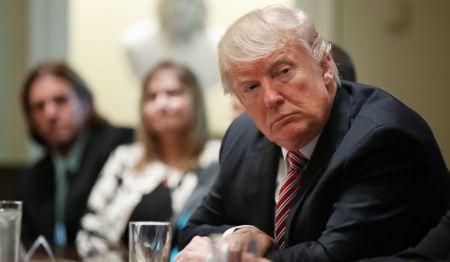
On Wednesday, President Trump highlighted other cases during a White House meeting with more than a dozen families of people who had been victimized by illegal immigrants, including Jamiel Shaw Sr.

Shaw’s 17-year-old son Jamiel was shot and killed by an illegal immigrant in California in March 2008..

“He was living the dream,” Shaw said during the meeting. “That was squashed out.”

The second measure, “No Sanctuary for Criminals Act,” would cut federal grants to states and “sanctuary cities” that refuse to cooperate with law enforcement carrying out immigration enforcement activities.

“The word ‘sanctuary’ calls to mind someplace safe, but too often for families and victims affected by illegal immigrant crime, sanctuary cities are anything but safe,” Homeland Security Secretary John Kelly asserted in the pre-vote press conference.

“It is beyond my comprehension why federal state and local officials … would actively discourage or outright prevent law enforcement agencies from upholding the laws of the United States,” he added.

While gaining support in the Senate for similar legislation will be a tough road, Trump called for Congress to act quickly.

Trump called on the House and the Senate to “to honor grieving American families” by approving a “package of truly key immigration enforcement bills” so that he could sign them into law.

“I promise you, it will be done quickly.  You don’t have to wait the mandatory period. It will be very quick,” promised Trump.

Earlier on Wednesday, Immigration and Customs Enforcement Director Thomas D. Homan and U.S. Attorney for Utah John W. Huber made their case for the bills during the White House press briefing.

Huber said 40 percent of Utah’s current felony caseload involves criminal alien prosecutions and the number is increasing.

The bills, Huber asserted, would “advance the ball for law enforcement in keeping our communities safe” and “would give officers and prosecutors more tools to protect the public.

Many immigration rights groups have characterized efforts to crack down on sanctuary cities as “anti-immigrant,” but Attorney General Jeff Sessions says it is not sound policy to allow sanctuary cities to flout federal immigration laws.

According to Homan, ICE already has arrested nearly 66,000 individuals this year that were either known or suspected to be in the country illegally. Of those arrested, 48,000 were convicted criminal aliens.

“The practices of these jurisdictions are not only contrary to sound policy; they’re contrary to the law enforcement cooperation that is carried out every day in our country and is essential to public safety,” Sessions wrote in a Fox News op-ed backing the bills.

Fox in the Hen House: Allowing Terrorists to Re-enter Prisons

June 29, 2017

Fox in the Hen House: Allowing Terrorists to Re-enter Prisons, Investigative Project on Terrorism, Patrick Dunleavy , June 28, 2017

Allowing a fox into the hen house does irreparable harm to all. Allowing a terrorist back into prison will only do the same.

*****************************

Recent articles by the IPT and other news organizations have addressed the growing concerns regarding the upcoming release of over a hundred inmates convicted of terrorism related crimes. Experts have spoken on the lack of a bona fide strategy that will address the unique security issues presented when a terrorist is released. The need for post release specialized supervision programs is clear.

The one idea that should not be on the table is to allow them to re-enter prisons to speak with inmates as a religious volunteer. Yet this is exactly what has happened in the Virginia Department of Corrections (VADOC) for the last two years.

Edwin Lorenzo Lemmons, also known as Asad al Salaam, is an employee of the Muslim Chaplain Services of Virginia. He is licensed in the state as an Islamic clergyman authorized to perform marriages and other religious ceremonies. He has been issued a statewide pass to enter any VADOC facility and speak with inmates. He is currently teaching a class in Arabic for inmates. He is also an ex-offender. While that in itself is not unusual, many ex-offenders, in a desire to give back and help others in similar situations, have successfully done so. This particular ex-offender, Edwin Lorenzo Lemmons, (FBI # 939113RA3), is quite unique.

Lemmons’ criminal history began in a small rural community in upstate New York. His parents had sent him there from Chicago in hopes of protecting him from the scourge of gang violence and drugs. His first arrest occurred when he was a teenager, and for the next two years he amassed charges ranging from DUI to Burglary, Assault, and finally, Robbery. The last charge resulted in his being sentenced to a term of 2-4 years in a New York State prison. Upon his entrance to a Reception and Classification facility in April of 1996, he declared his religion as Christian. A few months later, after meeting with several inmates of Middle Eastern descent, one, a former Colonel in the Yemeni army and the other, a member of Hamas, Mr. Lemmons informed his counselor that he was changing his religious affiliation to Islam. Following that development, he began to attend Arabic classes taught by another inmate in the Cayuga Correctional Facility. The inmate teacher’s name was Abdel Nasser Zaben.

Abdel Zaben, a Palestinian, was born in Jordan in 1969. He illegally entered the United States in 1990, arrested by the NYPD in 1993 for Kidnapping and Robbery, and sentenced to 18 years in prison. Zaben was also the target of an investigation by the Joint Terrorism Task Force who had received confidential information that he had sworn allegiance to Osama bin Laden and was recruiting disenfranchised inmates to his group for training and to fight in the Jihad. At the time he first met with Edwin Lemmons, Zaben worked as a clerk for the prison’s Islamic Chaplain . For the next two years he tutored Lemmons in both Arabic and the Koran. When the time for Lemmons’ release from prison drew near, inmate Zaben provided him with names and contact information of individuals in the Middle East who would assist Lemmons in his travel and studies.

Following his release, in the fall of 1998, Lemmons had his parole supervision transferred to Florida, and enrolled in the Islamic Center of Gainesville. In March 2000, Lemmons made his first trip overseas to the Middle East. Upon his return from Jordan through New York’s JFK Airport and then on to Gainesville, Florida, he approached the president of the Islamic center and asked about fighting in the jihad overseas. The then-president, Mohamed Bahmaid, in an interview with members of the Joint Terrorism Task Force, stated that he tried to discourage Lemmons from any future overseas travel. Lemmons did not heed his advice. Four months later Lemmons made another trip overseas, this time to Egypt. He stayed for three months and while there, according to a reliable source who knew both Lemmons and Zaben, he received “underground tactical training.”

Later, while under surveillance by the JTTF, Lemmons was observed at a firing range in Melbourne, Florida with two other individuals, firing AK 47’s and SKS assault rifles. They were practicing tactical maneuvers known as “cover & concealment.” In addition, authorities received credible information from a reliable source that described Lemmons as someone with extremist Islamic views similar to that of the Taliban. Lemmons himself admitted to extremist views in a recorded conversation with inmate Abdel Zaben. The majority of Lemmon’s conversations with Zaben were in Arabic and required the use of government translators. The translators often remarked as to the skill and scholarly approach to the language that Lemmons had acquired. That development caused concern with investigators in June 2003 when monitoring a conversation between Lemmons and Zaben. Lemmons kept saying over and over to Zaben that he needed to learn how to say “Big Truck” in Arabic. He was fluent in Arabic and knew precisely how to say those words. Why was he repeating the phrase, “Big Truck”? Investigators believed this was a coded message about a possible future attack that Lemmons was to be involved with.

That is why on September 6, 2003, members of the FBI’s Joint Terrorism Task Force arrested Lemmons in the Orlando airport as he returned from yet another trip to the Middle East. He was charged with possession of a firearm by a convicted felon. But this was no ordinary gun case. This was the result of a joint investigation dubbed “Operation Hades” which included investigators from my Office, the NYPD, the NYSP, and the JTTF. The goal of the investigation was to determine the level of Islamic radicalization in the prison system both here and abroad and also to identify and neutralize any radicalizing influences.

Lemmons was only one of the many radicals we uncovered.

As a result of his plea arrangement, he received a sentence of twenty seven months in the Federal Bureau of Prisons. He was released from prison on May 12, 2006. He continued to have contact with Abdel Zaben and other individuals in the Middle East whom he met during his travels. He has never recanted his extremist views.

The question arises as to why the Muslim Chaplains Services of Virginia would hire someone holding such extremist views. Perhaps they were unaware of Lemmons’ background, or perhaps they share the same beliefs as Mr. Lemmons. The MCSVA is a non-profit organization incorporated in 2003 whose stated mission is “to serve incarcerated individuals, ex-offenders, and their families.” To accomplish that goal, MCSVA has received funding from various organizations including the Islamic Relief (IRUSA), an organization with ties to the Muslim Brotherhood. Its former global affiliate and current partner organization Islamic Relief Worldwide (IRW) was banned from operating in Israel on allegations the charity funneled funds to Hamas. Later the same year, the United Arab Emirates declared IRW to be a terrorist group.

One of the MCSVA board members, Sa’ad El-Amin, pled guilty to Tax Fraud and sentenced to 37 months in a federal prison. Adding to this, MCSVA is now employing an individual who was radicalized in prison and has spoken of fighting and dying for jihad, namely Edwin Lorenzo Lemmons, also known as Asad al Salaam

Allowing an individual with such radical Islamic views to meet, teach, and influence a particularly vulnerable group of society, incarcerated men and women, is in direct opposition to the FBI’s Correctional Intelligence Initiative which seeks to detect, deter, and disrupt the level of violent extremism and radicalization in correctional institutions. It specifically speaks of preventing un-vetted religious clergy and volunteers with extremist views from any interaction with inmates. The DOJ Inspector General’s Office has also spoken of this security concern. That inmates could be radicalized while incarcerated and then carry out terrorist attacks after release is a very real concern both here and in abroad.

It seems incredulous to me that, in light of the recent terrorist attacks in the UK and other European countries, carried out in part by individuals radicalized in prison, someone with Mr. Lemmons’ background would be allowed to reenter a prison, let alone teach inmates.

When notified of Lemmons’ well documented criminal activity since his release from a New York State prison, Melissa Welch, the Operations Support Manager for VADOC, whose office oversees religious volunteers, stated that the approval to allow Mr. Lemmons to visit and teach inmates in Virginia was granted by her predecessor in 2015. She went on to say that the agency is in the process of reviewing how Edwin Lemmons slipped through the cracks and what action VADOC will need to take to correct the security error.

Three crucial steps will be necessary to effectively neutralize this egregious security breach. First, Virginia Department of Corrections Director Harold Clarke should immediately suspend Mr. Lemmons’ authorization to enter any correctional facility. Second, an audit/investigation into how religious volunteers are vetted should be conducted, and changes made, to prevent individuals with prior convictions for terror related crimes to gain access to any correctional facility. And thirdly, a list of the names of all the inmates, both in custody or released, who attended any classes or services conducted by Mr. Lemmons should be forwarded to the National Joint Terrorism Task Force that has oversight for the Correctional Intelligence Initiative Program.

Failing to implement these steps will only increase the level of radicalizing influences in the U.S. prison system.

Allowing a fox into the hen house does irreparable harm to all. Allowing a terrorist back into prison will only do the same.

IPT Senior Fellow Patrick Dunleavy is the former Deputy Inspector General for New York State Department of Corrections and author of The Fertile Soil of Jihad. He currently teaches a class on terrorism for the United States Military Special Operations School.

Humor | CNN Tries To Move Forward After Its Latest Humiliation

June 29, 2017

CNN Tries To Move Forward After Its Latest Humiliation, TownhallKurt Schlichter, June 29, 2017

(Please see also, Van Jones Exposed! Tucker Carlson Reacts to Project Veritas Exposing CNN. — DM

“People, listen up! Trump just tweeted ‘This Russia fake news is fake. Failing CNN is failing. Sad!’ Clearly, he’s hiding something, and I’m guessing its collusion. Put up the ‘TREASON WATCH’ chyron and someone get Louise Mensch on the phone! This is not a drill – we’re flooding the zone! CNN is back!”

**********************

“Ladies, gentlemen, and non-binary beings who refuse to be forced into one or more specific genders,” began CNN Worldwide President Jeff Zucker, employing the network’s prescribed group salutation. “I have gathered you all today here in the CNN newsroom to discuss this Anthony Scaramucci Russia story we retracted and how it has had a negative impact on our network’s sterling reputation for journalistic integrity and objectivity. Hey, pay attention! Stop laughing!”

The room quieted down. Even Don Lemon looked up from the bar, where he was mixing a cosmopolitan.

“Listen, people….,” Zucker began.

“I identify as an otherkin and that’s humanocentric!” shouted a producer dressed in a bright blue fox costume. The network was rightfully proud of its “a-furry-mative action” outreach to the marginalized furry and brony communities.

Zucker sighed. “Before I go on, I just want to make sure that O’Keefe guy isn’t secretly taping us again. You’re the sharpest, keenest investigative journalists in the business – any sign of him?”

“Nope, he’s totally not here,” replied a voice from the audience, a young white man dressed like Superfly.

“Great. Now this Scaramucci story was a big problem, and not just because we got caught. As you know, Russia is ratings gold, but if we keep coming up empty we’ll leave our audience as unsatisfied as a woman married to a liberal man,” Zucker explained, using an analogy his audience could relate to. “We just can’t keep reporting shaky Russia stories about billionaires based on single, anonymous sources that turn out to be fake news.”

“So … avoid slandering billionaires? Maybe focus on rodeo clowns and so forth?” suggested Jim Acosta.

“Exactly,” replied Zucker. “Don’t do this kind of thing to people who buy their lawyers in bulk! I’m not saying pick on people who can’t fight back against a giant media company but, you know, try and pick on people who can’t fight back against a giant media company.”

A cheerful voice from someone in the front row cried out: “I got a new puppy! His name is Woofy!”

“Yes, Chris, you’ve already told us all about Woofy several times,” sighed Zucker.

“Woofy likes to bark at squirrels, and my brother is governor!”

“That’s terrific, Chris. Someone, get him his fidget spinner. Anyway, starting now, we’re instituting new policies for handling Russia stories. Stop groaning! This important! From now on, we’re going to need your Russia stories to all have an element of truth.”

The room erupted into chaos.

“What the hell?” screeched Wolf Blitzer. “Preposterous!”

“Wolf, your name is sort of like my puppy Woofy’s!” said Chris Cuomo. “Sort of.”

“Never!” snorted Christiane Amanpour, who had been annoying Jake Tapper because her enormous pink gyno hat was blocking his view.

“Look at it spin!” piped up Chris Cuomo between delighted giggles.

Jim Acosta stood up and adjusted his tie. “I want to register my outrage and disapproval of this hateful attack on the free press in the strongest possible terms!”

“Oh, knock it off, Jimmy. There’s no camera here,” Zucker said. “From now on, your anonymous sources have to actually exist. That’s final. I’m sorry people – calm down! – but you can’t quote sources who don’t exist.”

From the back, Don Lemon finished his drink and howled, “The voices tell me MANY THINGS!”

“Look,” said Jim Sciutto. “Like my friend Don, I deeply believe that invisible voices in our heads can be legitimate news sources. Especially if a different voice in our head confirms what the first voice told us.”

“But don’t you understand,” stuttered an indignant Brian Stelter. “Don’t you know that democracy will die in darkness if you impose arbitrary rules on us that limit our ability to report things that never happened?”

“Look, I know this represents a sea change in how CNN operates, but there’s a lot of heat on us right now,” said Zucker. “Personally, I’m still heartbroken that we were unable to go forward with our plans for CNN Kidz Newz Nite With Kathy Griffin.”

“Kathy is a saint and she was robbed!” yelled Don Lemon, who staggered up the aisle, pausing to “accidentally” spill his fresh cosmo on Jake Tapper.

“Hey!” shouted Tapper. “That suit cost more than your pec implants!”

“Get out of my head!” screamed Lemon, who began sobbing. He’d been an emotional train wreck since the defeat of his friend Hillary, who he had steadfastly defended against all sorts of awful people who insisted on telling the truth about her.

“Settle!” howled Zucker. “We are journalists! We are all about our sacred duty as reporters to tell the truth to our viewers in an objective and professional manner! And also ratings. Sweet, sweet, life-giving ratings.”

“Sometimes daddy used to come home late at night with his special friends and they were all dirty and had shovels. They always took the cannoli,” Chris Cuomo said to John Berman, who got up and moved down three chairs.

“All right, all right, let’s move on to solutions. Cooper, your eyebrows are fine, so put down that mirror and pay attention! Now, we’ve had some troubles, but we’re going to come back stronger. The consensus is that the best way to do that is by leveraging exciting, diverse talents and marginalized minority voices, like Shaun King…”

“You want to tell him?” Jake Tapper whispered to Brooke Baldwin.

“Nope.”

“And Sally Kohn,” said Zucker. “Their smart, common sense takes on current issues will help reach out to red America on whatever issues those hicks care about.”

Just then a young production assistant with “#Resist” tattooed across xis forehead rushed over to the network president and handed him a note. He read it and furrowed his brow.

“People, listen up! Trump just tweeted ‘This Russia fake news is fake. Failing CNN is failing. Sad!’ Clearly, he’s hiding something, and I’m guessing its collusion. Put up the ‘TREASON WATCH’ chyron and someone get Louise Mensch on the phone! This is not a drill – we’re flooding the zone! CNN is back!”

The crowd broke up as people rushed to their places. And while a producer led Chris Cuomo by his soft hand to the anchor chair, he was heard to say, “I got a new puppy! His name is Woofy!”

Republicans Force Pentagon to Push Global Warming

June 29, 2017

Republicans Force Pentagon to Push Global Warming, The Point (Front Page Magazine), Daniel Greenfield, June 29, 2017

Every time you think Congress has hit rock bottom, they manage to exceed your expectations.

The House Armed Services Committee’s annual defense policy bill will include a provision requiring a Defense Department report on the effects of climate change on military installations.

Why? You’re wondering.

Why is the Pentagon going to be wasting time providing ammo and employment to leftists to continue Obama’s corruption of the military into a social justice organization instead of focusing on the somewhat more pressing national security threats that we face, ranging from terrorism to nuclear war to China’s escalation?

Why are we going to see these same reports and the leftists writing them being touted in a larger push to impose carbon taxes and other Warmunist plans to raise the prices of everything with the profits going to their special interests and agendas?

Because a Dem proposed it and enough Pubs backed it.

The amendment — brought up by Rep. Jim Langevin (D-R.I.) in the readiness portion of Wednesday’s markup — instructs each military service to come up with a list of the top 10 military installations likely to be affected by climate change over the next 20 years.

Such a provision aims to ensure that the Defense Department “is prepared to address the effects of a changing climate on threat assessments, resources and readiness,” according to the amendment language.

Rep. Liz Cheney (R-Wyo.) was the sole lawmaker to speak out against the amendment, claiming it instructs the Pentagon “to take their eye off the ball.”

“We have heard testimony in front of this committee consistently about the array of imminent threats we face … the Russians, Chinese, ISIS, al Qaeda, Iran, North Korea. … There is simply no way that you can argue that climate change is one of those threats. Not even close,” she said. “There is no evidence that climate change causes war.”

She continued: “North Korea is not developing nuclear tipped ICBMs because the climate’s changing. ISIS and al Qaeda are not attacking the West because of the weather.”

You would think that this would be the Republican position… you would think.

But several of her Republican colleagues, including Rep. Rob Bishop (R-Utah), disagreed with her take.

“There is a line in the play ‘1776’ about the Declaration of Independence: ‘I’ve never seen, heard nor smelled an issue so dangerous it couldn’t be talked about.’ There’s nothing dangerous about talking about it. It’s a report,” Bishop said.

I’m glad that Bishop is taking his inspiration for national security policy from musicals.

There’s a big difference between “talking about it” and making it a priority to produce reports validating a leftist talking point. How about having the Pentagon produce reports discussing the threat of Islamic immigration to bases.

Suddenly, that will be an issue too dangerous to be talked about. Even though it, unlike the Great Flying Global Warming Monster whom the left worships, is actually a national security threat.

Rep. Jim Bridenstine (R-Okla.) backed up Bishop’s line of thinking. “It’s just a report and there are strategic implications that we need to be aware of,” he said.

That’s politese for “I have no idea hat any of this is about, but let me stay on the safe side and not stick my neck out.”

Rep. Susan Davis (R-Calif.) called the amendment “a start.”

Climate change “is one of those issues that is sort of in that bucket that we ignore at our own peril,” Davis said.

The leftist corruption of the GOP is another of those issues.

This is what happens when there’s no organized agenda, no comprehensive messaging, and no understanding of the threats and problems we face.

Van Jones Exposed! Tucker Carlson Reacts to Project Veritas Exposing CNN

June 29, 2017

Van Jones Exposed! Tucker Carlson Reacts to Project Veritas Exposing CNN, Fox News via YouTube, June 28, 2017

(Mark Steyn suggests that CNN’s talking puppet should replace at least one of the CNN “news”  purveyors. — DM)

IPT Exclusive: Updated Suit Against San Diego Schools Highlights CAIR’s Radical Ties

June 29, 2017

IPT Exclusive: Updated Suit Against San Diego Schools Highlights CAIR’s Radical Ties, Investigative Project on Terrorism, John Rossomando, June 28, 2017

Lawyers for parents suing the San Diego Unified School District (SCUSD) over the implementation of its Council on American Islamic Relations (CAIR)-backed anti-Islamophobia program have updated the complaint they filed in federal court last month. The updated filing adds focus on CAIR’s Hamas ties and its status as a religious organization, in addition to shining a greater spotlight on how the scheme violates California law.

This anti-Islamophobia program came about due to lobbying by CAIR, and was passed by the school board, according to the plaintiffs, with the aim of stopping anti-Muslim bullying. But the Freedom of Conscience Defense Fund (FCDF) – the group filing the lawsuit – and plaintiff parents don’t buy into the rationale.

As in the original complaint, the plaintiffs continue to assert that the school district created a “discriminatory scheme” that establishes Muslims as a privileged group. The anti-Islamophobia program allegedly does so because similar policies do not protect adherents of non-Muslim religions from similar harassment, and as such, violates state and federal law.

School district officials noted they would “identify safe places” for Muslim students and “explore clubs at the secondary level to promote the American Muslim Culture,” the updated complaint said. Similar accommodations are not being given to adherents of other religions who feel bullied or harassed.

The amended complaint notes that the school district only found seven reported incidents of religiously motivated bullying of K-12 students between July 1, 2016 and Dec. 31, 2016, but did not specify the victims’ religion(s).

“Applying this number, the number of K-12 students who reported an incident of religiously motivated bullying and harassment is approximately 0.006 % of actively enrolled students,” the revised complaint said.

It also notes that CAIR-CA’s 2014 report that led the school district to adopt its anti-Islamophobia program found that only 7 percent of students reported being subjected to mean comments or rumors about them because of their religion. FCDF Executive Director Daniel Piedra told the Investigative Project on Terrorism (IPT) the so-called anti- Islamophobia program might be a solution to a non-problem, but it’s great for CAIR’s fundraising.

“CAIR-SD solicits donations on its public website to ‘Combat Bullying in Schools,’ which is listed as a ‘specific program,'” the updated complaint said.

Is CAIR a Religious Ministry or a Civil Rights Group?

This revised complaint aims to undermine any attempt by the San Diego schools to cast CAIR as a secular civil rights group; the complaint now includes CAIR testimony in a recent National Labor Relations Board (NLRB) case explicitly claiming it is a religious group.

“This can help shape public opinion, so that’s what’s great about so-called lawfare [filing lawsuits to accomplish political goals],” Piedra said.

Yet CAIR San Diego Executive Director Hanif Mohebi sought to downplay his group’s religious character after Freedom of Conscience Defense Fund (FCDF) attorney Charles LiMandri announced the suit. The FCDF claimed among other things that having the SCUSD work with CAIR to formulate the anti-Islamophobia program violated the Establishment Clause of the U.S. Constitution.

Mohebi described CAIR as a civil rights and liberties organization.

“I am appalled. I am not happy with people who have no shame to label people with no facts,” NBC San Diego quoted Mohebi as having said in response.

CAIR’s National Executive Director Nihad Awad, referred to in the NRLB case as Nehad Hammad, contradicted Mohebi, asserting that CAIR is a religious ministry and is therefore exempt from the NLRB’s jurisdiction. [Awad’s full name is Nehad Awad Hammad, according to a 200-page deposition.]

“The Employer’s letterhead includes a header that reads, ‘In the Name of God, the Compassionate, the Merciful.’ According to Hammad, the header is there to identify the Employer as a religious organization, and the header [on CAIR stationery] is the opening verse of every chapter of the Quran,” Charles L. Posner, regional director of the National Labor Relations Board, wrote in his April 7 ruling.

The lawyers cite Awad’s testimony in the NRLB case, noting that he stated that “informing the American public about the Islamic faith is a religious obligation, and distributing these publications is both a religious and educational exercise.”

They also note in their amended complaint in the San Diego case that CAIR’s National Communications Director Ibrahim Hooper told The Minneapolis Star-Tribune in 1993 that he “wouldn’t like to create the impression that I wouldn’t like the government of the United States to be Islamic sometime in the future. … I’m going to do it through education.”

These facts can go a long way toward helping the plaintiffs build their case that working with CAIR violates the Establishment Clause, Piedra said.

SDUSD has had a long relationship with CAIR. Back in March 2012 the school district entered into a partnership agreement with the Islamist group to create a “Teaching Against Islamophobia Training Program for Faculty and Staff of SDUSD.” The amended complaint also notes that the school board gave CAIR San Diego Executive Director Hanif Mohebi an award in November 2015 recognizing CAIR’s role in “promoting equitable educational opportunity for all students.” The proclamation recognizing Mohebi also noted that CAIR San Diego had taught students for 10 years to “accept and honor religious and cultural differences among their peers.”

Another example of CAIR-CA’s religious activity is the distribution by CAIR-CA, the parent organization of CAIR San Diego, of a pamphlet titled, “An Educator’s Guide to Islamic Practices,” that includes citations from the Quran. Further, CAIR San Diego officials visited an elementary school in the district in February to lecture Seventh and Eighth graders about Islamophobia.

Mohebi has already been in the schools over a dozen times talking about Islam, Piedra said.

CAIR-CA urges Muslim students to report alleged bullying episodes through its website rather than through the school district directly. According to the school district’s bullying and intimidation policy students making the complaints may seek damages in civil court, the amended complaint notes.

“According to CAIR-CA, if the Anti-Islamophobia Initiative is successful, ‘San Diego Unified School District would be the leading school district in the nation to come up with a robust and beautiful anti-bully and anti-Islamophobic program,'” the amended complaint said.

CAIR-CA has a broader definition of bias and bullying than the school district does. The updated lawsuit said that CAIR’s definition could cause students to be accused of Islamophobia even if they “neither prefer nor incline toward Islamic beliefs and Muslim culture.”

“The California education code prohibits school districts from sponsoring any activity that promotes discriminatory bias on the basis of religion,” Piedra said. But “[t]he anti-Islamophobia program promotes a discriminatory bias.”

Piedra notes that state law requires complete neutrality when it comes to religion, and CAIR’s definition of bullying is so broad that unintentional slights could potentially land students in hot water.

Plaintiffs Raise Questions Regarding CAIR Hamas Ties

Piedra contends the amended complaint also offers an opportunity to define who CAIR is, particularly when it comes to its Hamas ties.

“Six CAIR leaders have been arrested, convicted or deported for terrorism crimes; of course, we have it as an unindicted co-conspirator [in the Holy Land Foundation (HLF) Hamas fundraising trial]. Among those convicted [in the HLF trial] was [Ghassan] Elashi, the founder of CAIR’s Dallas chapter,” Piedra said.

The amended complaint alludes to the HLF trial’s findings, saying “Federal prosecutors have acknowledged that Muslim Brotherhood leaders founded CAIR and that CAIR conspired with other affiliates of the Muslim Brotherhood to support terrorists.” Federal Judge Jorge Solis wrote that pieces of evidence introduced by prosecutors in the 2008 HLF trial “do create at least a prima facie case as to CAIR’s involvement in a conspiracy to support Hamas” in his July 2009 ruling.

Awad openly expressed his support for Hamas at a March 22, 1994 forum held at Barry University in Florida saying, “I used to support the PLO, and I used to be the President of the General Union of Palestine Students which is part of the PLO here in the United States, but after I researched the situation inside Palestine and outside, I am in support of the Hamas movement more than the PLO.”

He again defended Hamas and other Palestinian terrorist groups a decade later when he accused CAIR’s critics of spreading “an Israeli viewpoint” during a 2004 interview with Al-Jazeera. He referred to Hamas and other Palestinian terrorist groups, as well as Hizballah, as “liberation movements.

“I truly do not condemn these organizations,” Awad said. “I will condemn them only when I see that media outlets are requiring the heads of Jewish foundations in America to condemn Israel for its treatment of innocent people; for killing people whether in Lebanon, Qana, or Palestine; for bulldozing their homes; and for their flagrant human rights violations.

“We do not and will not condemn any liberation movement inside Palestine or Lebanon.”

Internal documents seized by the FBI show that CAIR and its founders, Omar Ahmad and Nihad Awad, belonged to a Muslim Brotherhood network known as the Palestine Committee. Both men appear on a telephone list of Palestine Committee members [Ahmad is listed under a pseudonym “Omar Yehya”]; CAIR is listed on a meeting agenda listing the committee’s branches.

The amended complaint references an April 2009 letter from FBI headquarters in Washington to former U.S. Sen. John Kyl explaining its 2008 decision to suspend its relationship with CAIR due to concern about “a connection between CAIR or its executives and HAMAS.”

The plaintiffs’ lawyers note that the U.S. Department of Justice reaffirmed this policy of not cooperating with CAIR in September 2013, and that the United Arab Emirates classified CAIR as a terrorist organization in 2014.

In Syria, Trump’s Red Line May be Holding

June 29, 2017

In Syria, Trump’s Red Line May be Holding, Front Page MagazineJoseph Klein, June 29, 2017

It is not only what Assad has been doing in unleashing his ghastly chemical weapons on his own people, causing horrible suffering in their wake, which demands our attention. After all, Assad has been causing such suffering with conventional weapons as well, including his use of barrel bombs, which we have repeatedly condemned but have not taken specific military action to stop. To do so would almost inevitably draw us into a wider war. What makes chemical and other weapons of mass destruction different is their potential proliferation to the very Islamic terrorists we are trying to defeat.

**************************

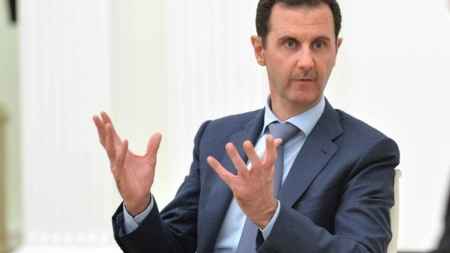
Secretary of Defense Jim Mattis claimed Wednesday that the Syrian regime has drawn back from plans to conduct another chemical attack, following a warning by the Trump administration of serious consequences if Syrian President Bashar al-Assad’s forces followed through with their plans. 

U.S. intelligence detected “active preparations for chemical weapons use” at the same air base from which the regime allegedly had launched its prior chemical attack last April that caused mass casualties. President Trump had responded to the April chemical attack with a barrage of cruise missiles targeting that air base. The White House issued its public warning to the Assad regime on Monday in unambiguous terms, declaring that Assad and his military would pay a “heavy price” if his regime conducted another chemical attack.

“It appears that they took the warning seriously. They didn’t do it,” Mattis told reporters.

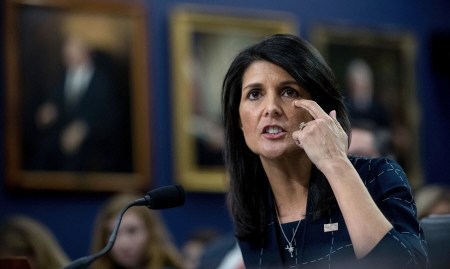
Nikki Haley, the U.S. ambassador to the United Nations, went even further in crediting the Trump administration for stopping Assad at least for now. “I can tell you that due to the President’s actions, we did not see an incident,” Ambassador Haley claimed at a House of Representatives foreign affairs committee hearing. “I would like to think that the President saved many innocent men, women and children.”

It is difficult to prove what may have actually motivated Assad. In any case, whether Assad holds back for good remains to be seen. But we do know the Trump administration is watching constantly for any moves by the Assad regime that could signal an imminent chemical attack and has military assets in place to swiftly respond to such an attack, if not prevent one in the first place.

President Trump not only demonstrated last April that he would follow through on his threats if certain red lines of his were crossed, unlike our previous president. In addition to its warning, the Trump administration may have sent some concrete signals to the Assad regime that it means business this time as well. According to Debkafile, “Signs were gathering in Washington and the Middle East Tuesday, June 26 that the Trump administration was preparing a substantial military operation against the Syrian army and Bashar Assad’s allies, such as the foreign pro-Iranian Shiite militias and Hizballah. Some US military sources suggested that an American preemptive strike was in store in the coming hours to prevent Assad’s army from again resorting to chemical warfare against his people.”

Assad may still decide to launch another chemical attack, figuring that his key allies, particularly Russia, will continue to back him. No doubt, he took note of Russia’s stern response to the U.S.’s downing of a Syrian warplane earlier this month, including a warning from the Russian Defense Ministry that “All kinds of airborne vehicles, including aircraft and UAVs of the international coalition detected to the west of the Euphrates River will be tracked by the Russian SAM systems as air targets.” The Syrian regime had also already taken some precautions by moving most of its operational aircraft to a Russian airbase in Syria after the April missile strike. The Russian airbase is protected by fairly advanced air defense systems. An American missile strike on Syrian aircraft located at a Russian air base would in all likelihood be seen as a major escalation of the war by the Russian government, risking a direct military confrontation between U.S. and Russia that the Trump administration may be loath to risk. As if to thumb his nose at the Trump administration’s latest threats by demonstrating the strength of his military alliance with Russia, Assad was seen strutting around a Russian air baseinspecting its aircraft and defense systems. He was even photographed sitting in the cockpit of a Russian fighter jet.

Indeed, Russia appears ready to raise the stakes to bolster the Syrian dictator’s regime. Debkafile reports that Russia is “building a new base in southeastern Syria,” which would “provide Russia with a lever of control over the volatile Syrian southeast and its borders, where US-backed and Iranian-backed forces are fighting for dominance.”

As Russia raises the stakes, the U.S. must be clearer than ever as to its strategic objectives in Syria, which it is willing to back up with military force even in the face of Russian threats.  We must do all we can to prevent getting sucked into Syria’s civil war, including by undertaking any military efforts at regime change. That said, we must repel any military action by the Syrian regime or its allies that would prevent us from prosecuting the war against ISIS, which remains our number one objective until the ISIS sanctuaries, infrastructure and leadership are for all intents and purposes destroyed.

However, we also cannot ignore the threat that Assad’s chemical weapons program continues to pose. The Obama administration had thought that it had largely eliminated the threat “diplomatically,” when it reached a phony deal with Russia to oversee the removal and destruction of the Syrian regime’s declared chemical weapons. The opportunity for cheating was all too plain to see, except by Obama and his clueless Secretary of State John Kerry. We are now seeing the consequences. According to Secretary of Defense Mattis, Syria’s chemical program remains intact.

It is not only what Assad has been doing in unleashing his ghastly chemical weapons on his own people, causing horrible suffering in their wake, which demands our attention. After all, Assad has been causing such suffering with conventional weapons as well, including his use of barrel bombs, which we have repeatedly condemned but have not taken specific military action to stop. To do so would almost inevitably draw us into a wider war. What makes chemical and other weapons of mass destruction different is their potential proliferation to the very Islamic terrorists we are trying to defeat. The transfer of chemical or biological weapons to terrorist hands would represent the most dangerous outcome of the Syrian conflict to the rest of the world, including to the United States. That is why we must monitor where we believe Assad’s remaining chemical weapons and production facilities are located, prevent them from being used or even moved from known locations, do all that we can to keep them out of the hands of the terrorists and destroy the chemical weapons and production facilities when the opportunity presents itself.

A nuclear trip wire for North Korea

June 29, 2017

A nuclear trip wire for North Korea, Washington TimesDaniel Gallington, June 28, 2017

(Don’t pussyfoot around. — DM)

Illustration on locking down North Korea’s nuclear weapons threat by Linas Garsys/The Washington Times

ANALYSIS/OPINION:

Now that North Korea has a bunch of nukes and is testing ways to deliver them by ballistic missile, we need to address the stark realities of what this new threat really means for us.

And just as important — what it should mean for them.

However, before we begin, it should now be a reality for us that negotiations with fat boy Kim Jong-un’s regime are a total waste of our time, energy and money, just as they were with his stroked-out father’s crew.

Politically, of course, this result was the collective failure of our State Department, the Clinton, Bush and Obama administrations, together with the defective concept of the “Six Party Talks.” The only “accomplishment” was to provide the time and diplomatic cover for the Democratic People’s Republic of Korea’s nuke program, plus give the regime lots of oil and money in the process. In short, the Six Party Talks enabled North Korea’s nuke weapons program. If this sounds familiar, Barack Obama and John Kerry made the same mistakes with Iran.

So, North Korea is now a dangerous nuclear rookie and we must develop — and articulate — policies that reflect, in the words of Defense Secretary James Mattis, the “clear and present danger” they represent.

What should our new policies look like? What should be the “red lines,” and what North Korean behaviors should cause virtually automatic responses from us? As this is a whole new ball game, what should be the thresholds for our responses and what should we be telling the Russians and Chinese about it?

This because nothing we do in response to North Korean aggressive behaviors should come as a surprise to anyone.

It also seems clear we need both short- and longer-term strategies. Along with this approach, we should rule out a number of troublesome scenarios for possible armed conflicts with North Korea — in other words, let’s also define those situations in which we simply will not “play.”

Shorter-term strategies: The short term is, for a number of reasons, the most dangerous. This is because it’s the nuclear muscle-flexing stage for the fat boy and also the period he is most likely to make a mistake or do something dumb. For this same reason, it’s also the period when our responses should be in the virtually “automatic” mode, including pre-emptive strikes.

While there are a number of scenarios that should be addressed, there are a few that deserve special attention. In this category should be a pre-planned nuclear response option for each North Korean action:

• Preparations for a massive artillery attack on Seoul.

• Massing troops at the border.

• Interception of ocean or coastal traffic.

• Interception of aviation.

• Launch of any ballistic missile with an aggressive trajectory.

Longer-term strategies: These should be developed with urgency, but on a different track from the shorter-term ones. In this category should be:

• Discussions with the Japanese for a cooperative nuclear relationship.

• Re-positioning nuclear assets — and nuclear-capable assets — to and around the Korean peninsula.

• Excluding North Korea from any relevant diplomatic discussions; maximizing all types of sanctions — in the U.N. and domestically; terminating any remaining Six Party benefits.

• Working trade embargoes; interceptions of suspicious commerce; very aggressive information operations.

Defining when we won’t “play”: This category is as important as the other two — maybe more so, because it is the essence of deterring the fat boy from doing something stupid. Here are some things we won’t do in context of any conflict or confrontation with the North:

• A land war on the Korean peninsula — been there, done that.

• A build-up of our conventional forces in the region in response to North Korean aggressive behaviors — gradualism does not work.

• Any kind of negotiations with the North — they have given up this option.

Combined, these strategies are intended to have a simple “message” for the North Korean regime: We have defined the limits of your behavior. If you cross the lines, our response will be quick — and pre-emptive if we decide you are about to do something dumb. The response will be nuclear if that is appropriate for the risk you present to us — and in that event, you will cease to exist as a political entity.

Perhaps as important as promulgating these strategies is that they be articulated publicly and fully briefed to our allies and enemies alike.

A useful analogy: During the Cold War, we had a SIOP — a Single Integrated Operational Plan — that included a targeting doctrine (promulgated during the Carter administration) that focused on the top Soviet leadership. My personal experience during the ‘80s was that the leadership-targeting aspect of the SIOP got the attention of the Soviets, along with President Reagan’s Strategic Defense Initiative.

Will the fat boy behave differently if we promulgate the strategies described above? That’s his choice, of course, but if he doesn’t, he should realize that the slightest miscalculation on his part, let alone a dangerous overt act, could cause the end of him and his regime. In short, he has no margin for error — nor do we — and it should surprise no one.

• Daniel Gallington served through 11 rounds of bilateral negotiations in Geneva as a member of the U.S. Delegation to the Nuclear and Space Talks with the former Soviet Union.

Nikki Haley’s Comments on Iran Highlight Russian-Related Complications

June 29, 2017

Nikki Haley’s Comments on Iran Highlight Russian-Related Complications, Iran News Update, Edward Carney, June 29, 2017

On Tuesday, Nikki Haley, the US ambassador to the United Nations delivered testimony to the House panel on foreign operations, a subcommittee of the Appropriations Committee in the US House of Representatives. In that testimony, Haley addressed multiple issues relating to the Islamic Republic of Iran, thereby reasserting the Trump administration’s assertive policies toward the Iranian regime. By most accounts those policies are still emerging, but they have already come to include purposive outreach to other adversaries of the Islamic Republic and a program of expanded sanctions on matters such as Iran’s ballistic missile program.

However, those efforts to confront and contain the Islamic Republic are arguably complicated by other aspects of the Trump administration’s policy commitments, including a focus on domestic issues and an effort to improve relations between the US and Russia, which boasts close relations with Iran in the areas of trade and military cooperation, especially as it relates to the Syrian Civil War.

While the US supports moderate rebel groups fighting against the dictatorship of Bashar al-Assad, the Iranians and Russians have been credited with turning the war in favor of Assad. Various Shiite militias are currently operating as proxies for Iran in that war, and the Iranian Revolutionary Guard Corps is increasingly playing a direct role in the conflict. Meanwhile, Russia has been providing air support for pro-Assad ground operations since 2015.

Western commentators, including officials in the Trump administration, have variously accused Russia and Iran of ignoring or actively facilitating human rights abuses by the Assad regime, including an April chemical weapons attack that killed at least 80 people in a rebel-controlled civilian area.

As the Associated Press points out, Ambassador Haley’s comments to the House panel came shortly after the White House had issued a warning to Syria regarding alleged preparations for another such chemical attack. The article specified that Pentagon officials had confirmed the intelligence underlying that warning, involving particular movements at the same Syrian air base that had been used as the staging area for the previous chemical attack on Khan Sheikhoun.

White House Press Secretary Sean Spicer said of Assad that “he and his military will pay a heavy price” if they follow through with apparent plans for another “mass murder attack using chemical weapons.” But the AP quoted Haley as saying that the administration’s remarks were not intended only for Assad, but also for Russia and Iran. Both of the Syrian allies joined in denying Assad’s responsibility for the attacks, with some officials insisting that the chemical weapons had originated in a rebel warehouse at the site of a conventional military airstrike.

The dispute over this issue and the subsequent US cruise missile strike on Shayrat air base can be seen as early examples of the escalation between Iranian allies and adversaries which is still going on to this day. In fact, Haley’s effort to fold Russia and Iran into a warning directed more explicitly against Syria is reminiscent of an incident earlier in June wherein a member of Iran’s Revolutionary Guard said that a ballistic missile strike on eastern Syria had been intended largely as a warning to the US and Saudi Arabia.

Those two traditional adversaries of the Islamic Republic have been expanding relations under the Trump administration, sometimes with explicit reference to shared anxieties over expanding Iranian influence and meddling in the broader Middle East. President Trump’s visit to Riyadh in May for an Arab-US summit coincided with the signing of trade agreements that included 110 billion dollars in arms sales to the Arab Kingdom.

But at the same time that the White House is openly siding with Saudi Arabia and its regional allies against the Iranian regime, it does not appear to be giving up on the prospect of improved relations with Russia. In fact, the Western strategy for a political solution to the Syrian Civil War seems to presently involve the expectation that Russia can be encouraged to rein in the Islamic Republic and prevent it from further sabotaging ceasefire agreements.

Recent developments have cast doubt upon the practicality of this strategy however. As the US has taken a more direct role in defending rebel groups, even resorting to the shoot-down of at least two military controlled drones and a Syrian warplane, Russia has responded by threatening to target US aircraft and to halt the use of a hotline intended to prevent mid-air collisions between the multiple powers operating in the skies over Syria.

Haley’s comments on Tuesday were indicative of a roughly matching increase in American criticism of Russia. And this criticism was not limited to the issue of chemical weapons. Haley also explained that Russia’s position on the UN Security Council allowed it to stymie US efforts to sanctions Iran and hold it to account for ongoing misbehavior in matters including the development of the Iranian nuclear program.

“[The Iranians are] going to continue their nuclear capabilities and we just gave them a lot of money to do it with,” Haley said, referring to the 2015 nuclear agreement that President Trump has described as “the worst deal ever negotiated.” She went on to highlight concerns about Iran’s sponsorship of terrorism, suggesting that nuclear weapons could find their way into the hands of terrorist groups at some point in the future, and that Russia would effectively prevent the US and its allies from doing anything to stop this.

“Yes, we would love to sanction Iran; and, yes we will continue to be loud about it; and, yes, Russia will veto it,” Haley said, according to the Washington Examiner.

But this is not to say that the Trump administration has positively brought an end to its strategy of attempting to improve relations with Russia. In fact, various reports suggest that this endeavor is even standing in the way of congressional legislation aimed at increasing national-level sanctions on both Iran and Russia. The Countering Iran’s Destabilizing Activities Act passed the Senate two weeks ago by a margin of 98 to 2, but it was subsequently stalled in the House on procedural grounds, leading Democrats to argue that the House Republican leadership was trying to protect the president’s Russian agenda.

The prospects for resolution appeared to grow dimmer on Tuesday when the Washington Post reported that energy lobbyists were urging lawmakers to reevaluate the bill on the grounds that its restrictions on doing business with Russian companies could have a punishing effect on American firms and foreign firms doing business in the US. These objections could bolster the prospects of the House leadership sending the bill to various committees for review and markup – a process that could delay a final vote by months.

As it concerns Iran, the bill would include sanctions on Iran’s ballistic missile activities and also extend all terrorism-related sanctions to the Revolutionary Guard Corps, for which Trump has urged designation as a foreign terrorist organization. This position has not changed, and it seems that neither has the Trump administration’s hardline approach to Iran policy. Some have suggested that the emerging policy is pointing in the direction of regime change, though this has not become a declared position as yet.

The Washington Examiner pointed out that one member of the House panel on foreign operations, Republican Representative Hal Rogers, had directly raised the prospect of regime change on Tuesday, asking Nikki Haley whether it is an option. The ambassador’s only response was “I don’t know.”

This coming Saturday, the National Council of Resistance of Iran will hold its annual Free Iran rally, which will include explicit calls for regime change driven by a domestic opposition movement within the Islamic Republic. The event is expected to be attended by tens of thousands of Iranian expatriates, plus hundreds of policymakers and experts from the US, Europe, and throughout the world. Notably, these dignitaries will include figures with close ties to the Trump administration, such as John Bolton, who served the second Bush administration in the position now occupied by Haley.

Obama-appointed judges dismiss Supreme Court ruling, continue blocking Trump’s immigration crackdown

June 29, 2017

Obama-appointed judges dismiss Supreme Court ruling, continue blocking Trump’s immigration crackdown, Washington TimesStephen Dinan, June 28, 2017

President Trump met Wednesday with what the White House identified as “immigration crime victims” to urge passage of House legislation. (Associated Press)

President Trump may have won a partial victory at the Supreme Court this week, but other federal judges remain major stumbling blocks to his aggressive immigration plans, with courts from California to Michigan and Atlanta limiting his crackdown on sanctuary cities and stopping him from deporting illegal immigrants he has targeted for removal.

The judges in those deportation cases have rejected Mr. Trump’s argument that he has wide latitude to decide who gets kicked out, without having to worry about district courts second-guessing him on facts of the case.

Instead, the judges said, they get to decide their jurisdiction, and that extends to reviewing Mr. Trump’s immigration policy.

One judge in Michigan ordered the Homeland Security Department to freeze all deportation plans for about 200 Chaldean Christians arrested over the past two months and scheduled to be sent back to Iraq. Nearly every one of them has a criminal record.

A judge in Atlanta ordered the department to reinstate the temporary deportation amnesty — known in governmentspeak as the DACA program — for Jessica Colotl, an illegal immigrant Dreamer whose past made her a target for deportation, officials said.

“The public has an interest in government agencies being required to comply with their own written guidelines instead of engaging in arbitrary decision-making,” said Judge Mark H. Cohen, breaking new ground in establishing legal rights for some illegal immigrants.

On Tuesday, a federal judge in California ordered the Border Patrol to improve its treatment of illegal immigrant children caught sneaking across the border. She said she was troubled by stories from illegal immigrants who said they were kept in dirty rooms without private toilets and sometimes had to wait up to 12 hours for their first meals.

When they were fed, it wasn’t enough, concluded Judge Dolly M. Gee.

Judge Gee ruled that the Border Patrol must provide the children with soap, toothbrushes and toothpaste, and access to showers.

Notably, all four of the judges — including one in San Francisco who blocked part of Mr. Trump’s executive order against sanctuary cities — were appointed to the bench by President Obama.

“Almost all of the judges are acting outside of established law,” said Hans von Spakovsky, a senior legal fellow at The Heritage Foundation who served as a Justice Department lawyer in the Bush administration.

For David Leopold, a former president of the American Immigration Lawyers Association, the judges are heroes upholding the Constitution when the political branches of government won’t.

“You’ve got the Republicans playing ball in the Senate and the House. The only institution that’s putting a check on this guy is the judiciary,” he said.

The Trump administration is fighting all the rulings but has had little luck convincing lower-court judges of Mr. Trump’s powers on immigration.

Mr. Trump, though, has had success at the Supreme Court, which issued a 9-0 decision this week reviving part of his travel ban executive order, which imposes a 90-day pause on some visitors from six majority-Muslim countries and a 120-day halt to all refugee admissions.

Reversing several lower-court rulings — all also issued by judges appointed by Democrats — the Supreme Court said Mr. Trump could stop refugees and visitors when they don’t already have “bona fide” close connections to people or entities in the U.S. For those who do have close connections, however, they have rights that must be respected.

Homeland Security is working out how it will interpret those directives, but analysts are deeply divided on what it means and whether the justices delivered a message to lower courts to back off their criticism of Mr. Trump.

Where lower-court judges pored over Mr. Trump’s campaign statements and perused his Twitter account looking for evidence to use against him, the Supreme Court took the president’s executive order at face value.

“The Supreme Court treated this like a normal case, like a normal executive action. So certainly this has to affect — probably not all judges, but certainly some,” said Ilya Shapiro, editor-in-chief of the Cato Institute’s Supreme Court Review.

He said that could set the stage for a return to the posture of the Obama years, when many of his actions were challenged in court but were greeted with seriousness by the judges who heard the cases — what legal scholars have come to call the “presumption of regularity.”

“I don’t think we’re there yet,” Mr. Shapiro said. “The [president’s] constant tweets — not just about immigration but lots of things — feed the fire of the resistance.”

Mr. von Spakovsky called the Supreme Court ruling “a slap in the face” to the judges who ruled against the broad swath of the president’s immigration plans.

“These judges are clearly hoping these cases don’t get appealed, don’t get to the Supreme Court, because if they do, they’re going to get overturned,” he predicted. “The lesson to them is they need to quit making political decisions based on the fact they don’t like the president and his policy, and start making legal decisions that follow binding precedent.”

Some analysts said the key part of the Supreme Court’s ruling was showing deference to the president’s national security decision-making. The justices said his judgment had to carry weight, particularly when it came to people who don’t have a connection to the U.S. and therefore don’t have constitutional rights to be weighed.

The court will hear broader arguments in the travel ban case in October.

Mr. Leopold said he initially saw the ruling as a loss for immigrant rights advocates, but after rereading it he concluded it’s a major win for his side and a slap at Mr. Trump.

“This is a rebuke,” he said. “They weren’t harsh in their words. It was very professional … But if you read between the lines, they basically say, ‘No, no, we’re not going to defer to you on national security here.’”

He also said the ruling is much more limited in empowering Mr. Trump than it might seem and that few people will be snared by the part of the executive order that the court revived, targeting those without close connections to the U.S.

But on Wednesday evening, the State Department issued a new set of visa guidelines to U.S. embassies on the six affected countries that was much narrower than immigration advocates might have hoped.

Refugee agencies argue that most refugees already in the pipeline have close connections because their names have already been forwarded for placement in the U.S. Immigrant rights advocates said anyone with a job offer, a relative living in the U.S. or who are part of a school program will also be exempted.

Advocacy groups said earlier Wednesday that if they thought the president was being too stingy, they would head back to the courts and likely the same lower-court judges who first ruled against Mr. Trump.

Mr. Leopold said that, far from being chastened, those judges will now feel emboldened by the Supreme Court.

“I think it stiffens the spine because they’re looking at this and they’re basically being upheld on the injunction,” he said. “Those judges have not been overruled.”