Archive for June 3, 2017

Denmark stops funding for Palestinian NGOs for “glorifying” terror

June 3, 2017

Denmark stops funding for Palestinian NGOs for “glorifying” terror, DEBKAfile, June 3, 2017

The Danish ambassador to Israel Jesper Vahr announced Saturday that his country has stopped financial support to Palestinian non-governmental organizations for “glorifying terrorism, and demands money back.”

Copenhagen announced the decision a few days after Norway decided to stop funding for a Palestinian youth center for women, because it was named after the Palestinian female terrorist Dalal al-Maghrabi. In 1978, Maghrabi commanded a horrendous hijack-cum murder operation which left 38 Israelis dead, including 13 children, as well as an American photographer Gail Rubin. Another 72 were injured. A public square in Ramallah honors her memory as “martyr.”

Earlier this month, Israeli Prime Minister Benjamin Netanyahu urged Danish foreign minister Anders Samuelsen to cancel Denmark’s funding for Palestinian NGOs that promoted incitement against Israel.

Egypt’s Battle Against Islamic Extremism

June 3, 2017

Egypt’s Battle Against Islamic Extremism, Gatestone InstituteShireen Qudosi, June 3, 2017

Sisi faces more than just militant and political extremists within Egypt’s borders; he is also walking a theological tightrope. Egypt is home to the regressive theocratic influence of the most revered Islamic institution in the Sunni world, Cairo’s Al-Azhar University, which openly views freedom as a “ticking time-bomb.”

Being held hostage intellectually by the grip of Al-Azhar University ensures that there is a constant supply when it comes to producing the next generation of militant and political Islamists.

President Sisi’s response to the brutal slaughter of peaceful Christian worshippers is being called rare but should not be surprising, considering the aggressive measures that need to be taken to hold extremism at bay, and to eradicate the threat that local groups pose to the Egyptian people. Coming out of the Riyadh Summit, where President Trump and a host of Muslim nations, including Egypt, agreed to drive out extremism, Sisi’s reaction was necessary.


*********************************

When it comes to regional interests in the Middle East, the priority is the most dominant and violent force.

Egypt stands out as a primary target, given the cocktail of challenges that position it as a center of radical Islam. Egypt faces political, violent, and theological militancy within its borders.

For a nation to do what it must to survive, it needs the steadfast support of world powers. Step one is annihilating all sources of violent Islam.


For a Western audience, Egyptian President Abdel Fattah al-Sisi is a complex figure, who was shunned by the Obama administration. There appear truly pressing, immediate priorities in Egypt, such as developing the economy and combating the avalanche of extremist attempts to overthrow him. Among Middle East and North African territories, Egypt stands out as a primary target, given the cocktail of challenges that position it as a center of radical Islam.

President Sisi faces violent extremist hotbeds in the Sinai Peninsula, and the still-destabilizing influence of the Muslim Brotherhood (a political arm of violent radicals). Most notably, Sisi brought a reality check to the Arab Spring when he led the military overthrow of the Muslim Brotherhood government in 2013, ushering a spiritual and cultural Islamic reformation with widespread popular support from Egyptians on a grass-roots level.

Sisi faces more than just militant and political extremists within Egypt’s borders; he is also walking a theological tightrope. Egypt is home to the regressive theocratic influence of the most revered Islamic institution in the Sunni world, Cairo’s Al-Azhar University, which openly views freedom as a “ticking time-bomb.”

Being held hostage intellectually by the grip of Al-Azhar University ensures that there is a constant supply when it comes to producing the next generation of militant and political Islamists.

Egypt also faces extremist infiltration from neighboring Libya, a nation caught in a power vacuum after the murder of its leader, Col. Muammar Gaddafi. This vacuum has been readily filled by Islamic militants, including ISIS.

Upon returning home in April from his first visit to the U.S. since 2013, Sisi faced a series of domestic terror attacks that once again put Egypt in a global spotlight. On Palm Sunday, in April, two suicide bombings in Coptic Christian churches killed more than 45 people and injured another 120. For Egypt, one of the last regional strongholds that still has a vibrant non-Muslim minority population, violent eruptions on major Christian holidays have become routine.

In England, just days after the May 22 Manchester suicide bombing, attention was once again on Egypt where 29 Coptic Christians were gunned down on a bus traveling to a monastery near the city of Minya. The attack was launched by masked terrorists who arrived in three pick-up trucks and opened fire on the passengers, many of whom were children. Egyptian intelligence believes the Minya attack was led by ISIS jihadists based in Libya. In February, the aspiring terrorist caliphate also launched a campaign against Egypt’s Christian population. The Egyptian military responded swiftly with air strikes against terrorist camps, along with a televised warning against sponsored terrorism.

President Sisi’s response to the brutal slaughter of peaceful Christian worshippers is being called rare but should not be surprising, considering the aggressive measures that need to be taken to hold extremism at bay, and to eradicate the threat that local groups pose to the Egyptian people. Coming out of the Riyadh Summit, where President Trump and a host of Muslim nations, including Egypt, agreed to drive out extremism, Sisi’s reaction was necessary.

Egyptian President Abdel Fattah al-Sisi (front row, far-right) attended the May 21 Arab Islamic American Summit in Riyadh, Saudi Arabia, along with U.S. President Donald Trump (front-center). The problems of Islamic extremism and terrorism were much-discussed at the summit. (Photo by Thaer Ghanaim/PPO via Getty Images)

In a war that is equally ideological and kinetic, Muslim nations and others trying to survive the plague of Islamic terrorism will need to be as ruthless as their extremist counterparts. That is something that the warring political factions in the U.S. quickly need to understand. When it comes to regional interests in the Middle East, the priority is combating the most dominant and violent force. If that force wins, human rights are completely off the table. Beyond Egypt, President Trump has received considerable backlash in the U.S. for siding with what are seen as repressive regimes, whether it was hosting Turkey’s President Recep Tayyip Erdoğan in the White House or engaging with dictators and monarchs during the Riyadh Summit.

In order to bring security to the region, alliances need to look at the real instigators and agents of chaos. There is a metastasizing threat that requires a new coalition of the willing. For a nation to do what it must to survive, it needs the steadfast support of world powers. Step one is annihilating all sources of violent Islam.

Shireen Qudosi is the Director of Muslim Matters, with America Matters.

Foreign politicos punch Trump, copy his campaign

June 3, 2017

Foreign politicos punch Trump, copy his campaign, DEBKAfile, June 3, 2017

While several European politicians seize on US President Donald Trump as a punching bag, at least three are pragmatic enough to copycat his tactics and slogans for boosting their chances to get elected.

The heat Trump is taking at home meanwhile goes from one crescendo to another. Hillary Clinton, the Democratic rival he defeated in 2016, continues to buck all forecasts by apparently shaping up for another bid for the White House in 2020 at the age of 74. This week, she went on about the many culprits responsible for her defeat – all external – until even loyal fans wearily urged her to “move on.”

Nonetheless, she is sticking to her guns. The president is somehow dodging a barrage of assaults on his “Russian connection” – and since Friday, his decision to withdraw from the Paris Climate Accord – sluggish progress on his health, tax and immigration reforms, White House infighting and a Republican party divided against him. Clinton appears to be encouraged enough to pin her hopes on midterm elections next year, which she is counting on enablinlg Democrats to snatch the House majority. Weakened by the blitz against him, the president will fall under the axe of impeachment, she hopes, and Trump and family will be finally driven out of the White House and Washington.

However, impeachment legislation could drag on for years, as in the case of her husband, Bill Cllinton, and not necessarily end in firing the president. Hillay is not fazed by this, nor by the fact that Trump’s accusers, including former intelligence chiefs and Obama appointees, have failed so far to turn up a scintilla of proof that he is guilty of criminal wrongdoing.

But the months of relentless pressure are taking their toll – even on the president’s following in the House and the Senate. His administration faces major obstacles in pursuing its agenda and a shrinking number of foreign friends, especially in the West.

Now and then, an occasional cool headed observer sees through the anti-Trump tsunami to glimpse the grassroots popularity that brought him to the White House and still weathers the storm of disparagement.

One is former New York Mayor Michael Bloomberg, an antagonist who Friday donated $15 million to the UN fund for combating climate change, to make up for the shortfall caused by Trump’s decision to withdraw from the Paris climate accord. Bloomberg predicted in a news interview that Trump would win a second term in the White House.

In Europe, the most articulate Trump-bashers are German Chancellor Angela Merkel, French President Emmanuel Macron and the British opposition leader, Labor’s Jeremy Corbyn.

While campaigning for a fourth term in the Sept. 17 election, Merkel was dismayed to discover that having turned its back on Trump’s America and post-Brexit Britain, Germany is on its own: “The times when we could completely rely on others are, to an extent, over,” she commented.

There is more than a dash of cynicism in her comment.  The United States began withdrawing from Europe and pivoting towards Asia when George W. Bush was in the White House. This process accelerated under the Obama administration. But now the chancellor faces an electorate which expects practical solutions to its problems, and she may not be able to avoid expanding German military strength. It is convenient for her to pin the blame for this undesirable situation on Trump, making him the symbol of the unreliable NATO order.

And then Macron, scion of the banking establishment and representative of the French elite classes which control it, won the presidency by posing as a non-politician and promising to sweep away “the establishment” and conduct reforms. (Remember Trump’s slogan: “Drain the swamp”?).

The most radical of the three is Britain’s Labor leader Jeremy Corbyn, who has maintained that terrorists, like members of Hamas and Hizballah, whom he has called “friends,” should not be blamed for their violence, but the “establishments” which persecute them. Hence his membership of the Palestine Solidarity Campaign and defense of is party’s refusal to expel former London Mayor Ken Livingstone for linking Zionism to Adolf Hitler, and other anti-Semitic members.

But since Corbyn dedicated his campaign for election on June 8, to overturning the “rigged” system which favors elites over ordinary working people, this hitherto veteran back-bencher who espoused leftist fringe causes, has suddenly shot up in the polls. Less than a week before voting, the ruling Conservative’s majority of 20 points is estimated to have shrunk to three. The far-left Corbyn is now in with a chance of replacing Prime Minister Theresa May at 10 Downing Street.

UNRWA recycles image of Syrian girl, now claims she is Gazan victim of Israel in fundraising campaign

June 3, 2017

UNRWA recycles image of Syrian girl, now claims she is Gazan victim of Israel in fundraising campaign, Jihad Watch, June 2, 2017

(The UN Rocket Warehousing Agency strikes again. Please see also, Gaza on the Brink. — DM)

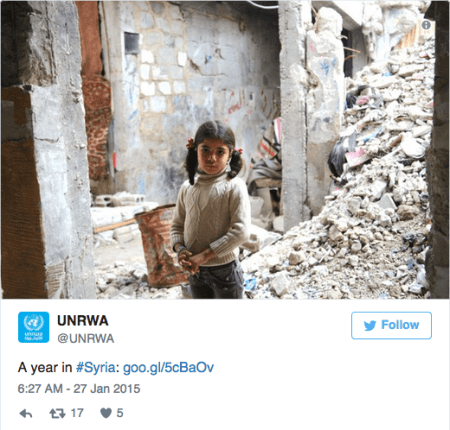
Notice also that not only do they cynically reuse the photo, but they make up a whole tear-jerking story about little “Aya,” victim of Israeli oppression. Three years ago they used the identical picture as a girl standing in bombed-out Damascus.

Two primary lessons:

  1. The UNRWA is a viciously corrupt and dishonest organization, bent on enabling the jihad against Israel and willing to lie brazenly in the process.
  2. There is so little actual oppression of the “Palestinians” that images from elsewhere have to be used to demonize the Israelis.

Nikki Haley, Trump’s ambassador to the United Nations, said that the U.S. would fight against the demonization of Israel at the UN. Why is the UN receiving even a penny of U.S. funding at this point?

“UNRWA fakes Gaza girl campaign with image of bombed-out Damascus,” UN Watch, June 2, 2017 (thanks to The Religion of Peace):

GENEVA, June 2, 2017 – UN Watch today demanded that UNRWA chief Pierre Krahenbuhl apologize for using fake images of a girl in a bombed-out Syria building in a major global campaign to raise money for the organization by pretending the girl is a Gaza victim of Israeli actions.

UNRWA is now running the above photo on Facebook and Twitter ads. It is also now UNRWA’s cover image.

Imagine being cut off from the world – for your whole life. That’s reality for children like Aya. The blockade of Gaza began when she was a baby, the occupation in the West Bank before her parents were born. Now she is eleven, and the blockade goes on.

Aya’s childhood memories are of conflict and hardship, walls she cannot escape, and the fear that the only home she knows, however tiny, could be gone when she returns from school.

This Ramadan, please help support children like Aya who have known nothing but conflict and hardship. Donate here: http://buff.ly/2qgsP0Y#forPalestinerefugees

Yet neither the girl nor the bombed-out building are in Gaza; it’s an old photo from Syria, dating apparently to 2014.

Here is UNRWA tweeting the original image in a January 2015 story on Syria:

The photo also appeared on other UNRWA Syria pages, here, here, and here, an UNRWA report in which the caption reads:

A young girl stands in the rubble of Qabr Essit, near Damascus. In 2014, UNRWA was able begin rebuilding facilities within the neighbourhood, including a school and community centre © 2014 UNRWA Photo by Taghrid Mohammad

How can Ginsburg participate in Travel Order case after her *campaign* statements about Trump?

June 3, 2017

How can Ginsburg participate in Travel Order case after her *campaign* statements about Trump?, Legal Insurrection, , June 2, 2017

(To the extent that credibility is at issue, shouldn’t Candidate Trump’s campaign statements about a “Muslim ban” be examined rather than the “facially neutral” executive order? Please see also, Trump’s “Muslim Ban,” Obamacare and Sally Yates. — DM)

This is not a situation where a Justice merely is presumed to have political leanings (don’t they all?), or is affiliated with one political party more than another. Justice Ginsburg has publicly questioned Trump’s credibility, and that credibility is an issue in the case as it presents itself in the 4th Circuit decision from which review is sought.

****************************************

Donald Trump’s second Executive Order on visa entry from six majority Muslim countries is now before the Supreme Court.

Trump is seeking review of the 4th Circuit’s decision upholding a Maryland District Court injunction halting the Executive Order. In addition to the Petition for a Writ of Certiorari asking SCOTUS to hear the case on the merits, Trump has a request for a stay of the lower court injunctions pending a decision on the merits. The application is on a fast track, with the Court setting June 12 as the deadline for opposition papers.

The 4th Circuit’s decision found that the Executive Order, though facially neutral, “in context drips with religious intolerance, animus, and discrimination” and that context was “a backdrop of public statements by the President and his advisors and representatives at different points in time, both before and after the election and President Trump’s assumption of office.”

Those statements, including by Trump himself, the 4th Circuit concluded:

… creates a compelling case that EO-2’s primary purpose is religious. Then-candidate Trump’s campaign statements reveal that on numerous occasions, he expressed anti-Muslim sentiment, as well as his intent, if elected, to ban Muslims from the United States….

As a candidate, Trump also suggested that he would attempt to circumvent scrutiny of the Muslim ban by formulating it in terms of nationality, rather than religion….

These statements, taken together, provide direct, specific evidence of what motivated both EO-1 and EO-2: President Trump’s desire to exclude Muslims from the United States. The statements also reveal President Trump’s intended means of effectuating the ban: by targeting majority-Muslim nations instead of Muslims explicitly….

EO-2 cannot be read in isolation from the statements of planning and purpose that accompanied it, particularly in light of the sheer number of statements, their nearly singular source, and the close connection they draw between the proposed Muslim ban and EO-2 itself.

The 4th Circuit decision has been widely criticized for its reliance on campaign statements, as well as for substituting judicial security evaluations for those of the executive branch.

This case, unlike other more mundane cases involving Trump policies that may come before the court, clearly places Donald Trump’s words, personality and credibility in issue.

One of the Justices already has expressed a view on Trump’s credibility. In July 2016, Justice Ruth Bader Ginbsburg was quoted in a CNN interview deriding Trump as “a faker”:

Supreme Court Justice Ruth Bader Ginsburg’s well-known candor was on display in her chambers late Monday, when she declined to retreat from her earlier criticism of Donald Trump and even elaborated on it.

“He is a faker,” she said of the presumptive Republican presidential nominee, going point by point, as if presenting a legal brief. “He has no consistency about him. He says whatever comes into his head at the moment. He really has an ego. … How has he gotten away with not turning over his tax returns? The press seems to be very gentle with him on that.” ….
“At first I thought it was funny,” she said of Trump’s early candidacy. “To think that there’s a possibility that he could be president … ” Her voice trailed off gloomily.
“I think he has gotten so much free publicity,” she added, drawing a contrast between what she believes is tougher media treatment of Democratic candidate Hillary Clinton and returning to an overriding complaint: “Every other presidential candidate has turned over tax returns.”
That July 2016 CNN lashing of Trump was not a one-off. Justice Ginsburg made two other negative public statements about Trump during the campaign (via Politifact):

Interview July 7, 2016 with Associated Press

Asked what if Trump won the presidency, Ginsburg said: “I don’t want to think about that possibility, but if it should be, then everything is up for grabs.”

Interview July 8, 2016 with New York Times

“I can’t imagine what this place would be — I can’t imagine what the country would be — with Donald Trump as our president. For the country, it could be four years. For the court, it could be — I don’t even want to contemplate that.

Referring to something she thought her late husband, tax lawyer Martin Ginsburg, would have said, she said: “Now it’s time for us to move to New Zealand.”

Justice Ginsburg came under heavy criticism from a wide spectrum of commentators, since it is unusual for a Supreme Court Justice to express views on a political candidate and campaign. Even the Editorial Board of the NY Times agreed that Justice Ginsburg’s comments were inappropriate, Donald Trump Is Right About Justice Ruth Bader Ginsburg:

Justice Ruth Bader Ginsburg needs to drop the political punditry and the name-calling.

Three times in the past week, Justice Ginsburg has publicly discussed her view of the presidential race, in the sharpest terms….

There is no legal requirement that Supreme Court justices refrain from commenting on a presidential campaign. But Justice Ginsburg’s comments show why their tradition has been to keep silent.

In this election cycle in particular, the potential of a new president to affect the balance of the court has taken on great importance, with the vacancy left by the death of Justice Antonin Scalia. As Justice Ginsburg pointed out, other justices are nearing an age when retirement would not be surprising. That makes it vital that the court remain outside the presidential process. And just imagine if this were 2000 and the resolution of the election depended on a Supreme Court decision. Could anyone now argue with a straight face that Justice Ginsburg’s only guide would be the law?
The Washington Post editorial board also was critical of Justice Ginsburg’s comments, Justice Ginsburg’s inappropriate comments on Donald Trump:
However valid her comments may have been, though, and however in keeping with her known political bent, they were still much, much better left unsaid by a member of the Supreme Court. There’s a good reason the Code of Conduct for United States Judges flatly states that a “judge should not . . . publicly endorse or oppose a candidate for public office.” Politicization, real or perceived, undermines public faith in the impartiality of the courts. No doubt this restriction requires judges, and justices, to muzzle themselves and, to a certain extent, to pretend they either do or do not think various things that they obviously do or do not believe. As the saying goes, however, “hypocrisy is the compliment vice pays to virtue.”
As journalists, we generally favor more openness and disclosure from public figures rather than less. Yet Justice Ginsburg’s off-the-cuff remarks about the campaign fall into that limited category of candor that we can’t admire, because it’s inconsistent with her function in our democratic system….
Justice Ginsburg didn’t quite apologize, but did say she regretted the comments:

“On reflection, my recent remarks in response to press inquiries were ill-advised and I regret making them,” Ginsburg said in a statement. “Judges should avoid commenting on a candidate for public office. In the future I will be more circumspect.”

Later Thursday in an interview with NPR, Ginsburg described her remarks as “incautious.”

“I said something I should not have said,” she remarked. When NPR’s Nina Totenberg asked her “if she just goofed,” Ginsburg responded: “I would say yes to your question, and that’s why I gave the statement. I did something I should not have done. It’s over and done with and I don’t want to discuss it anymore.”

Justice Ginsburg’s negative comments about Trump, though less direct, continued after inauguration. On February 24, 2017, the Washington Post reported:

Supreme Court Justice Ruth Bader Ginsburg, a noted critic of President Trump, suggested that she doesn’t believe the country is in good hands but said she is hopeful about the future.

“We’re not experiencing the best of times,” Ginsburg said Thursday on BBC’s “Newsnight,” though she did not comment directly about the president.

In a case in which Trump’s campaign comments are front and center, how can Ginsburg hear a case in which she has complained publicly about Trump and Trump’s campaign?

This is not a situation where a Justice merely is presumed to have political leanings (don’t they all?), or is affiliated with one political party more than another. Justice Ginsburg has publicly questioned Trump’s credibility, and that credibility is an issue in the case as it presents itself in the 4th Circuit decision from which review is sought.

Justice Ginsburg cannot be removed from the case. The judicial code cited by the Washington Post editorial doesn’t apply to Supreme Court Justices. She would have to recuse herself voluntarily.

I don’t expect Justice Ginsburg to recuse herself. But her *campaign* comments about Trump’s campaign look even worse in hindsight.

Cartoons and Video of the Day

June 3, 2017

Via LatmaTV


H/t Vermont Loon Watch


H/t Power Line


Gaza on the Brink

June 3, 2017

Gaza on the Brink, Commentary Magazine, June 2, 2017

in Gaza City, Monday, April 17, 2017. (AP Photo/Adel Hana)

The testimony of these Gazan refugees in Greece provides a rare opportunity to hear what Palestinians say when they’re out of reach of their own repressive governments and can speak freely. It thereby offers a glimpse at the true source of much Palestinian suffering – and a rebuke to all the journalists, diplomats, and NGOs who have collaborated with both Palestinian governments to hide this truth from the world.

******************************

If you ask Palestinians in either Gaza or the West Bank who’s responsible for their suffering, most would probably say Israel. But what would they say if they were safely overseas and no longer needed to fear their own governments? That’s not a question reporters, diplomats, or nongovernmental organizations usually bother asking. We now have an answer to it, at least with regard to Palestinians who fled Gaza. They left not because of anything Israel did, but because of persecution by Gaza’s Hamas-run government

Their testimony was brought by Haaretz reporter Zvi Bar’el, who went to Greece in search of Syrian refugees but accidentally stumbled instead on Palestinians from Gaza–thousands of them, by their own count. One Gazan refugee estimated there were about 6,000 Palestinians from Gaza in Athens alone. The Badil Resource Center for Palestinian Residency and Refugee Rights says the real figure is probably higher.

And that’s just those who have been able to leave. Many would like to but are stuck in Gaza because the border crossing to Egypt is open only a few days per month. Even when it’s open, only a few hundred people per day can leave. Osama, one of the Palestinians Bar’el interviewed, said that when he left Gaza (via a cross-border smuggling tunnel) over 25,000 people were on the waiting list to leave via the official border crossing.

And why have so many Gazans fled or tried to flee? The Palestinians Bar’el met had a uniform answer: Hamas. Not a single one of them even mentioned Israel in their responses.

“There’s a Palestinian doctor here who came with his wife and three children,” Osama told Bar’el. “Imagine, a doctor, a respectable person with a profession, has to flee Gaza only because he was suspected of disloyalty to Hamas.”

Ayman, who has been listening to the conversation in silence, joins in. “I’m a cartoonist, an artist, and I’ve had exhibitions in Gaza. Hamas didn’t like my cartoons and they forbade me to draw, and they also arrested me. After I spent time in a Hamas prison I decided to escape,” he says.

“They tied my hands and feet, they beat me, and after I was injured from the blows they transferred me to a hospital where I was for more than a month. In the meantime they also arrested my brother to get information out of him about me.”

Naji, another Gazan, showed Bar’el a deep scar on his leg that he said came from being tortured in a Hamas prison.

“One day I even tried to commit suicide. I slammed my head hard against a windowpane and put my neck up against the broken glass. But they pulled me back and I wasn’t successful,” he says, pointing to an ugly scar on his neck. “I’m telling you, Gaza is on the brink of civil war and no one knows what’s happening there. No one is interested.”

There are numerous UN agencies ostensibly devoted exclusively to helping the Palestinians, while human rights groups allocate disproportionate attention to this issue. In both cases, their only real interest in Palestinian suffering is finding some way to blame Israel for it. They couldn’t care less about protecting Palestinians from the abuses of their own government. That’s why they keep issuing reports accusing Israel of being the “key cause” of Palestinian suffering, as one UN agency put it this week, despite all evidence to the contrary.

Yet their blatant bias often obscures a larger problem that affects even well-meaning journalists, NGOs, diplomats and almost everyone else involved in telling the world about what’s happening in the West Bank and Gaza–a failure to understand the way fear affects what people say in nondemocratic societies. For Palestinians, blaming anyone other than Israel for their problems risks serious repercussions from either their own governments or vigilante groups affiliated with both governments. And that’s true not just in Hamas-run Gaza, as people like Ayman and Naji discovered to their sorrow, but also in the Fatah-run West Bank, where journalists, businessmen, and Palestinian security officers have all suffered arrest and financial sanctions for daring to criticize the Palestinian Authority or its president, Mahmoud Abbas. Blaming Israel is always the safest solution, even in cases where it’s patently untrue.

Responsible journalists, NGOs, and diplomats would take this fear factor into account and try to dig a little deeper to try to get at the truth. They would also recognize that the very fact that Israel is the one party no Palestinian fears to criticize is in itself a potent refutation of Palestinian claims that Israel is an oppressive regime. People who truly live under an oppressive regime are generally afraid to go on record criticizing it.

Instead, these opinion shapers take everything they hear from Palestinians in the West Bank and Gaza at face value and parrot it uncritically. That does nothing to better the Palestinians’ lot, but a great deal to bolster the Palestinians’ own repressive governments by absolving them of all scrutiny and pressure to reform.

The testimony of these Gazan refugees in Greece provides a rare opportunity to hear what Palestinians say when they’re out of reach of their own repressive governments and can speak freely. It thereby offers a glimpse at the true source of much Palestinian suffering – and a rebuke to all the journalists, diplomats, and NGOs who have collaborated with both Palestinian governments to hide this truth from the world.

Iran and Middle East Instability

June 3, 2017

Iran and Middle East Instability, American ThinkerShahriar Kia, June 3, 2017

During President Donald Trump’s trip to the region and beyond Iran was strongly condemned by the American leader and senior Saudi officials for its support for terrorism, destructive role across the Middle East, and meddling in Syria, Iraq, and Yemen. Tehran is most specifically concerned with world leaders denouncing Iran’s human rights violations and acknowledging how the Iranian people are the main victims of the mullahs’ atrocities.

The Arabs, as the flagbearers of implementing U.S. sanctions, have launched the domino of freezing Iran’s money abroad. Iranian bank accounts in countries such as Turkey, Oman, and the UAE, especially in Dubai and Abu Dhabi, are being blocked one after another. This can be considered the prelude to comprehensive sanctions on Iran’s banking network.

***********************

The end result of Iran’s presidential election has created further rifts and launched a more intense power struggle amongst the regime’s senior ranks. Supreme Leader Ali Khamenei, fearing a repeat of the 2009 scenario of nationwide uprisings, failed to “engineer” the election results with the aim of unifying his regime apparatus. Khamenei sought to prepare conservative cleric Ebrahim Raisi as his heir by first placing him in the presidency, similar to the process he himself went through.

The elections, however, failed to provide such a finale and in fact prompted all candidates to unveil corruption in the most senior ranks. This has prompted the general public to increase their demands. Protests and demonstrations are witnessed these days in more than 30 cities and towns across Iran, with sporadic reports of clashes, following the bankruptcy of two state-run financial firms, Caspian and Arman.

Iran is also facing major foreign dilemmas, with a new international coalition shaping and targeting Tehran’s interests. The Arab-Islamic-American alliance, with the presence of 55 States, and Iran’s absence, delivered a major blow to the mullahs’ objectives in the Middle East.

On the other hand, Iranian opposition People’s Mojahedin Organization of Iran (PMOI/MEK), transferring all its members from Iraq to a number of European countries, has become ever more powerful. Through a vast network of supporters inside Iran, the PMOI/MEK was able to significantly influence the recent elections and place the regime in a quagmire like never before.

A major rally is scheduled for July 1st by supporters of the National Council of Resistance of Iran (NCRI), the political umbrella group of Iranian dissidents, including the PMOI/MEK. Policymakers and influential figures from across the globe will be gathering to provide a concrete plan to evict the mullahs’ presence from the region, how to establish freedom and democracy in Iran, and thus result in peace and stability in the Middle East. Last year more than 100,000 people took part in this convention.

During President Donald Trump’s trip to the region and beyond Iran was strongly condemned by the American leader and senior Saudi officials for its support for terrorism, destructive role across the Middle East, and meddling in Syria, Iraq, and Yemen. Tehran is most specifically concerned with world leaders denouncing Iran’s human rights violations and acknowledging how the Iranian people are the main victims of the mullahs’ atrocities.

Despite the heavy blows and new sanctions against Tehran, Khamenei has chosen to remain completely silent. This is in complete contrast to the Obama era, where the mullahs’ leader resorted to harsh outbursts in response to even the slightest hint of threats by U.S. officials.

To this end, adopting a strong approach against Tehran has proven to be correct, parallel to the weakness seen in Tehran following the presidential election.

To add insult to injury for Iran, the Trump administration has imposed sanctions on dozens of Iran’s companies, sending a highly important message.

Sanctions have now expanded from ballistic missiles and reached the human rights perspective, and specifically targeting the Revolutionary Guards (IRGC) with the objective of designating this entity as a foreign terrorist organization

The IRGC-affiliated Fars news agency described a new U.S. Senate bill as an “effort to bring Europe aboard in nuclear sanctions.”

“Foreign investment in Iran during the past four years has halved during the past four years, lowering from $4.6 billion to $2.05 billion,” according to Naseem Online citing a UN report.

The Arabs, as the flagbearers of implementing U.S. sanctions, have launched the domino of freezing Iran’s money abroad. Iranian bank accounts in countries such as Turkey, Oman, and the UAE, especially in Dubai and Abu Dhabi, are being blocked one after another. This can be considered the prelude to comprehensive sanctions on Iran’s banking network.

Is Rouhani able, or even willing?

Rouhani is neither willing nor able to carry out any measures outside of Khamenei’s framework. The entire apparatus and power structure is controlled by the Supreme Leader. As long as Iran remains under the mullahs’ regime structure, one should set aside all expectations of change emanating from within Iran. A look at Mohammad Khatami’s tenure is president from 1997 to 2005, andRouhani’s first term, are undeniable proof to this reality.

“They want to change our behavior, but changing it means changing our regime,”Khamenei said recently, signaling his red line.

Rouhani defending Iran’s missiles

The regime’s president recently said that Tehran would continue its ballistic missile program.

“… US officials should know whenever we need to technically test a missile, we will do so and will not wait for their permission,” he said in a news conference.
The Iranian regime reported recently the construction of a third underground ballistic missile production factory and will keep developing its missile program.

This came in the same week when Trump in his foreign visit described Iran as a supporter of militia groups and a threat to all Middle East countries.

Rouhani is an “utterly ruthless operator,” who had presided since 2013 over a collapsing economy and what Amnesty International called “a staggering execution spree,” murdering and imprisoning so many dissidents that Iran has per capita the highest execution rate in the world, according to Christopher Booker in a recent Telegraph article.

Obama’s departure ended the period of appeasement and golden opportunities for Tehran’s mullahs. The road ahead promises to be very difficult, to say the least.

The past four decades have proven that only regime change will bring about what the Iranian people desire and deserve. This is something that is supported by the NCRI and Rajavi’s ten-point plan, calling for a free and democratic Iran where equal opportunities are provided to all citizens regardless of gender, ethnicity, and religion. During the short campaigning season, Iranians manifested their support for Rajavi’s plan by putting up posters reading “Maryam Rajavi is our president.”


Charges mulled against Wilders over anti-Islam tirade implying Koran incites terrorism — RT News

June 3, 2017

Published time: 3 Jun, 2017 02:27

Source: Charges mulled against Wilders over anti-Islam tirade implying Koran incites terrorism — RT News

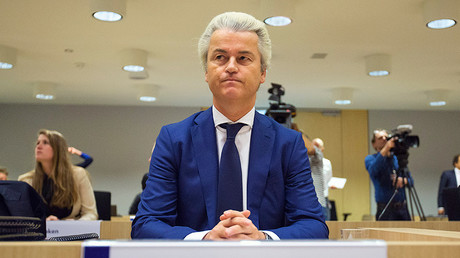
Dutch prosecutors are looking into the speech delivered by far-right Party for Freedom (PVV) leader Geert Wilders, in which he slammed Islam as an “ideology of war and hatred.” Wilders says he’s being targeted for “speaking the truth.”

Wilders, whose PPV came second in Dutch parliamentary elections in March, faces charges of incitement in the complaint filed by the human rights advocacy group back in March 2015, when he claimed that Islam “calls on people to be terrorists” and “be violent” and that the “Koran leaves no doubt about it.”

Read more

Wilders appeared in court with his trademark peroxide blonde hair. © Michael Kooren

The provocative statements made by Wilders during a speech at the conference of PPV’s Austrian ally Freedom Party (FPO) drew ire of the local Austrian Muslim Initiative (AMI) group.  Its chairman, Tarafa Baghajati, lodged a criminal complaint against Wilders, accusing him of resorting to “Nazi rhetoric of the 1930s,” Dutch News.nl reported.

“They (Austrian prosecutors) must now investigate whether Wilders has committed nation incitement and whether he insulted Islam as a religion,” Baghajati told Der Telegraaf at the time.

Acting on the complaint, Austria investigators opened a probe into Wilders’ remarks. On Friday, Dutch public prosecutor’s spokesman revealed that Austrian authorities appealed to their Dutch colleagues to take over the case. Confirming that the prosecutors in the Hague have been “busy studying” the request, he said it is not clear yet if the formal investigation is to be launched into the controversial statements.

Explaining their decision to ditch the dragged-on probe, Austrian prosecutors said it was a result of  “practical consideration.”

Meanwhile, Wilders hit back at the Dutch prosecutors, saying that instead of tackling crime and fighting terrorism, they focus on hunting “a politician for speaking the truth about Islam,” he wrote on Twitter, accompanying the message with #legaljihad hashtag.

Read more

FILE PHOTO: Dutch far-right Party for Freedom (PVV) leader Geert Wilders © Laszlo Balogh

In his March 2015 speech, which has now become subject to scrutiny, Wilders already called out the authorities for clamping down on him while turning a blind eye on a threat arising from Islamic extremism.

“When we warn against Islam, the authorities call it hate speech and bring us to court. But when the grim forces of hatred march down our streets, the police look on and do not interfere,” he said, calling the approach “a disgrace” and “a scandal.”

READ MORE: Far-right Wilders targets ’Moroccan scum’ in his election campaign launch in the Netherlands (VIDEO)

Wilders, a far-right politician who has repeatedly courted controversy inside and outside his country by calling  freedom and Islam “not compatible,” has also likened the Koran to Hitler’s Mein Kampf.

In December last year, he was found guilty of discrimination against Moroccans in the Netherlands. In 2014, he asked his supporters at a rally, if they want fewer or more Moroccans on the streets, provoking a chant: “Fewer! Fewer! Fewer!”

Wilders denouncing the ruling, which however does not impose any punishment on him, as politically motivated, calling it “madness” carried out by “three PVV hating judges.”

Saying it’s Russians’ fault like blaming everything on Jews

June 3, 2017

Putin’s best quotes at SPIEF — RT News

Source: ‘Saying it’s Russians’ fault like blaming everything on Jews’ – Putin’s best quotes at SPIEF — RT News

© Mikhail Metzel / TASS / Host Photo Agency / Reuters

Russian President Vladimir Putin has largely resorted to irony at the St. Petersburg International Economic Forum (SPIEF) as reporters seemingly failed to come up with new questions, focusing on Moscow’s alleged meddling in the US elections, and Donald Trump.

‘No secret deal’

There have been no secret agreements between the Russian ambassador to the US, Sergey Kislyak and the Trump administration, Putin said at Friday’s Q&A session in St. Petersburg.

“My answer is – no!… No talks had even started,” the president told the forum, adding that he was surprised with all the fuss surrounding the work of the Russian diplomat in the US and calling anti-Moscow allegations “delirious.”

“It’s not even clear where all the people spreading such information come from… So, the ambassador meets someone. And what is an ambassador supposed to do? It’s his job, he’s being paid for that. He must be meeting people, discussing pending issues, making agreements. What else is he supposed to do there? Visit some venues that would then see him fired?” Putin wondered.

The panic surrounding some of Trump’s decisions is blown way out of proportion, Putin noted at the forum. Commenting on the US president’s decision to pull out of the Paris Climate Agreement, the Russian leader joked that now any weather-related issues can be blamed on “American imperialism.”

“By the way, we should be thankful to President Trump. I’ve heard it has been snowing in Moscow today, and here it’s raining, and terribly cold. Now we can blame it all on him and on American imperialism, hold them accountable,” Putin said. “But we will not do that,” he added, smiling.

Noting that the decision on the Paris climate deal had been taken by another US president, Barack Obama, Putin said that the new administration would probably just rework the agreements, or come up with a new climate deal.

“[Trump] is not refusing to work on the issue, as far as I know… The [Paris] agreement will come into effect in 2021. So we still have time, and if we all work constructively, we can agree on something,” the Russian leader said, then switched to English and added tunefully: “Don’t worry, be happy.”

READ MORE: Putin on Paris climate change agreement: ‘Don’t worry, be happy’

Those who accuse Moscow of the defeat of the US Democratic Party in last year’s elections behave like those who blame the Jews for everything, the Russian president said.

“It’s easier to say that it’s not our [US Democrats’] fault, but Russians’ fault, say that they interfered with the elections… It reminds me of anti-Semitism, when everything is Jews’ fault. Someone is a mutt, can’t do a thing, but the Jews are to be blamed. But we know where such an attitude leads to, it never ends well,” Putin said.

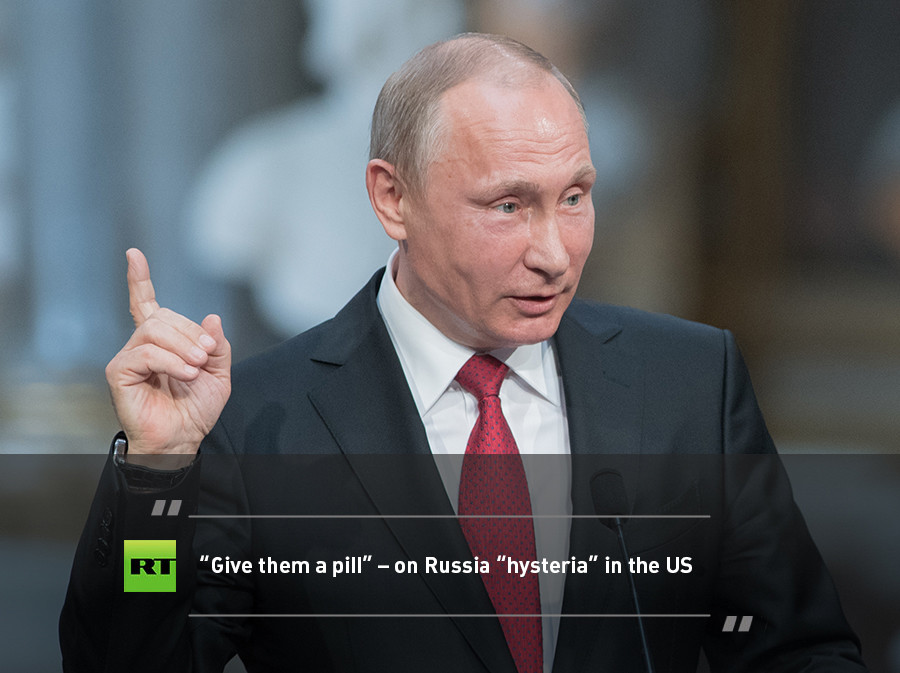
Once again asked to comment on the situation surrounding Russian diplomats in the US, who allegedly tried to tempt some Trump people into favoring Russia, Putin reacted quite emotionally, saying he was tired of the “hysteria” which the US “fails to cease.”

“Should you be given some pill? Does anyone have a pill? Give [them] a pill! Seriously now,” the Russian president said.

‘Western media always meddling in Russian politics’

The Russian president also called on the West to stop meddling in Russia’s domestic policies.

“Look at your colleagues, what they are doing here,” Putin told NBC journalist Megyn Kelly, who was asking questions at the forum. “They are all over our domestic policy, they’re sitting on our head, dangling their feet and chewing a bubble gum. Entertaining themselves. It’s a systematic, rude and absolutely unceremonious interference in our domestic policies that lasts for many years, also at a diplomatic level,” he said.

Having called NATO “an instrument of US foreign policy,” the Russian president said that the lack of “constructive dialogue” with the military alliance impedes joint efforts on fighting terrorism. Having wondered what is the purpose of the alliance if both the Soviet Union and the Warsaw Pact are no more, the president said that the failed dialogue with NATO is not Russia’s fault.

Asked to comment on reported disagreements within the alliance, Putin commented, with irony: “Well, if you suggest that NATO could fall apart, then these [disagreements] would help us. But so far we don’t see it coming.”

‘Use Al-Qaeda today, it will be fighting you tomorrow’

Commenting on the Syrian issue, the Russian president said that the conflict in the Middle East should “in no way be used as means to sort out [someone’s] pressing political issues.”

“And we sometimes see such attempts [in Syria],” Putin said, explaining that forces within the country are being used by other foreign parties to fight Assad.

Read more

© Aleksey Nikolskyi

“You use them today, and never know what happens to you tomorrow. They might be fighting you… So, Al-Qaeda was at some point created to fight against the Soviet Union in Afghanistan, and then Al-Qaeda hit the US on September 11,” Putin pointed out.

The Syrian President, Bashar Assad, “might have made mistakes,” but the groups he’s fighting within the country “are no angels either,” Putin said, adding that the latest chemical attack in Syria was a provocation against the government.

“Regarding the people who were killed and suffered from weapons, including chemical weapons – this information is false. As of today, we are totally convinced that it was just a provocation. Assad did not use that weapon. It was all done by the people who wanted to blame him for it,” Putin said.