Archive for June 2, 2017

Palestinians: Israel’s Goodwill Gestures Send Wrong Messages

June 2, 2017

Palestinians: Israel’s Goodwill Gestures Send Wrong Messages, Gatestone InstituteBassam Tawil, June 2, 2017

Here is what is being said on the Palestinian street: Today Israel runs away from the West Bank or the Gaza Strip; tomorrow Israel will run away from Ashkelon, then from Tel Aviv and from there to the sea, and we have achieved our goal of destroying Israel. Therefore, we need to continue attacking Israel.

As with the Gaza Strip, the withdrawal from Lebanon taught the Palestinians that terrorism could drive Israelis out of their country.

Never have the Palestinians given Israel credit for its goodwill steps. On the contrary, they scoff at these moves and describe them as “cosmetic changes”. The Palestinian line is that Israel’s steps are “insufficient” and “unhelpful.” Its concessions are regarded as gestures of a terrified people and as the rightful reward for terrorism. Far from satiating the appetite of the terrorists, such steps prompt them to step up their attacks against Israelis.

The West suffers under a major misconception concerning the Israeli-Palestinian conflict: that “goodwill gestures” and territorial concessions on the part of Israel boost the prospects of peace in the Middle East. The facts, however, suggest that precisely the opposite is true.

Last week, Israel’s Channel 10 television station reported that the U.S. administration was pushing Israel to transfer parts of Area C — areas under full Israeli security and civilian control in the West Bank — to the control of Mahmoud Abbas’s Palestinian Authority (PA). According to the report, the U.S. believes that the transfer of the territory to the PA would be a “goodwill step” towards the Palestinians, paving the way for the revival of the stalled peace process with Israel.

This assumption, of course, has already proven wrong. The experiences of the past few decades have shown clearly that Israeli concessions have always sent the wrong message to the Palestinians.

In fact, Palestinians read Israeli goodwill steps as signs of weakness and retreat. This misinterpretation on the part of the Palestinians then leads to more violence against Israel. It would be hard for anyone not to conclude that if pressure works, keep on pressuring.

The past 24 years are littered with examples of how the Palestinians react to Israeli concessions.

The Oslo Accords that were signed between Israel and the PLO in 1993 were seen by Palestinians as a first step by Israel towards total capitulation.

The accords, which brought the PLO from several Arab countries to the West Bank and Gaza Strip, came after five years of the first Palestinian Intifada. By allowing the PLO to assume control over large parts of the West Bank and Gaza Strip, Israel sent a message that it was caving in to the violence and terrorism of the First Intifada.

Barely a breath after Oslo, Israel was again asked to conciliate the Palestinians: this time, hundreds of prisoners, many with Jewish (and Arab) blood on their hands, were released from Israeli prison in order to create an atmosphere “conducive” to the peace process.

Instead of viewing the prisoner release for what it was, namely a generous gesture, many Palestinians considered it a “victory” for terrorism and violence. Worse, it was not long before many of the released prisoners were rearrested for their role in further terrorism against Israel. The release of prisoners also sent a message of recidivism to Palestinians: terror does indeed pay! A short stint in an Israeli prison is sure to lead to release in some Israeli “confidence-building measure” or other.

According to statistics, at least half of released Palestinian prisoners have returned to terrorism.

Despite the grim statistics, the international community regularly demands that Israel release more convicted terrorists as a “gesture” towards Mahmoud Abbas and other Palestinians.
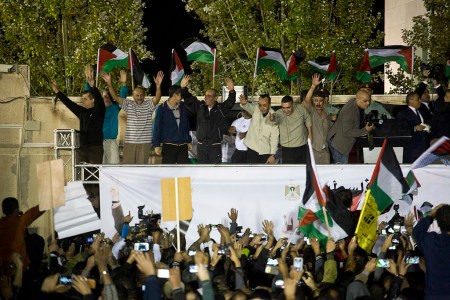
RAMALLAH, WEST BANK – OCTOBER 30: Released Palestinian prisoners stand on a sage as they arrive to the Mukata Presidential Compound in the early morning hours on October 30, 2013 in Ramallah, West Bank. The 26 Palestinian prisoners were released by Israel as part of the terms of renewed U.S.-brokered peace talks. (Photo by Oren Ziv/Getty Images)

Since 1993, Israel has complied again and again with such international pressure, only to reinforce the message to Palestinians: terrorism is indeed worth the trouble.

Let us consider, for a moment, Gaza. In 2005, Israel unilaterally withdrew from the Gaza Strip, after destroying 21 Jewish settlements and expelling more than 8,000 Jews from their homes there.

In Palestinian eyes, however, the Israeli “disengagement” from the Gaza Strip was anything but an olive branch of peace. The withdrawal came after five years of the bloody Second Intifada, when Palestinians waged a massive campaign of suicide bombings and rocket attacks against Israelis.

Thus, for Palestinians, Israel was once again retreating in the face of unremitting bloodshed.

Here is what is being said on the Palestinian street: Today Israel runs away from the West Bank or the Gaza Strip, tomorrow Israel will run away from Ashkelon, then from Ashdod and Tel Aviv and from there to the sea, and we have achieved our goal of destroying Israel. Therefore, we need to continue attacking Israel.

Moreover, it was also precisely the Israeli pullout from Gaza that launched Hamas to its current pinnacle of popularity among Palestinians. Hamas took credit for expelling the Jews from the Gaza Strip through terrorism. A few months later, Hamas even won the Palestinian parliamentary election because Palestinians gave Hamas total credit for driving Israel out of the Gaza Strip.

The Israeli pullout told Palestinians in no uncertain terms: Why bother negotiating when terror will do the trick?

Five years earlier, the Israeli withdrawal from southern Lebanon also had the same effect: it emboldened the Iranian-backed Hezbollah terror group. As with the Gaza Strip, the withdrawal from Lebanon taught the Palestinians that terrorism could drive Israelis out of their country.

In the past few years, additional Israeli goodwill gestures, such as removing security checkpoints and the easing travel restrictions in the West Bank, led to yet more violence, claiming the lives of yet more Israelis.

Abbas and his top officials have always responded to Israeli gestures with cynicism. Never have they given Israel credit for its goodwill steps. On the contrary, they scoff at these moves, and describe them as “cosmetic changes aimed at beautifying Israel’s ugly face” or as public-relations stunts.

For the sake of clarity, let us say it clearly: handing over areas in the West Bank to the Palestinian Authority, and the release of convicted murderers, does not contribute to any sort of “peace process;” it only contributes to the death of more Israelis.

The Palestinian line is that Israel’s steps are “insufficient” and “unhelpful.” Its concessions are regarded as gestures of a terrified people and as the rightful reward for terrorism. Far from satiating the appetite of the terrorists, such steps prompt them to step up their attacks against Israelis. The next time Americans and Europeans think of asking Israel to cede yet more to the Palestinians, let them consider what Israel might be receiving in return, other than the spilling of more Jewish blood.

Bassam Tawil is a Muslim based in the Middle East.
Tom Fitton discusses Shocking, New Clinton Emails, Soros Lawsuit, Clean Elections, & Immigration

June 2, 2017

Tom Fitton discusses Shocking, New Clinton Emails, Soros Lawsuit, Clean Elections, & Immigration, Judicial Watch via YouTube, June 2, 2017


Former Gitmo Captive on Saudi Payroll Arrested in French ISIS Cell

June 2, 2017

Former Gitmo Captive on Saudi Payroll Arrested in French ISIS Cell, Judicial Watch, June 2, 2017

Despite his disturbing Pentagon document, the Obama administration released Lahmar from the top security compound at the U.S. Naval base in southeast Cuba in 2009 after France agreed to take him. This week he was arrested in Bordeaux as part of a terrorist cell that operated a recruiting network for the Islamic State in Iraq and Syria (ISIS).

As far back as 2010 former president Barack Obama’s National Intelligence Director confirmed that one in four inmates released from Gitmo resume terrorist activities against the United States. A year earlier the Pentagon’s Defense Intelligence Agency, which gathers foreign military intelligence, disclosed that the number of Gitmo prisoners who returned to the fight since their release had nearly doubled in a short time.

******************************

Surprise, surprise, another inmate released from the U.S. military prison in Guantanamo Bay, Cuba has been arrested for reengaging in terrorism. His name is Sabir Mahfouz Lahmar and his Department of Defense (DOD) file says he has links to “multiple terrorist plots” and as a member of the Algerian Armed Islamic Group (GIA) plotted with Al Qaeda to attack the United States Embassy in Sarajevo.

“Detainee advocated hostilities against US forces and the international community in Bosnia, and is linked to multiple terrorist plots and criminal related activity,” according to Lahmar’s DOD file. “Detainee had intentions to travel to Afghanistan and Iran, and is reported as doing so prior to his capture. Detainee has demonstrated a commitment to jihad, and would likely engage in anti-US activities if released.” Lahmar ended up at Gitmo in 2002 because the Algerian government refused to take him into custody after Bosnian authorities exhausted the legal limits for detention. The Pentagon recommended continued detention and determined that he was a high risk that posed a threat to the U.S., its interests and allies. Lahmar was also labeled a “high threat” from a detention perspective and of high intelligence value.

Also of note in the DOD file is that Lahmar was on Saudi Arabia’s payroll as an employee of the Saudi High Commission for Relief (SHCR), a non-governmental organization (NGO). He was arrested and convicted in 1997 for assaulting an American Citizen in Bosnia but was released, “after the SHCR intervened on his behalf,” the military file states. “After his release, detainee returned to work for the SHCR in Sarajevo.” Authorities in Croatia believe Lahmar was involved in the 1997 bombings in Travnik and Mostar and that he served in the el-Mujahid Brigade conducting training for acts of terrorism in the 1990s. Other reports link Lahmar to car theft and document forgery and indicate he’s wanted in Belgium and France for his involvement in violent activities, the military file says.

Despite his disturbing Pentagon document, the Obama administration released Lahmar from the top security compound at the U.S. Naval base in southeast Cuba in 2009 after France agreed to take him. This week he was arrested in Bordeaux as part of a terrorist cell that operated a recruiting network for the Islamic State in Iraq and Syria (ISIS). A British newspaper report says Lahmar was one of six people—four men and two women—captured as part of an aggressive crackdown on a jihadist recruiting network in the European nation that’s been rocked by multiple terrorist attacks in recent years. Just a few years ago a former Gitmo captive, 46-year-old Moroccan Lahcen Ikassrien, was arrested in Spain for operating a sophisticated recruitment network for the Syrian and Iraqi-based terror group known as Islamic State of Iraq and the Levant (ISIL).

Like Lahmar and Ikassreien, many of the captives released from Gitmo have predictably returned to terrorist causes and it has long been documented in military and intelligence assessments. Just last year a report issued by the Office of the Director of National Intelligence (ODNI) showed that of the 161 Gitmo detainees released by the Obama administration, nine were confirmed to be “directly involved in terrorist or insurgent activities” and that 113 of the 532 Gitmo captives released during the George W. Bush administration have engaged in terrorist activities. “Based on trends identified during the past eleven years, we assess that some detainees currently at GTMO will seek to reengage in terrorist or insurgent activities after they are transferred,” according to the ODNI, which is composed of more than a dozen spy agencies, including Air Force, Army, Navy, Treasury and Coast Guard intelligence as well as the Federal Bureau of Intelligence (FBI) and the Central Intelligence Agency (CIA). The agency also stated in its report that “former GTMO detainees routinely communicate with each other, families of other former detainees, and previous associates who are members of terrorist organizations. The reasons for communication span from the mundane (reminiscing about shared experiences) to the nefarious (planning terrorist operations). We assess that some GTMO detainees transferred in the future also will communicate with other former GTMO detainees and persons in terrorist organizations.”

Other examples of recidivism among Gitmo captives include dozens who have rejoined Al Qaeda in Yemen, the country where the 2009 Christmas Day airline bomber proudly trained, and a number of high-ranking Al Qaeda militants in Yemen involved in a sophisticated scheme to send bombs on a U.S.-bound cargo plane. A few years ago, a Gitmo alum named Mullah Abdul Rauf, who once led a Taliban unit, established the first ISIS base in Afghanistan. In 2014, Judicial Watch uncovered an embarrassing gaffe involving an Al Qaeda operative liberated from Gitmo years earlier. Turns out the U.S. government put him on a global terrorist list and offered $5 million for information on his whereabouts!

As far back as 2010 former president Barack Obama’s National Intelligence Director confirmed that one in four inmates released from Gitmo resume terrorist activities against the United States. A year earlier the Pentagon’s Defense Intelligence Agency, which gathers foreign military intelligence, disclosed that the number of Gitmo prisoners who returned to the fight since their release had nearly doubled in a short time. The assessment was made by using data such as fingerprints, pictures and other intelligence reports to confirm the high rate of recidivism among the released prisoners.

Iran’s 1988 Mass Executions Result in US Congress Resolution

June 2, 2017

Iran’s 1988 Mass Executions Result in US Congress Resolution, Iran News Update, June 2, 2017

A recently introduced resolution in the U.S. Congress, H.Res. 159, refers to the horrific mass executions of political prisoners by the Islamic Republic of Iran. Mike McCaul, the House Homeland Security Chair, introduced the resolution, and it was cosponsored by Ed Royce, the House Foreign Affairs Committee Chair, as well as Ranking Member Eliot Engel, and Rules Committee Chair Representative, Peter Sessions.

It came as Iranian President Hassan Rouhani, recently re-elected to a second term, and was addressing the 71st Session of the United Nations General Assembly.

The Associated Press reported that thousands of people gathered outside the United Nations to protest Iran’s human rights abuses, executions, and the 1988 massacre of more than 30,000 prisoners.

Speakers for the Resolution included former Democratic vice Presidential candidate, Senator Joe Lieberman, and Sir Geoffrey Robertson, former Head of UN war crimes tribunal for Sierra Leone. Robertson wrote a report on Iran’s 1988 massacre, published on the United Nations Arts Initiative.

The resolution “condemns the Government of the Islamic Republic of Iran for the 1988 massacre of political prisoners and [calls] for justice for the victims.”

It adds that “over a 4-month period in 1988, the Government of the Islamic Republic of Iran carried out the barbaric mass executions of thousands of political prisoners and many unrelated political groups. … [A]ccording to a report by the Iran Human Rights Documentation Center, the massacre was carried out pursuant to a fatwa, or religious decree, issued by then Supreme Leader Ayatollah Ruhollah Khomeini, that targeted the People’s Mojahedin of Iran (PMOI), also known as the Mujahedeen-e-Khalq (MEK).”

The resolution quotes one of Iran’s own senior former officials, the late Hussein Ali Montazeri, a grand ayatollah who served as Khomeini’s chief deputy, who said the 1988 massacre was ‘’the greatest crime committed during the Islamic Republic, for which history will condemn us.”

Accordingly, in 1988, the Islamic Republic executed the thousands of prisoners who had even slight affiliations with the main opposition movement Mujahedin-e Khalq (MEK), because of their political beliefs. The victims were buried in mass graves in Iran after they were shot or hung over a period of just a few months.

Amnesty International reported on November 2, 2007, ‘’between 27 July 1988 and the end of that year, thousands of political prisoners [in Iran], including prisoners of conscience, were executed in prisons nationwide.”

Noted by H.Res. 159, “Those personally responsible for these mass executions include senior officials serving in the current Government of Iran; … [P]risoners were reportedly brought before the commissions and briefly questioned about their political affiliation, and any prisoner who refused to renounce his or her affiliation with groups perceived as enemies by the regime was then taken away for execution.”

Accordingly, “thousands of people, including teenagers and pregnant women, imprisoned merely for participating in peaceful street protests and for possessing political reading material, many of whom had already served or were currently serving prison sentences,” were among the victims.

Stated in the congressional resolution, “[P]risoners were executed in groups, some in mass hangings and others by firing squad, with their bodies disposed of in mass graves.”

According to Amnesty International, ‘’the majority of those killed were supporters of the PMOI [MEK], but hundreds of members and supporters of other political groups . . . were also among the execution victims.’’

The resolution further states, “The later waves of executions targeted religious minorities, such as members of the Baha’i faith, many of whom were often subjected to brutal torture before they were killed.” It add “The families of the executed were denied information about their loved ones and were prohibited from mourning them in public”.

The resolution mentions a recently disclosed audiotape, where Hussein Ali Montazeri can be heard to say that the 1988 mass killings were “the greatest crime committed during the Islamic Republic, for which history will condemn us.”

Amnesty International’s report concluded, “there should be no impunity for human rights violations, no matter where or when they took place. The 1988 executions should be subject to an independent impartial investigation, and all those responsible should be brought to justice, and receive appropriate penalties’’

The resolution says, “The current Supreme Leader Ali Khamenei was reportedly aware of, and later publicly condoned the massacre.”

The Montazeri audiotape was released by Ayatollah Hossein Ali Montazeri’s son, Ahmad, a moderate cleric, who posted the confidential audio of his father on his website. He was ordered by the intelligence to remove it, and was later arrested.

On the tape, Montazeri states, “You [Iranian officials] will be in the future etched in the annals of history as criminals. The greatest crime committed under the Islamic Republic, from the beginning of the Revolution until now, which will be condemned by history, is this crime [mass executions] committed by you.”

Ironically, the people Montazeri is addressing and warning on the tape appear to enjoy high positions currently. They include:

• Mostafa Pourmohammadi was appointed by the Hassan Rouhani to be justice minister. After the release of a tape, Pourmohammadi defended the commission of the massacre and said he is “proud“ to have carried out “God’s commandments” in killing the political opponents.

• Ebrahim Raeisi was appointed as the head of Astan Quds Razavi, which has billions of dollars in revenues.

• Hussein Ali Nayeri is now the deputy of the Supreme Court of Iran. In his memoir, Montzari writes that he told Nayeri to stop the executions at least in the month of Moharram religious holidays, but according to the BBC, Nayeri said, “We have executed so far 750 people in Tehran… we get the job done with [executing] another 200 people and then we will listen to whatever you say.”

These people are only few of those who were involved in the 1988 massacre. They have been awarded more senior positions, power, and money.

Montazeri warned them, “Beware of 50 years from now, when people will pass judgment on the leader (Khomeini) and will say he was a bloodthirsty, brutal and murderous leader.”

The message from Iran’s ex-heir Supreme Leader highlights the methods that the officials of the Islamic Republic use to oppress the opposition. Executions or brutal punishments are common, as Iran ranks top in the world when it comes to executions per capita. Crimes against humanity continue to occur. These are the means that the government uses to silence the opposition.

Human rights organizations, the United Nations, and the International Criminal Court (ICC) must conduct investigations, and bring those who have committed and continue to commit these crimes to justice. Calls for justice are increasing. Those who commit crimes against humanity should be held accountable.

Congress must follow up on the recent Congressional resolution.

The president keeps a solemn promise to put America first

June 2, 2017

The president keeps a solemn promise to put America first, Washington Times, Wesley Pruden, June 1, 2017

President Donald Trump arrives in the Rose Garden of the White House in Washington, Thursday, June 1, 2017, to speak about the US role in the Paris climate change accord. (AP Photo/Andrew Harnik)

Whatever new agreement Mr. Trump can make will be a treaty, and must, as the Constitution makes clear, be ratified by the Senate. Barack Obama, the famous professor of constitutional law, wouldn’t do that because he knew that the Paris agreement would never have made it through the Senate. Climate does change sometimes. Thursday was a sunny day in Washington.

************************

Uncle Sugar doesn’t live here any more, and he didn’t leave a forwarding address. This is the message, spoken loud and clear by Donald Trump Thursday in the White House Rose Garden, and it’s just now getting through to the easy riders out there.

“As of today,” he said, “the United States will cease all implementation of the non-binding Paris accord and the draconian financial and economic burdens the agreement imposes on our country. We’re getting out but we’ll start to negotiate and we will see if we can make a deal that’s fair. And if we can, that’s great. And if we can’t, that’s fine.”

This was exactly what the 196 signers needed to hear, and the president told them without heat, bombast or blather. Just the facts, ma’am, and that means Madame Merkel. Before all the news from Washington was in, Madame Merkel, with France and Italy tagging along in the lady’s considerable wake, said in haughty voice that the Paris accord “will not be renegotiated.” So the lady says, subject to invoking the feminine privilege of changing her mind.

The president thus makes good on one of his most important campaign promises, mocking the holy writ of global warming, or “climate change” as it’s called now because the globe refuses to warm as promised and all the dead polar bears are still not dead and the ocean that was supposed to have inundated the financial district of lower Manhattan by now, has still not obeyed Al Gore.

The president sounds like the reasonable one now. “In order to fulfill my solemn duty to protect America and its citizens, the United States will withdraw from the Paris accord for an entirely new transaction on terms that are fair to the United States.” He identified several sectors of the American economy that would lose jobs and paychecks if the United States stays in the accord — 2.7 million jobs by 2025. Fair is fair, after all, even for Uncle Sugar.

This puts a large dent in Barack Obama’s legacy, about which he can’t stop talking. He was first in line to cavil Thursday, presumably caviling from his walled mansion behind a moat of security a quarter of a mile long, where he leads what he imagines the U.S. Government in more or less permanent exile, or at least until he gets bored with exile and goes home, like presidents before him, and comes to term with the fact that his day is done.

“The nations that remain in the Paris Agreement will be the nations that reap the benefits in jobs and industries created,” he said, trying to remember how to affect a presidential tone. “I believe the United States of America should be at the front of the pack. But even in the absence of American leadership, even as this administration joins a small handful of nations that reject the future, I’m confident that our states, cities and businesses will step up and do even more to lead the way, and help protect for future generations the one planet we’ve got.” This was a stunning exercise in disrespect for the one president we currently have, and for the office as well.

Pittsburgh and Peoria with a foreign policy. Who knew? But several cities with Democratic administrations have vowed to remain in the Paris accord, as if they could. Several tycoons of finance and industry seem to regard their companies as sovereign, too, and were quick to take the president to task. It seems not to have occurred to these cities and tycoons that if they want to clean up their act and eliminate pollution, nobody, least of all Donald Trump, will stop them.

Mr. Trump’s critics are eager now to play holier than thou — even the pope, who had said earlier that if Mr. Trump withdrew from Paris the Vatican would take it as “a slap in the face.” Leonardo DiCaprio was disappointed, too, because he had earlier urged Mr. Trump to “make the moral position.” Moral tutelage from the Vatican and Hollywood on the very same day. Religiosity reigns, if only for the day.

But back where it counts, the president’s decision won praise from Republicans in Congress. “I applaud President Trump and his administration for dealing with yet another blow to the Obama administration’s assault on domestic energy production and jobs,” said Sen. Mitch McConnell, the Republican majority leader. Sen. John Barrasso of Wyoming, chairman of the Senate Committee on the Environment, observed that “the Paris climate agreement set unworkable targets that put America at a competitive disadvantage.”

Whatever new agreement Mr. Trump can make will be a treaty, and must, as the Constitution makes clear, be ratified by the Senate. Barack Obama, the famous professor of constitutional law, wouldn’t do that because he knew that the Paris agreement would never have made it through the Senate. Climate does change sometimes. Thursday was a sunny day in Washington.

A new head appointed to CIA’s Iran Operations

June 2, 2017

A new head appointed to CIA’s Iran Operations, DEBKAfile, June 2, 2017

New CIA Chief Mike Pompeo has named Michael D’Andrea head of the Iran Operations as part of the overhaul President Trump has ordered of the agency’s espionage, counterintelligence and covert operations departments. This is reported by intelligence sources in Washington. D’Andrea, nicknamed “Dark Prince” or “Ayatollah Mike,” commanded the operation against Osama bin Laden and has orchestrated numerous drone attacks on terrorist targets across the Middle East. According to those sources, his appointment attests to the president’s determination to put more muscle behind operations against Iran. DEBKAfile adds: Some of the senior CIA agents dismissed from their jobs as a result of the overhaul are feeding the campaign of disparagement against the president.

Post “Fact-Checkers” Swing and Miss at Trump’s Paris Accord Speech

June 2, 2017

Post “Fact-Checkers” Swing and Miss at Trump’s Paris Accord Speech, Power LinePaul Mirengoff, June 2, 2017

By now, most people understand that “fact-checkers” for organs like the Washington Post are just liberals trying to package their talking points under a byline they hope will bolster their waning credibility. That’s certainly the case with this Washington Post “fact check” (by Glenn Kessler and Michelle Ye Hee Lee) of President Trump’s explanation for withdrawing from the Paris climate agreement.

This howler appears in the second paragraph:

Trump also suggested that the United States was treated unfairly under the agreement. But each of the nations signing the agreement agreed to help lower emissions, based on plans they submitted. So the U.S. target was set by the Obama administration.

Q.E.D. But for which side of the debate?

In the online version I’m working from, the “fact-checkers” don’t bother to link to the text of Trump’s speech. Apparently, they would prefer not to be fact-checked.

If one bothers to read the text, one finds that Trump didn’t say the process that produced the agreement — e.g., the way the targets were set — is unfair. He said: “the Paris Accord is very unfair, at the highest level, to the United States.” In other words, the outcome — in particular, the targets — is unfair.

Thus, the fact-checkers have assumed that targets set by Obama are, by definition, fair to the United States. That’s what they used to call “begging the question.”

It would be hard for the “fact-checkers” to go downhill from there, but they make a good run at it. Trump cited a study finding that full implementation and compliance with the agreement would produce only a “tiny, tiny” 0.2 degree reduction in global temperature by 2100. The fact-checkers deny that a 0.2 degree reduction is “tiny, tiny” and say that the author of the study disagrees with Trump’s characterization.

Do we really need fact-checkers to tell us what is, and is not, “tiny, tiny”?

The Post’s “fact-checkers” take a rather different approach when it comes to assessing the magnitude of lost economic growth. Citing a study, Trump said the agreement would cost the economy nearly $3 trillion in lost gross domestic product by 2040. The fact-checkers say “that number must be viewed in context over more than two decades, so ‘$3 trillion’ amounts to a reduction of 6 percent.”

A 6 percent loss of GDP isn’t “tiny, tiny.” It seems significant to me. Others may view things differently, but that’s a matter of opinion, not fact. Trump hasn’t said anything here that constitutes factual error.

Much of the criticism leveled by the Post’s “fact-checkers” is based on the fact that the nations aren’t bound by the key elements of the Paris agreement. Thus, they note that Trump could change Obama’s commitments because it is “technically allowed under the accord.” (Emphasis added).

But in evaluating whether to stay in the deal, Trump has the right to take it seriously. What’s the point of being a party to an agreement that any party can blow off?

The point, from the climate activist perspective, may be to provide a vehicle for challenging decisions like Trump’s roll back of the Clean Power Plan. Trump alluded to this prospect, which has been raised by the White House Counsel, in his speech.

According to the Post’s fact-checkers, State Department lawyers strongly deny that the Paris accords could be used this way. I suspect they are either disingenuous, insufficiently creative, or oblivious. Anyway, Trump is entitled to rely on the view of his White House Counsel.

In the end, I come away from the Post’s “fact-check” believing that, (1) if fully implemented and complied with, the Paris agreement will have only a negligible impact on the earth’s temperature and (2) even if the U.S. remained in the deal, it would not be fully implemented and complied with.

I also coming away believing that, with the possible exception of taking the Paris accord too seriously, Trump’s speech contains no error of fact.

State to approve wave of construction in Judea and Samaria

June 2, 2017

State to approve wave of construction in Judea and Samaria, Israel National News, David Rosenberg, June 2, 2017

Construction in Gush Etzion Flash90

The Civil Administration’s Higher Planning Committee is scheduled to meet next week to approve a series of building projects in Jewish communities in Judea and Samaria. Combined, the projects include plans for more than 2,600 housing units.

If passed as expected, this would mark the first time the committee has approved housing projects in Jewish communities in Judea and Samaria since President Trump took office in January.

The hearings will take place Tuesday and Wednesday, and will cover a number of projects which had been blocked out of political considerations, Channel 2 reported.

The projects include housing outside of the major settlement blocs, in towns such as Kfar Tapuah in central Samaria.

Officials in Jerusalem say the housing projects are not likely to elicit criticism from the White House, noting the open lines of communication between the Prime Minister’s Office and the Trump administration regarding Israeli policy in Judea and Samaria.

The Limits of Israeli Power

June 2, 2017

The Limits of Israeli Power, Front Page MagazineCaroline Glick, June 2, 2017

(As to Jerusalem, please see Turkish takeover in Jerusalem. — DM)

Originally published by the Jerusalem Post

Washington and the rest of the governments of the world know that their refusal to recognize Israel’s capital does not endanger Israel or its control of Jerusalem. They are free to bow to Arab pressure, safe in the knowledge that Israel will continue to protect the unified city.

The time has come, at the outset of the second 50 years of Israeli control over Judea and Samaria, for Israel to take matters into its own hands. Our leaders must stop beating around the bush. They need to use the powers they have to secure Israel’s military and civilian interests in Judea and Samaria for the next 50 years as best they can. And they need to stop waiting for someone else to solve our problems for us.

*********************************

On Thursday, US President Donald Trump bowed to the foreign policy establishment and betrayed his voters. He signed a presidential waiver postponing the transfer of the US Embassy to Jerusalem for yet another six months.

Ahead of Trump’s move, Prime Minister Benjamin Netanyahu made a last-ditch bid to convince Trump to move the embassy to Jerusalem. But it was not to be.

Israel’s failure to convince Trump to do what he repeatedly promised US voters he would do during his presidential campaign shows the disparity in power between Israel and the US.

Israel lacks the power to convince foreign nations to recognize its capital – much less to locate their embassies there. The US, on the other hand, not only has the power to recognize Jerusalem and transfer its embassy to Israel’s capital whenever it wishes to do so, it also has the ability to convince dozens of other countries to immediately follow its lead.

The disparity between what the Americans can do and what Israel can do was on display on Monday evening in a glittering hall at the King David Hotel in Jerusalem. There, Bar-Ilan University conferred its Guardian of Zion award on former US ambassador to the UN John Bolton. In his acceptance speech, Bolton presented his vision for the resolution of the Palestinian conflict with Israel.

Bolton’s views are important not merely because his past work at the State Department and the UN brought the US some of its only diplomatic victories in recent decades. His views are important as well because of his close relationship with Trump.

Bolton began his discussion Monday evening by rejecting the “two-state solution.” The two-state model, he noted, has been tried and has failed repeatedly for the past 70 years. There is no reason to believe that it will succeed now. This is particularly true, he said, given the lack of Palestinian social cohesion.

Hamas controls Gaza. The PLO, which is supposed to be Israel’s peace partner, barely controls parts of Judea and Samaria. At a time when more cohesive Arab societies are unraveling, the notion that a Palestinian state would survive and advance regional peace and stability is laughable, Bolton argued.

Bolton then turned to his preferred policy for resolving the Palestinian conflict with Israel, which he dubbed “the three-state solution.” Under his plan, Egypt and Jordan would work with Israel to solve the Palestinian conflict. Egypt would take over the Gaza Strip and Jordan would negotiate the status of Judea and Samaria with Israel.

The crowd at the King David responded enthusiastically to Bolton’s proposal. This is not surprising.

Since 1967, Israelis have hoped for Jordan and Egypt to work with them to solve the problem of the Arabs of Judea, Samaria and Gaza who lived under Jordanian and Egyptian occupation from 1949-1967.

Unfortunately, Israel’s support for Bolton’s plan is irrelevant. Israel is powerless to advance it. Israel cannot convince Arab nations to help it resolve the Palestinian conflict any more than it can convince the PLO to cut a peace deal with it.

Like PLO leaders, the leaders of the Arab world know that they cannot help Israel with the Palestinians.

Doing so would involve disowning the Palestinian narrative.

The Palestinian narrative claims that the Jews of Israel are colonialist interlopers who stole the land from the Palestinians, its rightful owners. The narrative makes no distinction between Tel Aviv and Hebron. All of Israel is a crime against the Arab world. All of Israel is illegitimate.

The overwhelming majority of the Arab world believes the Palestinian narrative. For an Arab leader to walk away from it or even to signal an attenuation of his fealty to it in the interest of regional peace would be the riskiest of moves.

Israel has nothing to offer Arab leaders that could induce them to take that risk.

Although it is far from certain, the US may very well have the ability to convince Arab leaders to do so. If Trump decided that this is the way to advance peace in the Arab world, chances are he would make some headway. In other words, Bolton’s three-state plan is a plan that only America can adopt. It cannot be an Israeli plan no matter how enthusiastically the public supports involving Jordan and Egypt in solving the conflict.

Given Israel’s inability to offer the Arabs anything valuable enough for Arab leaders to risk life and limb to accept in exchange for helping to solve the Palestinian conflict, as Israel considers its own options in relation to the Palestinians, it needs to limit its goals to things that it can achieve without them. In other words, the only steps that Israel can take in relation to the Palestinians are unilateral steps.

For the past 50 years, hoping that the Arabs – and since 1993, the PLO – would finally make peace with it and so settle the permanent status of Judea and Samaria, Israel refused to take any unilateral actions in relation to its permanent interests in Judea and Samaria. Rather than apply its legal code to Judea and Samaria, it opted for the stop-gap measure of installing a military government to run the areas on the basis of Jordanian law.

Between 1994 and 1996, Israel canceled the military government in the Palestinian population centers in Judea and Samaria and Gaza. In 2005, when it withdrew, it canceled the residual military government in the rest of Gaza. Since then, the only area that remains under the Israeli military government is Area C in Judea and Samaria. Area C includes all of the Israeli communities in Judea and Samaria, and strategically critical areas including the Jordan Valley, the Samaria mountain range and the south Hebron Hills.

On Tuesday, Prime Minister Netanyahu gave an interview with Army Radio where he set out part of his vision for the permanent status of Judea and Samaria. He limited his statement to the military status of the areas. He said that under any possible future scenario, Israel must retain full security control of the areas. This, he said, is the lesson of Israel’s 2005 withdrawal from the Gaza Strip.

That pullout led to the transformation of Gaza into a Hamas-controlled hub of global jihad. Moreover, under Hamas, the Palestinians turned Gaza into one big, densely populated missile-launching pad against Israel.

While justified, Netanyahu’s position obscures more than it illuminates about his long-term vision for Judea and Samaria.

What does he mean by security control? Would the IDF remain in sole control over Israel’s eastern boundaries or would it serve as an overall coordinator of foreign forces operating along the border? Would IDF forces be confined to fortified positions while the Palestinians reign free in the open areas, as was the case in southern Lebanon in the years leading up to Israel’s disastrous withdrawal in 2000? Or would the IDF have freedom of action and maintain the initiative throughout Judea and Samaria? Moreover, does Netanyahu envision the IDF remaining the only military organization operating in Judea and Samaria in the long term? Beyond the security issues that require clarification, Netanyahu’s statements make no mention of the rights of Jews to live in Judea and Samaria.

Does he believe that Jews should be permitted to live permanently in the areas that Israel controls? If so, why are they subjected to the Jordanian legal code used by the military government and which proscribes their right to purchase land and register land sales? This brings us to the issue of governance. What does Netanyahu think about the military government in Area C? Does he believe that the 50-year reign of generals should continue until the Arabs choose to resolve the Palestinian conflict with Israel? What if this means that the generals will continue to rule over hundreds of thousands of Israeli citizens for another 50 or 100 or 150 years? Does he, on the other hand, prefer to transfer governance responsibility in Area C to the Palestinians and place the nearly 500,000 Israelis in the area under Palestinian control? In the course of his remarks, Bolton noted that if Jordan is responsible for the Palestinians of Judea and Samaria, the issue of Jerusalem will be removed from the equation. After all, if their capital is Amman, Israel has no reason to divide its capital city.

And this brings us back to Jerusalem, which Trump spurned on Thursday.

As is the case today, 50 years ago, Israel had no power to influence the positions of foreign governments regarding its capital city. But in contrast to its decision to establish a military government in Judea and Samaria, Israel didn’t wait for foreigners to give it permission to act where it had the power to act in order to change the status of the city and ensure its ability to govern and control its capital for generations to come.

In 1967, the government voted to expand the municipal boundaries of Jerusalem to include the eastern, northern and southern quarters that had been under Jordanian occupation since 1949.

Everyone benefited from the move – including the foreign powers that still refuse to recognize the simple fact that Jerusalem is Israel’s capital.

Washington and the rest of the governments of the world know that their refusal to recognize Israel’s capital does not endanger Israel or its control of Jerusalem. They are free to bow to Arab pressure, safe in the knowledge that Israel will continue to protect the unified city.

Trump’s decision to sign the waiver delaying the embassy move is a betrayal of his campaign promise, but it doesn’t change the situation in Jerusalem. Last week, Israel celebrated 50 years of sovereignty over its united capital. Jerusalem will be neither more nor less united if and when the US moves its embassy to the capital.

Perhaps Trump will eventually keep his word and move the embassy. Perhaps he will continue to breach his promise. And as far as the Palestinians are concerned, perhaps Trump adopts Bolton’s three-state plan in relation to Judea, Samaria and Gaza. Perhaps he will maintain his predecessors’ slavish devotion to the establishment of a PLO state.

Israel can’t control what Trump will do any more than it can influence what the Arabs will do. And so it needs to take a lesson not only from its bitter experience of withdrawing from Gaza, but from its positive experience of taking matters into its own hands in Jerusalem.

The time has come, at the outset of the second 50 years of Israeli control over Judea and Samaria, for Israel to take matters into its own hands. Our leaders must stop beating around the bush. They need to use the powers they have to secure Israel’s military and civilian interests in Judea and Samaria for the next 50 years as best they can. And they need to stop waiting for someone else to solve our problems for us.

Jewish Leaders Sign Statement Defending Linda Sarsour

June 2, 2017

By – on June 2, 2017

Source: Jewish Leaders Sign Statement Defending Linda Sarsour – Geller Report

Jewish Lay Leadership: Neo Kapos

Never have these Jewish leaders stood up for proud Jews and Zionists like me. On the contrary, they have viciously attacked my work, my groundbreaking ads in defense of Israel against vicious anti-Semitic bloodlibels, and me.

“100 Prominent Jewish Leaders Condemn Attacks On Linda Sarsour,” by Josh Nathan-Kazis, Forward, June 1, 2017

More than 100 Jewish leaders condemned attacks on Linda Sarsour, the Palestinian-American activist whose Thursday speech at a City University of New York graduation ceremony has become a flashpoint.

Signatories to the letter include many of the most prominent left-leaning Jewish communal leaders, including J Street’s Jeremy Ben-Ami, Bend the Arc’s Stosh Cotler, HIAS’s Mark Hetfield, the National Council of Jewish Women’s Nancy Kaufman, and T’ruah’s Rabbi Jill Jacobs. Rabbis from Congregation B’nai Jeshurun on the Upper West Side and Congregation Beth Elohim in Park Slope also signed, as did the playwright Tony Kushner and New York City Council member Brad Lander.

“We will not stand by as Sarsour is falsely maligned, harassed and smeared, as she, her organization and her family suffer vicious public threats and intimidation,” the letter reads. “We unequivocally oppose these assaults against her, and publicly state our commitment to working alongside her for a more just and equal society.”…