Archive for May 2017

Al Qaeda criticizes Saudi relations with West during President Trump’s visit

May 22, 2017

Al Qaeda criticizes Saudi relations with West during President Trump’s visit, Long War Journal May 22, 2017

Al Qaeda seized on President Donald J. Trump’s recent visit to Saudi Arabia to once again criticize the royal family and call for an uprising.

According to bin Laden, these early Saudi dealings with the West led to the British capture of Palestine and, later on, the establishment of the Israeli state.

Osama bin Laden liked to argue that there is a “Zionist-Crusader” conspiracy against Muslims. His son, Hamza, has continued with these themes, making it one of his central talking points and accusing the House of Saud of being part of it.

****************************

On May 20, al Qaeda’s propaganda arm, As Sahab, released an audio message from Hamza bin Laden. The junior bin Laden follows in his father’s footsteps by blasting the Saudi royal family. His speech is the second part in a series aimed at the House of Saud. Part 1, in which Hamza called for regime change, was released last August.

It’s not clear when Hamza recorded his latest anti-Saudi message. He does not mention President Trump or the American delegation. Instead, he focuses on the early decades of the Saudi dynasty, portraying it as a corrupt regime that serves the interests of the West. Still, al Qaeda undoubtedly wanted to maximize the audience for Hamza’s audio by releasing it during President Trump’s visit.

Then, on May 21, al Qaeda published the 15th issue of its Al Nafir Bulletin (seen below). The one-page newsletter is devoted to Trump’s visit. “The Al Saud rulers and all apostate rulers appear before us today in wasteful ceremonies to offer loyalty and renew their allegiance to the hateful Crusader master of the White House, Trump,” the newsletter reads.

Just hours before Al Nafir was released online, President Trump attended a ceremony with King Salman and Egyptian President Abdel Fatah al-Sissi to commemorate the opening of the Global Center for Combating Extremist Ideology in Riyadh. Unsurprisingly, Al Nafir’s editors criticize the move, arguing that the “rulers” had really committed to building “an apostate army to fight jihad and the Mujahideen in the name of fighting terror and terrorism.” The center will be used “to fight faith, purity, and commitment, under the call to fight extremism, backwardness, and intolerance,” al Qaeda contends.

In Al-Nafir, al Qaeda also argues that the Saudi government should give its money to the people instead of investing it in defense deals and other arrangements with the US. Al Qaeda uses these two issues — the Saudis’ supposed misuse of funds and the creation of the new center — to renew its call for jihad.

“So here are the Crusaders and the apostates, and they have stolen your money, fought your religion, shed your blood, and transgressed against your honor,” Al Nafir reads. “When will you return to your religion and do jihad in the cause of Allah?”

Hamza bin Laden’s critique of Ibn Saud

Al Qaeda has been raising Hamza’s media profile since the summer of 2015, when he was first introduced as a prominent jihadist figure. On May 13, just one week before Hamza’s new anti-Saudi message, As Sahab released another speech from Osama’s heir. In that talk, Hamza provided advice to “martyrdom seekers” living in the West. [See FDD’s Long War Journal report: Hamza bin Laden offers ‘advice for martyrdom seekers in the West’]

In his latest message, Hamza accuses the Saudi government of promulgating a false version of its own history, arguing that “generations have been raised” ignorant of what truly transpired during the first years of the 20th Century, when the House of Saud rose. Bin Laden is keen to undermine King Abdul Aziz bin Abdul Rahman Al Saud’s (Ibn Saud) legacy, portraying him as a witting agent of the British. Only when the proper history is told, Hamza says, will Muslims “understand the magnitude of the injustice brought upon” their country and then work to “restore” their “stolen rights.”

Bin Laden accuses Ibn Saud of working with the British from the beginning, seeking their “approval” before leaving Kuwait (where the Saud family lived) and conquering the city of Riyadh in 1902. Riyadh and large parts of the Arabian peninsula were controlled by Ibn Rashid’s men, who were allied with the Ottoman Empire at the time. Bin Laden says Ibn Saud could only expand his power at the expense of the Ottoman Empire’s allies and he sought assistance from the British to do it. This, from al Qaeda’s perspective, violates Islamic law, as Ibn Saud attacked fellow Muslims while working with the British.

According to bin Laden, the Saudi telling of Ibn Saud’s early conquests omits these “sharia violations,” including the assault on the Ottoman’s ally “to serve the English” and the “unlawful killing of Muslims.”

In the period leading up to World War I, the Ottoman government sought to reconcile the opposing forces inside the Arabian Peninsula. And so a deal was struck between the Ottomans and Ibn Saud, which granted the Saudi patriarch territorial rights in exchange for military cooperation and an agreement to prevent “foreign powers” from expanding their influence in the region. But Ibn Saud broke this agreement as well, bin Laden says, after he again sided with the British. (Ibn Saud’s territory was declared a British protectorate as part of a treaty in 1915.) Ibn Saud moved on the Turks’ main client, Ibn Rashid, despite their previous understanding. In so doing, bin Laden charges, the founder of the Saudi dynasty paved the way for “the English and their allies to occupy the homelands of the Muslims.”

Bin Laden reminds his audience that Captain William Henry Irvine Shakespear, a British emissary, served as Ibn Saud’s military adviser and had “command” of the Muslim forces while organizing “their ranks.” This was part of Britain’s broader “financial and military” support for Ibn Saud. This is all “clear evidence” of English support, bin Laden says, and led to “Crusader hegemony” over the region.

According to bin Laden, these early Saudi dealings with the West led to the British capture of Palestine and, later on, the establishment of the Israeli state.

Osama bin Laden liked to argue that there is a “Zionist-Crusader” conspiracy against Muslims. His son, Hamza, has continued with these theme, making it one of his central talking points and accusing the House of Saud of being part of it.

LIVE NOW President Donald Trump Israel Speech & Press Conference w/ Benjamin Netanyahu 5/22/17

May 22, 2017

LIVE NOW President Donald Trump Israel Speech & Press Conference w/ Benjamin Netanyahu 5/22/17 via YouTube


Dore Gold on “Fox & Friends,” May 22, 2017

May 22, 2017

Dore Gold on “Fox & Friends,” May 22, 2017, The Jerusalem Center via YouTube


Melania Trump: Breakout Star of Trump’s First Foreign Trip

May 22, 2017

Melania Trump: Breakout Star of Trump’s First Foreign Trip, Breitbart, Joel B. Pollak, May 22, 2017

MANDEL NGAN/AFP/Getty Images

First Lady Melania Trump has won rave reviews from the foreign press — and even the American press — as she accompanies President Donald Trump on his first foreign trip.

The visit, which has taken President Trump to Saudi Arabia and Israel thus far, and which will conclude with a stop at the Vatican on Tuesday, is the first foreign trip of the administration. It is also one of the first major public events for the First Lady, who has kept a low profile thus far.

Yet she made her mark immediately in Saudi Arabia, descending Air Force One in a flowing black pantsuit and golden belt that was hailed by the local press as “classy and conservative,” even though both she and Ivanka Trump declined to cover their faces in deference to local custom.

The Los Angeles Times noted Melania Trump’s “newsmaking style,” quoting a local television host who described her outfit as a “a really considerate gesture.”

Even the British press was impressed, gushing later in the day: “Melania Trump dazzles in purple Reem Acra gown for first evening in Saudi Arabia.”

She also impressed observers in Israel with her choice of outfit: a crisp white jacket and skirt, in deference to the main color in the Israeli flag, as well as to the color of peace.

More than her sartorial savvy, however, what was most impressive was the First Lady’s gesture of holding the hand of Israel’s First Lady, Nechama Rivlin, who carries an oxygen tank due to a respiratory illness. The image of the tall Mrs. Trump guiding the congenial but frail Mrs. Rivlin (above) went beyond normal diplomatic protocol and presented an image of kindness.

At the Western Wall, Mrs. Trump acknowledged the Orthodox Jewish custom of separating the sexes during prayer by visiting the women’s side of the plaza. However, as in Saudi Arabia, she kept her hair uncovered (though Jewish women are not required to cover their hair during prayer, or before marriage).

She also visited the Hadassah Medical Center Ein Kerem later in the day with Sara Netanyahu, the Israeli prime minister’s wife. The hospital treats both Jews and Arabs, and features both Jewish and Arab staff.

The First Lady will be moving from New York to Washington, D.C. shortly, after the president’s youngest son, Barron Trump, completes his school year.

Welcoming Ceremony for US President Trump

May 22, 2017


Trump: Iran must disarm militias, never gain nuke

May 22, 2017

Trump: Iran must disarm militias, never gain nuke, DEBKAfile, May 22, 2017

Our military sources add: The issue of the pro-Iranian militias ties in directly with the battlefield confrontation building up in the past fortnight along Syria’s borders with Jordan and Iraq. DEBKAfile reports have disclosed the arrival of American and other Western special operations forces at a key crossing. They were followed this week by Russian elite contingents, who arrived nearby to support a Syrian-Iranian-Hizballah scheme to grab this vitally important border. The Americans are positioned there to prevent Iran from forging a land bridge from Tehran to Syria through Iraq by seizing control of this strategic border.

*********************

“We can declare with one voice that Iran must not be allowed to possess a nuclear weapon ever, ever and must cease training terrorists and militias immediately!’ said US President Donald Trump in a statement he issued at the Israeli president’s residence in Jerusalem on Monday on May 22, shortly after arriving in Israel.

“I come her to affirm that we are not only friends, but allies and will stand together always,” he went on to say and urged: “We must strengthen our cooperation, as we both face common threats from ISIS and other terrorists who foment terrible violence all over the world. Together we can end scores of years of violence,” he said.  Trump, who flew to Israel directly from Riyadh, reported on the strong consensus he found in the Muslim world on the need to stand up together against Iran.

He cited Saudi King Salman in this consensus, adding that the monarch and other Arab rulers feel strongly about the need for peace between Israel and the Palestinians. Many of them, he said, expressed the will to end extremism, after hearing his speech. He also found a growing realization among the Arab and Muslim leaders he met in Riyadh Sunday of “their common cause with Israel under threat from Iran” and a willingness to help in the peace effort.

Trump said he was honored to be in the homeland of the Jewish people. He commended Israel’s commitment to peace and said he looked forward to discussing the process with the Palestinian leader Mahmoud Abbas in Bethlehem Tuesday.

In a throwaway remark to reporters on arrival at the president’s residence, the US president said he had two first-rate envoys working on promoting a peace treaty, and named his special Middle East envoy Jason Greenblatt and the new US Ambassador to Israel, David Friedman. He joked: “If there is no peace, I’ll know whom to blame.”
President Reuven Rivlin said: We can’t wake up with Iran and Hizballah on our border. We want Iran out of Syria, out of Lebanon and away from our borders, and we must move forward to this goal together with America.”

DEBKAfile:  Donald Trump once again rebutted media evaluations of his trip to Israel as a demonstration of friendship without real content. Very shortly after his arrival, he stood up at the president’sl residence in Jerusalem and delivered a string of important policy statements and new revelations:

1. Iran would not be permitted to possess a nuclear weapon.

2, Iran must dismantle the Shiite terrorists and militias.

3. Iran must remove all those same foreign militias from Syria.

4. Iran must evacuate Hizballah forces from Syria and disarm this Lebanese Shiite organization.

5.  The Saudi King Salman had told him first hand of his fervent wish for an Israeli-Palestinian peace. Trump heard the same sentiment from other Arab and Muslim rulers.

Our military sources add: The issue of the pro-Iranian militias ties in directly with the battlefield confrontation building up in the past fortnight along Syria’s borders with Jordan and Iraq. DEBKAfile reports have disclosed the arrival of American and other Western special operations forces at a key crossing. They were followed this week by Russian elite contingents, who arrived nearby to support a Syrian-Iranian-Hizballah scheme to grab this vitally important border. The Americans are positioned there to prevent Iran from forging a land bridge from Tehran to Syria through Iraq by seizing control of this strategic border.

President Trump visits western wall in Jerusalem, Israel. May 22, 2017. President Trump in Israel

May 22, 2017

President Trump visits western wall in Jerusalem, Israel. May 22, 2017. President Trump in IsraelCHANNEL90seconds newscom via YouTube, May 22, 2016


Trump: Israel is the homeland of the Jewish people

May 22, 2017

Trump: Israel is the homeland of the Jewish people, The Jewish Press, Gary Willig, May 22, 2017

Rivlin and Trump Reuters

Rivlin congratulated Trump on his arrival in Israel and said, “We are happy to see that America is back in the area. America is back again … Israel appreciates America’s leadership and your administration in the action you took in Syria.”

Trump congratulated Rivlin and thanked him for his warm hospitality. “I am honored to be in the great State of Israel, the homeland of the Jewish people. I am awed by the beauty and majesty of this sacred and very holy land.”

“This is an amazing country. What you have done, perhaps, has virtually never been done before. I come to this ancient land to reaffirm the enduring friendship between the United States and the State of Israel, and it will always be enduring,” Trump added.

*****************************

US President Donald Trump arrived Monday afternoon at the President’s Residence in Jerusalem and signed the guest book before beginning his working meeting with President Reuven Rivlin.

Rivlin congratulated Trump on his arrival in Israel and said, “We are happy to see that America is back in the area. America is back again … Israel appreciates America’s leadership and your administration in the action you took in Syria.”

“Even during our most difficult times, we have not given up on our dream of living here in peace with our neighbors,” Rivlin added, “Our destiny, Palestinians and Jews, is to live together in this land.”

Trump congratulated Rivlin and thanked him for his warm hospitality. “I am honored to be in the great State of Israel, the homeland of the Jewish people. I am awed by the beauty and majesty of this sacred and very holy land.”

“This is an amazing country. What you have done, perhaps, has virtually never been done before. I come to this ancient land to reaffirm the enduring friendship between the United States and the State of Israel, and it will always be enduring,” Trump added.

Trump addressed threats in the region. “Israel and America face common threats from ISIS and other terrorist groups to countries like Iran, that sponsor terrorism and foment terrible violence.”

He said that Israel and the US would speak with one voice to prevent Iran from obtaining nuclear weapons.

“Most importantly the United States and Israel can declare with one voice that Iran must never be allowed to possess a nuclear weapon — never ever — and must cease its deadly funding, training and equipping of terrorists and militias.”

A Dose of Reality in Riyadh

May 22, 2017

A Dose of Reality in Riyadh, Front Page MagazineBruce Bawer, May 22, 2017

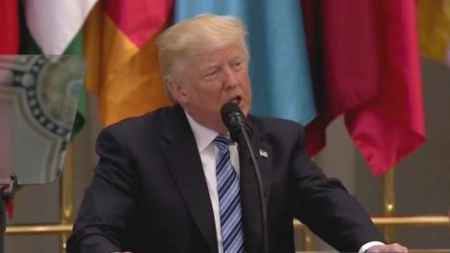
Early on in his speech, Trump addressed his audience as friends and partners; within a few minutes, without pointing a finger, and without abandoning the collegial tone or the complimentary language, made it clear he was lecturing them. He was the boss, the capo di tutti capi, and he was laying down terms. This wasn’t Obama, who naively thought he could change the world with groveling apologies for the West, praise for Islam built on sheer fantasy, and yet another retelling of his own supposedly inspiring personal story – all the while oozing beta-male deference and docility. No; this was a man of power who – never once talking about himself – made expert use of that power, wielding an iron fist in a velvet glove. His message was unmistakable: either set aside this stupid religion (or at least rein it in, and now), join the modern world, and set your people free to dream, hope, create, grow, and prosper. Or else face the consequences. When, at the end, he summed up the assets of the Islamic world, he didn’t even mention Islam: he cited, among other things, its “spirit of enterprise” and ambitious young people. Where Obama had falsely attributed all kinds of past wonders to Islam, Trump imagined an implicitly Islam-free future in which the region could finally enjoy “glorious wonders of science, art, medicine, and commerce to inspire mankind.” 

*****************

On June 4, 2009, Barack Obama went to Cairo and delivered a speech, addressed to the Muslim world, that was full of praise for Islam and apologies on behalf of the West. In the address, entitled “A New Beginning” (“I’ve come here to Cairo,” he explained, “to seek a new beginning between the United States and Muslims around the world”), he called the university at which he was speaking (which, if it were anywhere in the West, would probably not be able to gain accreditation) “a beacon of Islamic learning”; he blamed tensions between the West and Islam largely on Western “colonialism”; he said “Salaam aleikum” and kept referring to “the Holy Koran”; he asserted, in a ridiculous example of hyperbole, that “Islam has always been part of America’s story”; he served up a big wallop of revised history, giving Islam unmerited praise for centuries-old accomplishments in science, architecture, music, art, and medicine and even holding it up as “a model of tolerance and equality” (at one point, he seemed to imply that in some ways women’s rights are more advanced in the Muslim world than in the U.S.); and, with utter predictability, he quoted the the “Holy Koran” out of context, plucking out that favorite verse of all Western apologists that supposedly teaches “that if one kills an innocent, it is as if it he has killed all of mankind.”

And of course, as always, he talked about himself: a descendant of “generations of Muslims” in Kenya; a man who, in his Indonesian boyhood, daily heard the beautiful Islamic call to prayer; a president who had “known Islam on three continents before coming to the region where it was first revealed.” As someone with such intimate ties to the Religion of Peace, asserted Obama, he saw it as part of his job to “fight against negative stereotypes of Islam.” Yes, he spoke about the need to fight terror, but he was quick to maintain that “Islam is not part of the problem” but rather “an important part of promoting peace.” He defended U.S. ties to Israel and recognized the “reality of the Holocaust,” but quickly pivoted to the “suffering” of Palestinians, the “pain of dislocation” they experienced, and the “daily humiliations” of the “occupation” – preaching, in short, to Israel from a Cairo pulpit. He quoted from the Talmud, but was careful not to call it holy. He implied that the histories of the Jews and Palestinians were equally tragic. And he preached to America too, suggesting that when Americans criticize the “choice” of women – and girls (!) – to wear hijab they were disguising their “hostility” to Islam “behind the pretense of liberalism.” Similarly, instead of thundering against the evil of 9/11, Obama apologized for the supposed excesses of some Americans’ responses to that atrocity, saying with nauseating chagrin that “in some cases it led us to acts contrary to our principles and our ideals.” Oh, and he vowed to close Guantánamo “by early next year.”

This Sunday, almost exactly as far into his presidency as Obama was when he gave his Cairo speech, Donald Trump spoke in Riyadh. For some of us, the very prospect of this appearance had been, to put it mildly, dismaying. Trump won the election, after all, largely because of his tough and bracingly realistic talk about Islam. Now, on his first trip abroad as president, he was going to Saudi Arabia. It was bad enough that this was a trip to a Muslim country. But Saudi Arabia isn’t just any Muslim country. It’s the mother of all Muslim countries. It’s the single most backward of them all. It’s a state sponsor of terrorism. It, and members of its royal family, have bankrolled mosques and madrassas and university departments of Middle Eastern Studies throughout the Western world – places that are nothing more than centers of Islamic propaganda. Most of the 9/11 hijackers, as the whole world knows, were Saudis. And the whole point of Trump’s visit to Riyadh was to celebrate a gigantic sale of U.S. arms to the Saudis on the premise that they represent a major bulwark against an even more dire threat, namely Iran. Nor was Trump just addressing the Saudis: also in attendance were the leaders of most of the other Muslim countries on the planet – in other words, a whole boatload of really nasty customers. It was hard not to conclude that Trump, like Obama, was going to try to brown-nose his way into a “new beginning between the United States and Muslims.”

The opening minutes of Trump’s speech certainly did nothing to dispel this expectation. It was gag-inducing to hear him praise the “magnificent kingdom” of Saudi Arabia, “the splendor of your country,” “the grandeur of this remarkable place,” and so on. It was absurd to hear him talk about working together with the ultra-extremist Saudis to eliminate “extremism.”

But then something happened. Even as he continued to serve up the usual glowing rhetoric about Islam being “one of the world’s great faiths,” and to refer to this and that as being “holy,” he made a couple of exceedingly elegant transitions. First, he began mixing the ethereal praise with realistic businessman-type talk about the value of international partnership. “We are not here to lecture, to tell other people how to live, what to do, who to be, or how to worship,” he said. “Instead, we are here to offer partnership” between the West and the Muslim world – a partnership that would bring prosperity to future Muslim generations. But he underscored the fact that in order for such a partnership to work, something would have to change. And it would have to change a lot. The Islamic world, he insisted, had to turn into a place where young Muslims could grow up “innocent of hatred.” And then he spelled out the results of that hatred, presenting first a roll call of some of the “barbaric attacks” on America – 9/11, Boston, San Bernardino, Orlando – and then a list of other places (“Europe, Africa, South America, India, Russia, China, and Australia”) where that hatred has manifested itself.

However delicately he worked his way around to it, it was nothing less than an accusation.

No, he didn’t explicitly charge Muslim leaders with funding terrorism – but he told them, in no uncertain terms, that they needed to cut off funds to terrorists. Nor did he explicitly blame Islam for terror or explicitly call it evil (as much as some of us would have loved to hear him do so) – but he came tantalizingly close to doing so, speaking bluntly about the “vile creed,” the “wicked ideology,” the “craven ideology”, that underlies terror. He did use the word “evil.” And, yes, he spoke of “Islamic” (not “Islamist” or “radical Islamic”) terror. And he made it clear he wasn’t just talking about terrorism – he was talking about Islam itself. He condemned “the oppression of women, the persecution of Jews, and the slaughter of Christians.” He warned: “barbarism will deliver you no glory. Piety to evil will bring you no dignity.”  Yes, “piety to evil.” Even as he continued to make flattering references to Islam, they felt increasingly pro forma, and it became increasingly manifest that he was identifying that religion as the root not just of terror but of all that is primitive and barbaric about that portion of the world in which it is most commonly practiced. In one remarkable passage, he listed a number of wonders of the Arab region of which his listeners should be proud. What was remarkable was that they were all wonders that dated to pre-Islamic times. In short, he was reminding these people that they had a proud history, a proud identity, that predated their prophet and that could, if they wished, help form the foundation of a new, free, forward-looking culture.

Of course, even to express such thoughts, in some Islamic countries, is considered heretical, illegal; but Trump did it in such a masterly way that you could imagine some of these Muslim big shots sitting there trying to figure out whether they should be offended or not.

In fact, it was all quite masterfully done. Early on in his speech, Trump addressed his audience as friends and partners; within a few minutes, without pointing a finger, and without abandoning the collegial tone or the complimentary language, made it clear he was lecturing them. He was the boss, the capo di tutti capi, and he was laying down terms. This wasn’t Obama, who naively thought he could change the world with groveling apologies for the West, praise for Islam built on sheer fantasy, and yet another retelling of his own supposedly inspiring personal story – all the while oozing beta-male deference and docility. No; this was a man of power who – never once talking about himself – made expert use of that power, wielding an iron fist in a velvet glove. His message was unmistakable: either set aside this stupid religion (or at least rein it in, and now), join the modern world, and set your people free to dream, hope, create, grow, and prosper. Or else face the consequences. When, at the end, he summed up the assets of the Islamic world, he didn’t even mention Islam: he cited, among other things, its “spirit of enterprise” and ambitious young people. Where Obama had falsely attributed all kinds of past wonders to Islam, Trump imagined an implicitly Islam-free future in which the region could finally enjoy “glorious wonders of science, art, medicine, and commerce to inspire mankind.”

Yes, it would have been terrific to hear an American president spell out the truth about Islam in a less nuanced, less diplomatic fashion. And it was frankly bizarre to hear Trump, in his closing moments, singling Iran out as uniquely malevolent after having heaped praise on other equally nefarious regimes whose leaders were right there in the room with him. But we critics of Islam have our jobs and Trump has his. Given the occasion and the purpose, this was, even at its worst, an immense improvement over Obama’s Cairo oration, and, at its best, a convincing assertion of authority, a strongly pitched demand for radical transformation, and a perfectly calibrated use of the carrot-and-stick approach.

No, international Islam is almost certainly beyond meaningful reform. But history has shown that it can at least be contained and controlled in ways that give citizens of Muslim-majority countries a certain degree of freedom and that keep to a minimum the scale of violence in the West originating in those countries. (The rampant Islamization of the West, and the concomitant increase in home-grown Islamic terror, are separate questions.) And no, a single speech can’t accomplish much of anything. But Trump’s tough presentation in Riyadh, if followed up by equally tough interactions with our “friends” in that audience, may well get a few things, here and there, moving in welcome directions.

We want peace, not a peace ‘process’

May 22, 2017

We want peace, not a peace ‘process’, Israel Hayom, Boaz Bismuth, May 22, 2017

After 100 years of conflict, this is what we’ve learned: There is no chance to advance toward peace as long as there is no Arab-Palestinian recognition of Israel as the Jewish state. Sadly, the war against us will continue no matter how much we withdraw. This land was never a separate, sovereign entity for any nation other than the Jewish people. Even Jerusalem only became important religiously and historically thanks to the Jews. These are the fundamental conditions for fruitful negotiations. For once, we would also like to hear the Palestinians declare out loud what they would accept as a final offer, one that would end the conflict and after which they would make no more demands.

********************

“I love the people of Israel,” you told me in the Oval Office. Seeing as this wasn’t our first interview — I had already gotten to know you rather well during the campaign — I know you were speaking from the heart, rather than trying to curry favor with me.

I know you are sincere when you say you are committed to the security and future of Israel. You believe the United States and Israel are allies that share common values, and that America must not forsake old friends. Your powerful bond with Israel and the Jewish people was not imposed on you by your position. There are even those who say that your affection for Israel is a family affair.

The commitment and affection between Americans and Israelis is mutual. There is a great deal of love in Israel for the U.S. and its people. Throughout your campaign, Mr. President, you had many supporters here in Israel. Less in the media and more on the street — see? I told you the U.S. and Israel have a lot in common.

Here in Israel, no one burns American flags. Not now and not ever. The American flag is almost as popular here as the Israeli flag. For us, both flags symbolize liberty and hope.

Mr. President, you arrive here from Saudi Arabia with a passion to see Israel and its neighbors make peace. We thank you for this genuine desire and wish you, and us, success in this endeavor. But you must know that the last thing we need is another failed peace process. We are tired of futile diplomacy that only leads to more bloodshed, prompting us to adopt a more sober view regarding the prospects of successful negotiations and tempering our faith in peace. We want peace, not a peace process.

The country of the Jewish people

After 100 years of conflict, this is what we’ve learned: There is no chance to advance toward peace as long as there is no Arab-Palestinian recognition of Israel as the Jewish state. Sadly, the war against us will continue no matter how much we withdraw. This land was never a separate, sovereign entity for any nation other than the Jewish people. Even Jerusalem only became important religiously and historically thanks to the Jews. These are the fundamental conditions for fruitful negotiations. For once, we would also like to hear the Palestinians declare out loud what they would accept as a final offer, one that would end the conflict and after which they would make no more demands.

In Riyadh on Sunday, we heard King Salman talk about the need to combat terrorism and warning of the Iranian threat that is jeopardizing the prospects of regional peace. Israel has been saying this for years. In your speech, you, too, sought to distinguish between good and evil. We need this distinction, after years of politically correct ambiguity.

You noted in your speech the need to combat the extremists; you mentioned Iran, al-Qaida, Hezbollah and Hamas. But this axis of evil claims the opposite: that Israel and the U.S. are responsible for terrorism around the world. College campuses across the U.S. are disgracefully portraying Israel as being responsible for terrorism.

But the sad truth is quite the opposite: For over 100 years, we have been subjected to murderous terrorism in various forms, long before the so-called “occupation.” Terrorism in Israel needs to be treated the same as terrorism anywhere else in the world. All terrorism draws on the same source.

There is no Zionism without Zion

Mr. President, you chose to visit during a festive week. Fifty years ago, Israeli soldiers liberated Jerusalem from foreign rule. It has been 1,835 years since Bar-Kokhba’s fighters entered the destroyed city in 132 C.E. They engraved coins with the words “To the freedom of Jerusalem” and commemorated King David, who made it the eternal city. Jerusalem is Zion. There is no Zionism without Zion. This is the place we yearned to return to for 2,000 years. Now that we have returned, nothing can ever cut out the heart of the Jewish people.

Israel welcomes you with blessings, Mr. President. We wish you a successful visit. We bless your arrival with these words: The Lord gives strength to His people; the Lord blesses His people with peace (Psalms 29:11).