Tillerson and Saudi Foreign Minister hold briefing, PBS via YouTube, May 20, 2017
Source: Bashar Assad’s towering inferno – Opinion – Jerusalem Post
A picture taken on March 22, 2017 in the Syrian town of Tayyibat al-Imam in the countryside of the central province of Aleppo, shows fighters running amdist destruction down a street past a rising plume of smoke from a burning tire meant to disrupt warplanes. (photo credit:OMAR HAJ KADOUR / AFP)
The American administration thus endorsed and bolstered a previous report, by Amnesty International, that charged Assad’s regime with systematic hangings of its opponents, whether real, perceived or invented. According to that charge sheet, published last winter, serial hangings took place at the installation every week between the autumns of 2011 and 2015.
Now, due to seismic political changes on both sides of the Atlantic, the American report seriously raises the prospect of moral interference in the Syrian civil war, regardless of its complex alignments.
America’s confirmation of Amnesty’s accusation is too potent, and the mention of a crematorium is too dramatic for Assad to get away this time.
Historical analogies are always problematic, and even more so when they involve the Holocaust, which was about much more than Syria’s kind of mass murder, whether in terms of its aims, magnitude, motivation or mechanics.
Moreover, this time around the American government is not the disbelieving listener that Franklin Roosevelt, Frankfurter, and secretary of state Cordell Hull were to Jan Karski. Now the US government is the one exposing the horrors, and its information comes not from a singular hero but from 84 prisoners, guards and other Saydnaya Prison workers whom Amnesty debriefed.
CYNICISM, NEEDLESS to say, abounded this week, as many recalled the free world’s failure to prevent previous postwar genocides, from Cambodia to Rwanda. As long as Russia backs Assad, goes the conventional wisdom, he can pretty much do whatever he pleases. Well, he can’t.
Russia itself understands Assad’s conduct is bad for its business.
It wants to retain the naval and air bases it keeps on Syrian soil, but this it can do with another Syrian leader, should it decide that Assad has become a liability.
Assad is evidently concerned. That is why his government was quick to flatly deny the American report, which it called “a new Hollywood story detached from reality.” Yet Syria, and Assad personally, have already lied to the media about many other atrocities, including last month’s gas attack on the town of Khan Sheikhoun.
Assad already made a grave miscalculation when he launched that attack, apparently assuming not much had changed since 2013, when he avoided an American attack by signing the chemical disarmament agreement that he ultimately violated.
Considering America’s response last month – a massive missile attack on the Sharyat Air Force base near Homs – Assad now has reason to fear that the American statement this week, made publicly during a press briefing by Acting Assistant Secretary for Near Eastern Affairs Stuart Jones, will lead to additional action.
Just what exactly that action will be remains to be seen, but who will deal Assad the blow that he has invited can be predicted, and also who will not: It won’t be Israel.
One unusual statement this week – “it’s time Assad be liquidated” – broke with Israel’s policy to shun the Syrian war’s intra-Arab dynamics.
Delivered by Construction Minister Yoav Gallant while addressing an IDF conference in Latrun, the statement carried some weight, as he is a major general in the reserves and a member of the security cabinet, who previously served as the IDF’s OC Southern Command.
Son of Polish-born Holocaust survivor Fruma, who arrived in British Palestine aboard the fabled Exodus 1947 ship, Gallant is particularly sensitive to the Holocaust’s potential repetition. Then again, Gallant’s statement completely ignored Israel’s hard-earned lesson from the First Lebanon War, which is that the Jewish state is in no position to meddle in the Arab world’s internal affairs.
For Israel to set foot in Syria’s sectarian jungle might prove catastrophic, and for it to try and cleanse that country morally would be the equivalent of expecting Switzerland to attack Auschwitz during World War II. The Jews expected the superpowers to confront Nazi Germany, not the smaller countries.
Israel has been strategically neutral toward the civil war, in which no viable Sunni alternative will be any more accommodating to Israel, or more humane to the Syrian people, than Assad has been.
Gallant’s statement, then, “when we will be done with the snake’s tail [Assad], we will be able to reach its head, which is in Tehran,” is derelict by any yardstick, certainly Prime Minister Benjamin Netanyahu’s.
For Israel to attack Assad personally, or his regime, would mean not only to intrude in internal Arab affairs, but also to provoke Assad’s Russian patrons, a course of action Netanyahu would never pursue.
From its precarious position, all Israel can do in the face of Assad’s atrocities is offer his victims medical treatment. It may not be a lot, but it is so much more than what others are doing in the face of the Syrian war, beginning with the Arab world itself.
The Jews did not have during the Holocaust any army anywhere that could have done anything about what was happening in Europe. The Sunni Arabs, by contrast, have the well-equipped armies of Saudi Arabia, Egypt, Jordan and the Gulf states, which can level Assad’s gallows in a snap. For them, the Saydnaya Prison’s inmates are not neighbors, as they are for Israel, but brethren; and the Sunni states, unlike Israel, can afford the diplomatic price that their kin’s salvation would entail.
Sadly, chances that the Sunni governments will dive into the Syrian mess in the name of solidarity are not much better than chances that Israel will do so in the name of morality. Perhaps most tragically, Arab intellectuals and literati remain mostly silent in the face of Assad’s assault on his Sunni population.
It follows, that action against Syria’s genocide can be expected only from the West.
PRESIDENT TRUMP, having already attacked Assad’s operation once, and having done so for a cause that was purely moral, is likely to seek a broader assault on the war-crime machine whose serial hangings and mass cremations complemented habitual shelling, gunning and gassing of citizens in their homes.
The US may be joined in this, and even preempted, by Europe, for two reasons: France and Germany.
France is coming under new management. The establishment with which the world has been familiar since de Gaulle’s return to power nearly 60 years ago has just been evicted by a frustrated electorate that crowned a populist president eager to display the kind of vision, conviction and guts his predecessors lacked. Attacking Assad can deliver him all of the above.
For Germany, the Syrian situation is tempting for a different reason: the Holocaust. No, Germany will not take part in any military action – it might take generations before Germany sends its army on the assault again – but Berlin will back Paris wholeheartedly, should it raze the crematorium that this week became the loaded symbol of Assad’s genocide.
While morally driven, a Western assault on Assad will also carry strategic benefits.
The gas attacks were part of Assad’s broader effort to rid western Syria of Sunni populations and replace them with Shi’ites, mainly from Iraq. That ethnic cleansing would serve the Alawite minority’s postwar interests as well as Iran’s quest for an overland corridor from Tehran to the Mediterranean.
While the Syrian part of this formula serves to multiply Western revulsion with Assad’s moral record, the Iranian part is anathema geopolitically.
An Iran that effectively stretches to Europe’s doorstep – Latakia is less than 150 km. from Cyprus – constitutes a strategic threat to the European Union, especially the way its post-communist members view all things Muslim.
Assad, in short, has overplayed his hand. Israel, including Gallant, will not be involved, but the drama the Jewish state will follow from behind the border fence will be as cathartic for millions of Jews as it will be long overdue for millions of Arabs.
Syria & allies push back at US-held border post, DEBKAfile, May 20, 2017
The US bombardment of that force Thursday underlined for Saudi Arabia and the dozens of Arab and Muslim rulers, gathered in Riyadh to meet the US president, his administration’s determination to prevent Iran and its Lebanese surrogate, Hizballah, from gaining control of Syria. American troops were accordingly engaged proactively in securing the border crossings between Syria and Iraq.
This clash of arms is likely to expand into an outright US showdown with the US and Syria, Iran and Hizballah in the next 24-48 hours ahead of President Trump’s visit to Israel, the second stop of his four-national trip.
*********************
The Syrian-pro-Iranian-Hizballah force in southern Syria renewed its advance on the Iraqi border on Saturday, May 20, two days after sustaining heavy casualties from a US air strike on its convoys and in spite of US Defense Secretary James’ Mattis warning, “We will defend our troops.”
Syrian military sources reported the capture Saturday of the Suweida region and another 60 square kilometers. This offensive brought the Syrian army and its allies closer to the strategic Al-Tanf crossing at the Syrian border intersection with Iraq and Jordan, which is held by US and other special operations units.
The US-led coalition force is also made up of elite units from Britain, Holland, Germany and the Czech Republic, as well as Jordan and a large contingent of the rebel Free Syria Army trained and armed by American instructors in Jordan.
The latest arrival to boost this force, DEBKAfile’s military sources report, was a unit of Norwegian special forces, which entered Syria from Iraq through the Al-Waleed border crossing in western Anbar. They arrived along with American reinforcements and linked up with the US and British forces deployed at Al Tanf.
However, the Syrian force and its allies to the US air strike moved fast enough Saturday to threaten the FSA troops fighting there with being trapped by a siege. They have pushed their offensive forward against the US-led force, despite their losses from an American air raid, as a show of defiance that was timed for President Donald Trump’s arrival in Saudi Arabia.
Another US air strike appears to be unavoidable for pushing them back. The danger is also rising of a major clash on the ground between US-led coalition special forces troops and the combined Syrian-Iranian-Hizballah force.
The US bombardment of that force Thursday underlined for Saudi Arabia and the dozens of Arab and Muslim rulers, gathered in Riyadh to meet the US president, his administration’s determination to prevent Iran and its Lebanese surrogate, Hizballah, from gaining control of Syria. American troops were accordingly engaged proactively in securing the border crossings between Syria and Iraq.
However, Tehran, Damascus and Hizballah are evidently not about to shirk a direct confrontation with Washington and the Trump administration, apparently with the support of Moscow.
This clash of arms is likely to expand into an outright US showdown with the US and Syria, Iran and Hizballah in the next 24-48 hours ahead of President Trump’s visit to Israel, the second stop of his four-national trip
After landing this morning in Saudi Arabia for the first leg of his international diplomacy tour, US President Donald Trump, according to diplomatic sources, will present his plan for peace in the Middle East while on tour. According to the sources, the plan will include direct negotiations within a year’s time frame and no settlement freeze.
Source: Reports claim Trump will announce MidEast peace plan on tour | JerusalemOnline

Trump greeted by the royal Saudi family Photo Credit: Reuters/Channel 2 News
Al-Hayat News revealed today (Saturday) that according to diplomatic sources, US President Donald Trump intends to present his Middle East peace initiative during his international tour. As part of the initiative, the president will propose direct negotiations between Israel and the Palestinians with a 12-16 month timeframe and no settlement freeze.
As reported earlier by JOL, amid escalating political problems back in the US, Trump landed this morning with his wife Melania and the two were welcomed by the King of Saudi Arabia on the red carpet at the Riyadh airport. From there, Trump went on to attend a series of meetings with senior officials in the Saudi capital.
Trump expressed his gratitude for the pleasant welcome in Saudi Arabia via Twitter:
Saudi Royals signal the real magnitude of the deal they made with Trump, American Thinker, Thomas Lifson, May 20, 2017
President Trump’s spectacular reception in Riyadh is a signal to the world (and to Saudi subjects, in particular) that big changes are coming. Elderly and frail King Salman ventured out onto the apron in 110 degree heat and actually shook Melania Trump’s hand as she deplaned Air Force One, thereby touching a female infidel.

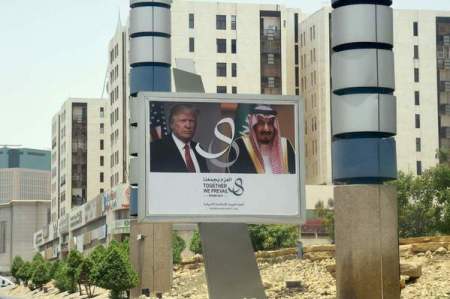

Perhaps even more important in terms of Saudi daily life, the women in attendance at functions did not wear head coverings and abayas. The entire nation saw this on television and understands that the fracking-created global oil glut changes everything, that the infidels no longer cower in fear of a cutoff of the oil that Allah granted to the protectors of the holy cities of Mecca and Medina. The old arguments of the fanatics hold less water. Change is coming. The King signaled that the restrictions declared by the Wahhabi clergy are no longer the ultimate arbiter of personal behavior, and that Saudis are going to have to start respecting the customs of the infidels. Something like his handshake gesture can seem trivial, quaint, or even humorous to Americans, but it is very serious business. The role modeling of the women at the highest and most formal level reaches deep into the culture.
This would be against the wishes of powerful factions of the Saudi Royal Family (about 5,000 strong), some of whom are closely aligned with (and fund) the radical Wahhabi clergy. For decades, the (principally) Saudi-funded Wahhabis have poisoned the Ummah (the global Muslim community) with their feudal views. Saudi Arabia only became mega-wealthy in the 1950s, and the world’s Muslims were not violently engaged in much jihad. The Wahhabi clergy and the Saudi-funded mosques they brought with them prepared the soil for Al Qaeda at home and abroad.
Make no mistake: there is every possibility that a violent reaction or a coup within the Royal Family if sufficiently provoked. The clergy are important because they preach to the Saudi masses, and could whip them up into an attempt at an overthrow of the corrupt Royals who siphon off so much of Allah’s bounty for their own decadent pleasures, many of them haram. That is why Saudi Arabia has such a large investment in its security forces. The plan is for them to remain loyal in the event of an uprising, but man plans and Allah laughs.
The Royals are in a very delicate position. The dominant faction, the King and his two designated successors, have to loosen things up gradually, step by step, so as to not put their opponents over the edge into a revolt that would brutally slaughter untold numbers, quite possibly including themselves. Like the mythological frog in a pot of water on the stove, they have to increase the heat very slowly.
They have already agreed to a deal to reward President Trump with a massive arms purchase worth $109.7 billion. That’s jobs and profits. But this aspect of the deal, from the New York Times, is important:
On the afternoon of May 1, President Trump’s son-in-law, Jared Kushner, welcomed a high-level delegation of Saudis to a gilded reception room next door to the White House and delivered a brisk pep talk: “Let’s get this done today.”
Mr. Kushner was referring to a $100 billion-plus arms deal that the administration hoped to seal with Saudi Arabia in time to announce it during Mr. Trump’s visit to the kingdom this weekend. The two sides discussed a shopping list that included planes, ships and precision-guided bombs. Then an American official raised the idea of the Saudis’ buying a sophisticated radar system designed to shoot down ballistic missiles.
Sensing that the cost might be a problem, several administration officials said, Mr. Kushner picked up the phone and called Marillyn A. Hewson — the chief executive of Lockheed Martin, which makes the radar system — and asked her whether she could cut the price. As his guests watched slack-jawed, Ms. Hewson told him she would look into it, officials said.
Mr. Kushner’s personal intervention in the arms sale is further evidence of the Trump White House’s readiness to dispense with custom in favor of informal, hands-on deal making. It also offers a window into how the administration hopes to change America’s position in the Middle East, emphasizing hard power and haggling over traditional diplomacy.
This is a tangible and personal signal to the factions of the Saudi family represented in the high-level delegation. An Orthodox Jew, married to the favored child of the President (who became a Jew herself) saved them money using his personal connections. Call me suspicious but I think this was carefully planned theatre. You have to see this against the background of the sudden new confluence of interests between Israel and Saudi Arabia, united in opposition to Iran and Arab Radical Islamic terrorists. The two nations already covertly cooperate, a ruse that cannot last forever. Slowly and surely the Saudis have to turn away from the Palestinians and toward an embrace of Israel. And it turns out that there can be a considerable upside to making peace with Israel and the Jews.
So, where do the Saudis go from here? How do they demonstrate to Trump, the world, and their own subjects that things are changing, and that it is acceptable.
My guess is that a symbolic measure that does not affect anyone in Saudi Arabia would be the next step. An easy one would be to end the prohibition against Israeli civilian airliners flying over Saudi airspace when flying eastward toward India, Thailand, and beyond. Israel’s economic and tourism ties with Asia are large and growing, so this restriction, which adds hours and costs, is an irritant to Israelis, as well as a political statement to the world that Israel is illegitimate.
The fact is that President Trump’s planned nonstop Air Force One flight from Riyadh to Ben Gurion Airport in Israel will be the first publicly-known flight between the two nations. (There is a decent chance that secret flights have taken place because the governments do talk to each other covertly.) So Trump is already liberalizing their aviation restrictions.
Allowing Israeli airliners to fly over Saudi territory would be a good first step toward eventual direct flights, a sign of complete acceptance of Israel as a legitimate nation, which is the only long term solution to peace between Arabs and Jews in the Middle East. It is a long path, but there is no alternative to a step at a time, given the delicate political situation of the Saudi Royals.
It is clear to me that President Trump has made a transformational deal, and that the West has stake in helping it come to fruition.
ISIS’s real target: Saudi Arabia, Fox News Opinion, Ali Shihabi, May 19, 2017
(An old Scotts proverb states that many a mickle makes a muckle — much little stuff makes lots. A Chinese proverb states that a journey of a thousand miles begins with one step. Rather than taking one step forward, President Obama took several leaps backward, and not only by bowing to the King of Saudi Arabia. President Trump took a step forward by not bowing and therefore meeting the King on an equal basis. First Lady Melania helped by not wearing a head covering. Apparently, Saudi Arabia is already moving in, or at least toward, the right direction.
Saudi Arabia will not reject Islam, but there are signs that efforts are underway to temper it. The trip will take longer than we might wish, but with perserverence and good will we will get closer and closer and perhaps even arrive. — DM)
As custodian of Islam’s holiest sites, Mecca and Medina, and as leader of the 41-nation Islamic coalition established to combat terror, Saudi Arabia is on the front line of the global fight against radical jihadi terrorism. It is also the ultimate target of terrorist organizations that dream of controlling the center of the Islamic world and the nation’s vast oil wealth. President Trump, in making Riyadh his first overseas stop, is demonstrating this weekend that the U.S.-Saudi strategic relationship is a vital one, and that the kingdom is an essential partner in countering and crushing violent jihadi extremism.
And yet, some critics in the West continue to ridicule any Saudi role in fighting terrorism. They accuse the kingdom of promoting “Wahhabism,” the conservative Islam practiced in Saudi Arabia, arguing that its teachings are a precursor to terrorism. This, despite the fact that the kingdom is itself in the crosshairs of ISIS, al-Qaeda and a revolutionary and belligerent Iran and has seen multiple terror attacks since 1995.
In truth, the Saudi government understands that it has a problem, and it is working to temper the intolerance and rigid thinking of its clerics, a process that will be durable only if done gradually. Part of reforming its reactionary, conservative religious establishment involves utilizing it as a force that, while still not liberal by Western standards, can leverage its considerable stature, prestige and influence in the Muslim world to outlaw all forms of terrorism and ostracize those who promote them.
Saudi Arabia’s progress in the fight against extremism will be also be marked by Mr. Trump when he attends the opening of a center in Riyadh intended to fight radicalism.
“By establishing and operating this center, our Muslim friends, including Saudi Arabia, are taking a firm stand against extremism and those who adopt a perverted interpretation of religion to advance their criminal and political agendas,” National Security Adviser H.R. McMaster told journalists earlier this week.
The kingdom is well-versed and battle-tested in this fight. The Saudi government has built a world-class anti-terrorism capability that uses intelligence, community outreach, rehabilitation and, when necessary, brute force to fight terrorism, perhaps more effectively than any other country facing such militancy in its homeland.
Saudi Arabia’s commitment to the fight against terrorism may be hard to fathom for many Americans. After all, in the confusion following the terror attacks of Sept. 11, 2001, a narrative developed that the terrorists attacked America because they wanted to change the American way of life.
In fact, Al Qaeda – a strain of which became ISIS – has never held illusions about its capacity to spread its ideology in the United States. Instead, the 9/11 attacks were highly strategic, designed with one goal: to sever the strong Saudi–U.S. alliance. There is a reason Al Qaeda deliberately chose 15 Saudis among the hijackers. It was not because of “Wahhabism” or because of a secret Saudi hatred of the Western way of life. It was because Al Qaeda’s goal has been, and remains, the provocation of a U.S.-Saudi divorce.
Al Qaeda then, and ISIS today, hope to use terror to push the U.S. into withdrawing from the Gulf region, because they perceive the American presence as essential to preserving the existing political order in the Arabian Peninsula. Iran shares this strategy with ISIS, which is why it funds and arms destabilizing terror groups in the region, from Hezbollah in Syria to the Houthis in Yemen. Without an American presence in the region, jihadi leaders believe they could overthrow the Gulf monarchies.
Meanwhile, campaigns of terror have only brought the U.S. and Saudi Arabia closer together, deepening a relationship that has endured for three-quarters of a century. Trump’s decision to visit Riyadh first is evidence of that.
This bilateral bond and strengthening alliance against terrorism between the U.S. and Saudi Arabia will ensure that neither Mecca nor Main Street, USA, will fall to the perverted and murderous ideology of radical jihadis. The Trump administration is signaling its strong understanding of the critical value Saudi Arabia brings to the table in its partnership against terror. Now that’s an idea worth spreading in the U.S.
Ali Shihabi is the executive director of the Arabia Foundation (www.ArabiaFoundation.org), a Washington, DC-based think tank focused on the geopolitics of the Arabian Peninsula.
Foreign Policy reports tense meetings between sides after president revealed classified info to Russians

US President Donald Trump’s reported sharing of a highly classified Israeli tip with Russia led to incredibly tense meetings between Israeli and American intelligence officials, Foreign Policy Magazine reported Friday.
The Israelis reportedly shouted at their US counterparts, demanding an explanation for Trump’s actions, according to the magazine, which quoted a US defense official.
“To them, it’s horrifying,” the official said. “Their first question was: ‘What is going on? What is this?’”
Meeting Russia’s foreign minister and ambassador to Washington in the Oval Office on May 10, Trump shared intelligence about an Islamic State threat involving laptops carried on airplanes, according to a senior US official.
ABC News reported that the information came specifically from a spy embedded in the terrorist group on behalf of Israel, and that Trump’s reported leak had placed the person’s life at risk.
The Israeli government has not officially confirmed that is the source of the reportedly leaked intelligence.
Though Washington and Jerusalem have publicly brushed aside reports of the incident, behind the scenes top Israeli defense officials are said to be angry and concerned by the president’s actions.
Beyond the possible danger to the source, FP reported that Israelis feared they had lost any further access to the spy’s intel.
Though the magazine noted that IS is not currently a major concern for the Jewish state, the spy was also reportedly a major asset in gaining information on the actions of Iran in Syria — through its Revolutionary Guards Corps and Lebanese proxy Hezbollah, both of which have been fighting for Syrian President Bashar Assad.
Israeli is increasingly worried of Iran entrenching itself along its northern border through its proxy groups and agents.
“To the Israelis, ISIS is not that big of a concern,” the defense official said, using another name for IS. “We have a partner that has done us a favor. They went out of their way to support us in a campaign against ISIS, that they have no real skin in.”
US and Israeli officials have tried to allay concerns. National Security Adviser H.R. McMaster told reporters that Trump’s disclosure was “wholly appropriate.” Israeli Defense Minister Avigdor Liberman tweeted that the allies will continue to have a “deep, meaningful and unprecedented” security relationship.
But some of the people who’ve spent years safeguarding that relationship say there will be consequences.
Intelligence professionals in the United States are “deeply concerned, frustrated and increasingly disillusioned,” one former intelligence official said. Another former intelligence official said the concern is that Israel will start “fuzzing” intelligence it shares with the US, avoiding specifics or detailing how information is obtained. Both individuals spoke on condition of anonymity because they weren’t authorized to relay the sentiments they gleaned from conversations with current intelligence officials.
Shabtai Shavit, who led the Mossad in the 1990s, said that were he in charge of the intelligence organization today, he would not be inclined to share more information with his American counterparts. “If tomorrow I were asked to pass information to the CIA, I would do everything I could to not pass it to them. Or I would first protect myself and only then give it, and what I’d give would be totally neutered,” Shavit told The Times of Israel on Wednesday. “If some smart guy decides that he’s allowed to leak information, then your partners in cooperation will be fewer or just won’t be at all,” he warned. Danny Yatom, another ex-Mossad boss, told an Israeli radio station that if reports were accurate, Trump likely caused “heavy damage” to Israeli and American security.

Former head of the Mossad, Shabtai Shavit, attends a press conference organized by ‘Commanders for Israel’s Security’ in Tel Aviv on January 15, 2017. (Miriam Alster/Flash90)
Both nations gain much from the exchange of information.
Israel, which lives in close proximity to Arab enemies and Iran, has human spies in parts of the volatile Middle East where the US doesn’t. It also has robust cyber capabilities, enabling it to sometimes get word of plots that the United States doesn’t know about.
Washington, in turn, provides Israel with financial and military assistance, and intelligence that US agencies collect on threats far beyond Israel’s immediate borders.
No one thinks the incident will derail the long-standing alliance. But subtle changes and a more careful approach to sharing may be inevitable.
But it’s not a threat some Israeli officials didn’t foresee. Even before Trump took office, Jacobs said, Israeli professionals expressed concern that his loose lips would intentionally or inadvertently lead to Israeli intelligence being shared with Russia. That, in turn, might mean the intelligence ends up with Iran, a sworn enemy of Israel.
AP contributed to this report.
US President Donald Trump arrives in Saudi Arabia, Abbtakk News via YouTube, May 20, 2017
 What a difference an election makes
by Alan M. Dershowitz
May 19, 2017 at 3:00 pm
Source: Who Will Stand up for Civil Liberties?
At a moment in history when the ACLU is quickly becoming a partisan left wing advocacy group that cares more about getting President Trump than protecting due process (see my recent op-ed in the Wall Street Journal,) who is standing up for civil liberties?
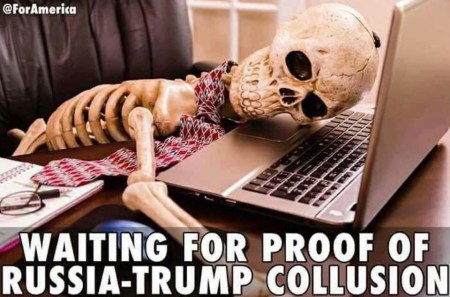
The short answer is no one. Not the Democrats, who see an opportunity to reap partisan benefit from the appointment of a special counsel to investigate any ties between the Trump campaign/ administration and Russia. Not Republican elected officials who view the appointment as giving them cover. Certainly not the media who are revelling in 24/7 “bombshells.” Not even the White House, which is too busy denying everything to focus on “legal technicalities” that may sound like “guilty man arguments.” Legal technicalities are of course the difference between the rule of law and the iron fist of tyranny. Civil liberties protect us all. As H.L. Mencken used to say: “The trouble about fighting for human freedom is that you have to spend much of your life defending sons of bitches: for oppressive laws are always aimed at them originally, and oppression must be stopped in the beginning if it is to be stopped at all.” History demonstrates that the first casualty of hyper-partisan politics is often civil liberties.
Consider the appointment of the special counsel to investigate “any links and/or coordination between the Russian government and individuals associated with the campaign of President Donald Trump.” Even if there were such direct links that would not constitute a crime under current federal law. Maybe it should, but prosecutors have no right to investigate matters that should be criminal but are not.
This investigation will be conducted in secret behind closed doors; witnesses will be denied the right to have counsel present during grand jury questioning; they will have no right to offer exculpatory testimony or evidence to the grand jury; inculpatory hearsay evidence will be presented and considered by the grand jury; there will be no presumption of innocence; no requirement of proof beyond a reasonable doubt, only proof sufficient to establish the minimal standard of probable cause. The prosecutor alone will tell the jury what the law is and why they should indict; and the grand jury will do his bidding. As lawyers quip: they will indict a ham sandwich if the prosecutor tells them to. This sounds more like Star Chamber injustice than American justice.
And there is nothing in the constitution that mandates such a kangaroo proceeding. All the Fifth Amendment says is: “no person shall be held to answer for a capital, or otherwise infamous crime, unless on a presentment or indictment of a Grand Jury.” The denials of due process come from prosecutorially advocated legislative actions. The founding fathers would be turning over in their graves if they saw what they intended as a shield to protect defendants, turned into a rusty sword designed to place the heavy thumb of the law on the prosecution side of the scale.
Advocates of the current grand jury system correctly point out that a grand jury indictment is not a conviction. The defendant has the right to a fair jury trial, with
all the safeguards provided in the constitution. But this ignores the real impact of an indictment on the defendant. Based on a one-sided indictment alone, the “ham sandwich” can be fired from his or her job or suspended from university. Consider what happened to the Arthur Andersen company and its thousands of employees when it was indicted for obstructing an official proceeding by destroying records relating to one of its clients. Although Andersen was ultimately vindicated, the indictment itself forced it into bankruptcy causing a loss of thousands of jobs and millions of dollars in shareholder values. Many individual have been indicted on the basis of one sided grand jury prosecutions and subsequently acquitted after a fair trial. Many of these individuals also suffered grievously as the result of being unfairly indicted.
Consider the consequences of an indictment by the special counsel’s grand jury in this matter. Not a conviction – just an indictment handed down by a grand jury that heard only one side in secret. It depends, of course on who the indictment named. In the Nixon case, for example, the president was named as an unindicted co- conspirator by the Watergate grand jury. This meant that he could not even defend himself at a trial. I was on the national board of the ACLU at the time. And although I despised Nixon and campaigned for his opponent, I wanted the ACLU to object to the unfairness of a one sided grand jury naming him as an unindicted co conspirator.
So I will be standing up for civil liberties during the duration of this investigation. As a civil libertarian, I care more about due process and the rule of law than I do about politics. But many people conflate my advocacy for civil liberties with support for President Trump. I have been bombarded with tweets such as: “Alan loves Donald. He’s throwing him lifelines;” “Has he been hired by Trump? Time to come clean;” “@AlanDersh I thought you were a smart guy. After hearing you support Trumpie, guess not;” “Has Trump already hired @AlanDersh to defend him? Clearly sounds that way;” and “No matter the subject, he inserts himself in the conversation with a full-throated and nonsensical defense of Trump.”
Let me be clear: I voted for Hillary Clinton and oppose many of President Trump’s policies. I would be taking the same position if the shoe were on the other foot – if Hillary Clinton had been elected and she were being subjected to an unfair process. Indeed I did do precisely that when she was threatened with prosecution. Remember the chants of “lock her up” during the campaign?
I will continue to monitor the current investigations into President Trump and his associated for any violation of civil liberties. I will call them as I see them, without regard to which side benefits.




 anneinpt
 artaxes
 danmillerinpanama
 davidking1530
 Peter Hofman
 Joseph Wouk
 Peter
Peter Louisiana Steve





 WarSclerotic
Recent Comments