Archive for May 2, 2017

Terrorist ultimatum: Hamas gives Israel 24 hours to respond to hunger strikers

May 2, 2017

Demands range from better medical care to phone access.

Source: Terrorist ultimatum: Hamas gives Israel 24 hours to respond to hunger strikers – Israel National News

Marwan Barghouti Flash 90

Hamas’ armed wing on Tuesday gave Israel 24 hours to respond to the demands of hunger-striking
prisoners, warning the Jewish state it would face consequences for failure to act.

“We warn the enemy not to ignore the just and legitimate demands of the prisoners, and we say we are giving the enemy leadership 24 hours to respond,” a spokesman for the Ezzedine al-Qassam Brigades said in a recorded speech.

Otherwise, he warned, Israel would “pay the price every day they delay responding to the demands”.

The statement did not list all potential responses but said the number of prisoners demanded in any future prisoner exchange would be increased.

The hunger strike over prison conditions began on April 17, with those taking part ingesting only water and salt.

They have issued demands ranging from better medical care to phone access.

The Palestinian Authority says around 1,500 prisoners are refusing food, though an Israeli minister said Sunday around 300 had recently abandoned their claim, putting the number of remaining strikers at 980.

The protest is being led by Marwan Barghouti, a senior figure in the Hamas’ rival Fatah who is in jail over the deaths of five Israelis during the second intifada, or uprising.

Barghouti accused Israel of “inhumane” treatment of prisoners and “judicial apartheid” in a New York Times opinion piece published last month outlining the reasoning for the strike.

Israeli Prime Minister Binyamin Netanyahu criticized the newspaper for referring to Barghouti as a “Palestinian leader and parliamentarian” while failing to note his five convictions for murder and history as a commander of Arab terrorist organisations.

In 2011 Israel released more than 1,000 Arab prisoners in exchange for Gilad Shalit, an Israeli soldier kidnapped five years earlier.

Hamas claims to have two current Israeli soldiers, though the Jewish state says they are dead but still wants their bodies.

The Islamist movement is also believed to have detained two Israelis who entered Gaza separately, both of whom allegedly have serious mental health issues.

Earlier Tuesday thousands of Arabs demonstrated in several cities over Israel’s decade-long blockade of Gaza.

During one of the marches senior Hamas leader Ismail Haniya said in a statement carried on Hamas media that a prisoner exchange was “always on the table” but it depended on Israel’s willingness to compromise.

Israel and Hamas have fought three wars since 2008, the most recent in 2014.

White House: Trump and Putin Had ‘Very Good’ Conversation on Syria

May 2, 2017

BY:
May 2, 2017 3:54 pm

Source: White House: Trump and Putin Had ‘Very Good’ Conversation on Syria

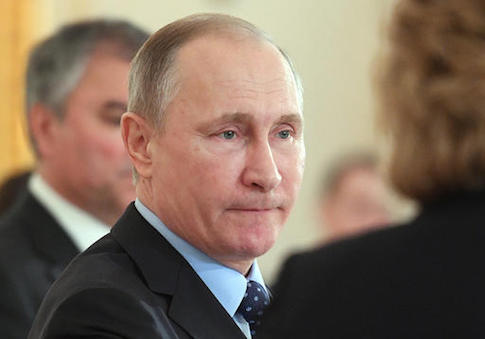
Putin looks tired

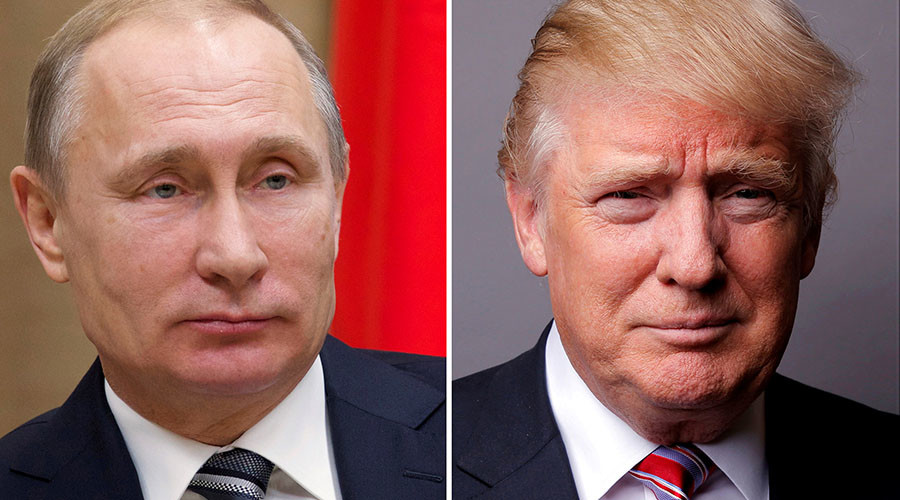
Russian President Vladimir Putin and U.S. President Donald Trump. © Reuters

AP

The White House released a statement that President Donald Trump and Russian President Vladimir Putin had a “very good” phone conversation on Tuesday about Syria.

It was their third conversation since Trump took office, and it marked their first talk since Putin criticized Trump’s military strike last month against Syria, a Russian ally, in retaliation for the Assad regime killing more than 80 people with chemical weapons.

“President Trump and President Putin agreed that the suffering in Syria has gone on for far too long and that all parties must do all they can to end the violence,” the statement said. “The conversation was a very good one, and included the discussion of safe, or de-escalation, zones to achieve lasting peace for humanitarian and many other reasons.  The United States will be sending a representative to the cease-fire talks in Astana, Kazakhstan on May 3-4.”

The statement added that the pair discussed eradicating terrorism in the Middle East and how to resolve the “very dangerous situation in North Korea.”

Trump’s call w/ Putin focused on Syria, touched on North Korea pic.twitter.com/MflFlbXs06

Secretary of State Rex Tillerson met with his Russian counterpart Sergey Lavrov in April and acknowledged that relations between the two countries were at a “low point.” Among the sticking points for the two nations are disagreements over Syria, Ukraine, and Russian meddling in the 2016 U.S. election.

Congress blames State Department after draft sanctions bill leaked to pro-Hezbollah media

May 2, 2017

Congress blames State Department after draft sanctions bill leaked to pro-Hezbollah media, Al-Monitor

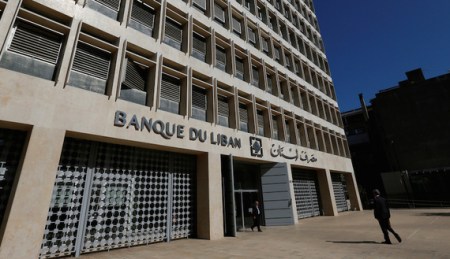
People walk outside Lebanon’s Central Bank in Beirut November 6, 2014. REUTERS/Jamal Saidi/File Photo – RTSEJDF

Congress is blaming the State Department and the US Embassy in Lebanon after draft sanctions legislation was leaked to the Lebanese media, setting off a political and diplomatic firestorm.

House Foreign Affairs Committee Chairman Ed Royce, R-Calif., began devising a new bill targeting Hezbollah last year amid concerns that the Barack Obama administration was slow-walking implementation of a previous effort that was signed into law in December 2015. Royce shared an early draft with State Department experts for their input, sources on and off Capitol Hill told Al-Monitor, but got burned when a media outlet close to Hezbollah got wind of it. 

The State Department has not officially acknowledged or denied being involved. Royce declined to comment.

As a result of the leak, numerous newspaper articles in Lebanon over the past month have picked apart — and possibly distorted — an unfinalized draft that only a handful of people in Washington have heard about and fewer still have seen. Even House Foreign Affairs ranking member Eliot Engel, D-N.Y., a natural ally on sanctions legislation, has yet to see the proposed draft, according to a Democratic aide. Sen. Marco Rubio, R-Fla., is working on a similar effort in the Senate.

Lebanese officials say destabilizing sanctions would be ill-advised while tiny Lebanon is struggling to absorb more than a million refugees from Syria.

“We are surprised by all the leaks about new sanctions,” Lebanese member of parliament Yassine Jaber, a former economy minister who met with administration officials during the congressional recess two weeks ago, told Al-Monitor in an email. “We don’t see a need for further legislation, we feel that all these leaks about further legislation to come, only hurts Lebanon, its economy and banking sector, at a moment of very high weakness and vulnerability.”

According to Lebanese media accounts, the 20-page draft bill has also caused a panic in Lebanon because of its potential political impact. While the 2015 bill unnerved a banking sector that is one of the pillars of the country’s economy, the new draft has government leaders fretful that Congress is now coming after them.

The Royce draft, Lebanese President Michel Aoun said last week during a meeting with the Washington-based American Task Force for Lebanon, “would harm Lebanon and its people greatly.” Critics are worried that the draft bill paves the way for sanctioning Lebanese allies and political parties that are close to Hezbollah, including Aoun, the Christian Free Patriotic Movement headed by his son-in-law and Foreign Minister Gebran Bassil, and the Shiite Amal Movement of parliament Speaker Nabih Berri.

In response, the Lebanese government is planning to send a delegation to Washington later this month of government officials, lawmakers and other dignitaries, possibly including Central Bank Governor Riad Salameh. The government hopes to have representatives of the private banking sector tag along to play up any potential threat to the financial sector, a Lebanese source told Al-Monitor, but the main concern appears to be with the bill’s political ramifications.

“This is more about the political groups of the speaker, etc., being nervous rather than the issues of the banks,” the source said. “Politicians — and the government, actually — are trying to get the private banks involved in their effort. I can tell you the private banks do not like that: They do not want to come with politicians here.”

The Association of Banks in Lebanon spent $200,000 in the first three months of this year to discreetly lobby Congress about the bill and other matters, according to lobbying records. The banks would prefer to wait until President Donald Trump fills in top spots at the Treasury Department before organizing their annual visit to Washington, the source said.

Hezbollah claims to get all its funding from Iran. US experts, however, have long suspected that much more comes from Lebanese expatriates, illegal activities and other sources, fueling Congress’ desire to crack down on as many funding streams as possible.

The Lebanese source, who has seen a draft of the bill, said it does not designate Hezbollah’s allies as terror groups. Rather, it would require the Trump administration to publicly report on their financial links to the Shiite militia, including estimates of the net worth of some top Lebanese officials.

“Obviously they don’t want their net worth to be mentioned,” the source said. “I totally see how Nabih Berri could be panicking even if his own party knows how much money he has.”


UCLA: Coddling Hamas on Campus While Trampling the First Amendment

May 2, 2017

UCLA: Coddling Hamas on Campus While Trampling the First Amendment, Front Page MagazineSara Dogan, May 2, 2017

(Israel seems to be doing very well despite these and similar jerks. Please see, Israel’s 69th Independence Day: Remarkable Achievements, Continuing Dangers. If only freedom of speech in academia were doing half as well as Israel, it would be a great improvement. — DM)

Editor’s note: UCLA is the latest school to be named to the Freedom Center’s report on the “Top Ten College Administrations Most Friendly to Terrorists and Hostile to the First Amendment.” It joins the campuses of Brooklyn College (CUNY), Tufts University, Brandeis University, and Vassar College on the list. These campuses provide financial and institutional support to terrorist-linked campus organizations such as the Hamas-funded hate-group Students for Justice in Palestine while actively suppressing speech critical of Israel’s terrorist adversaries and their allies in the United States.

Last night, the Freedom Center placed posters exposing the links between SJP and Hamas terrorists on the UCLA campus. UCLA administrators such as Vice Chancellor for Equity, Diversity, and Inclusion Jerry Kang have previously labeled similar Freedom Center posters “ethnic slander” and an effort to “trigger racially-tinged fear.” These posters pose a challenge to the UCLA administration to abandon these attacks on speech that exposes the truth about SJP and its ties to terrorism, and to fulfill its constitutional obligation to uphold the First Amendment on campus.

University of California-Los Angeles: Jerry Kang, Vice Chancellor for Equity, Diversity, and Inclusion and Gene Block, Chancellor:

UCLA Vice Chancellor for Equity, Diversity and Inclusion Jerry Kang has undergone  extreme intellectual and political contortions in defending the UCLA chapter of Students for Justice in Palestine (SJP) as “an officially recognized student organization, based on political commitments, that is also in good standing” despite SJP’s constant manifestation of Jew hatred on the Los Angeles campus.

In one widely noted expression of the group’s anti Semitism, SJP members illegally questioned student government candidate Rachel Beyda about whether her status as a Jew would bias her decisions on campus matters. It also attempted to create a litmus test for student government candidates by introducing an initiative that would require them to sign a pledge to not take trips to Israel sponsored by pro-Israel organizations.

Such incidents violate UCLA’s Principles of Community which state, in part, “We are committed to ensuring freedom of expression and dialogue, in a respectful and civil manner, on the spectrum of views held by our varied and diverse campus communities.”

Despite his title as the UCLA administrator in charge of Equity, Diversity & Inclusion, Vice Chancellor Kang has ignored SJP’s continual violation of these Principles of Community, disregarding the harassment of Jewish students forced to endure SJP’s mock “apartheid walls” plastered with Hamas propaganda and its rallies decrying the founding of the Jewish state as “Al-nakba” or “the catastrophe.”  But when the David Horowitz Freedom Center hung posters on campus exposing SJP’s ties to anti-Israel terror group Hamas, and naming campus activists who had worked to bring about the destruction of the Jewish state, both Kang and UCLA Chancellor Gene Block were quick to condemn them.  In an email to the entire 50,000 member UCLA community, Kang said the posters were  “designed to shock and terrify,” and accused the Freedom Center of using “the tactic of guilt by association, of using blacklists, of ethnic slander, and sensationalized images engineered to trigger racially-tinged fear.” In a second diatribe, he claimed the posters caused “chilling psychological harm” and “focused, personalized intimidation.”

University Chancellor Gene Block also reacted to the posters by stating “Islamophobic posters appeared on campus, in complete disregard of our Principles of Community and the dignity of our Muslim students. But we can, and we will, do our best to hold ourselves to the standards of integrity, inclusion, fairness and compassion that are the hallmarks of a healthy community.”

Quick to defend SJP and its violent rhetoric, Kang and Block have been missing in action when Jewish students faced intimidation and harassment from anti-Semitic speakers and Hamas propaganda plastered across campus.

In addition to the incidents listed above, UCLA SJP holds an annual “Palestine Awareness Week” on campus featuring speakers who endorse the genocidal BDS movement against Israel. SJP’s 2016 event featured journalist Max Blumenthal, who stated during his address that suicide bombing against Jews is justified by “the occupation” and described Palestinian terrorists as “young men who took up arms to fight their occupier.” He also compared Israel to the Islamic state, calling it “‘JSIL,’ the Jewish State in Israel and the Levant.” Another speaker, Miko Peled, also defended Palestinian terrorism, renaming it “a struggle for freedom and justice and equality,” and describing terrorists as “very brave Palestinians who are engaged in fighting this brutal occupation.” Peled also described Jews as analogous to Hitler, calling Jewish soldiers “young little Jewish gestapos,” and further accused Israel of “massive, violent, brutal oppression,” “genocide,” “ethnic cleansing,” and of being “a colonialist, apartheid, racist system.”

Nor is such hate speech directed at Israel and Jews restricted to SJP events. In 2015, UCLA’s Center for Near Eastern Studies held a conference on “Palestine and Pedagogy” during which speakers compared Israel to the Nazis, praised anti-Israel terrorism and supported the BDS movement against Israel. UC Irvine Professor and Director of the UC Institute for Humanities Research Theo Goldberg accused Israel of practicing “eliminationist racism” similar to the Nazis’ and claimed Israelis view Palestinians as  “vermin, cockroaches, rats, snakes…that take boots on the ground to get rid of.” Goldberg further charged that Israelis make “snuff films” featuring the deaths of innocent Palestinians which go viral resulting in “an orgasm” for Israelis. Meanwhile UC Riverside Professor David Lloyd called Israel “a colonial Zionist project that has become a…nightmare, ever more rigid and oppressive” and endorsed the right of Palestinians to take up arms against Israel.

This hate speech was ignored by Kang and Block and other appeasement-minded UCLA administrators.

Kang’s support for SJP and its pro-terrorism agenda was also evident in his lack of support for second year law student Milan Chatterjee, president of the Graduate Student Association (GSA) at UCLA.  When he attempted to keep the GSA out of the Boycott, Divest, and Sanction controversy on campus, Chatterjee was subjected to such severe harassment by SJP and Kang that he resigned. He later announced he was leaving UCLA to continue his law degree elsewhere because of the “hostile and unsafe campus climate” created by groups supporting the BDS movement on campus in concert with the UCLA administration.

Chatterjee wrote in a letter to UCLA Chancellor Gene Block: “It is unfortunate, indeed, that your administration has not only allowed BDS organizations and student activists to freely engage in intimidation of students who do not support the BDS agenda, but has decided to affirmatively engage in discriminatory practices of its own against those same students. Whether you choose to acknowledge it or not, the fact is that the UCLA campus has become a hostile and unsafe environment for students, Jewish students and non-Jewish, who choose not to support the BDS movement, let alone support the state of Israel.”

In comments made to the media, Chatterjee also stated, “I filed a complaint with the office of Vice Chancellor for Equity, Diversity and Inclusion Jerry Kang, who took zero action and refused to investigate… This is very disturbing behavior and shows a double standard at play at UCLA. If SJP files a complaint, they will bend over backwards. If it’s anyone else, they don’t care.”

In their zeal to defend pro-terrorist campus organizations like SJP, both Kang and Block have not hesitated to violate the First Amendment rights of their critics. The taxpayers of the state of California would be well advised to take note of their actions.

Israel’s 69th Independence Day: Remarkable Achievements, Continuing Dangers

May 2, 2017

Israel’s 69th Independence Day: Remarkable Achievements, Continuing Dangers, PJ MediaP. David Hornik, May 2, 2017

Israeli youths wave national flags as they enter Jerusalem’s Old City through Damascus Gate during a march celebrating Jerusalem Day, Sunday, May 17, 2015. (AP Photo/Sebastian Scheiner)

Israel’s growth is not, of course, merely quantitative; today it punches far above its weight in a wide range of fields. It was recently ranked the eighth most powerful country in the world. Compared to Israel’s 8.7 million people, the seven countries ranked above it have populations of: United States, 324 million; China, 1.37 billion; Japan, 127 million; Russia, 142 million; Germany, 81 million; India, 1.27 billion; Iran, 83 million.

Israel shines its light to the nations from a dark region, and its emergence as an incubator of optimism, vitality, and creativity is one of the great stories of our time.

***********************************

Today, Israel marks its 69th Independence Day. The country is a success beyond what anyone could have dreamed when independence was declared on May 14, 1948. (Today is May 2; Israeli holidays are guided by the Hebrew calendar.)

Around this time of year, Israel’s Central Bureau of Statistics publishes its annual data. Some of this year’s highlights:

Israel’s current population of 8.7 million is almost eleven times its population of 800,000 when it was established. Back then, 6 percent of the world’s Jews lived in Israel; now it’s home to 43 percent of world Jewry.

Since last Independence Day, the country’s overall population — Jews and non-Jews — has grown by 159,000: 174,000 births, 44,000 deaths, 30,000 new immigrants. Estimates show the population will reach 15 million by 2048; by then the Jewish portion of it should, by current trends, constitute a considerable majority of world Jewry.

In 1948, the “ingathering of the exiles” was a Zionist slogan. Today it’s a statistically demonstrable fact.

Since that era, large numbers of Jewish immigrants have come to Israel — particularly from post-Holocaust Europe, the Middle East, the Soviet Union, and the post-Soviet nations. At a time when Western countries’ fertility rates are falling perilously, Israel’s fertility rate keeps growing — and is far beyond that of any other Western country.

Israel’s growth is not, of course, merely quantitative; today it punches far above its weight in a wide range of fields. It was recently ranked the eighth most powerful country in the world. Compared to Israel’s 8.7 million people, the seven countries ranked above it have populations of: United States, 324 million; China, 1.37 billion; Japan, 127 million; Russia, 142 million; Germany, 81 million; India, 1.27 billion; Iran, 83 million.

How does Israel do it? By having incredible capabilities to offer in various domains.

Just some examples: Only the United States and China have more companies listed on the NASDAQ. Last year, a top Google official ranked Israel’s tech sector as second only to Silicon Valley for innovation. Israel also has “one of the highest per capita rates of patents filed” and “the 2nd highest publication of new books per capita.”

In the crucial field of desalination and water management, tiny Israel is the world’s leader. It’s also a “powerhouse in medical innovation.” And it’s a leader in disaster relief; last year the UN – which is generally hostile to Israel — ranked its army’s emergency medical team as “No. 1 in the world.” Israeli agriculture, too, is exceptionally innovative, and feeds a considerable part of the planet’s population.

Because of its circumstances, Israel has had to excel not only in saving and sustaining life but also in protecting it. It has the world’s most technologically advanced army and is “rapidly becoming the world leader” in cybersecurity. The prowess of its intelligence agencies, particularly the Mossad, has an almost mythological status.

When you’re so good at so many things, others want to benefit from it. The past few decades have seen a dramatic increase in the number of countries having diplomatic ties with Israel. From a pariah status in the 1970s, as of last year Israel had diplomatic relations with 158 of the world’s 193 countries. Apart from Arab and Muslim countries that still — at least officially — boycott Israel, that means almost all of the world’s countries.

That trend has included, perhaps most dramatically, rapidly growing ties with the world’s two largest countries, China and India. Both were formerly hostile to Israel, but are now — despite their size — eager to gain from what it can offer.

For all that, the world’s per capita most innovative, productive, beneficent country remains, almost seven decades after its birth, the only country specially marked for annihilation in some quarters.

Whereas decades ago Arab states led the push to eradicate the world’s only Jewish state, today the dubious mantle has passed to the Islamic Republic of Iran and its proxies. Second only to that axis is the worldwide BDS (Boycott, Divestment, and Sanctions) movement, which uses the Goebbels big-lie technique to spread canards about “Israeli Apartheid” and the like — particularly on Western campuses where minds are being formed.

But after almost seven decades at the front line of civilization, danger and hostility are not new to Israel. Despite the pressures, the aggressions, and the losses, Israel ranks — perhaps surprisingly — high in yet another, more subjective domain. This year’s UN Happiness Index ranked Israel 11th in the world; other surveys have placed it in the top 10.

Israel shines its light to the nations from a dark region, and its emergence as an incubator of optimism, vitality, and creativity is one of the great stories of our time.

China demands ‘immediate’ halt to THAAD deployment in South Korea

May 2, 2017

Beijing has called for an immediate stop to the deployment of the US Terminal High Altitude Area Defense (THAAD) anti-missile system to South Korea and is ready to protect its interests, according to the Chinese Foreign Ministry.

Source: China demands ‘immediate’ halt to THAAD deployment in South Korea — RT News

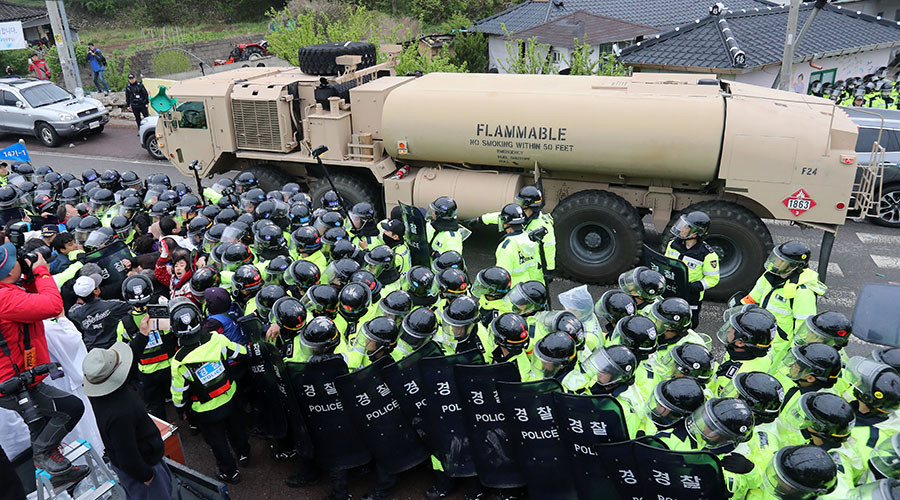
Protesters and police stand by as trailers carrying US THAAD missile defence equipment enter a deployment site in Seongju, early on April 26, 2017. © YONHAP / AFP

Beijing has called for an immediate stop to the deployment of the US Terminal High Altitude Area Defense (THAAD) anti-missile system to South Korea and is ready to protect its interests, according to the Chinese Foreign Ministry.

Foreign Ministry spokesperson Geng Shuang voiced the government’s position against the move during a briefing on Tuesday.

Read more

FILE PHOTO: China's Liaoning aircraft carrier conducts a drill in an area of South China Sea © Reuters

“We oppose the deployment of the US missile system to South Korea and call on all parties to immediately stop this process. We are ready to take necessary measures to protect our interests,” he said, adding that “China’s position on the THAAD issue has not changed.”

The spokesperson didn’t specify what protective measures China had in mind. However, responding to the THAAD installation, China announced on Thursday that it will stage live-fire exercises and test new weapons to protect its security.

Beijing has previously voiced concerns over the THAAD system and joint US-South Korean drills near the Korean Peninsula, consistently urging all the parties involved to find a peaceful solution to the volatile situation in the region.
Backed by Russia, it also proposed a halt to military drills in exchange for an end to Pyongyang’s missile and nuclear tests during a United Nations Security Council (UNSC) session held in New York on Friday.

Moscow considers the stationing of the THAAD system to be an “additional destabilizing factor for the region” amid alarmingly increasing tensions. It has called on Washington and Seoul to reconsider the decision.

READ MORE: ‘Ready to intercept North’s missiles’: US THAAD missile defense system goes operational in S. Korea

Recently installed in South Korea, the THAAD system is aimed at detecting and shooting down missiles. It became operational on Monday and is able “to intercept North Korean missiles and defend the Republic of Korea [South Korea],” according to US Forces Korea spokesman Col. Rob Manning.

The deployment of the US defense system triggered protests in South Korea, with citizens saying that it would only provoke an attack from their northern neighbor.

Seoul was also reportedly asked to pay for the US missile shield, as President Donald Trump called on South Korea to cough up for the “phenomenal billion-dollar system.” He received a firm rebuke in response, however.

READ MORE: Trump wants S. Korea to foot $1bn THAAD bill, Seoul says no

The THAAD deployment comes as a part of other US steps to deter North Korea from testing nuclear and non-nuclear missiles. Pyongyang held two failed missiles tests in April, also threating to sink US warships and submarines in South Korean waters in the event of any provocation.

Boeing Reps Meet With Iranian Terror Leader Who Threatened to ‘Destroy’ U.S. Forces

May 2, 2017

Boeing Reps Meet With Iranian Terror Leader Who Threatened to ‘Destroy’ U.S. Forces, Washington Free Beacon, May 1, 2017

The first Boeing 737 MAX 9 airplane is pictured during its rollout for media at the Boeing factory in Renton, Washington on March 7, 2017. /Photo credit should read JASON REDMOND/AFP/Getty Images)

Boeing’s efforts to ink multi-billion dollar deals with Iran, the world’s foremost state sponsor of terror, has prompted outrage on Capitol Hill and currently is being reviewed by the Trump administration, which will have the final say on whether Boeing is granted licenses to sell new planes to Iran.

**********************************

Leaders from Boeing reportedly traveled to Tehran recently to meet and sign a deal with a top former Iranian Revolutionary Guards Corps (IRGC) member who threatened to blow up U.S. forces in the Persian Gulf region, raising new questions about the U.S. aerospace company’s continued efforts to ink multi-billion dollar deals with the Iranian regime.

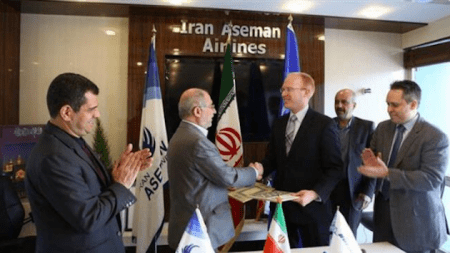
Representatives from Boeing traveled to Iran last month to meet with Hossein Alaei, CEO of Aseman Airlines, which is owned and controlled by the state. Boeing is moving forward with a $3 billion dollar deal to sell new planes to Aseman despite fierce opposition on Capitol Hill and direct evidence Iran has used commercial aircraft to ferry weapons and fighters across the region.

A photograph from the meeting shows a Boeing representative shaking hands with Alaei, who has been identified by Congress as a “prominent and longtime member of Iran’s Islamic Revolutionary Guard Corps,” which is responsible for killing and wounding scores of U.S. troops. The Boeing representative was not named in reports from the Iranian-controlled press or in information provided by U.S. foreign policy insiders.

Alaei, who was a senior figure in the IRGC before being installed as CEO of Aseman Airlines, served as commander of the IRGC Navy until 1990. Alaei oversaw the harassment of U.S. forces in the Persian Gulf and efforts by the IRGC Navy to plant mines in international waters.

Alaei was quoted during this time as threatening to “destroy” U.S. Navy assets in the region.

“We have drawn up plans whereby we will utilize all our military capability to destroy the U.S. fleet and solve the Persian Gulf issue once and forever,” Alaei was quoted as saying in 1987. “The Americans are here to fight us.”

Photo via @mdubowitz Twitter

Boeing’s efforts to ink multi-billion dollar deals with Iran, the world’s foremost state sponsor of terror, has prompted outrage on Capitol Hill and currently is being reviewed by the Trump administration, which will have the final say on whether Boeing is granted licenses to sell new planes to Iran.

Boeing’s deals with Iran are reported to be worth more than $16 billion.

The aerospace company has lobbied Congress aggressively to back the deal and was a key supporter of the Obama administration’s efforts to forge the landmark nuclear deal with Iran, which provided Tehran with billions in economic relief and cash windfalls.

“According to the U.S. Department of Commerce, an aerospace sale of this magnitude creates or sustains approximately 18,000 jobs in the United States,” Boeing said in a statement carried in Iran’s state-controlled media. “Boeing continues to follow the lead of the U.S. government with regards to working with Iran’s airlines, and any and all contracts with Iran’s airlines are contingent upon U.S. government approval.”

Senior sources on Capitol Hill who are working to stop the deal told the Washington Free Beacon that Boeing’s reported meeting with Alaei crosses the line. Representatives of major U.S. corporations should not be posing for pictures with senior IRGC members who have explicitly committed to killing U.S. soldiers, these sources said.

“If Boeing is trying to convince us they are doing their due diligence, they’re not doing a very good job,” said one senior congressional source working on the matter. “These photos of Boeing executives smiling and glad-handing with a prominent member of the Islamic Revolutionary Guard Corps are truly sickening. No self-respecting American should shake Hossein Alaei’s hands. They have American blood on them.”

Sen. Marco Rubio (R., Fla.) and Rep. Peter Roskam (R., Ill.) recently petitioned President Donald Trump to shut down these sales, citing Alaei’s role in the IRGC and Iran’s use of commercial planes to facilitate terrorism.

“Iran, the world’s leading state sponsor of terrorism, has systematically used commercial aircraft for illicit military purposes, including to transport troops, weapons, and cash to rogue regimes and terrorist groups around the world,” the lawmakers wrote. “The possibility that U.S.-manufactured aircraft could be used as tools of terror is absolutely unacceptable and should not be condoned by the U.S. government.”

Germany: Migrant Crime Spiked in 2016

May 2, 2017

Germany: Migrant Crime Spiked in 2016, Gatestone InstituteSoeren Kern, May 2, 2017

None of this seems to be having an impact on the German elections set for September 24, 2017. Polls show that if the election for German chancellor were held today, Angela Merkel, who is largely responsible for the migration crisis, would be re-elected with 37% of the vote. Martin Schulz, the Social Democrat candidate who has pledged to increase migration to Germany even further, would win 29% of the vote and the anti-immigration Alternative for Germany would win 8%. For now, German voters appear to believe that the alternatives to Merkel are all worse.

*****************************

Although non-Germans make up approximately 10% of the overall German population, they accounted for 30.5% of all crime suspects in the country in 2016.

Nearly 250,000 migrants entered the country illegally in 2016, up 61.4% from 154,188 in 2015. More than 225,000 migrants were found living in the country illegally (Unerlaubter Aufenthalt) in 2016.

The Berlin Senate launched an inquiry into why migrants disproportionally appear as criminals in the city-state compared to Germans.

An official annual report about crime in Germany has revealed a rapidly deteriorating security situation in the country marked by a dramatic increase in violent crime, including murder, rape and sexual assault.

The report also shows a direct link between the growing lawlessness in Germany and Chancellor Angela Merkel’s decision to allow in more than one million mostly male migrants from Africa, Asia and the Middle East.

The report — Police Crime Statistics 2016 (Polizeiliche Kriminalstatistik, PKS) — was compiled by the Federal Criminal Police Office (Bundeskriminalamt, BKA) and presented by Interior Minister Thomas de Maizière in Berlin on April 24.

The number of non-German crime suspects (nichtdeutsche Tatverdächtige) legally residing in Germany jumped to 616,230 in 2016, up from 555,820 in 2015 — an increase of 11% — according to the report. Although non-Germans make up approximately 10% of the overall German population, they accounted for 30.5% of all crime suspects in the country in 2016, up from 27.6% in 2015.

In this year’s report, the BKA created a separate subcategory called “migrants” (Zuwanderer) which encompasses a combination of refugees, pending asylum seekers, failed asylum seekers and illegal immigrants.

According to the BKA, the number of migrant crime suspects (tatverdächtiger Zuwanderer) in Germany in 2016 jumped to 174,438 from 114,238 in 2015 — up 52.7%. Although “migrants” made up less than 2% of the German population in 2016, they accounted for 8.6% of all crime suspects in the country — up from 5.7% in 2015.

In terms of non-German crime suspects residing legally in Germany, Turks were the primary offenders in 2016, with 69,918 suspects, followed by Romanians, Poles, Syrians, Serbs, Italians, Afghans, Bulgarians, Iraqis, Albanians, Kosovars, Moroccans, Iranians and Algerians.

In terms of migrant crime suspects, Syrians were the primary offenders, followed by Afghans, Iraqis, Albanians, Algerians, Moroccans, Serbs, Iranians, Kosovars and Somalis.

Police in Bremen, Germany frisk a North African youth who is suspected of theft. (Image source: ZDF video screenshot)

The report’s other findings include:

  • Violent crime surged in Germany in 2016. These include a 14.3% increase in murder and manslaughter, a 12.7% increase in rape and sexual assault and a 9.9% increase in aggravated assault. The BKA also recorded a 14.8% increase in weapons offenses and a 7.1% increase in drug offenses.
  • Non-German crime suspects committed 2,512 rapes and sexual assaults in Germany in 2016 — an average of seven a day. Syrians were the primary offenders, followed by Afghans, Iraqis, Pakistanis, Iranians, Algerians, Moroccans, Eritreans, Nigerians and Albanians. German authorities have repeatedly been accused of underreporting the true scale of the migrant rape problem for political reasons. For example, up to 90% of the sex crimes committed in Germany in 2014 do not appear in the official statistics, according to André Schulz, the head of the Association of Criminal Police (Bund Deutscher Kriminalbeamter, BDK).
  • Non-German crime suspects committed 11,525 robberies in Germany in 2016 — an average of 32 a day. Moroccans were the primary offenders, followed by Algerians, Syrians, Georgians, Tunisians, Albanians, Afghans, Serbs, Iraqis and Iranians.
  • Non-German crime suspects committed 56,252 aggravated assaults in 2016 — an average of 154 a day. Syrians were the primary offenders, followed by Afghans, Iraqis, Iranians, Moroccans, Algerians, Somalis, Albanians, Eritreans and Pakistanis.
  • Bavaria was the German state most affected by non-German criminality, followed by North Rhine-Westphalia, Baden-Württemberg, Hesse, Berlin, Lower Saxony, Rhineland-Palatinate, Saxony, Hamburg, Schleswig-Holstein, Saxony-Anhalt, Brandenburg, Mecklenburg-Vorpommern, Saarland, Bremen and Thüringen.
  • Berlin was the German city most affected by non-German criminality, followed by Munich, Hamburg, Frankfurt, Cologne, Düsseldorf, Hanover, Stuttgart, Dortmund, Bremen, Leipzig, Nürnberg, Essen, Duisburg, Mannheim, Karlsruhe, Dresden, Freiburg im Breisgau, Chemnitz, Aachen, Bielefeld, Wuppertal, Augsburg, Bonn, Bochum, Gelsenkirchen, Wiesbaden, Münster, Kiel, Halle, Krefeld, Braunschweig, Mainz, Lübeck, Mönchengladbach, Erfurt, Oberhausen, Magdeburg and Rostock.
  • The BKA also recorded 487,711 violations of German immigration laws (ausländerrechtliche Verstöße), up 21.1% from 402,741 violations in 2015. Nearly 250,000 migrants entered the country illegally in 2016, up 61.4% from 154,188 in 2015. More than 225,000 migrants were found living in the country illegally (Unerlaubter Aufenthalt) in 2016.

The new data contradicts claims made by the BKA in December 2016 — just four months before the current report — that migrant criminality was actually decreasing.

During a press conference in Berlin on April 24, Interior Minister Thomas de Maizière admitted:

“The proportion of foreign suspects, and migrants in particular, is higher than the average for the general population. This cannot be sugarcoated. There is an overall rise in disrespect, violence and hate. Those who commit serious offenses here forfeit their right to stay here.”

Separately, officials in Bavaria revealed that the number of crimes committed by asylum seekers and refugees there increased by 58% in 2016. They accounted for 9.6% of all crimes committed in the state, up from 3.2% in 2015 and 1.8% in 2012. Syrians were the primary offenders, followed by Afghans, Iraqis and Nigerians.

“The increase in crime in Bavaria in 2016 is mainly due to foreign suspects, especially immigrants,” said Bavarian Interior Minister Joachim Herrmann.

At the same time, officials in Baden-Württemberg noted a 95.5% increase in the number of physical assaults involving at least one migrant in 2016.

Meanwhile, the Berlin Senate launched an inquiry into why migrants disproportionally appear as criminals in the city-state compared to Germans. In 2016, 40% of all crime suspects in the German capital were non-Germans.

None of this seems to be having an impact on the German elections set for September 24, 2017. Polls show that if the election for German chancellor were held today, Angela Merkel, who is largely responsible for the migration crisis, would be re-elected with 37% of the vote. Martin Schulz, the Social Democrat candidate who has pledged to increase migration to Germany even further, would win 29% of the vote and the anti-immigration Alternative for Germany would win 8%. For now, German voters appear to believe that the alternatives to Merkel are all worse.

How to Defuse the Crisis with North Korea

May 2, 2017

How to Defuse the Crisis with North Korea, American ThinkerHerbert E. Meyer, May 2, 2017

(There is no excellent solution and the concept behind the suggestion needs to be expanded. However, something along its lines may be the best we can do. North Korean peasants would be better off as East German clones and China would prefer the arrangement to a reunification of North and South Korea. Please see also, Krauthammer: U.S. does have cards to play against North Korea and my parenthetical comment there. — DM)

North Koreans would have far more confidence that a guarantee of sovereignty by the U.S. and South Korea would hold if China’s leaders backed it publicly, as well as privately. And if the Chinese would promise to provide the level of economic support that North Korea needs to keep it at least stable, and perhaps more prosperous than it is now, that would help encourage the generals to act. Let’s hope that President Trump at least talked about all this when he met at Mar-a-Lago last month with his new best-buddy, Chinese president Xi.

*********************

The looming crisis with North Korea provides a perfect illustration of what’s gone wrong with the way Washington works. Everyone is so eager to propose a policy, no one can be bothered to articulate an objective. So policymakers start arguing about what to do, before deciding what they want to accomplish. That’s like arguing over what route to take, before deciding where you want to go. (Which, to point out the obvious, is why we keep ending up in the middle of nowhere, or upside down in a ditch.)

Here’s one possible objective that would defuse this crisis and perhaps even bring a few decades of stability: to turn North Korea into a modern version of East Germany.

For those of you too young to remember the Cold War, during those decades after World War II Germany was divided. West Germany was free, prosperous, and an American ally. East Germany was a miserable dictatorship, not very prosperous, and a Soviet satellite. (To get a feel for what life was like in East Germany, watch the great movie The Lives of Others, and the German television seriesWeissensee.) But during all these decades, East Germany was never a threat to West Germany, or to the U.S. Its communist regime wanted only to be left alone. And in return, the West Germans and the Americans made it absolutely clear they had no intention of unifying Germany by attacking or otherwise bringing down the East.

When the Korean war ended with an armistice in 1953, that country was divided. South Korea became free, prosperous, and an American ally. North Korea became a miserable dictatorship, not very prosperous, and a sort-of satellite of China. The difference between Germany and Korea is that while East Germany wanted only to be left alone, North Korea keeps threatening to conquer South Korea and reunify the country under its control, and to fire nuclear-armed missiles at the U.S. itself.

President Trump’s Got Their Attention

But now, for the first time in its history — and thanks entirely to President Trump — North Korea faces the real possibility of a massive military attack, certainly to destroy its nuclear facilities and perhaps even to obliterate the regime itself. And there’s nothing like the looming prospect of an attack by the United States to get a government’s attention.

Simply put, it may be possible to defuse the current crisis without a war by cutting a deal along these lines: If North Korea will give up its nuclear weapons and cease threatening South Korea and the U.S., the U.S. and South Korea will guarantee North Korea’s sovereignty.

Once again, there’s an historic parallel between Korea and Germany: Adolf Hitler was crazy; a foaming-at-the-mouth, chewing-the-carpet raving lunatic. He was also a brilliant, cunning politician who not only held onto power, but who kept within his grip the total loyalty of Germany’s military leaders. These generals weren’t crazy; they were hard, practical, highly intelligent men who had fought and lost World War I and then rebuilt Germany’s war machine. They knew in their bones that another world war would devastate their country. They understood that invading Russia would end in catastrophe.

Yet the generals didn’t get rid of Hitler. While a small number were prepared to overthrow Hitler, most were caught up in appalling, fawning loyalty to him that had more to do with twisted psychology than with military strategy. The minority willing to act received no encouragement from the Western Allies. The others plunged ahead, caught in Hitler’s hypnotic spell. There’s no way to know this for sure, but it’s widely accepted among historians that if the generals had gotten rid of Hitler in 1937 or 1938, there would not have been a Second World War. (Plots to overthrow Hitler by some brave German continued after the war started, but by that time it was too late; all their efforts failed.)

We can argue all day whether Kim Jong-un is crazy, but it’s obvious he isn’t, um, normal. He’s held onto power, and he’s kept within his grip the loyalty of North Korea’s generals. These generals aren’t crazy. Crazy people cannot build weapons, organize complex programs to develop nuclear bombs — or build roads, operate electric power systems, keep the trains and buses running, assure that at least some food gets produced and distributed, operate schools and hospitals. They must be hard, practical, and highly intelligent. And while they may not be charming and fun to hang out with, they aren’t suicidal.

How to Organize a Coup d’Etat

Today, just like the German generals in the Spring of 1939, North Korea’s generals are careening toward war. But the point of studying history is to learn from it. Back in 1939 there was no serious effort in London, Paris, and Washington to try and break Hitler’s grip on his generals and to help them organize a coup d’etat. So the world plunged into war. Might it be possible to do this now? Is there some way to break Kim Jong-un’s grip on his generals — to snap them out of their hypnotic spell and help them to organize a coup before it’s too late?

For an effort like this to have even a chance of success, we’ll need answers to these questions:

Who are these guys? Presumably our intelligence service knows at least something about the two or three dozen officials who actually run North Korea. Well, which ones are most likely to abandon Kim and work with us? Who are the ones we would like to see take power?

How do we reach them? Of course, we can communicate with these generals over the airwaves, so to speak. That would involve official statements by President Trump and his national security team threatening war, and clearly offering a guarantee of regime survival in exchange for disarmament. But there must also be ways of reaching these officials individually — and very privately.

What precisely do we want them to do? We want the generals to replace Kim and his closest advisors with officials who will work with the U.S. to dismantle North Korea’s nuclear weapons program, then work with South Korea to establish the kind of sullen but stable peace that existed for decades between West and East Germany.

What help do they need? It’s possible that a serious threat to attack by President Trump, combined with the offer of regime survival in return for disarmament, will be sufficient to push at least some of the generals into taking action. But they may need more help, for instance a massive propaganda campaign to generate support for them before they act by telling the North Korean population how their lives will become immeasurably better once Kim is replaced. The generals also may need the kind of help that only a powerful intelligence service like ours can provide, for instance a covert communications system so they can be in touch with us, and with one another, without being overheard by Pyongyang’s security officials. They may even need the kind of help only the Pentagon can provide, for instance SEAL Team Six.

China’s help would vastly increase the chances of success. Beijing’s diplomatic and intelligence services probably have a better grasp of what’s actually going on in Pyongyang than ours. And they can probably provide detailed information about which generals to work with, and which to avoid — or remove. Most of all, the North Koreans would have far more confidence that a guarantee of sovereignty by the U.S. and South Korea would hold if China’s leaders backed it publicly, as well as privately. And if the Chinese would promise to provide the level of economic support that North Korea needs to keep it at least stable, and perhaps more prosperous than it is now, that would help encourage the generals to act. Let’s hope that President Trump at least talked about all this when he met at Mar-a-Lago last month with his new best-buddy, Chinese president Xi.

Don’t bother asking the usual Washington policymakers whether turning North Korea into a modern version of East Germany might actually be possible. They will reply — in unison, within two-billionths of a second — No, this is impossible! Kim Jong-un is crazy, and the North Koreans will never give up their nukes or agree to stop threatening South Korea and the U.S. Well, they may be right. On the other hand, these are mostly the same geniuses who told us, also with 100 percent confidence, that it was impossible to win the Cold War, and impossible for Donald Trump to get elected president. Impossible things sometimes do happen, even in politics — especially in politics. Given the risk we face of nuclear war, this is worth a shot.

White House Clearance Process Increasingly Politicized

May 2, 2017

White House Clearance Process Increasingly Politicized, Washington Free Beacon, May 1, 2017

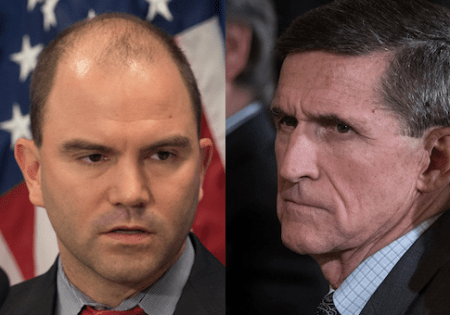
Ben Rhodes, Michael Flynn / Getty Images

“The CIA did not want to deal with him,” Codevilla stated. “Hence, it used the power to grant security clearances to tell the president to choose someone acceptable to the agency, though not so much to him.”

***************************

Security clearances granting access to state secrets have become increasingly politicized in a bid by opponents to block senior advisers to President Trump from joining the closed White House community of those with access secret intelligence.

In February, intelligence agencies denied a high-level security clearance to Robin Townley, an African affairs specialist and close aide to then-White House National Security Adviser Michael Flynn.

The denial of the Top Secret, Sensitive Compartmented Information clearance, the high-level security clearance known as TS/SCI, was widely viewed as a bureaucratic power play by opponents of both Flynn and Townley inside intelligence agencies.

Angelo Codevilla, an intelligence expert, said the denial of clearances was engineered by the CIA and came despite Townley’s holding of the high level clearance for many years when he worked at the Defense Intelligence Agency.

The clearance denial drove Townley out of the White House National Security Council staff.

The apparent motivation was political, as Townley was known inside government as a critic of the current intelligence structure. Townley, like Flynn, advocated for intelligence reforms designed to improve what many critics regard as an outdated system of intelligence agencies.

“The CIA did not want to deal with him,” Codevilla stated. “Hence, it used the power to grant security clearances to tell the president to choose someone acceptable to the agency, though not so much to him.”

Flynn also is under scrutiny from the Pentagon inspector general over foreign payments he received after retiring as an Army three-star general and whether they were reported on security clearance forms.

Several months before Townley’s clearance denial, Democrats on Capitol Hill complained about plans to give high-level security clearances to Trump’s daughter Ivanka Trump, and her husband, Jared Kushner. Both were granted interim TS/SCI clearances and currently are presidential advisers.

The blocking of security clearances under Trump contrasts with the handling of clearances during the Obama administration when a key liberal adviser with a questionable security background was given a high-level clearance.

Ben Rhodes, the White House deputy national security adviser for strategic communications under Obama, was denied an interim TS/SCI clearance by the FBI in October 2008, according to an email obtained from John Podesta last year.

The email stated that Rhodes was the only White House official out of 187 prospective White House aides to be denied the interim TS/SCI clearance.

Yet, despite the denial, Rhodes would later be granted access to some of the most secret U.S. intelligence information and emerge as one Obama’s closest aides who boasted of a “mind-meld” with the president on various issues.

Rhodes became one of the most active originators and shapers of key American foreign and national security policies under Obama.

He engineered what he dubbed the “echo chamber” of pliable news reporters and think tank experts who could be relied on to spread White House propaganda, including false and misleading information, to the American public on the Iran nuclear deal in a bid to win congressional backing for the accord.

Two House Republicans asked the FBI in January to investigate how Rhodes was granted access to secrets for eight years after the initial denial of an interim clearance in 2008.

Regarding Ivanka Trump and Kushner, two House Democrats, Rep. Elijah Cummings (Md.) and Rep. Bennie Thompson (Miss.) complained on Twitter in November that granting clearances to the couple would be improper and a conflict of interest because they were in business and lacked government experience.

High-level security clearances are granted to White House officials so they can participate in various activities, including policy development work, meetings with the president and senior advisers, working groups, and intelligence briefings.

Most internal meetings are classified and thus a security clearance is required for access. Denying a clearance to an official can be tantamount to firing.

In the White House complex, junior clerical staff members often are granted TS/SCI clearance.

Most jobs inside the White House complex, which includes the executive mansion and the adjacent Eisenhower executive office building, where the National Security Council and other key posts are located, require the TS/SCI clearance. Other clearance levels include Secret and Confidential.

The process for gaining a clearance includes filling out Form SF-86 that requires disclosing details of past employment and finances.

Chinese hackers were able to gain access to millions of the secret and highly sensitive forms during the hack disclosed last year of the Office of Personnel Management. The stolen SF-86s were among some 22 million documents on federal employees stolen and could greatly assist Chinese intelligence agent recruitment and cyber espionage operations.

Ground for clearance denial can include illegal drug use, contacts with foreign governments, or a history of bankruptcy.

The TS/SCI clearance grants a holder access to special intelligence, such as information obtained from foreign recruited agents and electronic communications intelligence.

The clearance also can include signing extensive non-disclosure agreements.