Archive for April 29, 2017

Israeli ‘Sex Mania’ A Global Threat, Says PA TV

April 29, 2017

Israeli ‘Sex Mania’ A Global Threat, Says PA TV, Jerusalem PostAriane Mandell, April 29, 2017

According to a Palestinian Authority broadcast, Israel is using sex as a weapon and the CIA is controlling global moods through hallucinogens.

Bar Refaeli in a commercial for the Hoodies chain. (photo credit:screenshot)

According to Palestinian Authority TV host Imad Hamato, Israel is waging war against the Muslim world via “sex mania.”

In a broadcast translated by the Palestinian Media Watch, Hamato, who was appointed by Palestinian Authority President Mahmoud Abbas as dean of Gaza’s Al-Azhar institutes in October 2016, can be seen denouncing Israel’s threats to Muslim modesty protocols.

“Our conflict today between us and Israel is the conflict between spirit and body,” Hamato says with a green screen of Temple Mount behind him. “Israel’s global media has expanded, and its war against the Arabs and Muslims is through sex mania which it distributes globally. Israel had to use this sex mania, as we mentioned in a previous lesson, in order to destroy the spirit of Arabs and Muslims. Everything among the Muslims has died, except for their lust.”

Hamato goes on to specify exactly what kind of immodesty was spreading: “Therefore we see filth and immodesty on many satellite channels, pictures and ads for penis enlargement and for all sorts of things. All of these are contrary to modesty.”

Why does Hamato suppose Jews would do such a thing? Because, he says, “The Jews, as it is said in the Quran, believe only in the body, not in the spirit. What has Israel given to the world in our times, aside from moral corruption and corrupt values, aside from the use of drugs and pills?”

Hamato then turns on long-standing ally of Israel, the United States, who he claims has been controlling the moods of citizens of the Middle East using drugs in Brave New World fashion: “I said in a previous lesson that the CIA has a unit called the Unit for Creating the Global Mood. They look at a map: ‘What is appropriate for Gaza, or Jordan, or Syria? Tramadol pills [pain killers]? Mood enhancers? Hallucinatory substances? They are produced in India, sent to Israel, and distributed in Sinai. Afterwards, they are spread in the region in order to destroy what remains of our children’s values.'”

The program was broadcast this month as a rerun from 2015. Hamato has long been a controversial character on the topic of Israel and religion in general. In 2006, he called on the pope to “repent and ask for forgiveness,” and added: “We want to use the words of the Prophet Muhammad and tell the pope: ‘Aslim Taslam.'”

Aslim Taslam is a phrase that was taken from the letters sent by the Prophet Muhammad to the chiefs of tribes in his times in which he reportedly urged them to convert to Islam to spare their lives.

While there is no evidence of Israel exporting sex mania, as a weapon or otherwise, here are a list of seven other contributions Israel has made to the world.

EXCLUSIVE – Arab Intelligence Source: Jihadists Are Wearing Down Hezbollah on Syria-Lebanon Border

April 29, 2017

EXCLUSIVE – Arab Intelligence Source: Jihadists Are Wearing Down Hezbollah on Syria-Lebanon Border, BreitbartAaron Klein and Ali Waked, April 29, 2017

ANWAR AMRO/AFP/Getty

Fighters of the Al Nusra Front, Al Qaida’s affiliate in Syria, or as the group now calls itself, Jabhat Fatah al-Sham, have recently been posing a serious challenge to Hezbollah in the border area between Lebanon and Syria, a senior Arab intelligence official told Breitbart Jerusalem.

“Dozens of Hezbollah fighters have been wounded in engagements over the last few weeks between the two sides,” the official stated. “The jihadists decided to switch their offensive from Syria to Lebanon. “

“In the area of Arsal and in other regions, they’ve continued to surprise Hezbollah and force the group to send many soldiers to the area.”

The challenge presented by the jihadists has forced Hezbollah to reconsider the positions of their troops in Syria and at home in Lebanon, according to the intelligence source. “According to intelligence reports, Hezbollah is taking the most recent engagements very seriously,” said the intelligence source.

“The slow stream of jihadists into Lebanon represents a disruption of the relative stability within the country’s borders, especially just before the beginning of the fasting month of Ramadan next month,” said the source.

“Hezbollah understands that Al Nusra and the jihadists are trying to turn the month of Ramadan into a bloody month for the Shi’ite organization and the communities supporting it, and so, we are witnessing the reduction in age of volunteers and fighters being recruited by the organization and they’re continuing to go down and even now we can see that 16-year-olds are among the fighters.”

The intelligence source also said that, as far as Hezbollah is concerned, “The threat from Al-Nusra isn’t nearing its strongholds in Lebanon. The increased troop presence on the border comes at a direct cost to troop numbers in Syria.

“In any case, Hezbollah already conducted a new assessment of the deployment of its forces in Syria due to the American airstrike, but now the fear is double.”

According to the source, “Hezbollah’s fundraisers and recruiters are investing far more effort than in the past.  If Ramadan passes without any special attacks, it should be a month of fundraising that will help the organization deal with the need to expand its recruitment of volunteers.”

The source added that “the main deliberation within Hezbollah concerns the need to prepare for a direct attack on the organization from Israel or even the U.S. The organization understands that Hezbollah is in the cross hairs of the American government as a source of disruption of U.S. interests in the area.”

“Hezbollah is fundraising, recruiting volunteers and fighting for public opinion. The organization is preparing for a very difficult summer.”

Cartoons and Video of the Day

April 29, 2017

Her Bunk via YouTube


Saudi Arabia’s ‘Lavish’ Gift to Indonesia: Radical Islam

April 29, 2017

Saudi Arabia’s ‘Lavish’ Gift to Indonesia: Radical Islam, Gatestone InstituteMohshin Habib, April 29, 2014

(A few days after I retired from the practice of law in 1955, my wife and I flew to Bali and stayed there for a couple of weeks. According to the article, that’s where Saudi King Salman spent six days “vacationing.” His total stay in Indonesia was nine days.

According to the 2010 Census, “83.5% of Bali’s population adhered to Balinese Hinduism,[3] followed by 13.4% Muslim, Christianity at 2.5%, and Buddhism 0.5%.[7]“. Most of the Muslims were on the southern coast and I can recall seeing none elsewhere. The Balinese Hindus we met were among the kindest and most welcoming people I have ever met. I wonder what’s happening there now. Please see also, Misogyny Meet Irony: Saudi Arabia Elected To United Nation’s Women’s Rights Commission.– DM)


Despite its pluralistic constitution, which says, “The state guarantees each and every citizen the freedom of religion and of worship in accordance with his religion and belief,” Indonesia — which declared independence in 1945 — has grown increasingly intolerant towards Christians, Hindus and Shiite Muslims.

***********************

Prior to Saudi Arabia’s attempts to spread Salafism across the Muslim world, Indonesia did not have terrorist organizations such as Hamas Indonesia, Laskar Jihad, Hizbut Tahrir, Islamic Defenders Front and Jemmah Islamiyah, to name just a few. Today, it is rife with these groups.

A mere three weeks after the Saudi king wrapped up his trip, at least 15,000 hard-line Islamist protesters took to the streets of Jakarta after Friday prayers, calling for the imprisonment of the capital city’s Christian governor, who is on trial for “blaspheming the Quran.”

In a separate crisis, crowds were demanding that Basuki Tjahaja Purnama (known familiarly as Ashok) be jailed for telling a group of fishermen that, as they are fed lies about how the Quran forbids Muslims from being governed by a kafir (infidel), he could understand why some of them might not have voted for him. If convicted, Ashok stands to serve up to five years in prison.

Accompanied by a 1,500-strong entourage, Saudi King Salman bin Abdul Aziz arrived in Indonesia on March 1 for a nine-day gala tour. He was welcomed warmly not only as the monarch of one of the world’s richest countries, but as the custodian of Islam’s two holiest cities, Mecca and Medina.

While appearing to be taking a holiday rather than embarking on an official state visit — the 81-year-old sovereign spent six days at a resort in Bali — the king had some serious business to attend to. In what was advertised as an effort to promote “social interaction” between Saudi Arabia and Indonesia — with His Majesty announcing a billion-dollar aid package, unlimited flights between the two countries and the allotment of 50,000 extra spots per year for Indonesian pilgrims to make the hajj to Mecca and Medina – it seems as if the real purpose of the trip was to promote and enhance Salafism, an extremist Sunni strain, in the world’s largest Muslim country, frequently hailed in the West as an example of a moderate Islamic society.

President Joko Widodo of Indonesia (foreground, left) meets with King Salman of Saudi Arabia (foreground, right), at Halim Perdanakusuma Airport in Indonesia. (Image source: Indonesian Presidential Palace)

Jakarta-based journalist Krithika Varagur, writing in The Atlantic on the second day of the king’s visit, describes Saudi efforts in Indonesia:

“Since 1980, Saudi Arabia has devoted millions of dollars to exporting its strict brand of Islam, Salafism, to historically tolerant and diverse Indonesia. It has built more than 150 mosques (albeit in a country that has about 800,000), a huge free university in Jakarta, and several Arabic language institutes; supplied more than 100 boarding schools with books and teachers (albeit in a country estimated to have between 13,000 and 30,000 boarding schools); brought in preachers and teachers; and disbursed thousands of scholarships for graduate study in Saudi Arabia.”

This Saudi influence has taken a serious toll on Indonesia, 90% of whose 250 million people are Sunnis. Despite its pluralistic constitution, which says, “The state guarantees each and every citizen the freedom of religion and of worship in accordance with his religion and belief,” Indonesia — which declared independence in 1945 — has grown increasingly intolerant towards Christians, Hindus and Shiite Muslims.

Prior to Saudi Arabia’s attempts to spread Salafism across the Muslim world, Indonesia did not have terrorist organizations such as Hamas Indonesia, Laskar Jihad, Hizbut Tahrir, Islamic Defenders Front and Jemmah Islamiyah, to name just a few.

Today, it is rife with these groups, which adhere strictly to Islamic sharia law, Saudi Arabia’s binding legal system, and which promote it in educational institutions. Like al-Qaeda and ISIS, they deny women equal rights, believe in death by stoning for adulterers and hand amputation for thieves, and in executing homosexuals and “apostate” Muslims.

The most recent example of the way in which this extremism has swept Indonesia took place a mere three weeks after the Saudi king wrapped up his trip. On March 31, at least 15,000 hard-line Islamist protesters took to the streets of Jakarta after Friday prayers, calling for the imprisonment of the capital city’s Christian governor, who is on trial for “blaspheming the Quran.”

This paled in comparison to the crowds — numbering about 200,000 at each violent rally — which flooded the city last November, December and February. The crowds were demanding that Basuki Tjahaja Purnama (known familiarly as Ashok) be jailed for telling a group of fishermen that, as they are fed lies about how the Quran forbids Muslims from being governed by a kafir, an infidel, he could understand why some of them might not have voted for him. If convicted, Ashok stands to serve up to five years in prison.

Sadly, such a jail term is nothing, when one considers the Islamist prison that the country as a whole has become — courtesy of King Salman and his lavish “gifts.”

North Korea launches new missile. US sabotages

April 29, 2017

North Korea launches new missile. US sabotages, DEBKAFile, April 29, 2017

(???????????????? — DM)

North Korea early Saturday, April 29, launched a medium ballistic missile. It failed, detonating in North air space seconds after launch, just like the first one that was sabotaged by the US on April 16, DEBKAfile reports. US President Donald Trump tweeted as soon as he was informed: “North Korea disrespected the wishes of China & its highly respected President when it launched, though unsuccessfully, a missile today. Bad!”

He was apparently hinting that he would wait for China’s reaction before the US took action.

This missile was also the same as the first, a KN-17, a single-stage, short to medium range, liquid-fueled Scud or No Dong variant. It was test-fired Saturday as a deliberate act of defiance by Kim Jong-un in the face of Trump’s warning Thursday, “There is a chance that we could end up having a major, major conflict” over his expanding nuclear and missile capabilities. Hours earlier, on Friday, American, Chinese and Russian foreign ministers all stood up at the UN Security Council meeting in New York to demand that he give up his nuclear and missile programs.

State Department Secretary Rex Tillerson called for tough new action to punish Pyongyang.

The latest missile launch was not announced by Pyongyang. Nor was it fired from the usual base near the port city of Sinpo, but a site near the capital. US military sources estimated that the KN-17, most likely an upgraded Scud missile adapted for anti-ship warfare, was intended to support Kim’s threat to sink one of the US warships approaching Korean waters with two Japanese destroyers.

One of Tokyo’s major subways systems says it shut down all lines for 10 minutes early Saturday after receiving warning of a North Korean missile launch. Tokyo Metro official Hiroshi Takizawa says the temporary suspension affected 13,000 passengers.

The Trump method

April 29, 2017

The Trump method, Washington Examiner, W. James Antle III, April 29, 2017
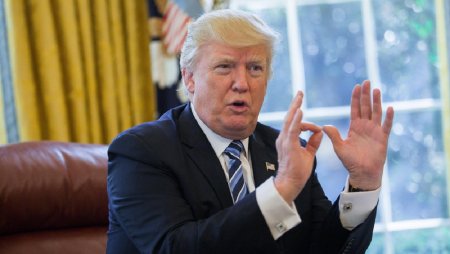
President Trump has been more measured toward China, despite near-constant criticism of that burgeoning strategic rival during the presidential campaign. “President Xi wants to do the right thing,” Trump said of his Chinese counterpart in a press conference. “We had a very good bonding. I think we had a very good chemistry together.” (Graeme Jennings/Washington Examiner)

When President Trump held a reception for conservative media at the White House in April, he was asked whether he was being tough enough on China. Beijing was dumping steel, his interlocutor said, and should also be designated a currency manipulator.

Trump responded, according to several attendees, with a certain incredulity, asking why he would label China a currency manipulator while it is helping to contain North Korea’s increasingly belligerent behavior. It’s a variant of a line he debuted on Twitter earlier in the month.

“No, it’s not going to be the Trump doctrine,” Trump memorably said of his foreign policy approach during the campaign. “Because in life, you have to be flexible. You have to have flexibility. You have to change. You know, you may say one thing and then the following year you want to change it, because circumstances are different.”

The president has come under fire from some of his fiercest defenders for saying one thing while running for office and then a year later wanting to “change it” on the core issues that got him elected. He relented on funding of the border wall with the continuing resolution to avert a government shutdown. He hasn’t fully rescinded former President Obama’s immigration executive actions. He ordered strikes on Syria after promising a less interventionist “America First” foreign policy.

Trump spoke favorably of Federal Reserve Chairwoman Janet Yellen. He declared NATO was no longer obsolete. He signaled support for the Export-Import Bank, even as he nominated a conservative critic to run it. He endorsed a GOP healthcare bill that seemed to advance few of his campaign policy goals.

All these position changes came shortly after there were ubiquitous reports of White House palace intrigue suggesting the populist, nationalist faction associated with chief strategist Stephen Bannon was being marginalized in favor of Trump’s centrist son-in-law and senior adviser Jared Kushner.

“We may as well have had Jeb,” lamented conservative columnist Ann Coulter, author of the election yearbook In Trump We Trust. She now tweets daily about the number of miles of border wall completed since Inauguration Day. The number is always zero. “Do you want war with Russia, all of you idiots, all of you fools who are pounding the war drums?” protested pro-Trump veteran radio talk show host Michael Savage after the Syria intervention.

Some Trump supporters think all this is a misreading of the president. Washington is used to ideologues, they say. Trump is a pragmatist. They maintain he is a master negotiator straight out of The Art of the Deal and there is a method even to his apparent Twitter madness.

“When President Trump negotiates, nothing is off the table,” said a former Republican national security official. “He leverages the full resources of the American government. He brings the economy into the picture even when doing diplomacy. He outright says, ‘If you want a better trade deal, you will help us with North Korea.'”

The new president is, in other words, making a bonfire of the pieties, discarding the idea, perhaps the pretense, of principled consistency, and instead does piecemeal what he believes will work at that moment.

Asked if this wasn’t par for the course in presidential negotiations, the official agreed but said there were two important caveats that make Trump different: “Trump says it publicly instead of dancing around it. And don’t underestimate how much our people try to make humanitarian arguments to foreign governments that just aren’t very humanitarian.”

A Republican diplomat concurred, saying there was an overreliance on moral arguments in difficult negotiations with foreign countries sometimes led by people who do not share our values. “These moral arguments don’t work with China or Russia,” the diplomat said. “They’re hit or miss with Egypt or Saudi Arabia. They’re not working with Turkey.”

So Trump took a harder line on Russia, or at least allowed his appointees to do so. This isn’t surprising from United Nations Ambassador Nikki Haley, for example, but Secretary of State Rex Tillerson is a past recipient of the Russian Order of Friendship, and yet he said Moscow was “complicit or simply incompetent” when it came to Syria’s use of chemical weapons.

And Trump has been more measured toward China, despite near-constant criticism of that burgeoning strategic rival during the presidential campaign. “President Xi wants to do the right thing,” Trump said of his Chinese counterpart in a press conference. “We had a very good bonding. I think we had a very good chemistry together.”

On the North American Free Trade Agreement, Trump floated an executive order terminating the United States’ participation in the pact, and almost immediately received phone calls from the president of Mexico and prime minister of Canada. Having got their attention, he walked back his threat while speaking magnanimously about those two allies.

“I decided rather than terminating NAFTA, which would be a pretty big, you know, shock to the system, we will renegotiate,” Trump told reporters. He had previously issued a statement praising the leaders of Mexico and Canada: “It is an honor to deal with both President Pena Nieto and Prime Minister Trudeau, and I believe that the end result will make all three countries stronger and better.”

To some, this reflects the “strategic ambiguity” Trump promised last year and a willingness to make a deal wherever possible. Others regard it as the kind of incoherence one might expect from a politically inexperienced president who hasn’t shown much interest in policy. The New York Times described Mexican elites as increasingly seeing Trump as a poker table “bluffer.”

This is a debate that dates back to before Trump was in office and extends to domestic policy as well. Is Trump simply more flexible than your average politician or is he less aware of what he is doing?

“What elitists misinterpret as uneven principles, entrepreneurs understand as adaptability,” SkyBridge Capital founder Anthony Scaramucci argued in the Wall Street Journal. He went on to claim, “Mr. Trump would be the greatest pragmatist and deal maker Washington has ever seen.”

“In the political sense, pragmatists reject the traditional left/right binary, which they may derisively view as dogma,” Christopher Scalia wrote in a Washington Post piece on Trump’s ideological flexibility. “They are willing to sample widely from the smorgasbord of political ideas to find the best solution to a pressing problem.”

Trump’s critics have also described him as a pragmatist. “I … think that he is coming to this office with fewer set, hard-and-fast policy prescriptions than a lot of other presidents might be arriving with. I don’t think he is ideological,” Obama told reporters at the White House after the election. “I think ultimately he’s pragmatic in that way, and that can serve him well as long as he’s got good people around him and he has a good sense of direction.”

Ben Shapiro argued in National Review that Trump was pragmatic, but that wasn’t necessarily a good thing. “That’s because pragmatism is a progressive philosophy,” he wrote. “There is no clear consensus on ‘what works.’ This is why elections matter, and why political ideology matters. It’s an empty conceit of arrogant politicians that they alone can determine, based on expert reading of facts, the best solution; they can’t.”

This tendency hampered Trump’s first attempt to repeal and replace Obamacare. He negotiated with the conservative Freedom Caucus, occasionally driving a hard bargain. “I’m coming after you,” Trump quipped to the group’s chairman, Rep. Mark Meadows, R-N.C., at one point during the talks.

But Trump’s jibes against the conservative lawmakers got more serious. The president tweeted that the Freedom Caucus would “hurt the entire Republican agenda” if they failed to get on board and that they needed to be fought as well as the Democrats in 2018.

“Tweets, statements and blame don’t change facts,” said Rep. Jim Jordan, R-Ohio. Meadows said Trump’s scathing comments made it “harder” to arrive at a healthcare compromise. A Republican congressional aide said Trump’s tactics merely “emboldened” GOP holdouts.

Trump and the Freedom Caucus have since reconciled on Obamacare. Some even stick up for his handling of the early healthcare discussions.

“I think he did everything he could on healthcare in round one,” said Faith and Freedom Coalition chairman Ralph Reed. “The president was speed dialing members of Congress on their cellphones.”

“The biggest problem you had under Bush and under Obama is that each party on the Hill thought the White House didn’t talk to them,” said Americans for Tax Reform president Grover Norquist, who added that all the feedback he has gotten has indicated improved communications under this administration. “Trump’s leadership is to talk about the Reagan agenda in terms of creating jobs.”

Nevertheless, Trump had difficulty out of the gate because he did not understand how to strike a deal that was only partly about dollars and cents. Freedom Caucus members dissented from the first version of the American Health Care Act because of values and ideology too. Trump’s pragmatic language made no allowance for that.

“He had nothing to sell us,” said a GOP legislative assistant. Trump’s arguments centered on Republican political survival, the need to fulfill campaign promises on Obamacare but relatively little to say about the merits of the bill.

Debates over the efficacy of Trump’s methods often break down over a question that has hung over him ever since the national media began to hang on his every tweet, upending politics as we know it: is he clever or just lucky?

“Occasionally, Trump displays moments of pure genius with his use of Twitter to change the subject away from bad storylines,” said Republican strategist Liz Mair. “Frequently, however, he uses Twitter to keep what are, for him, extremely bad narratives alive and to beclown himself in the eyes of most observers who are vaguely politically astute. Sometimes, he also just gets lucky and does something stupid on Twitter that coincidentally detracts from something bad, news-wise, but where you’re pretty confident it wasn’t intentional, it was just random.”

Maybe Trump’s luck will eventually run out. For now, however, when this pragmatist walks into a roomful of ideologues, he sits at the head of the table.