Archive for April 27, 2017

Afghanistan’s terrorist resurgence: Al Qaeda, ISIS, and beyond

April 27, 2017

Afghanistan’s terrorist resurgence: Al Qaeda, ISIS, and beyond, Long War Journal, April 27, 2017

More than 15 years after the U.S. military invaded Afghanistan to destroy al-Qaeda, the group maintains a persistent and significant presence in the country. Despite the Obama administration’s surge of U.S. forces in Afghanistan from 2010 to 2012, the Taliban, which has maintained its close alliance with al-Qaeda, is resurgent and today holds more ground in the country since the U.S. ousted the jihadists in early 2002.

And the threat posed by jihadist groups in Afghanistan has expanded. The Islamic State has established a small, but significant, foothold in the country. Pakistani jihadist groups that are hostile to the U.S. – such as the Movement of the Taliban in Pakistan, Lashkar-e-Taiba, and Harakat-ul-Muhajideen – operate bases inside Afghanistan as well.

For nearly seven years, the Obama administration wrote off al-Qaeda as a spent force. The group has been described as “decimated.” After Osama bin Laden was killed in Pakistan, President Obama said the “core of al-Qaeda in Pakistan and Afghanistan is on a path to defeat.” The Obama administration pushed this narrative hard, with many counterterrorism analysts adopting the line that al-Qaeda was either defeated or close to it.

Between 2010 and 2016, Obama administration officials, including CIA Director Leon Panetta, as well as other U.S. military and intelligence officials, characterized al-Qaeda’s presence in Afghanistan as minimal and consistently told the American public that the group has a presence of just 50 to 100 fighters. “I think at most, we’re looking at maybe 50 to 100, maybe less. It’s in that vicinity. There’s no question that the main location of al-Qaeda is in tribal areas of Pakistan,” Panetta said on ABC News This Week.


***********************************

Editor’s note: Below is Bill Roggio’s testimony before the House Committee on Foreign Affairs Subcommittee on Terrorism, Nonproliferation. A PDF of the testimony, with footnotes, can be downloaded here.

Chairman Poe, Ranking Member Keating, and other members of this subcommittee, thank you for inviting me here today to speak about the terrorist groups based in Afghanistan and their continuing threat to U.S. national security.

More than 15 years after the U.S. military invaded Afghanistan to destroy al-Qaeda, the group maintains a persistent and significant presence in the country. Despite the Obama administration’s surge of U.S. forces in Afghanistan from 2010 to 2012, the Taliban, which has maintained its close alliance with al-Qaeda, is resurgent and today holds more ground in the country since the U.S. ousted the jihadists in early 2002.

And the threat posed by jihadist groups in Afghanistan has expanded. The Islamic State has established a small, but significant, foothold in the country. Pakistani jihadist groups that are hostile to the U.S. – such as the Movement of the Taliban in Pakistan, Lashkar-e-Taiba, and Harakat-ul-Muhajideen – operate bases inside Afghanistan as well.

U.S. Estimates on al-Qaeda in Afghanistan Were Incorrect

For nearly seven years, the Obama administration wrote off al-Qaeda as a spent force. The group has been described as “decimated.” After Osama bin Laden was killed in Pakistan, President Obama said the “core of al-Qaeda in Pakistan and Afghanistan is on a path to defeat.” The Obama administration pushed this narrative hard, with many counterterrorism analysts adopting the line that al-Qaeda was either defeated or close to it.

Between 2010 and 2016, Obama administration officials, including CIA Director Leon Panetta, as well as other U.S. military and intelligence officials, characterized al-Qaeda’s presence in Afghanistan as minimal and consistently told the American public that the group has a presence of just 50 to 100 fighters. “I think at most, we’re looking at maybe 50 to 100, maybe less. It’s in that vicinity. There’s no question that the main location of al-Qaeda is in tribal areas of Pakistan,” Panetta said on ABC News This Week.

This assessment, which contradicted the U.S. military’s own press releases announcing raids against al-Qaeda in Afghanistan, was consistently repeated by U.S. intelligence and military officials. In June 2015, the U.S. military claimed in its biannual Enhancing Security and Stability in Afghanistan report that al-Qaeda “has a sustained presence in Afghanistan of probably fewer than 100 operatives concentrated largely in Kunar and Nuristan Provinces, where they remain year-round.” The December 2015 report claimed that al-Qaeda is “primarily concentrated in the east and northeast.

This estimate of al-Qaeda’s strength, which consistently downplayed al-Qaeda’s presence in Afghanistan, came crashing down in mid-October 2015, when the U.S. military and Afghan forces orchestrated a large-scale operation against two al-Qaeda camps in the Shorabak district in the southern Afghan province of Kandahar.

The scale of al-Qaeda’s presence at the two camps in Shorabak quickly disproved the longstanding 50 to 100 estimate. A U.S. military statement, quoting spokesman Brigadier General Wilson Shoffner, described the raid as “one of the largest joint ground-assault operations we have ever conducted in Afghanistan.” It took U.S. and Afghan forces more than four days to clear the two camps, with the aid of 63 airstrikes.

Shoffner’s description of the al-Qaeda facilities indicated that they had been built long ago. “The first site, a well-established training camp, spanned approximately one square mile. The second site covered nearly 30 square miles,” Shoffner said. “We struck a major al-Qaeda sanctuary in the center of the Taliban’s historic heartland,” he added.

Weeks later, General John F. Campbell, then the commander of U.S. Forces – Afghanistan and NATO’s Resolute Support mission, described one of the camps, which was run by al-Qaeda in the Indian Subcontinent (AQIS), al-Qaeda’s branch in South Asia, as “probably the largest training camp-type facility that we have seen in 14 years of war.”

It has been estimated that at least 150 al-Qaeda fighters were killed during the raids on the two camps in Shorabak. This is 50 more al-Qaeda fighters than the upper end of the Obama administration’s estimate of al-Qaeda’s strength throughout all of Afghanistan. And the al-Qaeda members were killed in southern Afghanistan, not in the northeastern provinces of Kunar and Nuristan, where we have been told they were concentrated.

The U.S. military was ultimately forced to concede its estimate of al-Qaeda’s strength in Afghanistan was wrong. In mid-December 2016, General Nicholson admitted that the U.S. military killed or captured 50 al-Qaeda leaders and an additional 200 operatives during calendar year 2016 in Afghanistan.

In April 2016, Major General Jeff Buchanan, Resolute Support’s deputy chief of staff, told CNN that the 50 to 100 estimate was incorrect based on the results of the Shorabak raid. “If you go back to last year, there were a lot of intel estimates that said within Afghanistan al-Qaeda probably has 50 to 100 members, but in this one camp we found more than 150,” he said. The estimate of al-Qaeda operatives in Afghanistan was revised upwards to about 300.

However, well before the Shorabak raids, it was evident to those of us closely watching the war in Afghanistan that al-Qaeda was stronger in Afghanistan than the official estimates, and was not confined to small areas in the northeast. Al-Qaeda consistently reported on its operations throughout Afghanistan, and the U.S. military, up until the summer of 2013, reported on raids against al-Qaeda cells in multiple provinces.

Surely, there was something seriously wrong with the CIA and the U.S. military’s ability to properly report on al-Qaeda’s presence in Afghanistan.

Al-Qaeda’s footprint inside Afghanistan remains a direct threat to U.S. national security and, with the resurgence of the Taliban, it is a threat that is only growing stronger.

The Enduring Taliban-al-Qaeda Relationship

Al-Qaeda’s presence in Afghanistan has not occurred in a vacuum. It has maintained its strength in the country since the U.S. invasion, launched a new branch, AQIS, and established training camps with the help and support of the Taliban.

When Generals Campbell and Buchanan discussed al-Qaeda in the wake of the Shorabak raid, they described the group as resurgent. Campbell described the Taliban-al-Qaeda relationship as a “renewed partnership,” while Buchanan said it “has since ‘grown stronger.’”

But like the estimate that al-Qaeda maintained a small cadre of 50 to 100 operatives in Afghanistan between 2010 and 2016, the idea that the Taliban and al-Qaeda have only recently reinvigorated their relationship is incorrect. Al-Qaeda would not have been able to maintain a large cadre of fighters and leaders inside Afghanistan, conduct operations in 25 of Afghanistan’s 34 provinces, establish training camps, and relocate high-level leaders from Pakistan’s tribal areas to Afghanistan without the Taliban’s long-term support.
Al-Qaeda has remained loyal to the Taliban’s leader, which it describes as the Amir al- Mumineen, or the “Commander of the Faithful,” since the U.S. invaded Afghanistan in 2001. Osama bin Laden maintained his oath of allegiance to Mullah Omar, the Taliban’s founder and first emir. When bin Laden died, Ayman al-Zawahiri renewed that oath. And when Mullah Omar’s death was announced in 2015, Zawahiri swore bayat (an oath of allegiance) to Mullah Mansour, the Taliban’s new leader. Mansour publicly accepted Zawahiri’s oath.

The close relationship between the two jihadist groups is also evident with the assent of the Taliban’s new deputy emir, Sirajuddin Haqqani, who leads the powerful Taliban subgroup known as the Haqqani Network. Sirajuddin and the Haqqani Network have maintained close ties to al-Qaeda for years. The relationship is evident in the U.S. government’s designations of multiple Haqqani Network leaders. Two documents seized from Osama bin Laden’s compound show that Siraj has closely coordinated his operations with al-Qaeda in Afghanistan and Pakistan.

The Taliban-al-Qaeda relationship remains strong to this day. And with the Taliban gaining control of a significant percentage of Afghanistan’s territory, al-Qaeda has more areas to plant its flag.

Rise of the Islamic State

Shortly after Abu Bakr al-Baghdadi declared the establishment of the caliphate in 2014, announcing the formation of the Islamic State, a small number of disgruntled jihadists from the Afghan and Pakistani Taliban, as well as al-Qaeda, discarded their oaths to the Taliban, pledged their fealty to Baghdadi, and established the so-called Khorasan province.

While the Islamic State dominates the jihad in Iraq and is a major player in Syria, the group has posed a smaller threat in Afghanistan and Pakistan when compared to the Taliban, al-Qaeda, and their jihadist allies. The U.S. military estimated the group had upwards of 2,000 fighters at the beginning of 2016, but had lost between 25 and 30 percent of its men in the months that followed. While U.S. military estimates of the strength of jihadist groups in Afghanistan must be taken with a grain of salt, this number is likely in the right ballpark.
The Islamic State has a much smaller presence in Afghanistan when compared to the Taliban. While the Taliban controls or contests more than 200 of Afghanistan’s 400 districts, the Islamic State only controls terrain in several districts in the eastern province of Nangarhar. The group also reportedly has a presence in the Afghan north.

The Islamic State’s Khorasan province has remained entrenched in Nangarhar and has withstood multiple U.S.-backed offensives over the past two years. The U.S. military has had success in killing key leaders, but the group has proven resilient.

Still, the so-called caliphate’s Khorasan province has remained on the margins of the Afghan war. It has conducted a limited number of suicide attacks and other operations in the Afghan capital of Kabul and elsewhere, but has not come close to matching the Taliban’s operational tempo.

Khorasan province has had a difficult time gaining traction throughout much of Afghanistan and Pakistan, as it is unwilling to cooperate with other, long-entrenched jihadist groups. In fact, the Taliban crushed the Khorasan province’s forces in Helmand, Farah, and Zabul after they demanded that the Taliban’s fighters swear allegiance to Baghdadi.

Pakistani Jihadist Groups Operating in Afghanistan

In addition to the Taliban, al-Qaeda, and the Islamic State, numerous Pakistan-based jihadist groups are known to operate in Afghanistan. For the most part, these organizations remain in the Taliban and al-Qaeda sphere, and leaders of the groups often backfill leadership positions when al-Qaeda commanders are killed in U.S. airstrikes.

The three largest Pakistani groups operating in Afghanistan are the Movement of the Taliban in Pakistan, Lashkar-e-Taiba, and Harakat-ul-Muhajideen.

The Movement of the Taliban in Pakistan (TTP) is largely made up of Taliban groups from Pakistan’s tribal areas. It is closely allied with the Afghan Taliban and al-Qaeda. In 2010, the TTP organized the Times Square bombing plot.

The TTP has taken advantage of the turbulent and ungoverned Afghan-Pakistani border to shift its base of operations when the Pakistani military targets it in offensives. The U.S. has killed several TTP leaders in airstrikes in Afghanistan.

Lashkar-e-Taiba (LeT) is a dangerous jihadist group that is backed by Pakistan’s military and Inter-Services Intelligence Directorate. The LeT is known to operate training camps in Afghanistan and attacked the Indian Consulate in Herat in 2014.26 The U.S. has killed several senior LeT operatives in airstrikes in northeastern Afghanistan over the years. The U.S. has also listed several senior LeT operatives, including Hafiz Saeed, the group’s emir, as Specially Designated Global Terrorists.

Harakat-ul-Mujahideen (HuM) is another Pakistani jihadist group that is known, as of August 2014, to operate training camps in Afghanistan.27 HuM has been involved in numerous acts of terror in the region, including hijacking an Indian airplane, attacking the U.S. Consulate in Karachi, and murdering Wall Street Journal reporter Daniel Pearl.

How Team Trump plans to kill Obama’s Paris climate deal by declaring it a treaty

April 27, 2017

How Team Trump plans to kill Obama’s Paris climate deal by declaring it a treaty, Washington timesStephen Dinan, April 26, 2017

President Barack Obama meets with President-elect Donald Trump in the Oval Office of the White House in Washington, Thursday, Nov. 10, 2016. (AP Photo/Pablo Martinez Monsivais)

A briefing paper circulated among Republican senators this week said the deal should have been sent to Capitol Hill by Mr. Obama, but he “knew that Congress would never approve such a flawed deal, so he refused to seek the Senate’s advice and consent.”

****************************

As President Trump’s top advisers prepare to hash out a final policy on the Paris climate agreement dumped onto their laps by President Obama, another option has hit the table: Declare the deal a treaty and send it to the Senate to be killed.

The treaty option could emerge as the middle ground in the increasingly tense battle between “remainers” on the one hand, who say the president should abide by Mr. Obama’s global warming deal, and the Paris agreement’s detractors, who say Mr. Trump would be breaking a key campaign promise if he doesn’t withdraw from the pact.

Mr. Trump’s principal advisers are slated to meet Thursday to hash out a final set of recommendations for the president, with several deadlines looming next month.

At an initial meeting of top staffers Tuesday, several memos and letters that were circulated laid out the options, including the treaty proposal put forth by Christopher C. Horner and Marlo Lewis Jr., senior fellows at the Competitive Enterprise Institute.

Under their vision, Mr. Trump could toss out Mr. Obama’s decision that the Paris accord was an executive agreement, declare it a treaty and send it to the Senate, where it would need a two-thirds vote for ratification.

Given Republican control of the chamber, the agreement’s opponents say senators would either shelve the deal or outright defeat it. Either option would derail the deal, the memo suggested.

“That option affirms that we are a nation of laws, not men and, importantly, discourages both our negotiating partners and future U.S. officials against attempting to circumvent our system,” the memo says.

A briefing paper circulated among Republican senators this week said the deal should have been sent to Capitol Hill by Mr. Obama, but he “knew that Congress would never approve such a flawed deal, so he refused to seek the Senate’s advice and consent.”

Supporters of the Paris accord have their own memo drafted by lawyers in the State Department. That memo says that by sending the agreement to the Senate, the president would be giving up important powers and leave Mr. Trump and his successors open to congressional meddling.

“Because the large majority of international agreements concluded by the United States are concluded as executive agreements, this could have far-reaching implications for our conduct of foreign affairs,” the State Department document says.

The Paris agreement is the main international vehicle for trying to combat climate change. Mr. Obama committed the U.S. to the deal in 2015 but never submitted it for ratification, saying it was an extension of a U.N. Framework Convention on Climate Change, which the Senate ratified in 1992.

The State Department memo says there are few risks to remaining part of the Paris deal. It says the “legal obligations are relatively few and are generally process-oriented [and] discretionary in their application or repeat existing obligations already contained in the Framework Convention.”

Michael McKenna, a Republican energy strategist, said anything short of withdrawal would leave the U.S. open to legal challenges, with judges potentially attempting to enforce strict climate limits based on the commitments.

“The president is being asked to travel a path that leads him — ultimately — to continue the Obama administration policies on climate change,” said Mr. McKenna, who has authored his own memo calling for withdrawal.

He blamed Obama administration “holdovers” at the State Department for trying to preserve their former boss’ plans.

Mr. Obama committed the U.S. to cutting greenhouse gas emissions at least 26 percent below 2005 levels by 2025. The former president tried to enforce the commitment through a series of executive and administration actions, imposing tight limits on power plants and auto emissions.

Federal courts have halted some of those plans, and Mr. Trump and Congress have nixed others, easing the pressure on American industry. During the campaign, Mr. Trump also pledged to cancel the Paris deal.

As a decision nears, the sides among Mr. Trump’s top advisers have become clear.

Energy Secretary Rick Perry on Tuesday appeared to join the remainers, though he said the deal should be renegotiated.

“I’m not going to tell the president of the United States to walk away from the Paris accord,” Mr. Perry said at a conference sponsored by Bloomberg. “I will say that we need to renegotiate it.”

Mr. Perry said other countries are breaking their self-imposed commitments, giving the U.S. an opportunity to insist on changes.

Secretary of State Rex W. Tillerson is a remainer, as are perhaps Mr. Trump’s closest advisers, son-in-law Jared Kushner and daughter Ivanka Trump. The White House general counsel’s office also appears to be leaning toward remain, sources familiar with the negotiations said.

Environmental Protection Agency chief Scott Pruitt is pushing for withdrawal, and he is joined by U.N. Ambassador Nikki R. Haley, analysts said. Top presidential strategist Stephen K. Bannon is also a withdrawal advocate.

Exxon Mobil Corp. has written a letter urging the administration to stick with the Paris agreement, and the National Mining Association said this week, after its leaders met with Mr. Pruitt, that it will push for withdrawal, Politico reported.

The next test for the Paris accord will be in the middle of May, when finance ministers of the Group of Seven major economies meet in Italy. The heads of state meet at the end of the month.

The leaders are hoping for a communique reaffirming the Paris agreement, while opponents within the U.S. are hoping to prevent that, saying it would tie Mr. Trump’s hands going forward.

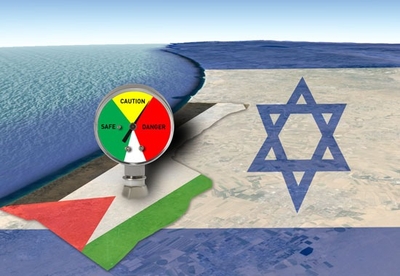
Congressional Caucus Seeks New Approach to Israeli-Palestinian Conflict

April 27, 2017

Congressional Caucus Seeks New Approach to Israeli-Palestinian Conflict, Investigative Project on Terrorism, April 27, 2017

(Please see also, The Agenda for the Trump-Abbas Meeting. — DM)

The Congressional Israel Victory Caucus (CIVC) was launched on Thursday in an effort to revitalize U.S. engagement with the Israeli-Palestinian conflict, building on perspectives espoused by the Middle East Forum (MEF).

The caucus calls for the need to put the onus of peace on the Palestinians, to give up their rejectionist claims about Israel’s right to exist as Jewish state. The initiative also calls for the U.S. to cease pressuring Israel to make major concessions that often lead to more Palestinian violence and terrorism.

Co-chairs, Reps. Ron DeSantis, R-Fla., and Bill Johnson, R-Ohio, expressed strong support for Israel and its right to defend itself at Thursday’s launch event, which featured several other Republican congressmen.

“Israel is not the problem in the Middle East; it is the solution to many of the problems that bedevil the region. American policy must ensure that Israel emerges victorious against those who deny or threaten her existence,” DeSantis said in a statement announcing the initiative.

The caucus wants the Palestinian Authority (PA) to stop its violent incitement against Jews and Israelis. It aims to help reverse one sided, anti-Israel United Nations resolutions and oppose efforts to delegitimize Israel through initiatives such as the Boycott, Divestment, and Sanctions (BDS) campaign.

Palestinian incitement prevents peace from materializing, Johnson said, specifically calling out the widespread practice of naming Palestinian institutions and schools after terrorists responsible for murdering innocent Israelis.

DeSantis also blasted the PA for continuing to pay terrorists’ families after they committed attacks against Israelis.

“Any financial assistance to the Palestinian Authority by American taxpayers cannot continue so long as the PA continues to pay pensions and salaries for families of terrorists. It’s a simply inappropriate use of taxpayer money and it’s not fair to the American taxpayer,” DeSantis said at Thursday’s event.

The Taylor Force Act, a bill named after a 28-year-old American tourist killed by a Palestinian terrorist in Israel last year, would prohibit U.S. assistance to the PA until terrorist salaries and payments cease.

“If you die as a terrorist, as a ‘martyr,’ your family will get an annual stipend greater than the average Palestinian earns. In this case, the terrorist who killed Taylor Force…was hailed as a hero, was basically given a state funeral, and his family was given money by the state,” says sponsor Sen. Lindsey Graham, R-S.C.

An Outsider Election

April 27, 2017

An Outsider Election, Bill Whittle.com via YouTube, April 26, 2017


New Sheriff in Town: The First 100 Days at the Sessions DOJ

April 27, 2017

New Sheriff in Town: The First 100 Days at the Sessions DOJ, BreitbartIan Mason, April 27, 2017

(It’s still a work in progress.  He — like President Trump — can’t do everything first, particularly with the “deep state” swamp still in need of drastic draining. — DM)

Sandy Huffaker/Getty Images

Wednesday saw the first of Attorney General Sessions’ Senate-confirmed subordinates take office: Deputy Attorney General Rod Rosenstein. Over the coming weeks, it is expected that serious progress will be made on nominating and confirming permanent occupants for the dozens of political positions at the Department of Justice, including the over 90 U.S. Attorneys who lead federal criminal prosecutions. The key victories of the first 100 days were accomplished by the Attorney General without any of them in place. As his team assembles around him, Attorney General Sessions looks to be better able to direct the legal policy of the United States government to restore his vision of law and order.

**********************

Under the leadership of Attorney General Jeff Sessions, the first 100 days at the Department of Justice have seen perhaps the most straightforward and earnest efforts to bring the promises of the Trump movement to fruition.

Stepping into leadership at a DOJ managed for eight years by Eric Holder and Loretta Lynch, Sessions has had an uphill battle to implement the key tenets of law and order that so many Americans have long craved and which President Donald Trump promised as a candidate: an end of the lawless hypocrisy on the southern border and in the internal enforcement of our immigration laws, especially in state a jurisdictions that openly flaunt federal law and proclaim themselves “sanctuaries;” a firm commitment to get a handle on rising violent crime, especially in our most dangerous inner cities; and steadfast support of our law enforcement officers at a time when they face danger and disparagement from inside the government and without.

Hitting the Ground Running:

Attorney General Sessions was confirmed by the Senate on February 9, 2017, three weeks into the new administration. One of the very first national politicians to endorse candidate Trump, he was the fifth cabinet member to take his seat, but not before a smooth yet contentious confirmation process yielded one of the most awkwardly worded and forced political slogans of recent memory.

“Nevertheless, she persisted,” the much-touted line goes, a reference to Senate Majority Leader Mitch McConnell’s (R-KY) explanation of his use of Senate rules to prevent Sen. Elizabeth Warren (D-MA) reading a 30-year old letter from Coretta Scott King to imply racist motives to then Senator Sessions. The use was later criticized by Ms. King’s niece.

The fireworks on the Senate floor were quickly followed up in the White House. On his first day as Attorney General, Sessions stood by President Trump’s side as he signed no fewer than four executive orders pertaining to the Justice Department.

A “New Era” on the Border

Without doubt, cracking down on illegal aliens and the resultant lawlessness on the border and in our immigration system has been the greatest focus of Sessions’ attentions in his tenure at DOJ. Merely the signal of will from the new administration has already brought extraordinary results. March of 2017 saw the lowest number of illegals caught on the border in 17 years, a 72 percent reduction in apprehensions from the last month of the Obama administration.

Rhetoric was repeatedly backed up with action on the Attorney General’s part. In early March, the DOJ shifted 50 immigration judges to detention center along the border and in illegal alien heavy cities. The were set to work in twelve-hour shifts to help clear the massive backlog of deportation cases. This proved to be merely a prelude to much more substantial reform.

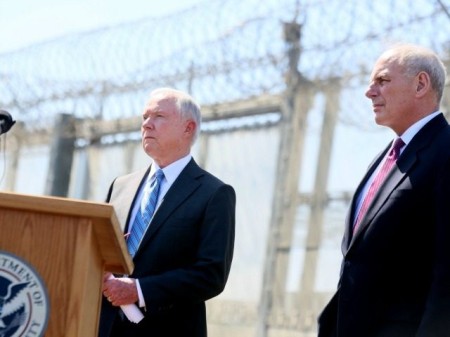
On the morning of April 11, 2017, the Attorney General toured the southern border with officers of U.S Customs and Border Protection. Addressing them and the nation, he proclaimed, “For those that continue to seek improper and illegal entry into this country, be forewarned: This is a new era. This is the Trump era.”

“The catch and release practices of old are over,” Sessions continued, announced that 125 additional immigration judges would be hired on expedited basis. They would be needed because from this point on all adults apprehended at the border were to be detained by federal authorities.

A new set of guidelines was sent to every federal prosecutor in the country. Those who illegally enter the United States a second time will now face felony prosecution as a matter of course, as well those who illegal enter after having been deported, and transporting or harboring three or more illegal aliens. Charges of aggravated identity theft are to be levied on those caught with fraudulent documentation.

These measures are designed to work in tandem with a similar ramping up at the Department of Homeland Security, where 10,000 additional ICE officers have been authorized and are in the process of being hired. Attorney General Sessions made a point of making joint appearances with DHS Secretary John Kelley, presenting a united front to bring order to the border. The two cabinet officials noted increased arrests, more deportations of criminals, and other operations contributing to the apparent decrease in illegal border crossings.

While President Trump has, so far, not seen it fit to reverse Obama’s Deferred Action on Childhood Arrivals executive order, granting amnesty to those who came illegal as children and register with the federal government, the Attorney General has made it clear that the law remains the law. Asked by Fox News in April about the deportation of certain so-called DREAMer (after the never enacted DREAM act), Sessions was unequivocal, “The policy is that if people are here unlawfully, they’re subject to being deported. Our priority is clear. Our priority is to end the lawlessness at the border.”

No Sanction for “Sanctuaries”

From the very beginning of his tenure, Attorney General Sessions has tried to bring jurisdictions who refuse to cooperate with federal immigration enforcement back to legal normality, even if it means cutting their federal funds to convince them to do so. Sessions has done this in the face of steadfast refusal to cooperate by some of nation’s most powerful local leaders. For example, Chicago, under the leadership of Mayor Rahm Emmanuel, went so far as to issue a new type of identification available to illegal alien without the city keeping records in response to fears the administration might be able to force the “sanctuary” to give up information on immigration status. Sessions made a point of calling out a California prosecutor who appears to, as a matter of policy, be reducing charges to avoid triggering “violent felon” deportation requirements.

The most troubling resistance, however, came this final week of the first 100 days, as a federal court in San Francisco blocked enforcement of President Trump’s executive order commanding Sessions to cut off federal funds from recalcitrant jurisdictions. At the moment, as the administration has released no comprehensive plan as to what funds are subject to suspension, it is unclear what effect this temporary order will have. It will, however, prevent the use of that executive order’s authority while a lawsuit from a number of California sanctuary jurisdictions makes its way through the courts.

Sessions has not taken this tactic to continue flaunting federal immigration law lightly. In a statement Wednesday, the Attorney General was very clear as to how he saw the lawsuit:

At the heart of this immigration debate is disagreement over whether illegally entering this country is a crime.  Our duly enacted laws answer that question.

Nevertheless, actions that have always been understood to be squarely within the powers of the President, regardless of the Administration, have now been enjoined.  The Department of Justice cannot accept such a result, and as the President has made clear, we will continue to litigate this case to vindicate the rule of law.

Separate from the wider pledge to cut the flow of federal funds to sanctuary jurisdictions, Sessions has used his independent authority to bring pressure to bear. After weeks of threatening action, the Department of Justice sent letters to nine of the states and cities who most vigorously stifle immigration enforcement, demanding they show compliance by June 30 or forfeit their DOJ Bryne Grants for law enforcement. As these grants already have requirements to follow federal law attached to them, these letters may be unaffected by the ongoing court fracas over President Trump’s executive order.

Zero Tolerance:

The mayhem of our inner cities in the waning years of the Obama administration was no less troubling than the chaos on the border. On the day Sessions took office, an executive order established a task force for tackling the violent crime increase seen in certain cities. Sessions has spoken on numerous occasions on his support for a return to “broken windows” policing and taking local law enforcement’s side in their effort to wrestle their crime rates back down to the historic lows seen only a few years ago.

Some of the violence is fueled by what the justice department calls “transnational criminal organizations,” brutal gangs like MS-13 and wide-reaching networks like the Mexican drug cartels. At a meeting of the Attorney General’s Organized Crime Council, Sessions made clear his department would have “zero tolerence” for gang violence as it brings an executive order targeting these organizations for deportation and dismantling into reality.

On several occasions, Sessions has highlighted his continued support for the type of rigorous policing that came under intense fire in the last administration.

Supporting Law Enforcement:

To many Americans, the Holder-Lynch DOJ’s failure to keep crime in check and the border under control was compounded by the perceived failure to adequately support law enforcement officers and their in this trying time. Black Lives Matter and other left-wing groups brought anti-police rhetoric to the forefront of the public discourse and politicized violence against the police made headlines throughout 2014, 2015 and 2016. The Justice Department responded by launching investigations into police brutality, bias, and misconduct, making it anything but clear that American law enforcement had their unequivocal support.

Spearheaded by Assistant Attorney General Vanita Gupta’s Civil Rights Division, the Obama administration responded to riots in Ferguson, Missouri, and Baltimore, Maryland by launching federal investigations into those cities’, and others like murder-capital Chicago’s, police departments. The results were predictable. A “Ferguson Effect,” where officers were reluctant to make the routine stops necessary to keep crime under control for fear of being sanctioned for misconduct contributed to a shocking rise in violent crime in the very communities supposedly protected by federal oversight of police. Initially dismissed as a right-wing conspiracy theory, the Ferguson Effect has since been supported by a survey of police officers and by a National Institute of Justice study funded by the Obama DOJ.

When Attorney General Sessions took the reigns at DOJ, there was an immediate shift in tone. “Please know that you have the full support of our Department,” Sessisons told a meeting of police chiefs in April. He went on to call out the former administration’s treatment of police:

In recent years, as you know, law enforcement as a whole has been unfairly maligned and blamed for the crimes and unacceptable deeds of a few bad actors. Amid this intense criticism, morale has gone down, while the number of officers killed in the line of duty has gone up.

Attorney General Sessions has done what is in his power to try and reverse the damage done to Law Enforcement relations. He ordered a complete review of all Obama-era investigations into local law enforcement. He has even sought to scale back the consent decree reached to install federal monitoring of Baltimore’s Police Department in the waning days of the Obama administration. When the federal judge in the case refused to reopen the issue, Sessions issued a public statement criticizing the whole endeavor, saying, “There are clear departures from many proven principles of good policing that we fear will result in more crime.”

Looking Forward:

Wednesday saw the first of Attorney General Sessions’ Senate-confirmed subordinates take office: Deputy Attorney General Rod Rosenstein. Over the coming weeks, it is expected that serious progress will be made on nominating and confirming permanent occupants for the dozens of political positions at the Department of Justice, including the over 90 U.S. Attorneys who lead federal criminal prosecutions. The key victories of the first 100 days were accomplished by the Attorney General without any of them in place. As his team assembles around him, Attorney General Sessions looks to be better able to direct the legal policy of the United States government to restore his vision of law and order.

Hamas Wants Quiet As It Prepares For Next Assault on Israel

April 27, 2017

Hamas Wants Quiet As It Prepares For Next Assault on Israel, Investigative Project on Terrorism, Yaakov Lappin, April 27, 2017

In the long run, Sinwar and his regime plan to continue to prepare for the ‘grand’ destiny they have chosen for Gaza. So long as Hamas rules Gaza, it will be the base of unending jihad against Israel, buffered by tactical ceasefires, until conditions are ripe for a new assault.

**************************

Strategically, Hamas remains as committed as ever to its objective of destroying Israel and toppling the Fatah-run Palestinian Authority in the process. Tactically, however, Hamas exhibits pragmatism and won’t rush into wars with Israel when conditions are ill suited.

Hamas looks at the long run, and remains convinced that it can eradicate Israel, even if it takes decades or centuries. Yet it would prefer to bide its time, and build up its force until the next clash while working to decrease its acute regional isolation. For this to happen, Hamas needs to avoid plunging Gaza into a new war any time soon. Yet it remains far from clear that it will be able to do this.

Should a war erupt in the near future, it likely will be triggered by unplanned dynamics of escalation.

Gaza’s woeful living standards and infrastructure are among those factors. Crises such as the ongoing electricity supply problem plaguing the Strip could facilitate an early conflict, as Hamas may try to distract the population’s frustrations from its failings, and divert them to Israel.

The Palestinian Authority (PA) is threatening to make matters worse by cutting off cash for Gaza’s power plant. It’s part of the ongoing feud between the Fatah-run PA in Ramallah and Hamas in Gaza. Gazans now receive electricity only four to six hours a day due to this feud. In January, Gazans took the unprecedented step of protesting power cuts, making Hamas extremely nervous.

In addition to tensions over the electricity crisis, a Hamas-run terror cell could spark conflict if it carries out a mass casualty attack that spawns Israeli retaliation.

The sheer scope of such plots that Israel thwarts every year is enormous.

Last year, 184 shooting attacks, 16 suicide bombings, and 16 kidnapping plots were foiled, Shin Bet chief Nadav Argaman testified last month before the Knesset’s Foreign Affairs and Defense Committee. Hamas had “significantly increased” efforts to pull off attacks in the West Bank and in Israel, he said, adding that Israeli security forces arrested more than 1,000 Hamas members in the West Bank last year and broke up 114 cells.

These are risks Hamas is prepared to take, since the day that it ceases all attempts to carry out jihadist terrorism against Israel is the day that it stops being Hamas.

Yet Hamas is also a government now, and it must consider the Gazans it rules. Hamas is keenly aware of Palestinian sentiment. Its leaders grew up in Gaza’s refugee camps and always have their finger on the pulse of Gazan society.

Hamas leaders seem to understand that the public opposes a new damaging war with Israel. They recognize that the Palestinian public cannot stomach a war with Israel every two years. The reconstruction program in Gaza following the 2014 conflict is far from complete. There are still Gazans whose homes haven’t been repaired from the damage inflicted in 2014.

The general population, despite being exposed to Hamas’s daily propaganda diet of jihadist rhetoric, would likely be reluctant to be again be used as human shields by the military wing, barely three years since the end of the last clash.

The price of Hamas’s policy of embedding its rocket launchers and fighters in Gaza’s civilian areas also is not alluring to many Gazans.

On the flip side, one of Hamas’s worst fears is of being perceived as weak. After one of its senior operatives was mysteriously killed recently, it executed three people it accused of collaborating with Israel.

Hamas also responded to Mazen Fuqaha’s murder by sending threatening messages to Israel promising vengeance. Hamas videos suggest it will target senior Israeli security officials for assassination.

Fuqaha was a key figure in the Izzadin Al-Qassam Brigades, and reportedly in charge of setting up multiple terrorist cells in the West Bank. His bullet-ridden body was found last month outside of his Gazan apartment building.

The Israeli defense establishment takes these Hamas threats seriously. Despite the noise, however, Hamas has not rushed to respond just yet – underlining the fact that Hamas is aware of the restraints factors that it is under.

Since the end of the 2014 war with Israel, the Islamist regime has shied away from escalating the security situation with Israel.

Hamas’s leadership sees unfavorable regional conditions. They lack any powerful regional backer following the 2013 downfall of Muhammad Morsi, the Muslim Brotherhood president in neighboring Egypt, in whom Hamas staked so many of its hopes.

In the past, Hamas enjoyed many partnerships, enjoying arms support and funding from the Shi’ite axis (Iran and Hizballah) – and forming relationships with Sunni powers.

But the Middle Eastern regional upheaval, which pits Sunnis against Shiites, and Islamists against non-Islamists, forced Hamas to make choices. It could no longer be on the same side of both Shi’ite Iran and Sunni Saudi Arabia, who are locked in a transnational proxy war. In the same vein, Hamas cannot be on the same side as both the Assad regime and the Sunni rebels fighting to remove him.

Worst of all from Hamas’s perspective, Morsi’s departure means it cannot rely on its primordial impulse to attach itself to a Sunni Muslim Brotherhood-led backer.

Five years ago, there were initial signs of a regional wave of Muslim Brotherhood successes. The Brothers rose to power in Egypt, Turkey, Tunisia, and had Qatari backing. Morsi’s 2013 fall changed Hamas’s fortunes for the worse. The rise of Egyptian President Abdel Fattah El-Sisi, a leader who identifies Hamas as a Gazan branch of his domestic arch-enemy, the Egyptian Muslim Brotherhood, guaranteed Hamas’s isolation.

Relations with Cairo remain rocky despite recent Hamas attempts to improve ties. Egypt may open its Rafah border crossing a few days a week, but this does not change its core view of Hamas as a true enemy, to be held at bay, weakened, and deterred.

Hamas has also fallen out with Saudi Arabia. And Hamas and Iran do not get along very well either, despite Iran continuing to be the chief sponsor of the military wing, paying it $50-$60 million a year, according to various estimates.

This leaves Hamas with just two stalwart friends: Qatar and Turkey, neither of which can back them substantially. Turkey is not an Arab state, meaning that its role in the Arab world is limited, and its desire to lead the Arab world will always be met with suspicion. A failure by Turkey to infiltrate the region means that it can only do so much to assist Gaza. Qatar, though wealthy, is politically weak, and geographically distant.

New Hamas leader Yihyeh Sinwar, despite his fundamentalist inclinations, must consider these constraints and see that his Islamist-run enclave has little real backing.

To compound its problems, Hamas also has serious financial issues. It has three main sources of income: Donations from states, donations from private individuals, and Hamas’s network of investments.

Hamas gets far less money than it used to from its donors, according to Israeli assessments. Only Qatar and Turkey donate on a regular basis, while Iran continues to finance the military wing, but not the entire movement.

Hamas is a large organization, with operations in the West Bank, Qatar, and Turkey in addition to Gaza. In the Strip, it needs to pay salaries, and prepare for its next clash with Israel. Hamas also seeks to export terrorism to the West Bank and build up political support among West Bank Palestinians. All of this costs money. It is has offices and headquarters in multiple states overseas that require annual budgets.

Private Gulf State donors are drying up. Wealthy Saudis are more interested in supporting Syrian rebels. Hamas’s cause has moved to the back of the line.

Its investments, meant to be saved for a rainy day, now must be tapped.

So what can Hamas do? First and foremost, it continues its domestic military build-up, mass producing rockets, mortar shells, variants of shoulder-fired missiles, drones, and digging tunnels – all at the expense of the welfare of the 2 million Palestinians it rules.

That’s because Hamas drew many operational lessons from its last conflict with Israel, and is keen on rebuilding its terrorist-guerrilla army without interruptions.

One lesson was to focus on a perceived Israeli vulnerability through short-range strikes. To that end, it is building new rockets that carry 200 kilogram warheads – significantly larger than past rockets made in Gaza.

These projectiles are not accurate, but would cause enormous damage if they slammed into a southern Israeli town or village.

Hamas weapons factories produce simple RPGs as well.

Second, Hamas is trying to becoming more ‘acceptable’ to the region and to the world. It is about to unveil a new charter which will be an attempt to obfuscate its jihadist ideological leanings and ties with the Muslim Brotherhood, and present itself as being merely a national “resistance” organization.

In the long run, Sinwar and his regime plan to continue to prepare for the ‘grand’ destiny they have chosen for Gaza. So long as Hamas rules Gaza, it will be the base of unending jihad against Israel, buffered by tactical ceasefires, until conditions are ripe for a new assault.

Yaakov Lappin is a military and strategic affairs correspondent. He also conducts research and analysis for defense think tanks, and is the Israel correspondent for IHS Jane’s Defense Weekly. His book, The Virtual Caliphate, explores the online jihadist presence.

The Agenda for the Trump-Abbas Meeting

April 27, 2017

The Agenda for the Trump-Abbas Meeting, Front Page MagazineCaroline Glick, April 27, 2017

Originally published by the Jerusalem Post

The day after Israel celebrates its 69th Independence Day, US President Donald Trump will greet PLO chief Mahmoud Abbas at the White House. The date of their meeting, May 3, is notable not least for its timing.

The timing of the meeting presumes a linkage between the establishment of Israel and the establishment of a Palestinian state. This is not merely obnoxious, it is also blind to reality.

In reality, an independent state of Palestine has existed for the past 12 years in Gaza. Rather than build that up and declare independence, Abbas and his comrades surrendered Gaza to Hamas in 2007.

Hamas, in turn, transformed independent Palestine into a base for jihad.

Abbas’s failure to declare independence in 2005 – and the subsequent failure of his US-trained forces to defend their control over Gaza in June 2007 from Hamas terrorists – is generally overlooked. But it is critical that Trump understand the significance of his behavior before he meets with Abbas.

Since the inception of the peace process between Israel and the PLO in 1993, the professed goal of the PLO has been to establish an independent Palestinian state on any territory over which it was able to take control from Israel. Yet 12 years ago, when Israel withdrew its citizens and military from Gaza, the PLO refused to take responsibility for the area insisting ridiculously that Gaza was still controlled by Israel.

Then 10 years ago, US-trained PLO forces fled to Israel rather than defend their control of Gaza when Hamas took up arms against them.

There are, it seems, two main reasons for Abbas’s behavior. The first is directly related to how he understood Israel’s decision to withdraw.

In December 2003, then-prime minister Ariel Sharon stunned the country when he adopted the platform of the Labor Party – which he had just massively defeated in the general elections – and removed all Israeli communities and military installations from Gaza, including from the border with Egypt, by the end of 2005.

Israeli society was nearly torn apart in the one year and eight months between Sharon’s surprise announcement and the expulsion of Gaza’s Jews in August 2005. The media hemorrhaged with continuous propaganda that demonized the Israeli residents of Gaza and the religious Zionist community in general.

A reminder of that toxic period came earlier this month, when Haaretz published a column by veteran reporter Yossi Klein in which he alleged that religious Zionists posed a graver danger to the State of Israel than Hezbollah.

Abbas and his lieutenants viewed the domestic chaos that engulfed Israel at the time as proof of Israel being on its way off the stage of history.

If this was how Israelis reacted to the destruction of 21 communities in Gaza (and four in northern Samaria) and the dispossession of 10,000 Israelis, it was clear to Abbas and his comrades that Israeli society would collapse if Sharon carried out his plan to reenact the Gaza withdrawal tenfold in Judea and Samaria after the 2006 elections.

Why accept Gaza if all of Israel was about to be destroyed – by its own hand? The second reason that Abbas didn’t declare independence in Gaza, is because he had no interest in being held accountable for his behavior – as leaders of independent states are. If he accepted sovereign power, then the Palestinians as well as Israel and, presumably, the rest of the world would be able to hold him to account for what happened within the territory he controlled. His ability to blame Israel for his failures would be diminished, at least in theory.

Far better, Abbas concluded, to pretend that Israel’s withdrawal was meaningless and blame Israel for his failure to govern his own territory.

Both reasons for Abbas’s rejection of responsibility over Gaza are important because they also reflect the views of the Palestinians as a whole.

Dan Polisar, from Shalem College, summarized in a recent article in the online magazine Mosaic, his study of more than 400 public opinion surveys of the Palestinians in Judea, Samaria and Gaza taken by professional pollsters over the past 23 years.

Like Abbas in 2005, the overwhelming majority of Palestinians believe that Israel isn’t long for this world.

In one 2011 survey, for instance, a mere 23% of Palestinians said they were certain that Israel will continue to exist 25 years hence. 44% were certain it would not.

The fact that more than three quarters of Palestinians are uncertain if Israel will survive is not only a function of Israel’s own self-destructive behavior – it is premised as well on Palestinian ideology.

The vast majority of Palestinians reject Israel’s right to exist. Indeed, a mere 12% of Palestinians believe that Jews have ties to the land of Israel.

Polisar showed that, whereas a plurality to a bare majority of Palestinians accepts the premise of a twostate solution, the overwhelming majority reject any deal that would leave Israel intact as a viable state capable of defending itself. Equally importantly, 68% of Palestinians believe that even if a Palestinian state is established in Gaza, Judea and Samaria with Jerusalem as its capital, they should continue to aspire to Israel’s destruction.

In other words, even if the PLO signs a deal with Israel that says the conflict has been resolved, for 68% of Palestinians the conflict will continue. They oppose ending the education of their children to seek Israel’s destruction and accepting Israel as a peaceful neighbor.

This then, brings us to Trump’s visit with Abbas, the day after Israel’s 69th birthday.

What does he intend to discuss with Abbas? From media reports, it appears that Trump intends to discuss the Palestinian Authority’s subsidization of terrorism to the tune of $300 million each year, which it pays out as salaries to terrorists in Israeli prisons and as stipends to their families.

In an interview with Sean Hannity on Fox News earlier this week, Prime Minister Binyamin Netanyahu urged Trump to hold Abbas to account for his massive budgetary outlays to terrorists and their families. He asked that Trump demand as well that Abbas stop the PA ’s indoctrination of the Palestinians to seek the annihilation of Israel and the murder of its citizens.

This is well and good. But it seems a bit beside the point. The point is that 69 years ago, the Jews established our state. A Palestinian state was not established then or since, not because Israel was unwilling for such a state to come into being, but because the Palestinians refuse to accept Israel’s right to exist.

If any good is to come from Trump meeting with Abbas – on May 3 or at any other time – then he should send the following message to Abbas and to the rest of the world.

To date, the US has supported the goal of Palestinian statehood, because it convinced itself that the Palestinians were interested in a state that would live at peace with Israel. The US pressured Israel to make concessions to the Palestinians in order to encourage them to accept Israel. And the US funded the PA thinking that doing so would advance the cause of peace. It trained and armed PA security forces for the same reason.

To date, the Palestinians, the PLO and the PA have not lived up to their side of the bargain – on anything.

They have not come to terms with Israel’s existence; they have not abjured terrorism; and they have not accepted responsibility for the areas under their control, either in Gaza, or in Judea and Samaria.

Since his is a new administration, Trump is willing to give Abbas the benefit of the doubt for three months. In that time Abbas needs to stop all financial transfers to terrorists and their families – in and out of prison; he needs to change the names of all the public sites now named after terrorists; and he needs to purge all anti-Jewish content from his PA -controlled media and mosques.

If Abbas fails to do all of these things by August 3, then the Trump administration will abandon its support for Palestinian statehood and its recognition of the PLO .

Golan tension: Pro-Iran troops move on Quneitra

April 27, 2017

Golan tension: Pro-Iran troops move on Quneitra, DEBKAfile, April 27, 2017

(Please see also, Massive Explosion Reported Near Damascus International Airport Following Israeli Airstrikes. — DM)

There is no word yet on whether the warning issued by the defense minister from Moscow has produced a direct Israeli response to the provocation. Very possibly the five explosions and ball of fire they set off at Damascus international airport Thursday morning may prove to be connected to that response.

***************************

Early Thursday, April 26, a mixed Syrian-Iranian-Hizballah force embarked on a general offensive in southern Syria ready for a leap on Israel’s Golan border. They moved forward in the face of Israeli warnings that were relayed from Moscow to Tehran and Hizballah.

This latest warning was issued by Defense Minister Avigdor Lieberman, who is visiting the Russian capital this week to attend an international security conference. After meeting Russian Foreign Minister Sergey Lavrov and Defense Minister Gen. Sergey Shogun, the Israeli minister stated clearly on Wednesday: “Israel will not allow the concentration of Iranian and Hizballah forces on its Golan border.”

By Thursday morning, it was evident that a decision had been taken in Moscow, Tehran, Damascus and Beirut to ignore Lieberman’s warning.

DEBKAfile’s military sources report that early Thursday, Shiite militias under the command of Iranian Revolutionary Guards officers, alongside Hizballah troops, organized as the Southern Shield Brigade, launched their offensive at Mt. Hermon southwest of Damascus, on their way to the Syrian-Israeli Golan border in the region of Quneitra. The Syrian contingents taking part in this push are the Syrian army’s elite 42nd Brigade and elements of the 4th Mechanized Division.

Their first objective is to capture a string of villages held by Syrian rebel groups in the region of Hadar on the Hermon slopes. They are advancing towards the Golan along the Beit Jinn route.

There is no word yet on whether the warning issued by the defense minister from Moscow has produced a direct Israeli response to the provocation. Very possibly the five explosions and ball of fire they set off at Damascus international airport Thursday morning may prove to be connected to that response.

Where Are the Moderate Muslims?

April 27, 2017

Where Are the Moderate Muslims? Prager University via YouTube, April 27, 2017

(This is similar to what Muslim reformers, also known as “Islamophobes”, such as Dr. Zuhdi Jasser and the Clarion Project, which also promotes reform, have been saying. The stats were presented by Clarion Project several years ago. A Muslim reformation will be difficult, will take a long time — so did the Christian reformation — and may not happen. For America, however, I see no alternative for the reasons stated here. — DM)


UTT Throwback Thursday: Leaders Inability to Tell Friend from Foe

April 27, 2017

UTT Throwback Thursday: Leaders Inability to Tell Friend from Foe, Understanding the Threat, April 26, 2017

One lesson the recent debacle in Sioux Falls brought to center stage is that many leaders cannot discern friend from foe, which exposes Americans to greater danger each day.

Here are a few examples:


Abdurabman Alamoudi was the most prominent Islamic leader in the United States in the 1990’s, and founded or led major Islamic organizations, including the Muslim Students Association.  He created the Muslim Chaplain program for the Department of Defense, was a “Goodwill Ambassador” for the State Department, and was the Islamic Advisor to President Clinton.  The Washington Post called him the “pillar” of the Islamic community in Washington, D.C.

In 2003, Alamoudi was arrested at Heathrow Airport in London, England with $340,000 cash he received from the Libyan government for the global jihad.  As the US government publicly stated, Alamoudi was a financier for Al Qaeda.  He was sentenced to 23 years in prison – the sentence was reduced under President Obama’s administration by 6 years.  He will be released in 3 years.

None of the men or women working directly with Alamoudi were prosecuted.

Mohamed Magid holds a secret clearance and, until recently sat on the Homeland Security Advisory Committee. He worked directly with the last several Secretaries of State, received awards from the FBI, lectures at CIA headquarters, worked with the Obama administration, and was publicly lauded by the President’s Deputy Mational Security Advisor – Denis McDonough.  Until 2014, Magid was the President of the largest Islamic organization in North America, the Islamic Society of North America (ISNA) – which also happens to be, according to the Department of Justice, a Muslim Brotherhood organization which directly funds the terrorist group Hamas.

Magid was recently given another award by FBI Director James Comey.

Anwar al Awlaki was called the “new face of moderate Islam” by some in the media, like NPR and PBS.  He gave lectures inside the US Capitol about Islam’s prophet Mohammad and spoke at the Pentagon while he was the Imam of a Hamas mosque in Virginia – Dar al Hijra Islamic Center.  This “moderate” muslim was killed in September 2011 by a US drone strike because he was the leader of Al Qaeda in Yeman.

Suhail Khan currently works for Microsoft, and has been given access into inner circles inside the Republican party.  His lead advocate is Republican strategist Grover Norquist of Americans for Tax Reform.  A number of Republicans have stepped up to defend Khan including leaders of the American Conservative Union, and others.  Khan served for two successive Secretaries of Transportation under the Bush administration and held a secret clearance

Suhail Khan is the son of one of the most influential Muslim Brotherhood leaders in the United States.  ISNA has an annual award named after his father.  Khan himself publicly lauds his deceased father and proudly proclaims the jihadi mantra that muslims love death more than the unbelievers love life.

Siraj Wahhaj was the first Muslim Imam to offer prayers inside the US House of Representatives.  Wahhaj is an unindicted co-conspirator in the 1993 World Trade Center bombing and was a character witness for the Blind Sheikh, convicted for his part in a number of terrorist plots in the US.

On any given day, Nihad Awad can be found walking the halls of Congress, on CNN or Fox News programs (like the O’Reilly Factor when it was on the air) or meeting with Christian or Jewish leaders around the nation as a part of “outreach.”

Local and and national media fall over themselves to promote Awad’s organization, the Council on American Islamic Relations (CAIR), as a “civil rights organzation.”

The US Department identifies CAIR as a member of the US Muslim Brotherhood’s Palestine Committee, which is Hamas.  CAIR is Hamas.

Nihad Awad is the leader Hamas in the United States and – in UTT’s professional opinion – is also the General Masul (Guide/Leader) of the US Muslim Brotherhood.

American citizens, your leaders across the board – of both political parties – have proven they are incapable of discerning friend from foe.

As UTT continues to restate:  this war will be won at the local level or it will be lost.  Local Sheriffs and pastors are the key.  Get to work educating them.  UTT stands ready to help.