Should the U.S. shift to a merit-based immigration system? Fox News via YouTube, March 3, 2017
(Yep. — DM)
Should the U.S. shift to a merit-based immigration system? Fox News via YouTube, March 3, 2017
(Yep. — DM)
Iran in Crisis, American Thinker, Heshmat Alavi, March 5, 2017
(Please see also, Mullahs’ Nightmare: Huge Demonstration Breaks Out In Tehran. — DM)
Forecasting what lies ahead is truly impossible, making Khamenei and his entire regime extremely concerned, trekking this path very carefully and with a low profile. As we witnessed with the inauguration of Ronald Reagan, Iran immediately released the 52 hostages held for 444 days.
This regime understands the language of force very carefully. And yet, there is no need to use military force to inflict a significant blow and make Tehran understand the international community means business. Blacklisting Iran’s IRGC as a terrorist organization by the U.S. at this timing would be the nail in the coffin for the mullahs.
********************************
The recent dust storms that wreaked havoc in southwest Iran signaled only one of the many crises the mullahs are facing less than three months before critical elections. Tehran has been hit with severe blows during the Munich Security Conference, contrasting interests with Russia, the recent escalating row with Turkey, and most importantly, a new U.S. administration in Washington.
These crises have crippling effects on the mullahs’ apparatus, especially at a time when Iranian Supreme Leader Ali Khamenei sees his regime facing a changing balance of power in the international community, and is faced with a major decision of selecting the regime’s so-called president.
Iran and Ahvaz
The dust storms crisis in Ahwaz, resulting from the mullahs’ own destructive desertification policies, caused severe disruptions in water and power services and people pouring into the streets in major protests.
The regime, and especially the Revolutionary Guards (IRGC), has for decades pursued a desertification policy of constructing dams, drying lagoons, digging deep oil wells beneath underground water sources with resulting catastrophic environmental disasters. Various estimates indicate the continuation of such a trend will literally transform two-thirds of Iran into desert lands in the next decade. This will place 14 to 15 million people at the mercy not only dust storms but also salt storms.
Iranian Foreign Minister Mohammad Javad Zarif attended this conference with a series of objectives in mind, only to face a completely unexpected scene. U.S. Vice President Mike Pence described Iran as the world’s leading state sponsor of terrorism. Saudi Arabia Foreign Minister Adel al-Jubeir said the mullahs are the source of threats and instability throughout the Middle East. Turkey went one step further and said Tehran is the heart of sectarianism and spreads such plots across the region, and all traces in Syria lead to Iran’s terrorism and sectarian measures.
This resembles a vast international coalition against Tehran, inflicting yet another blow to the mullahs following a new administration taking control of the White House. These developments are very costly for Khamenei and the entire regime.
In comparison to the early 2000s when the U.S. launched wars against Afghanistan and Iraq, Iran was the main benefactor. The current balance of power now is quite different, as seen in Munich. While there is talk of an Arab NATO, any coalition formed now in the Middle East will be completely against Iran’s interests.
Iran and Russia
Following a disastrous joint campaign in Syria, for the first time Russia is reportedly supporting a safe zone in Syria. Russian Deputy Foreign Minister Mikhail Bogdanov said contacts have been made with the Syrian regime to establish safe zones in Syria. These are the first remarks made by any Russian official on the issue of safe zones in Syria.
Moscow’s increasing contrast in interest with Iran over Syria has the potential of playing a major role in regional relations. Russia certainly doesn’t consider Bashar Assad remaining in power as a red line, a viewpoint far different from that of Iran. Moscow is also ready to sacrifice its interests in Syria in a larger and more suitable bargain with the Trump administration over far more important global interests.
Iran and Turkey
Yes, Ankara and Tehran enjoy a vast economic partnership. However, recent shifts in geopolitical realities have led to significant tensions. Turkish President Recep Tayyip Erdogan accused the mullahs of resorting to “Persian nationalism” in an effort to split Iraq and Syria.
Turkish Foreign Minister Mevlut Cavusoglu accused Iran of seeking to undermine Bahrain and Saudi Arabia as part of Tehran’s “sectarian policy.” Cavusoglu used his speech in Munich to say, “Iran is trying to create two Shia states in Syria and Iraq. This is very dangerous. It must be stopped.”
Tehran considers Ankara’s soldiers in Iraq and Syria as a major obstacle in its effort to expand its regional influence.
U.S. president Donald Trump’s strong approach vis-à-vis Iran and the possibility of him supporting the establishment of a Turkish-administered northern Syria safe zone may have also played a major part in fuming bilateral tensions between these two Middle East powers.
Erdogan has obviously realized completely the new White House in Washington intends to adopt a much more aggressive stance against Tehran. This is another sign of changing tides brewing troubles for Iran’s mullahs.
Iran and Presidential Elections
With new reports about his ailing health, Khamenei is extremely concerned about his predecessor. One such signal is the candidacy of Ibrahim Reisi, current head of the colossal Astan Quds Razavi political empire and a staunch loyalist to Khamenei’s faction, for the presidency. With former Iranian president Ali Akbar Hashemi Rafsanjani out of the picture, Khamenei may seek to seal his legacy by placing Reisi against Iranian president Hassan Rouhani in the upcoming May elections.
This is literally Khamenei playing with fire, as Reisi is considered a hardline figure and such an appointment may spark 2009-like protests across the country, as the country has become a scene of massive social challenges. Rouhani himself doesn’t enjoy any social base support, especially after four years of lies and nearly 3,000 executions.
Final Thoughts
This places the entire regime in a very fragile situation. From the internal crises of Ahwaz, the upcoming elections and the formation of a significant international front threatening the Iranian regime’s strategic interests.
Forecasting what lies ahead is truly impossible, making Khamenei and his entire regime extremely concerned, trekking this path very carefully and with a low profile. As we witnessed with the inauguration of Ronald Reagan, Iran immediately released the 52 hostages held for 444 days.
This regime understands the language of force very carefully. And yet, there is no need to use military force to inflict a significant blow and make Tehran understand the international community means business. Blacklisting Iran’s IRGC as a terrorist organization by the U.S. at this timing would be the nail in the coffin for the mullahs.
Source: Blog: Wiretapping Donald Trump
On March 4 President Trump tweeted that former President Obama had tapped his phone during the election campaign:
“How low has President Obama gone to tapp my phones during the very sacred election process. This is Nixon/Watergate. Bad (or sick) guy!”
The New York Times’ skeptical headline reads, “Trump, Offering No Evidence, Says Obama Tapped His Phones.” A spokesman for the former president stated, “Neither President Obama nor any White House official ever ordered surveillance on any U.S. citizen. Any suggestion otherwise is simply false.”
Could this be another example of Trump “fake news?
It seems unlikely. Former President Obama did not need to micromanage his minions. It is unlikely that he had to give a direct order to wiretap Donald Trump’s phone. So it is probably true that he did not order the surveillance.
However, was Trump wiretapped under the Obama administration? The answer appears to be yes.
Even the New York Times has reported this: “One official said intelligence reports based on some of the wiretapped communications had been provided to the White House.” The apparent justification for this conclusion is based on reports of a FISA warrant that was first requested in June 2016. FISA stands for Foreign Intelligence Surveillance Act. The warrant request is based on the belief that the target of the surveillance has acted as an agent of a foreign power.
This original warrant was denied by the court, so it was reissued in October. The October warrant was approved. According to Andrew McCarthy, “The Obama Justice Department and the FBI spent at least eight months searching for Trump–Russia ties. They found nothing criminal, and clearly nothing connecting Trump to Russian hacking.”
However, the government did not need a FISA warrant to wiretap Donald Trump. The National Security Agency more than likely possesses all of that information. NSA Director James Clapper testified before Congress in 2013 that the agency did not collect “any type of data at all” on millions of Americans. Three months later, documents leaked by Edward Snowden revealed that Clapper had lied.
It would be reasonable to believe that after this revelation, Congress would have increased its oversight of NSA. It would also be reasonable to believe that James Clapped would have been indicted for perjury. One of the major problems with press coverage of these events is that much of the information provided is provided by criminals. These reliable anonymous sources are by definition criminals.
This wiretap incident is all part of a larger unconstitutional government intrusion into the lives of its citizens. There is a long history of illegal government surveillance. It goes back before the J. Edgar Hoover sex tapes of Martin Luther King, Jr., for one. Congresswoman Maxine Waters commented on this database in 2013. She claimed,
“The president has put in place an organization that contains a kind of database that no one has ever seen before in life. That’s going to be very, very powerful.”
This is not simply a database developed by a political party to keep track of its donors. As Waters says,
“that database will have information about everything on every individual in ways that it’s never been done before.”
The federal government conducts millions of background investigations. Most of these are fairly routine. However, in certain cases, a more thorough investigation may be required. Some of these investigations may even require creating compromising situations. Highly respected politicians may be subject to pressure because of their past behavior. Dennis Hastert and Larry Craig have demonstrated that prominent politicians are vulnerable. When President Obama left the White House he took this database with him. This will be a “very, very powerful” tool.
John Dietrich is a freelance writer and the author of The Morgenthau Plan: Soviet Influence on American Postwar Policy, Algora Publishing, 2013.
Secretary of Defense Jim Mattis wants to tap the former U.S. ambassador to Egypt, Anne Patterson, as his undersecretary of defense for policy, but the Pentagon chief is running into resistance from White House officials.
By Pamela Geller – on March 4, 2017

Is Mattis nuts? As ambassador to Egypt, Patterson was instrumental in Obama’s backing of the Muslim Brotherhood Morsi regime in Egypt. And the Egyptians knew it:
Could you imagine if Patterson were a Republican and this was how the Egyptians felt about her? The media would be plastering this all over the place. But in this case, you haven’t heard boo.
“White House pushing back against Mattis appointment,” by Eliana Johnson, Politico, March 2, 2017:
Secretary of Defense Jim Mattis wants to tap the former U.S. ambassador to Egypt, Anne Patterson, as his undersecretary of defense for policy, but the Pentagon chief is running into resistance from White House officials, according to multiple sources familiar with the situation.
If nominated and confirmed, Patterson would hold the fourth most powerful position at the Pentagon – and would effectively be the top civilian in the Defense Department, since both Mattis and his deputy, Robert Work, were military officers.
As ambassador to Egypt between 2011 and 2013, Patterson worked closely with former Egyptian President Mohammed Morsi and his Islamist government. She came under fire for cultivating too close a relationship with the regime and for discouraging protests against it—and White House officials are voicing concerns about those decisions now.
The skirmish surrounding Patterson’s nomination is the latest in a series of personnel battles that have played out between Mattis and the White House, with each side rejecting the names offered up by the other while the Pentagon remains empty. The White House has yet to nominate a single undersecretary or deputy secretary to the Defense Department, while Work, Mattis’s deputy, is an Obama administration holdover who only agreed to stay on until the secretary taps a deputy of his own.
A similar tug of war has played out between the White House and other agency chiefs, most notably Secretary of State Rex Tillerson, whom the president denied his top choice for deputy secretary of state last month.
But it is Mattis who’s dug in most stubbornly, insisting on staffing his own department. “Mattis is a guy who cares very much about personnel,” said a Mattis friend. “He doesn’t want people off the tracks that he has laid down and that he’s running his train on.”
Patterson, a career diplomat, has never held a Defense Department position. She previously served as ambassador to Colombia and Pakistan. President Barack Obama nominated her to be the assistant secretary of State for Near Eastern Affairs, the post from which she retired last month.
She was the top American official in the country during a tumultuous time that saw the rise of Morsi and his supporters and his supporters in the Muslim Brotherhood and, shortly thereafter, their ouster at the hands of the Egyptian military. Patterson became the subject of withering criticism when she dismissed the 2013 uprising against Morsi as “street protests.” Protesters plastered her face – crossed out with a red X – on signs and banners. In part, she had the misfortune of being the face of Obama’s policies in the country, and of the administration’s decision to stick with the Morsi government. Patterson did not immediately respond to a request for comment.
“The biggest pushback [from the White House] is that she was ambassador to Egypt immediately before and after the Morsi presidency,” said a person familiar with the conversations. For Mattis’s part, he has “put her name forward and he doesn’t quite understand why people have an objection,” the person said.
A spokesman for Mattis declined to comment on the secretary’s personnel recommendations to the president.
The secretary of defense has been warring with the president and his aides over personnel since before the inauguration in January.
Transition officials swatted down Michele Flournoy, who served as undersecretary of defense for policy in the Obama administration and who was Mattis’s top choice to be his deputy; she eventually took herself out of the running for the position. Weeks later, Mattis was outraged when he learned from the news media that Trump had nominated an Army secretary without consulting with him, according to several transition aides.
“General Mattis has made it known that Mad Dog’s personnel choices are his and not what we are told are in his opinion political hacks from the Trump team—even though they’re great people,” said a former Trump campaign aide. “It’s the world view of a four-star general.”
US blitzes AQAP in Yemen with an unprecedented 30 airstrikes, Long War Journal, Bill Roggio, March 4, 2017
The large number of strikes over a short period of time indicates the US is changing its tactics in fighting AQAP in Yemen. The US military previously described AQAP as one of the most dangerous terrorist networks that is determined to strike US interests, yet it had been overly cautious in targeting the group. Over the previous five years, the US military averaged just two to three strikes against AQAP a month.
***************************************
The US military has launched more than 30 airstrikes against al Qaeda’s branch in Yemen in three separate provinces over the last several days. Such a large number of strikes is unprecedented in Yemen and indicates a changing US approach to attacking al Qaeda in the Arabian Peninsula, possibly acting on new intelligence gained from a controversial raid by US special operations forces in late January.
It is unknown how many AQAP fighters were killed during the operation. AQAP has not announced the death of any senior leaders.
The Department of Defense announced the airstrikes against al Qaeda in the Arabian Peninsula in a statement attributed to Pentagon spokesman Captain Jeff Davis.
“More than 30 strikes in Yemen” hit “militants, equipment and infrastructure in the governorates of Abyan, Al Bayda and Shabwah,” according to the statement.
Davis described the Yemeni government as “a valuable counterterrorism partner” and said the blitz was coordinated with and approved by the government and its president, Abd Rabbo Mansour Hadi. Davis noted that AQAP continues to use “ungoverned spaces in Yemen to plot, direct, and inspire terror attacks against the United States and our allies.”
The attacks “will degrade the AQAP’s ability to coordinate external terror attacks and limit their ability to use territory seized from the legitimate government of Yemen as a safe space for terror plotting,” according to the statement.
The latest press release also described AQAP as an “extremely dangerous al Qaeda affiliate.”
With the more than 30 strikes against AQAP over the past several days and an additional five in January, the US has already come close in the first two-plus months of 2016 to exceeding the average number of yearly strikes since the program began in 2009. Only two other years (38 in 2016 and 41 in 2012) have a higher strike total.
The large number of strikes over a short period of time indicates the US is changing its tactics in fighting AQAP in Yemen. The US military previously described AQAP as one of the most dangerous terrorist networks that is determined to strike US interests, yet it had been overly cautious in targeting the group. Over the previous five years, the US military averaged just two to three strikes against AQAP a month.
Additionally, the military may have obtained more information about AQAP’s network and exploited it with a series of quick hits over a short period of time to shock the group. The US military and the Trump administration claimed that a controversial raid by US special operations forces against AQAP in Al Baydah province in January netted significant intelligence. One US Navy Seal, two senior AQAP leaders, and at least 13 civilians, including the eight year old daughter of slain radical AQAP cleric Anwar al Awlaki, were among those killed during the raid, which quickly evolved into a heavy firefight that also resulted in the loss of an Osprey aircraft.
Despite years of targeting AQAP, the group retained significant capacity. Davis estimated that AQAP maintains a strength in the “low thousands,” and that the group “can skillfully exploit the disorder in Yemen to build its strength and reinvigorate its membership and training.”
AQAP still controls rural areas of central and southern Yemen despite both attacks from the US and a United Arab Emirates-led ground offensive, which ejected the group from major cities and towns that it held between March 2016 and the summer of 2016. AQAP claims to still operate training camps in Yemen to this day. In mid-July, AQAP touted its Hamza al Zinjibari Camp, where the group trains its “special forces.” Zinjibari was an AQAP military field commander who was killed in a US drone strike in Feb. 2016.
Did the Obama Administration Try Stacking the Deck Against Trump at the Justice Department? Weekly Standard, Mark Hemingway, March 3, 2017
Amid Thursday’s over-hyped brouhaha about Jeff Sessions meeting with the Russian ambassador, a curious detail emerged. In Sessions’ recusal memo, it was explained who at the Justice Department would be handling any investigations into the Trump campaign’s alleged ties to Russia. “Consistent with the succession order for the Department of Justice, Acting Deputy Attorney General and U.S. Attorney for the Eastern District of Virginia Dana Boente shall act as and perform the functions of the Attorney General with respect to any matters from which I have recused myself to the extent they exist,” reads Sessions’ official statement on the matter.
Except that if the Obama administration had its way, Dana Boente wasn’t supposed to be the U.S. attorney to handle these matters in the event that Sessions recused himself. On February 10, USA Today reported the following:
Seven days before he left office, President Obama changed the order of succession without explanation to remove Boente from the list. Obama’s order had listed U.S. attorneys in the District of Columbia, the Northern District of Illinois and the Central District of California.
Why would the Obama administration make this eleventh-hour change to the line of succession at the Justice Department? “At the time, I was told it was done in consultation with Trump transition,” Gregory Korte, the USA Today reporter who wrote the story quoted above, told me Thursday. “Looking back, that’s clearly not the case.”
In fact, it seems like it was quite obviously not the case. The man Obama placed at the head of the line of succession is D.C.’s U.S. Attorney Channing Phillips, who is quite cozy with President Obama and his attorney general, Eric Holder. He is a former senior adviser to Holder, and he stayed on to work under Obama’s next AG Loretta Lynch before Obama appointed Phillips D.C.’s U.S. attorney in 2015. But Phillips goes way back with Holder—Holder first hired Philips in the D.C. U.S. Attorney’s Office in 1994. It’s also safe to say that the AG offices in the Northern District of Illinois and the Central District of California are not hotbeds of Trump supporters.
It looks like the Obama administration was hoping that the reins of power here would unknowingly default to someone unfriendly to Trump in the event Sessions was forced to recuse himself—or even resign, as so many Democrats breathlessly demanded Thursday. (It’s worth noting that Sessions’s claims that he was already considering recusing himself from the Russia investigations because of his role on the campaign seem pretty sincere. Reuters reported last Sunday that the White House was considering the need for Sessions’s recusal long before the teacup tempest about Sessions failing to disclose minor encounters with the Russian ambassador.)
This might seem far-fetched, except to say that the leak-coordinated campaign by former Obama officials to undermine Trump seems to be very real, per the reporting of Lee Smith. Indeed, the New York Times reported Thursday, “In the Obama administration’s last days, some White House officials scrambled to spread information about Russian efforts to undermine the presidential election — and about possible contacts between associates of President-elect Donald J. Trump and Russians — across the government.”
Lt. Col. Shaffer on wiretapping: This is Soviet behavior, Fox News via YouTube, March 4, 2017
(Please see also, Trump Goes Nuclear with Claim Obama Wiretapped him During Election [Updated] and my parenthetical comment there. — DM)
Pat Condell – What I Know About Islam via YouTube, March 4, 2017
(Condell observes, at about three minutes into the video, that if Muslims would interpret the Qu’ran themselves, instead of relying on “Islamic scholars” to do it for them, Islam would be a different and better religion than it is now. Isn’t that what Muslim reformers are trying to do? In Infidel, Ayaan Hirsi Ali complained that it was considered a grave sin to question the wisdom and interpretations of Islamic scholars. In Heretic, she explained the need to reform Islam and to abandon the teachings of such Islamic scholars.
Why do Islamic Scholars who oppose Islam, e.g., Robert Spencer et al, side with the Muslim scholars who favor authoritative interpretations and hence claim that there can be no Muslim reformation?– DM)
France’s Fatal Attraction to Islam, Gatestone Institute, Giulio Meotti, March 4, 2017
Instead of fighting to save what is savable, French opinion-makers are already writing the terms of surrender.
By hybridizing cultures and rejecting Christianity, France will soon end up not even teaching also Arabic, but only Arabic, and marking Ramadan instead of Easter.
Instead of wasting their time trying to organize an “Islam of France”, French political leaders, opinion makers and think tanks should look for ways to counter the creeping Islamization of their country. Otherwise, we may soon be seeing not only a “Grand Imam de France”, but also lashes and stonings on the Champs Élysées.
Two years ago, the rector of the Great Mosque of Paris, Dalil Boubakeur, suggested converting empty churches into mosques, to accommodate the growing Muslim community in abandoned Christian sites. Now, many people in France seem to have taken the idea so seriously that a report released by the foundation Terra Nova, France’s main think tank that provides ideas to the governing Socialist Party, suggests that in order to integrate Muslims better, French authorities should replace the two Catholic holidays — Easter Monday and Pentecost — with Islamic holidays. To be ecumenical, they also included a Jewish holiday.
Written by Alain Christnacht and Marc-Olivier Padis, the study, “The Emancipation of Islam of France,” states: “In order to treat all the denominations equally, it should include two important new holidays, Yom Kippur and Eid el Kebir, with the removal of two Mondays that do not correspond to particular solemnity”.
Thus, Easter and Pentecost can be sacrificed to keep the ever-elusive multicultural “peace”.
Terra Nova’s proposal was rejected by the Episcopal Conference of France, but endorsed by the Union of Islamic Organizations of France, close to the Muslim Brotherhood, which would also like to include the Islamic holidays of Eid al-Fitr and Eid al-Adha in the calendar. The idea of replacing the Christian holidays was also sponsored by the Observatory of Secularism, an organ created by President François Hollande to coordinate secularist policies. The Observatory of Secularism also proposed eliminating some Christian holidays to make way for the Islamic, Jewish and secular holidays. “France must replace two Christian holidays to make way for the Yom Kippur and Eid,” said Dounia Bouzar, a member of the Observatory.
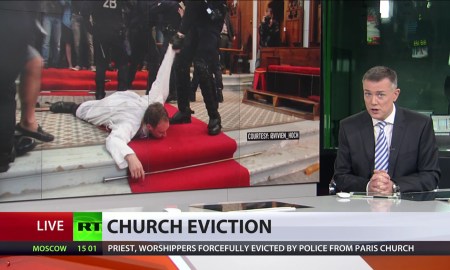 In his recent book, Will the Church Bells Ring Tomorrow?, Philippe de Villiers notes the disappearance of churches in France, and their replacement by mosques. Pictured above: On August 3, 2016, French riot police dragged a priest and his congregation from the church of St Rita in Paris, prior to its scheduled demolition. Front National leader Marine Le Pen said in fury: “And what if they built parking lots in the place of Salafist mosques, and not of our churches?” (Image source: RT video screenshot)
“France is no longer a Catholic country”, wrote Frederic Lenoir, editor-in-chief of Le Monde des Religions. The newspaper Le Figaro wondered if Islam can already be considered “France’s prime religion.” Instead of fighting to save what is savable, French opinion-makers are already writing the terms of surrender. That is the meaning of Terra Nova’s proposal.
A similar shocking idea came from another think tank, the Montaigne Institute, which provides ideas to another presidential candidate, Emmanuel Macron. In its report, written by Hakim El Karoui, the Montaigne Institute proposed the creation of a “Grand Imam of France“, no less, as if Paris and Cairo would have the same historic roots. Macron recently apologized for French colonialism, feeding a defeatist sense of guilt that fuels Islamic extremists in their demands.
The Montaigne Institute has also suggested teaching Arabic in public schools. This idea was also sponsored by Jack Lang, president of the Institute of the Arab world, who stated, “the Arab world is part of us”. By hybridizing cultures and rejecting Christianity, France will soon end up not even teaching also Arabic, but only Arabic, and Ramadan instead of Easter.
If the goal is accommodating Muslims in the French Republic instead of assimilating them, why not ban pork in the schools, avoid sensitive subjects such as the Crusades and the Holocaust, separate men and women in swimming pools, call cartoonists to “responsibility,” and allow Islamic veils in the public administration? In fact, all these things are taking place in France today. And the result is not “emancipation,” but religious segregation.
It is in this Apartheid that Islamic extremists grow and permeate hearts and minds. France’s director-general of intelligence, Patrick Calvar, has been clear: “The confrontation is inevitable,” he said. There are an estimated 15,000 Salafists among France’s seven million Muslims, “whose radical-fundamentalist creed dominates many of the predominantly Muslim housing projects at the edges of cities such as Paris, Nice or Lyon. Their preachers call for a civil war, with all Muslims tasked to wipe out the infidels down the street”.
The Socialist front-runner for the Presidential elections, Benoit Hamon, to whom the Terra Nova’s report was directed, even justified the disappearance of French women from the cafés in Muslim-majority areas: “Historically, in the workers’ cafes, there were no women,” he said.
Instead of wasting their time trying to organize an “Islam of France”, French political leaders, opinion-makers and think tanks should look for ways to counter the creeping Islamization of their country. Otherwise we may soon be seeing not only a “Grand Imam de France”, but also lashes and stonings on the Champs Élysées.
Hizballah lists targeted Israeli “nuclear sites”, DEBKAfile, March 3, 2017

Our military and counterterrorism sources draw a straight line from Hizballah’s latest stance and the newfound aggressiveness displayed this week by the Palestinian extremist Hamas which rules the Gaza Strip.
****************************
Hizballah’s latest round of threats against Israel reached a new peak Thursday, March 2, with the release of a videotape claiming to expose nine locations allegedly tied to the production and assembly of Israel’s nuclear weapons, DEBKAfile reports. The Lebanese Shiite terror organization said it possessed precise missiles for wiping out Israel’s nuclear infrastructure and attached addresses to all its targets.
Five locations topped the list, starting with the nuclear reactors at Dimona in southern Israel and Nahal Soreq on the Mediterranean coast. “Revealed” next are three secret locations for the production, assembly and storage of nuclear missiles and warheads. Kfar Zacharia near Beit Shemesh in the Jerusalem Hills, defined as the main depot for the Jericho Series I, II and III, of three-stage ballistic missiles, which can reach ranges of up to 6,000 km.
Two others were a factory in Beer Yaakov near the central Israeli town of Ramleh, the alleged production site for nuclear warheads; and the “Galilee Wing-20” plant at the Tefen Industrial Park, 17km from the town of Carmiel, a facility where the Rafael Advanced Defense System Authority was said to mount nuclear warheads on ballistic missiles and prepare them for launching.
The video stresses that Hizballah now possesses precise missiles able to pinpoint and destroy every single facility.
Just two weeks ago, Nasrallah “advised” Israel in an aggressive speech, to dismantle its large ammonia tank in Haifa and the nuclear reactor in Dimona before they were hit by Hizballah rockets and caused massive casualties. He and his associates have repeatedly warned in recent weeks that their Lebanese terrorist group has acquired weapons capable of deterring Israel as well as the capability to catch Israeli intelligence unawares by “surprises.”
In previous articles, DEBKAfile accounted for the heightened bellicosity of Hizballah’s leaders by the permission Bashar Assad recently granted Hizballah to launch missiles against Israel from Syrian soil as well as from Lebanon.
Our military and counterterrorism sources draw a straight line from Hizballah’s latest stance and the newfound aggressiveness displayed this week by the Palestinian extremist Hamas which rules the Gaza Strip.
Thursday, March 2, Hamas spokesmen stated that the group would no longer exercise restraint in responding to the heavy Israeli air and artillery strikes that are conducted in retaliation for rocket fire from the Gaza Strip. Henceforth, it would conduct a policy of “military position for military position” – meaning that for every Hamas position destroyed by Israel, the Palestinian extremists would swipe at a comparable Israeli military site.
The new Hamas posture challenged Defense Minister Avigdor Lieberman”s strategy of holding the Hamas government of Gaza responsible for any attacks coming from the Palestinian enclave – whether the work of Hamas or the extremist Salafis running loose there.
On Feb. 27, the Israeli Air Force smashed five Hamas targets in the northern, central and southern regions of the enclave after a rocket from Gaza exploded in Israel. The IDF did not respond to the rocket fired subsequently at the Hof Ashkelon region. But then, after a round of fire from Gaza to shoot up IDF military engineering equipment, the IDF knocked over two small Hamas look-out positions in the north.
Hamas had in fact given the defense minister an ultimatum: either exercise restraint, or continue the policy of massive retaliations for every rocket coming from the Gaza Strip – at the risk of a fresh round of fighting with Hamas. Lieberman appears to have settled for the first option for the time being.




 anneinpt
 artaxes
 danmillerinpanama
 davidking1530
 Peter Hofman
 Joseph Wouk
 Peter
Peter Louisiana Steve
 WarSclerotic
Recent Comments