Archive for February 2017

‘I won’t condemn Israel, it’s been through enough’

February 10, 2017

Source: Israel Hayom | ‘I won’t condemn Israel, it’s been through enough’

In exclusive interview with Israel Hayom, U.S. President Donald Trump says he understands and respects Israel greatly • Trump stresses he would like to see peace in the Middle East and beyond, says he looks forward to meeting with PM Netanyahu next week.

Boaz Bismuth
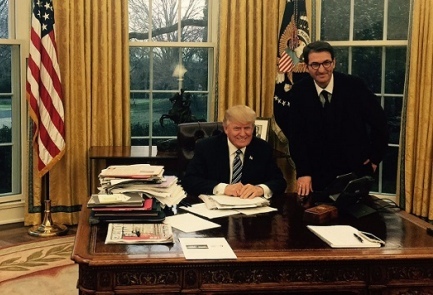
U.S. President Donald Trump and Israel Hayom’s foreign news editor and senior analyst Boaz Bismuth

Will Trump back Israel in the next war?

February 10, 2017

Will Trump back Israel in the next war? Israel Hay0m, Ruthie Blum, February 10, 2017

Analysts on both sides of the Atlantic Ocean — and of the political spectrum — have been scrutinizing every syllable uttered by members of the new administration in Washington to determine whether U.S. President Donald Trump is as good a friend to the Jewish state as Israeli Prime Minister Benjamin Netanyahu hopes.

So far, four issues have been discussed and debated ad nauseam: U.S. Ambassador to the U.N. Nikki Haley’s pronouncement that her government would not abandon Israel at the world body, as the Obama administration did when it enabled the passage of Security Council Resolution 2234, which deemed all Jewish presence beyond the 1949 Armistice Lines illegal; the nomination of David Friedman — a settlements sympathizer who supports relocating the American Embassy from Tel Aviv to Jerusalem — as U.S. ambassador to Israel; a recent Trump administration warning that Israeli settlement construction could be potentially harmful to peace negotiations toward Palestinian statehood (the “two-state solution”); and the omission of any mention of Jews in the statement issued by the administration on International Holocaust Remembrance Day.

Where the bigger picture is concerned, Israel is observing Team Trump’s behavior toward Iran, telling Tehran that its saber-rattling and ballistic missile tests will incur serious consequences; imposing new sanctions on the mullah-led regime; and openly weighing the designation of the Islamic Revolutionary Guard Corps as a terrorist organization.

But the one question that has not been raised is how the Trump administration will respond when Israel is forced to go to war, yet again, with Hamas in Gaza and/or with Hezbollah in Lebanon.

Middle East experts have been predicting, albeit cautiously, that neither scenario is likely in the near future, due to the internal difficulties each terrorist group is currently experiencing. Hezbollah is deeply entrenched in the Syrian civil war, and has already lost many of its men in the fighting. Hamas is suffering from a loss of income, as a number of European countries begin to reconsider the process of transferring cash earmarked for the rehabilitation of Gaza, which ends up paying for the rebuilding and enhancement of tunnel and rocket infrastructure.

Recent developments indicate, however, that more serious military action — in addition to retaliatory IDF moves following errant or aimed fire on Israel from just beyond its southern and northern borders — may be unavoidable.

This week, a Haifa court ordered the temporary closure of the city’s 12,000-ton ammonia tank, pending further discussion on Sunday. This was after the municipality requested that it be shut down completely, following a report indicating that in any explosion, tens of thousands of people in the area would be killed. And since Hezbollah Secretary General Hassan Nasrallah threatened in February to attack it, residents of the region have been living in fear.

Meanwhile, over the past few days, Hezbollah has been engaging in a crowd-funding campaign on social media hashtagged “Money for jihad is a must,” with a video appeal featuring fighters and clerics asking people to donate to the “resistance.”

Though this is clearly a result of the organization’s dwindling resources, caused by its extended stint in Syria, Nasrallah’s deputy, Naim Qassem, said in an interview with the Lebanese newspaper Al-Binaa that the group’s message to Israel remains the same: “We are willing to pay the price of the conflict. Are you?”

Hamas, too, has been busy threatening Israel online. In a new music video — titled “Zionist, You Will Die in Gaza” — the terrorist organization that reigns supreme in the enclave lodged between Israel and Egypt warns, “A rocket will come to you, Zionist, wherever you live. You will die sleeping, awake or on the mountain. I will make you drink from the glass of death; what a bitter taste.”

It would appear, then, that war is on the horizon.

During Operation Protective Edge, Israel’s battle against Hamas in Gaza in the summer of 2014, then-President Barack Obama said that though the Jewish state had a right to defend itself, it should exercise “restraint.”

In a meeting at his New York office with Jewish journalists during the U.S. presidential primaries, Trump was asked whether he agreed with the statement — made by Democratic hopeful Bernie Sanders to the editorial board of the Daily News — that Israel had used “disproportionate force” in Gaza.

“When missiles are being shot into your country, I don’t know what ‘disproportionate force’ is supposed to mean,” he replied.

It is a matter of when — not if — this attitude in relation to Israel and its enemies is put to the test. So far, Netanyahu, who will be convening with Trump on Wednesday in the White House, has good reason to believe that Obama’s successor will pass it with flying colors.

The bad news… and the good news… – YouTube

February 10, 2017

Here’s the bad news and the good news about minorities in the Middle East.

First the bad news: The Middle East is torn apart by hatred of minorities—Yazidis, Christians, Bahais, Kurds and others.

Now, the good news: In Israel, minorities thrive. Israel has over one million Arab citizens.
They enjoy equality under the law, and we’re working very hard to make sure that they enjoy equality of opportunity.

Here’s what we’ve done:
Over the past decade, the number of Arabs working in high-tech in Israel increased tenfold; Arab students studying at the Technion, Israel’s MIT, tripled; Arab judges nearly doubled; an Arab Supreme Court Justice served as chairman of the Central Election Committee overseeing our national elections; Arab participation in the workforce has grown significantly; Arab unemployment is down; for the first time ever, an Arab has been appointed a deputy commissioner of the police, the second highest rank attainable.

My friends, none of this is accidental.

My government has worked tirelessly to advance equality and opportunity for all.

We’re investing 14 billion shekels—more money than has ever been given to the Arab sector in order to decrease unemployment and improve health, education and safety.

I chose to open this school year at an Arab school in the Galilee.

I encouraged these young vibrant Arab students to achieve all their dreams because, I told them, this is your country too.

Israel is launching a program to teach mandatory Arabic to young Jewish children, and of course, I encourage these young Arab students to learn Hebrew, so they can better integrate into the Israeli economy and Israeli society, take part in the Israeli miracle.

Now, this isn’t exactly the image you get of my government by reading some media outlets, but these are the facts.

Israel isn’t only strong because of our army. Israel is strong because of our spirit, and that includes our tolerance, our diversity, our pluralism.

I hope more states in our troubled region begin to emulate Israel and treat minorities with dignity and respect, the dignity and respect that all human beings deserve.

Just imagine, imagine if the Middle East looked a bit more like Tel Aviv and a bit less like Aleppo.

Uncertain Futures: China, Trump and the Two Koreas

February 10, 2017

Uncertain Futures: China, Trump and the Two Koreas, 38 North, February 9, 2017

(Kim Jong-un may be insane. Or, like his predecessors, he may pretend to be insane to make predictions about his behavior very difficult and often impossible. China’s leaders are not insane, they are merely devious. Dealing with them has been, and will continue to be, very difficult. — DM)

China waving flag on bad day

China waving flag on bad day

At the beginning of the Trump administration, the situation on the Korean peninsula is highly uncertain and potentially volatile. During a late January research trip to Beijing, “uncertainty” and “concerns” were the keywords that best characterized how Chinese scholars and officials are feeling about Trump and the two Koreas. During his presidential campaign, Trump suggested that he would be willing to negotiate with North Korea directly. However, that scenario has become more uncertain in recent months, especially given the hawkish instincts of President Trump and his national security team. Chinese analysts nonetheless expect the US to enlist Beijing’s support on the North Korea issue and are anxiously waiting for Washington to engage so that China can bargain for its preferred outcomes. The prolonged silence from the administration is making Beijing increasingly uncertain and uncomfortable, and complicating its plans to reduce the threat that the United States and its network of alliances in Northeast Asia poses to Chinese security and strategic influence.

Between 2013 and 2016, China tested an alternative alignment strategy on the Korean peninsula. Frustrated with North Korea’s brinkmanship continuously damaging Chinese security interests, President Xi Jinping placed his hope on South Korean President Park Geun-hye to improve China’s strategic position. At the heart of this scheme was an effort to turn South Korea into China’s “pivotal” state in Northeast Asia, thereby undermining the US alliance system in the region and diminishing its threat to China. As a result of Sino-ROK rapprochement, senior-level visits soared, bilateral economic ties strengthened and many South Koreans questioned the utility and future of the US-ROK alliance. In an ideal scenario, China’s new realignment strategy would defeat the US-orchestrated “Northeast Asia NATO” based on America’s alliances with Japan and Korea, and counter the US-Japan alliance with an alignment between China and both Koreas. From the Chinese point of view, this would not only reduce China’s vulnerability vis-à-vis the US, but also lay a firm foundation for Chinese regional predominance.

However, events after the fourth North Korean nuclear test in January 2016 entirely derailed China’s scheme. Overestimating its presumed influence over Seoul, Beijing refused to adequately address South Korea’s legitimate security concerns, which eventually led to Seoul’s decision to deploy the Terminal High Altitude Area Defense (THAAD) system. China sees the THAAD deployment as a threat to strategic stability with the United States and an obstacle to its desired regional blueprint. As such, Chinese policy toward the Korean peninsula has evolved significantly in the last year, reflecting the realization that undermining the US-ROK alliance and turning South Korea into a Chinese strategic asset were both improbable in the near future and raising the prospect that Beijing might not have a choice between the two Koreas after all.

Nonetheless, while China’s ambitious efforts to transform geopolitical alignments on the Korean peninsula did not come to fruition, it still has two other key priorities. First, Beijing has not completely given up its efforts to defeat the THAAD deployment. At a minimum, it hopes that a victory for progressive forces in the upcoming South Korean presidential election, such as the Minjoo Party, could alter Seoul’s deployment plans for the system. While acknowledging that a complete reversal of the deployment decision is unlikely, Beijing hopes that a new South Korean government might delay the initial deployment or reduce the number of deployed units. China sees the propensity of the progressives to engage North Korea, to improve relations with China and to limit the scope of the US-ROK alliance as aligned with its overall strategic agenda. Although China’s ability to sway a South Korean domestic election is limited—for example, by maintaining the implicit sanctions China has imposed on South Korean companies, products and industries for the THAAD deployment—its preference and influence are expected to have an impact.

Second, China hopes to mitigate the impact that any future North Korean intercontinental ballistic missile (ICBM) test might have on its strategic position and influence on the peninsula. The conventional wisdom is that North Korea will not want to conduct the test immediately after Trump’s inauguration, as it will almost certainly block the chance for dialogue with the new US administration and boost the popularity of the conservatives in the South Korean election. However, based on North Korea’s previous pattern of behavior, Chinese experts expect to see provocations in the coming months if Trump chooses to follow Obama’s policy of strategic patience. At the same time, Chinese analysts are inclined to downplay the significance of such an ICBM test, citing the immaturity of North Korea’s long-range missile technology and its likely failure. Still, Beijing will oppose any preemptive strike by the US on the launch site, although it does not fully believe that the US would take such a risky move and jeopardize South Korean security—a fundamental assumption embedded in China’s assessment of the prospects for conflict on the Korean peninsula.

Beijing has always insisted that North Korea’s nuclear development is motivated by Pyongyang’s vulnerability and insecurity, and argued that only the US and North Korea can resolve the stalemate through a peace negotiation. Selfless as it may sound, there is a certain level of hypocrisy in that position. As it has become clear to American officials and experts that strategic patience failed to address the North Korean nuclear threat, there have been more vocal calls to resume US-DPRK dialogue in return for a decision by Pyongyang to suspend its nuclear and missile tests. For China, the danger lies in the unpredictable consequences of such a bilateral negotiation. If the United States and North Korea decide to move ahead with a deal, the improvement of relations between them and the shifting balance of power on the Korean peninsula will diminish what China perceives as its leverage and strategic influence. Therefore, if the Trump administration unilaterally initiates bilateral talks with North Korea, it will be met with suspicion rather than enthusiasm from Beijing.

China’s potential reaction to a North Korean ICBM test all comes down to one question: What does Beijing want? One thing is clear: China wishes to see denuclearization and peace dialogues, but also wants to be an indispensable party in these dialogues to monitor and influence their direction. Beijing believes that the “dual-track” approach (parallel negotiations on denuclearization and a peace treaty) it proposed in 2016 offers the best hopes for achieving its strategic and security goals. Although the Obama administration largely rejected this approach, Beijing sees a new opportunity to try it again with the Trump administration. Trump should understand, however, that China’s position on the Korean peninsula is neither objective nor neutral and that it will view all solutions primarily through the lens of its strategic competition with the United States. As a result, it is important for all the concerned parties to have realistic expectations about a grand bargain with China over North Korea and treat it with extreme caution.

The US-China relationship under Trump is undoubtedly the largest uncertainty in China’s relations with both North and South Korea. If the Trump administration, as appears to be the case, chooses a more confrontational approach towards China, soliciting Beijing’s support and assistance in pressuring North Korea will be exceedingly difficult. A more hawkish stance from the United States will make Beijing instinctively seek more policy leverage, and provocative North Korea behavior that goes unpunished militarily by the United States offers tremendous opportunities for Beijing to be wooed by Americans to rein in Pyongyang. Past experience, including the Cheonan incident, the shelling of Yeonpyeong Island and South Korea’s THAAD deployment, have demonstrated the high level of leniency Beijing will afford Pyongyang when the United States applies greater pressure on China in response to such provocations.

The application of US secondary sanctions on China, which some American officials and experts have discussed, is likely to make China less rather than more cooperative on North Korea. It is unlikely that effective sanctions could be imposed on these entities without poisoning bilateral relations and adversely affecting China’s willingness to cooperate with the US on North Korea. China opposes unilateral sanctions as a general principle, and in particular condemns those that affect Chinese companies or interests. Beijing’s cooperation on the Iran nuclear deal was not incentivized by US sanctions on the Chinese Bank of Kunlun and Zhuhai Zhenrong, but by the opportunities offered for expanding Chinese influence in the Middle East and leveraging its cooperation in overall relations with Washington. In the Chinese view, the North Korea nuclear program, unlike the Iranian case, is much more complicated and sensitive because it directly affects China’s national security, and therefore requires more comprehensive and political solutions.

If the Trump administration’s primary goal is to confront China and thwart Beijing’s regional ambitions, the most effective policy (and the worst nightmare for China) would be a unilateral improvement of relations with North Korea. Whether that is politically possible depends on how far the administration is willing to pursue diplomacy and negotiations to defuse the North Korean threat. On the contrary, pressuring China is unlikely to make it cooperate. Beijing wants a grand bargain over the future of the Korean peninsula conducive to China’s interests. Without a proper endgame to incentivize the Chinese and a policy of dialogue that allows Beijing a key seat at the table, neither pressure nor solicitation will succeed.

U.S. Ill Prepared for Convicted Jihadis Ending Their Prison Sentences

February 9, 2017

U.S. Ill Prepared for Convicted Jihadis Ending Their Prison Sentences, Investigative Project on Terrorism, Patrick Dunleavy, February 8, 2017

1966

The old adage, “Out of sight, out of mind” does not apply to dealing effectively with the threat of Islamism especially in the case of terrorists who have been captured or incarcerated.

Radical Islamic organizations such as al-Qaida and ISIS never forget their members. To them, going to prison is part of the pathway to paradise. Both groups’ leaders, Ayman al-Zawahri and Abu Bakr al-Baghdadi, spent considerable periods of time locked up. It did nothing to diminish their zeal, but rather, fueled their fervor. Often, as in their cases, what comes out of prison is worse than what went in.

This is further illustrated by the increased number of terrorists released from Guantanamo who rejoin the fight against U.S. military personnel. Almost one in three released prisoners return to the jihadists’ fold. This recidivism can be attributed in part to the admonitions terrorists receive to assist those who are captured or imprisoned. That support may include financial help for their families and for legal fees.

These instructions were found in a training manual discovered in 2000 by law enforcement officers in Manchester, England.

“I take this opportunity to address our prisoners. We have not forgotten you,” al-Zawahiri said in an interview with Al Shabab commemorating the fourth anniversary of the 9/11 attacks. “We are still committed to the debt of your salvation . . . until we shatter your shackles.”

AQAP’s Inspire magazine went so far as to list the names of incarcerated members for all to remember.

They do this because jihadis firmly believe that sooner or later they’ll be reunited with those members.

If that isn’t ominous enough, consider the fact that as many as 100 people convicted of terror-related offenses in U.S. prisons will be set free in less than four years.

And yet, while Islamic terrorist organizations have rapidly changed in their recruitment and tactical methodologies overall, the U.S. has not adapted to countering the evolving threat.

In the United States, the number of terror-related incidents increased exponentially since 9-11. As they did, authorities adapted new ways to investigate. State of the art technologies help collect and analyze data. Fusion centers were created to get the information into the hands of investigators in real time. Counter terrorism, intelligence, and law enforcement agencies joined together to share.

Legislation has changed how the judicial system prosecutes terrorists. “Our criminal law was unprepared for international terrorism. We simply did not have statutes and penalties that fit what terrorists do,” said former federal prosecutor Andrew McCarthy, who led the prosecution against the first World Trade Center bombers and blind sheik Omar Abdel Rahman.

A vigorous debate continues whether to treat terrorists as criminals or as enemy combatants. A reasonable consensus among the military and the judicial branches is building for the use of both designations.

Two significant changes, in policy and practice, toward radical Islamic terrorists remain to be addressed.

Terrorists go into prison much the same way as the burglar, the drug dealer, or the pedophile. They are housed and fed in existing correctional facilities with common criminals. No mandatory rehabilitation or de-radicalization programs exist for convicted Islamic terrorists. And when they are released, there is no specialized supervisory program applied to monitor their employment or whereabouts.

This situation has to change if we are to deal effectively with terrorism. We should establish a registration list for convicted terrorists. This would provide local authorities with the identity of those recently released to their communities. It has been successfully used with sex offenders. It can work if properly applied.

With as many as 500 terrorists now in custody and more to come, the custodial system must also evolve in how it handles jihadists. Security classification must not be downgraded simply because the terrorist has become “jail wise” (exhibited good behavior) like “American Taliban” John Walker Lindh, who will be released from prison in two years.

Special administrative measures – conditions of confinement – which restrict visits, correspondence and other prison privileges assigned to terrorists must continue.

Uniform security standards for imprisoned terrorists should be established in the federal, state, and local correctional facilities. Jose Padilla, the alleged “dirty bomber” who first learned of a radical form of Islam while in a Florida county jail and was originally sentenced to life in prison, is scheduled to be released in eight years. Who will be the parole officers assigned to supervise him and will those officers be afforded any specialized training before that happens?

In some cases, specialized facilities like Guantanamo are necessary in dealing with enemy combatants and other committed jihadists. They are effective. No anecdotal evidence has been presented showing them to be a recruitment tool for ISIS or al Qaida. That is like saying that Alcatraz was responsible for the increase in violent crime.

The number of people arrested in the U.S. for terrorism-related crimes nearly tripled in 2015. That year, FBI Director James Comey testified that more than 200 people traveled overseas from the United States in an attempt to fight alongside ISIS or al-Qaida related groups in the Middle East and North Africa.

In 2016, Comey said his agents still had 1,000 open cases related to ISIS. Within the next few years, he said, there may be a “terrorist diaspora” of ISIS fighters leaving the battlefield of Syria and returning to their home countries, committed to carrying out more terrorist attacks.

We can only hope that the vast majority will be apprehended before they can carry out attacks here in the United States. And when they are, we had better be prepared to effectively deal with them throughout their entire time in the system. Anything less is unacceptable to the citizens of this great country.

Yazidis to Anti-Trumpers: Where Were You During Islamic State Genocide Against Us?

February 9, 2017

Yazidis to Anti-Trumpers: Where Were You During Islamic State Genocide Against Us? BreitbartEdwin Mora, February 8, 2017

(But, but . . . since the Islamists are doing the persecuting, they should get the first chance to come to America. Giving priority — or even allowing entry —  to those whom they persecute would just make matters worse: they might be persecuted where we can see it, which would cause Islamophobia, a far worse evil than persecution of weird people like Yazidis, Christians and the few remaining Jews. At least that seems to be the logic — if any —  behind the complaints. — DM)  

yazidi-women-reutersrodi-said-640x480REUTERS/Rodi Said

Outrage over President Donald Trump’s executive order prioritizing refugee claims by persecuted religious minorities has puzzled activists from Iraq’s Yazidi community, who note the lack of major protests against the brutal massacre of thousands of Yazidis and Christians by the Islamic State.

Former President Barack Obama’s administration and the United Nations recognized that Yazidis, Christians, and other ethnoreligious minorities in the Middle East have been victims of genocide at the hands of the Islamic State (ISIS/ISIL).

Nevertheless, opponents of the executive order (EO) have lambasted the religious minority exception, denouncing President Trump for giving preferential treatment to persecuted minority groups. The order bars the entry into the United States of visa travelers from seven terrorism-linked countries (Iran, Iraq, Libya, Somalia, Sudan, Syria, Yemen) for at least 90 days and orders the U.S. government to prioritize refugee claims by persecuted religious minorities.

The order, which has sparked protests and outcry across the nation, does not identify religious minority groups by name. However, Michael Short, a White House spokesman, told Breitbart News,“Yazidis would be covered under the EO as they are a persecuted religious minority.”

U.S. District Court Judge James Robart in Seattle has issued a ruling that temporarily blocks Trump’s order, which the Trump administration argues is primarily intended to strengthen U.S. national security.

Breitbart News spoke to several Yazidi activists who expressed support for the executive order and argued that it does not amount to a Muslim ban, as critics argue.

Echoing Iraqi Catholic Archbishop Bashar Warda, Mizra Ismail — a Yazidi activist with the Yazidi Human Rights Organization-International — told Breitbart News, referring to opponents of Trump’s executive order:

My first question for those protesters is: where were they when ISIS was committing genocide against the Yezidis and Christians in Iraq and Syria? ISIS killed and kidnapped thousands of Yezidis, mostly young women, girls and children. The ISIS jihadists also beheaded many Yezidis and Christians openly in the most brutal way and posted their videos on social media.

What were those protesters doing then? I believe when ISIS committed all those crimes against the Yezidis and Christians, those protesters were blind.

Another Yazidi activist expressed support for Trump’s order, saying it is necessary to keep the U.S. safe.

“As a Yezidi, I am supportive of any genuine effort and precaution meant to keep this country safe and prosperous,” Gulie Khalaf from Yezidis International, told Breitbart News. “If a 90-day ban on all refugees, including Yezidis, is what it will take to ensure that this country does not become full of residents who neither care for the values of this society nor its constitution, then let us have the 90-day ban. Hopefully, that time will be spent to figure out who is deserving of the opportunities and the rights this country offers.”

The activist argued that the persecuted minority exception is necessary and does not subject Muslims to “discrimination” as many opponents of the order have claimed.

“It is not breaking laws or going against any kind of values if Trump and his administration decide that endangered groups should be an exception to the ban,” declared Khalaf.

A different Yazidi activist, Haji Hameka, stressed that the executive order is not a Muslim ban but rather an effort to keep America safe.

“It is not a ban against bringing Muslim refugees to the United States. It is a security check to avoid the entry of terrorists from groups such as al-Qaeda, and ISIS,” he told Breitbart News.

“Trump is a real American Patriot who is putting America and Americans first,” noted the activist. “He has to protect, support, and save the United States. He was elected by Americans to put America first.”

Trump’s measure dictates that once refugee admissions resume after a 120-day suspension aimed at improving the vetting process, the U.S. government, “to the extent permitted by law,” is expected to “prioritize claims made by individuals on the basis of religious-based persecution, provided that the religion of the individual is a minority religion in the individual’s country of nationality.”

In other words, persecuted minorities in Iraq in Syria, such as the Christians and Yazidis, may go to the front of the line after the refugee program suspension is over.

During the 120-day suspension, the Secretaries of the State and Homeland Security have the discretion “on a case-by-case basis” to allow the entry of members of persecuted religious minority groups.

“Identifying specific countries with Muslim majorities and carving out exceptions for minority religions flies in the face of the constitutional principle that bans the government from either favoring or discriminating against particular religions,” argued American Civil Liberties Union Executive Director Anthony Romero in a statement.

The Trump administration and Republican lawmakers, including House Speaker Paul Ryan (R-WI), have defended the religious minority exception.

Meanwhile, Democrats like Sen. Diane Feinstein from California have denounced the directive, arguing that granting priority to persecuted minorities is unfair to Muslims.

The Islamic Jihad and Peace with Jews

February 9, 2017

The Islamic Jihad and Peace with Jews, Gatestone InstituteBassam Tawil, February 9, 2017

(“Normalization?” In what way is the present situation abnormal? The dispute has been festering for centuries. — DM)

On the face of it, the anti-normalization campaign appears driven by political motivations. However, it turns out that there is also a powerful Islamic angle to this campaign of hate, which is aimed at delegitimizing Israel and demonizing Jews.

The Palestinian anti-normalization “enforcers” do their utmost to conceal the Islamic aspect of their campaign. They are not eager for the world to know that Islam supplies much of the ideology and justification for their anti-Israel activities.

Fatwas (Islamic religious decrees) and statements issued by leading Muslim scholars and clerics have long warned Muslims against normalization with the “Zionist entity.” Such normalization, they have made it clear, is considered an “unforgivable crime.” The authors of these hate messages are not opposed to normalization with Israel because of settlements or house demolitions, but rather because they believe Jews have no rights at all to any of the land.

In 1989, more than 60 eminent Muslim scholars from 18 countries ruled that it was forbidden for Muslims to give up any part of Palestine.

The vicious campaigns to boycott Israel and Jews, while political in dress, are in fact deeply rooted in Islamic ideology.

These campaigns are patently not a legitimate protest. They are not even part of an effort to boycott Israeli products or politicians and academics. The real goal of the campaigns is revealed in the words of the Muslim leaders: that Jews have no rights whatsoever to the land, and must be targeted through jihad as infidels and enemies of all Muslims and Arabs

Settlements, checkpoints and fences are irrelevant; Muslim scholars want Jews off what they define as sacred Muslim land. Supporters of BDS and the anti-normalization movement would do well to consider this fact. Failing to do so is tantamount to aiding and abetting Muslims to destroy Israel, and kill as many Jews as possible in the process.

Muslim scholars have feverishly citing chapter and verse from the Quran and the hadith, the words of the Prophet Mohammed, in their efforts to encourage Arabs and Muslims to avoid normalization with Jews.

The Quran and hadith have also been leveraged to promote boycotts against Israel and Jews — thereby refuting claims by anti-Israel activists that their campaigns are just about politics.

Palestinians have long maintained that their campaign to ban normalization with Israel is mainly directed against the Israeli “occupation” of the West Bank, Gaza Strip and East Jerusalem. The Palestinian anti-normalization movement, which continues to target Israeli and Palestinian peace activists who hold — horrors! — public meetings, has in recent years gained momentum, largely thanks to the ongoing anti-Israel campaign of incitement and indoctrination in the Palestinian media and mosques.

In recent years, Palestinian anti-normalization activists have managed to foil several meetings between Israelis and Palestinians, under the pretext that such encounters cause damage to the Palestinians. The activists justify their disruption by citing what they see as Israeli practices against Palestinians, and violently object to any meetings with Israelis, including those who wholeheartedly support the Palestinians and oppose the policies of the Israeli government.

The most recent incident occurred at the Ambassador Hotel in East Jerusalem, where Israeli and Palestinian activists gathered to talk about peace and coexistence. Shortly after the meeting began, a number of anti-normalization activists stormed the conference hall to protest the meeting.

“Meeting with Zionists is an act of treason,” one of the protesters shouted. “There are no solutions. Palestinian must be freed, from the (Jordan) River to the (Mediterranean) Sea. Shame on you!”

The protesters claimed that they were opposed to the meeting because Israel was “demolishing Arab houses and killing Palestinians.”

1069-1Palestinian “anti-normalization” activists disrupt an unofficial Israeli-Palestinian peace conference Jerusalem’s Ambassador Hotel, in 2104.

Hind Khoury, a Christian woman who has previously served as Palestinian Authority ambassador to France, received the brunt of their anger. Khoury’s attempts to persuade the protesters that the meeting was not about normalization, but about achieving a just and comprehensive peace, fell on deaf ears. Ironically, it was the intervention of the Israeli Police that allowed Israeli and Palestinian activists to proceed with their conference.

Such scenes have become commonplace at the East Jerusalem hotel, a preferred site for unofficial peace conferences organized by Israelis and Palestinians. Anti-normalization activists raid the conference hall several times a year in their attempts to disrupt such gatherings.

The anti-normalization activists have also been vocal in Ramallah and other Palestinian cities. The Palestinian newspaper Al Quds, which recently published an interview with Israeli Defense Minister Avigdor Lieberman, has also come under attack. For these Palestinians, conducting an interview with an Israeli government official is engaging in “media normalization.”

“The newspaper must apologize to the Palestinians,” the protesters demanded.

On the face of it, the anti-normalization campaign appears driven by political motivations. However, it turns out that there is also a powerful Islamic angle to this campaign of hate, which is aimed at delegitimizing Israel and demonizing Jews. The Palestinian anti-normalization “enforcers” do their utmost to conceal the Islamic aspect of their campaign. They are not eager for the world to know that Islam supplies much of the ideology and justification for their anti-Israel activities.

Fatwas (Islamic religious decrees) and statements issued by leading Muslim scholars and clerics have long warned Muslims against normalization with the “Zionist entity.” Such normalization, they have made it clear, is considered an “unforgivable crime.”

The authors of these hate messages are not opposed to normalization with Israel because of settlements or house demolitions, but rather because they believe Jews have no rights at all to any of the land.

“Normalization with the Zionist enemy means turning the presence of Jews in Palestine to something normal,” explained one scholar, Adnan Adwan. “Normalization means accepting the right of the Zionist entity to Arab lands and Palestine.”

In response to an inquiry from Palestinians about the perspective of Islam regarding peace and normalization with Jews, a group of leading Muslim scholars issued a fatwa stating that this was completely haram (forbidden). They even went farther by ruling that any form of peace with Jews was also haram, despite the fact that Prophet Mohammed signed a treaty, known as the Constitution of Medina, with Jews and other non-Muslims shortly after his arrival at Medina from Mecca in 622 CE.

In their fatwa, the Muslim scholars wrote: “It is true that Prophet Mohammed signed a treaty with the infidels, including the Quraysh tribe and the Jews, but he did not make concessions that are contrary to Islam.” They pointed out that Prophet Mohammed did not strike the deal with the infidels in order to allow them to stay in their homes permanently. Nor did the prophet promise to abandon jihad (holy war) as a result of this treaty, they added in their fatwa. “There is no evidence whatsoever that the Prophet or any of his successors had made peace with infidels controlling Islamic lands,” the fatwa clarified.

To support their argument, the scholars quote verses from the Quran which — they maintain — prohibit Muslims from making peace or ever placing their confidence in Jews. One verse which they claim refers to Jews is taken from Surah Al-Anfal (The Spoils of War): “And if they intend to deceive you, then verily, Allah is All-Sufficient for you. He it is Who has supported you with His Help and with the believers.” (62) According to the fatwa, this verse from the Quran refers specifically to Jews.

The scholars continue with another verse from the same Surah Al-Anfal to explain why Muslims must continue to fight against Jews:

“O Prophet (Mohammed)! Urge the believers to fight. If there are twenty steadfast persons amongst you, they will overcome a two hundred, and if there be a hundred steadfast persons they will overcome a thousand of those who disbelieve, because they (the disbelievers) are people who do not understand.” (65)

Yet a further verse from the Quran is then cited to substantiate their ideology of war against the Jews — verse 7 from Surah At-Taubah (The Repentance):

“How can there be a covenant with Allah and with His Messenger for the Mushrikin (polytheists, idolaters, pagans, disbelievers in the Oneness of Allah) expect those with whom you made a covenant near Al-Masjid al-Haram (at Makkah)? So long, as they are true to you, stand you true to them. Verily, Allah loves Al-Muttaqun (the pious).”

According to the fatwa, the “treacherous” Jews have since failed to “repent” (presumably, convert to Islam) and that is why it is forbidden to make peace with them.

The Muslim scholars also point to several fatwas prohibiting peace and normalization with Jews issued in the past century. The ban dates back to 1935, when a group of Muslim scholars and clerics ruled during a conference in Jerusalem that it was forbidden for Muslims to sell Arab-owned lands to Jews. A year later, scholars from Egypt’s Al-Azhar University, one of the first Islamic universities in the Arab world, ruled that it was the duty of all Muslims to engage in jihad “to salvage Palestine.” In 1989, more than 60 eminent Muslim scholars from 18 countries ruled that it was forbidden for Muslims to give up any part of Palestine.

Other Muslim scholars have referred to another verse in the Quran to justify banning normalization with Jews. In Surah Al-Mumtahinah (The Woman to be examined), verse 1 states: “O you who believe! Take not My enemies and your enemies as friends, showing affection towards them, while they have disbelieved in what has come to you of the truth.” They also quote the following hadith (a saying attributed to Prophet Mohammed) to support their claim against making peace with Jews: “Those who side with the unjust to assist them in their injustice, while knowing that they are unjust, walk out of Islam.”

The vicious campaigns to boycott Israel and Jews, while political in dress, are in fact deeply rooted in Islamic ideology.

The anti-normalization activists and those promoting boycotts, divestment and sanctions (BDS) against Israel perceive Jews as the enemies of Allah and Prophet Mohammed. These campaigns are patently not a legitimate protest. They are not even part of an effort to boycott Israeli products or politicians and academics. The real goal of the campaigns is revealed in the words of the Muslim leaders: that Jews have no rights whatsoever to the land, and must be targeted through jihad as infidels and enemies of all Muslims and Arabs.

Muslim scholars have left no room for doubt about their view of the true nature of the Israeli-Palestinian conflict. Settlements and checkpoints and fences are irrelevant; Muslim scholars want Jews off what they define as sacred Muslim land. BDS and anti-normalization movement supporters might do well to consider this fact. Failing to do so is tantamount to aiding and abetting Muslims to destroy Israel, and kill as many Jews as possible in the process.
Did Gorsuch Blunder?

February 9, 2017

Did Gorsuch Blunder? Power LineJohn Hinderaker, February 9, 2017

(Please see also, A Maniac is Running Our Foreign Policy! (It’s Not Trump). — DM)

Newspaper headlines across the country are blaring Judge Neil Gorsuch’s characterization of President Trump’s criticism of Judge James Robart as “disheartening” and “demoralizing.” This is one more in a long series of anti-Trump propaganda victories for the Democrats:

Donald Trump’s Supreme Court nominee has said he found the president’s attacks on the judiciary “disheartening” and “demoralizing,” according to a Democratic senator.

Sen. Richard Blumenthal of Connecticut disclosed the comments from Judge Neil Gorsuch after meeting with the nominee Wednesday, as the candidate for the high court vacancy paid a series of courtesy visits to senators.

In a tweet this past weekend, Trump lashed out at Judge James Robart after he issued a stay on the president’s refugee and immigration ban.

“The opinion of this so-called judge, which essentially takes law-enforcement away from our country, is ridiculous and will be overturned!” Trump tweeted.

I wouldn’t take far-left Senator Blumenthal’s word for it, but the AP tells us that “Gorsuch’s confirmation team confirmed the judge’s comments.”

What to make of these statements by Gorsuch? I think they betray a serious lack of judgment and, perhaps, loyalty. Trump’s reference to Judge Robart, who violated his judicial duty by issuing a political opinion that he didn’t even attempt to justify with facts, law or logic, as a “so-called judge,” was arguably apt. In any event, if Gorsuch really would be “demoralized” by such a mild rebuke as “so-called judge,” he lacks the stomach to sit on the Supreme Court.

It would have been easy for Gorsuch to deflect Blumenthal’s question about the president’s tweet by saying that it was nowhere near as harsh as what Barack Obama said about the Supreme Court. If pressed, he could have added that judges in a democracy are not above criticism, and in fact, they are often criticized. Gorsuch must understand that he is engaged in a political process. So why would he sell out the man who has just appointed him to the Supreme Court?

A friend emailed a different perspective on Gorsuch’s criticism of Trump:

I think Gorsuch’s comment to Blumenthal was a very clever effort to lure Dems into thinking he may be more on their side than they think. It’s a gambit to get sixty votes.

Maybe, but I am not so sanguine. I fear it is a sign that Gorsuch lacks the tough-mindedness that we need in conservative Supreme Court justices.

Dr. Jasser reacts to a Seattle judge’s ruling regarding the travel ban 02.07.2017

February 9, 2017

Dr. Jasser reacts to a Seattle judge’s ruling regarding the travel ban 02.07.2017, AIFD via YouTube, February 7, 2017

(Please see also, A Maniac is Running Our Foreign Policy! (It’s Not Trump). — DM)


Congress Wants New Sanctions on Venezuela for Ties to Iran-Backed Terrorists

February 9, 2017

Congress Wants New Sanctions on Venezuela for Ties to Iran-Backed Terrorists, Washington Free Beacon, February 9, 2017

(Based on what I read daily in the Latin American Herald Tribune and local Panamanian papers, the proposal would likely do substantially more harm than good. Maduro’s supporters would jump on anything useful to damn American imperialism: “Imperialistic America is interfering in Latin American affairs again!

Panama is still mad at Theodore Roosevelt for creating Panama out of part of Colombia — even though an annual holiday rejoicing over Panamanian independence from Colombia is widely celebrated — and for our “imperialism” in building the Panama Canal– an economic resource we turned over to Panama years ago and which provides mucho dinero for Panama.

Clearly, Maduro is an uneducated, corrupt jerk and has worsened the mess left by el Thugo Chavez. Food? Medicine? Toilet paper? Human rights? Human dignity? freeing imprisoned opposition leaders? Democracy? No way, Jose.  There is little or nothing we can do to improve the lives or to change the regime under which Venezuelans now exist. –DM)

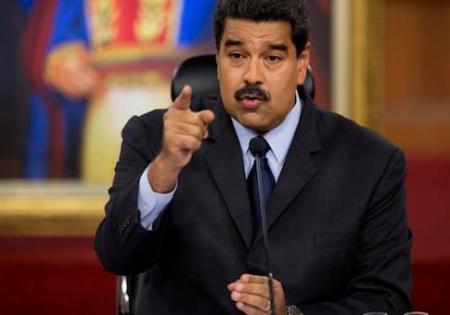
Venezuela's President Nicolas Maduro, speaks during a press conference with international and national press at Miraflores presidential palace in Caracas, Venezuela, Wednesday, Jan. 18, 2017. Maduro speaks about the economic war his government have faced and measures to stabilize economy. (AP Photo/Ariana Cubillos)

Venezuela’s President Nicolas Maduro, speaks during a press conference with international and national press at Miraflores presidential palace in Caracas, Venezuela, Wednesday, Jan. 18, 2017. (AP Photo/Ariana Cubillos)

A bipartisan team of lawmakers is calling on President Donald Trump to immediately sanction Venezuela for its ongoing human rights violations and ties to terrorist organizations that reach the highest levels of government, according to a new congressional communication sent to the White House.

Sen. Bob Menendez (D., N.J.) and Rep. Ileana Ros-Lehtinen (R., Fla.) petitioned the White House this week to take action against Venezuela and sanction leading government officials, including the country’s second-in-command, Tareck El Aissami, who is believed to have ties to radical terror organizations.

Venezuela has been devolving into further chaos in recent months as the oppressive socialist regime of Nicolas Maduro continues its crackdown on dissident voices and other reformists.

Maduro caused an outrage in the United States earlier this year when he appointed former regional governor El Aissami to a high-level post that puts him next in line to assume control from Maduro. Aissami has long been accused of having ties to drug kingpins and radical terrorist organizations.

Rogue nations such as Iran have made overtures to anti-Western nations such as Venezuela in an effort to boost the number of rogue nations thriving in America’s backyard. Numerous experts have claimed Hezbollah, an Iranian proxy group, and other terrorist forces have been spotted moving across Latin America.

The call for sanctions by these lawmakers comes as the Trump administration considers ratcheting up international pressure on a range of bad actors, including Iran, North Korea, and others. Many GOP leaders in Congress have been urging the White House to be more aggressive when it comes to dealing with rogue nations across the globe.

“We are writing to request that your administration take immediate action to sanction regime officials responsible for the ongoing dire humanitarian situation, oppressive human rights conditions, and unconscionable corruption taking place in Venezuela,” write Menendez and Ros-Lehtinen, according to a copy of the letter obtained by the Washington Free Beacon.

“Moreover, Maduro’s recent appointment of Tareck El Aissami puts him next in line to possibly become the next leader of Venezuela, which is extremely troubling given his alleged ties to drug trafficking and terrorist organizations,” the lawmakers write.

“It is extremely concerning that the Maduro regime continues to undertake increasingly authoritative measures against innocent people in Venezuela,” according to the letter, which accuses the Venezuelan leader of committing mass human rights atrocities in an effort to retain power.

“The opposition has been subjected to intense persecution, being vilified on state media by Maduro regime officials, routinely accused of false crimes, and arbitrarily imprisoned,” the lawmakers write, adding that there are more than 100 political prisoners, including U.S. citizens, being held captive in the country.

“We believe that all of them must be freed,” the lawmakers write. “Maduro has also relied on corrupted branches of his regime, such as the Supreme Court and the National Electoral Council, to invalidate actions undertaken by the National Assembly, including an amnesty bill for the country’s political prisoners and a motion for a constitutionally enshrined recall referendum on the presidency.”

The United States must take aggressive action against Venezuela in order to further isolate Maduro’s government and spark regime change, according to Menendez and Ros-Lehtinen.

U.S. business interests also are at stake, according to the lawmakers, who make the case that corruption in Venezuela is harming American interests. Many companies, they say, have been forced to pay millions in bribes to Venezuelan officials in order to complete business transactions in the country.

“We are concerned that over payments of food contracts could likewise represent a potential liability for U.S. companies,” according to the letter. “Thus, we believe that the Office of Foreign Assets Control [OFAC] should issue clarifying regulations to ensure that U.S. companies do not inadvertently engage in business directly with any corrupt regime entity in Venezuela that would violate the Foreign Corrupt Practices Act of 1977.”

The appointment of El Aissami is particularly concerning to Menendez, Ros-Lehtinen, and others in Congress.

El Aissami has been suspected of issuing passports to members of the Hamas and Hezbollah terror groups during his tenure overseeing the country’s immigration bureau.

El Aissami also has been alleged to have played a role in the recruitment of radicalized individuals to Hezbollah.

“The nexus between corruption, drug trafficking, and the influence of extremist terrorist organizations in Venezuela is well documented, many of these nefarious and illicit activities are associated with El Aissami,” the lawmakers write.