Archive for December 2016

Trump urges Israel to ‘stay strong’ till January 20

December 28, 2016

Source: Trump urges Israel to ‘stay strong’ till January 20 | The Times of Israel

Netanyahu tweets his thanks as president-elect slams UN resolution on settlements, saying US can’t keep treating Jewish state with ‘total disdain’

December 28, 2016, 5:05 pm
President-elect Donald Trump speaks during a rally at the Giant Center in Hershey, Pa. on Thursday, Dec. 15, 2016. (AP Photo/Evan Vucci)

President-elect Donald Trump speaks during a rally at the Giant Center in Hershey, Pa. on Thursday, Dec. 15, 2016. (AP Photo/Evan Vucci)

US President-elect Donald Trump lashed out at the Obama administration on Wednesday over its decision not to veto the recent UN Security Council resolution condemning Israeli settlements.

Taking to his preferred medium of Twitter, the Republican president-elect said that Washington cannot continue to treat Israel “with such total disdain and disrespect.”

Trump also implied that under Obama, the US was no longer “a great friend” to the Jewish state.

“We cannot continue to let Israel be treated with such total disdain and disrespect. They used to have a great friend in the U.S., but…” Trump wrote. “Not anymore. The beginning of the end was the horrible Iran deal, and now this (UN)! Stay strong Israel, January 20th is fast approaching!”

Prime Minister Benjamin Netanyahu responded to the tweet minutes after it was posted, thanking Trump for his “warm friendship and your clear-cut support.” He also included the Twitter handles of Trump’s children Ivanka and Eric JrEarlier this week, Trump criticized the UN on Twitter for the vote, vowing the ineffective world body would see an overhaul once he took office.

“The United Nations has such great potential but right now it is just a club for people to get together, talk and have a good time. So sad!” he tweeted.

Israel responded furiously to the UN Security Council resolution, downgrading ties with the countries that voted in favor and calling in their ambassadors on Christmas Day for a dressing-down.

Trump, who publicly called for the US to veto the resolution, has repeatedly criticized Obama’s policies on Middle East.

Russia reportedly rejects Kerry request to adopt his Mideast peace framework

December 28, 2016

Source: Russia reportedly rejects Kerry request to adopt his Mideast peace framework | The Times of Israel

Lavrov urges direct talks, warns outgoing administration against ‘bringing US domestic agenda into work of Quartet’

December 28, 2016, 5:05 pm

Russia's Foreign Minister Sergey Lavro (left) and US Secretary of State John Kerry talk during a meeting of the International Syria Support Group, September 22, 2016. (AP Photo/Jason DeCrow)

Russia’s Foreign Minister Sergey Lavro (left) and US Secretary of State John Kerry talk during a meeting of the International Syria Support Group, September 22, 2016. (AP Photo/Jason DeCrow)

Amid frantic diplomatic maneuvers ahead of a Wednesday speech by US Secretary of State John Kerry on the Israeli-Palestinian conflict, Russia reportedly rejected a request by United States for the Middle East Quartet to adopt the principles set to be presented in the speech.

Kerry spoke with Russian Foreign Minister Sergey Lavrov on Tuesday night, at which time the Russian foreign minister dismissed the US secretary’s proposal, according to Haaretz.

Lavrov subsequently released a statement urging direct peace talks between Israel and the Palestinians.

“The two top diplomats exchanged views on the situation in the Palestinian-Israeli settlement and around it,” says a transcript from the call, which appears on Russia’s semi-official Tass news agency.

“Lavrov stressed the necessity of creating conditions for direct talks between the leaders of Israel and Palestine and warned against bringing US’ domestic agenda into the work of the Middle East Quartet and the United Nations Security Council. He stressed that attempts to use these formats in bickering between the Democrats and Republicans are harmful.”

Prime Minister Benjamin Netanyahu reportedly fears that the Middle East Quartet — made up of the US, UN, Russia and EU — could adopt the principles set out by Kerry Wednesday at a Paris summit on the Israeli-Palestinian conflict next month, and then return to the Security Council in the very last days of Barack Obama’s presidency to cement these new parameters in a resolution on Mideast peacemaking.

On Friday, Russia was one of 14 states that voted in favor of a Security Council resolution denouncing Israeli settlements. The decision, which infuriated Israel, was allowed to pass after the US decided to depart from its traditional policy and abstain instead of veto the resolution.

According to a partial account by Haaretz of some behind-the-scenes events before the anti-settlements vote, Prime Minister Benjamin Netanyahu had hoped Russia would delay the vote in return for Israel’s acquiescence to a Russian request to skip a UN General Assembly vote days earlier on a resolution that would have allowed for the establishment of a mechanism to investigate allegations of war crimes and crimes against humanity in Syria.

Netanyahu called Russian President Vladimir Putin hours before the vote Friday, according to Haaretz, in an attempt to persuade him to postpone. It seems Putin answered the call: less than an hour before the 15-member council was set to cast votes, Russian Ambassador to the United Nations Vitaly Churkin asked for closed consultations to request a delay on the vote until after the Christmas holiday.

Churkin, according to Western diplomats who spoke to Haaretz, said Russia was not satisfied with the text, which slammed Israeli settlement building and expansion in the West Bank and East Jerusalem, and with the timing of the vote — just weeks before a new US administration is set to take power.

But Churkin was rebuffed and the vote passed with the 14 votes in favor, including Russia’s, and the US abstention.

The Middle East Quartet’s June 30 report lambasted Israeli settlement expansions but was seen in Israel as a success because of its unexpected focus on Palestinian wrongdoing. That document was issued jointly on behalf of United Nations Secretary-General Ban Ki-moon, US Secretary of State John Kerry, European Union foreign policy czar Federica Mogherini and Russian Foreign Minister Sergey Lavrov.

Kerry was originally slated to give his address on Thursday, in the immediate aftermath of the scheduled vote, but canceled the speech after Egypt pulled the resolution at the last minute, apparently responding to pressure from Israel and US President-elect Donald Trump. The measure was reintroduced Friday by New Zealand, Senegal, Malaysia and Venzuela.

Trump slams Obama for his ‘disdain’ and ‘disrespect’ toward Israel

December 28, 2016

Source: Trump slams Obama for his ‘disdain’ and ‘disrespect’ toward Israel – Israel News – Jerusalem Post

The United States last week abstained from wielding its veto power at the UNSC, allowing an anti-settlement resolution to pass.

US President-elect Donald Trump on Wednesday took to social media to rail against the Obama administration’s treatment of Israel, criticizing the White House’s foreign policy decisions and its most recent move at the United Nations.

“We cannot continue to let Israel be treated with such total disdain and disrespect,” Trump wrote on Twitter hours before US Secretary of State John Kerry was scheduled to give a speech on Middle East peace.

He continued by stating: “[Israel] used to have a great friend in the U.S., but… not anymore. The beginning of the end was the horrible Iran deal, and now this (U.N.)!”

“Stay strong Israel, January 20th is fast approaching!,” the president-elect added.

Shortly after Trump issued his remarks, Prime Minister Benjamin Netanyahu thanked the incoming American commander-in-chief for backing Israel.

“President-elect Trump, thank you for your warm friendship and your clear-cut support for Israel!” Netanyahu wrote on Twitter.

The social media exchange ensued after the United Nations Security Council on Friday passed a motion condemning Israel’s settlement construction, after the United States abstained from casting a vote over the controversial decision. The US had previously been expected to yield its veto power as a permanent member of the 15-state body over the issue.

Jerusalem has expressed outrage over the resolution, calling the decision “shameful.” Prime Minister Benjamin Netanyahu later said that the United States had worked “behind the back” of Israel.

Kerry’s speech is expected lay out his vision for ending the Israeli-Palestinian conflict and address the abstention decision later on Wednesday.

The speech, less than a month before US President Barack Obama leaves office, is expected to be the administration’s last word on a decades-old dispute that Kerry had hoped to resolve during his four years as America’s top diplomat.

It could also be seen in Israel as another parting shot at Netanyahu, who has had an especially acrimonious relationship with Obama since they both took office in 2009.

Kerry Rebukes Israel, Calling Settlements a Threat to Peace – The New York Times

December 28, 2016

https://warsclerotic.com/wp-content/uploads/2016/12/coffin.jpg

( Kerry = The last nail in the coffin of the “legacy” of the Obama administration. – JW )

WASHINGTON — In a harsh rebuke of Prime Minister Benjamin Netanyahu of Israel, Secretary of State John Kerry declared on Wednesday that the United States cannot “allow a viable two-state solution to be destroyed before our eyes.’’

Mr. Kerry, in one of his last speeches as secretary of state, said that Mr. Netanyahu was allowing the agenda of the settler movement to define the future of Israel. But he said “there is still a way forward if the responsible parties are willing to act.’’

And he defended the Obama administration’s policy on Israel, citing what he called unprecendented military assistance and cooperation. “No American administration has done more for Israel’s security than Barack Obama’s,’’ he declared.

For Mr. Kerry, the speech was a rueful valedictory. As soon as he took over from Hillary Clinton as secretary of state in 2013, he plunged into the tarpit of Middle East peace negotiations with an enthusiasm neither his predecessor nor President Obama shared. The goal was a nine-month negotiation leading to a “final status” of the Israeli-Palestinian conflict by the summer of 2014.

It never got that far. Despite scores of meetings between Mr. Kerry and his two main interlocutors, Mahmoud Abbas, the Palestinian president, and Mr. Netanyahu, Mr. Kerry and his lead mediators, Martin Indyk and Frank Lowenstein, could not make progress. They blamed both sides for taking actions that undermined the process, but the continued expansion of the settlements was one of their leading complaints — an effort, in the American and European view, to establish “facts on the ground” so that territory could not be traded away.

In the years since, the population of the settlements has expanded rapidly. The effort to get talks going again never gained the slightest momentum. But Mr. Kerry’s warning, that a collapse would lead to another intifada, also did not come true. Instead it has led to stagnation and a hardening of positions.

Mr. Kerry wanted to deliver Wednesday’s speech more than two years ago, current and former aides say. But he was blocked from doing so by the White House, which saw little value in further angering Mr. Netanyahu, who has opposed any speech that might limit Israel’s negotiating room or become the basis for a United Nations Security Council resolution to guide the terms of a “final status” deal.

Now, after a remarkable confrontation with Israel after the Security Council’s passage of a resolution condemning Israeli settlements as a flagrant violation of international law, Mr. Kerry appears to have concluded there is nothing left to lose.

Mr. Netanyahu has accused the United States of “orchestrating” the vote, and his aides have said that Mr. Kerry and Mr. Obama effectively stabbed Israel in the back. Israeli officials have said they have evidence that the United States organized the resolution, whicth the State Department denies.

At the core of Mr. Kerry’s argument on Wednesday was the need for all sides to embrace a two-state solution, with Israel and a Palestinian state recognizing each other. Even that idea may not last: Mr. Trump has nominated an American ambassador to Israel, David M. Friedman, who has rejected the idea of a two-state solution — a concept that President George W. Bush and President Bill Clinton also embraced — and who has helped finance the new settlements that the United Nations condemned. Mr. Clinton gave a similar speech at the end of his presidency, just after the collapse of negotiations at Camp David.

The speech was intended, a senior State Department official said on Tuesday night, to make the case that “the vote was not unprecedented” and that Mr. Obama’s decision “did not blindside Israel.” Mr. Kerry, the official said, would cite other cases in which Washington officials had allowed similar votes under previous presidents.

The official, who spoke on the condition of anonymity to describe a coming speech, said Mr. Kerry would also argue that, with the notable exception of Israel, there was a “complete international consensus” against further settlements in areas that might ultimately be the subject of negotiations.

LIVE: US Secretary of State to deliver speech on Middle East peace

December 28, 2016

LIVE: US Secretary of State to deliver speech on Middle East peace via YouTube, December 28, 2016

Analysis:The dangers of UN Security Council Resolution 2334 (2016)

December 28, 2016

Analysis: The dangers of UN Security Council Resolution 2334 (2016), Israel National News, Amb. Alan Bake, December 28, 2016

The resolution cannot, in and of itself, serve as grounds for legal proceedings in the International Criminal Court (ICC) or other international tribunals. But clearly, it will be used by the Palestinian leadership as a political tool to buttress existing complaints. This despite the fact that the issues of Palestinian status vis-à-vis the ICC and the court’s jurisdiction regarding the territories have yet to be reviewed juridically. The fact that the ICC Prosecutor has recognized the accession of “the State of Palestine” to the ICC Statute and has accepted their complaints are political decisions.

****************************

The resolution does not make law, and as such, the determinations as to the lack of legal validity of Israel’s settlements are no more than declaratory, but they are a major impediment to negotiations.

The December 23, 2016, resolution adopted by the UN Security Council regarding Israel’s settlement policy has been received with mixed and even extreme reactions.  [Click to read the text of UN Security Council Resolution 2334]

The Palestinian leadership, having initiated the resolution, is celebrating its adoption as an affirmation by the international community, including the United States, of its claims against Israel.

Israel sees this resolution as a major impediment to continued peace negotiations in light of the fact that it by-passes the negotiation process in an attempt to prejudge central issues that are on the negotiating table. As such, it seriously prejudices any possible return to the negotiating process.

Israel considers that the resolution provides political incentives to those in the international community hostile to Israel. It advances boycotts and sanctions and could even be used to support possible litigation against Israeli leaders.

Summary of Implications

Following is a brief summary of the legal and quasi-legal implications of the resolution:

The resolution (as all previous resolutions regarding Israel) was adopted under the sixth chapter of the UN Charter (Pacific Settlement of Disputes) and as such is not mandatory. It contains a series of political determinations and recommendations to the international community. The resolution does not make law, and as such, the determinations as to the lack of legal validity of Israel’s settlements are no more than declaratory.

Much of the terminology repeats UN terminology and language used in previous Security Council and General Assembly resolutions (“inadmissibility of acquisition of territory by force,” “Palestinian territory occupied since 1967 including East Jerusalem,” “secure and recognized borders,” “violation (serious or flagrant) under international law,” the references to the lack of legal validity of settlements, and their being an “obstacle” or “major obstacle” to achieving a two-state solution).

References in the tenth preambular paragraph to the fact that “the status quo is not sustainable” and “entrenching a one-state reality” are new and would appear to be inspired by, or even direct quotes from statements by President Obama, Secretary of State Kerry, and Vice President Biden. Similarly, expressions not previously included in major Security Council resolutions regarding the peace process, such as “two-state solution based on the 1967 lines” (operative paragraph seven), as well as the references in the ninth paragraph to the “Arab Peace Initiative” and the “principle of land for peace” as additional bases for peace, clearly are intended to instill concepts that have never been agreed-upon elements in the negotiating process.

The call upon states in the fifth operative paragraph to distinguish between dealings between Israel-proper and the territories will also be used by BDS activists and states to buttress their boycott campaigns.

The reference in the third operative paragraph to the “4 June 1967 lines” as a basis for negotiations would appear to be a new element, echoing statements by Obama and Kerry, and running counter to the 1967 Security Council resolution 242, which is the basis for all of the Arab-Israeli peace process, which calls for negotiation of “secure and recognized boundaries.” The Israeli-Palestinian Oslo Accords make no specific reference to the 1967 lines. As such this reference would appear to be an attempt to prejudge or unduly influence the negotiating issue of borders.

Despite the declaratory and recommendatory determinations in the resolution attempting to prejudge the status of the territories, east Jerusalem, borders, and settlements, the resolution nevertheless would appear to contradict itself in that it goes on to reaffirm the call for negotiations on “all final status issues” (operative paragraph eight) and for “a comprehensive, just and lasting peace.”

Analysis

While the resolution does not replace Security Council Resolution 242, which is the accepted and agreed basis for the Israel-Arab peace process, it nevertheless contains elements that attempt to modify Resolution 242 and to sway the negotiating process in a particular direction.

The resolution cannot, in and of itself, serve as grounds for legal proceedings in the International Criminal Court (ICC) or other international tribunals. But clearly, it will be used by the Palestinian leadership as a political tool to buttress existing complaints. This despite the fact that the issues of Palestinian status vis-à-vis the ICC and the court’s jurisdiction regarding the territories have yet to be reviewed juridically. The fact that the ICC Prosecutor has recognized the accession of “the State of Palestine” to the ICC Statute and has accepted their complaints are political decisions.

The United States, through its decision not to veto the resolution, enabled acceptance of a Security Council resolution referring to “occupied Palestinian territory including East Jerusalem.” This indicates U.S. acceptance of the fact that the territories and east Jerusalem belong to the Palestinians. This despite the claim that the United States has consistently agreed with Israel that there has never been any legal determination, agreement, treaty, or other binding source determining that.

This represents a serious, and even irresponsible departure from U.S. policy which has consistently advocated negotiated settlement of the issues of permanent status, Jerusalem, and borders. This position taken by the United States (as well as the other members of the Security Council) also undermines the basic obligation of the Oslo Accords, signed by the PLO and witnessed by the United States (as well as the EU, Russia, Egypt and others), that the permanent status of the territories, the issues of Jerusalem, and borders are to be negotiated.

While the United States and Israel have entertained basic disagreements on settlement policy, the United States has consistently rejected, as a matter of basic policy, any attempt by the international community to prejudge this or the other permanent status negotiating issues.

The outrage voiced by Israel with both the resolution itself and the Obama administration’s enabling it to pass stems from five basic components:

  • The text of the resolution, which is unprecedented in the extent of the condemnatory language used.
  • Israel’s frustration at the irresponsible behavior by the Obama administration.
  • The evident irreversibility of the resolution and the potential for future damage.
  • The imbalance between accusations of Israeli violations of the Oslo Accords and the Palestinians’ blatant violations of international law in their incitement and payment to terrorists.
  • The issue of settlements is not the core of the conflict. It remains the Palestinians’ refusal to recognize the Jewish State and its right to any part of the land west of the Jordan River.

Turkish army like Iraqis stalled by ISIS pushback

December 28, 2016

Turkish army like Iraqis stalled by ISIS pushback, DEBKAfile, December 28, 2016

turkeytrot

Wednesday, Dec. 28, hours before US Secretary of State John Kerry was due to deliver a major speech on his vision for the Middle East, Turkey and Russia announced a ceasefire plan going into effect the same night for the whole of Syria, and in all regions, where fighting between pro-government forces and opposition groups were taking place – excepting for terrorist organizations.

Moscow and Ankara assumed the role of guarantors of the process. This accord will be brought for approval before the Syrian peace conference to be convened in the Kazakhstan capital, Astana, this week, attended by Russia, Turkey, Iran, the Syrian government and Syrian opposition groups. The US and Europe were not invited.

Not content with kicking Washington out of any role in resolving the Syrian crisis, the Turkish president Tayyip Erdogan accused the US, leader of the Western war on the Islamic State, of supporting “terrorist groups.”

He claimed Tuesday to have evidence of the US “giving support to terrorist groups including Daesh, YPG, PYD,” adding, ” We have…  pictures, photos and videos.”

While Erdogan is scoring in the diplomatic arena, he faces nothing but frustration militarily over the failure of the large, professional Turkish army to gain ground in the battle for Al Bab in northern Syria. This is Turkey’s first face-to-face with the Islamic State in its  four-month old Euphrates Shield operation in northern Syria – and it is not gong well. The fighting is deadly with no end in sight.

This may partly account for Erdogan’s oddly inconsistent behavior.

Tuesday, Dec. 26, he quietly asked the Obama administration to step up its air support for the Turkish campaign to capture Al Bab, 55 km north of Aleppo and the only major town in ISIS hands in northern Syria. He accused the US of not doing enough.

It was doubly odd in that Turkey has a large air force of its own, and if that force was not enough to support the campaign against ISIS, Erdogan’s obvious address for assistance would be his ally in the Syrian arena, Russian President Vladimir Putin. After all, Ankara, Moscow and Tehran are in the middle of a shared effort to set the rules of the game in Syria, which has pointedly excluded the US under the Obama administration.

As to the state of the fighting, on Dec. 21, Erdogan claimed: “Right now, Al-Bab is completely besieged by the Free Syrian Army and our soldiers.” In fact, this siege has been in place for weeks and, worse still, the casualties are mounting.

Wednesday, Dec. 28, the Turkish military said  it had “neutralised” 44 Islamic State fighters in Al Bab and wounded 117 in Al Bab,  while 154 Islamic State targets had been struck by artillery and other weaponry.

No casualty figures have been released for the Turkish army fighting for Al Baba. They are conservatively estimated at 90 dead and hundreds injured. The losses of Free Syrian Army (FSA), the local rebel force fighting alongside the Turkish army, are undoubtedly heavier still.

Our military and counterterrorism experts explain how the Islamic State’s beleaguered fighters are not just holding out in Al Bab against a superior army, but running circles around it.

The jihadists took the precaution of clearing back passages from Al Bab to their headquarters in Raqqa, 140km to the southeast, and Palmyra, 330km away.

This heritage town, which the Russians took from ISIS several months ago, was recaptured by the jihadists earlier this month, when Russian forces were fully engaged with capturing Aleppo. The US air force has in the last few days redoubled its strikes on Palmyra – both to cut off the flow of reinforcements and supplies to the besieged ISIS fighters in Al Bab and to clear the way for Russian forces to recover the lost town.

This US-Russian cooperative effort is at odds with the Obama administration’s presentation of Washington’s prickly relations with Moscow.

Notwithstanding the forces ranged against it, ISIS has so far managed to repel almost every Turkish bid to break into Al Bab – thanks to the new tactics it has introduced to the battles for Syrian Al Bab and Iraqi Mosul, which mark a turning point in the war on Islamist terror in those countries.

Those tactics hinge heavily on maximizing enemy casualties in order to knock the opposing army off the battlefield.

This is achieved by a deadly mix of guerilla and terrorist methods, and includes car bombs, bomb belt-clad suicides, improvised explosive devices (IED), sniper squads, gliders carrying explosives with small parachutes, as well as the increasing use of anti-air missiles and poison chemicals.

Tuesday, Iraqi Prime Minister Haydar Al-Abadi estimated that the Iraqi army needed another three months to beat ISIS in Mosul. He was trying to buck up the Iraqi people by concealing the true situation.
The fact is that the Iraqi military offensive against ISIS in its Mosul stronghold has ground to a halt – and no wonder, when some units have suffered a 50 percent manpower loss.

Gen. Stephen Townsend, commander of American troops in Syria and Iraq, was of the opinion last week that at least two years of fighting were needed to drive ISIS out of its two capitals, Mosul and Raqqa. He did not spell this out, but his meaning was clear: to achieve this objective, a far larger army was needed than the military manpower available at present.

Congress Moving to Cut U.S. Funding to U.N. in Wake of Anti-Israel Vote

December 28, 2016

Congress Moving to Cut U.S. Funding to U.N. in Wake of Anti-Israel Vote, Washington Free Beacon, , December 28, 2016

While the Trump administration will not take office until the end of January, Congress will be working overtime before then to stop the Obama administration from further damaging the U.S.-Israel relationship, according to the source, who hinted that a full cut-off of U.S. funding to the U.N. currently is on the table.

********************************

Congress is already setting the stage to cut off U.S. funding to the United Nations in the wake of a contested vote last week in which the Obama administration permitted an anti-Israel resolution to win overwhelming approval, according to congressional leaders, who told the Washington Free Beacon that the current administration is already plotting to take further action against the Jewish state before vacating office.

Other punitive actions by Congress could include expelling Palestinian diplomats from U.S. soil and scaling back ties with foreign nations that voted in favor of the controversial measure, according to multiple sources who spoke to the Free Beacon about the situation both on and off the record.

The Obama administration is still under bipartisan attack for its decision to help craft and facilitate the passage of a U.N. resolution condemning the construction of Jewish homes in Jerusalem, a move that reversed years of U.S. policy on the matter.

The Free Beacon was the first to disclose on Monday that senior Obama administration officials played a key role in ensuring the measure was passed unanimously by the U.N. Security Council. This included a phone call by Vice President Joe Biden to Ukraine’s president to ensure that country voted in favor of the measure.

While Biden’s office continues to dispute the claim, reporters in Israel and Europe confirmed in the intervening days that the call between Biden and Ukrainian President Petro Poroshenko did in fact take place.

With anger over the issue still roiling, leading members of Congress told the Free Beacon on Wednesday that they will not delay in seeking retribution against the U.N. for the vote. This could include cutting off U.S. funding for the U.N. and stripping the Palestinian mission’s diplomatic privileges.

Lawmakers also will work to rebuff further attempts by the Obama administration to chastise Israel on the international stage. This would include freezing funds that could be spent by the administration on further U.N. action.

“The disgraceful anti-Israel resolution passed by the UNSC was apparently only the opening salvo in the Obama administration’s final assault on Israel,” Sen. Ted Cruz (R., Texas) told the Free Beacon. “President Obama, Secretary Kerry, Ambassador Power, and their colleagues should remember that the United States Congress reconvenes on January 3rd, and under the Constitution we control the taxpayer funds they would use for their anti-Israel initiatives.”

“The 115th Congress must stop the current administration’s vicious attack on our great ally Israel, and address the major priorities of the incoming administration,” Cruz said, expressing his desire to work with the incoming Trump administration to reset the U.S. relationship with Israel.< Senior congressional sources currently working on the issue further disclosed to the Free Beacon that lawmakers on both sides of the aisle are in an uproar over the Obama administration, which they accuse of plotting behind closed doors to smear Israel.

“Not content with spending the last eight years using the United Nations to undermine American sovereignty, the Obama administration has finally trained their sights on Israel and is trying to exploit this unelected and unaccountable international body to impose their resolution of the Palestinian issue on Israel,” one senior congressional aide told the Free Beacon. “Enough is enough.”

While the Trump administration will not take office until the end of January, Congress will be working overtime before then to stop the Obama administration from further damaging the U.S.-Israel relationship, according to the source, who hinted that a full cut-off of U.S. funding to the U.N. currently is on the table.

“A new administration will arrive on January 20th, but in the intervening weeks Congress has an important role mitigating the damage President Obama can do in his final hours,” the source said. “Why on earth would we throw good taxpayer dollars after bad in support of the UN, which has proven itself again and again utterly unable to encourage any positive progress? Just take Syria — if they were doing anything over the last five years, it should have been working out a fair and equitable adjudication of the Syrian war.”

“Instead, they’ve proven themselves utterly useless–in fact they’ve probably made a gut-wrenching catastrophe worse,” the source explained. “There’s no reason to think this action will turn out any more favorably.”

A second senior congressional aide working on a package of repercussions expressed fear that the U.N. vote was just the first salvo targeting Israel.

“The question now is whether this was the finale or the prologue of what this administration has planned against Israel,” the source said, adding that “everything is on the table right now — including funding cuts and scaling back diplomatic relations with countries that brought forward this resolution.”

A similar list of punitive actions was confirmed by multiple congressional sources who spoke to the Free Beacon about the matter. The sources were granted anonymity so they could speak freely.

“Obama went to the U.N. because a U.N. resolution is functionally irreversible by normal means,” added a veteran foreign policy insider who is currently working with the incoming Trump administration. “Obama’s goal was to eliminate any limited options that could be used to repair the damage to Israel, and he gambled that Trump and Congress would be too intimidated to use the remaining big stick options. He’s going to lose that gamble.”

“American leaders will now use exactly those options,” the source explained. “Everything is on the table, from systematically going after the U.N., to moving the U.S. embassy into parts of Jerusalem the U.N. says aren’t Israeli, to kicking the Palestinians out of Washington.”

“Members on both sides of the aisle are furious, so our response will be swift and forceful,” the second congressional source said. “With a Trump administration in place, any nation that seeks to delegitimize the Jewish state will need to answer to the United States.”

The UN resolution on Israel

December 28, 2016

The UN resolution on Israel, Israel Hayom, Elliott Abrams, December 28, 2016

Since the adoption last week of the Security Council resolution on Israel, I’ve had my say in ‎The Weekly Standard and The Washington Post condemning the Obama administration’s ‎decision to allow the resolution to pass.

The resolution rewards the Palestine Liberation Organization for refusing to ‎negotiate and adopts its tactic of replacing serious, face-to-face negotiations with useless ‎dramas in New York. It is a danger to Israel. And by refusing to veto the resolution, the Obama ‎administration abandoned the usual American practice of defending Israel from what ‎former U.S. Ambassador to the U.N. Jeane Kirkpatrick called “the jackals” at the United Nations.‎

Over this past weekend, administration spokesmen have tried to defend this abandonment ‎of Israel in truly Orwellian terms, inverting the meaning of their action. This was done to ‎”help” Israel and to “defend” it; we know better than its ‎elected government (and main opposition parties) where its interests lie; we abandoned Israel because we are its ‎friend.‎

These were main themes of the president’s aide Ben Rhodes when he spoke to reporters ‎Friday, saying the resolution “expresses the consensus international view on Israeli settlement ‎activity. … This is consistent with long-standing bipartisan U.S. policy as it relates to ‎settlements. … One of our grave concerns is that the continued pace of settlement activity, ‎which has accelerated in recent years, which has accelerated significantly since 2011. … ‎

“Let’s be clear here: We exhausted every effort to pursue a two-state solution through ‎negotiations, through direct discussions, through proximity discussions, through ‎confidence-building measures, through a lengthy and exhaustive effort undertaken by ‎Secretary [of State John] Kerry earlier in the president’s second term. We gave every effort that we could ‎to supporting the parties coming to the table.‎

“So within the absence of any meaningful peace process, as well as in the face of accelerated ‎settlement activity that put at risk the viability of a two-state solution, that we took the ‎decision that we did today to abstain on this resolution.‎

“Where is the evidence that not doing this is slowing the settlement construction?‎”

Those who enjoy the children’s exercise where the child is asked to find all the things wrong in ‎a picture — signs upside down, dogs with horns, etc. — will enjoy pondering Rhodes’ ‎misleading narrative.‎

Yes, the resolution “expresses the consensus international view on Israeli settlement ‎activity,” and calls them illegal, and that is the point: Until the Obama administration, the ‎United States’ position was that they were unhelpful but not illegal. Therefore, the ‎resolution is not “consistent with long-standing bipartisan U.S. policy.”‎

As to the pace of settlement activity, Rhodes is simply wrong. I reviewed the ‎statistics in Foreign Policy and there Uri Sadot and I concluded that‎: “A careful look into the numbers shows that neither the population balance between Jews ‎and Palestinians, nor the options for partition in the West Bank have materially ‎changed. … Israeli population in the settlements is growing, but at a rate that reflects mostly ‎births in families already there, and not in-migration of new settlers.‎”

In fact, settlement growth has not “accelerated significantly” since 2011, whatever ‎Rhodes says.‎

His most disingenuous remark is about the failure of negotiations. Indeed, the ‎Obama/Kerry efforts failed because the Palestinians refused to come to the table even ‎when Israel undertook a 10-month construction freeze. One of President Barack Obama’s officials, ‎Martin Indyk, was described in Haaretz as saying this in 2014 about those negotiations:‎ ‎”Netanyahu moved to the zone of possible agreement. I saw him sweating bullets to find a ‎way to reach an agreement.”

Indyk continued that Palestinian Authority President Mahmoud Abbas did not show flexibility.

“We tried to get Abu Mazen [Abbas] to the zone of possible agreement but we were ‎surprised to learn he had shut down,”‎ Indyk said.

So what is to be done when the Palestinians refuse to negotiate? Punish Israel. Join the ‎jackals in Turtle Bay. Adopt the PLO view that action in the United Nations will replace face-‎to-face talks. That was Obama’s decision.‎

Rhodes’ twisted formulation of “where is the evidence that not doing this is slowing the ‎settlement construction?” is a kind of epitaph for Obama policy. He said: “We have a ‎body of evidence to assess how this Israeli government has responded to us not taking this ‎kind of action, and that suggests that they will continue to accelerate the type of settlement ‎construction that puts a two-state solution at risk.”

Settlements expand if we veto ‎resolutions, he is saying, so we have decided not to veto resolutions.‎

This is precisely wrong, an inversion of the truth. The Obama account of settlement ‎expansion is invented and avoids the facts to build a case against Israel. Netanyahu is not ‎popular among settlers exactly because he has restrained settlement growth and ‎adopted a 10-month freeze. In 2009, Hillary Clinton said, “What the prime minister has ‎offered in specifics on restraints on a policy of settlements … is unprecedented.” What has ‎been the Obama reaction to his restraint, to his freeze, to the PLO refusal to negotiate?‎

The reaction has been to blame Israel and assault Netanyahu year after year, including with ‎childish epithets. And this attitude culminated finally in the abandonment of Israel at the ‎United Nations. Supporters of strong Israel-American relations can only be glad that the ‎‎22nd Amendment limits presidents to two terms in the White House.‎

Transcript claims to show US worked with Palestinians on UN resolution

December 28, 2016

Transcript claims to show US worked with Palestinians on UN resolution, Times of Israel, December 27, 2016

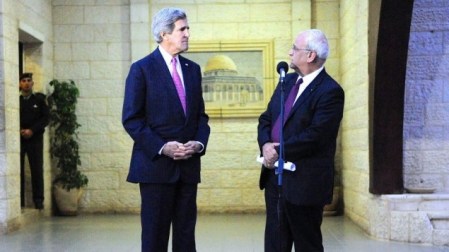
kerryandpalPalestinian Authority lead negotiator Saeb Erekat, right, and US Secretary of State John Kerry in Ramallah, West Bank, on January 4, 2013. (State Department)

Report published in Egypt has Kerry and Rice advising senior Palestinians on strategy at UN and after Trump takes power.

An Egyptian paper published what it claims are the transcripts of meetings between top US and Palestinian officials that, if true, would corroborate Israeli accusations that the Obama administration was behind last week’s UN Security Council resolution condemning Israeli settlements.

An Egyptian paper published what it claims are the transcripts of meetings between top US and Palestinian officials that, if true, would corroborate Israeli accusations that the Obama administration was behind last week’s UN Security Council resolution condemning Israeli settlements.

At the same time, a report in an Israeli daily Tuesday night pointed to Britain helping draft the resolution and high drama in the hours leading up to the vote, as Jerusalem tried to convince New Zealand to bury the Security Council measure.

In a meeting in early December with top Palestinian negotiator Saeb Erekat, US Secretary of State John Kerry told the Palestinians that the US was prepared to cooperate with the Palestinians at the Security council, Israel’s Channel 1 TV said, quoting the Egyptian Al-Youm Al-Sabea newspaper.

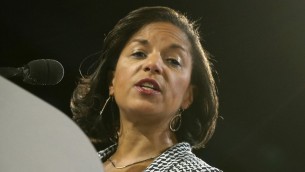
Also present at the meeting were US National Security Adviser Susan Rice, and Majed Faraj, director of the Palestinian Authority’s General Intelligence Service.

riceniceUS National Security Adviser Susan Rice speaks during the American Israel Public Affairs Committee 2015 Policy Conference, March 2, 2015 in Washington, DC. (photo credit: Mark Wilson/Getty Images/AFP)

Kerry is quoted as saying that he could present his ideas for a final status solution if the Palestinians pledge they will support the proposed framework. The US officials advised the Palestinians to travel to Riyadh to present the plan to Saudi leaders.

Israel fears that Kerry, who is slated to give a speech Wednesday on the subject, will then lay out his comprehensive vision for two-state solution at a Paris peace conference planned for January. Israel has refused to attend. Israel further fears that this Kerry framework could be enshrined in another UN Security Council resolution.

The Egyptian report fits with Israeli claims that it had received “ironclad” information from Arab sources that Washington actively helped craft last week’s UN resolution declaring Israeli settlements illegal.

samanthaSamantha Power, U.S. Ambassador to the United Nations, addresses the United Nations Security Council, after the council voted on condemning Israel’s settlements in the West Bank and East Jerusalem, Friday, Dec. 23, 2016 (Manuel Elias/The United Nations via AP)

Responding to a question about the Al-Youm Al-Sabea report, State Department Spokesman Mark Toner denied that the US discussed the language of the resolution with Erekat or in a meeting with officials from New Zealand.

The Obama administration has denied it was behind the resolution, saying that it only decided not to veto it after reading the final text.

Meanwhile, a report in the daily Haaretz Tuesday cited Western and Israeli officials detailing how Britain, and not the US, worked with the Palestinians to craft the text of the resolution, toning it down to make it palatable enough for Washington to avoid a veto.

“The Israeli diplomats say that from information that reached the Foreign Ministry in Jerusalem, British legal figures and diplomats had been working directly with the Palestinians on the wording of the resolution even before it was distributed by Egypt,” Haaretz said.

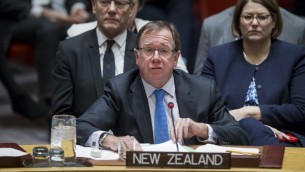
nzdipNew Zealand Foreign Minister Murray McCully addresses a Security Council meeting on the situation in the Middle East on December 16, 2016. (UN/Manuel Elias)

According to Haaretz, in the hours before the resolution went forward, Netanyahu phoned New Zealand Foreign Minister Murray McCully, and warned him that going ahead with the resolution “will be a declaration of war.”

“It will rupture the relations and there will be consequences. We’ll recall our ambassador to Jerusalem,” Netanyahu is reported to have said.

Since the resolution passed, Netanyahu has taken a series of measures against the states that supported the resolutions, minimizing ties with some and calling in their envoys for rebuke.

According to the Egyptian report, the US diplomats expressed their mistrust of Netanyahu, saying he wanted to destroy the two-state solution and was only interested in maintaining the status quo between Israel and the Palestinians.

The transcript showed Kerry and Rice advising the Palestinians not to make any provocative moves when US President-elect Donald Trump takes office on January 20, calling him dangerous.

They warned against such steps as ending security cooperation with Israel, pursuing legal action against Israeli officials in the ICC, or dissolving the Palestinian Authority.

They also said Trump’s administration was likely to adopt a policy on the Israel-Palestinian conflict that would be totally different to that of previous administrations going back to 1967.

mideast-palestinians-_horo-4-305x172In this Friday, Dec. 11, 2015 file photo, Palestinian chief negotiator Saeb Erekat delivers a speech at the Mediterranean Dialogues Conference Forum, in Rome. (AP Photo/Andrew Medichini, File)

When asked how the Palestinians would react if Trump carried out his promise to move the US embassy to Jerusalem, Erekat reportedly said the Palestine Liberation Organization would rescind its recognition of Israel and ask Arab states to expel their US envoys.

Erekat made precisely that threat in a December 19 conference call organized by the Wilson Center policy forum. He said he would immediately resign as the chief Palestinian negotiator, and that “the PLO will revoke its recognition of Israel” as well as all previously signed agreements with Israel. Furthermore, said Erekat, all American embassies in the Arab world would be forced to close — not necessarily because Arab leaderships would want to close them, but because the infuriated public in the Arab world would not “allow” for the embassies to continue to operate.

The Associated Press contributed to this report.