How can Israel do that when the Palestinian Authority and Hamas teach children to hate and kill Israeli Jews?
How can Israel do that when the Palestinian Authority and Hamas teach children to hate and kill Israeli Jews?
LIVE: Netanyahu to deliver televised statement via YouTube, December 28, 2019
The Saga of Hillary’s Emails Continues, Front Page Magazine (The Point), Daniel Greenfield, December 28, 2016
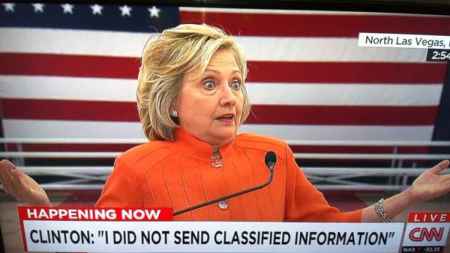
Hillary is increasingly disposable. It’s now a matter of whom else she may take down with her.
************************
It’s not over until the pantsuit sings.
In a new legal development on the controversy over former Secretary of State Hillary Clinton’s emails, an appeals court on Tuesday reversed a lower court ruling and said two U.S. government agencies should have done more to recover the emails.
The ruling from Judge Stephen Williams, of the U.S. Court of Appeals for the District of Columbia Circuit, revives one of a number of legal challenges involving Clinton’s handling of government emails when she was secretary of state from 2009 to 2013.
While the State Department and National Archives took steps to recover the emails from Clinton’s tenure, they did not ask the U.S. attorney general to take enforcement action. Two conservative groups filed lawsuits to force their hand.
A district judge in January ruled the suits brought by Judicial Watch and Cause of Action moot, saying State and the National Archives made a “sustained effort” to recover and preserve Clinton’s records.
But Williams said the two agencies should have done more, according to the ruling in the U.S. Court of Appeals for the District of Columbia Circuit. Since the agencies neither asked the attorney general for help nor showed such enforcement action could not uncover new emails, the case was not moot.
Obviously the case.
The government’s people repeatedly obstructed investigations and the investigations of their obstructionism will likely drag on long after Obama is out of office as one of the dirty polluted remnants of his tainted legacy. The IRS, the emails and Benghazi, along with so much else represent a prolonged battle between activist investigators and radical government figures embedded in the system.
The difference is that Hillary is increasingly disposable. It’s now a matter of whom else she may take down with her.
The Obama administration’s parting assault on Israel continues.
Kerry is actually right that Israel won’t ever really be at peace, but if he thinks that a two-state solution will bring about that peace, then he is even more delusional than he seems to be. Israel will not be at peace as long as there are believers in the Qur’an, which tells Muslims, “drive them out from where they drove you out” (2:191).
Meanwhile, Kerry’s statement about Israel not being able to be Jewish and democratic is flatly false. There are Israeli Arab Knesset members now. Non-Jews in Israel, including Muslims, enjoy more rights than non-Muslims do in majority-Muslim countries.

“Kerry: ‘Israel Can Either Be Jewish or Democratic — It Cannot Be Both,’” Grabien News, December 28, 2016:
…”The truth is that trends on the ground, violence, terrorism, settlement expansion and the seemingly endless occupation, they are combining to destroy hopes for peace on both sides and increasingly cementing any reversible — an irreversible one state reality that most people do not actually want.
Today, there are a similar number of Jews and Palestinians living between the Jordan river and the Mediterranean sea. They have a choice. They can choose to live together in one state or they can separate into two states. But here is a fundamental reality. If the choice is one state, Israel can either be Jewish or democratic. It cannot be both. And it won’t ever really be at peace.
Moreover, the Palestinians will never fully realize their vast potential in a homeland of their own with a one state solution.”
Source: Trump urges Israel to ‘stay strong’ till January 20 | The Times of Israel
Netanyahu tweets his thanks as president-elect slams UN resolution on settlements, saying US can’t keep treating Jewish state with ‘total disdain’

US President-elect Donald Trump lashed out at the Obama administration on Wednesday over its decision not to veto the recent UN Security Council resolution condemning Israeli settlements.
Taking to his preferred medium of Twitter, the Republican president-elect said that Washington cannot continue to treat Israel “with such total disdain and disrespect.”
Trump also implied that under Obama, the US was no longer “a great friend” to the Jewish state.
“We cannot continue to let Israel be treated with such total disdain and disrespect. They used to have a great friend in the U.S., but…” Trump wrote. “Not anymore. The beginning of the end was the horrible Iran deal, and now this (UN)! Stay strong Israel, January 20th is fast approaching!”
Prime Minister Benjamin Netanyahu responded to the tweet minutes after it was posted, thanking Trump for his “warm friendship and your clear-cut support.” He also included the Twitter handles of Trump’s children Ivanka and Eric JrEarlier this week, Trump criticized the UN on Twitter for the vote, vowing the ineffective world body would see an overhaul once he took office.
“The United Nations has such great potential but right now it is just a club for people to get together, talk and have a good time. So sad!” he tweeted.
Israel responded furiously to the UN Security Council resolution, downgrading ties with the countries that voted in favor and calling in their ambassadors on Christmas Day for a dressing-down.
Trump, who publicly called for the US to veto the resolution, has repeatedly criticized Obama’s policies on Middle East.
Source: Russia reportedly rejects Kerry request to adopt his Mideast peace framework | The Times of Israel
Lavrov urges direct talks, warns outgoing administration against ‘bringing US domestic agenda into work of Quartet’

Russia’s Foreign Minister Sergey Lavro (left) and US Secretary of State John Kerry talk during a meeting of the International Syria Support Group, September 22, 2016. (AP Photo/Jason DeCrow)
Amid frantic diplomatic maneuvers ahead of a Wednesday speech by US Secretary of State John Kerry on the Israeli-Palestinian conflict, Russia reportedly rejected a request by United States for the Middle East Quartet to adopt the principles set to be presented in the speech.
Kerry spoke with Russian Foreign Minister Sergey Lavrov on Tuesday night, at which time the Russian foreign minister dismissed the US secretary’s proposal, according to Haaretz.
Lavrov subsequently released a statement urging direct peace talks between Israel and the Palestinians.
“The two top diplomats exchanged views on the situation in the Palestinian-Israeli settlement and around it,” says a transcript from the call, which appears on Russia’s semi-official Tass news agency.
“Lavrov stressed the necessity of creating conditions for direct talks between the leaders of Israel and Palestine and warned against bringing US’ domestic agenda into the work of the Middle East Quartet and the United Nations Security Council. He stressed that attempts to use these formats in bickering between the Democrats and Republicans are harmful.”
Prime Minister Benjamin Netanyahu reportedly fears that the Middle East Quartet — made up of the US, UN, Russia and EU — could adopt the principles set out by Kerry Wednesday at a Paris summit on the Israeli-Palestinian conflict next month, and then return to the Security Council in the very last days of Barack Obama’s presidency to cement these new parameters in a resolution on Mideast peacemaking.
On Friday, Russia was one of 14 states that voted in favor of a Security Council resolution denouncing Israeli settlements. The decision, which infuriated Israel, was allowed to pass after the US decided to depart from its traditional policy and abstain instead of veto the resolution.
According to a partial account by Haaretz of some behind-the-scenes events before the anti-settlements vote, Prime Minister Benjamin Netanyahu had hoped Russia would delay the vote in return for Israel’s acquiescence to a Russian request to skip a UN General Assembly vote days earlier on a resolution that would have allowed for the establishment of a mechanism to investigate allegations of war crimes and crimes against humanity in Syria.
Netanyahu called Russian President Vladimir Putin hours before the vote Friday, according to Haaretz, in an attempt to persuade him to postpone. It seems Putin answered the call: less than an hour before the 15-member council was set to cast votes, Russian Ambassador to the United Nations Vitaly Churkin asked for closed consultations to request a delay on the vote until after the Christmas holiday.
Churkin, according to Western diplomats who spoke to Haaretz, said Russia was not satisfied with the text, which slammed Israeli settlement building and expansion in the West Bank and East Jerusalem, and with the timing of the vote — just weeks before a new US administration is set to take power.
But Churkin was rebuffed and the vote passed with the 14 votes in favor, including Russia’s, and the US abstention.
The Middle East Quartet’s June 30 report lambasted Israeli settlement expansions but was seen in Israel as a success because of its unexpected focus on Palestinian wrongdoing. That document was issued jointly on behalf of United Nations Secretary-General Ban Ki-moon, US Secretary of State John Kerry, European Union foreign policy czar Federica Mogherini and Russian Foreign Minister Sergey Lavrov.
Kerry was originally slated to give his address on Thursday, in the immediate aftermath of the scheduled vote, but canceled the speech after Egypt pulled the resolution at the last minute, apparently responding to pressure from Israel and US President-elect Donald Trump. The measure was reintroduced Friday by New Zealand, Senegal, Malaysia and Venzuela.
Source: Trump slams Obama for his ‘disdain’ and ‘disrespect’ toward Israel – Israel News – Jerusalem Post
The United States last week abstained from wielding its veto power at the UNSC, allowing an anti-settlement resolution to pass.
US President-elect Donald Trump on Wednesday took to social media to rail against the Obama administration’s treatment of Israel, criticizing the White House’s foreign policy decisions and its most recent move at the United Nations.
“We cannot continue to let Israel be treated with such total disdain and disrespect,” Trump wrote on Twitter hours before US Secretary of State John Kerry was scheduled to give a speech on Middle East peace.
He continued by stating: “[Israel] used to have a great friend in the U.S., but… not anymore. The beginning of the end was the horrible Iran deal, and now this (U.N.)!”
“Stay strong Israel, January 20th is fast approaching!,” the president-elect added.
Shortly after Trump issued his remarks, Prime Minister Benjamin Netanyahu thanked the incoming American commander-in-chief for backing Israel.
“President-elect Trump, thank you for your warm friendship and your clear-cut support for Israel!” Netanyahu wrote on Twitter.
The social media exchange ensued after the United Nations Security Council on Friday passed a motion condemning Israel’s settlement construction, after the United States abstained from casting a vote over the controversial decision. The US had previously been expected to yield its veto power as a permanent member of the 15-state body over the issue.
Jerusalem has expressed outrage over the resolution, calling the decision “shameful.” Prime Minister Benjamin Netanyahu later said that the United States had worked “behind the back” of Israel.
Kerry’s speech is expected lay out his vision for ending the Israeli-Palestinian conflict and address the abstention decision later on Wednesday.
The speech, less than a month before US President Barack Obama leaves office, is expected to be the administration’s last word on a decades-old dispute that Kerry had hoped to resolve during his four years as America’s top diplomat.
It could also be seen in Israel as another parting shot at Netanyahu, who has had an especially acrimonious relationship with Obama since they both took office in 2009.

( Kerry = The last nail in the coffin of the “legacy” of the Obama administration. – JW )
WASHINGTON — In a harsh rebuke of Prime Minister Benjamin Netanyahu of Israel, Secretary of State John Kerry declared on Wednesday that the United States cannot “allow a viable two-state solution to be destroyed before our eyes.’’
Mr. Kerry, in one of his last speeches as secretary of state, said that Mr. Netanyahu was allowing the agenda of the settler movement to define the future of Israel. But he said “there is still a way forward if the responsible parties are willing to act.’’
And he defended the Obama administration’s policy on Israel, citing what he called unprecendented military assistance and cooperation. “No American administration has done more for Israel’s security than Barack Obama’s,’’ he declared.
For Mr. Kerry, the speech was a rueful valedictory. As soon as he took over from Hillary Clinton as secretary of state in 2013, he plunged into the tarpit of Middle East peace negotiations with an enthusiasm neither his predecessor nor President Obama shared. The goal was a nine-month negotiation leading to a “final status” of the Israeli-Palestinian conflict by the summer of 2014.
It never got that far. Despite scores of meetings between Mr. Kerry and his two main interlocutors, Mahmoud Abbas, the Palestinian president, and Mr. Netanyahu, Mr. Kerry and his lead mediators, Martin Indyk and Frank Lowenstein, could not make progress. They blamed both sides for taking actions that undermined the process, but the continued expansion of the settlements was one of their leading complaints — an effort, in the American and European view, to establish “facts on the ground” so that territory could not be traded away.
In the years since, the population of the settlements has expanded rapidly. The effort to get talks going again never gained the slightest momentum. But Mr. Kerry’s warning, that a collapse would lead to another intifada, also did not come true. Instead it has led to stagnation and a hardening of positions.
Mr. Kerry wanted to deliver Wednesday’s speech more than two years ago, current and former aides say. But he was blocked from doing so by the White House, which saw little value in further angering Mr. Netanyahu, who has opposed any speech that might limit Israel’s negotiating room or become the basis for a United Nations Security Council resolution to guide the terms of a “final status” deal.
Now, after a remarkable confrontation with Israel after the Security Council’s passage of a resolution condemning Israeli settlements as a flagrant violation of international law, Mr. Kerry appears to have concluded there is nothing left to lose.
Mr. Netanyahu has accused the United States of “orchestrating” the vote, and his aides have said that Mr. Kerry and Mr. Obama effectively stabbed Israel in the back. Israeli officials have said they have evidence that the United States organized the resolution, whicth the State Department denies.
At the core of Mr. Kerry’s argument on Wednesday was the need for all sides to embrace a two-state solution, with Israel and a Palestinian state recognizing each other. Even that idea may not last: Mr. Trump has nominated an American ambassador to Israel, David M. Friedman, who has rejected the idea of a two-state solution — a concept that President George W. Bush and President Bill Clinton also embraced — and who has helped finance the new settlements that the United Nations condemned. Mr. Clinton gave a similar speech at the end of his presidency, just after the collapse of negotiations at Camp David.
The speech was intended, a senior State Department official said on Tuesday night, to make the case that “the vote was not unprecedented” and that Mr. Obama’s decision “did not blindside Israel.” Mr. Kerry, the official said, would cite other cases in which Washington officials had allowed similar votes under previous presidents.
The official, who spoke on the condition of anonymity to describe a coming speech, said Mr. Kerry would also argue that, with the notable exception of Israel, there was a “complete international consensus” against further settlements in areas that might ultimately be the subject of negotiations.
Analysis: The dangers of UN Security Council Resolution 2334 (2016), Israel National News, Amb. Alan Bake, December 28, 2016
The resolution cannot, in and of itself, serve as grounds for legal proceedings in the International Criminal Court (ICC) or other international tribunals. But clearly, it will be used by the Palestinian leadership as a political tool to buttress existing complaints. This despite the fact that the issues of Palestinian status vis-à-vis the ICC and the court’s jurisdiction regarding the territories have yet to be reviewed juridically. The fact that the ICC Prosecutor has recognized the accession of “the State of Palestine” to the ICC Statute and has accepted their complaints are political decisions.
****************************
The resolution does not make law, and as such, the determinations as to the lack of legal validity of Israel’s settlements are no more than declaratory, but they are a major impediment to negotiations.
The December 23, 2016, resolution adopted by the UN Security Council regarding Israel’s settlement policy has been received with mixed and even extreme reactions. [Click to read the text of UN Security Council Resolution 2334]
The Palestinian leadership, having initiated the resolution, is celebrating its adoption as an affirmation by the international community, including the United States, of its claims against Israel.
Israel sees this resolution as a major impediment to continued peace negotiations in light of the fact that it by-passes the negotiation process in an attempt to prejudge central issues that are on the negotiating table. As such, it seriously prejudices any possible return to the negotiating process.
Israel considers that the resolution provides political incentives to those in the international community hostile to Israel. It advances boycotts and sanctions and could even be used to support possible litigation against Israeli leaders.
Following is a brief summary of the legal and quasi-legal implications of the resolution:
The resolution (as all previous resolutions regarding Israel) was adopted under the sixth chapter of the UN Charter (Pacific Settlement of Disputes) and as such is not mandatory. It contains a series of political determinations and recommendations to the international community. The resolution does not make law, and as such, the determinations as to the lack of legal validity of Israel’s settlements are no more than declaratory.
Much of the terminology repeats UN terminology and language used in previous Security Council and General Assembly resolutions (“inadmissibility of acquisition of territory by force,” “Palestinian territory occupied since 1967 including East Jerusalem,” “secure and recognized borders,” “violation (serious or flagrant) under international law,” the references to the lack of legal validity of settlements, and their being an “obstacle” or “major obstacle” to achieving a two-state solution).
References in the tenth preambular paragraph to the fact that “the status quo is not sustainable” and “entrenching a one-state reality” are new and would appear to be inspired by, or even direct quotes from statements by President Obama, Secretary of State Kerry, and Vice President Biden. Similarly, expressions not previously included in major Security Council resolutions regarding the peace process, such as “two-state solution based on the 1967 lines” (operative paragraph seven), as well as the references in the ninth paragraph to the “Arab Peace Initiative” and the “principle of land for peace” as additional bases for peace, clearly are intended to instill concepts that have never been agreed-upon elements in the negotiating process.
The call upon states in the fifth operative paragraph to distinguish between dealings between Israel-proper and the territories will also be used by BDS activists and states to buttress their boycott campaigns.
The reference in the third operative paragraph to the “4 June 1967 lines” as a basis for negotiations would appear to be a new element, echoing statements by Obama and Kerry, and running counter to the 1967 Security Council resolution 242, which is the basis for all of the Arab-Israeli peace process, which calls for negotiation of “secure and recognized boundaries.” The Israeli-Palestinian Oslo Accords make no specific reference to the 1967 lines. As such this reference would appear to be an attempt to prejudge or unduly influence the negotiating issue of borders.
Despite the declaratory and recommendatory determinations in the resolution attempting to prejudge the status of the territories, east Jerusalem, borders, and settlements, the resolution nevertheless would appear to contradict itself in that it goes on to reaffirm the call for negotiations on “all final status issues” (operative paragraph eight) and for “a comprehensive, just and lasting peace.”
While the resolution does not replace Security Council Resolution 242, which is the accepted and agreed basis for the Israel-Arab peace process, it nevertheless contains elements that attempt to modify Resolution 242 and to sway the negotiating process in a particular direction.
The resolution cannot, in and of itself, serve as grounds for legal proceedings in the International Criminal Court (ICC) or other international tribunals. But clearly, it will be used by the Palestinian leadership as a political tool to buttress existing complaints. This despite the fact that the issues of Palestinian status vis-à-vis the ICC and the court’s jurisdiction regarding the territories have yet to be reviewed juridically. The fact that the ICC Prosecutor has recognized the accession of “the State of Palestine” to the ICC Statute and has accepted their complaints are political decisions.
The United States, through its decision not to veto the resolution, enabled acceptance of a Security Council resolution referring to “occupied Palestinian territory including East Jerusalem.” This indicates U.S. acceptance of the fact that the territories and east Jerusalem belong to the Palestinians. This despite the claim that the United States has consistently agreed with Israel that there has never been any legal determination, agreement, treaty, or other binding source determining that.
This represents a serious, and even irresponsible departure from U.S. policy which has consistently advocated negotiated settlement of the issues of permanent status, Jerusalem, and borders. This position taken by the United States (as well as the other members of the Security Council) also undermines the basic obligation of the Oslo Accords, signed by the PLO and witnessed by the United States (as well as the EU, Russia, Egypt and others), that the permanent status of the territories, the issues of Jerusalem, and borders are to be negotiated.
While the United States and Israel have entertained basic disagreements on settlement policy, the United States has consistently rejected, as a matter of basic policy, any attempt by the international community to prejudge this or the other permanent status negotiating issues.
The outrage voiced by Israel with both the resolution itself and the Obama administration’s enabling it to pass stems from five basic components:




 anneinpt
 artaxes
 danmillerinpanama
 davidking1530
 Peter Hofman
 Joseph Wouk
 Peter
Peter Louisiana Steve
 WarSclerotic
Recent Comments