Archive for December 23, 2016

Nothing New in Rouhani’s “Charter of Citizens Rights.” Just a Re-Hash of Past Election Statements

December 23, 2016

Nothing New in Rouhani’s “Charter of Citizens Rights.” Just a Re-Hash of Past Election Statements, Iran Focus, December 23, 2016

charter-of-citizens-rights-750

London, 23 Dec – On the very day that the UN General Assembly condemned violations of human rights in Iran, its president, Hassan Rouhani, published a statement, “Charter of Citizens Rights”, which merely repeats the Constitution and laws of the clerical regime, albeit rearranged. It’s shocking that this occurred in the midst of the justice seeking movement for the 1988 Massacre has gained strength both inside and outside Iran.

During 2013 election, Rouhani announced the same statements, and now he’s reusing them for next year’s election. What’s interesting is that he announced the initial report on implementation will be due after the election.

The Charter consists of 120 articles, none of which challenge the absolute authority of the Supreme Leader, or the complete denial of popular sovereignty, the violation of fundamental rights of women is not addressed, nor are other inhumane laws that have been institutionalized in the clerical regime.

The first article states, “The right to life cannot be denied from citizens except in accordance with law”. According to an article published by the National Council of Resistance of Iran (NCRI) on Wednesday, December 21, “This is nothing but confirmation of 120,000 political executions and mass executions that are happening every day. All these crimes are carried out based on the “law” of Velayat-e-Faqih. Rouhani has previously described all these executions as implementing law and divine command.”

Women’s rights are discussed within the framework of the law — the same law that denies all economic, social and political rights to women. The same law considers women’s rights as being half of men’s, and denies them many careers.

Here is what is said about freedom: “These freedoms are only limited based on necessity and according to the law.” He fails to mention various police organs established according to the law to quell all freedoms, whose wages are paid for by Rouhani’s cabinet and are under the command of his Interior Minister. Mercenaries titled as ‘Hijab (veiling) Police’, ‘Cyber Police’, ‘Mountain Police’, ‘Invisible Police’ and …

Ownership rights are referred to in Article 75, which reads that expropriation is banned, ‘unless it is according to the law’. “Rouhani, fails to explain the fate of the hundreds of billions of dollars stolen by the mullahs’ regime and senior regime officials from the Iranian people over the 38 years of the mullahs’ rule, and what happened to the $95 billion wealth in the ‘The Executive Headquarters of Imam’s Directive,’ practically becoming Khamenei’s personal wealth, all stolen from the Iranian people,” declares the NCRI.

The last part of the Charter speaks to the export of terrorism, calling the killings in Syria, Iraq, Yemen and other countries “foreign policy using various wise measures” for “combating violence, extremism and in defense of innocent people’s rights,” emphasizing “allocating adequate resources to equip and strengthen the armed forces” and “allocating enough supplies to strengthen the defense capability.” This is the same policy Khamenei and his inner circle, including Rouhani, have been imposing on the people of Iran and the rest of the region.

Spending The Iranian people are angry of the use of their assets on the wars like those in Syria and Iraq. “Undoubtedly, Rouhani deserves the medal of obscenity. When introducing this document he said, “These citizenship rights tell the world that Islamic Republic of Iran has this capacity; Islamic Revolution has this capacity to make the best use of all new legal characteristics of today’s world in the context of Iranian Islamic culture,” concludes the NCRI.

It’s A Global Jihad, Stupid

December 23, 2016

It’s A Global Jihad, Stupid, Huffington Post, Raheel Raza, December 21, 2016

(I was alerted to this article this morning via an e-mail from Dr. Zuhdi Jasser. — DM)

terrorists1

Now that Donald J. Trump is officially the President-elect of the United States, moderate Muslims like myself are hoping he changes course and refuses to surround himself with radical Muslim advisors, or members of the so-called “Islamophobia Industry” – who actually have the nerve to call real moderate Muslims – like me – an Islamophobe.

The politically correct status quo, and ominous silence on the issue of global jihad, will only give us more terror and mayhem. We need change. Whether that means pausing immigration from terror-producing countries or “extreme vetting” of new immigrants, let’s not be afraid to have the conversation.

******************************

Dr. Zuhdi Jasser, president of the American Islamic Forum for Democracy and a fellow reformist Muslim, has just suggested a new mantra in the fight against terror: “It’s the global jihad, stupid.”

I totally concur, as a moderate Muslim woman who wrote a book on radical Islam, has taken part in various documentaries, penned numerous op-eds on the issue, and toured Pakistan, parts of the Middle East and recently Europe (in fact last week I was in Berlin at the exact spot where the terrorist struck) – all in search for the root causes of radicalization.

What I found is simple: the Islamists are waging a global war – a global jihad – against the West.

We can call it a clash of civilizations; a third world war; we can listen to endless analysis given by so-called experts who cry “racism” or “Islamophobia,” we can disguise the real issue under the umbrella of political correctness, or hide behind a victim ideology – but that does nothing to change the reality.

The reality is: this is a global jihad and its target is the West.

When the radical Islamists tell us it is a jihad, while they are killing us, why are Western governments and media seemingly unable to accept reality for what it is?

The answer to this question is simple, not stupid, if we only take a moment to clear the cobwebs, to get over our Western liberal guilt and take a close hard look at where we are.

Western governments have been taking advice from Muslim advisors who are linked to the Muslim Brotherhood. And law enforcement agencies are aligning themselves with organizations that have subversive agendas.

Take a look at Mr. Obama’s invitees to the White House for Ramadan and Eid celebrations – they’re certainly not reformist Muslims. We have Keith Ellison making a run for the DNC. In Europe we see Tariq Ramadan (grandson of Hasan al Banna) posing as a celebrity and a voice for European Muslims, and organizations like CAIR in Canada and USA insist that they speak for all Muslims.

Well; they don’t speak for me. And they don’t speak for the majority of Muslims.
But they do speak to Western leaders and media. Over the past number of years; many bad decisions have been made – based on those whispers-in-the-ear from the likes of the Muslim Brotherhood and radical Islamist apologists. If you ever wonder how bad decisions get made – that’s how.

Now that Donald J. Trump is officially the President-elect of the United States, moderate Muslims like myself are hoping he changes course and refuses to surround himself with radical Muslim advisors, or members of the so-called “Islamophobia Industry” – who actually have the nerve to call real moderate Muslims – like me – an Islamophobe.

The politically correct status quo, and ominous silence on the issue of global jihad, will only give us more terror and mayhem. We need change. Whether that means pausing immigration from terror-producing countries or “extreme vetting” of new immigrants, let’s not be afraid to have the conversation.

Let’s not be afraid to use our common sense. And let’s have the courage to call it what it is:

It’s a global jihad, stupid!

Trump and Sisi discuss Middle East peace

December 23, 2016

Trump and Sisi discuss Middle East peace, Israel National News, Elad Benari, December 23, 2016

trumpandsisiTrump and Sisi meet in New YorkReuters

“The presidents agreed on the importance of affording the new U.S. administration the full chance to deal with all dimensions of the Palestinian case with a view of achieving a full and final settlement,” he added.

Sisi recently praised Trump and said he expected greater engagement in the Middle East from his administration.

******************************

Egyptian President Abdel Fattah al-Sisi on Thursday night spoke with U.S. President-Elect Donald Trump, Sisi’s office said, according to Reuters.

The call came hours after the UN Security Council postponed indefinitely a vote on Egypt’s draft resolution denouncing Israeli “settlements”.

“During the call they discussed regional affairs and developments in the Middle East and in that context the draft resolution in front of the Security Council on Israeli settlement,” said Sisi’s spokesman, Alaa Yousef.

“The presidents agreed on the importance of affording the new U.S. administration the full chance to deal with all dimensions of the Palestinian case with a view of achieving a full and final settlement,” he added.

Thursday’s vote on the UN Security Council resolution was reportedly postponed after Sisi instructed his nation’s delegation to push for a delay in the vote.

Trump had earlier called for the United States to veto the resolution, as it has traditionally done with similar proposals. American officials indicated that the Obama administration was planning to abstain from voting or even to vote yes.

Sisi recently praised Trump and said he expected greater engagement in the Middle East from his administration.

The Egyptian President has also been at the forefront of the effort to resume talks between Israel and the Palestinian Authority, having several months ago urged Israelis and Palestinian Arabs to seize what he said was a “real opportunity” for peace and hailed his own country’s peace deal with Israel.

The comments were welcomed by Prime Minister Binyamin Netanyahu, who stressed that “Israel is ready to participate with Egypt and other Arab states in advancing both the diplomatic process and stability in the region.”

Palestinian Authority (PA) chairman welcomed Sisi’s call as well, saying he welcomed the Egyptian president’s efforts to achieve peace and establish a Palestinian state.

Israel and the rising new West

December 23, 2016

Source: Column One: Israel and the rising new West – Opinion – Jerusalem Post

Caroline Glick

Next year will see general elections in Holland, France and Germany, and nationalist parties in all three countries are likely to win or at a minimum be profoundly strengthened.
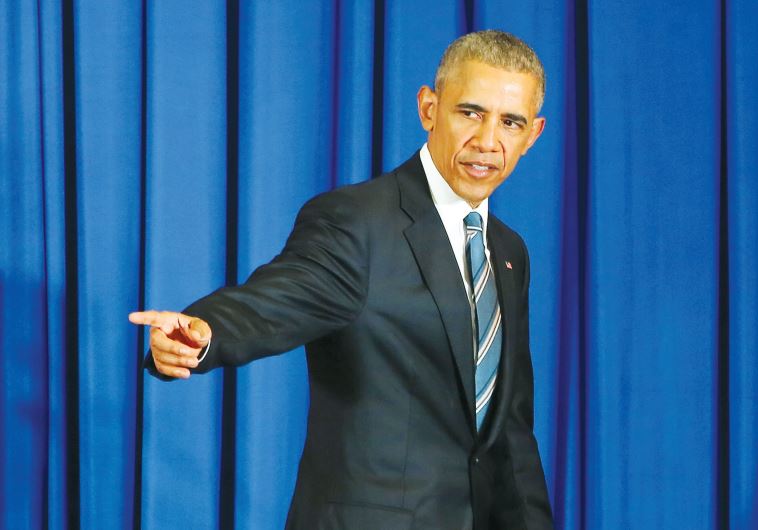
US President Barack Obama has but a month left in office. But he has a month left. And he is using it. In the days remaining, Obama is using the full authority of his office to advance his policies with the hope of rendering permanent his mark on American policy.

Domestically, Obama is working to undercut the capacity of his successor, President-elect Donald Trump, to implement his plans of expanding domestic oil and gas exploration and development.

On Tuesday, Obama banned offshore drilling in large swathes of the Artic and Atlantic oceans.

In foreign affairs, Obama has Israel in his crosshairs.

It is now apparent that the lame duck president, bereft of any partisan restraints, intends to make good on his eight years of promises to use his last month in office to stick it to Israel at the UN.

The opening act of Obama’s onslaught on Israel came on Wednesday, with State Department Spokesman James Kirby’s fatuous and unprecedented claim that Israeli communities built beyond the 1949 armistice line – the so-called settlements – are illegal.

Late Wednesday, the UN suddenly announced it would hold a vote on an Egyptian resolution parroting that language, and calling for a complete halt on construction projects for Jews in the areas, including Jerusalem.

The draft resolution included a call for an international governmental embrace of economic warfare against Israel. It called upon member states “to distinguish in their relevant dealings, between the territory of the State of Israel and the territories occupied since 1967.”

An indication of the depth of Obama’s commitment to enabling the resolution to pass came amid reports that Secretary of State John Kerry was planning to address the Security Council ahead of the scheduled vote.

In any event, following massive pressure from Israel and a statement by President-elect Donald Trump calling for Obama to veto the resolution, Egypt postponed the vote on its resolution “indefinitely.”

But with or without the resolution – and there are at least two others also poised for a vote – Obama is using his remaining time to empower the anti-Israel boycott, divestment and sanctions operation aimed at destroying Israel’s economy and international position.

As Anne Bayevsky reported in the Washington Examiner on Wednesday, Obama is supporting the UN budget which allocates funding toward the implementation of a UN Human Rights Council resolution promoting BDS. The resolution requires the Human Rights Council to compile a blacklist of companies worldwide with direct or indirect business ties to Israeli communities built beyond the 1949 armistice lines. Since all businesses doing business with Israeli entities have indirect or direct ties to the areas where some 750,000 Israeli live, the resolution represents a bid to conduct total war against the Israeli economy.

And Obama is funding its implementation.

Moreover, Obama is trying to box the Trump administration into continuing his supportive stance on the Human Rights Council. Whereas the Bush administration refused to join the inherently and incurably anti-Israel body, Obama has lavished it with legitimacy and funding.

This month the administration won a new three-year term for the US on the council beginning on January 1. This means that regardless of Trump’s approach to the phony human rights body, the US is now saddled with membership for the bulk of his presidential term.

One of the things operating in Israel’s favor as it seeks to undo Obama’s hostile legacy once he is gone, is that Trump’s election is part and parcel of a wide-scale change in Western politics that is fundamentally transforming the so-called “international community” that provides knee-jerk support for BDS and every other anti-Israel initiative.

The term “international community,” of course, is just a grandiose name for the collective views of the Western European elites and those of their counterparts on the US coasts. And as Trump’s victory and the British decision to withdraw from the European Union indicated, the elites’ capacity to impose their views on voters is fast disappearing.

The populist wave that approved Brexit and brought Trump to power is far from spent force. Next year will see general elections in Holland, France and Germany, and nationalist parties in all three countries are likely to win or at a minimum be profoundly strengthened. This means that the likelihood the EU will break apart is rising with each passing day. And the foreign policies of the separate states of Europe will be far different than their collective positions under the EU.

The main cause of the swift rise of the nationalist Right throughout Western Europe is the mass Muslim migration to Europe. Profound public opposition to the deluge of migrants from Muslim states is bringing about wholesale popular rejection of the multicultural and anti-nationalist values that dictated the tone and substance of European politics for two generations. The implications of this revolutionary shift in values and its impact on European politics are enormous. And Israel stands to be one of the first beneficiaries of this transformation, if our foreign policy bureaucracy is capable of understanding what is happening.

Unfortunately, actions by the Foreign Ministry this week indicate that our diplomatic bureaucrats haven’t the vaguest idea of what is happening, or why these developments can be beneficial for Israel.

The Foreign Ministry announced this week that the government was boycotting a delegation of visiting European lawmakers because Kristina Winberg, a member of Sweden’s rightist Swedish Democrats party, was among its members.

In recent weeks, the Foreign Ministry has managed to boycott Sweden’s entire political spectrum. Last week, the ministry announced that Prime Minister Benjamin Netanyahu had rejected Swedish Foreign Minister Margot Wallstrom’s request for a meeting due to scheduling difficulties.

Wallstrom richly deserves the government’s unofficial boycott. Among other things, Wallstrom blamed Israel for the massacres in Paris last November.

While the Foreign Ministry used a procedural excuse to brush off Wallstrom, it threw diplomatic protocol to the seven winds when it announced that Deputy Foreign Minister Tzipi Hotovely’s scheduled briefing of the delegation of European lawmakers was canceled due to Winberg’s participation.

Foreign Ministry Spokesman Emmanuel Nahshon said that the Swedish Democrats party “has neo-Nazi tendencies, and therefore the Foreign Ministry decided not to include [Winberg] in the meeting with Hotovely.”

Winberg’s colleague, who included a member of Trump’s transition team, were appalled by the boycott. To protest the move, the entire delegation canceled its meeting with Hotovely.

The delegation was in Israel to participate in a leadership summit in Jerusalem. Due to its position on the Sweden Democrats, the Foreign Ministry caused Justice Minister Ayelet Shaked to cancel her scheduled remarks at the conference.

In other words, the Foreign Ministry adopted and implemented a comprehensive, public and undiplomatic boycott of the rightist party.

It is unclear who stands behind this policy. But whoever is responsible should be subjected to a career review. The policy is as destructive to Israel’s national interests as it is unjust to the Swedish Democrats.

The Swedish Democrats party is the only pro-Israel political party in Sweden. It is the only party that opposed Sweden’s recognition of “Palestine.”

The Foreign Ministry’s claim that the party has “neo-Nazi tendencies” is tendentious. Earlier this month, the party took the extreme step of banning one of its own lawmakers from the party after she made an antisemitic statement. In the past it disbanded its youth wing and formed a new one amidst allegations of antisemitism. How many Nazi parties expel their members or disband their youth wings for hating Jews? The Swedish Democrats party, which is identified with the nationalist right, has built is political position around its unqualified opposition to immigration. For its opposition to immigration, the Democrats are castigated continuously as racists by their political rivals.

There is every reason to believe there are Jew-haters among the party’s members. But unlike members of Wallstrom’s Social Democratic Party, Swedish Democrats don’t participate in anti-Israel demonstrations where Hezbollah and Hamas flags are prominent. Indeed, they don’t participate in anti-Israel demonstrations at all.

Moreover, they are the fastest growing and largest party in Sweden. This fact makes the Foreign Ministry’s treatment of Winberg not only unjust, but deeply stupid as well. A mere decade after it won its first representation in parliament, the Swedish Democrats have been leading political polls for the past year. And the Foreign Ministry just called it a Nazi party.

Sadly, it isn’t much of a surprise that the Foreign Ministry has failed to read the writing on the walls in Sweden and act appropriately. Our foreign and defense bureaucracies have a storied record of missing major developments. They are too busy talking to their bureaucratic counterparts to pay attention to what the public is saying.

In Egypt for instance, no one was more surprised at then-president Hosni Mubarak’s overthrow and the concomitant rise of the Muslim Brotherhood in Egypt than the defense establishment, whose members were largely responsible for handling Israel’s bilateral relations with Mubarak.

In the decade or more that preceded Mubarak’s overthrow, anyone paying attention to open source polling data of public opinion in Egypt, or to what was being said in the Egyptian media, was aware of the deep-seated and rising public frustration and disgust with Mubarak, his sons and his cronies. But since the only people that Israel’s defense establishment spoke to were Mubarak, his sons and his cronies, they were taken by complete surprise when he was overthrown and replaced with the Muslim Brotherhood.

Obama will continue to be the president until 12:00 p.m. on January 20. And Israel can expect him to use this time to take the actions against Israel that he has been threatening to take for eight years. One way or another, he will exact his pound of flesh.

But at 12:01 on January 20, a new era will begin.

And in the coming months, as the next wave of populist right-wing parties rise to power in Europe, the “international community” that has been unanimous in its backing of the anti-Israel policies for a generation will become an altogether different body.

This new era presents Israel with profound, indeed unprecedented opportunities. But if our foreign and defense bureaucrats continue to behave as though nothing has happened, we will fail to benefit from any of them.

ANALYSIS: UN saga shows sands shifting

December 23, 2016

And the catalyst of change is US President-elect Donald Trump.

Source: ANALYSIS: UN saga shows sands shifting – Israel News – Jerusalem Post

And the catalyst of change is US President-elect Donald Trump.

It’s a new day.

Egypt’s 11th-hour decision to pull back its anti-settlement resolution at the UN Security Council on Thursday demonstrates that what was is definitely not what will be from now on in the Middle East diplomatic process.

And the catalyst of change is US President-elect Donald Trump.

Amid all the head-scratching and speculation early Thursday regarding whether President Barack Obama would use the US veto to protect Israel from a UN resolution calling for a clear distinction between the Jewish state and the territories, Trump released the following statement.

“The resolution being considered at the United Nations Security Council regarding Israel should be vetoed. As the United States has long maintained, peace between the Israelis and the Palestinians will only come through direct negotiations between the parties, and not through the imposition of terms by the United Nations. This puts Israel in a very poor negotiating position and is extremely unfair to all Israelis,” he said.

While it was not clear whether this message would matter at all to Obama, it does matter to Egyptian President Abdel Fattah al-Sisi, who will have to work with Trump for the next four years. Obama already pushed through this week one regulation he knew Trump would oppose – a ban on offshore drilling in the US-controlled Arctic and Atlantic seaboard – and there was no reason to believe he would not do the same on this resolution.

But Sisi has a different set of considerations.

Sisi, like Netanyahu, met both Trump and his Democratic rival Hillary Clinton in September, before the election. Unlike Netanyahu, however, he did not hide his preference for Trump, and in interviews after those meetings made clear he supported Trump. Sisi was the first international leader to call and congratulate the president-elect after his victory, and said he hoped the victory would breathe new life into the Egyptian-American relationship.

Ties between the two countries were strained as a result of what Sisi viewed as Obama’s support for the Muslim Brotherhood, and because of Washington’s criticism of Sisi’s human rights record. With Trump, Sisi sees the possibility of turning a new page with Washington, and it is clear that following Trump’s statement on the UN resolution on Thursday – and likely messages he received from the Trump team – he realized this would not be the best way to begin afresh.

There are some who are saying that the Egyptian change of mind had more to do with pressure coming from Israel. This is highly unlikely.

Does anyone really believe that Sisi did not realize before spearheading and introducing this resolution that it would infuriate Prime Minister Benjamin Netanyahu? Sisi obviously knew in advance what Jerusalem’s reaction would be. But since when does Egypt forgo promoting anti-Israel resolutions in international forums because of a fear of Israeli displeasure? In 2014 and 2015, Egypt was behind unsuccessful resolutions at the International Atomic Energy Agency that would have forced Israel to open its nuclear sites to international inspection, a resolution far more inimical to Israel’s real interests than an anti-settlement resolution without any real teeth in the Security Council.

Some critics are using the very fact that Sisi put forward this proposal as proof that Netanyahu’s claim of strong ties with Egypt, Jordan and other Arab states is hollow. If the ties are so great, why would Egypt push forward such a resolution? But the ties are indeed strong. On security and intelligence matters, the two countries are coordinating and cooperating to an unprecedented degree. Not because they love each other, but because they need each other, to deal with common threats: combating Iranian expansion in the region, preventing Islamic State inroads in northern Sinai and fighting Hamas/Muslim Brotherhood.

But Egypt has other interests as well. Sisi still needs to placate a domestic constituency which likes to see it take the lead on the Palestinian issue, and Egypt uses this issue – and its role in trying to solve it – as a way to cement its status as a leader in the Arab world.

In Sisi’s calculations, he could afford to irritate Netanyahu with this UN resolution, knowing that because Israeli-Egyptian cooperation is so important to Israel, Netanyahu would not reciprocate by curtailing Israeli-Egyptian coordination.

But he also had a different calculation: Is this an issue over which it is worth irritating Trump, quite possibly getting their relationship immediately off on the wrong foot? By pulling back the resolution, he gave the world his answer. And it is an answer that shows that even before the president-elect takes office, some of the basic assumptions in the Middle East have already started to shift.

Egypt scuttles UN vote on Israeli settlement after Trump warning

December 23, 2016

Egypt scuttles UN vote on Israeli settlement after Trump warning, Washington Examiner, Joel Gehrke. December 22, 2016

Trump’s statement might have had the greatest influence on the Egyptian decision, beyond Netanyahu’s lobbying or other American statements. “Diplomats in Tel Aviv speculating that Sisi didn’t cave because of Israel, but rather because he didn’t want to piss off incoming president,” Economist correspondent Gregg Carlstrom tweeted.

*********************

Egyptian officials scrapped a plan to proceed with a United Nations Security Council vote condemning the construction of Israeli settlements, following pushback from Israeli officials and President-elect Trump.

“Egypt requested the vote’s delay to permit them to conduct an additional meeting of the Arab League’s foreign ministers to work on the resolution’s wording,” Haaretz reported, citing Western diplomats. But the vote might be postponed “indefinitely,” according to the report.

Israeli settlement construction drew condemnation from the State Department earlier this year, in addition to the rebukes of more customary critics, raising fears in Israel and among congressional Republicans that President Obama might not veto a resolution on the matter in the waning days of his presidency. President-elect Trump stated his opposition to the resolution, as Israeli Prime Minister Benjamin Netanyahu was lobbying Egyptian President Abdel-Fattah El-Sisi to drop the resolution.

“The resolution being considered at the United Nations Security Council regarding Israel should be vetoed,” Trump said in a statement. “As the United States has long maintained, peace between the Israelis and the Palestinians will only come through direct negotiations between the parties, and not through the imposition of terms by the United Nations.”

House Speaker Paul Ryan, R-Wis., also called on the Obama administration to veto it.

Trump’s statement might have had the greatest influence on the Egyptian decision, beyond Netanyahu’s lobbying or other American statements. “Diplomats in Tel Aviv speculating that Sisi didn’t cave because of Israel, but rather because he didn’t want to piss off incoming president,” Economist correspondent Gregg Carlstrom tweeted.

Egypt is a temporary member of the UN Security Council, which is dominated by five permanent members — the United States, the United Kingdom, Russia, China, and France — which have the authority to veto council resolutions. Obama used that authority to block a similar resolution condemning Israeli settlements in 2011, but his administration’s increasingly public frustration with the failure of talks between Israel and the Palestinians raised the possibility that he wouldn’t veto it this time around.

Secretary of State John Kerry acknowledged the appeal of a change in policy when asked about a potential resolution to be authored by French diplomats. “If it’s a biased and unfair and a resolution calculated to delegitimize Israel, we’ll oppose it,” he said at the Haim Saban Forum on December 4. “But it’s getting more complicated now because there is a building sense of what I’ve been saying to you today, which some people can shake their heads, say, well, it’s unfair.”

Kerry emphasized that the Israeli settlements in disputed territory are not the cause of violence, but he argued that were nonetheless a “barrier” to an ultimate peace that was being tolerated by the Israeli government. “I’ll tell you why I know that: because the left in Israel is telling everybody they are a barrier to peace, and the right that supports it openly supports it because they don’t want peace,” Kerry said.


