Archive for November 12, 2016

Early Returns on Trump’s Appointments are Good

November 12, 2016

Early Returns on Trump’s Appointments are Good, Power Line, John Hinderaker, November 12, 2016

Donald Trump has been appointing members of his transition team, appointments that presumably foreshadow the ultimate composition of his administration. So far, I have been impressed by his choices. A case in point is Myron Ebell, who will lead Trump’s EPA transition team. The headline says it all: “Trump Picks Top Climate Skeptic to Lead EPA Transition.”

Donald Trump has selected one of the best-known climate skeptics to lead his U.S. EPA transition team, according to two sources close to the campaign.

Myron Ebell, director of the Center for Energy and Environment at the conservative Competitive Enterprise Institute, is spearheading Trump’s transition plans for EPA, the sources said.

The Trump team has also lined up leaders for its Energy Department and Interior Department teams. Republican energy lobbyist Mike McKenna is heading the DOE team; former Interior Department solicitor David Bernhardt is leading the effort for that agency, according to sources close to the campaign.

Ebell is a well-known and polarizing figure in the energy and environment realm. His participation in the EPA transition signals that the Trump team is looking to drastically reshape the climate policies the agency has pursued under the Obama administration. Ebell’s role is likely to infuriate environmentalists and Democrats but buoy critics of Obama’s climate rules.

This could hardly be better. It suggests that Trump is willing to stand up to the bullies in the EPA and the environmental movement generally. Fantastic news, if that really is what it means.

Perhaps the most important question about Trump’s administration is, what will his economic policies turn out to be? On the campaign trail, Trump often didn’t sound like an orthodox conservative on the economy. Yet I was encouraged by my interview with Steve Moore of the Heritage Foundation when I guest hosted the Laura Ingraham show yesterday. The first hour of the program is below. It starts with my monologue on the election, and the interview with Moore begins at 18:40.

The whole hour is interesting, I think, but the Moore interview particularly so for what it tells us about Trump’s economic policies. If you are a conservative, you will like what you hear. Steve names Larry Kudlow as another of Trump’s key economic advisers and lists repatriation, reform of corporate tax rates, repeal of Dodd-Frank and rejection of job-killing climate deals among the incoming administration’s objectives. As you will see, Steve Moore is still giddy about the economic prospects he sees as a result of Trump’s election:

(Podcast at the link — DM)

Trump’s first ME military action may target Iran

November 12, 2016

Trump’s first ME military action may target Iran, DEBKAfile, November 12, 2016

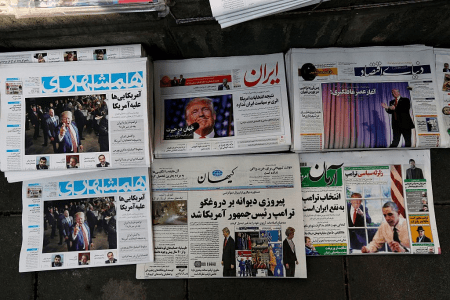
trump_election_iran_9-11-16Donald Trump’s ratings soar in Iranian media too

In more than one campaign speech, President elect Donald Trump declared that his number priority was “to dismantle the disastrous deal” with Iran, which he said was “the worst deal ever” He was referring to the 2015 accord negotiated with Iran by the 5P+1 (five Permanent Security Council members plus Germany), which the Obama administration presented as putting the lid on Iran’s nuclear weapons program.

Trump vowed to use force if necessary to prevent Tehran from acquiring the bomb.

So does Tehran have more to fear from Donald Trump than from Barack Obama in the way of US military intervention? They can’t be sure that he will not set out to show the world – and especially the Iranians – that under his presidency, they can no longer “mess with America.”

DEBKAfile’s Iranian sources report that the ayatollahs are concerned enough to seriously contemplate the following scenario.

The incoming president, after he takes office in the White House on Jan. 20, will act to raise America’s lame image in the Middle East by a surgical strike against an Iranian nuclear facility. One option projected is the blowing up of the Arak heavy water plant for plutonium production at the military complex city of Arak; another would be destroying an Iranian ballistic missile base.

Trump and the Republican-ruled Congress would certainly not tolerate Iranian breaches after America coughed up $150 billion in eased sanctions and released frozen assets.

A Trump administration would be able to marshal seven arguments to justify military action:

1. On Nov. 2, a week before the presidential election, the International Atomic Energy Agency (IAEA) in Vienna reported Iran in violation of the nuclear deal by producing 130.1 tons of heavy water at the Arak plant, one ton more than allowed. In past cases, the Iranians quickly exported the excess amount. But with a new US president on the way, they may try to use it as a one-ton test of his resolve.

2. In another challenge, Iran is threatening to renege unless more economic benefits are forthcoming.

2. The nuclear restrictions imposed under the deal end in about seven years, when Iran can start going back to its weapons program.

3.  Tehran never actually signed the 2014 nuclear deal in the first place. It has remained on paper on three pages as “The Joint Comprehensive Plan of Action Regarding the Islamic Republic of Iran’s Nuclear Program” announced in Lausanne on July 14, 2015 by US Secretary of State John Kerry and Iran’s Foreign Minister Muhammed Javad Zarif.

Three days later, Iran’s supreme leader Ayatollah Ali Khamenei commented: “Our policy will not change with regard to the arrogant US government.”

4. The document was eventually endorsed by the UN Security Council. This obliged the IAEA to follow up it its presumed commitments by inspections on the ground to confirm Iran’s compliance. However, because much of its content was kept under wraps, American and Iranian obligations have been hard to pin down.

5. The deal’s omissions are a lot clearer. Tehran is not committed to release information on its nuclear program prior to the date of the deal – including how far it had progressed towards a weapon.

6. The nuclear deal did not cover Iran’s long-range ballistic missile program, which continues to develop apace.

Ten months ago, the Obama administration tried to correct this omission by imposing fresh sanctions on Iran unless the program was curtailed. There is no information available up until now as to whether this deterrent worked.

7. US military action against Iran’s nuclear or missile programs may also serve the Trump administration to drive a wedge in the partnership between Moscow and Tehran and draw a new line in the sands of the Middle East. The Russians would certainly not step in by force in Iran’s defense, except for possibly sharing some intelligence. Moscow would be shown as failing to back its ally and therefore secure the gains Vladimir Putin managed to  amass in the Middle East  when Obama was president.

Europe’s Planned Migrant Revolution

November 12, 2016

Europe’s Planned Migrant Revolution, Gatestone InstituteYves Mamou, November 12, 2016

Between 2005 to 2014, Germany welcomed more than 6,000,000 people.

Two essential questions about integration must be put on the table: 1) What do we ask of newcomers? And 2) What do we do to those who do not accept our conditions? In Europe, these two questions of integration were never asked of anyone.

In the new migrant order, the host population is invited to make room for the newcomer and bear the burden not of what is an “integration,” but the acceptance of a coerced coexistence.

“No privileges are granted to the Europeans or to their heritage. All cultures have the same citizenship. There is no recognition of a substantial European culture that it might be useful to preserve.” — Michèle Tribalat, sociologist and demographer.

“We need people that we welcome to love France.” — French Archbishop Pontier, Le Monde, October 2016.<

When “good feelings” did not work, however, the authorities have often criminalized and prosecuted anti-immigration critics. The Dutch politician Geert Wilders is currently on trial for trying to defend his country from Moroccan immigrants whose skyrocketing crime wave has been transforming the Netherlands.


Everyone now knows — even German Chancellor Angela Merkel — that she committed a political mistake in opening the doors of her country to more than a million migrants from the the Middle East, Africa and Asia. It was, politically, a triple mistake:

  • Merkel may have thought that humanitarian motives (the war in Syria and Iraq, the refugee problem) could help Germany openly pursue a migration policy that was initially launched and conducted in the shadows.
  • Merkel mainly helped to accelerate the defense mechanisms against the transformation of German society and culture into a “multicultural” space — the “multi” being a segregated, Islamic way of life. The anti-immigration party Alternative for Germany (AfD) is now a big player on the German political scene.
  • Merkel raised anxiety all over Europe about the migrant problem. She might even have encouraged the United Kingdom to Brexit and pushed central European countries such as Hungary to the point of seceding from the European Union.

For many years, Germany was the country in Europe most open to immigration. According to Eurostat, the official data body of the European Union, between 2005 to 2014, Germany welcomed more than 6 million people. [1]

Not all six million people came from Middle East. The vast majority of them, however, were not from Europe. Clandestine immigration is not, of course, included in these figures.

Other countries also participated in a migrant race. In the same time frame, 2005-2014, three million people immigrated to France, or around 300,000 people a year. In Spain, the process was more chaotic: more than 700,000 migrants in 2005; 840,000 in 2006; almost a million in 2007 and then a slow decrease to 300,000 a year up to 2014.

The “refugee crisis,” in fact, helped to make apparent what was latent: that behind humanitarian reasons, a huge official immigration policy in Europe was proceeding apace. For economic reasons, Europe had openly decided years ago to encourage a new population to enter, supposedly to compensate for the dramatic projected shrinking of Europe’s native population.
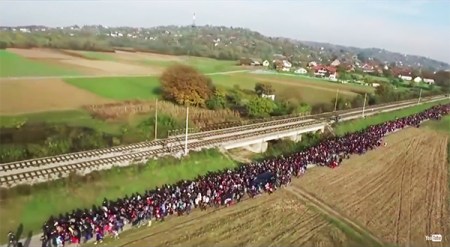
1340Thousands of migrants cross illegally into Slovenia on foot, in this screenshot from YouTube video filmed in October 2015.

According to population projections made by Eurostat in 2013, without migrants, Europe’s population would decline from 507.3 million in 2015 to 399.2 million by 2080. In roughly 65 years, a hundred million people (20%) would disappear. Country by country, the figures seemed even were more terrifying. By 2080, in Germany, 80 million people today would become 50 million. In Spain, 46.4 million people would become 30 million. In Italy, 60 million would decline to 39 million.

Some countries would be more stable: by 2080, France, with 66 million in 2015 would grow to 68.7 million, and England, with 67 million in 2015, would shrink only to approximately 65 million.

Is migration in itself a “bad” thing? Of course not. Migration from low-income countries to higher-income countries is almost a law of nature. As long as the number of births and deaths remains larger than the number of migrants, the result is considered beneficial. But when migration becomes the major contributor to population growth, the situation changes and what should be a simple evolution becomes a revolution.

It is a triple revolution:

  1. Because the number of migrants is huge. The 2015 United Nations World Population Prospects report states: “Between 2015 and 2050, total births in the group of high-income countries are projected to exceed deaths by 20 million, while the net gain in migrants is projected to be 91 million. Thus, in the medium variant, net migration is projected to account for 82 per cent of population growth in the high-income countries.”
  2. Because of the culture of the migrants. Most of them belong to a Muslim and Arabic (or Turkish) culture, which was in an old and historical conflict with the (still?) dominant Christian culture of Europe. And mainly, because this Muslim migration process happens at a historic moment of a radicalization of the world’s Muslim population.
  3. Because each European state is in position of weakness. In the process of building the European Union, national states stopped considering themselves as the indispensable integrator tool of different regional cultures inside a national frame. On the contrary, to prevent the return of large-scale chauvinistic wars such as World War I and World War II, all European nation-states engaged in the EU process and decided to program their own disappearance by transferring more and more power to a bureaucratic, unelected and untransparent executive Commission in Brussels. Not surprisingly, alongside Islamist troubles in all European countries, weak European states have now to cope with the strong resurgence of secessionist and regionalist movements, such as Corsica in France, Catalonia in Spain, and Scotland and Wales in United Kingdom.

Why did France, Germany and many other countries of the European Union opt for massive immigration, without saying it and without letting voters debate it? Perhaps because they thought a new population of taxpayers could help save their healthcare and retirement systems. To avoid the bankruptcy of social security and the social troubles of “dissatisfied retirees,” the EU took the risk of transforming more or less homogenous nation-states into multicultural societies.

Politicians and economists seem blind to multicultural conflicts. They seem not even to suspect the importance of identity questions and religious topics. These questions belong to nations and since WW II, “the nation” is considered “bad.” In addition, politicians and economists appear to think any cultural and religious problem is a secondary question. Despite the growing threat of Islamist terrorism (internal and imported from the Middle East), for example, they seem to persist in thinking that any violent domestic conflict can be dissolved in a “full-employment” society. Most of them seem to believe in U.S. President Barack Obama’s imaginary jobs-for-jihadists solution to terrorism.

To avoid cultural conflicts (Muslim migrants vs non-Muslim natives) Germany could, of course, have imported people from the countries of Europe where there were no jobs: France, Spain, Italy. But this “white” workforce is considered “expensive” by big companies (construction, care-givers and all services…) who need cheap imported workers no matter the area (Middle East, Turkey, Northern Africa) they are coming from. Internal migration inside the EU would not have solved either the main problem of a projected shrinking European population as a whole. Added to that, in a world where competition is transferred partially from nations to global regions, the might of European countries might be thought to lie in their population numbers.

Can Europe borrow a Muslim population from Turkey, Northern Africa, sub-Saharan Africa and the Middle East, and become a European world power, based on a population that is multicultural and multi-religious?

In theory, one can do that. But to succeed and avoid being crossed, day after day, by racial and religious tensions, two essential questions about integration must be put on the table: 1) What do we ask of newcomers? And 2) What do we do to those who do not accept our conditions?

In other words, integration is an asymmetrical process where the newcomer is expected to produce the effort to adapt.

Of course, if the flow of migrants is big, the host society will change, but that is evolution; the sense of cultural and historical continuity will not be demanded into a decline.

In Europe, these two questions of integration were never asked of anyone. According to Michèle Tribalat, sociologist and demographer:

“EU countries agreed at the Council of 19 November 2004, on eleven common basic principles to which to commit. When it is question of integration they disclaim any asymmetry between the host society and newcomers. No privileges are granted to the Europeans or to their heritage. All cultures have the same citizenship. There is no recognition of a substantial European culture that it might be useful to preserve. The social bond is designed as a horizontal one, between the people in the game. Its vertical dimension in reference to history and to the past seems to be superfluous. They speak about values, but these values appear to be negotiable”.

In France, in Germany, and in Sweden, it became rapidly clear that growing flow of a radicalized Muslim population began to change the rules of the integration game. The migrants did not have to “adapt” and are free to reproduce their religious and cultural habits. By contrast, the local “natives” were ordered not to resist “environmental” changes produced by immigration. When they tried to resist anyway, a political and media machine began to criminalize their “racist” behavior and supposed intolerance.

In the new migrant order, the host population is expected to make room for the newcomer and bear the burden of not what is “integration”, but the acceptance of a coerced coexistence.

France’s Archbishop Pontier declared to Le Monde in October 2016:

“We need people that we welcome to love France. If we always offer a negative view, they cannot love the country. However, if we see them as people who bring us something new, we get to grow together”.

When “good feelings” did not work, however, the authorities have often criminalized and prosecuted anti-immigration critics. The Dutch politician Geert Wilders is currently on trial for trying to defend his country from Moroccan immigrants whose skyrocketing crime wave has been transforming the Netherlands.

He may go to jail for as long as a year and could be fined a maximum of ‎€7,400 ($7,000 USD).

In France, the Paris prosecutor opened a preliminary investigation for an “apologia of terrorism” against the anti-immigration writer Eric Zemmour. In an interview with the magazine Causeur, published October 6, Zemmour said that “Muslims must choose” between France and Islam. He added that he had “respect for jihadists willing to die for what they believe.” The Paris prosecutor chose to take this sentence out of context to prosecute him.

Will this double movement — the injunction to love Islam plus criminalizing anti-Islam critics — be enough to kill off any opposition to the EU’s migration policy, and serve to Islamize the continent?

We shall find out.

______________________

[1] Statistical breakdown:

  • 707.352 migrants in 2005
  • 661.855 in 2006
  • 680.766 in 2007
  • 682.146 in 2008
  • 346.216 in 2009
  • 404.055 in 2010
  • 489.422 in 2011
  • 592.175 in 2012
  • 692.713 in 2013
  • 884.893 in 2014

Steep Learning Curve: DNC Staff Rally Behind Brazile As Democratic Leaders Reportedly Groom Chelsea For Congress

November 12, 2016

Steep Learning Curve: DNC Staff Rally Behind Brazile As Democratic Leaders Reportedly Groom Chelsea For Congress, Jonathan Turley’s Blog, Jonathan Turley, November 12, 2016

donna


chelsea_clinton_dnc_july_2016_cropped

For even the armchair political commentator, the results of this election were not surprising. The voters made two things clear from the outset of the election: they wanted a change from the establishment and they did not like Hillary Clinton. The Democratic leadership responded by engineering the selection of perhaps the greatest establishment figure in politics and someone with a record level of unpopularity with voters. On election day, voters followed through on every poll: they voted against Clinton and the establishment. Only the mainstream media and democratic insiders seemed bowled over by the news — shocked that the voters would reject their sage advice and lopsided coverage. Indeed, as someone who contributed to the coverage that night, I was shocked how shocked everyone was. It showed how entirely out of touch the core Democratic leadership (and media) has become. Now, that thick cloak of denial appears firmly in place as Democrats blame FBI Director Comey for the loss despite the fact that Hillary was declining in the polls before his late disclosure to Congress and the fact that Hillary set records on dishonesty in poll after poll. Two stories this week have brought this home. One was the rallying behind Donna Brazile by DNC staff last week with the notable exception of one man who confronted both Brazile and his colleagues. The second is the report that Democratic leaders immediately turned form Hillary Clinton’s historic defeat to start grooming Chelsea Clinton for political office. The problem it seems was that the public was not given enough Clintons. Faced with a populist uprising, the Democratic leadership seems to be offering more of the same like an actor who cannot move beyond one script and one role.

We have previously discussed the unethical actions of interim DNC chief Brazile and the conspicuous failures of the media to investigate her claims of altered emails. While CNN Worldwide President Jeff Zucker called Brazile’s actions “disgusting” and others have denounced her actions, the DNC has stuck with Brazile and she recently appeared before staff to given them a pep talk.

The event however did not turn out quite as planned when one staffer had had enough. According to The Huffington Post, a staffer named Zach asked “Why should we trust you as chair to lead us through this? You backed a flawed candidate, and your friend [former DNC chairwoman Debbie Wasserman Schultz] plotted through this to support your own gain and yourself.” He continued by saying “You are part of the problem. You and your friends will die of old age and I’m going to die from climate change. You and your friends let this happen, which is going to cut 40 years off my life expectancy.”

He then left — a personification for millions of independents and Democrats who abandoned the party to elect Donald Trump.

Nevertheless, the rest of the DNC rallied behind Brazile and gave breathless accounts of her inspiring leadership. A DNC staffer told HuffPost that there was “overwhelming” support for Brazile and that her words “had some staffers in tears.” That would be welcomed news for Republican strategists. It is also worth noting that, after emails showed that Debbie Wasserman-Shultz (Brazile’s predecessor) had worked to rig the primary and dealt dishonestly with Sanders, she was overwhelmingly reelected and embraced by the DNC leadership.

The second story is even more curious. Many viewed the election as the ultimate rejection of the Clinton dynasty that has controlled the Democratic party for over a decade. The Clintons put their family and its “brand” front and center in this election . . . and voters rejected it. However, within hours of the defeat, Democratic leaders were reportedly turning to Chelsea Clinton as the new flag bearer. Clinton, 36, is reportedly being groomed by the same leadership to replace Rep. Nita Lowey, 79, in representing New York’s 17th District. Of course, Chelsea does not live there but the district covers part of Westchester County, including Bill and Hillary Clinton’s hometown of Chappaqua.

Chelsea was previously given a high-ranking media position with disastrous results— a move that was denounced by journalists as political connections overwhelming journalistic merit. Her role in the Clinton Foundation has come under fire. However, the greatest problem is that her resume is largely the result of her family and foundation ties.

The question is whether the Democrats are going to spin the result of this election and deny reality when, in two years, they will be facing the inverse of this election: more Democratic seats will be up for grabs and Trump could receive a super majority in Congress, including a veto-proof margin.

I am an independent and do not have a horse in this race. However, in speaking with my Democratic students, they express complete separation from the Democratic leadership and the establishment politics that it has come to represent. I come from a long-standing Democratic and liberal family in Chicago. When I was raised in that environment, the Democratic party was the populist party — the voice of the outsider and emerging constituencies. Now it is viewed as the party of insiders and establishment power brokers. There may be enough unhappy members (particularly Sanders people) to change the party, but these stories do not help with that image.

It seems to me that, if the Democrats want to resurrect their party, it will require entirely new leadership and a new vision to fit an increasing independent populace.

What do you think?

4 killed as blast rocks US Bagram airbase in Afghanistan

November 12, 2016

4 killed as blast rocks US Bagram airbase in Afghanistan

Published time: 12 Nov, 2016 04:51 Edited time: 12 Nov, 2016 09:43

Source: 4 killed as blast rocks US Bagram airbase in Afghanistan — RT News


An explosion rocked Bagram airfield, the largest US base in Afghanistan, early Saturday morning, killing at least four people and injuring 14 others, according to a NATO-led Resolute Support Mission press release.

“An explosive device was detonated on Bagram Airfield resulting in multiple casualties. Four people have died in the attack and approximately 14 have been wounded,” Resolute Support said in a statement.
The mission added that response teams are investigating the incident.

https://twitter.com/ResoluteSupport/status/797323011502309376/photo/1?ref_src=twsrc%5Etfw

The blast was caused by a man wearing a suicide west, NBC News reported, citing a senior US official. The attacker chose the time and location because he “was looking for an opportunity to do the most damage,” the official added.

The Taliban has claimed responsibility for the attack, according to a statement of the group’s spokesman Zabihullah Mujahid on Twitter, Reuters reported.

Bagram Airfield is the largest US military base in Afghanistan and is located in the Parwan Province of Afghanistan. Bagram is currently maintained by the Combined Joint Task Force 1st Cavalry Division (CJTF-1). The base is mainly occupied by the International Security Assistance Force (ISAF), and occasionally used by the United States Armed Forces.

The airfield has a dual runway capable of handling heavy military aircraft, such as the Lockheed Martin C-5 Galaxy or Russian Antonov An-225.

The American military presence in Afghanistan has been largely scaled down since the US invasion to oust the Taliban government in October 2001. The NATO combat mission in Afghanistan officially ended in 2014, when responsibility for the nation’s security was handed over to domestic forces. Approximately 10,000 US troops remain in the country as part of NATO’s “Resolute Support” mission.

Muslim Trump Voter Unloads on Democrats and Radical Islam

November 12, 2016

Muslim Trump Voter Unloads on Democrats and Radical Islam, Iran Aware, Ed Straker, November 12, 2016

(The author need not have been quite so surprised. At least a few other Muslims, including Dr. Zuhdi Jasser’s American Islamic Forum for Democracy, also reject Islamist notions. Perhaps President Trump will ask for their help in dealing with American’s Islamist problems. — DM)

boom

For a long time I’ve been critical of the Muslim community, many of whom seem to revel in victimhood status even when it’s clear that they are not the victims of anything.  Meanwhile, a substantial number of their coreligionists are slaughtering people by the thousands, including, from time to time, Americans, and they don’t seem to have any public opinions about that.

So nothing could be more surprising to me to see Asra Q. Nomani, a Muslim who penned an op-ed in the Washington Post announcing that not only did she vote for Trump, but she has a deep dislike for Hillary and, yes, wait for it… radical Islam!

I – a 51-year-old, a Muslim, an immigrant woman “of color” – am one of those silent voters for Donald Trump. And I’m not a “bigot,” “racist,” “chauvinist” or “white supremacist,” as Trump voters are being called, nor part of some “whitelash.”

I have been opposed to the decision by President Obama and the Democratic Party to tap dance around the “Islam” in Islamic State.

… the issue that most worries me as a human being on this earth: extremist Islam of the kind that has spilled blood from the hallways of the Taj Mahal hotel in Mumbai to the dance floor of the Pulse nightclub in Orlando, Fla.

The revelations of multimillion-dollar donations to the Clinton Foundation from Qatar and Saudi Arabia [which Wikileaks emails claimed are funders of ISIS] killed my support for Clinton.

I have absolutely no fears about being a Muslim in a “Trump America.” The checks and balances in America and our rich history of social justice and civil rights will never allow the fear-mongering that has been attached to candidate Trump’s rhetoric to come to fruition.

What worried me the most were my concerns about the influence of theocratic Muslim dictatorships, including Qatar and Saudi Arabia, in a Hillary Clinton America. These dictatorships are no shining examples of progressive society with their failure to offer fundamental human rights and pathways to citizenship to immigrants from India, refugees from Syria and the entire class of de facto slaves that live in those dictatorships.

We have to stand up with moral courage against not just hate against Muslims, but hate by Muslims[.]

Nomani condemned radical Islam and the Democrats’ refusal to fight it.  Can you imagine if most American Muslims spoke this way publicly?

Can you imagine if even some American Muslims spoke this way publicly, instead of blaming people who want to scrutinize fundamentalists for our own safety?

Nomani’s op-ed piece, while unprecedented, highlights the continuing moral crisis in the Muslim community by virtue of the near uniqueness of her perspective.

UN to Israel: Stop shooting terrorists

November 12, 2016

UN to Israel: Stop shooting terrorists UN official blasts IDF soldiers’ self-defense against knife-wielding Arab terrorists, demands Israel do more to protect lives of terrorists.

Arutz Sheva Staff,

11/11/16 08:0

Source: UN to Israel: Stop shooting terrorists – Defense/Security – News –

United Nations Headquarters

Thinkstock

The United Nations special rapporteur to Judea, Samaria, and Gaza said on Thursday he was “very concerned” by Israel’s use of live fire in dealing with Arab terrorists during stabbing attacks.

“Lethal force is supposed to be used as a last resort and only when there is a legitimate threat to a security officer’s life,” Michael Lynk, the UN special rapporteur on human rights in Judea, Samaria, and Gaza, told AFP.

Lynk, who took over the role in March and has so far been denied a visa to visit, said this rule was “being neglected.”

More than 200 Arab terrorists have been eliminated during attacks on Jews since October 2015. Dozens of Israelis have been murdered by such terrorists in the same period.

Israel has dismissed allegations of excessive force in most cases, saying its officers do only what is necessary to protect lives.

Lynk compared the shootings of Arab terrorists to the stabbing attack by Yishai Shlissel on participants in a gay pride parade in Jerusalem last year that left one dead.

In that case, Lynk said, the attacker was wrestled to the ground.

“He was actually brought down and wasn’t actually physically harmed in any way,” Lynk said in a phone interview with AFP shortly after the release of his first report.

In some cases, Arab terrorists brandishing knives have also been captured without the use of weapons fire, though terrorists often charge security forces attempting to take them into custody, forcing them to open fire.

“If that kind of force can be used to neutralize an attacker with a knife, why can’t that be used with most of the alleged Palestinian assailants in similar circumstances?”

Israel has long accused the special rapporteur position of being inherently biased as it is only mandated to investigate alleged Israeli abuses.

Lynk, like his predecessors, has so far been refused a visa and he said Israeli officials have also refused his offer to meet in North America, where the Canadian is based as a law professor at Western University in Ontario.

Lynk said the idea of extending his mandate to include rights abuses by all sides was “something I am open to and am considering.”

AFP contributed to this report.

Vice President-elect Mike Pence Leading Trump Administration Transition Team

November 12, 2016

Vice President-elect Mike Pence Leading Trump Administration Transition Team

by Alex Swoyer

11 Nov 2016Washington, DC

Source: Vice President-elect Mike Pence Leading Trump Administration Transition Team – Breitbart

Mark Wilson/Getty Images


Vice President-elect Mike Pence is heading up President-elect Donald Trump’s transition team, assembling a new administration after Trump’s victory earlier this week.

New Jersey Gov. Chris Christie had been in charge of Trump’s transition, but Pence is taking over and will be advised by members of Congress.

Pence will serve as Chairman of the Presidential Transition Team, according to a press release on Friday. It adds:

Dr. Ben Carson, New Jersey Governor Chris Christie, Former Speaker of the U.S. House of Representatives Newt Gingrich, Lieutenant General Michael Flynn, USA (Ret.), Former New York City Mayor Rudy Giuliani and U.S. Senator Jeff Sessions will join the team’s Executive Committee as Vice Chairs.

According to the press release, the following individuals will serve as leaders on the Presidential Transition Team Executive Committee:

Congressman Lou Barletta
Congresswoman Marsha Blackburn
Florida Attorney General Pam Bondi
Congressman Chris Collins
Jared Kushner
Congressman Tom Marino
Rebekah Mercer
Steven Mnuchin
Congressman Devin Nunes
Anthony Scaramucci
Peter Thiel
Donald Trump Jr.
Eric Trump
Ivanka Trump
RNC Chairman Reince Priebus
Trump Campaign CEO Stephen K. Bannon

“Together this outstanding group of advisors, led by Vice President-elect Mike Pence, will build on the initial work done under the leadership of New Jersey Gov. Chris Christie to help prepare a transformative government ready to lead from day one,” stated President-elect Donald Trump, adding:

The mission of our team will be clear: put together the most highly qualified group of successful leaders who will be able to implement our change agenda in Washington. Together, we will begin the urgent task of rebuilding this nation – specifically jobs, security and opportunity. This team is going to get to work immediately to Make America Great Again.

Rick Dearborn will serve as the team’s executive director. Dearborn previously served as Sen. Jeff Sessions (R-AL) chief of staff.

Others joining Dearborn on the team are:

Kellyanne Conway, Senior Advisor
David Bossie, Deputy Executive Director
Stephen Miller, National Policy Director
Jason Miller, Communications Director
Hope Hicks, National Press Secretary
Dan Scavino, Director of Social Media
Don McGahn, General Counsel
Katie Walsh, Senior Advisor

Pence will continue to have his top senior advisers, Nick Ayers, Josh Pitcock, and Marc Short, work with him on this process.

“President-elect Trump will bring about fundamental change in Washington, and these are the right people to make that happen,” stated Vice President-elect Pence. “This team of experienced leaders will form the building blocks of our Presidential Transition Team staff leadership roster, and will work with elected officials and tireless volunteers to prepare our government for the transfer of power on January 20th.”

Trump Hails Israel as ‘Beacon of Hope’

November 12, 2016

Source: Trump Hails Israel as ‘Beacon of Hope’

“I believe that my administration can play a significant role in helping the parties to achieve a just, lasting peace,” Trump said in a message published by the Israel Hayom newspaper.

He also said that any peace deal “must be negotiated between the parties themselves, and not imposed on them by others”.

France is currently pushing for an international conference to revitalise the moribund peace process, but Israel has said it will not take part — saying any peace talks should be bilateral between the two sides.

Russia has also offered to host direct talks between the two sides that have so far yet to take place.

The Palestinians have called for international involvement, accusing Israel of reneging on past agreements.

Speaking Friday after meeting Russian Prime Minister Dmitry Medvedev, Palestinian president Mahmud Abbas said Trump’s victory was “American business”.

“We followed the electoral process for over a year. What matters to us is what Mr Trump will say once he enters the White House,” he said at a press conference.

He added that he had stressed to Medvedev his willingness to hold negotiations in Russia “but the Israeli side asked to postpone it”.

Medvedev said Russia was willing to “immediately” open a dialogue between the two sides, whether under Russian or international mediation.

Israeli Prime Minister Benjamin Netanyahu and US President Barack Obama have had frosty relations for much of the past eight years, but initial indications are that Trump’s victory could see a warming of personal relations.

Netanyahu was among the first leaders Trump spoke to after his election victory, and the president-elect’s message called Israel a “beacon of hope”.

“Israel and America share so many of the same values, such as freedom of speech, freedom of worship and the importance of creating opportunities for all citizens to pursue their dreams,” Trump’s Israel Hayom message said.

“Israel is the one true democracy and defender of human rights in the Middle East and a beacon of hope to countless people.”

Israeli right-wingers have hailed Trump’s win as an opportunity to consolidate control over the occupied West Bank and annexed east Jerusalem.

Meir Turjeman, chairman of the Jerusalem municipality planning committee, told public radio that it provided a green light to revive suspended permits for Israeli settlement expansion in Arab east Jerusalem.

He said the municipality intended to authorise thousands of housing units that had been frozen.

Education Minister Naftali Bennett, who heads the hardline Jewish Home party, said on Wednesday that the US election result meant the idea of a Palestinian state was over.

A vote against cultural radicalism

November 12, 2016

Source: Israel Hayom | A vote against cultural radicalism

Ruthie Blum

The shock of Donald Trump’s victory in the U.S. presidential election has provided pundits around the world with a fresh round of material to dissect. The bulk of the analysis is centering on the question of why pollsters and others were taken by surprise by the historic event.

The answers have included: shame among voters to admit they would be casting a ballot for the Republican candidate; the gap between the number of registered Democrats and those who actually went out to vote; the hostility of the mainstream press to the billionaire businessman, which colored their coverage; and the Washington establishment’s cluelessness about the genuine disillusionment of large swaths of the public outside the elite “bubble.”

What is conspicuously absent from the discussion, however, is the role that popular culture played in ushering Trump into the White House, to the horror of many and huge relief of those who tipped the scale in his favor against Hillary Clinton.

I am not referring to the fact that the president-elect owns flashy buildings and starred in the reality TV show “The Apprentice.” Those are merely the reasons he was known, a celebrity with name-and-face recognition and money of his own to jump-start his utterly unlikely bid for the highest office in the land.

The popular culture I am talking about is the liberalism-gone-haywire that has not only characterized the eight years of Barack Obama’s presidency, but has been shoved down the throats of the populace. In circles naturally prone to obtuse ideology and feelings of ill-deserved entitlement — such as in academia and Hollywood — this has been a comfortable fit.

And since most of the people who occupy those realms need not ever really contemplate what it’s like to have to make an ordinary living, they welcome anything that threatens to unravel the society whose demise they champion. Well, in theory, that is, since not one of the best and the brightest among them would be enjoying such great gifts of prosperity and liberty without the free market and other American success stories they profess to hate.

But the citizens who live in the real world, full of financial and other struggles — such as worrying more about keeping their kids alive than about whether they get into Harvard — know full well that the bill of goods being sold to them by the Left does nothing but prevent them from achieving what used to be called the “American dream.” For them, liberalism has been a nightmare from every perspective.

They are angry that their patriotism, religion, ideas about men and women, common sense about good and evil — when it comes to bullies in the schoolyard and Islamist terrorists in their neighborhoods and abroad — are under perpetual assault by people whose condescension knows no bounds.

They are irritated that they cannot watch even innocuous comedies without being fed the message that their values are skewed.

They are furious that they have no recourse when the source of their livelihood suddenly disappears as a result of pressure from environmentalists pointing to junk science as an excuse to hold the rights of plants and animals in higher esteem than those of human beings.

They are outraged at being berated for teaching their children to strive for both excellence and victory, and to accept that life involves overcoming disappointment and failure.

And they are totally fed up with having to worry that every little thing they say or do is construed as offensive or racist.

Yes, things have gone too far in the United States, and the electorate decided to pull the pendulum back in the other direction. Trump vowed he would help them do that. Whether he delivers on this promise remains to be seen.

But the very fact that college professors across U.S. campuses excused their distraught students from classes on Wednesday to enable them to nurse their wounds over the election explains its outcome in a nutshell.

Ruthie Blum is the managing editor of The Algemeiner.