Robert Spencer, Jihad Watch, YAFTV via YouTube, September 24, 2016
(The video deals with Obama’s “narrative” on Islamist terrorism. — DM)
Robert Spencer, Jihad Watch, YAFTV via YouTube, September 24, 2016
(The video deals with Obama’s “narrative” on Islamist terrorism. — DM)
O’Reilly & Turley Destroy Any Credibility That Clinton & Comey May Have Ever Had At One Time, Fox News via YouTube, September 29, 2016
(Please see also, Comey: Combetta Insisted That He Acted Alone In Destroying Evidence After He Was Given Immunity by Prof. Turley. — DM)
France’s New Sharia Police, Gatestone Institute, Yves Mamou, September 29, 2016
Are French institutions sacrificing one freedom for another? Is equality between men and women being sacrificed to freedom of religion (Islam) to impose its diktats on French society?
If someone still does not realize that the Islamic dress code is the Trojan horse of Islamist jihad, he will learn it fast.
For years, “big brothers” have been obliging their mothers and sisters to wear a veil when they go out. Now that this job is done, they have begun to fight non-Muslim women who wear shorts and skirts — no longer just in the sensitive Muslim “no-go zones” of the suburbs, where women no longer dare to wear skirts — but now also in the heart of big cities.
“The law guarantees women, in all fields, same equal rights as men.”
What people do not seem to know is that in the heart of Paris, a Muslim man can insult a woman for drinking a cola in the street and is served in stores first, before women.
Many people evidently still do not know that Islam is a religion and a political movement at war with the West — and openly intent on subjugating the West. It must be responded to as such. The problem is, every time it is responded to as such, Muslim extremists run for cover under the claim of freedom of religion.
It is crucial for Western societies to start making a distinction between freedom of speech and incitement to violence, and to begin seriously penalizing attacks on innocents, as well as calls to attack innocents.
The Council of State, the highest administrative court in France, decided that, to allow freedom of religion, the burkini must not be banned. At first the ruling looked sound: why should people not be able to wear what they wish when they wish? What is not visible, however, is that the harm comes later.
If someone still does not realize that the Islamic dress code is the Trojan horse of Islamist jihad, he will learn it fast.
A few recent incidents include:
September 7. In Guingamp, Brittany, a 17-year-old girl in shorts was beaten by a man who considered her outfit “too provocative”. Although the attacker escaped, so that the police have no idea who he is or what his background might be, it is a taste of things to come.
September 7. In Toulon, southern France, two families were on a bicycle path when they were insulted by a gang of 10 “youths” (the French press uses “jeunes” [youths] in order not to say Arabs or Muslims). According to the local prosecutor, the “youths” shouted at the women, “whores!” and “strip naked!” When the women’s husbands protested, the “youths” approached and a fight began. One of the husbands was found unconscious with multiple facial fractures.
At first, the motive of the attack was reported to be linked to the women wearing shorts, but in fact the women were not wearing shorts; they were wearing leggings.
July 19. In a resort in Garde-Colombe (Alps), a Moroccan man stabbed a woman and her three daughters, apparently because they were scantily dressed. One of the girls was seriously injured. The attacker, Mohamed, says that he was the “victim,” because he claims the husband of the woman he stabbed scratched his own crotch in front of Mohamed’s wife. According to the prosecutor, “the husband of the victim does not remember having made such a gesture.”
July 7. A day-camp center in Reims, eastern France, circulated a note asking parents to avoid dressing their daughters in skirts because of the improper conduct of boys aged 10 to 12. A mother published the document on Twitter and commented on Facebook: “Obviously the idea did not occur to them that it is not for little girls to adapt their dress to big creeps, but for big creeps to get educated? ”
In early June, 18-year-old Maude Vallet was threatened and spat on by a group of girls on a bus in Toulon because she was wearing shorts. She posted a photo of herself on Facebook with the caption, “Hello, I’m a slut.” The posting was shared by more than 80,000 people. The attackers were Muslim girls, but Maude, according the “politically correct” who believe “thntdwi” (this has nothing to do with Islam), did not want to reveal their ethnic origin.
April 22. Nadia, a 16-year-old girl wearing a skirt, was severely beaten in Gennevilliers, a suburb of Paris, by three girls who were apparently Muslims.
 Snapshots of France’s new sharia police. Left: In Toulon, 18-year-old Maude Vallet was threatened and spat on by a group of Muslim girls on a bus, because she was wearing shorts. She posted a photo of herself on Facebook with the caption, “Hello, I’m a slut.” Right: In a resort in Garde-Colombe, a Moroccan man stabbed a woman and her three daughters on July 19, apparently because they were scantily dressed.
These cases were dramatically publicized in all media, both official and social. Ironically, however, none of these incidents triggered the international attention and outrage that greeted a Burkini incident in Nice: A woman, apparently Muslim, was lying alone on a beach with no towel, no book, no parasol, no sunglasses, no husband (or brother, or father) to “protect” her, in the full glare of the midday sun near a police post — with a photographer nearby ready and waiting to take pictures of her surrounded by four policemen. Who alerted them? The woman was issued a fine and possibly ordered to remove some of her clothes on the beach. Pictures of the incident were first published on August 23 by the Daily Mail and within minutes went viral, provoking international indignation against these seemingly racist French people discriminating against innocent Arab women. A week later, however, the Daily Mail suggested that this incident may well have been “staged” and the “pictures may be SET UP.”
So the real question is: Are Islamists in France now using photos and videos, the way the Palestinians are doing against Israel: to film and disseminate fake and staged situations in order to provoke global indignation about supposedly poor Muslim “victims” — especially women who are allegedly “discriminated against” in France?
If fabricated propaganda is allowed to persist, the defrauders will win a big war.
“In the war that Islamism is leading with determination against civilization, women are becoming a real issue,” said Berenice Levet, author and professor of philosophy at the École Polytechnique to the daily Le Figaro.
She added:
“Rather than produce figures that say everything and nothing, I want it recognized once and for all that if today the roles of the genders are forced to regress in France, if domination and patriarchy are spreading in our country, this fact is related exclusively to our having imported Muslim values.”
Ironically, at the same moment, France’s Minister for Family, Children and Women’s Rights, Laurence Rossignol, decided to spend public money on an ad campaign against “ordinary sexism” — the supposed sexism by all French men against supposedly eternally victimized women. But there was not a word in this campaign about the possible victimization or potential outcome from the increasing proliferation of the burqa, veil or burkinis on Muslim women.
Commenting the ad campaign, Berenice Levet added:
“Laurence Rossignol should read Géraldine Smith’s book, Rue Jean-Pierre Timbaud. Une vie de famille entre barbus et bobos (“Jean-Pierre Timbaud Street: The life of a family among bearded men [Islamists] and Bohemians”). She would learn — among other things — that in some stores or bakeries, men are served first, before women.”
In this book, we can learn also that in the heart of Paris, a Muslim can insult a woman for drinking a cola in the street. But for many, including Rossignol, it seems the only enemy is the white Frenchman.
Two serious questions are at stake:
In France, no organized Islamist brigades patrol the streets (as in Germany or Britain) to fight alcohol consumption or to beat women for the way they are dressed. Yet gangs of “youths”, again, both men and women, are increasingly doing just that in practice. For years now, “big brothers” have been obliging their mothers and sisters to wear a veil when they go out. And now that this job is done, they have begun to fight non-Muslim women who wear shorts and skirts — no longer just in the sensitive Muslim enclaves, the “no-go zones” of the suburbs, where women no longer dare to wear skirts — but now also in the heart of big cities.
More and more, the equivalent of “Islamist Virtue Police” try to impose those standards by violence. As Celine Pina, former regional councilor of Île-de-France, said in Le Figaro:
“In the last recorded attack [on the families in Toulon], with cries of “whores” and “strip naked”, the young men were behaving as a “virtue police” that we had thought impossible here in our parts…
“It cannot be expressed more clearly: it is a command to modesty as a social norm and self-censorship as a behavioral norm… [it]… illustrates the rejection of the female body, seen as inherently impure and dirty…
“The question of the burkini, the proliferation of full veils, assaults against women in shorts and the beating of their companions, share the same logic. Making body of the woman a social and political issue, a marker of the progress of an ideology within society.”
Laurent Bouvet, a professor of political science, noticed on his Facebook page that after the men were beaten in Toulon, so-called human rights organizations — supposedly “professionals” of “anti-racism” — remained silent in the debate.
The prosecutor of #Toulon said: “the fight was trigger by a women’s dress code. These women were not wearing shorts… Sexism is undeniable. Where are the professionals of public indignation?”
Laurence Rossignol, Minister for Women’s Rights, remained silent too. So a new rule has emerged in France: the more politicians and institutions do not want to criticize Islamists norms, the more violent the debate on social networks.
The silence of politicians and human rights organizations, when non-Muslim women are violently assaulted because they wear shorts that are not compatible with sharia — as opposed to their thundering indignation against police for issuing a fine to a Muslim woman in a burkini — signals an immensely important political and institutional move: A fundamental and constitutional principle, equality between men and women, is being sacrificed in the name of freedom of religion, thereby enabling one religion (Islam) to impose its diktats on the rest of society.
Studying the burkini case in Nice, Blandine Kriegel, philosopher and former president of Haut Conseil à l’intégration (High Council of Integration) published an analysis in which she establishes that in the burkini case, secularism or individual freedom were not even in danger in the first place. But “fundamentally an openly, the principle of equality between men and women” was surrendered:
In its remarkable ordinance, the Council of State refers to the jurisprudence of 1909 concerning the wearing of a cassock and does not pay attention to more recent laws voted on by sovereign people, prohibiting the veil at school (2004) and burqa in public places (2010).
The Council of state did not feel inspired either by the constitutional commitment towards women: “the law guarantees women, in all fields, same equal rights as men.”
In the burkini affair, neither secularism nor individual freedom is at stake; but fundamentally and openly the principle of equality between men and women. … This term “burkini” integrates intentionally the word “burqa”; this word does not express the desire to go swimming at the beach (nothing prohibits this); or the affirmation of a religious freedom (no mayor has ever prohibited the exercise of the Muslim religion); the word burkini express only the essential inequality of women.
Contrary to their husbands, who feel free to exhibit their nudity, some women must be covered from head to toe. Not only because they are impure, but mostly because of the legal status conferred to them: they are under the private law of the husband, the father or the community.
The Republic cannot accept something opposed to its laws and values. Inequality of women cannot be defended on the ground of religious freedom… of freedom of conscience. This issue was addressed three centuries ago by our European philosophers, who are founding fathers of the Republic. To those who were legitimating oppression, slavery and inequality were merely the expression of free will, explained the French philosopher Jean-Jacques Rousseau, inspiring our 1789 Declaration [of the Rights of Man and of the Citizen], and that freedom and equality are inalienable possessions.
France’s socialist government and administrative judges have apparently found it politically useful to make concessions to Islamists. Perhaps they originally agreed to burkinis not only because they may think that people should wear what they like, but also in the vain hope of calming down the permanent pressure that increasingly appears to be a cultural jihad. It may not even have occurred to them that they were potentially sacrificing the principle of equality of women.
Many people evidently still do not know that Islam is a religion and a political movement at war with the West — and openly intent on subjugating the West. It must be responded to as such. The problem is, every time it is responded to as such, Muslim extremists run for cover under the claim of freedom of religion.
It is high time for French and European politicians to draw a hard line between where one person’s right to worship as they see fit ends, and where society’s right to freedom and security begins. And it is time to outlaw, not necessarily the burkini, but the very real problem of aggressive supremacism.
The root problem is incitement to violence. It is crucial for Western societies to start making a distinction between freedom of speech and incitement to violence, and to begin seriously penalizing attacks on innocents, as well as calls to attack innocents.
Egyptian Columnist: Western Women Wear More Revealing Clothing Than Egyptian Women, But Experience Less Sexual Harassment, MEMRI, September 28, 2016
In a September 12, 2016 column titled “New York… Sex and the City,” in the Egyptian English-language daily Egypt Independent, columnist Fatema Nouali relates her impressions from a recent visit to New York city. She writes that, due to her familiarity with and love for the American series “Sex and the City,” she expected New York women to be chic and lovely,” and to attract the attention of men in streets. However, she was surprised to discover that, even though New York women wear clothes that are revealing by Egyptian standards, and mix freely with men in public places, men do not stare at them and they do not experience the kind of sexual harassment that is prevalent in Egypt. This, she says, is not due to any inherent difference between Western men and Egyptian ones, but only due to the law, which in the West grants people freedom of expression and action while also obliging them to respect others.
The following are excerpts from her column:[1]
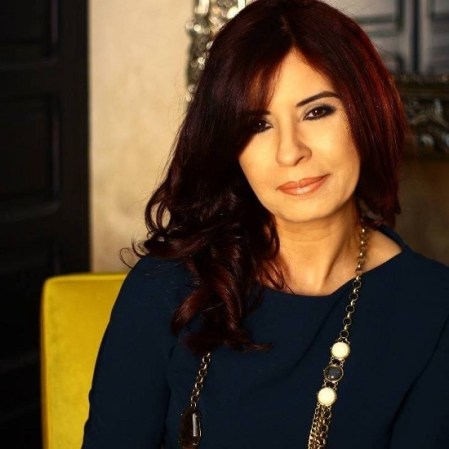 Fatema Nouali (Image: Egyptindependent.com)
“Before I came to New York city, I lived the details of New York life through an American television comedy series called Sex and the City. I had a close relationship with the heroines of the famous TV series. I lived with them the details of New York women’s lives — which seemed characterized prominently by freedom. Four women who made all the decisions with regard to their lives, each with her own character and goals, they share the city with men on an equal footing, in a way that seemed unimaginable. They live the small details that transform the daily stuff of life into a sphere of self-realization and ambition. Four women, each with her own lifestyle — but this difference doesn’t harm their friendship…
“The series is narrated by sex columnist, Carrie Bradshaw, who tells the lives of women in the sleepless city. The story follows the lives of her friends: the serious rational character Miranda, a lawyer; Charlotte, respected art dealer who once dreamed of owning her own gallery, the romantic character; and Samantha, the oldest and most sexually confident of the four.
“Samantha is an independent businesswoman. She is confident, strong, and outspoken, and calls herself a ‘try-sexual’ (meaning she’ll try anything once).
“I lived with these women, via the screen, following their lives, so packed with events both romantic and tragic, including some close to our lives as Arab women and others so distant that we can’t imagine them happening in public — for religious or social reasons.
“I came to New York with a prior assumption that women in the city are chic, lovely, and charming, the eyes of men following their beauty in the street, the women meanwhile happy and inviting. However, I was surprised to find completely different behaviors.
“Women here do not experience the kind of sexual harassment so often practiced by men. Their clothing is more than revealing by our standards, but their almost naked bodies does not necessarily provide a provocation to men, who simply turn a blind eye. Tight spaces contain both sexes in the subway, but no one is looking at anyone else, in full respect for privacy.
“I was the only one looking at people of both sexes for long periods, with a thousand questions spinning in my head, and I am still looking for an answer to one question. What makes these people different from us to such a degree? Do men here have different genes from our men? Or is the Arabic man more virile and masculine, and should we be thankful to nature for granting us this sort of man?
“It didn’t take me too long to work out that the aversion of one’s gaze here is not ideologically or religiously motivated. Here the law obliges you to respect others, and it guarantees you freedom of expression, clothing and action — so long as it only affects you, rather than impinging upon the freedom of others.
“I always considered myself free, practicing my freedom without restrictions. But when I experienced living with women here and followed their movements about the city, I realized how far we are from that sense of sharing public space with the other half of society.
“Here in New York, the body does not necessarily refer to sex. Women wear whatever they wish. Moreover, the dictatorship of beauty in the accepted standards for women, which require them to abide by fitness and femininity, applies only to a minority.
“I found a city that allows women to live in dignity, freedom, safety, coexisting with men — and not a hint of sex or harassment. Even the signs of expressing love, such as kisses and hugs between lovers, which are familiar in European countries, are almost non-existent here. Love and sex has its place in the bedroom — and with the consent of both partners.”
Endnote:
[1] Egyptindependent.com, September 12, 2016.
Canadian imam: Islam and democracy are “absolutely incompatible”, Jihad Watch,
(Here is the video referenced in the article:
— DM)
Mazin AbdulAdhim, a prominent Imam of Iraqi descent in London, Ontario who is affiliated with the radical Islamic global movement of Hizb ut-Tahrir, asserts that “Islam and democracy are contradictory and absolutely incompatible.
So what is Imam Mazin AbdulAdhim doing in Canada? He’s on a mission, of course, as are his “stealth” jihadist counterparts…..
He called on Canadian Muslims to stick to the Islamic law, reject secularism, work together to spread Islam, re-establish the Islamic State (Caliphate) and implement the rulings of Islam (Sharia Law).
Recently, a Canadian study found that “extremism” was common in mosque literature.
“Canadian Imam: ‘Islam and democracy are contradictory, absolutely incompatible’”, by Jonathan Halevi, CiJNews, September 26, 2016:
Mazin AbdulAdhim, a prominent Imam of Iraqi descent in London, Ontario who is affiliated with the radical Islamic global movement of Hizb ut-Tahrir, asserts that “Islam and democracy are contradictory and absolutely incompatible.”
AbdulAdhim’s statement comes in response to a video posted by Mehdi Hasan, a British political journalist, broadcaster and author, in who he argues that Muslims accept democratic values and argues Muslims not to listen to “experts” who claim otherwise.
The following is the transcript of Mehdi Hasan’s video (shortened version) that was broadcast on Al Jazeera TV:
“Muslims, Islam, democracy, elections – they just don’t go together. Do they? At least that’s what we’re told by some of the faiths biggest critics most
[Ayaan Hirsi Ali, Author, “Infidel”]: “Most Muslim countries are dictatorships. There is no democracy.”
“But look at the big picture. Sure the Arab world is home to plenty of kings, generals, dictators, but the majority of the world’s Muslim population doesn’t actually live in the Arab world.
“In fact, it’s the Asia Pacific region that’s home to 62 percent of all Muslims and of the top five countries in the world with the biggest Muslim population Indonesia, India, Pakistan, Bangladesh and Nigeria.
“Not only are none of them in the Middle East, but they’re all democracies too. Flawed democracies, yes, but democracies nevertheless, in which hundreds of millions of Muslims, regularly go to the polls to elect their rulers.
“And support for democracy goes beyond these 5 countries as the pollsters from Pew noted in the exhaustive study of 39 countries and 38,000 Muslims: “Most Muslims around the world expressed support for democracy.” And, yes, that includes those ordinary Arab Muslims, yes, the ones living under kings and generals. Remember 2011 when people across the region rose up in the Arab Spring.
“But, Arabs prefer a strong man in charge right? Wrong! Between 54 to 81 percent of Muslims from 5 Arab countries said they support having a democratic government over a leader with a strong hand.
“Just look at Tunisia which sparked the Arab Spring. Tunisians ousted a dictator, passed a relatively progressive constitution, elected a president from a secular party and chose a parliament comprised of both secularists and “Islamists”.
“Then there are the 50 million Muslims living in the West. Most of them seem perfectly happy to vote in and even stand in free and fair elections. The new directly-elected mayor of London, one of the world’s biggest greatest cities, is a Muslim
“In 2015 the U.K. increased its number of Muslim members in parliament from 8 to 13. Canada elected 11 Muslim MPs in the same year, and in the US, which has two Muslim congressman, Muslim voter registration is up ahead of the presidential election.
“So the next time some pseudo expert tells you Muslims don’t like democracy or Islam is incompatible with democracy, remember the hundreds of millions of Muslims, in fact the majority of the world’s Muslims, who prove that expert wrong.”
In response Mazin AbdulAdhim wrote among other things the following:
“This video does not discuss whether Islam is compatible with democracy, rather he is discussing whether Muslims can handle living under a democracy. These are two very separate issues.
“If we are going to discuss whether *Islam* is compatible with democracy, we need to define the two systems properly first.
“More specifically, we must defined:
“1) Who is the “sovereign” (meaning, who has the right to legislate laws) in both systems, 2) who has “authority” (meaning, who has the right to choose the ruler) in both systems.
“The issue is very simple:
“1- Sovereignty: In a democracy, man is the sovereign legislator, so laws are legislated based exclusively on the will of the people. In Islam, on the other hand, Allah (swt) is the Sovereign Legislator, so laws are legislated based exclusively on the texts of the Qur’an and Sunnah; the people have no right or capability to make Halal into Haram, or Haram into Halal, no matter how many people vote in favor of it.
“2- Authority: In a democracy, man has the right to elect his ruler. In Islam, man has the right to elect his ruler.
“So, people tend to confuse these two things. Yes, people can elect their ruler in both Islam and democracy, but no, people cannot legislate their own laws in Islam, whereas they can in a democracy.
“Therefore, Islam and democracy are contradictory and absolutely incompatible, because Islam forbids mankind from legislating laws in the place of the Creator, even if the overwhelming majority of the people vote in favor of it…
Source: At Least 3 Dead, Up to 100 Hurt in Major Hoboken Train Crash | NBC New York
( Terror alert ! – JW )
Preliminary reports suggest the crash was an accident or caused by operator error, according to four law enforcement officials, though they stress it is early in the investigation
By Jonathan Dienst, Brian Thompson, Marc Santia and Rana Novini
At least three people died and up to 100 were hurt, some of them critically, when an NJ Transit train crashed into the station in Hoboken at the height of Thursday’s morning rush, leaving twisted piles of metal and bricks and causing part of the highly trafficked terminal to collapse, officials said.
Preliminary reports suggest the crash involving train No. 1614 on the Pascack Valley Line was accidental or caused by operator error, according to four law enforcement officials, though they stress it is early in the investigation.
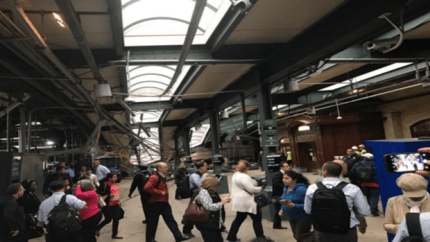
Pictures on social media showed serious damage to the train and extensive structural damage to the station. At least one of the NJ Transit cars appeared to be partially inside the building, with some of the supporting beams that hold up the canopy where the trains come in caved in around it.
It appeared the train went through a bumper stop at the end of the track. It came to a stop in a covered area between the station’s indoor waiting area and the platform. From above, chopper footage showed the glass arches atop the building crunched like an accordion over the platform.

Nancy Bido, a passenger in the first car of the train, told NBC 4 New York the train “just felt like it never stopped. It didn’t slow down. It didn’t brake.”
Others said the train seemed to be moving faster than usual as it entered the station, but they didn’t think much of it — until the impact.
“You felt like this huge, huge bang,” said passenger Steve Mesiano. “The lights went off, and then you started to see like –- I was in the window seat, so I could see like outside, what was happening, and the roof just collapsed on the first car.”
Tearful passengers described people screaming, bloodied and trapped in the first car. Several people who were on the train tweeted they felt “lucky to be alive.”
Passenger Bhagyesh Shah said he boarded the train at Secaucus. He said he normally stands near the window, but stood in the back of the train Thursday.
“The next thing I know, we are plowing through the platform,” Shah said. “It was for a couple seconds, but it felt like an eternity.”
He said the train was crowded, particularly the first two cars, because they make for an easy exit into the Hoboken station and onto the PATH train. Passengers in the second car broke the emergency windows to get out.
“I saw a woman pinned under concrete,” Shah said. “A lot of people were bleeding; one guy was crying.”
Nearby Jersey City Medical Center said it had sent several trauma and emergency units to the scene, which was swarming with and first responders within minutes of the crash. Another hospital said it had received four patients and was expecting additional victims.
Hoboken, which is New Jersey Transit’s fifth-busiest stations with 15,000 boardings per weekday, is the final stop for several train lines and a transfer point for many commuters on their way to New York City.
All PATH service at the Hoboken station is suspended. NJ Transit said service in and out of the station was also shut down; NJ Transit bus and private carrier buses were cross-honoring tickets. Ferry service was suspended.
#Hoboken#traincrash train hit the station pic.twitter.com/5xteTKLavU
— Leon O (@monduras) September 29, 2016
The Federal Railroad Administration says it has investigators en route to the scene. The National Transportation Safety Board is also responding.
Comey: Combetta Insisted That He Acted Alone In Destroying Evidence After He Was Given Immunity, Jonathan Turley’s Blog, Jonathan Turley, September 29, 2016
I recently wrote a column on FBI investigation into the Clinton email scandal and revised my view as to the handling of the investigation in light of the five immunity deals handed out by the Justice Department. I had previously noted that FBI Director James Comey was within accepted lines of prosecutorial discretion in declining criminal charges, even though I believed that such charges could have been brought. However, the news of the immunity deals (and particularly the deal given top ranking Clinton aide Cheryl Mills) was baffling and those deals seriously undermined the ability to bring criminal charges in my view. Now, Comey has testified before both the Senate and the House. His answers only magnified concerns over the impact and even the intent of granting immunity to those most at risk of criminal charges.
First the timeline is now becoming clear and it makes the immunity deal even more bizarre given what the FBI knew Colorado-based tech specialist Paul Combetta and Clinton aides Cheryl Mills and IT specialist Bryan Pagliano.

In July 2014 , then-chief of staff Cheryl Mills was told that Clinton’s emails were being sought.
On July 23, 2014 Combetta got a call from Mills on the server and emails.
On July 24, 2014, Combetta received an email from Clinton IT specialist Pagliano.
On July 24, Combetta then went online to Reddit to solicit help on stripping out “a VIP’s (VERY VIP) email address from a bunch of archived emails.” He revealed that “they don’t want the VIP’s email address exposed to anyone.”
What is incredible is that the Justice Department would give immunity to the parties on both ends of those communications — guaranteeing that a criminal prosecution is no longer a real threat.
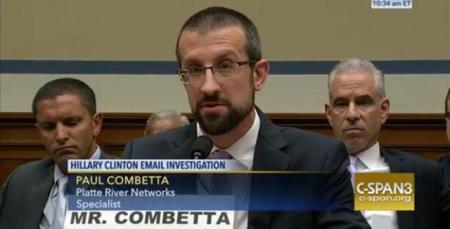
Comey deepened those concerns with his testimony. After these conversations with Mills and Clinton aides, Combetta destroyed the evidence. Comey admits that Mills did disclose the preservation order. Combetta however mysteriously then destroys the evidence. Comey was asked what he got from the immunity deal with Combetta. He said “We learned no one directed him to do that.” However, that was simply what Combetta said after he was assured that there would not be a charge. The problem is that it hardly makes sense. Why would Combetta take it upon himself to destroy evidence that he knew was being sought by Congress and was already a matter of intense national attention. Comey could not explain why he simply accepted Combetta’s word or why that denial was worth an immunity deal.
None of that makes any logical sense if you are trying to build a criminal case. It certainly strains credulity to believe that a techie in Colorado decided to unilaterally defy the United States Congress and destroy evidence in one of the nation’s greatest scandals. The fact that this occurred immediately after calls from Clinton figures like Mills would raise considerable doubt in most investigators. Yet, the Justice Department jumped at the chance to immunize the key players in the key communications. That is a legitimate matter of congressional concern . . . and investigation.
Khamenei on WWII: Iran Must Not Go the Way of Germany and Japan Khamenei on WWII: Iran Must Not Go the Way of Germany and Japan, Israel National News, Col (res.) Dr. Eran Lerman, September 29, 2016
Speaking on September 18, 2016 before commanders of Iran’s Revolutionary Guards Corps (IRGC), the Supreme Leader of Iran launched into a bitter polemic against Rafsanjani’s call to invest more in the economy and less in military build-up. (Ref. MEMRI translation and analytical observations.) The IRGC, Khameini declared, is the key to the success of the revolutionary project. Deterrence can only be achieved if fear of Iran’s raw power is instilled in the hearts of her enemies. Neither the JCPOA (the nuclear deal between Iran and the P5+1 powers) in itself, nor a shift in strategy to more civilian pursuits, can protect Iran. The revolution must be translated into military might.
At this point in the speech, Khameini offered a fascinating point of reference. Look, he suggested, at Germany and Japan at the end of World War II: forced into submission, humiliated, and required to disarm. He made no effort to hide his sympathy. As far as Khameini is concerned, the bad guys won and the good guys lost in 1945, and the time has come to overthrow the entire post-war dispensation.
Speaking on September 18, 2016 before commanders of Iran’s Revolutionary Guards Corps (IRGC), the Supreme Leader of Iran launched into a bitter polemic against Rafsanjani’s call to invest more in the economy and less in military build-up. (Ref. MEMRI translation and analytical observations.) The IRGC, Khameini declared, is the key to the success of the revolutionary project. Deterrence can only be achieved if fear of Iran’s raw power is instilled in the hearts of her enemies. Neither the JCPOA (the nuclear deal between Iran and the P5+1 powers) in itself, nor a shift in strategy to more civilian pursuits, can protect Iran. The revolution must be translated into military might.
At this point in the speech, Khameini offered a fascinating point of reference. Look, he suggested, at Germany and Japan at the end of World War II: forced into submission, humiliated, and required to disarm. He made no effort to hide his sympathy. As far as Khameini is concerned, the bad guys won and the good guys lost in 1945, and the time has come to overthrow the entire post-war dispensation.
This position is, after all, in line with Iran’s denial of the Holocaust (recall the caricature competition designed to denigrate and diminish it) and exterminatory stand towards Israel. It is not the personal quirk of Ahmadinejad, who was, in fact, just told by the Leader that he will not be allowed to run for president again this time. It is the position of Khamenei himself and of Khomeini before him: “Khatt al-Imam,” the line of the Imam, the ultimate imperative of the revolutionary regime.
According to this line, Iran has a religious (or, rather, ideological) imperative to reject all Western mores. For this to be possible, the Revolution, even more than the State as such, must position itself as a strong military power in regional and global affairs. The alternative is unthinkable. The “values” the West and the US seek to impose include utterly base and noxious notions like homosexuality (with which Iran’s present leaders are apparently obsessed). Military weakness would lead to moral weakness, a “cultural invasion,” and the loss of all that Khameini and Khomeini have sought to establish.
Khameini told his audience that there are misguided souls in Iran who seek to negotiate with the US even as the Americans themselves seek a dialog with Iran on regional affairs (e.g., on Syria, Lebanon, Iraq and Yemen). He rejects this quest not only as poisonous for Iran, but as evidence that America is now a spent force.
With that American weakness in mind, the Iranian leadership is now openly calling for the total destruction of Wahhabism (read: the Saudi state). It makes this call while complaining, as did Foreign Minister Zarif in an op-ed at The New York Times, that “big money is being used to whitewash terrorism.” This claim is, of course, extremely rich to anyone with even a smattering of knowledge about Iran’s behavior in recent years.
Iranian arrogance is thus on the rise in the post-deal era, and with it Iran’s hope of steadily undoing Israel and undermining regional and global stability until the true Imam or Mehdi appears on earth. Meanwhile, as Saudi Foreign Minister Adel Jubayr wrote in response to Zarif, it is Iran that remains at the top of the terror lists. It is Iran’s ally in Syria, with the help of Iran’s proxies in Lebanon, who is now engaging in unprecedented acts of carnage in Aleppo.
The Leader’s extolling of military might is thus frightening to all in the region, even as Tehran tries to present itself as the voice of reason in the struggle against the Islamic State (Iran was quick to denounce the assassination in Amman this week of a Christian journalist who “insulted” the IS radicals).
There could be an opportunity here. Neither candidate for the US presidency seems to have bought into the strange notion, implicit (and at times explicit) in the positions taken by Obama and his inner circle, that Iran can serve as a useful counterweight to other forces in the region. Nor have they bought (yet) into the delusion that Iran’s revolutionary impulse can be assumed to be benign. The US is thus still able to think of Iran as an enemy, which it is.
If so, the domestic tension and turmoil over the unfulfilled promise of economic relief, and over Khamenei’s demand for more and more sacrifices by the people (a “resistance economy,” as he calls it) can provide fertile ground for destabilization of the Iranian regime. Such an opportunity was lost in 2009. It need not be lost again.
Meet the New Authoritarian Masters of the Internet
29 Sep 2016
Source: Meet the New Authoritarian Masters of the Internet – Breitbart

Getty Images
In fact, they are likely to have much more influence than America, because they will collectively push hard for a more tightly controlled Internet, and they are known for aggressively using political and economic pressure to get what they want.
Here’s a look at some of the regimes that will begin shaping the future of the Internet in just a few days, if President Obama gets his way.
China
China wrote the book on authoritarian control of online speech. The legendary “Great Firewall of China” prevents citizens of the communist state from accessing global content the Politburo disapproves of. Chinese technology companies are required by law to provide the regime with backdoor access to just about everything.
The Chinese government outright banned online news reporting in July, granting the government even tighter control over the spread of information. Websites are only permitted to post news from official government sources. Chinese online news wasn’t exactly a bastion of freedom before that, of course, but at least the government censors had to track down news stories they disliked and demand the site administrators take them down.
Unsurprisingly, the Chinese Communists aren’t big fans of independent news analysis or blogging, either. Bloggers who criticize the government are liable to be charged with “inciting subversion,” even when the writer in question is a Nobel Peace Prize winner.
Chinese citizens know better than to get cheeky on social media accounts, as well. Before online news websites were totally banned, they were forbidden from reporting news gathered from social media, without government approval. Spreading anything the government decides is “fake news” is a crime.
In a report labeling China one of the worst countries for Internet freedom in the world, Freedom House noted they’ve already been playing games with Internet registration and security verification:
The China Internet Network Information Center was found to be issuing false digital security certificates for a number of websites, including Google, exposing the sites’ users to “man in the middle” attacks.
The government strengthened its real-name registration laws for blogs, instant-messaging services, discussion forums, and comment sections of websites.
A key feature of China’s online censorship is that frightened citizens are not entirely certain what the rules are. Huge ministries work tirelessly to pump out content regulations and punish infractions. Not all of the rules are actually written down. As Foreign Policy explained:
Before posting, a Chinese web user is likely to consider basic questions about how likely a post is to travel, whether it runs counter to government priorities, and whether it calls for action or is likely to engender it. Those answers help determine whether a post can be published without incident — as it is somewhere around 84 percent or 87 percent of the time — or is instead likely to lead to a spectrum of negative consequences varying from censorship, to the deletion of a user’s account, to his or her detention, even arrest and conviction.
This was accompanied by a flowchart demonstrating “what gets you censored on the Chinese Internet.” It is not a simple flowchart.
Beijing is not even slightly self-conscious about its authoritarian control of the Internet. On the contrary, their censorship policies are trumpeted as “Internet sovereignty,” and they aggressively believe the entire world should follow their model, as the Washington Post reported in a May 2016 article entitled “China’s Scary Lesson to the World: Censoring the Internet Works.”
China already has a quarter of the planet’s Internet users locked up behind the Great Firewall. How can anyone doubt they won’t use the opportunity Obama is giving them, to pursue their openly stated desire to lock down the rest of the world?
Russia
Russia and China are already working together for a more heavily-censored Internet. Foreign Policy reported one of Russia’s main goals at an April forum was to “harness Chinese expertise in Internet management to gain further control over Russia’s internet, including foreign sites accessible there.”
Russia’s “top cop,” Alexander Bastrykin, explicitly stated Russia needs to stop “playing false democracy” and abandon “pseudo-liberal values” by following China’s lead on Internet censorship, instead of emulating the U.S. example. Like China’s censors, Russian authoritarians think “Internet freedom” is just coded language for the West imposing “cultural hegemony” on the rest of the world.
Just think what Russia and China will be able to do about troublesome foreign websites, once Obama surrenders American control of Internet domains!
Russian President Vladimir Putin has “chipped away at Internet freedom in Russia since he returned to the Kremlin in 2012,” as International Business Times put it in a 2014 article.
One of Putin’s new laws requires bloggers with over 3,000 readers to register with the government, providing their names and home addresses. As with China, Russia punishes online writers for “spreading false information,” and once the charge is leveled, it’s basically guilty-until-proven-innocent. For example, one of the “crimes” that can get a blogger prosecuted in Russia is alleging the corruption of a public official, without ironclad proof.
Human-rights group Agora estimates that Russian Internet censorship grew by 900% in 2015 alone, including both court orders and edicts from government agencies that don’t require court approval. Censorship was expected to intensify even further throughout 2016. Penalties include prison time, even for the crime of liking or sharing banned content on social media.
Putin, incidentally, has described the entire Internet as a CIA plot designed to subvert regimes like his. There will be quite a few people involved in the new multi-national Internet control agency who think purging the Web of American influence is a top priority.
The Russian government has prevailed upon Internet Service Providers to block opposition websites during times of political unrest, in addition to thousands of bans ostensibly issued for security, crime-fighting, and anti-pornography purposes.
Many governments follow the lead of Russia and China in asserting the right to shut down “extremist” or “subversive” websites. In the United States, we worry about law enforcement abusing its authority while battling outright terrorism online, arguing that privacy and freedom of speech must always be measured against security, no matter how dire the threat. In Russia, a rough majority of the population has no problem with the notion of censoring the Internet in the name of political stability, and will countenance absolutely draconian controls against perceived national security threats. This is a distressingly common view in other nations as well: stability justifies censorship and monitoring, not just physical security.
Turkey
Turkey’s crackdown on the Internet was alarming even before the aborted July coup attempt against authoritarian President Recep Tayyip Erdogan.
Turkey has banned social media sites, including temporary bans against even giants like Facebook and YouTube, for political reasons. Turkish dissidents are accustomed to such bans coming down on the eve of elections. The Turkish telecom authority can impose such bans without a court order, or a warning to offending websites.
Turkey is often seen as the world leader in blocking Twitter accounts, in addition to occasionally shutting the social media service down completely, and has over a 100,000 websites blacklisted. Criticizing the government online can result in anything from lost employment to criminal charges. And if you think social-media harassment from loyal supporters of the government in power can get pretty bad in the U.S., Turks sometimes discover that hassles from pro-regime trolls online are followed by visits from the police.
Turkish law infamously makes it a crime to insult the president, a law Erdogan has already attempted to impose beyond Turkey’s borders. One offender found himself hauled into court for creating a viral meme – the sort of thing manufactured by the thousands every hour in America – that noted Erdogan bore a certain resemblance to Gollum from Lord of the Rings. The judge in his case ordered expert testimony on whether Gollum was evil to conclusively determine whether the meme was an illegal insult to the president.
The Turkish example introduces another idea common to far too many of the countries Obama wants to give equal say over the future of the Internet: intimidation is a valid purpose for law enforcement. Many of Turkey’s censorship laws are understood to be mechanisms for intimidating dissidents, raising the cost of free speech enough to make people watch their words very carefully. “Think twice before you Tweet” might be good advice for some users, but regimes like Erdogan’s seek to impose that philosophy on everyone. This runs strongly contrary to the American understanding of the Internet as a powerful instrument that lowers the cost of speech to near-zero, the biggest quantum leap for free expression in human history. Zero-cost speech is seen as a big problem by many of the governments that will now place strong hands upon the global Internet rudder.
Turkey is very worried about “back doors” that allow citizens to circumvent official censorship, a concern they will likely bring to Internet control, along with like-minded authoritarian regimes. These governments will make the case that a free and open Internet is a direct threat to their “sovereign right” to control what their citizens read. As long as any part of the Internet remains completely free, no sector can be completely controlled.
Saudi Arabia
The Saudis aren’t too far behind China in the Internet rankings by Freedom House. Dissident online activity can bring jail sentences, plus the occasional public flogging.
This is particularly lamentable because Saudi Arabia is keenly interested in modernization, and sees the Internet as a valuable economic resource, along with a thriving social media presence. Freedom House notes the Internet “remains the least repressive space for expression in the country,” but “it is by no means free.”
“While the state focuses on combatting violent extremism and disrupting terrorist networks, it has clamped down on nonviolent liberal activists and human rights defenders with the same zeal, branding them a threat to the national order and prosecuting them in special terrorism tribunals,” Freedom House notes.
USA Today noted that as of 2014, Saudi Arabia had about 400,000 websites blocked, “including any that discuss political, social or religious topics incompatible with the Islamic beliefs of the monarchy.”
At one point the blacklist included the Huffington Post, which was banned for having the temerity to run an article suggesting the Saudi system might “implode” because of oil dependency and political repression. The best response to criticism that your government is too repressive is a blacklist!
The Saudis have a penchant for blocking messaging apps and voice-over-IP services, like Skype and Facetime. App blocking got so bad that Saudi users have been known to ask, “What’s the point of having the Internet?”
While some Saudis grumble about censorship, many others are active, enthusiastic participants in enforcement, filing hundreds of requests each day to have websites blocked. Religious figures supply many of these requests, and the government defends much of its censorship as the defense of Islamic values.
As with other censorious regimes, the Saudi monarchy worries about citizens using web services beyond its control to evade censorship, a concern that will surely be expressed loudly once America surrenders its command of Internet domains.
For the record, the Saudis’ rivals in Iran are heavy Internet censors too, with Stratfor listing them as one of the countries seeking Chinese assistance for “solutions on how best to monitor the Iranian population.”
North Korea
You can’t make a list of authoritarian nightmares without including the psychotic regime in Pyongyang, the most secretive government in the world.
North Korea is so repressive the BBC justly puts the word “Internet” in scare quotes, to describe the online environment. It doesn’t really interconnect with anything, except government propaganda and surveillance. Computers in the lone Internet cafe in Pyongyang actually boot up to a customized Linux operating system called “Red Star,” instead of Windows or Mac OS. The calendar software in Red Star measures the date from the birth of Communist founder Kim Il-sung, rather than the birth of Christ.
The “Internet” itself is a closed system called Kwangmyong, and citizens can only access it through a single state-run provider, with the exception of a few dozen privileged families that can punch into the real Internet.
Kwangmyong is often compared to the closed “intranet” system in a corporate office, with perhaps 5,000 websites available at most. Unsurprisingly, the content is mostly State-monitored messaging and State-supplied media. Contributors to these online services have reportedly been sent to re-education camps for typos. The North Koreans are so worried about outside contamination of their closed network that they banned wi-fi hotspots at foreign embassies, having noticed information-starved North Korean citizens clustering within range of those beautiful, uncensored wireless networks.
This doesn’t stop South Koreans from attempting cultural penetration of their squalid neighbor’s dismal little online network. Lately they’ve been doing it by loading banned information onto cheap memory sticks, tying them to balloons, and floating them across the border.
Sure, North Korea is the ultimate totalitarian nightmare, and since they have less than two thousand IP addresses registered in the entire country, the outlaw regime won’t be a big influence on Obama’s multi-national Internet authority, right?
Not so fast. As North Korea expert Scott Thomas Bruce told the BBC, authoritarian governments who are “looking at what is happening in the Middle East” see North Korea as a model to be emulated.
“They’re saying rather than let in Facebook, and rather than let in Twitter, what if the government created a Facebook that we could monitor and control?” Bruce explained.
Also, North Korea has expressed some interest in using the Internet as a tool for economic development, which means there would be more penetration of the actual global network into their society. They’ll be very interested in censoring and controlling that access, and they’ll need a lot more registered domains and IP addresses… the very resource Obama wants America to surrender control over.
Bottom line: contrary to left-wing cant, there is such a thing as American exceptionalism – areas in which the United States is demonstrably superior to every other nation, a leader to which the entire world should look for examples. Sadly, our society is losing its fervor for free expression, and growing more comfortable with suppressing “unacceptable” speech, but we’re still far better than anyone else in this regard.
The rest of the world, taken in total, is very interested in suppressing various forms of expression, for reasons ranging from security to political stability and religion. Those governments will never be comfortable, so long as parts of the Internet remain outside of their control. They have censorship demands they consider very reasonable, and absolutely vital. The website you are reading right now violates every single one of them, on a regular basis.
There may come a day we can safely remand control of Internet domains to an international body, but that day is most certainly not October 1, 2016.
EU Commission’s Willful Blindness on Islamist Terror, Clarion Project, Leslie Shaw, September 29, 2016
 Illustrative photo: © Flickr/Ally Aubry
This outright refusal to call a spade a spade mirrors the policy of the Obama administration. The terminology is identical, with no reference to Islam, as if the problem were a generic one common to all belief systems rather than one in particular.
****************************
On September 26, 2016 the European Commission organized a conference in Brussels titled Addressing Radical Ideologies and Violent Extremism: The Role of Research.
The absence of the word “Islamic” from the title, prospectus and agenda of the conference is an indication of the extent to which the European Commission is in denial as to the nature of the threat, in spite of the fact that all of the terrorist attacks throughout Europe in the past number of years have been perpetrated by Islamic radicals.
This outright refusal to call a spade a spade mirrors the policy of the Obama administration. The terminology is identical, with no reference to Islam, as if the problem were a generic one common to all belief systems rather than one in particular.
The conference, attended by around 120 people, mostly academics and representatives of NGOs, was organized to coincide with the publication of the policy review Addressing Terrorism: European Research in social sciences and the humanities in support to policies for inclusion and security written by Gilles Kepel and Bernard Rouquier, two of France’s leading experts on the global jihad.
Their policy review is a summary of currently available scientific knowledge, including 10 projects funded by the European Union on emerging forms of violent radicalization and terrorism. It proposes concrete areas of research needed to further increase this knowledge.
The conference opened with an informative and no-holds-barred joint presentation by Kepel and Rougier, who, surprisingly, identified the threat for what it is: global jihad driven by Islamic radicalism.
Recognizing that the main problem was one of national security, they nevertheless subscribed to the idea that research conducted by social scientists could at least partially contribute to dealing with the problem by addressing the causes of radicalization and proposing ways to minimize or contain it.
However, they left the audience in no doubt that from their perspective the problem is not one of radicalization but jihad.
One could sense a degree of unease and embarrassment among the European Commission representatives on the panel, as well as in the audience, at the straight talk of Kepel and Rougier, as if their presentation had caused the mask of denial and political correctness to slip.
Robert-Jan Smits, Director General for Research and Innovation of the European Commission, even asked them to confirm he had understood correctly when they said that Europe was at war with radical Islam.
The conference continued with a series of presentations on EU-funded projects including topics such as identities, personal belonging, youth, cities and ideologies that erode social cohesion.
Not one of these presentations pointed the finger at radical Islam as the principal source of the deadly threat that Europe is facing and will continue to face for decades to come, if not longer.
Close observation of the body language of Kepel and Rougier revealed beyond a doubt that they were not impressed with the content of the presentations nor with the recommendations for the bridging of knowledge gaps and future research needs.
This is not surprising given their close proximity to global jihad in the course of their work. Kepel is even on the Islamic State hit-list.
None of the questions put by members of the audience challenged the softly-softly approach of the speakers, and some audience members seemed to be of the opinion that jihadists are victims of European society rather than its mortal enemies.
An obvious question would have pointed to the blatant policy contradiction involved in admitting over a million migrants to Europe in 2015 and continuing to let them in during 2016, in the full knowledge that among those migrants were Islamist terrorists and that the homegrown Islamist terrorists in France, Belgium and elsewhere are the children and grandchildren of previous waves of Muslim immigration.
All in all, aside from the outstanding contributions of Kepel, Rougier and Hugo Micheron, another French expert on jihad, one left the conference with the impression that the European Commission is willfully blind to the jihadist threat.
It is as if people living in a building with a leaking roof decided to research the causes of rainfall by studying meteorology, in the vain hope of finding a way to stop the rain, instead of fixing the roof.




 anneinpt
 artaxes
 danmillerinpanama
 davidking1530
 Peter Hofman
 Joseph Wouk
 Peter
Peter Louisiana Steve
 WarSclerotic
Recent Comments