Hillary Clinton’s claim that half of Donald Trump’s supporters are a “basket of deplorables” (i.e., racists, sexists, etc.) and are “not America,” as noted by Scott earlier today, spurred outrage from Republicans. Trump himself tweeted appropriately:
Clinton’s surrogates defended her comments–which she actually made twice, first to an Israeli news outlet and then in a fundraiser in New York–vigorously. But a little while ago, Clinton decided to back off from her assertion that half of Trump’s voters are beyond the pale:
Hillary Clinton expressed “regret” Saturday for comments in which she said “half” of Donald Trump’s supporters are “deplorables,” meaning people who are racist, sexist, homophobic or xenophobic.
“Last night I was ‘grossly generalistic,’ and that’s never a good idea. I regret saying ‘half’ — that was wrong,” Clinton said in a statement in which she also vowed to call out “bigotry” in Trump’s campaign.
You could say it was a non-apology apology. Apparently Clinton’s only concession is that she may have been off on the percentage. Perhaps only 40% of Trump’s supporters are bigots.
A senior Democrat close to the campaign told CNN it wants to have a conversation about what it sees as the racism in Trump’s campaign, but could not have that part of the conversation until Clinton backed away from the “half” comment.
I doubt that this incident will have much effect on the campaign. Many millions of Americans are tired of being smeared as racists and xenophobes, but they are pretty much all voting for Trump already.
(The views expressed in this article are mine and do not necessarily reflect those of Warsclerotic or its other editors. — DM)
On September 9th, North Korea conducted its fifth nuke test, of its most powerful nuke thus far. Can Obama get China to help make North Korea stop developing and testing nukes? Nope. China sees Obama, not as the representative of the world’s greatest power, but as a joke. He has no clout internationally and is a national embarrassment.
China and North Korea – a very short history
Here’s a link to an article I posted on June 25, 2013 about the Korean conflict. To summarize, China and the Democratic People’s Republic of Korea (North Korea) have a long history of acting together. China views the Republic of Korea (South Korea), which borders North Korea to the south and is an American ally, as a threat. She does not want reunification of the Korean peninsula under a government favorable to America.
When, on June 25, 1950, North Korea invaded South Korea with Russian aircraft, weaponry, training and other substantial support, China did not assist North Korea. North Korean forces pushed the South Korean government, as well as the few American military advisers (then under the command of the Department of State), south to the Pusan perimeter. Following General MacArthur’s unexpected and successful Inchon invasion which began on September 15th, American and other United Nations forces pushed the North Korean forces back north: MacArthur sent his by then greatly augmented forces east to Wonson and eventually managed to push North Korean forces to the northern side of the Yalu River. However, Chinese forces struck back en masse and MacArthur’s forces were driven back to Seoul.
Ever since bringing to an end MacArthur’s successes in the Korean Conflict, China has supported North Korea. She has opposed, and has then declined to enforce, significant sanctions responsive to North Korean nuclear and missile development and testing. While China may acquiesce in weak UN resolutions condemning North Korean provocations, she rarely goes beyond that.
China, Japan and the two Koreas
China has a long memory and still resents, bitterly, the lengthy period prior to and during World War II when Japan occupied significant parts of China. Ditto South Korea, all of which was under Japanese occupation for a lengthy period prior to and during World War II. Although China has substantial trade with both South Korea and Japan, she is more hostile to Japan than is South Korea; the latter two have substantial mutual interests transcending trade.
Perhaps the most important current dispute between China on the one hand, and Japan-South Korea-America on the other, involves the plans of Japan and South Korea to defend against North Korean missiles by the installation of THAAD anti-missile weapons provided by America. China’s stated reason for opposition to the THAAD system is that it could be used against Chinese, as well as North Korean, missiles. Why does China assert this objection unless she hopes to fire missiles at one or both of them? If China fires missiles at Japan and/or South Korea, they have every right to destroy her missiles and to respond in kind with U.S. assistance if requested.
condemned Pyongyang’s fifth nuclear test today in the “strongest possible terms as a grave threat to regional security and to international peace and stability” as outraged lawmakers from both parties called for tougher action to stop North Korea’s nuclear program. [Emphasis added.]
That may well be all that Obama does — despite the warnings of Rep. Adam Smith (D-Wash.), the top Democrat on the House Armed Services Committee, that
we have to make it absolutely clear that if they engage in any military activity, they will be destroyed. We have to have a credible deterrent. That seems to be the only thing that will stop North Korea from engaging in military action… We have sanctioned them, and we should keep sanctioning them, but it’s not going to stop them from developing the nuclear weapons.” [Emphasis added.]
Obama won’t do that:
In a statement Friday, President Obama vowed to “take additional significant steps, including new sanctions, to demonstrate to North Korea that there are consequences to its unlawful and dangerous actions.”
Obama did not suggest what He might have in mind, beyond historically ineffective sanctions and condemnations “in the strongest possible terms,” to let North Korea know that there will be “consequences.”
A September 9th article at the New York Times provides an unpleasant analysis of the options Obama now has, and which His successor will have, in dealing with North Korea.
A hard embargo, in which Washington and its allies block all shipping into and out of North Korea and seek to paralyze its finances, risks confrontations that allies in Asia fear could quickly escalate into war. But restarting talks on the North’s terms would reward the defiance of its young leader, Kim Jong-un, with no guarantee that he will dismantle the nuclear program irrevocably.
For more than seven years, President Obama has sought to find a middle ground, adopting a policy of gradually escalating sanctions that the White House once called “strategic patience.” But the test on Friday — the North’s fifth and most powerful blast yet, perhaps with nearly twice the strength of its last one — eliminates any doubt that that approach has failed and that the North has mastered the basics of detonating a nuclear weapon.
Despite sanctions and technological backwardness, North Korea appears to have enjoyed a burst of progress in its missile program over the last decade, with experts warning that it is speeding toward a day when it will be able to threaten the West Coast of the United States and perhaps the entire country. [Emphasis added.]
. . . .
Mr. Obama has refused to negotiate with the North unless it agrees first that the ultimate objective of any talks would be a Korean Peninsula without nuclear arms. But Mr. Kim has demonstrated, at least for now, that time is on his side. And as he gets closer to an ability to threaten the United States with a nuclear attack, and stakes the credibility of his government on it, it may be even more difficult to persuade him to give up the program.
In a statement Friday, Mr. Obama condemned the North’s test and said it “follows an unprecedented campaign of ballistic missile launches, which North Korea claims are intended to serve as delivery vehicles intended to target the United States and our allies.”
“To be clear, the United States does not, and never will, accept North Korea as a nuclear state,” he said.
Many experts who have dealt with North Korea say the United States may have no choice but to do so. [Emphasis added.]
“It’s too late on the nuclear weapons program — that is not going to be reversed,” William Perry, the defense secretary under President Bill Clinton during the 1994 nuclear crisis with North Korea, said in August at a presentation in Kent, Conn. The only choice now, he argued, is to focus on limiting the missile program. [Emphasis added.]
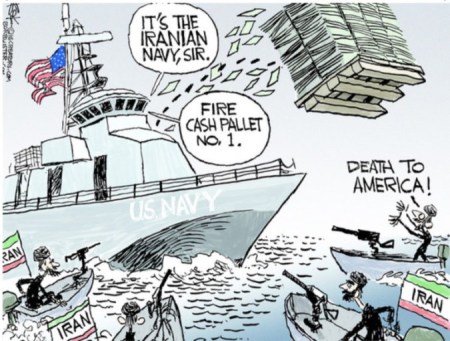
Obama has taken no significant steps to limit Iran’s continuing missile development and testing program. How can He limit that of North Korea without Chinese cooperation?
Yet the latest effort to do that, an agreement between the United States and South Korea to deploy an advanced missile defense system in the South, has inflamed China, which argues the system is also aimed at its weapons. While American officials deny that, the issue has divided Washington and Beijing so sharply that it will be even more difficult now for them to come up with a joint strategy for dealing with the North. [Emphasis added.]
China has been so vocal with its displeasure over the deployment of the American system that Mr. Kim may have concluded he could afford to upset Beijing by conducting Friday’s test. [Emphasis added.]
Fueling that perception were reports that a North Korean envoy visited Beijing earlier this week.
“North Korea almost certainly sees this as an opportunity to take steps to enhance its nuclear and missile capabilities with little risk that China will do anything in response,” Evans J.R. Revere, a former State Department official and North Korea specialist, said in a speech in Seoul on Friday. [Emphasis added.]
The breach between China and the United States was evident during Mr. Obama’s meeting with President Xi Jinping last week. “I indicated to him that if the Thaad bothered him, particularly since it has no purpose other than defensive and does not change the strategic balance between the United States and China, that they need to work with us more effectively to change Pyongyang’s behavior,” Mr. Obama said, referring to the Terminal High Altitude Area Defense system, as the advanced missile defense project is known. [Emphasis added.]
North Korea and Iran
Iran and North Korea have a long history of cooperation in developing nukes and missiles with which to deliver them. In the past, Iranian scientists have been present at North Korean nuke tests, and vice versa. They have also assisted each other in the development of nukes and missiles.
Iran and North Korea have substantial reasons to cooperate: by virtue of the Iran scam, Iran now has lots of money but is at least minimally restricted in its nuke development. North Korea has little usable currency, needs whatever it can get, and no attempts to halt or even to limit its nuke development have worked.
Photos released by North Korea of its launch of long-range ballistic missiles are the latest proof of the close military cooperation between Pyongyang and Tehran, an Israeli expert in the field told the news site IsraelDefense on Tuesday.
According to Tal Inbar — head of Space and UAV Research Centre at the Fisher Institute for Air & Space Strategic Studies — what was new in the photos was the shape of the warheads attached to the Nodong missiles, known in Iran as the Shahab-3.
Until now, such warheads — first detected by Inbar in Iran in 2010 — have not been seen in North Korea. At the time, Inbar dubbed them NRVs (or, “new entry vehicles”), which became their nickname among missile experts around the world. [Emphasis added.]
Inbar told IsraelDefense: “The configuration that we saw [on Tuesday] is identical to what we saw in Iran six years ago. In principle, its penetrating body (warhead) is identical to that of Scud missiles, but is mounted on the Shahab-3, and creates a more stable entity than other Shahab/Nodong warheads.”
Inbar said this was the third time that something of this nature had appeared in Iran before it did in North Korea. “But we must remember that the two countries engage in close cooperation where military and space-directed missiles are concerned,” he said. “It is thus possible that both plans and technology are being transferred regularly from one to the other.” [Emphasis added.]
Are North Korea and Iran rational? According to this New York Times analysis, North Korea is.
North Korea’s actions abroad and at home, while abhorrent, appear well within its rational self-interest, according to a 2003 study by David C. Kang, a political scientist now at the University of Southern California. At home and abroad, he found, North Korean leaders shrewdly determined their interests and acted on them. (In an email, he said his conclusions still applied.) [Emphasis added.]
“All the evidence points to their ability to make sophisticated decisions and to manage palace, domestic and international politics with extreme precision,” Mr. Kang wrote. “It is not possible to argue these were irrational leaders, unable to make means-ends calculations.” [Emphasis added.]
Victor Cha, a Georgetown University professor who served as the Asian affairs director on George W. Bush’s National Security Council, has repeatedlyargued that North Korea’s leadership is rational.
I submit that the same analysis, applied to Iran, produces the same result. Iran’s leaders know what they want, and are sufficiently rational to achieve it; they did. Obama, not the leader of a dictatorial theocracy, is sufficiently irrational to believe that what he wants for the Islamic Republic of Iran is what America needs it to have. It is not.
Obama and Iran
Obama’s Iran scam would be farcical were it not potentially deadly. He did not do what would have been best for America and the free world in general — increase sanctions until Iran complied fully with UN resolutions on missile testing, ceased Uranium enrichment and disposed of the means to do it, ceased all nuke research as well as all nuke cooperation with North Korea and ceased supporting all terrorist groups, including Hezbollah and Hamas. Instead, perhaps considering Himself above such trivia, Obama sought little more than what He considered His greatest achievement — His legacy:
Conclusions
If Obama were viewed internationally as the powerful leader of the world’s most powerful nation, He might be able to get China to clamp down, severely and successfully, on North Korea’s nuke and missile development. Were China to reject His overtures, He could arrange for it to wish that it had acceded. That’s not who Obama is, as demonstrated by, among His other actions, entering into the Iran Scam deal with Iran.
Perhaps Kim Jong-un needs to dress like an Iranian mullah to convince Obama to give him a “deal” similar to the one He gave to Iran. He had better hurry: that won’t work with President Trump.
Following a vehicle with gas cylinders near a cathedral in Paris last week, a similar incident occurred near a synagogue in Marseilles.
Armed French soldiers stand in front of a Synagogue during a visit of French Interior Minister Bernard Cazeneuve after an attack in front of a Jewish school in Marseille’s 9th district, France, January 14, 2016.. (photo credit:REUTERS/JEAN-PAUL PELISSIER)
A week after police in Paris discovered a booby-trapped car near a tourist attraction, a suspect vehicle with gas cylinders was found outside a Jewish community center in the southern city of Marseille.
The parked car found Saturday morning outside the Bar Yohaye Jewish Community Center and synagogue in Marseille’s 4th Arrondissement east of the Saint-Charles railways station had no trigger mechanism to cause an explosion and was not stolen, Laurent Nuñez, the police commissioner of the Bouches-du-Rhône region, told La Provence.
There was no indication that the car found in Marseille was connected in any way to what police believe was a foiled attempt to carry out a terrorist attack in Paris last week involving a car with several gas cylinders that was found abandoned near Paris’s Notre Dame cathedral, Nuñez added.
Three women were arrested last week in connection with the Paris incident. They were likely planning an imminent attack, French Interior Minister Bernard Cazeneuve said.
Police in Marseille were trying to locate the owner of the car they found near the synagogue, Nuñez said.
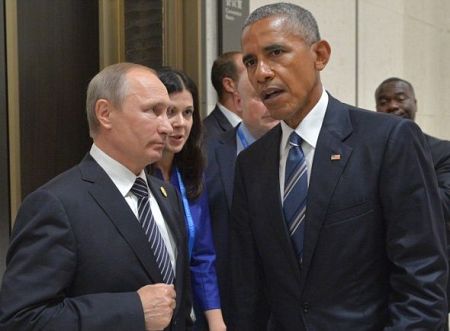
The Syrian cease-fire agreement that US Secretary of State John Kerry and Russian Foreign Minister Sergey Lavrov announced Friday night, September 9, in Geneva hands Syrian affairs over to Russia’s President Vladimir Putin and the country’s military.
The accord marked a sharp reversal for Washington. In his meeting with Putin in China last week, US President Barack Obama did not agree to those steps for the simple reason that such an agreement would be in line with the policy and stance of Republican presidential nominee Donald Trump, not those of the Democratic nominee Hillary Clinton.
Trump suggested several months ago that the US should let Putin finish the war in Syria, asserting that the Russian leader would be able to do it better.
Under the current situation it is no wonder that Kerry and Lavrov agreed not to release the details of the agreement.
Publication of the details would reveal that the rebels in the Aleppo area, and perhaps in all of Syria, have been abandoned.
The Syrian rebels now find themselves trapped by both the Russian-Turkish agreement and the Russian-US agreement, with a noose seemingly closing around them.
Meanwhile, on Friday, DEBKAfile released the following report:
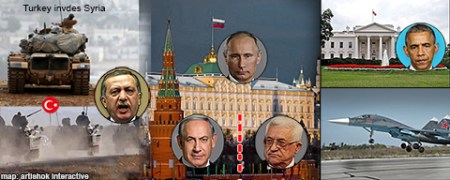
The fledgling “initiatives” reverberating this week in Washington, Moscow, Ankara, Jerusalem and the G20 summit were nothing but distractions from the quiet deals struck by two lead players, Russia and Turkey to seize control of the region’s affairs. Recep Tayyip Erdogan knew nothing would come of his offer on the G20 sidelines to US President Barack Obama to team up for a joint operation to evict ISIS from Raqqa. And, although Moscow was keen on hosting the first handshake in almost a decade between Israeli Prime Minister Binyamin Netanyahu and the Palestinian leader Mahmoud Abbas (Abu Mazen), neither were known to be ready for the last step toward a meeting.
But the game-changing events to watch out for took place in Hangzhou without fanfare – namely, the Obama-Putin talks and the far more fruitful encounter between Putin and Erdogan.
According to DEBKAfile’s intelligence and Mid East sources, Putin virtually shut the door on further cooperation with the United States in Syria. He highhandedly informed Obama that he now holds all the high cards for controlling the Syrian conflict, whereas Washington was just about out of the game.
Putin picked up the last cards, our sources disclose, in a secret deal with Erdogan for Russian-Turkish collaboration in charting the next steps in the Middle East.
The G20 therefore, instead of promoting new US-Russian understanding, gave the impetus to a new Russian-Turkish partnership.
Erdogan raked in instant winnings: Before he left China, he had pocketed Putin’s nod to grab a nice, 4,000-sq.km slice of northern Syria, as a “security zone” under the control of the Turkish army and air force, with Russian non-interference guaranteed.
This Turkish zone would include the Syrian towns of Jarablus, Manjib, Azaz and Al-Bab.
Ankara would reciprocate by withdrawing its support from the pro-US and pro-Saudi rebel groups fighting the Assad army and its allies in the area north of Aleppo.
Turkey’s concession gave Putin a selling-point to buy the Syrian ruler assent to Erdogan’s project. Ankara’s selling-point to the West was that the planned security zone would provide a safe haven for Syrian refugees and draw off some of the outflow perturbing Europe.
It now turns out that, just as the Americans sold the Syrian Kurds down the river to Turkey (when Vice President Joe Biden last month ordered them to withdraw from their lands to the eastern bank of the Euphrates River or lose US support), so too are the Turks now dropping the Syrian rebels they supported in the mud by re-branding them as “terrorists.”
The head of this NATO nation has moreover gone behind America’s back for a deal with the Russian ruler on how to proceed with the next steps of the Syrian conflict.
Therefore, when US Secretary of State John Kerry met Russian Foreign Minister Sergei Lavrov in Geneva Thursday and Friday, Sept. 8-9, for their sixth and seventh abortive sit-downs on the Syrian issue, there was not much left for them to discuss, aside from continuing to coordinate their air traffic over Syria and the eastern Mediterranean.
Washington and Moscow are alike fearful of an accidental collision in the sky in the current inflammable state of relations between the two powers.
As a gesture of warning, a Russian SU-25 fighter jet Tuesday, Sept 6, intercepted a US Navy P8 plane flying on an international route over the Black Sea. When the Russian jet came as close as 12 feet, the US pilots sent out emergency signals – in vain, because the Russian plane’s transponder was switched off. The American plane ended up changing course.
Amid these anomalies, Moscow pressed ahead with preparations to set up a meeting between the Israeli and Palestinian leaders, as the Russian Foreign Ministry announced Thursday.
Putin is keen to succeed where the Obama administration failed. John Kerry abandoned his last effort at peacemaking as a flop two years ago. But it is hard to see Netanyahu or Abu Mazen rushing to play along with the Russian leader’s plan to demean the US president in the last months of his tenure – especially when no one can tell who will win the November 8 presidential election – Hillary Clinton or Donald Trump – or what policies either will pursue.
All the region’s actors will no doubt be watching closely to see how Turkey’s “Russian track” plays out and how long the inveterate opportunists can hang together.
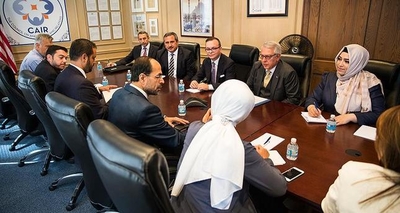
Parliamentarians from Turkey’s AK Party meet with CAIR officials earlier this week.
Awad was interviewed by Turkey’s Andolu news agency after this week’s meeting, which he called important in expressing “the support of the Muslim community for democracy and the rule of law in Turkey,” an IPT translation of his remarks shows.
**********************
A delegation from Turkey’s parliament came to Washington this week to make the case for extraditing Fethullah Gülen, an opposition figure living in self-imposed exile in Pennsylvania.
The Turkish government alleges Gülen was behind July’s failed coup attempt and President Tayyip Recep Erdoğan describes his extradition as a “priority.” Gülen denies any role in the coup and U.S. officials have said the Turkish evidence presented so far is not persuasive.
According to a Turkish press account, the delegation’s second meeting was with the Council on American-Islamic Relations (CAIR) and its executive director, Nihad Awad.
CAIR is a tax-exempt charity which presents itself as an American Civil Liberties Union devoted to protecting American Muslims from discrimination in housing, employment and other civil rights.
The visit from the Justice and Development Party (AKP) delegation, however, shows CAIR’s significant emphasis on influencing American foreign policy. CAIR is not a registered lobbying organization and isn’t registered as a foreign agent. Federal law requires registration by people or groups “before performing any activities for the foreign principal.”
CAIR routinely inserts itself into political debates on behalf of foreign entities, including a full campaign aimed at criticizing Israel during the 2009 and 2014 Gaza wars while staying silent about Hamas. Its Detroit director told a rally that being “defenders of the Palestinian struggle” was part of CAIR’s mission.
Awad was interviewed by Turkey’s Andolu news agency after this week’s meeting, which he called important in expressing “the support of the Muslim community for democracy and the rule of law in Turkey,” an IPT translation of his remarks shows.
“We believe in the need for more Turkish visitors and delegations to come to the United States to talk about their experiences and explain their views,” Awad said, “because there is a view against them and a pathological fear of Turkey here. The Turkish government must be aware of the need to employ more efforts to explain what is happening (in) Turkey to American public opinion.”
In his comments, Awad publicly acknowledges what he advised an official Turkish government delegation in private to get the desired political outcome.
We previously reported on the immediate support American-Islamists organized for Erdoğan’s AKP immediately after the failed coup. While Erdoğan’s dedicated followers inside CAIR may be comfortable with his crackdown on dissent, a recent New York Times editorial hints many U.S. policy leaders are not.
They believe “that Mr. Erdogan’s roundup of coup plotters looks like an attempt to silence any opposition, that Turkey has behaved outrageously in failing to stop conspiracy theories depicting the United States as a co-conspirator in the coup attempt, that Turkey has produced little evidence to warrant Mr. Gulen’s extradition and that Mr. Erdogan’s autocratic behavior is making him an unreliable ally.”
He has proven unreliable in the fight against ISIS, too. He failed to stop the flow of foreign fighters using Turkey as a way-station to join ISIS and places his fight against pro-Western Kurds above the global threat posed by ISIS.
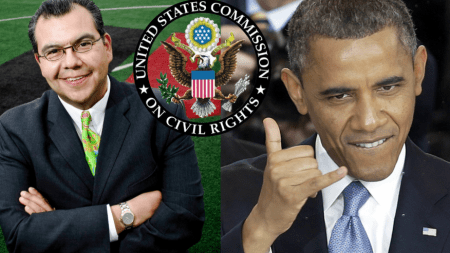
Martin R. Castro, a Chicago Democrat and Obama appointee as chairman of the U.S. Commission on Civil Rights, believes “religious freedom” and “religious liberty” are nothing more than “code words” for discrimination and intolerance.
In a 307-page report titled “Peaceful Coexistence: Reconciling Nondiscrimination Principles with Civil Liberties,” Castro writes, “The phrases ‘religious liberty’ and ‘religious freedom’ will stand for nothing except hypocrisy so long as they remain code words for discrimination, intolerance, racism, sexism, homophobia, Islamophobia, Christian supremacy or any form of intolerance.”
“Religious liberty was never intended to give one religion dominion over other religions, or a veto power over the civil rights and civil liberties of others,” Castro adds. In other words, “peaceful coexistence” is only possible when “supremacist” Christians abandon their First Amendment right to the free exercise of religion.
However, not everyone on the commission sees eye-to-eye with Castro. Some are quite concerned with the progressive mentality that anti-discrimination laws supersede constitutional rights.
Committee member and George Mason Law School Associate Dean Gail Heriot told The Washington Times, “I’m troubled by the growing attitude that somehow anti-discrimination laws trump everything. We live in a more complex world than that.”
Another, lawyer Mat Staver, criticized the report as being anti-American, saying, “This commission is not only out of touch with reality, but also out of touch with our Constitution.”
Castro’s report directly targets the federal Religious Freedom Restoration Act of 1993, and it makes clear the argument that a person’s civil rights are of “preeminent importance” above another’s religious liberty which has many lawyers scratching their heads. Some are accusing the Obama appointee of recruiting a majority of the commission to side with him in the name of identity politics rather than making compelling arguments.
The Washington Times concludes with a quote from University of Illinois law school professor Robin Fretwell Wilson, which should be taken as a warning for the future of freedom as viewed from the perspective of progressive America:
“There is no fair way to say that the concerns of the LGBT community are ‘preeminent’ over those of religious believers. Religious liberty will become code for discrimination and intolerance if opponents of nondiscrimination laws continue to claim the right, in the name of religious freedom, to block LGBT persons from enjoying protections that the rest of us take for granted. … We need thoughtful legislators to craft new thoughtful approaches to keeping the religious bakers in the business without saying gays can be turned away.”
If you support Donald Trump, you are “irredeemable,” part of a “basket of deplorables.” A “kind” who should never be allowed to rise again. You are a “radical fringe” made up of “racist,” “sexist,” “homophobic,” “Islamophobic,” “anti-Semitic,” “misogynist,” “xenophobic,” “you name it” types. Hillary Clinton paints you as hopeless moral lepers who should be banished to a remote island to live our final days.
We are so bad, so evil, that we are no better than “terrorists.”
We are “not America.”
We are all of these things (and more) according to Hillary Clinton. And anyone who thinks the language she uses to describe us is merely words spewed to inspire her base is fooling themselves.
Clinton will act on her words. And her actions will be as harsh and as anti-American as it gets. The boom will come down so hard that our lives will be impacted in ways that are almost impossible to fathom.
The stakes could not be higher.
It’s not enough to vote on November 8th. We must all be foot soldiers for the Trump campaign. It’s our last best hope. Because contrary to Jonah Goldberg’s perspective during a recent conversation with Glenn Beck that “we are never just one election away from doom,” I believe we are.
And on route to explaining why, I’d like to first take up one specific point they discussed: Supreme Court appointments under Clinton. Goldberg noted that Ginsberg will just be replaced by a younger version of Ginsberg, as if it would be a wash. But it wouldn’t be a wash because, as Goldberg pointed out, the replacement would be “younger.” Right. Younger. As in on the court for decades, irrespective of which party is in power.
But if Clinton wins, we can predict which party will be in power election after election after election. Her presidency will seal our fate on a broad and lasting scale. The Democratic Party will turn what is now a major Electoral College advantage into a guaranteed win as massive numbers of Hispanics and Muslims are imported into the United States – demographic groups that vote overwhelmingly for Democrats.
November 8th is, I believe, our last chance to grab the reins of power, to keep this nation from crashing over the precipice upon which we precariously sit. Teetering and holding our breath.
Hat tips: Breitbart, Daily Caller, Los Angeles Times, The Blaze
Washington calls Netanyahu’s ethnic cleansing video ‘inappropriate’ State Department in ‘direct conversations’ with Israeli government over prime minister’s clip released Friday
By Times of Israel staff and AP September 10, 2016, 4:06 am
Washington on Friday fumed at comments made by Prime Minister Benjamin Netanyahu in a video released online in which he accused the Palestinians of advocating ethnic cleansing of the Jewish population in the West Bank.
US State Department spokeswoman Elizabeth Trudeau told reporters the administration is “engaging in direct conversations with the Israeli government” about the video.
“We obviously strongly disagree with the characterization that those who oppose settlement activity or view it as an obstacle to peace are somehow calling for ethnic cleansing of Jews from the West Bank. We believe that using that type of terminology is inappropriate and unhelpful,” Trudeau said.
She said Israel expansion of settlements raises “real questions about Israel’s long-term intentions in the West Bank.”
Prime Minister Benjamin Netanyahu in a clip posted on Facebook on Friday, September 9 2016 (Screen capture Facebook)
Netanyahu on Friday decried what he said was the world’s silence on the issue.
Speaking in English in a video message posted on his Facebook page, Netanyahu asked whether people in other parts of the world would accept such demands in their own countries.
It’s “outrageous that the world doesn’t find it outrageous,” Netanyahu said, urging viewers to ask themselves whether they would accept “a territory without Jews, without Hispanics, without blacks” in their nation.
“Since when is bigotry a foundation for peace?” he asked.
“At this moment, Jewish schoolchildren in Judea [and] Samaria are playing in sandboxes with their friends,” he said, referring to the West Bank by its biblical Hebrew name. “Does their presence make peace impossible? I don’t think so.”
He said he envisioned a Middle East “where young Arabs and young Jews learn together, work together, live together side by side in peace.”
Defense Minister Avigdor Liberman visits Israeli students in the Israeli settlement of Susya, on their first day of school. September 1, 2016. (Ariel Hermoni/Ministry of Defense)
Israel began building settlements in the West Bank after it captured the territory, previously controlled by Jordan, in the 1967 Six Day War. Today, over 250,000 Israelis live in West Bank settlements and outposts.
The settlements are seen as an impediment by proponents of the two-state solution, which would see a Palestinian state alongside Israel in most of the West Bank and all of Gaza. Israel withdrew from Gaza in 2005, dismantling all its settlements there, while some of the West Bank settlements would potentially remain under Israel control as part of a territorial exchange under a final peace agreement.
Netanyahu’s video garnered 45,000 views and more than 4,300 “likes” within the first three hours of publication. It is the latest in a series of viral attempts in which the prime minister talks directly to the camera, speaking, usually in English, about a current affairs issue. The prime minister is known for his fluent, almost unaccented English, which he perfected during his years of study in the US.
In the first such video, which came after June’s deadly nightclub shooting in Orlando, Netanyahu called on the international community to stand together with the LGBT community, saying that the attack was not an isolated incident and slamming homophobic practices carried out by Islamic terrorist groups and countries across the Middle East.









 anneinpt
 artaxes
 danmillerinpanama
 davidking1530
 Peter Hofman
 Joseph Wouk
 Peter
Peter Louisiana Steve
 WarSclerotic
Recent Comments