Archive for August 2016

CRISIS: Internet to Have Global Governance October 1.

August 29, 2016

CRISIS: Internet to Have Global Governance October 1. Call Congress! Better Censorship for Tyrants by

Judith Bergman •

August 29, 2016 at 6:00 am

Source: Gatestone Institute

  • The U.S. announced its plan to pass the oversight of the agency to a global governance model on October 1, 2016. The Obama Administration says that the transition will have no practical effects on the internet’s functioning or its users, and even considers the move necessary in order to maintain international support for the internet and to prevent a fracturing of its governance. Oh really?
  • The absence of the U.S. in overseeing the governance of the internet could spell the end of the current era of free speech on the internet, as well as free enterprise.
  • What guarantees are there that internet governance will not eventually end up in the hands of those very governments, seeing as they are all very eager to gain control of it? None. The Geneva Declaration of Principles makes clear that the UN, run by a majority of authoritarian governments, wants a decisive role for governments in internet governance.
  • Civil society groups and activists are calling on Congress to sue the Obama Administration — perhaps at least to postpone the date until more Americans are aware of the plan. It is not too late.

Very soon, on October 1, 2016, much of the internet’s governance will shift from the US National Telecommunications and Information Administration (NTIA) authority to a nonprofit multi-stakeholder entity, the Internet Corporation for Assigned Names and Numbers, also known by its acronym ICANN.

Until now, NTIA has been responsible for key internet domain name functions, such as the coordination of the DNS (Domain Name System) root, IP addresses, and other internet protocol resources. But in March 2014, the U.S. announced its plan to let its contract with ICANN to operate key domain name functions expire in September 2015, passing the oversight of the agency to a global governance model. The expiration was subsequently delayed until October 1, 2016.

According to the NTIA’s press release at the time,

“NTIA’s responsibility includes the procedural role of administering changes to the authoritative root zone file – the database containing the lists of names and addresses of all top-level domains – as well as serving as the historic steward of the DNS. NTIA currently contracts with ICANN to carry out the Internet Assigned Numbers Authority (IANA) functions and has a Cooperative Agreement with Verisign under which it performs related root zone management functions. Transitioning NTIA out of its role marks the final phase of the privatization of the DNS as outlined by the U.S. Government in 1997”.

According to the NTIA, from the inception of ICANN, the U.S. government and internet stakeholders envisioned that the U.S. role in the IANA functions would be temporary. The Commerce Department’s June 10, 1998 Statement of Policy stated that the U.S. government “is committed to a transition that will allow the private sector to take leadership for DNS management.” The official reason, therefore, is that

“ICANN as an organization has matured and taken steps in recent years to improve its accountability and transparency and its technical competence. At the same time, international support continues to grow for the multi-stakeholder model of Internet governance as evidenced by the continued success of the Internet Governance Forum and the resilient stewardship of the various Internet institutions”.

The Obama Administration says that the transition will have no practical effects on the internet’s functioning or its users, and even considers the move necessary in order to maintain international support for the internet and to prevent a fracturing of its governance.

Oh really?

While the transition may appear ostensibly “technical”, the absence of the United States in overseeing the governance of the internet could spell the end of the current era of free speech on the internet, as well as free enterprise.

This is not merely wild speculation; it is evident in the statements that several governments, who are less than enchanted with the concept of freedom of speech, have made in recent years regarding the governance of the internet.

Some of these statements have come to light in the preparatory work of the United Nations World Summit on Information Society, known today as WSIS+10 — a process that began in 2003 with the Geneva Declaration of Principles and that continues to this day. Purportedly, the purpose of the process is a “commitment to build a people-centred, inclusive and development-oriented Information Society, where everyone can create, access, utilize and share information and knowledge” (section A.1), but already in section B.1 it becomes clear that the UN, run by a majority of authoritarian governments, wants a decisive role for governments in internet governance:

“Governments, as well as private sector, civil society and the United Nations and other international organizations have an important role and responsibility in the development of the Information Society and, as appropriate, in decision-making processes. Building a people-centred Information Society is a joint effort which requires cooperation and partnership among all stakeholders”.

The UN, in the form of International Telecommunication Union (ITU), has already tried in vain to wrestle control of the internet from ICANN, but where the ITU failed, WSIS+10 may succeed with the new “global governance” ICANN, unshielded from the protection of the US.
The urge of various governments to control the internet is evidently there. If anything, this was clear from the submissions for the December 2015 WSIS+10 UN General Assembly High Level Meeting.

The written submission of the Group of 77 plus China — a coalition, dating from 1964, of developing countries that now includes 134 nations — stated that, “The management of the Internet involves both technical and public-policy issues and … the overall authority for Internet related public policy issues is the sovereign right of States.”

China’s individual submission was even more interesting. It stated that,

“The multi-stakeholder governance model that brings together governments, the private sector and non-governmental organizations would be respected… This model should not be lopsided, and any tendency to place sole emphasis on the role of businesses and non-governmental organizations while marginalizing governments should be avoided. The roles and responsibilities of national governments in regard to regulation and security of the network should be upheld. It is necessary to ensure that United Nations plays a facilitating role in setting up international public policies pertaining to the Internet. We should work on the internationalization of Internet Corporation for Assigned Names and Numbers”.

When China says that ICANN should be internationalized, it hardly has in mind an increased role for non-governmental organizations.

Russia did not even pay lip service to the multi-stakeholder governance model but cut straight to the point:

“We consider it necessary to consecutively increase the role of governments in the Internet governance, with strengthening the activity of the International Telecommunication Union (ITU) in this field, as well as with support of the UNESCO activity in the development of ethical aspects of Internet use…”

“Ethical aspects of Internet use”?

Saudi Arabia, in its submission, also emphasized, that a priority for the WSIS+10 should be, “actualization of enhanced cooperation to enable governments… to carry out their roles and responsibilities in international public policy issues pertaining to the internet”.

According to the Wall Street Journal, the Obama Administration — as well as many in the high-tech community — regards the long-planned move as necessary to maintain international support for the internet and prevent a fracturing of its governance — a claim critics may find dubious. The U.S. government’s role “has long been a source of irritation to foreign governments,” according to the NTIA. One look at many foreign governments and it is easy to see why. The NTIA claims that, “These calls for replacing the multi-stakeholder model with a multilateral, government-run approach will only grow louder if the U.S. government fails to complete the transition”. Is that a threat?

But what guarantees are there that internet governance will not eventually end up in the hands of those very governments, seeing as they are all very eager to gain control of it? None.

In fact, those who claim to care about a free and uncensored internet, unbridled by government and international state organizations, should take a close look at the proposals for the plan for ICANN that the different stakeholders, including governments, came to agree on in March 2016 in Marrakech. According to this plan, the Governmental Advisory Committee (GAC), a decisional participant in ICANN, will — subject to certain limitations — be able to participate in decision-making on budgets, board member removals, and other matters of ICANN corporate governance. This is new and represents a major shift, which should concern those who care about internet freedom. Even if this plan is discarded for some reason, it shows how eagerly governments are pushing for control in internet matters. That observation alone should serve as a warning to those who take at face value the U.S. administration’s declarations that nothing will change.

The decision to transfer authority to ICANN has met with resistance in the U.S. Congress, and a coalition of more than two dozen civil society groups and activists are even calling on Congress to sue the Obama Administration — perhaps at least to postpone the date until more Americans are aware of the plan. It is not too late.

Judith Bergman is a writer, columnist, lawyer and political analyst.


Lieberman: “A fighter does not need to the battlefield with a lawyer”

August 29, 2016

Israeli Defense Minister Avigdor Lieberman: “A fighter does not need to go to the battlefield with a lawyer”

Aug 29, 2016, 3:46PM

Source: Lieberman: “A fighter does not need to the battlefield with a lawyer” – Israel Politics News | JerusalemOnline

photo Credit: Reuters/Channel 2 News

Lieberman strongly criticized how the media has responded to the trial of Elor Azaria, the Hebron soldier who shot the terrorist, and the Israeli fighter who shot a Palestinian earlier today.

A fighter does not need to go to the battlefield with a lawyer,” Israel’s Defense Minister Avigdor Lieberman stated this morning in reference to the trial of Elor Azaria, who is being investigated for shooting a terrorist, and the Israeli fighter who shot a Palestinian in Ofra earlier today, which was reported on JerusalemOnline.

“I would like to take this opportunity and to appeal to the Israeli media in three parts,” he stated. “First of all, the Israeli media needs to remember that Israel is a democratic country who only convicts people in court. It isn’t the media but the courts that decide. This includes Azaria and the other soldier.”

“The second thing that people need to remember is that we are fighting against terrorists every day,” Lieberman added. “They cannot go out on a mission with a lawyer glued to them. To reach a situation where every soldier asks for a lawyer before going out on a mission is impossible. I expect for the Israeli media to strengthen Israel’s deterrence and not to deter the soldiers in their struggle against the terrorists.”

Earlier today, one of Azaria’s commanders concurred with Lieberman regarding Azaria: “All of the time we updated that a knife is only the beginning and the day will come when there will be something greater, such a shooting incident or an explosive device. When the commanders came to the scene of the incident, it is the first thing that they think about. When I saw this big body and heard a citizen shout ‘fear of explosive device,’ this creates a frightening picture. I think that it is impossible to state at the scene that there is no fear and that there is a chance that something else is there.”

“As long as the incident is not finished, it is impossible to state that there was no danger to human life,” he added. “When terrorists are alive in the area, the danger exists. The terrorist was shot and moved a little. He was still a danger and I didn’t for nothing position a soldier beside him to differentiate him from the first terrorist that was shot in the head. I instructed soldiers to make sure that the terrorist doesn’t move and that they need to follow the rules of engagement. I positioned him further away for I feared an explosive device. The soldier was instructed to shoot if the terrorist implemented sudden movements or moved his hands towards his body. This shifting of responsibility is not responsible.”

Sinai attacks decline as Egypt’s fight against IS yields results

August 29, 2016

Sinai attacks decline as Egypt’s fight against IS yields results Through targeted bombings on Islamic State’s Jabal Hilal stronghold, Egyptian military deals strong blow to terror group’s capabilities

By Avi Issacharoff

August 29, 2016, 2:51 pm

Source: Sinai attacks decline as Egypt’s fight against IS yields results | The Times of Israel

Smoke rises after a house was blown up in a military operation in Egypt’s Sinai peninsula on November 20, 2014. (Abed Rahim Khatib/Flash90)

There has been a steady and significant decline in terror attacks carried out by the Islamic State in the Sinai Peninsula in recent months, according to both Egyptian and Israeli sources.

Get The Times of Israel’s Daily Edition by email
and never miss our top stories
  Free Sign up!

Though the Islamic State’s armed activities continue apace in the northeast triangle framed by the Israel, Gaza and Egypt borders, there have been fewer terror attacks on the Egyptian army, with a smaller number of casualties than last year, and the attacks have been less ambitious than those IS carried out in 2014 and 2015, as a result of the group’s weakened force and diminished weapons supply.

The Egyptian military’s operations in the central Sinai Peninsula and a series of airstrikes in the Jabal Hilal region — a terrorist-controlled area — have dealt a powerful blow to IS’s military capabilities, the sources said.

For the past few years, Jabal Hilal has been the stronghold of the extremist group in the peninsula, mostly due to its topography.

The region’s extensive cave system — it is considered the “Tora Bora of the Sinai,” an allusion to the rugged region of Afghanistan that Taliban and al-Qaeda fighters made into a bastion against the United States — has made it the preferred destination for IS, the current iteration of the Ansar Bayt al-Maqdis group.

Three months ago, toward the end of May, the Egyptian military spokesperson, Col. Muhammad Samir announced the killings of “88 armed members of the jihadist group in central and northern Sinai.”

May’s large-scale aerial campaign not only took out nearly 100 IS operatives, it also injured hundreds more, dozens of them seriously. In addition to the human casualties, the bombings destroyed the group’s weapons storage facilities and ammunition caches, which had been kept hidden for years.

Essentially, the “logistic front” of the Islamic State in Sinai was destroyed, the sources said.

Around the same time, Egyptian President Abdel-Fattah el-Sissi also discussed the actions against IS, which focused on Jabal Hilal, an area that is seen as particularly problematic. According to Sissi, there had been a significant victory in the fight against terror. However, he clarified, the state of emergency for Egypt would continue.

An image taken from a video clip released by the Sinai affiliate of the Islamic State group on August 1, 2016. (MEMRI)

An image taken from a video clip released by the Sinai affiliate of the Islamic State group on August 1, 2016. (MEMRI)

Earlier this month, the Egyptian military announced another achievement, the execution of Abu Duaa al-Ansari, the presumed commander of the Islamic State in Sinai, formerly known as Ansar Bayt al-Maqdis.

According to the military’s statement, the series of bombings south of el-Arish — the provincial capital of the Sinai — in which al-Ansari was killed came as the result of precise intelligence. During the bombings, a number of weapons storehouses were destroyed and some 45 operatives were killed.

Illustrative: Egyptian security forces in the Sinai, in July 2013. (Mohamed El-Sherbeny/AFP)

Illustrative: Egyptian security forces in the Sinai, in July 2013. (Mohamed El-Sherbeny/AFP)

Throughout 2015, dozens of Egyptian soldiers were killed by IS, with the worst attack taking place during the month of Ramadan in simultaneous assaults on a number of Egyptian military outposts near the town of Sheikh Zuweid that left over 50 dead.

Since the July 1, 2015 attack, however, the Egyptian military’s intelligence has improved. In addition, security collaboration and cooperation with Israel has continued.

Recently, Egypt has made a number of significant gestures in the diplomatic realm, including a rare meet-up between its foreign minister and Prime Minister Benjamin Netanyahu, that testify to the closeness of the two sides.

Iran deploys S-300 missiles around major nuclear site

August 29, 2016

Source: Israel Hayom | Iran deploys S-300 missiles around major nuclear site

Iranian state media shows footage of long-range defense system deploying near the Fordo underground uranium enrichment facility • Protecting nuclear facilities “is paramount under all circumstances,” Iranian Air Defenses commander tells local TV channel.

News Agencies and Israel Hayom Staff

Russia’s S-300 aerial defense missile system [Archives]

 Photo credit: AFP

Iran: No Range Limit for Our New Ballistic Missiles

August 29, 2016

Iran: No Range Limit for Our New Ballistic Missiles, Clarion Project, Meira Svirski, August 29, 2016

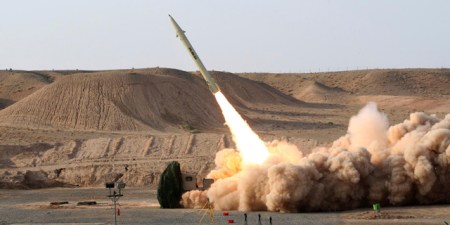
Iran-Missile-HP_9An Iranian missile test (Photo: © Reuters)

Iran has successfully played America as the fool, challenging the U.S. to stand up to its belligerence. Every time America backs down, by either making excuses for the Islamic Republic (i.e., by redefining the deal) or ignoring their latest outrage, Iran becomes more empowered.

Sanctions relief let the Iranian genie out of the bottle. Now, the terror-supporting and oppressive regime is taking its place on the world stage unrestrained and unopposed.

********************

The Iranian defense minister recently pronounced that the Islamic Republic has “no limit for the range” of the ballistic missiles it is developing.

In making the pronouncement, General Hossein Dehqan also said that Iran is now on par with world standards for most of its weapons and military equipment, specifically, that “production of the national individual weapons and efforts to improve the quality and precision-striking power of ballistic missiles are among the defense ministry’s achievements…”

One of the advanced weapons Iran has developed is a ballistic missile that deploys multiple warheads against a single target. As the government-aligned Fars News Agency reported, “This makes for an efficient area attack weapon.”

(Never mind that just three months ago, that the state-owned IranianPress TV announced that “all these advancements on the military level are only for defensive reasons.”)

In addition, Iran has now deployed the long-awaited Russian-made, long-range S-300 missile system. The system was deployed to protect the country’s Fordo nuclear facility, which the commander of Iran’s air force calls paramount “in all circumstances.”

Western officials, who tried to block the delivery of the missile system, said that once in place, the S-300 would essentially eliminate the military option to stop Iran from obtaining nuclear weapons.

The nuclear deal made with Iran and the world powers was sold to the public as a way to contain not just Iran’s nuclear weapons program, but its ballistic missile program as well.

Ballistic missiles are mainly used to deliver nuclear warheads. Under the terms of the agreement we were told that the current UN restrictions on Iran’s ballistic missile program would remain in effect for eight years, including forbidding Iran from testing of ballistic missiles.

Less than two months after the deal was formalized, a senior figure in the Iranian Revolutionary Guards Corps (IRGC), Brigadier General Amirali Hajizadeh, announced, “Some wrongly think Iran has suspended its ballistic missile programs in the last two years and has made a deal on its missile program … We will have a new ballistic missile test in the near future that will be a thorn in the eyes of our enemies.”

As far as the defense minister Dehqan, commenting about the restrictions, he said, “To follow our defense programs, we don’t ask permission from anyone.”

After the first ballistic missile test conducted by Iran after the agreement was made, the U.S. administration backtracked, saying that the test was really not a violation of the nuclear agreement but there were “strong indications” that the test violated UN restrictions.

The second ballistic missile test came as U.S. Vice President Joe Biden was visiting Israel. Painted on the two missiles (which had the capability of reaching the Jewish state) were written the word in Hebrew, “Israel should be wiped out.”

Hajizadeh said at the time, “The 1,240-mile range of our missiles is to confront the Zionist regime. IRNA, Iran’s state news agency, reported the head of the Islamic Revolutionary Guards Corps as saying the test had Iran’s enemies “shivering from the roar” of the missiles.

For his part, Biden said at the time, the U.S. would “act” if Iran broke the nuclear agreements.

Judging from its lack of action, the U.S. ostensibly does not count this as a violation of the agreement, despite clear evidence to the contrary.

Since the signing of the nuclear agreement Iran has engaged in aprovocative “cat and mouse” game with the U.S.

In addition, to the ballistic missile tests, since signing the agreement:

●      In September, Iran simulated a missile attack on a US aircraft carrier in an agitprop video titled “If Any War happens.”

●      In October, just three days after one of the ballistic tests, Iranian state TV aired unprecedented footage of an underground missile base.

●      In December, Iran tested rockets with live fire within 1,500 yards of American warships in the Strait of Hormuz

●      In January, Iran test-fired an upgraded surface-to surface cruise missile in a new set of wargames code-named Velayat-94

●      In January, an unarmed Iranian surveillance drone flew near U.S. and French aircraft carriers in the Gulf, managing to take “precise” photos while the ship was involved in an ongoing naval drill. An Iranian submarine was also detected in close proximity to the aircraft carriers.

●      In January, Iran captured 10 U.S. sailors whose boat had strayed into Iranian territorial waters. The soldiers were humiliated and held for 15 hours. Iran has since used the incident to mocked America in videos and plays.

“Without understanding Iranian culture, it is impossible to understand what is going on,” said Harold Rhode, an expert on Islamic culture who worked for the Pentagon for 28 years, in an interview with The Algemeiner. “Nothing is in and of itself. The way negotiations work among Iranians is that an agreement as we understand it means nothing. It is nothing more than a step along the way to getting what they want.”

“From an Iranian cultural point of view, at all times there is a balance — ‘Are you giving it or are you getting it?’ … It’s simply domination; it’s simply power.”

Iran has successfully played America as the fool, challenging the U.S. to stand up to its belligerence. Every time America backs down, by either making excuses for the Islamic Republic (i.e., by redefining the deal) or ignoring their latest outrage, Iran becomes more empowered.

Sanctions relief let the Iranian genie out of the bottle. Now, the terror-supporting and oppressive regime is taking its place on the world stage unrestrained and unopposed.

All-out Turkish-Kurd war. Barazani goes to Tehran

August 29, 2016

An all-out Turkish-Kurdish war has boiled over in northern Syria since the Turkish army crossed the border last Wednesday, Aug. 24. A Turkish Engineering Corps combat unit is equipped for crossing the Euphrates River and heading east to push the Kurds further back, but the main Kurdish force is deployed to the south not the east.   

DEBKA: All-out Turkish-Kurd war. Barazani goes to Tehran


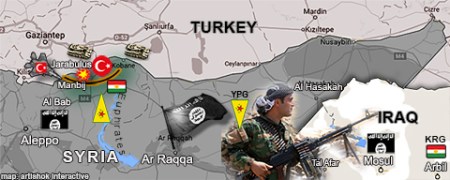
An all-out Turkish-Kurdish war has boiled over in northern Syria since the Turkish army crossed the border last Wednesday, Aug. 24 for the avowed aim of fighting the Islamic State and pushing the Syrian Kurdish YPG militia back. Instead of falling back, the Kurds went on the offensive and are taking a hammering. This raging confrontation has stalled the US-led coalition offensive against ISIS and put on indefinite hold any US plans for campaigns to drive the jihadists out of their Syrian and Iraqi capitals of Raqqa and Mosul.
The Kurdish militia ground troops, who were backed by the US and assigned the star role in these campaigns, are now fully engaged in fighting Turkey. And, in another radical turnaround, Iraqi Kurdish leaders (of the Kurdish Regional Republic) have responded by welcoming Iran to their capital, in retaliation for the US decision to join forces with Turkey at the expense of Kurdish aspirations.
The KRG’s Peshmerga are moreover pitching in to fight with their Syrian brothers. Together, they plan to expel American presence and influence from both northern Syria and northern Iraq in response to what they perceive as a US sellout of the Kurds.

debkafile’s military analysts trace the evolving steps of this escalating complication of the Syrian war and its wider impact:

  • Since cleansing Jarablus of ISIS, Turkey has thrown large, additional armored and air force into the battle against the 35.000-strong YPG Kurdish fighters. This is no longer just a sizeable military raid, as Ankara has claimed, but a full-fledged war operation. Turkish forces are continuing to advancing in three directions and by Sunday, Aug. 28 had struck 15-17km deep inside northern Syria across a 100km wide strip.
    Their targets are clearly defined: the Kurdish enclave of Afrin in northwest Syria and the Kurdish enclave of Qamishli and Hassaka in the east, in order to block the merger of Kurdish enclaves into a contiguous Syrian Kurdish state.
    Another goal was Al-Bab north of and within range of Aleppo for a role in a major theater of the Syrian conflict. To reach Al-Bab, the Turkish force would have to fight its way through Kurdish-controlled territory.
  • The Turks are also using a proxy to fight the Syrian Kurds. Thousands of Syrian Democratic Army (SDF) rebels, whom they trained and supplied to fight Syria’s Bashar Assad army and the Islamic State, have been diverted to targeting the Kurds under the command of Turkish officers, to which Turkish elite forces are attached.
  • A Turkish Engineering Corps combat unit is equipped for crossing the Euphrates River and heading east to push the Kurds further back. Contrary to reports, the Turkish have not yet crossed the river itself or pushed the Kurds back – only forded a small stream just east of Jarablus. The main Kurdish force is deployed to the south not the east of the former ISIS stronghold.
  • Neither have Turkish-backed Syrian forces captured Manbij, the town 35km south of Jarablus which the Kurds with US support captured from ISIS earlier this month. Contrary to claims by Ankara’s spokesmen, those forces are still only 10-15km on the road to Mabij.
  • Sunday, heavy fighting raged around a cluster of Kurdish villages, Beir Khoussa and Amarneh, where the Turks were forced repeatedly to retreat under Kurdish counter attacks. Some of the villages were razed to the ground by the Turkish air force and tanks. At least 35 villagers were reported killed.
  • In four days of fierce battles, the Kurds suffered 150 dead and the Turkish side, 60.
  • debkafile military sources also report preparations Sunday to evacuate US Special Operations Forces and helicopter units from the Rmeilan air base near the Syrian-Kurdish town of Hassaka. If the fighting around the base intensifies, they will be relocated in northern Iraq.
  • Fighters of the Iraqi-Kurdish Peshmerga were seen removing their uniforms and donning Syrian YPG gear before crossing the border Sunday and heading west to join their Syrian brothers in the battle against Turkey.
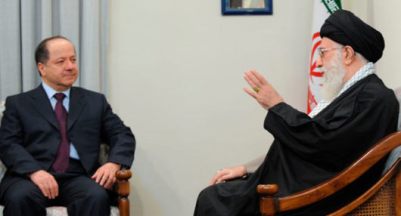
  • The KRG President Masoud Barazani expects to travel to Tehran in the next few days with an SOS for Iranian help against the US and the Turks. On the table for a deal is permission from Irbil for the Iranian Revolutionary Guards to win their first military bases in the Iraqi Kurdish republic, as well as transit for Iranian military forces to reach Syria through Kurdish territory..

Report: Putin to Host Netanyahu Abbas Summit in Moscow

August 29, 2016

By: JNi.Media Published: August 29th, 2016

Source: The Jewish Press » » Report: Putin to Host Netanyahu Abbas Summit in Moscow

Moscow’s Red Square / Photo credit: Vicente Villamón

Advanced talks have been conducted recently in preparation for a summit conference with Prime Minister Netanyahu and Chairman Abbas in Moscow this fall, according to the daily Yediot Aharonot. The paper reported on Monday that both PA and Israeli officials have confirmed that the summit is scheduled to take place in October or shortly thereafter, under the auspices of Russian President Vladimir Putin.

Abbas has personally expressed his willingness, in principle, to partake in a Moscow summit. However, according to Yediot, the PA Chairman still insists that Israel first commit to freezing settlement construction and carry out the fourth phase of terrorist prisoners release which was halted when Secretary of State Kerry’s peace initiative collapsed in 2015. Abbas also insists on setting a specific date for the end of negotiations and for reaching a final agreement.

Political sources in Jerusalem have told Yediot that when Netanyahu and Putin spoke on the phone last week, the summit plan was part of their discussion. But they stress that the summit idea at this point is “mere speculation, it’s too soon.” Still, the same sources say Netanyahu is willing to meet with Abbas directly any time.

On Wednesday, August 17, Russian Deputy Foreign Minister Mikhail Bogdanov, Putin’s Special Representative for the Middle East and Africa, discussed prospects for advancing PA-Israel peace talks with Abbas in Amman, and delivered a personal message from Putin to Abbas. Since then, Bogdanov has met twice with the head of the PA mission in Moscow Faed Mustafa and with Israeli ambassador Zvi Hefetz. One of Bogdanov’s meetings with Hefetz was on August 24, the day of the Putin-Netanyahu phone conversation.

He was a billionaire who donated to the Clinton Foundation. Last year, he was denied entry into the U.S.

August 28, 2016

He was a billionaire who donated to the Clinton Foundation. Last year, he was denied entry into the U.S.

Joseph Tanfani


Source: He was a billionaire who donated to the Clinton Foundation. Last year, he was denied entry into the U.S. – LA Times

Gilbert Chagoury has contributed $1 million to $5 million to the Clinton Foundation, according to its list of donors. (Getty Images)

Nigerian billionaire Gilbert Chagoury, one of Africa’s richest men, has built a reputation as a giant of global philanthropy.

His name is on a gallery at the Louvre and a medical school in Lebanon, and he has received awards for his generosity to the Catholic Church and St. Jude’s Children’s Hospital. He owns a seven-bedroom hilltop mansion in Beverly Hills, and he has a high-level network of friends from Washington to Lebanon to the Vatican, where he serves as an ambassador for the tiny island nation of St. Lucia. His website shows him shaking hands and laughing with Pope Francis.

“I never imagined what the future would hold for me,” Chagoury once said of his boyhood in Nigeria. “But I knew there was a vision for my life that was greater than I could imagine.… I consider it a duty to give back.”

Since the 1990s, Chagoury has also cultivated a friendship with the Clinton family — in part by writing large checks, including a contribution of at least $1 million to the Clinton Foundation.

By the time Hillary Clinton became secretary of State, the relationship was strong enough for Bill Clinton’s closest aide to push for Chagoury to get access to top diplomats, and the agency began exploring a deal, still under consideration, to build a consulate on Chagoury family land in Lagos, Nigeria.

But even as those talks were underway, bureaucrats in other arms of the State Department were examining accusations that Chagoury had unsavory affiliations, stemming from his activities and friendships in Lebanon. After a review, Chagoury was refused a visa to enter the U.S. last year.

Chagoury is a prominent example of the nexus between Hillary Clinton’s State Department and the family’s Clinton Foundation, which has come under renewed scrutiny during her presidential run. The organization, founded as a way for the Clintons to tap their vast network for charitable works, has tackled some of the steepest challenges in the developing world, including rebuilding Haiti and fighting AIDS in Africa. It has also come under fire for its willingness to accept money from foreign governments with interest in swaying U.S. policy during Clinton’s time as secretary of State, and the controversial histories of some donors.

Part of a dictator’s inner circle

Chagoury was born in 1946 in Lagos to Lebanese parents, and as a child attended school in Lebanon. He sold shoes and cars in Nigeria, according to a biography on his website, before marrying the daughter of a prominent Nigerian businessman.

During the rule of Gen. Sani Abacha, who seized power in Nigeria in 1993, Chagoury prospered, receiving development deals and oil franchises.

In the 1990s, Chagoury portrayed himself as an Abacha insider as he tried to influence American policy to be more friendly to the regime. Soon after President Clinton named Donald E. McHenry a special envoy to Nigeria in 1995, Gilbert and brother Ronald Chagoury visited McHenry in his office at Georgetown University in Washington. The U.S. was pushing for the return of democratic rule in Nigeria; Abacha, meanwhile, was eager to have his country taken off a U.S. list of nations that enabled drug trafficking, McHenry said.

“Their effort was to try and influence anyone who they thought could influence the U.S. government,” McHenry said, adding that the approach was heavy-handed. “They tried every key on the piano.”

Abacha turned out to be “one of the most notorious kleptocrats in memory,” stealing billions in public funds, acting Assistant Atty. Gen. Mythili Raman later said.

After Abacha’s death in 1998, the Nigerian government hired lawyers to track down the money. The trail led to bank accounts all over the world — some under Gilbert Chagoury’s control. Chagoury, who denied knowing the funds were stolen, paid a fine of 1 million Swiss francs, then about $600,000, and gave back $65 million to Nigeria; a Swiss conviction was expunged, a spokesman for Chagoury said.

Ties to the Clintons

In the years afterward, Chagoury’s wealth grew. His family conglomerate now controls a host of businesses, including construction companies, flour mills, manufacturing plants and real estate.

He has used some of that money to build political connections. As a noncitizen, he is barred from giving to U.S. political campaigns, but in 1996, he gave $460,000 to a voter registration group steered by Bill Clinton’s allies and was rewarded with an invitation to a White House dinner. Over the years, Chagoury attended Clinton’s 60th birthday fundraiser and helped arrange a visit to St. Lucia, where the former president was paid $100,000 for a speech. Clinton’s aide, Doug Band, even invited Chagoury to his wedding.

Chagoury also contributed $1 million to $5 million to the Clinton Foundation, according to its list of donors. At a 2009 Clinton Global Initiative conference, where business and charity leaders pledge to complete projects, the Chagoury Group’s Eko Atlantic development — nine square kilometers of Lagos coastal land reclaimed by a seawall — was singled out for praise. During a 2013 dedication ceremony in Lagos, just after Hillary Clinton left her post as secretary of State, Bill Clinton lauded the $1-billion Eko Atlantic as an example to the world of how to fight climate change.

“I especially thank my friends Gilbert and Ron Chagoury for making it happen,” he said.

By last summer, U.S. diplomats had selected a 9.9-acre property at Eko Atlantic as the preferred site for a new Lagos consulate, State Department documents obtained by the Los Angeles Times show. Two months ago, James Entwistle, then the U.S. ambassador to Nigeria, wrote to Washington, asking permission to sign a 99-year lease.

No deal has been signed, State Department spokeswoman Elizabeth Trudeau said. She did not answer questions about whether the Clintons recommended Eko Atlantic. She said at a recent briefing that she was unaware of whether Hillary Clinton knew the site was under consideration; it was on a list of possibilities submitted by a real estate firm in 2012, Trudeau said in response to questions from The Times. A spokesman for Clinton’s campaign noted that the State Department has said the process has been managed by “career real estate professionals.”

Chagoury declined requests for an interview. A friend and spokesman, Mark Corallo, said Chagoury was a generous and “peace-loving” man unfairly scrutinized because of his association with the Clintons. He said Chagoury last saw Hillary Clinton at a 2006 dinner. The Clinton Foundation and a spokesman for Bill Clinton did not respond to requests for comment.

Chagoury also has given to Republicans: He and his brother, along with Eko Atlantic, are listed as sponsors for a 2014 art exhibit at the George W. Bush Presidential Center.

Suspicions emerge in the U.S.

In spite of his network of powerful friends, Chagoury has aroused the suspicions of U.S. security officials. In 2010, he was pulled off a private jet in Teterboro, N.J., and questioned for four hours because he was on the Department of Homeland Security’s no-fly list. He was subsequently removed from the list and categorized as a “selectee,” meaning he can fly but receives extra scrutiny, Homeland Security documents show. The agency later wrote to Chagoury to apologize “for any inconvenience or unpleasantness.”

That letter did not explain why Chagoury was on the no-fly list, but another Homeland Security document shows agents citing unspecified suspicions of links to terrorism, which can include financing extremist organizations; Chagoury later told reporters that agents asked him what bank he used in Nigeria.

Chagoury believes it was unfair for government officials to disclose the episode and to “suggest that he was a potential threat,” Corallo said. He said that Chagoury’s lawyers resolved the issue and that he never asked anyone else for help.

Chagoury told ABC News and the Center for Public Integrity at the time that he was miffed because his travel problems made him miss seeing the Lakers in the playoffs. “I just love the Lakers,” he said.

His visa troubles stem at least in part from his involvement in the tangled politics of Lebanon. Chagoury has contributed to charitable projects there, advocated on behalf of the country’s Christians and formed political alliances, including with Michel Aoun, a Lebanese Christian politician who served as army commander and prime minister during the country’s civil war.

For a decade, Aoun’s party has been part of a political coalition with Hezbollah, the Shiite Muslim group backed by Iran that has seats in Lebanon’s parliament. Hezbollah is classified as a terrorist organization by the U.S., which holds the group responsible for the 1983 bombing of the U.S. embassy in Beirut and a Marine barracks blast that year that killed 241 American servicemen. Drug Enforcement Administration investigations have also found that Hezbollah is in league with Latin American cartels to launder hundreds of millions of dollars in drug profits.

Chagoury was “known to have funded” Aoun, a Lebanese government minister told then-Ambassador Jeffrey D. Feltman in 2007, according to a cable published by WikiLeaks that didn’t go in detail about Chagoury’s relationship with Aoun. The minister suggested that the U.S. “deliver to Chagoury a strong message about the possibility of financial sanctions and travel bans against those who undermine Lebanon’s legitimate institutions.”

Chagoury never got a scolding, though. Instead, Band, Bill Clinton’s aide, pushed for new access for Chagoury after Hillary Clinton took over at the State Department. In 2009, Band wrote his friends in the department. “We need Gilbert Chagoury to speak to the substance guy re Lebanon. As you know he’s key guy there and to us and is loved in Lebanon. Very imp.” Huma Abedin, a longtime aide and confidante to Clinton and now vice chairwoman of her presidential campaign, suggested Feltman.

When Band’s email was made public this month, Donald Trump pounced, calling the Chagoury episode “illegal” and a “pay-to-play” scheme.

But no meeting ever happened, according to both Feltman and Chagoury’s spokesman. Chagoury wanted only to pass along insights on Lebanese politics, Corallo said, adding that “nothing ever came of it” and that Chagoury never talked to anyone at the State Department. Band declined to comment for this story.

A Clinton campaign spokesman said Judicial Watch, the conservative organization that sued to make the emails public, “has been attacking the Clintons since the 1990s.”

“No matter how this group tries to mischaracterize these documents, the fact remains that Hillary Clinton never took action as secretary of State because of donations to the Clinton Foundation,” spokesman Josh Schwerin said.

This month, the foundation announced that it would stop accepting donations from foreigners and corporations should Clinton win the presidency.

Denied a visa

After Clinton left the State Department, Chagoury again found himself under suspicion by U.S. security officials. A 2013 FBI intelligence report, citing unverified raw information from a source, claimed Chagoury had sent funds to Aoun, who transferred money to Hezbollah. The source said Aoun was “facilitating fundraising for Hezbollah.” The U.S. put Chagoury in its database used to screen travelers for possible links to terrorism, interagency memos show.

The ties between Chagoury and Aoun ended years ago in a dispute over oil franchises, said Michel de Chadarev, an official with Aoun’s party. Chagoury now backs an Aoun rival for the presidency. De Chadarev said Aoun “categorically denied” any arrangement where he shared money with Hezbollah or passed funds from Chagoury: “No, no, no. Of course not. It is not in his principles to act as transporter to anyone.”

Last summer, when Chagoury planned a trip to Los Angeles, he applied at the U.S. embassy in Paris for a visitor’s visa and was refused, according to interviews and government documents. Based on the FBI report and other allegations from intelligence and law enforcement sources, the State Department denied the application. It cited terrorism-related grounds, a broad category that can apply to anyone believed to have assisted a terrorist group in any way, including providing money.

Chagoury has denied ties to Hezbollah. Two years ago, he helped pay for a conference in Washington on the persecution of Christians in the Middle East; some attendees supported Hezbollah, but the director of the group that organized the conference said that didn’t mean Chagoury or other conference organizers were among them. “Hezbollah is part of the political reality of the country,” Andrew Doran told the National Review.

Corallo did not answer questions about the visa denial, but said Chagoury “has been a friend and supporter of America all his life” and that “any allegation that Mr. Chagoury is involved in any way with providing material support to any terrorist organization, of any stripe, is false, outrageous and defamatory.” He said Chagoury has no business interests in Lebanon.

The visa decision process is opaque and provides little recourse for those who are denied entry. Typically, the person is told of the grounds for refusal, but not the details. The secretary of State can grant a waiver, but that is often difficult when the evidence used to block entry is terrorism-related.

For the last three decades, Corallo said, Chagoury spent at least a few months each year in Beverly Hills, where he owns an 18,000-square-foot estate, once the home of actor Danny Thomas, with commanding views of West Los Angeles and the ocean.

A year ago, after his visa application was denied, Chagoury’s mansion was put on the market, with an asking price of $135 million. It’s still for sale.

joseph.tanfani@latimes.com

Merkel slams European countries that say they won’t take Muslim refugees

August 28, 2016

Merkel slams European countries that say they won’t take Muslim refugees, Jihad Watch

”What I continue to think is wrong is that some say ‘we generally don’t want Muslims in our country, regardless of whether there’s a humanitarian need or not.’ We’re going to have to keep discussing that.”

It is actually doubtful that she will allow, or participate in, any genuine discussion of that. She is much more likely to content herself with consigning all concerns about Muslim migrants to “racism,” and never engaging in any discussion of Islamic supremacism, the Sharia imperative to subjugate non-Muslims as inferiors denied basic rights, the nature of Sharia as political as well as religious, etc.

Merkel honest discussion

 “Merkel rejects Muslim migrant ban, urges fair distribution,” Associated Press, August 28, 2016:

BERLIN (AP) — German Chancellor Angela Merkel on Sunday slammed those countries in Europe who say they won’t take in Muslim refugees, a position that several eastern European governments have taken in response to the influx of migrants from the Islamic world.

Merkel said she was hopeful that European Union members would reach an agreement on outstanding questions arising from the migrant crisis, one of which is how to fairly distribute asylum-seekers among all the bloc’s 28 member states.

She told German public broadcaster ARD that “everybody has to do their bit” and didn’t rule out the possibility of letting some countries take in fewer migrants if they contribute more financially instead.

“How the individual components are weighted will have to be seen,” said Merkel.

But she reiterated her stance that blocking refugees based on their religion was misguided.

“What I continue to think is wrong is that some say ‘we generally don’t want Muslims in our country, regardless of whether there’s a humanitarian need or not,’” she said. “We’re going to have to keep discussing that.”

Her comments come almost a year after Merkel’s decision to allow hundreds of thousands of migrants stuck in other European countries to come to Germany.

That move prompted a further wave of migration through the Balkans that culminated in the daily arrival of more than 10,000 asylum-seekers at German borders at one point.

Officials have spoken of more than a million arrivals in 2015, but Germany’s top migration official said the actual figure was likely lower once duplicate registrations and people who traveled on to other countries are excluded.

Frank-Juergen Weise, the head of the Federal Office for Migration and Refugees, said in an interview in the German weekly Bild am Sonntag that he expects a sharp drop in numbers in 2016 compared with last year.

Weise told German weekly Bild am Sonntag that his agency is planning for between 250,000 and 300,000 new arrivals this year.

The influx prompted countries such as Hungary to sharply criticize Merkel, and even accuse her of threatening Europe’s stability.

In Germany, anti-migrant feeling has increased too. A nationalist party to the right of Merkel’s Christian Democrats has received a surge in support and chancellor, who has stuck by her motto “we will manage,” has seen her popularity ratings fall….

Geert Wilders: Close All Mosques In The Netherlands

August 28, 2016

Geert Wilders: Close All Mosques In The Netherlands

by Chris Tomlinson

27 Aug 2016

Source: Geert Wilders: Close All Mosques In The Netherlands

Getty

Leader of Netherlands’ most popular party Geert Wilders has proposed a closure of all Mosques in the country and a total ban on the Koran ahead of the 2017 general election.

Leader of the populist Party for Freedom (PVV) Geert Wilders has proposed the most radical anti-Islamisation platform for any party in European politics. Wilders, whose PVV are currently top of all major polls in the Netherlands, has declared that the new platform for the party ahead of the general elections in 2017 will include the plan to close all Mosques in the country and place a ban on the Islamic holy book, the Koran. Wilders claims that the move is to counter the Islamisation he sees ongoing in the country reports Belgian paper Demorgen.

The PVV platform for the 2017 election was released by Wilders first via his Twitter account and carried the theme of “de-Islamisation.”  The PVV states that it would like to see not only a closure of all the mosques in the country and a ban on the Koran but also a ban on the Islamic headscarf for women in any public setting. Asylum seekers were also mentioned by the document which wants to repeal all temporary residency permits for all asylum seekers and close all asylum centres in the country.

Like many countries in Europe the Netherlands has had an issue with it’s citizens who have gone off to fight for the Islamic State in Syria and Iraq returning home. The PVV is clear on its position regarding these current or former Islamic State fighters saying that any ISIS members will not be allowed to return to the Netherlands.

The new platform makes a sharp increase in pressure from the party against Islamisation. During the last parliamentary campaign the PVV proposed to allow up to a thousand asylum seekers into the country per year. The ongoing migrant crisis and multiple acts of terror in European cities over the past few months has influenced the opinion of Wilders and the party who are known as one of the toughest on Islamism in Europe.

Wilders himself says he is, “incredibly proud of the draft,” of the party platform and reaffirmed his commitment to follow the United Kingdom out of the European Union. Wilders has long been an advocate of getting the Netherlands out of the political bloc who he claims stifle any meaningful asylum of immigration policy passed by the Dutch parliament.

Earlier this year writing exclusively for Breitbart London Wilders called for a “Patriot Spring” across Europe and North America. As Austrian Freedom Party presidential candidate Norbert Hofer leads in polls ahead of the October 2nd Austrian Presidential election, the German Alternative for Germany have become the 3rd largest party in Germany and Wilders PVV  are projected to win at least ten seats more than the current ruling party, the patriot spring may have begun.