RUSH: Obama’s Statement On Presidential Fitness – HILARIOUS PARODY via YouTube, August 5, 2016
Lebanese Olympics team stops Israelis from boarding shared bus Sailor Udi Gal, a member of Israel’s Olympics delegation, says members of the Lebanese delegation refused to let the Israelis ride the bus with them to the Maracana stadium, where the opening ceremony was to take place.
Ynet reporters|Last update: 06.08.16 , 16:07
Source: Ynetnews Culture – Lebanese Olympics team stops Israelis from boarding shared bus
The Rio 2016 Olympic Games began on a sour note for the Israeli delegation, but not one relating to the actual competition. When the delegation was ready to board the bus to the Maracana stadium in the Brazilian city, they were physically prevented from doing so by the Lebanese delegation, already aboard, according Israeli sailor Udi Gal.
“The 2016 Olympics – a disgrace!!” wrote Gal in a Facebook post. “(When) Israel’s Olympic delegation got ready to board the bus for the opening ceremony, it turned out the bus was shared with the Lebanese delegation. Once the members of the Lebanese delegation realized they were (sharing the bus) with the Israeli delegation, they asked the driver to close the door, with their delegation leader heading (the effort).”

Gal claimed that the organizers tried to calm things down. “The organizers tried to split us up to different buses, something which was not possible security and representation-wise,” he wrote, “I insisted and we insisted that we get on the intended bus, and if the Lebanese don’t want (to ride with us), they are welcome to get off (of it). The bus driver opened the door, but this time the head of the Lebanese delegation blocked the entrance with his body. The organizers tried to prevent an international incident and sent us aside to a special (vehicle).”
Gal was surprised the organizers gave in to the pressure, writing, “How is it that they let something like this happen, and on the opening night of the Olympic Games? Isn’t this the opposite of what the Olympics represent and (don’t the actions by the Lebanese delegation) work against it? I cannot describe the way I feel. I’m enraged and shocked by this event.”
Lebanese delegation head, Salim al-Haj Nakoula gave the Lebanese press his version of the story on Saturday. In an interview given to the An-Nahar newspaper, Nakoula claimed that each delegation was to have its own bus. “There are over 250 buses dedicated to transporting the delegations from the Olympic village to the opening ceremony. After we boarded Bus 22, which was dedicated to the Lebanese delegation, I was surprised by the Israeli delegation’s approaching and wanting to get on the bus with us,” he said.

“I asked the driver to shut the door, but the guide who was there with the Israeli delegation prevented him from doing so. I had to stand at the entrance to the bus to block it, and prevent the (Israeli) delegation from coming in,” Nakoula said. He claimed that the Israelis were trying to cause an incident on purpose. “They have a bus of their own like all delegations. Why did they want to get on the Lebanese delegation’s bus?” he asked.
Head of the Israeli delegation to the Rio 2016 games, Gili Lustig, responded to Nakoula by saying, “The organizing committee was the one that determined the travel arrangements, and which bus we would take to the ceremony. The organizing committee saw the rude behavior of the Lebanese delegation head and immediately provided an alternate bus. The behavior of the Lebanese delegation head is in conflict with the Olympic truce. As far as we are concerned, the whole thing is behind us and we’re ready for the competitions.”
Lusting mentioned that the organization committee apologized for the incident. “They pointed us at a bus with ten Lebanese people in it. It was an unwise decision from the start and it’s too bad they didn’t think of that before. This king of incident could have been prevented. We certainly don’t believe in boycotts. The committee’s people tried to talk to the Lebanese, who refused to accept us. It should be said that the busses were joint: They’d fill a bus, and move on. They asked that we not make a scene ahead of the opening ceremony.”

Lebanese Minister of Youth and Sport Abdel Motaleb Hannawi told a Lebanese news site that this was not the first time Israel has attempted to embarrass a Lebanese delegation in this kind of circumstance. He praised the delegation’s behavior, Nakoula’s specifically. “His stance was principled and patriotic,” he said.
Nakoula became the hero of the day in Lebanon after the incident was publicized. The Al Mayadeen and Al-Manar news networks, both associated with Hezbollah, gave Nakoula praise, with the latter also interviewing him. Hezbollah supporters and officials praised him on social media, with one Al-Manar broadcaster tweeting, “The Israelis were sent away from the bus because normalization (with Israel) is not to be had in any form, and because the Lebanese identity (is that of) resistance. Be proud to be Lebanese.”
Nadav Zenziper, Oren Aharoni, and Roi Kais contributed to this report.
Iran could have an operational nuke by 2017 end, DEBKAfile, August 6, 2016
The nuclear accord signed a year ago with Iran has become a hot US presidential campaign issue. On Thursday, Aug. 4, US President Barack Obama speaking at the Pentagon said the agreement “has worked exactly the way we said it would,” and even “Israeli defense officials are behind [it]… and now recognize the efficacy of the accord” and that the Iranians “no longer have the short term breakout capacity that would allow them to develop nuclear weapons.”
Hillary Clinton declared at the Democratic Party convention which gave her the presidential nomination: “We put a lid on Iran’s nuclear program without firing a single shot.”
Both these claims may be called hyperbolic at best and drew a response from Tel Aviv:

“The Israeli defense establishment believes that agreements have value only if they are based on reality. They have no value if the facts on the ground are opposite to the ones the agreement is based on.”
Documents reaching DEBKAfile’s intelligence sources in recent weeks bare some facts contained in unpublished sections of the nuclear accord – Joint Comprehensive Plan of Action (JCPA) – that Iran signed in Vienna with the US, China, France, Russia, retain and Germany on July 14 2015.
This data is at odds with the official version that accord delayed Iran’s short-term breakout capacity to a nuclear bomb by ten years plus one year. It is now demonstrated that if Tehran decides to violate the accord Iran retains the capability to achieve this goal in months – not years.
The strongest confirmation of this fact comes from the horse’s mouth: Ali Akbar Salehi, President of the Atomic Energy Organization of Iran, has said the nuclear deal stipulates that if any party violates it, then Iran can go back to enriching uranium at Natanz within 45 days at an even higher capacity than before the agreement was signed – – his deputy cited twenty-fold.
Their words followed supreme leader Ayatollah Ali Khamenei’s repeated allegations that the US is in violation of the JCPA.
US administration officials’ insistence that Iran will need a whole year to attain breakout capacity of its nuclear weapons program at the end of the 10-year moratorium is nullified by three cover Iranian steps:
1. Iran has concealed from International Atomic Energy Agency inspectors entire clusters of second-generation IR-2m centrifuges – some by upgrading IR machines at home and some imported from Pakistan and Germany. These hidden machines can substantially cut short the process of enriching uranium at the Natanz and Fordo plants up to weapons-grade.
2. Before signing the nuclear accord, Tehran stock-piled in Natanz alone 15,420 centrifuges – 9,156 of the first-generation IR-1 version and 1,000 high-speed IR-2m enrichment machines. On the date of signing, the inspectors were shown 5,060 IR-1 centrifuges – all dismantled and stowed away in storage along with the relevant feed equipment such as pipes, cooling systems and electronics.
That Iran is now in a position to reassemble its enrichment facilities within 45 days was admitted by Salehi himself.
3. The American calculation of the time Iran would need to build a nuclear bomb was based on the quantity of low-grade enriched uranium (LEU) left with Iran for further refinement to weapon-grade level. Washington was satisfied that Tehran abided by the 300 kilograms limit set by the accord.
However, Iran has since been revealed as cheating on that provision too by transferring a much larger LEU stock to Oman and continuing to clandestinely turn out further quantities disguised as materials required for “research.”
All this information adds up to Iran’s current ability to flout the JCPA at any time, having retained all its capabilities and means of production for breaking out to developing a nuclear weapon within months, up to the end of 2017 – rather than years. After marking strides in their missile program, the Iranians would also soon be able to mount a nuke on an intercontinental ballistic missile, which could wipe out a European or Middle East city.
Report: Russia Working to Pick Off U.S.-Backed Syrian Rebels Rebel leader blames U.S. policy
BY: Follow @nataliejohnsonn
August 5, 2016 3:30 pm
Source: Report: Russia Working to Pick Off U.S.-Backed Syrian Rebels
The Russian government is working to pick off Syrian rebels armed and trained by the U.S. to fight against the Islamic State who have often been dissatisfied with Washington’s assistance.
The political leader of a prominent U.S.-backed brigade in Aleppo said he met with a Russian official nearly two weeks ago, who offered him “unlimited amounts of weaponry and close air support” to wage war with ISIS and Jabhat al Nusra, an al Qaeda-linked jihadist group in Syria, the Daily Beast reported Friday.
Mustafa Sejry said members of his Liwa al-Mu’tasim Brigade were concerned about shifting their loyalties to Russia given Moscow’s close alliance with their enemy—the regime of President Bashar al-Assad.
“Honestly, I would have never ever even thought about working with the Russians after their horrific atrocities against us and their slaughtering thousands of my own people,” Sejry said. “But this change of mindset I blame on the Americans.”
Sejry said the Russians told him they wanted to “go back to 2012 when there was a government and an opposition,” which would divert resources from the fights against ISIS and other militant groups in the region.
Sejry said he hoped to use Moscow’s offer to leverage improved support from the U.S., but expressed doubt as he described a year and a half of weak American backing and “broken promises,” the Daily Beast reported.
He said he told two U.S. military officials about the Russian offer, but has yet to receive a response.
Sejry’s claims of Russians attempting to poach U.S.-backed Syrian rebels come roughly three weeks after the Obama administration reached an agreement with Russian President Vladimir Putin that instructs the two military forces to coordinate joint bombing operations against al Nusra.
The provisional deal mandates the U.S. military to share information with Russia about specific targets in Syria, in exchange for Moscow halting its bombing campaign against U.S.-supported rebels.
Opponents of the pact at the Pentagon and CIA said the Obama administration caved into “Russian bullying” and that Moscow could not be trusted to honor the agreement’s provisions.
Sejry is among the 1,000 Syrian rebels who enlisted in the Pentagon’s train and equip operation. The group threatened to leave the program after U.S. Central Command imposed stern restrictions, including a prohibition on rebels from using their U.S.-provided training or weaponry against Assad’s government.
Sejry said the U.S. pays his fighters infrequently, claiming they’ve received only a months-worth pay during the last three months.
“We feel betrayed. Now other options are on the table,” Sejry said. [The Russians] said, ‘We are more reliable and trustworthy. Just look how we stood with Assad all this time. And look at the Americans. They are not truthful, they’re not supporting you guys. We’ll be 100 percent with you.’”
Source: PMO calls US envoy to make plain Israel remains firmly opposed to Iran deal | The Times of Israel
After Obama’s assertion that Israeli security officials now back accord, PM stresses Israel still rejects it, Defense Ministry compares it to Munich agreement

Officials at the Prime Minister’s Office telephoned US ambassador to Israel Dan Shapiro on Friday to clarify that Israel remains firmly opposed to the Iran nuclear deal, in the wake of President Barack Obama’s assertion to the contrary.
Specific details of the conversation were not disclosed.
Prime Minister Benjamin Netanyahu and the Defense Ministry earlier Friday issued announcements denying Obama’s claim that Israeli security officials now support last year’s deal.
Netanyahu said Israel’s stance on the Iran deal had not changed, while the Israeli Defense Ministry angrily compared the accord to the Munich Agreement signed by the European powers with Nazi Germany in 1938.
Obama had said Thursday that Israeli defense officials are now behind the deal signed by world powers and Iran, and that they recognize the efficacy of the accord. The “Israeli military and security community … acknowledges this has been a game changer,” Obama said. “The country that was most opposed to the deal.”
In a statement issued Friday by his office in response, Netanyahu stressed that Israel “has no greater ally than the United States” but made plain nonetheless that Israel’s position on the Iran nuclear deal “remains unchanged.”

US President Barack Obama speaks to the media in Arlington, Virginia, on August 4, 2016. (Mark Wilson/Getty Images/AFP)
What mattered most now, Netanyahu went on, however, was to ensure that supporters and opponents of the deal alike work together for three goals: “Keep Iran’s feet to the fire to ensure that it doesn’t violate the deal; confront Iran’s regional aggression; and dismantle Iran’s global terror network.”
Netanyahu said he “looks forward to translating those goals into a common policy, and to further strengthening the alliance between Israel and the United States, with President Obama, and with the next US administration.”
A top minister close to Netanyahu, meanwhile, directly contradicted Obama’s assertion that Israeli security officials now back the accord. “I don’t know to which Israelis he (Obama) spoke recently. But I can promise you that the position of the prime minister, the defense minister and of most senior officials in the defense establishment has not changed,” Tzachi Hanegbi told The Times of Israel.
“The opposite is the case. The time that has elapsed since the deal was signed proved all our worries that, regrettably, we were justified before the deal was made,” said Hanegbi, a minister who works in the Prime Minister’s Office and who until recently chaired the Knesset’s powerful Foreign Affairs and Defense Committee.
The Defense Ministry used more emotive language to contradict Obama.
“The Israeli defense establishment believes that agreements have value only if they are based on the existing reality, but they have no value if the facts on the ground are the complete opposite of those the deal is based upon,” the Ministry said in a statement.
When the deal was signed last summer between Iran and world powers, Yisrael Beytenu party leader and current Defense Minister Avigdor Liberman compared it to the 1938 Munich Agreement, calling the deal with Tehran “total capitulation to unrestrained terrorism and violence in the international arena.”

Prime Minister Benjamin Netanyahu leads the weekly cabinet meeting at his office in Jerusalem on July 24, 2016. (Photo by Amit Shabi/POOL)
The Defense Ministry employed similar language in Friday’s rejection of Obama’s claim.
“The Munich Agreement didn’t prevent the Second World War and the Holocaust precisely because its basis, according to which Nazi Germany could be a partner for some sort of agreement, was flawed, and because the leaders of the world then ignored the explicit statements of [Adolf] Hitler and the rest of Nazi Germany’s leaders,” the ministry said.
“These things are also true about Iran, which also clearly states openly that its aim is to destroy the state of Israel,” it said, pointing to a recent State Department report that determined that Iran is the number one state sponsor of terrorism worldwide.
The Defense Ministry further said the deal reached “only damages the uncompromising struggle we must make against terrorist states like Iran.”
Some high-level former and current Israeli defense figures have spoken out in sometimes conditional defense of the nuclear deal. Chief of Staff Gadi Eisenkot said warily in January that it could present “opportunities” in the future but also raised concerns at the “challenges” it poses. But lawmakers from the ruling coalition have continued to criticize the agreement, citing continued ballistic missile tests banned under an attendant UN agreement, and pointing to Tehran’s continued anti-Israel rhetoric and support for terror groups.
Netanyahu remains openly critical of the agreement, which he says paves Iran’s path to a nuclear arsenal.
The nuclear agreement “removes the restrictions on Iran’s nuclear program based on dates certain, rather than on changes in Iran’s aggressive behavior, including its support for terrorism around the world,” a senior Israeli official told The Times of Israel two weeks ago. “The deal doesn’t solve the Iranian nuclear problem, but rather delays and intensifies it.”
The accord, which began its formal implementation in January, will expire in 15 years.
Obama also said Thursday that those who had been most critical of the deal should make mea culpas and admit they were wrong.
“What I’m interested in is if there’s some news to be made, why not have some of these folks who were predicting disaster come out and say, ‘This thing actually worked.’ Now that would be a shock,” he said.
“That would be impressive. If some of these folks who said the sky is falling suddenly said, ‘You know what? We were wrong and we are glad that Iran no longer has the capacity to break out in the short term and develop a nuclear weapon.’ But that wasn’t going to happen.”
More Obama Doublespeak on Iran, Gingrich Productions, Newt Gingrich, August 5, 2016
“Iran’s Guardian Council approved the government’s 2017 budget that instructed Iran’s Central Bank to transfer the $1.7 billion [the ransom plus interest] to the military.”
******************
The Obama administration has instructed us that Obamacare’s tax is not a tax, that its policy of not enforcing immigration law is “prosecutorial discretion,” and that hundreds of American military personnel on the ground in Iraq and Syria are not “boots on the ground.” So it’s not surprising to hear from the President this week that money paid in exchange for hostages is not a “ransom”.
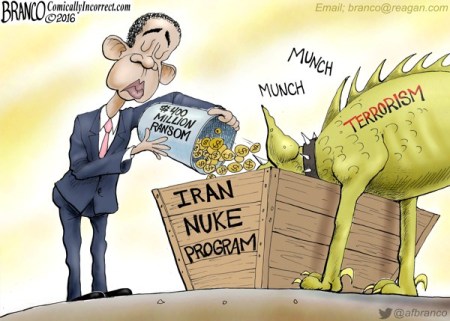
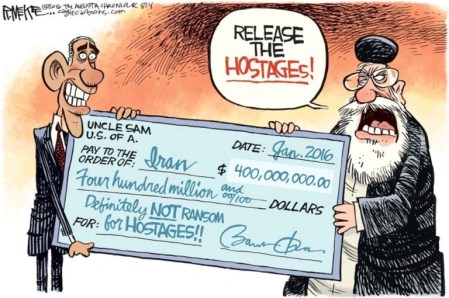
The administration insists that’s not what we should call the planeload of $400 million in cash that arrived in Iran at the same time as four American hostages were released in January.
Thankfully, the facts are in less dispute than the definition of the word.
In negotiations that led to the release of the hostages, the Wall Street Journal reports, “The Iranians were demanding the return of $400 million” sent to the U.S. in 1979, and “they also wanted billions of dollars as interest accrued since then.”
Since it would be a violation of U.S. law to pay the regime in U.S. dollars however, the Journal reports that the Treasury Department asked European central banks to change its payment into Euros and Swiss Francs before loading the notes on a plane and flying them to Iran.
There, one of the hostages involved told Fox News, the Iranian captors told the Americans they were “waiting for another plane” before they would be released.
So to review: the Iranians made a demand for $400 million in exchange for releasing the hostages. The U.S. government went to extraordinary lengths to deliver $400 million to Iran. And as a result, the hostages were released. But this wasn’t a ransom situation?
“No, it was not,” says White House Press Secretary Josh Earnest. “It is against the policy of the United States to pay ransom for hostages.”
“We do not pay ransom,” President Obama echoed. “We didn’t here, and we won’t in the future.”
In his famous essay, “Politics and the English Language,” George Orwell describes words for which “the person who uses them has his own private definition, but allows his hearer to think he means something quite different.” Perhaps President Obama’s own private definition of “ransom” requires the use of a paper bag–or U.S. dollars.
Whatever the President’s beliefs about what he’s done, however, clearly he has sent a signal to Iran that the regime can take hostages and extract concessions. The $400 million in cash will likely endanger more Americans and result in more false imprisonments.
It is worth remembering that prisoners whose stories are known to the public had done absolutely nothing wrong, and should never have been imprisoned to begin with. No payment should have been required to secure their release. And yet the same administration that recently arrested a police officer who tried to send $245 to ISIS has now sent hundreds of millions to the world’s leading state sponsor of terror.
That Iran would take innocent Americans hostage for ransom is a reminder of how untrustworthy and dangerous a regime the Obama administration is dealing with on nuclear weapons. Such actions are one of the reasons there are sanctions on the country in the first place.
Indeed, those restrictions made the $400 million in cash an even sweeter deal than it might seem. It solved a serious problem for the regime.
As a senior U.S. official explained to the Wall Street Journal, “Sometimes the Iranians want cash because it’s so hard for them to access things in the international financial system. They know it can take months just to figure out how to wire money from one place to another.”
In other words, Iran got more than its money’s worth out of the plane full of cash. And what did the regime do with it? As Bloomberg reported, the funds are going straight into their war chest: “Iran’s Guardian Council approved the government’s 2017 budget that instructed Iran’s Central Bank to transfer the $1.7 billion [the ransom plus interest] to the military.”
So the Obama administration hasn’t just struck a deal with Iran that will allow it to obtain nuclear weapons. In paying the ransom money, the U.S. has also funded the military that could seek to use those weapons against us.
Hillary Clinton’s Private Emails About Israel, Breitbart, Shmuley Boteach, August 5, 2016
November will see one of the consequential elections of our lifetime. With Israel and the world enduring another cycle of terrorism, and the Jewish State’s very existence threatened by the catastrophic Iran deal, the American election has a direct bearing on Israel’s future.
I’ve written in the past about the State Department’s email dump of Hillary Clinton’s communications from her private server. The former secretary of state received a veritable trove of advice and information about Israel from her closest advisers. Curiously, it was mostly negative and hostile to Israel. It behooves Hillary to explain the emails and why they are mostly of a negative nature.
Here are some examples.
Martin Indyk was advising Clinton during her time as Secretary of State. In 2007, Indyk’s Brookings Institution, a purportedly objective non-partisan government think tank, opened up a branch in Qatar, a country that is virulently anti-Israel and which currently serves as Hamas’ main financial backer. Seven years later it was revealed that Indyk’s relationship with Qatar had progressed to the point that Qatar had given $14.8 million dollars to Indyk’s institute. This phenomenon of foreign governments purchasing political influence via think tanks in Washington has been well attested to in the past.
Keep in mind that in the background of this concealed, blatant conflict of interest, Indyk was one of the top diplomats assigned to formulating policy and negotiating a two-state solution in Israel. The bombshell revelations of the Qatari donations compromised Indyk immensely and Netanyahu’s government responded by saying that Indyk could not be trusted. Nonetheless, during Clinton’s time as Secretary of State, Indyk had her ear when it came to Israeli-Palestinian negotiations. Indyk’s emails to Clinton show a Qatari-inspired anti-Israel bias. He talks about the need to look, not at Netanyahu’s politics, but his “psychology.” He writes to Clinton’s advisors of Netanyahu: “[A]t heart, he seems to lack a generosity of spirit.”
Indyk attacks Netanyahu over and over as having “inflated demands” and lacking the willingness to risk Israel’s security with a West Bank that would likely become yet another Hamastan. He writes nothing of Palestinian Authority President Mahmoud Abbas’s continual incitement and his calls for the murder of Israelis or the need to outlaw terrorist groups.
Indyk also describes how world opinion can be used against Netanyahu, writing, “If Israel doesn’t make a serious move, it will further delegitimize its standing internationally.” He also describes how the US can use the fear of a potential nuclear Iran to force Israel to sign a deal with the Palestinians, because “Bibi needs President Obama in his corner to deal with the threat from Iran.”
Then there is Jake Sullivan, who currently serves as a top foreign policy advisor for Hillary’s campaign and who was Clinton’s deputy chief of staff while she was Secretary of State. Sullivan has also been revealed to harbor anti-Israel views. In one heavily redacted email to Clinton regarding talks with Netanyahu, Sullivan’s subject line reads “dealing with Netanyahu.” There is often a cavalier attitude in how many of Hillary’s subordinates refer to the Prime Minister of Israel. His name rarely comes with any titles reflecting his status as an elected leader. Rather, he’s usually just “Netanyahu.”
Then there is, of course, Sidney Blumenthal, of whom I have written much in the past, especially about his anti-Semitic son Max, who recently celebrated the death of, and defamed, Elie Wiesel, prompting Hillary Clinton to disavow him, something for which she deserves great credit.
Sidney Blumenthal sent Hillary an anti-Semitic article entitled, “The preemptive strike on Jodi Rudoren” that claims the Jewish lobby “sought to influence media coverage in a variety of sometimes heavy-handed ways” and says “the pressure from these groups is relentless.” This column was retweeted by Max Blumenthal. And Hillary found the article important enough to forward it to Sullivan and her deputy assistant Secretary of State Phillipe Reines. She writes to them, “Had you seen this?” Sullivan responds to the anti-Semitic article, “I hadn’t. Interesting.” Reines, on the other hand, seems to have been so disgusted by this intolerant article that he surprisingly shoots back to Hillary, “My people control the banks too.” It appears Reines was letting Hillary know that this article was deeply biased and on a par with other well known libels against the Jewish people.
Jake Sullivan has also shown himself to be a fan of Peter Beinart, whom I have debated several times and someone who justified terrorist attacks against Israelis and demanded that America punish Israel for electing Netanyahu. Beinart, in one of our debates, compared the world’s foremost Jewish philanthropist and the principal sponsor of Birthright, Sheldon Adelson, to the terrorist leaders of Iran.
Beinart’s writings are blatantly anti-Israel and he has become infamous in the Jewish community for his calls for a complete boycott of Judea and Samaria in the hopes of forcing Israel to withdraw and allow terrorist Hamas to fill the vacuum. The fact that Hamas or Islamic State would inevitably overthrow Abbas’s weak government, as happened in Gaza, does not weigh in Beinart’s demands that Israel be punished if it does not accede to his demands.
Unfortunately, it isn’t just Sullivan. It seems that Hillary Clinton herself is a fan of Peter Beinart.
After Sid Blumenthal sent Hillary an anti-Israel column by Beinart, Hillary forwarded it to Sullivan, writing, “Pls read so we can discuss.” In response, Sullivan writes “Fascinating.”
When Blumenthal sent Hillary an article by his son Max filled with his usual anti-Israel drivel, Clinton forwarded the article to Sullivan with the message, “Interesting reading.”
Sullivan responds, “This is really fascinating. Does Beinart get into all of this?” Hillaryresponds, “Yes.”
Sullivan’s response to another Israel-hating Max Blumenthal article is to call it “fascinating” and try and compare the ideas it contains with the writings of Israel critic Peter Beinart. Of course, it was Bill Clinton himself who wrote a wild endorsement of Beinart’s book The Crisis of Zionism, in which Beinart charges Israel with everything from racism to apartheid-like conditions.
I have every desire to treat Hillary Clinton fairly when it comes to Israel and, as I wrote above, she deserves credit for finally disavowing the demented anti-Semitism of Max Blumenthal, even though he is the son of her foremost advisor.
But it’s important to note that when former senior adviser to President Barack Obama Dennis Ross wrote his tell-all book Doomed to Succeed: The U.S.-Israel Relationship from Truman to Obama, he described a faction within the White House that saw Israel as “more of a problem” than a partner. Since Hillary describes herself as someone who was a great friend to Israel in the Obama administration, it is imperative that she publicly clarify her position on Israel vis-a-vis some of her advisors whose opinions on Israel are deeply hostile.




 anneinpt
 artaxes
 danmillerinpanama
 davidking1530
 Peter Hofman
 Joseph Wouk
 Peter
Peter Louisiana Steve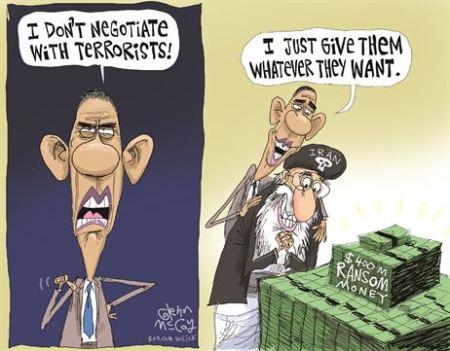




 WarSclerotic
Recent Comments