Archive for August 2016

African Migrants Brawl with Locals on French Island of Corsica

August 22, 2016

African Migrants Brawl with Locals on French Island of Corsica

by Thomas D. Williams, Ph.D.

15 Aug 2016

Source: African Migrants Brawl with Locals on French Island of Corsica

Getty

Tense relations between locals and North African migrants led to a violent skirmish between members of the two groups this weekend on the French island of Corsica, leading to several injuries and torched vehicles.

Authorities had to deploy some 100 police officers and firefighters to the small resort town of Sisco to try to restore order after a conflict grew out of hand, moving quickly from strong words to violence. In the end, the use of tear gas was necessary to stop the riot.

Witnesses claimed that an argument broke out Saturday evening when some tourists took a picture of a group of three families of North African Muslims sitting on a beach, with their women all wearing veils. The North Africans vocally objected to being photographed, and then a group of Corsicans arrived and began quarrelling with the migrants.

As the fight continued, a crowd of dozens of local inhabitants gathered and some started throwing stones and bottles, and three vehicles presumably belonging to the North Africans were set on fire.

In the violence that ensued, two Corsicans were wounded, with one being stabbed in the ribs by a spear, and three Africans were injured as well, including a pregnant woman. The five injured people were taken to the hospital but subsequently released.

The French Interior Ministry confirmed that the incident had taken place, but didn’t specify the nationality of the people attacked, simply calling them “foreigners.”

“Four people injured, including a pregnant woman, were evacuated to the hospital in Bastia,” the ministry said in a statement, adding that “three vehicles were burned, causing severe traffic disruption.”

French Interior Minister Bernard Cazeneuve condemned the violence, saying that he would mobilize all his forces to investigate into the incident, promising to get to the bottom of these “intolerable acts” and punish those responsible.

In a statement, the minister also urged citizens to remain calm so as to “avoid any escalation” of the events, and to assume “a sense of responsibility.”

Morning Joe Panel Rips Clinton’s ‘Unbelievable’ Email Comparisons to Powell

August 22, 2016

Morning Joe Panel Rips Clinton’s ‘Unbelievable’ Email Comparisons to Powell, Washington Free Beacon, , August 22, 2016

Morning Joe’s panel unanimously slammed Hillary Clinton on Monday for repeatedly trying to justify her private email server by comparing it to former Secretary of State Colin Powell’s sporadic use of a private email.

The segment opened on Monday with a compilation of clips of Clinton telling different crowds about the use of private email by different secretaries of state and the use of her own private email server.

“Colin Powell and I are exactly on the same page,” she said.

Morning Joe co-host Joe Scarborough had a simple response to this compilation.

“No,” he said.

The other co-host of Morning Joe, Mika Brzezinski, had the same reaction.

“No,” she said.

Scarborough said that Clinton seems to be using this defense based off of a memo that Powell sent her from a person AOL email account.

To drive the point home, the panel put up a graphic to show the distinct differences between Powell’s email practices at the State Department and Clinton’s, and it read the following:

  • Never used a private server
  • At the time he became secretary in 2001, the State Department didn’t have a comparable unclassified system
  • Used personal emails only for unclassified information
  • Used an office desktop of all classified communications

Scarborough cited that Powell spoke to People about this issue, telling the magazine that Clinton had been trying to pin the personal server scandal on him. He also said that she had been using her server for over a year before Powell sent the memo about his personal email use:

“Her people have been trying to pin it on me,” Powell, 79, told PEOPLE Saturday night at the Apollo in the Hamptons 2016 Night of Legends fête in East Hampton, New York.

“The truth is, she was using [the private email server] for a year before I sent her a memo telling her what I did,” Powell added.

“There is no comparison,” Scarborough said.

Left-leaning columnist Mike Barnicle agreed. He differentiated between the use of private email and having a private email server.

“The biggest distinction, the only distinction, the most important distinction is that … Powell never had his own personal server,” he said. “That is the biggest difference. I mean, if you had sent Colin Powell an email on his personal email account when he was secretary of state, you’d get a personal email back, having nothing to do with classification, nothing. But, there was no personal email server.”

“You look at these different places where he used different types of emails,” Brzezinski said. “It shows that he cared what he was emailing—and this was actually an issue back then.”

Scarborough said that the classification system had changed immensely between the two tenures of the secretaries of state.

“Therein lies the biggest problem,” Scarborough said. “What Hillary Clinton did was force anybody that wanted to communicate with her to not send the classified email, but to take it from the classified email server and then break it down, break that information down, on an unsecured and then send it in. It’s unbelievable.”

Iran unveils its own version of S-300 air defense system

August 22, 2016

Iran unveils its own version of S-300 air defense system, Israel Hayom, August 22, 2016

iran 373Iranian President Hassan Rouhani and Defense Minister Hossein Dehghan with the Bavar 373 | Photo credit: Reuters

According to Iranian media, the system can engage cruise missiles, drones, fighter jets and ballistic missiles. Production began after Russia put a deal to supply Iran with the original S-300 system on hold as part of international pressure geared toward curbing Iran’s nuclear program. The decision to suspend the deal was made after Israel and the U.S. pressured Moscow to enforce nuclear sanctions on Iran.

**************************

Iran revealed Sunday its first long-range, domestically built air defense system, which supposedly has similar characteristics to the Russian made S-300.

The Iranian media aired footage of President Hassan Rouhani and Defense Minister Hossein Dehghan standing near the system, the Bavar (Belief) 373, whose production was commissioned in 2010.

According to Iranian media, the system can engage cruise missiles, drones, fighter jets and ballistic missiles. Production began after Russia put a deal to supply Iran with the original S-300 system on hold as part of international pressure geared toward curbing Iran’s nuclear program. The decision to suspend the deal was made after Israel and the U.S. pressured Moscow to enforce nuclear sanctions on Iran.

In the wake of the landmark July 2015 nuclear agreement between Western powers and Iran, Russia agreed to proceed with the S-300 deal and some of the system’s components have reportedly already been delivered.

“Our goal was not to make an Iranian version of the S-300, but rather a [new] Iranian system, and we built it,” Dehghan told the state-run Islamic Republic News Agency on Saturday. A day earlier, during Friday prayers, he said that “our missile power is at such a level that we are able to destroy all targets at any operational range.”

Iran’s president echoed Dehghan’s comments on Sunday, telling Iranians in a televised speech that “we are able to engage world powers around the negotiating table because of our national strength, because of our national unity.”

Rouhani also unveiled his country’s first Iranian-made turbojet engine on Sunday. Iran claims it can be used for flight at 50,000 feet. “The Islamic republic is one of only eight countries in the world that have mastered the technology to build these engines,” the president said.

Rouhani also announced that Iran’s defense budget was more than double what it was the previous fiscal year.

WATCH: Boy Suicide Bomber Stripped of Explosive Belt in Iraq

August 22, 2016

WATCH: Boy Suicide Bomber Stripped of Explosive Belt in Iraq

by Alexander Jones

22 Aug 2016

Source: WATCH: Boy Suicide Bomber Stripped of Explosive Belt in Iraq

Frightening footage has emerged purporting to show Kurdish security forces removing an explosive belt from an alleged Islamic State teenage suicide bomber moments before it was about to be detonated in the northern Iraqi city of Kirkuk on Sunday.

The chilling scene, caught on camera and uploaded to YouTube by Kurdish channel Kurdistan24, shows the boy’s hands being held by two law enforcement officers as another member of the security establishment attempts to disarm the device.

Wearing a Barcelona football shirt before it was cut off, the boy, believed to be 12 or 13 years old, according to Kurdish media network Rudaw, reportedly then burst into tears as he was led away by police.

The arrest is believed to have taken place in Kirkuk’s Huzairan neighbourhood, Rudaw reports, but precise details on where the boy intended to stage his potential attack are unconfirmed — it has been claimed that the boy was planning to blow himself up outside a Shia mosque, however.

The device was later safely destroyed away from the public.

The incident came less than 24 hours after a child as young as 12 killed at least 51 people and injured 69 — 17 of them seriously, according to Turkish president Recep Tayyip Erdogan — in a suicide bombing at a packed wedding ceremony in the southern Turkish city of Gaziantep.

President Erdogan said on Sunday that “Daesh is the likely perpetrator of the attack”, using the Arabic name for ISIS, adding that it is not yet clear whether the youngster detonated the suicide vest or if the explosives were set off remotely by someone else.

What is clear, however, is that IS is mobilizing children at “an ever-accelerating rate”.

According to a report published earlier this year by the West Point-based Combating Terrorism Centre, IS is “mobilizing children and youth at an increasing and unprecedented rate [and] that the number of child and youth militants far exceeds current estimates.”

Contextualizing the upward trend in the terror group’s use of child suicide bombers, the report concluded: “It seems plausible that, as military pressure against the Islamic State has increased in recent months, such operations […] are becoming more tactically attractive.”

Recording instances of young people who were featured in official IS reports as “martyrs” between January 2015 and January 2016, the report found that of the 89 cases surveyed, 39 percent died upon detonating a vehicle-borne explosive device, 33 percent were killed as foot soldiers in unspecified battlefield operations, six percent died while working as propagandists, and four percent committed suicide in mass casualty attacks against the civilian populace.

Southern Command Warns Sunni Extremists Infiltrating From South

August 22, 2016

Source: Southern Command Warns Sunni Extremists Infiltrating From South

Islamists freely cross U.S. border with help of S. American alien smugglers

A Mexican soldier patrols along the U.S.-Mexico border wall on the outskirts of Nogales, Mexico

A Mexican soldier patrols along the U.S.-Mexico border wall on the outskirts of Nogales, Mexico / AP

BY:
August 22, 2016 5:00 am

Sunni extremists are infiltrating the United States with the help of alien smugglers in South America and are crossing U.S. borders with ease, according to a U.S. South Command intelligence report.

The Command’s J-2 intelligence directorate reported recently in internal channels that “special interest aliens” are working with a known alien smuggling network in Latin America to reach the United States. The smuggling network was not identified.

Army Col. Lisa A. Garcia, a Southcom spokeswoman, did not address the intelligence report directly but said Sunni terrorist infiltration is a security concern.

“Networks that specialize in smuggling individuals from regions of terrorist concern, mainly from the Afghanistan-Pakistan region, the Middle East, and East Africa, are indeed a concern for Southcom and other interagency security partners who support our country’s national security,” Garcia told the Washington Free Beacon.

“There are major hubs that serve as entry points into the region for migrants from those areas of concern attempting to enter the U.S. along our border with Mexico,” she said.

The infiltrators from terrorist states and unstable regions exploit vulnerabilities in commercial transportation systems and immigration enforcement agencies in some of the countries used for transit, Garcia said.

“In 2015, we saw a total of 331,000 migrants enter the southwestern border between the U.S. and Mexico, of that we estimate more than 30,000 of those were from countries of terrorist concern,” she said.

Another problem in dealing with migrants from the Middle East, North Africa, and South Asia is a lack of information among the governments of the countries used by potential terrorists for transit.

The exploitation of alien smuggling networks by terrorists until recently had been dismissed by both American security officials and private security experts as largely an urban myth.

However, the Southcom intelligence report revealed that the threat of Islamist terror infiltration is no longer theoretical. “This makes the case for Trump’s wall,” said one American security official of the Southcom report. “These guys are doing whatever they want to get in the country.”

Adm. Kurt Tidd, Southcom’s commander, said last week that the lack of information is hampering security efforts against alien smuggling.

“An element that has been long recognized is that our ability to track people moving through transportation systems is an area that we must continue to devote efforts on, and the ease with which human traffickers are able to use our transportation systems to move people through the networks relatively undetected should give us all concern,” Tidd said.

Special interest aliens are described by the U.S. government as aliens who pose a potential terrorism threat coming from 34 nations in the Middle East, Africa, Southwest Asia, Central Asia, and East Asia. The list of states of concern includes Afghanistan, Iran, Kuwait, Iraq, Lebanon, Syria, Eritrea, Libya, Saudi Arabia, Pakistan, Indonesia, and Malaysia.

Republican presidential nominee Donald Trump last week called for stepped up counterterrorism measures that he said would involve “extreme vetting” of immigrants in a bid to better screen out potential terrorists.

Trump also has made a campaign theme the construction of a wall across the United States’ southern border as part of efforts to better control the flood of illegal immigrants.

Joel Vargas, head of Contingent Security Services and a consultant to law enforcement agencies, said there is no evidence Sunni extremists are creating new relationships with alien smugglers. However, he said in an email that “existing smuggling networks from Central America are increasing their access.”

“We have intercepted immigrants coming from Asia but we have been unable to determine if they are extremists,” Vargas said. “Our Sunni illegal migration coming from [Latin America] is very small. On the other hand, they can use the networks set up by the Shia.”

A report produced by Vargas for the International Airport, Seaport and Transport Police states that the Iran-backed Shiite terror group Hezbollah mainly has ties to Latin American through overseas Lebanese expatriates.

Hezbollah recently increased support in transnational crime in the region by supply arms and training to various groups.

“Hezbollah’s current goals appear to be focused on accruing resources rather than conducting offensive operations, however the group’s growing capabilities are still a clear threat to regional U.S. interests,” the report said. “Iran’s involvement in Latin America is also increasing, and Hezbollah will likely be able to use these budding political and economic ties as cover for its operations.”

Vargas said Hezbollah’s networks in Latin America could be used by Sunni extremists to get to the United States. “That is a workable situation,” he said. “If they disclose they are ISIL or any other group, I doubt that even the Shias will help out. Even [drug] cartels are killing anyone who appears extremist. It is bad for their business.”

According to Vargas, Guatemala remains a weak link for regional security services. A sophisticated alien smuggling operation that is capable of moving foreign nationals into the United States from Africa and other states has been centered in that Central American state for at least the past six years.

The Washington Times reported in June that an international alien smuggling network centered in Brazil helped sneak illegal immigrants from Middle Eastern states to the United States, including an Afghan linked to a terror plot in North America.

At least a dozen Middle Easterners reached the Western Hemisphere through this alien smuggling ring that facilitated travel to Mexico, the Times reported, quoting internal government documents.

The aliens involved Palestinians, Pakistanis, and the Afghan man with ties to the Taliban.

Some of the aliens were stopped before entering the United States but others succeeded in crossing the U.S. border.

One transit route used in the past by alien smugglers was identified in a recent Justice Department alien smuggling case that traced illegal immigrants from Europe, the Middle East, and Africa to Honduras, then to Guatemala and finally to Mexico and into the United States.

The cost of getting into the United States can reach $400 or more per person, and the illegal immigrants are provided with transportation, covert smuggling contacts along routes into the country, as well as instructions on how to illegally cross the U.S. border. The instructions in the past have included armed guides who ferry illegal aliens across U.S.-Mexico border rivers on inner tubes.

Director of National Intelligence James Clapper testified during a Senate hearing in February that Islamic State terrorists would try to infiltrate the United State posing as immigrants.

“That’s one technique they’ve used is taking advantage of the torrent of migrants to insert operatives into that flow,” Clapper said. “As well, they also have available to them—and are pretty skilled at phony passports so they can travel ostensibly as legitimate travelers as well.”

The Sderot rocket – tied to covert Israel-ISIS war

August 22, 2016

Debka: The Sderot rocket – tied to covert Israel-ISIS war

Israel’s official spokesmen have long taken the line that the country should prepare itself for war with the Islamic State as a hypothetical threat still in the future. But that is not the case – either in the near neighborhood, especially in terrorist-ridden Egyptian Sinai, or elsewhere, even thousands of miles from Israel’s borders.
Prime Minister Binyamin Netanyahu made a suggestive remark Wednesday Aug. 17 during a visit to the Israeli Air Force Base at Tel Nof east of Tel Aviv, in the company of Defense Minister Avidor Lieberman, Dep. Chief of Staff, Maj. Gen. Yair Golan, and the Air Force chief Maj. Gen. Amir Eshel.
No obvious pressing reason was offered for the turnout of the entire national security elite at this air base at this time. debkafile’s military and intelligence sources are unfortunately constrained from elaborating on this. But one of Netanyahu’s comments offered a clue. He said that the Israeli Air Force had no rival anywhere and that, “It can go anywhere, at any time and perform any mission. That is true as we speak.”
This was a strong hint that the IAF was at that moment operating far from its Tel Nof Base and outside Israel’s borders, apparently on a broad mission involving several aircraft.
It may also be inferred, therefore, that the rocket from the Gaza Strip that, on Sunday, Aug. 21, exploded between two buildings in the southern Israeli town of Sderot – causing some damage but no casualties – was the first rejoinder to the mission that was the subject of the prime minister’s oblique reference.
And in fact, Ansar Bayt al-Maqdis – the Sinai Islamist terrorist group that merged into the Islamic State – took responsibility shortly after.
debkafile’s military sources report that the ISIS Sinai branch chose the afternoon to shoot its rocket as a demonstration of its ability tot strike at the heart of Israeli towns at any time of day when there were people on the streets. It was Sderot’s first direct rocket attack in two years.
Within minutes, the Israeli air force and tanks targeted Palestinian Hamas terrorist infrastructure in the northern and Gaza area of Bet Hanoun, following up with a second air strike supported by artillery fire.
All this was an excellent display of Israel’s rapid reactive capability, but it had little relevance to the action afoot in both the Gaza Strip and the adjacent Sinai Peninsula.
That the two air reprisals were boosted unusually by tanks and artillery may be explained by internal Israeli politics: Lieberman, facing his first challenge as defense minister, needed to make good on his known hawkish attitudes as an opposition figure.
However, say our military experts, mechanical strikes against Hamas in reprisal for ISIS-linked attacks have long been bankrupt as an effective tactic. Even though Hamas works hand in glove with the Islamic State in Sinai, Egypt and Libya, the Palestinian group has no role in ISIS decisions to attack Israel or any influence over its considerations. The global Islamists may therefore be expected to follow up on their rocket attack on Sderot undeterred by the IDF response.


Proxy Wars Between Turks and Kurds in Vienna

August 21, 2016

Proxy Wars Between Turks and Kurds in Vienna, Gates of Vienna, , August 21, 2016

(Rather than just provide links to the videos, as the article does, I have taken the liberty of embedding them. — DM)

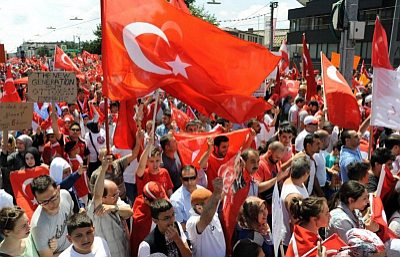
turkdemovienna

One might easily mistake the above photo for a scene from Istanbul or Ankara. But it was taken at a pro-Turkish demonstration in Vienna in 2013.

Turks stage these demos every week now in downtown Vienna, providing an occasion for near-warfare between Turkish-Austrians and Kurdish-Austrians. Last weekend the situation deteriorated even further than usual.

Many thanks to Nash Montana for translating this article from Politically Incorrect:

Turks in Vienna — Allahu Akhbar — “Like in a war”

More and more often there are conflicts that resemble civil war between leftist Kurdish PKK supporters and Turkish fascists, the Grey Wolves, on Austrian as well as on German ground. For quite a while now Kurds have been demonstrating every Saturday on the Stephansplatz to raise awareness of Turkish politics. But as soon as the demonstration begins, the Vienna city center becomes a danger zone. Tourists, residents, and business people are running the gauntlet. The people are in fear. Last weekend the situation escalated. Sonja, Prousek, the owner of the bakery Aida situated next to the Cathedral, was horrified: “It was like in the war.” The Stephansplatz became a bubbling cauldron. Hundreds of people fled in panic into surrounding areas, sought protection in hotels, stores and bars.

The Café Aida saw the most damage. Sonja Prousek told Zeitung Österreich: “Old people cried, children lost their parents. Dishes, drinks and food landed on the floor. We had to close up because customers and employees fled all the way to the other franchise down on Bognergasse.”

The Vienna police were present in full gear for security, but admit that these demonstrations, attended by 300 to 400 people, are increasingly becoming a serious problem. But also that there is the freedom to demonstrate.

Already on Friday evening 15 Kurds tried to invade the ORF-center at Vienna’s Küniglberg to force the channel to broadcast a message about Abdullah Öcalan, the PKK leader who is imprisoned in Turkey. Some of them made it all the way to the reception area. But that’s where the terror ended. The SEK WEGA (Special commando department Vienna) and trained dogs ended the chaos and escorted the Turkish mob out the exit. Once again, no one was arrested. There was merely one report for “disturbance of peace”.

In the upper Austrian Weis two young PKK supporters threw Molotov cocktails at a Turkish community center.

By now proxy wars on European ground, not just among these groups, are in full bloom thanks to unconscionable and brainless immigration politics. The escalation was programmed. The colorful future will become a nightmare.

Socialist Dictator of Starving Country Vows to Repress Opposition Even Harder

August 21, 2016

Socialist Dictator of Starving Country Vows to Repress Opposition Even Harder, Front Page Magazine, Daniel Greenfield, August 21, 2016

(I have fond memories of Venezuela from the late 1990’s, when my wife and I visited on our sailboat. That was about when Chavez came to power.  He moved slowly, at first, to foul up everything. Crime was not then a big problem, even in Caracas. Food and medicine were plentiful and it was rare to see someone who seemed unhappy. The then new subway system was excellent, as was bus transportation. Distant from Caracas, the city of Merida had an excellent university; we attended a concert there (it cost about 25 cents each) to listen to a conductor from Julliard conduct a German orchestra. What’s going in Venezuela now makes me very sad. If you would like to learn what’s happening there now, the best site, Venezuela News and Views, is run by a French chap named Daniel who still lives there. The situation keeps getting worse and worse. — DM)

mussolini_1

“If the opposition crosses the line, they will find out that Erdogan is a nursing infant next to me and I don’t give a damn about what the OAS says,” Maduro said during a live televised speech.

**********************

Venezuela, a country with oil wealth and a Socialist dictator, has food riots. The left lost the last election. But it just rigged the court system and is now operating as a brutal dictatorship with big plans.

In a replay of one of the ugliest chapters in the two-decade rule of the socialist party in Venezuela, a top government official said Thursday that a list of those who signed a petition seeking to recall President Nicolas Maduro will be handed over to government ministries and state-run companies.

“In a revolution, revolutionaries must be in charge of state institutions, not political opponents,” Diosdado Cabello, a top official in the ruling Socialist Party and a lawmaker, said at a rally. “This is not a violation of the right to work.”

Funny how “revolutionaries” became the repressive government busy putting down a revolution.

Cabello has made similar threats earlier this year, but Thursday’s comments brought back memories of the so-called Tascon List which was used by the government under then President Hugo Chavez to fire state workers and bar others from everything from jobs to loans for having signed a petition for a recall referendum in 2004 that Chavez eventually survived. The list was compiled by then lawmaker Luis Tascon and electronic versions of the list circulated throughout Venezuela even being sold by sidewalk vendors. Some Venezuelans even attempted to pay officials to be removed from the list.

A former army captain, Cabello aided Chavez launch a failed coup in 1992 that would eventually help propel the late socialist leader to the presidency.

And Maduro is promising purges and more purges.

Embattled Venezuelan President Nicolas Maduro warned the opposition asking for his recall that he is “prepared” to outperform Turkey’s Recep Erdogan when it comes to violent repression.

“If the opposition crosses the line, they will find out that Erdogan is a nursing infant next to me and I don’t give a damn about what the OAS says,” Maduro said during a live televised speech.

Also on Thursday, two journalists were detained and released after five hours for taking pictures of what authorities are now calling “the Presidential Corridor”: A portion of Caracas’ Sucre avenue that leads to the Miraflores Presidential Palace.

The opposition has called for a nationwide march on September 1st, asking that the recall against Maduro moves forward more rapidly, setting the stage for an almost certain confrontation between the anti-Maduro forces and the “colectivos”, a paramilitary faction of chavismo that uses handguns and motorcycles to enforce chavista rule in Venezuela.

Maduro riffed on the Erdogan theme for several minutes: “Let’s hope the right wing does not make that mistake, Erdogan is just wearing diapers, where I am already prepared,” he said.

Maduro might want to learn from Mussolini instead.

Understanding the Dispute Over Peshmerga Command

August 21, 2016

Understanding the Dispute Over Peshmerga Command, Kurdistan News, Laurie Mylroie, August 20, 2016

The battle to liberate Mosul, as well as the ongoing “shaping operations,” in which Peshmerga are prominently involved, is not the responsibility of the State Department. It is the job of the Defense Department—one reason to question the authoritativeness of State Department statements on this matter.

Moreover, there is a crucial difference between how the State and Defense Departments interpret White House guidance on Iraq.

******************

A dispute has erupted between Washington and Erbil over command and control of Peshmerga forces. Most probably, the argument reflects a State Department misunderstanding.

On Wednesday, the State Department’s Deputy Spokesperson was questioned about the recent remarks of Iraqi Prime Minister Haider al-Abadi, in which he said, “The Peshmerga should stay where they are now, and they should not expand their presence even if they help the Iraqi Army.”

When asked to comment on that statement, the Spokesperson replied, “The Peshmerga and all the various fighting groups in Iraq need to be under the command and control of the Iraqi Government and the Iraqi military.”

In turn, the Ministry of Peshmerga Affairs of the Kurdistan Regional Government (KRG) responded, “The Peshmerga are not under the command or control of the Iraqi government. According to the Iraqi constitution, the Peshmerga are part of Iraq’s defense system, but the Iraqi government has not supplied the Peshmerga with weapons or military training, and they have not assumed any responsibility toward the Peshmerga.”

The battle to liberate Mosul, as well as the ongoing “shaping operations,” in which Peshmerga are prominently involved, is not the responsibility of the State Department. It is the job of the Defense Department—one reason to question the authoritativeness of State Department statements on this matter.

Moreover, there is a crucial difference between how the State and Defense Departments interpret White House guidance on Iraq.

According to that guidance, Baghdad is in the lead, and the US (and others) follow its direction. The White House believes this is the best way to ensure Baghdad’s continuing cooperation in the fight against IS.

But the interpretation of that guidance varies. The State Department tends to adhere to it strictly; the Defense Department applies it more loosely.

For example, the Defense Department decided to support the Peshmerga directly, rather than channel aid through Baghdad. In July, it signed a Memorandum of Understanding with Erbil. The Pentagon secured Baghdad’s approval by telling the Iraqis what it intended to do and then asking them if they had any objection.

The State Department, however, tends to leave such decisions to the Iraqi government, as it did regarding the anti-ISIL Coalition meetings in Washington last month. KRG representation was minimal because Iraq’s Foreign Minister decided, as he liked.

The State Department’s restrictive interpretation of this guidance led them to make a major misstatement before. That came in response to a query of mine, following the recent International Pledging Conference that raised $2.1 billion in humanitarian aid for Iraq.

What mechanisms existed to ensure that the Kurdistan Region—which hosts 2/3 of the refugees and Internally Displaced Persons in Iraq—received its fair share, given Baghdad’s notorious corruption?, I asked a State Department Spokesperson.

She did not address the issue of Baghdad’s corruption but clearly affirmed, “Funding and support will go through Baghdad.”

That statement also prompted protest from Erbil. But it turned out to be wrong. The State Department soon clarified that the international aid would go through the UN, not Baghdad.

The State Department’s answer to any question that raises criticism of the Iraqi government, as I have learned, is likely to begin with an affirmation of US backing for Baghdad, and the rest of the answer will probably not address the criticism.

When the question involves a dispute between Baghdad versus Erbil, almost certainly, the answer will favor Baghdad. So I have learned not to ask such questions, unless Baghdad’s actions are so clearly wrong that the question itself will highlight the folly of the answer—and the policy behind it.

The spokespersons are the messengers, not the decision-makers, I regularly remind myself. Their deference to Baghdad’s decision-making may prove a grave error, as it does not seem to acknowledge the sectarian nature of the Iraqi government and the influence Tehran exerts over it. But they are not responsible for that policy.

And their jobs are not easy. For an hour each day, they stand before a camera, answering questions, which can be quite hostile, about a wide range of topics. Such questions may come from ambitious journalists who seem to think that their incessant, repetitive questioning may trap the spokespersons into revealing the kernel of some big scoop. Or they may come from the representatives of hostile states, who seem to think that through their barrage of queries, they can embarrass the US.

This situation happens in real time, on an indelible record, to be posted for the whole world to view. The spokespersons bear the hour with unflagging courtesy, and sometimes even good humor, all the while aware that certain slip-ups can create an international incident.

My guess is that is what happened with the misguided statement about command and control of the Peshmerga.


Calling for Another Nice-Style Attack, ISIS Suggests Jihadists Try Baseball Bat, Power Screwdriver

August 21, 2016

Calling for Another Nice-Style Attack, ISIS Suggests Jihadists Try Baseball Bat, Power Screwdriver, PJ MediaBridget Johnson, August 21, 2016

(Islamist terror tactics evolve while “our” submissive anti-Islamophobia strategy plods along. — DM)

truck jihadA policeman looks at the truck used for an attack on Bastille Day crowds in Nice on July 15, 2016. (AP Photo/Luca Bruno)

A new video out of ISIS’ Al-Khayr province in Syria suggests jihadists emulate the on-hand weaponry of the Nice attack with at-home items such as a power screwdriver, baseball bat or hypodermic needle.

The death toll in the July 14 attack on the French coastal city, in which a Tunisian living in Nice drove a cargo truck into a Bastille Day crowd, rose to 86 a few days ago as another man died of his injuries. Eighty-three were killed at the scene.

French authorities initially declared that the truck driver, Mohamed Lahouaiej-Bouhlel, had no known links to terrorism. The attacker’s uncle said Lahouaiej-Bouhlel, claimed by ISIS as one of their own, was recruited by an Algerian shortly before the attack even though he “didn’t pray, didn’t go to the mosque and ate pork.”

His choice of a truck as a weapon has been fueling the ISIS call for lone jihadists to use whatever weapons are convenient and less likely to arouse suspicion.

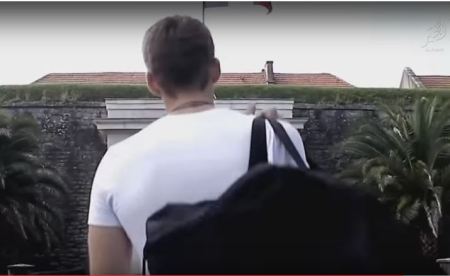
As far as targets, the new video focuses largely on France and the United States. After giving weapons suggestions, the video shows a white man in a white T-shirt and jeans carrying a black bag and approaching a gate with a French flag flying overhead.

white guy(ISIS video screenshot)

The video begins, though, with footage of Israel Defense Force soldiers clashing with Palestinians. It soon shows Catholics celebrating Mass and talks about kuffar (disbelievers) paying jizya tax to the Islamic State.

Among the multiple terror montages in the nearly 20-minute video are scenes from the World Trade Center on 9/11, specifically those trapped by the fire trying to summon help from windows or jumping.

They highlighted Hamas’ statement after the Nice attack, in which the Gaza terror group condemned the France attack “out of principle and moral and humanitarian rejection of all forms of extremism and terrorism.”

That July 15 Hamas statement added: “The movement emphasizes in this context that the Palestinian people are more than stung by the fire of Israeli terrorism, which our people are still suffering from for decades.” ISIS hopes to poach recruits from Hamas fighters in Gaza as they push toward Israel.

The ISIS video shows American polling places, including at the former Berryville Primary School in Arkansas, but does not show either candidate, just President Obama and his European counterparts. They also use footage of U.S. service members and drone operation, and a short clip that appears to be either news footage or a city video showing police officers receiving a briefing. The officers shown are from Medford, Ore. Another Medford officer lingers near the trunk of a patrol car.

isis screen(ISIS video screenshot)

The images of the West are broken up by people describing coalition strikes that hit their homes and photos of children allegedly killed in coalition airstrikes, telling jihadists that they have to get revenge.

After showing images of the Eiffel Tower, the Leaning Tower of Pisa in Rome, and the Statue of Liberty, the video encourages jihadists to diversify in their choice of weapons like the truck driver in Nice. They briefly show a do-it-yourself gun pattern, followed by a multi-bit ratcheting power screwdriver, a Louisville Slugger bat, a stock photo of a hand holding a test tube with an orange liquid, and a another stock photo of a hand holding a hypodermic needle with clear fluid inside.

Other suggestions include homemade explosives, a rock and a knife.

The video wraps up with footage of the Orlando shooting and praise of Mohamed Belkaid, an Algerian candy maker living in Belgium who was connected to the November Paris attacks and was killed by Belgian police in March, and Najim Laachraoui, one of the suicide bombers at the Brussels airport in March.