A Ramadan Piece: The “Other” Islam, Gatestone Institute, Salim Mansur, July 5, 2016
(A fascinating history of the battle between political Islam and non-political Islam. The battle continues. — DM)
♦ Abrahamic monotheism as represented in Judaism, Christianity, and Islam, precedes and stands apart from politics as an ethical vision that transcends history. It was a vision which invited people to embrace their common humanity as created and gifted by one omnipotent deity, and to follow a revealed code of ethics for righteous living, holding the promise of peace with an end to interminable conflicts that divided people into warring tribes.
♦ Thoughtful Muslims, for nearly a century before the demise of the Ottoman Empire and the abolition of the Caliphate, had been writing about the need for an Islamic reform. Europe’s cultural advancement following the Reformation and Enlightenment held up a mirror for the Islamic world to follow in similar direction to similar ends. There was a consensus among Muslims that Islam was not intrinsically opposed to the modern world, and a readiness to follow in the footsteps of the West.
♦ This is the “other” Islam. This is submission to truth, whose most righteous exemplar was Abraham when his faith was tested by his Deity, according to the Hebrew Bible, to sacrifice his son. And this is the faith of Sufis who took Muhammad’s message to people in places far removed from the desert confines of Arabia. It is simply, as the Qur’an reminds (30:30), deen al-fitrah, the natural religion, or inclination, of man to know his Creator. There is no return of this “other” Islam; it never went missing.
The cover of the January 1976 issue of Commentary magazine announced its main story, “The Return of Islam,” by Bernard Lewis. The year of publication coincided with the coming end of the fourteenth century of Islam, and the anticipation of a new Islamic century beginning in 1979. Forty years later this essay by Lewis, widely recognized and respected as the most eminent scholar on the Middle East and Islam alive today, came to be celebrated as the first warning of the coming upheaval inside the world of Islam.
Lewis’s essay was a corrective to viewing the Middle East and its people, Arabs and Muslims, in terms of Western values. “Modern Western man,” wrote Lewis, “being unable for the most part to assign a dominant and central place to religion in his own affairs, found himself unable to conceive that any other peoples in any other place could have done so… [or to] admit that an entire civilization can have religion as its primary loyalty.” This meant, Lewis continued, the “inability, political, journalistic, and scholarly alike, to recognize the importance of the factor of religion in the current affairs of the Muslim world”.
Recent events have proven that Lewis was correct in pointing to this critical flaw in much of Western understanding of Islam and Muslims. But the title of the essay was unfortunate and misleading; there was no “return of Islam” for Muslims, since at no point in Islamic or Muslim history had Islam been missing, or dormant.
Instead of the “return of Islam,” it was the return of political Islam, or Islamism. Lewis’s essay was a timely review of Muslim history in terms of political Islam. But political Islam is but one facet of Islam. It is a recurring mistake to see political Islam as the defining feature of Islam that obscures Islam’s spiritual dimension, which is more vital than the coarse authoritarian features of political Islam.
In antiquity, politics was inseparable from religion. It might be said that politics was the handmaiden of religion. A ruler among people in ancient times was a chief priest, or a demigod. This feature of the ancient world in which religion and politics were bound together could be described as “theopolitics”, and Islam was as much influenced in its history by theopolitics as were Judaism and Christianity.
Lewis wrote:
“The three major Middle Eastern religions are significantly different in their relations with the state and their attitudes to political power. Judaism was associated with the state and was disentangled from it; its new encounter with the state at the present time raises problems which are still unresolved. Christianity, during the first formative centuries of its existence, was separate from and indeed antagonistic to the state with which it only later became involved. Islam from the lifetime of its founder was the state, and the identity of religion and government is indelibly stamped on the memories and awareness of the faithful from their own sacred writings, history, and experience.”
A lot of history is compressed in this passage, and so some misreading of that history is inevitable. Lewis went on to discuss Islam as being entwined with political Islam since its inception. “Islam was associated with power from the very beginning,” wrote Lewis, “from the first formative years of the Prophet and his immediate successors.” Consequently, in Islam “religion is not, as it is in Christendom, one sector or segment of life, regulating some matters while others are excluded; it is concerned with the whole of life—not a limited but a total jurisdiction.”
The problem with Lewis’s view of Islam is that he uncritically accepted the theology of political Islam. This theology was constructed during the three centuries after the Prophet Muhammad when, in the course of events between the seventh and the tenth century of the Common Era, Arabs came to rule a vast empire. It was consistent with the temper of late antiquity, and it put a stamp on Islam ever since that most Muslims have accepted without questioning.
Abrahamic monotheism as represented in Judaism, Christianity, and Islam, however, precedes and stands apart from politics as an ethical vision that transcends history. It was a vision which invited people to embrace their common humanity as created and gifted by one omnipotent deity, and to follow a revealed code of ethics for righteous living, holding the promise of peace with an end to interminable conflicts that divided people into warring tribes.
It was the resistance of pagans and polytheists to Judaism, Christianity, and Islam at their origins that compelled their early followers in the course of their respective histories to seek in politics protection for their religious beliefs. In Judaism and Islam, the founders — Moses and Muhammad — combined in their personalities the roles of prophet, warrior, and statesman. The life of Jesus, in this respect, was different.
In Moses’s case, he never entered the promised land, and it was left to his successors to eventually found a state for the Jews. In the instance of Muhammad, there is the question that has divided Muslims ever since his death: was his prophetic mission primarily to establish an Islamic state that would define, for Muslims for all times, Islam as the ideal arrangement in which religion and politics were one and indivisible?
The answer to this question was surrounded in controversy right from the moment of the Prophet’s last illness before his death. The controversy over his succession, and what such succession meant, tore apart the immediate followers of the Prophet, and incited tribal warfare, fratricide and schisms that since then have provided the backdrop to Muslims in respect to their own understanding and practice of Islam as religion and politics.
Islam as the Abrahamic vision of man’s relation with God was supplanted by the theology of political Islam. The process began in the midst of the Prophet’s last illness and accelerated with his death. The majority Sunni sect in Islam coalesced around the view that the immediate successors of the Prophet, elected or chosen, ought to be the closest companions of Muhammad, and their rulings in the formative stage of Muslim history became the standard by which subsequent generations of Muslims innovated the requirements of ruling an empire.
Those Muslims who dissented from the majority view represented by Sunni Islam were the Shi’a, or the party of Ali. Ali was a cousin of the Prophet, raised from his childhood in the Prophet’s household and, hence, the closest companion of Muhammad. Ali was also the Prophet’s son-in-law by marriage to Fatima, his only surviving child. The Shi’a Muslims believed Ali was the designated successor of the Prophet because of their familial ties, but he was forcefully denied the succession by those who usurped it immediately following the Prophet’s demise. Shi’a Islam evolved as the main minority sect with its own theopolitics within Islam.
The first Muslims were Arabs of the desert, the Bedouins, among whom Muhammad was born. Their tribalism persisted despite the Prophet’s warnings and it shaped Islam from the first hour of the post-Prophetic history. Sectarianism within Islam was the unavoidable outcome of clan and tribal conflicts among the first Muslims, and the Sunni-Shi’a divide became the main cleavage as a result, setting the template of further divisions as sects proliferated over time in the history of Islam.
Less than a century after the Prophet’s death in 632 C.E., his followers, the Bedouin Arabs, became the rulers of an empire that stretched from the Iberian Peninsula in the West to the Indus River in the East. There was nothing in the Qur’an, or in the traditions of the Prophet, to instruct these Arabs on the mechanics of administrating an empire. They took to imitating the rulers of Persia, whom they defeated, and adopted the administrative manuals of both Byzantine and Persian officialdom to rule the lands and peoples they conquered. And in order to provide legitimacy in the name of Islam to Arab rule in Damascus and later in Baghdad, the ulema(religious scholars) worked out the details of law and society, the Sharia, derived from the Qur’an and the Prophetic traditions.
The origin of Islamic culture and civilization lies in the empire that Bedouin Arabs, through the force of arms, established in a very short period. This was also the origin of political Islam, which came to represent the dominant face of Islam as theopolitics.
The fight that erupted, with the news of the Prophet’s demise, among his closest companions over succession related to temporal power that the Prophet had exercised, and not his role as a Messenger of God (Rasul Allah). This fight culminated in 680 C.E. with the defeat of the Prophet’s grandson, Husayn, killed and decapitated in the field of Kerbala, close to the banks of the Euphrates in Iraq, by the army sent out by Yazid I, the Ummayad Caliph of the rapidly expanding Islamic empire.
The event in Kerbala was a watershed in the history of Islam. Ethnic Arabs, recently converted to Islam, delivered Husayn’s cruel end. Ever since, this crime, as sordid as the crucifixion of Jesus, has stained Muslim history with the mark of Cain.
After Kerbala, it could no longer be said that Islam, as Abrahamic monotheism, guided politics ethically along the path of justice and mercy. Instead, the politics that surfaced upon the death of the Prophet hardened after the killing of Husayn, and politics henceforth came to define Islam as faith, culture, and society.
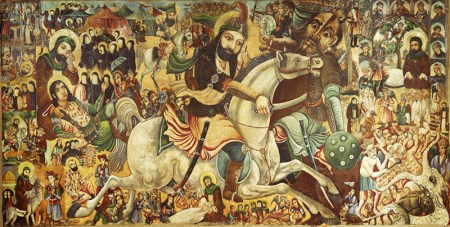 In the Battle of Kerbala, depicted in Abbas Al-Musavi’s painting, Husayn, the son of Ali and grandson of Muhammad, was killed along with his family and all his followers by the armies of the Umayyad Caliphate. It was the most crucial moment in the split between Shi’a and Sunni Islam. (Image source: Brooklyn Museum)
The Ummayads in Damascus, the imperial capital, were the first dynastic rulers among Arabs in Islamic history. The founder of the dynasty, Muawiyyah, seized power following the murder of Ali, the fourth Caliph and the cousin and son-in-law of the Prophet. With the Ummayads the institution of the Caliphate, which was an innovation to fill the void of leadership among the Arabs in Medina following Muhammad’s death, adopted the pomp and pageantry of the Persian and Byzantine rulers. The Caliphate, from that first century of Islamic history until its abolition in 1924 by Mustafa Kemal Ataturk, the founder of modern Turkey, was the embodiment of Oriental Despotism.
Those Muslims who witnessed the tribal conflicts erupt after the Prophet’s demise and recoiled in revulsion from politics turned inward in seeking union with the divine mystery, as mentioned in the Qur’an. They sought solace in the spiritual dimension of Islam and emulated the Prophetic tradition of withdrawal from the world through prayer and meditation. They became the founders of the Sufi, or mystical, tradition in Islam. This was the “other” face of Islam, distinct from political Islam.
The physical expansion of the Islamic empire was carried forth by the armies of the Caliphs. But the spread of Islam as a faith tradition was a slow process, carried forth by Sufi missionaries belonging to various fraternal orders and independent of political rulers of the world of Islam.
There is a world of difference in conversion brought about at the point of sword of conquering armies, and conversion that results from the communion of hearts and minds among people. The latter is more genuine and transformative than the former in every religion. The Qur’an itself — verse 49:13 — warned the Prophet that the acceptance of Islam by the Arabs of the desert was one of submission in the face of defeat, and that belief had not entered their hearts. This verse might be read as forewarning of crimes Muslims would commit through history in the cause of political Islam, beginning with the killing of Husayn in Kerbala.
Political Islam from its outset was an inquisition. It began with Abu Bakr, the first Caliph, when he subverted the Islamic principle stated in the Qur’an — “there is no compulsion in religion” (2:256) — and declared war on those Arab tribes who withheld their loyalty from him following the death of the Prophet. The “Ridda Wars,” or the “Wars of Apostasy,” launched by Abu Bakr inaugurated political Islam, and since then, the precedent he set for Muslim-on-Muslim violence has plagued Islamic history into our times.
The role of the a’lem (pl. ulema; religious scholars) was instrumental in the making of political Islam. The ulema provided legitimacy to the Ummayad Caliphs in Damascus in the period of intra-tribal conflicts that had led to the killings of the three Caliphs (Umar, Uthman, and Ali) after Abu Bakr and then the massacre in the field of Kerbala.
The consensus of the ulema — accepted by those who eventually came to represent the majority Sunni Muslims (the word “Sunni” derived from Sunna, meaning following the path or tradition of the Prophet) — was that political and social order however provided and maintained was preferable to fitnah (disorder). This consensus provided doctrinal legitimacy to the Caliphs. In return, the Caliphs recognized the special function of the religious scholars and jurists in the drafting, codification, and implementation of Sharia, or Islamic laws.
As a result of this bargain between men wielding swords and men wielding pens, the foundational arrangement of political Islam was firmly established. It was an arrangement consistent with the thinking prevalent in antiquity that religion (deen in Arabic) prescribed the totality of human affairs. This meant, as it was understood by the ulema in the formative period of Islamic history, that the primary function of state and government (dawlat in Arabic) was the establishment of the rule of Sharia. As Ann K.S. Lambton in her study, State and Government in Medieval Islam(1981), observed:
“The law precedes the state and is immutable at all times and under all conditions. The state is there to carry out the law. To disobey a law or to neglect a law is not simply to infringe a rule of the social order: it is an act of religious disobedience, a sin, and as such involves a religious penalty.”
Once the bricks and mortar of political Islam were set in the making of the Islamic civilization, Islam as the official doctrine of the state and empire clearly demarcated the norm as prescribed in the Sharia and made the ulema its official guardians. The Islamic state was a nearly perfect embodiment of a closed totalitarian system designed by men towards the end of the first millennium of the Common Era, and any suggestion of change or adoption of new idea in matters of either religion or politics was condemned as bid’ah (heresy deserving punishment).
But Muslim dissidents who viewed the doctrine of political Islam, or what might also be referred to as “official” Islam, as an aberration, went underground and kept the “other” Islam free from the shackles of politics. Beneath the hardened features of political Islam, the “other” Islam of Sufis provided solace to Muslims by tending to their humanity in the light of God’s most favoured attributes of mercy and compassion.
The “other” Islam, unlike political Islam, is not bound by time and space. It is directed to man’s inner yearnings for that which is eternal. It plunges in search of the inner meaning of the Qur’an as the Word of God, and the assuredness that God’s mercy is not denied to any of His creations. The Qur’an states, “We are nearer to man than his jugular vein” (50:16), reassuring man that he is not alone and God is not some distant uncaring deity.
Whereas the defining characteristic of political Islam was religion inseparable from politics, in “other” Islam politics was the corruption of religion and the dissolution of belief. Hence, from the perspective of “other” Islam, the Sharia as the corpus of Islamic laws codified by the ulema and sanctioned by the Caliphs was a poor, even corrupt, representation of the divine Sharia (in Arabic, a “path”) imprinted in the hearts of all believers as the path to acquiring God’s infinite grace.
ii.
Political Islam and the Islamic civilization it inaugurated was time-bound as a theopolitical system constructed in a certain historical period or context. It was a construct of late antiquity and the early medieval era. Since it was a fixed and closed system, it was invariably given to decay and dissolution.
During the Middle Ages, the Islamic civilization flourished just as other civilizations had. As Abdus Salam (1926-1996) — a physicist of Indo-Pakistani origin and the first Muslim scientist awarded the Nobel Prize for Physics in 1979 — observed in one of his lectures, the world of Islam and the world of Christianity (Europe) were more or less at a similar stage of development around the middle of the seventeenth century.
The evidence of this relative equality of the two civilizations, Salam suggested, could be seen in their technological achievements represented by the two monuments, the Taj Mahal in Agra, India, and St. Paul’s Cathedral in London, England, completed about the same time. Some two decades later, Salam observed,
“there was also created — and this time only in the West — a third monument, a monument still greater in its eventual import for humanity’s future. This was Newton’s Principia, published in 1687.”
Newton’s monument had no counterpart in India, or anywhere else in the Muslim world.
The Renaissance, the Age of Enlightenment and the Scientific Revolution, led by men of astounding intellect from Leonardo da Vinci to Galileo and Newton, propelled Europe out of the medieval age into the making of the modern world. But Islamic civilization, held together by political Islam, descended into a death spiral. A century after Newton published his major work, the Ottoman Empire was turning irreversibly into a pale shadow of a civilization that once had threatened the powers of Europe at the gates of Vienna.
In the aftermath of September 11, 2001 attacks in New York and Washington by the Islamist terrorists of al Qaeda, Bernard Lewis published What Went Wrong? (2002). It was Lewis’s effort to answer why, and how, the world of Islam had failed to accommodate the imperatives of the modern world.
“In most of the arts and sciences of civilization, medieval Europe was a pupil and in a sense a dependent of the Islamic world,” wrote Lewis.
“And then, suddenly, the relationship changed. Even before the Renaissance, Europeans were beginning to make significant progress in the civilized arts. With the advent of the New Learning, they advanced by leaps and bounds, leaving the scientific and technological and eventually the cultural heritage of the Islamic world far behind them.”
The civilizational success of political Islam in late antiquity and the early medieval era ironically carried within it the seeds of its own decline and demise. World War I eventually put an end to the anachronism that the Ottoman Empire had become, and the abolition of the Caliphate was a formal effort to bury political Islam for good.
Thoughtful Muslims, for nearly a century before the demise of the Ottoman Empire and the abolition of the Caliphate, had been thinking and writing about the need for an Islamic reform. Europe’s cultural advancement following the Reformation and Enlightenment held up a mirror for the Islamic world to follow in similar direction to similar ends.
In India under British rule, for instance, there were a significant number of Muslims who painfully recognized the malaise of Islamic societies and offered remedy for their advancement into the modern world. Among them the notable were Sir Sayyid Ahmad Khan (1817-98), the founder of the Aligarh University; Syed Ameer Ali (1849-1928), jurist and historian; and Muhammad Iqbal (1877-1938), poet and philosopher.
One of the most important works was published in 1925 by Ali Abd al-Raziq (1888-1966), an Egyptian scholar and jurist at Al-Azhar University in Cairo. In his seminal work, titled al-Islam wa ‘Usul al-Hukm (Islam and the Fundamentals of Authority), al-Raziq pointed out that there was no basis in the Qur’an and the Sunnah (traditions) of the Prophet for the institution of the Caliphate.
Al-Raziq was not someone from outside the ranks of the ulema, or a lay scholar unfamiliar with the intricacies of Islamic jurisprudence and theology in the construction of Sharia. He was a student of Muhammad Abduh (1849-1905) at al-Azhar, when Abduh had been appointed the Grand Mufti of Egypt.
Al-Raziq’s main contention was based on the distinction between spiritual and temporal authority. He indicated that the confusion among Muslims in the period after the Prophet arose from their inability to distinguish between the Apostolic role of Muhammad and the authority he derived as the Messenger of God (Rasul Allah), and the Caliphate as a temporal institution. Al Raziq wrote:
“Muhammad was but an apostle, sent on behalf of a religious summons, one pertaining entirely to religion and unmarred by any taint of monarchy or of summons to a political state; and he possessed neither kingly rule nor government, and he was not charged with the task of founding a kingdom in the political sense, as this word and its synonyms are generally understood.”
Al-Raziq was denounced by his peers. He was made to appear before the Council of the Greatest Ulema of Al-Azhar to hear the judgment against him, as his license to teach and practice law was revoked. Egypt was then ruled under Britain’s supervision, which likely saved al-Raziq from even more severe punishment.
But al-Raziq had stripped away the argument of traditional Islam on the sanctity of the Caliphate, and with it went the idea of Sharia being sacred. In the half-century following the abolition of the Caliphate by Mustafa Kemal, Muslims under European rule gained their independence as new states emerged in the Middle East and elsewhere in the world of Islam.
This period in the middle decades of the last century was a period of intense expectations on the part of Muslims for progress in their living conditions. A massive effort was invested to make the transition from the world of pre-Newtonian knowledge and learning to the modern world of science, industry and democracy.
There was a consensus among the rich and the poor that Islam was not intrinsically opposed to the modern world. There was a readiness among Muslims to follow in the footsteps of the West.
This consensus was reflected in a well-known and widely circulated aphorism attributed to Muhammad Abduh. On returning to Cairo from a visit to Europe, Abduh told his students, “I travelled in the West and found Islam, but no Muslims; I have returned to the East and find Muslims, but not Islam.”
The transition into the modern world, however, proved immensely complex and difficult. Europe’s transition had required several generations and a couple of centuries to break away from the feudal age into the modern age. The resistance from those invested in the ancien arrangements of society and culture was immense, and wars that followed were fierce.
Something similar to the European experience was unavoidable for Muslims in their effort to break from the hold of their traditional culture. And not unlike the wars in Europe, wars within the world of Islam since the 1970s are symptoms of the Muslim struggle to transit into the modern world.
iii.
The abolition of the Caliphate in 1924 was the formal announcement of political Islam’s death. But it refused to die, even as it was laid to rest. Its twitching was felt in the deep dark interior of the world of Islam, in remote and unwelcome places such as Nejd inside Arabia.
Here in Nejd, the medieval theology of Ibn Taymiyyah had struck roots. It had impressed an eighteenth-century itinerant preacher in the region, Abdul Wahhab (1703-92), who turned Ibn Taymiyyah’s extremist thinking into an even more rigid and austere doctrine, hostile to all things inimical to the Bedouin tribal culture of his time and environment.
Abdul Wahhab’s version of political Islam impressed a local tribal chief, and the marriage of convenience between the preacher and the tribal leader gave birth to the first Saudi state in the interior of Arabia. But when it sent tribal warriors to raid towns inside the frontiers of the Ottoman Empire, it provoked the Caliph of Islam in Istanbul, on whose orders this nascent state of the Wahhabi ruler was destroyed.
But the eventual collapse of the Ottoman Empire provided the conditions for the rebirth of the Saudi state as a kingdom under Abdul Aziz ibn Saud in the 1920s. Fortune, in the guise of great power politics, smiled upon him. He seized the support offered by the British, in return for influence in a region of strategic importance. The discovery of oil made the Saudi kingdom a prize to be protected by the Western powers, first Britain and later the United States, with far reaching consequences for the rest of the world, and even more so for the world of Islam and Muslims.
Any modernizing revolution is hugely disruptive. The movement from one stage of social development to another is not linear; it is, instead, filled with zigzags and reversals at every stage of the process toward an uncertain future.
When a people, however, pushes back against this process of change in their midst, or seeks to abort it, this reactionary effort pins its hopes on longing for an idealized past. The Newtonian revolution and the emergence of modern Europe made political Islam anachronistic. Wahhabism, as the official doctrine of the Saudi kingdom, was much more than a return of the most extreme version of political Islam in the early decades of the last century. It was, and remains, a demented effort of the most backward people within the world of Islam to remain culturally tied to antiquity, or jahiliyya (the age of ignorance), which Islam at its origin derided and rejected.
Political Islam in whatever version — Wahhabism, Khomeinism, Ikhwanism (the Muslim Brotherhood) and their derivatives — has no answer for Muslims on how to make their historic transition into the modern world. It can continue to rage against the modern world until its civilized inhabitants, including Muslims, have had enough of its destructiveness and obliterate it.
Then that vision of Abrahamic monotheism, which Muhammad was mysteriously directed to deliver to his people, will be emancipated from political Islam.
This message Muhammad was given admonished Arabs for their lack of faith, provided them with ethics for living honorably, told them in no uncertain term that the God of Abraham made no distinction among nations and people who believe in Him, and that on the Day of Final Reckoning, they need have no fear if they strive in doing what is right.
This is the “other” Islam. This is submission to truth, whose most righteous exemplar was Abraham when his faith was tested by his Deity, according to the Hebrew Bible, to sacrifice his son. And this is the faith of Sufis who took Muhammad’s message to people in places far removed from the desert confines of Arabia. It is simply, as the Qur’an reminds (30:30), deen al-fitrah, the natural religion, or inclination, of man to know his Creator. There is no return of this “other” Islam; it never went missing.









 anneinpt
 artaxes
 danmillerinpanama
 davidking1530
 Peter Hofman
 Joseph Wouk
 Peter
Peter Louisiana Steve
 WarSclerotic
Recent Comments