Archive for May 23, 2016

Iranian commander: We can destroy Israel ‘in under 8 minutes’

May 23, 2016

Iranian commander: We can destroy Israel ‘in under 8 minutes’ If supreme leader gives order, Revolutionary Guards ‘will raze the Zionist regime’ quickly, says senior adviser of elite al-Quds unit

By Times of Israel staff May 22, 2016, 4:14 pm

Source: Iranian commander: We can destroy Israel ‘in under 8 minutes’ | The Times of Israel

A missile launched from the Alborz mountains in Iran on March 9, 2016, reportedly inscribed in Hebrew, ‘Israel must be wiped out.’ (Fars News)

A senior Iranian military commander boasted that the Islamic Republic could “raze the Zionist regime in less than eight minutes.”

Ahmad Karimpour, a senior adviser to the Iranian Revolutionary Guards’ elite unit al-Quds Force, said if Supreme Leader Ali Khamenei gave the order to destroy Israel, the Iranian military had the capacity to do so quickly.

 “If the Supreme Leader’s orders [are] to be executed, with the abilities and the equipment at our disposal, we will raze the Zionist regime in less than eight minutes,” Karimpour said Thursday, according to the semi-official Fars News Agency.

A senior Iranian general on May 9 announced that the country’s armed forces successfully tested a precision-guided, medium-range ballistic missile two weeks earlier that could reach Israel, the state-run Tasnim agency reported.

Iranian Supreme Leader Ali Khamenei meets the Iranian Revolutionary Guards Corps (IRGC) Navy unit that detained US sailors earlier in January, in a photo released by Iran on January 24, 2016.

Iranian Supreme Leader Ali Khamenei meets the Iranian Revolutionary Guards Corps (IRGC) Navy unit that detained US sailors earlier in January, in a photo released by Iran on January 24, 2016.

“We test-fired a missile with a range of 2,000 kilometers and a margin of error of eight meters,” Brigadier General Ali Abdollahi was quoted as saying at a Tehran science conference. The eight-meter margin means the “missile enjoys zero error,” he told conference participants.

Iran in March tested ballistic missiles, including two with the words “Israel must be wiped off the earth” emblazoned on them, according to the US and other Western powers.

Under a nuclear deal signed last year between world powers and Iran, ballistic missile tests are not forbidden outright but are “not consistent” with a United Nations Security Council resolution from July 2015, US officials say.

According to the UN decision, “Iran is called upon not to undertake any activity related to ballistic missiles designed to be capable of delivering nuclear weapons, including launches using such ballistic missile technology,” until October 2023.

Khamenei has repeatedly threatened to annihilate the Jewish state, and in September 2015 suggested Israel would not be around in 25 years. In a quote posted to Twitter by Khamenei’s official account on September 9, 2015, Khamenei addressed Israel, saying, “You will not see next 25 years,” and added that the Jewish state will be hounded until it is destroyed.

“After negotiations, in Zionist regime they said they had no more concern about Iran for next 25 years; I’d say: Firstly, you will not see next 25 years; God willing, there will be nothing as Zionist regime by next 25 years. Secondly, until then, struggling, heroic and jihadi morale will leave no moment of serenity for Zionists,” the quote from Iran’s top leader reads in broken English.

In November 2014, Khamenei stated that the “barbaric” Jewish state “has no cure but to be annihilated.” A plan titled “9 key questions about the elimination of Israel” was posted on his Twitter account, using the hashtag #handsoffalaqsa, in reference to the tensions on the Temple Mount. The sometimes grammatically awkward list explained the how and why of Khomeini’s vision for replacing Israel with a Palestinian state.

The first point stated that “the fake Zionist regime has tried to realize its goals by means of infanticide, homicide, violence & iron fist while boasts about it blatantly.” Due to the above, Khomeini argued, “the only means of bringing Israeli crimes to an end is the elimination of this regime.”

ISIS seeks to destroy Israel, ‘liberate’ Jerusalem with Sinai Peninsula terrorist force

May 23, 2016

Islamic State aims to destroy Israel, ‘liberate’ Jerusalem with Sinai Peninsula terrorist force By Rowan Scarborough –

The Washington Times Sunday, May 22, 2016

Source: ISIS seeks to destroy Israel, ‘liberate’ Jerusalem with Sinai Peninsula terrorist force – Washington Times

With a media blitz, the Islamic State has set its sights on Egypt’s Sinai Peninsula as the next shot at expanding its empire and establishing a base from which to attack neighboring Israel.

The terrorist group’s propaganda units have gone into high gear for recruitment this month to build a force in Sinai large enough to one day conquer Jerusalem — the same way its fighters took over large parts of Syria and Iraq.


Last week, Marine Gen. Joseph Dunford, chairman of the Joint Chiefs of Staff, warned of the Islamic State’s presence in Sinai, where the group may have placed as many as 1,000 terrorists. The general’s concern is a signal that the U.S. faces another war front against the Islamic State in addition to Iraq, Syria and Libya.

More than a dozen Islamic State media arms in Iraq and Syria have produced videos narrated by a who’s who of hardened jihadis, who are surely on a U.S. kill list for daily airstrikes.

Islamic State propaganda promises recruits that they will one day “liberate” Jerusalem and end the state of Israel, according to analysis by the Middle East Media Research Institute, which tracks jihadi communications. The Egyptian army, the force standing in the way, is threatened with beheadings if soldiers continue to fight.

Such a massive propaganda effort for one mission is unusual for the Islamic State, also known as ISIS and ISIL. Analysts says it means leader Abu Bakr al-Baghdadi views the land as increasingly important to his group’s ultimate goal of bringing down governments in the region and expanding its so-called caliphate, or Islamic state.

“I think ISIS sees the Sinai as a steppingstone for launching greater attacks against Israel, which would boost its claim to primacy in championing the Arab/Muslim cause against Israel, an issue that strongly resonates with many Arab Islamists,” said Jim Phillips, a Middle East analyst at The Heritage Foundation. “The Sinai cells also pose a long-term threat to Egypt, a key state with the largest Arab population. Nature may abhor a vacuum, but terrorists love them.”

Steve Stalinsky, executive director of the Middle East Media Research Institute, said the Islamic State is applying lessons learned in Anbar, Iraq, parts of which it controls, as it tries to persuade Egyptians and people in Hamas-controlled Gaza to join. Hamas is a U.S.-designated terrorist organization.

“One of the videos noted that ISIS in Sinai has learned from the experience of ISIS in Al-Anbar as the two areas are similar in terms of its desert geography,” Mr. Stalinsky said.

“They have been calling Egyptian and Gazans to join them. They believe that ISIS in Sinai will be the gate towards the liberation of Palestine,” he said.For now, the Islamic State lacks the firepower to repeat its success in Anbar, where it captured a number of towns including the disputed Fallujah, after invading Iraq.

“Their strategy now in the Sinai is basically hit-and-run kind of attacks,” Mr. Stalinsky said.

Egyptian forces on the peninsula are hit by those attacks almost daily.

The Islamic State made an enormous statement in Sinai in October when it placed a bomb on Metrojet Flight 9268, sending the Russian airliner crashing onto the desert landscape. The Islamic State claimed it sabotaged the plane, killing 224 people, with explosives hidden in a soda can. If so, the bomb was likely placed on the plane by an Islamic State insider at the Sinai Red Sea resort of Sharm el-Sheikh.

“ISIS leadership views the Sinai province as a key extension for the organization outside of its core area of control in Syria and Iraq,” says an analysis by the Middle East Media Research Institute. “Indeed, the Sinai province is considered one of the most powerful and effective among these extensions.”

Mr. Phillips said the Arab Spring uprising centered in Cairo fed the Islamic State the fighters it needed in Sinai as many Islamists were released from prisons.

“Extremist groups flourished in the Sinai, where they recruited disaffected Bedouin tribes, which had long resented what they perceived to be neglect and marginalization at the hands of the Egyptian government,” he said. “The Sinai also offered a conduit to Gaza, where extremists received support from Hamas and other radical Palestinian Islamist groups.”

Counteroffensive

A sampling of some of the more than one dozen Sinai-centered Islamic State videos provided by the Middle East Media Research Institute:

Two jihadis in Iraq, Abu Qaswara Al-Masri, an Egyptian, and Abu Omar Al-Maqdisi, likely a Palestinian from Gaza, urge Egyptians to join the Islamic State in Sinai.

Al-Masri tells the Egyptian army: “We advise you to repent before we manage to find you. If we find you, there will be no other [fate] but beheading for you. There will be no mercy for you and you are aware of that. You have seen what the soldiers of the caliphate have done with your colleagues and you will see. I advise you to repent. I am a truthful adviser to you.”

Islamic State fighters Abu Suhaib Al-Ansari and Abu Omar Al-Ansari, in Iraq’s Ninawa province, appear in a recruitment video. Abu Omar Al-Ansari urges Egyptians to attack Egyptian government officials and “spill their blood and communicate with them with guns and explosives and turn them into corpses with bombs.” He specifically called on Gazans to travel to Sinai.

A video produced in Aleppo province, Syria, attacks the Muslim Brotherhood in Egypt as mainstream.

A fighter says, “You are the preachers for polytheism and falsehood, you are the ones who issued the fatwa for people to take part in the polytheist democracy, and you are the ones who issued the fatwa for people to vote for the pagan constitution, which puts sovereignty in the hands of the people instead of Allah.”

He added: “You have deceived your followers that [adhering to] democracy and entering the parliament will lead to [the implementation] of Islamic Shariah. Now, where is the Shariah, O enemies of Allah?”

The Brotherhood’s overriding goal is to spread Shariah, or Islamic law, around the world by undercutting secular governments.

Gen. Dunford, the Joint Chiefs chairman, raised alarm last week about the Islamic State’s growing presence in Sinai and said Egyptian forces had begun a counteroffensive against its units.

“We have seen a connection between the Islamic State in the Sinai and Raqqa,” Gen. Dunford told reporters, according to a dispatch by Voice of America. “We have seen communication between the Islamic State in the Sinai and the Islamic State in Libya and elsewhere, so we are watching that pretty closely.”

Raqqa is the Islamic State’s self-proclaimed capital in central Syria, from which it directs media operations and terrorist attacks.

“The Egyptians are taking the fight to the Islamic State right now,” he said aboard a flight for a NATO meeting in Brussels.

The Egyptian military said this weekend that it conducted a series of raids in Sinai that killed 51 Islamic State fighters, according to the Arab news site Al Bawaba.

“Just being able to have a presence and cause some disruption in between Egypt and Israel gives ISIS some propaganda value, at the very least, said retired Army Lt. Gen. James Dubik, an analyst at the Institute for the Study of War in Washington. “It also causes Egypt to look both East and West and may, therefore, provide some operational flexibility to ISIS planning.”

Newt Gingrich Full Interview with Maria Bartiromo Fox Business (5/22/2016)

May 23, 2016

Newt Gingrich Full Interview with Maria Bartiromo Fox Business (5/22/2016) via YouTube

https://www.youtube.com/watch?v=qWHPZ8SwxGw

Islamic Extremism in France Part III: Stemming the Tide

May 23, 2016

Islamic Extremism in France Part III: Stemming the Tide, Clarion Project, Leslie Shaw, May 23, 2016

(Too little, too late. — DM

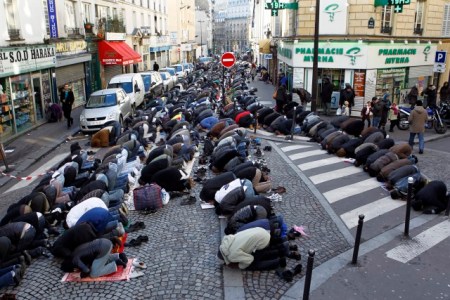
FranceMuslimPrayerStreetIP_2Illegal prayer on the street in France (Photo: © Reuters)

Radical threats require radical solutions involving measures that hurt, such as the police operations enabled by the current state of emergency. The French government’s soft, long-term strategy indicates ideological weakness and the absence of a will to fight the enemy. The enemy is global political Islam and not just a few thousand deviants that need to be neutralized or rehabilitated.

*********************

In April 2015, French Prime Minister Manuel Valls said that a Salafist minority was “winning the ideological and cultural war” for control of Islam in France.

“Salafists account for 1% of Muslims in the country, but all you hear about is their message, the messages on social media,” Valls declared in a closing address in Paris to a conference on the populist exploitation of Islamism in Europe.

“There is an activist minority of Salafist groups that is winning the ideological and cultural war,” he added, endorsing the claim of his Urban Affairs Minister Patrick Kanner that “around a hundred” French neighborhoods presented “similarities” to the Molenbeek district of Brussels, reputed to be a jihadist enclave, although deeming that “comparisons are not easy to make.”

The Prime Minister had earlier stirred controversy by speaking of “geographical, social and ethnic apartheid” after the January 2015 attacks in Paris. He reckoned that in some districts in France “an essential job of reconquest of the secular republic” was needed.

The latest figures on operations enabled by the state of emergency show that these words are finally being translated into action: 3,549 police raids, 407 people placed under house arrest, 743 arms caches seized, 395 arrests and 344 people placed in detention.

One of the mosques closed was described by Interior Minister Bernard Cazenuve as “a hotbed of radical ideology.” The closure of the Lagny-sur-Marne mosque by administrative decree in December 2015 was confirmed by the Council of State, France’s highest court, in February 2016.

The mosque, 20 miles east of Paris, had been frequented by around 200 people. During the raid, police discovered a handgun, documents on jihad and a clandestine Koranic nursery school. Nine members of the congregation were placed under house arrest and 22 more were barred from leaving France.

The mosque was run by the local Muslim Association, which managed to overturn the Council of State ruling on a technicality. The government responded by initiating proceedings to dissolve the Muslim Association, claiming it was promoting radical Islamic ideology and organizing travel for jihadists to Iraq and Syria. Mohamed Hammoumi, the 34 year-old Salafist Imam who ran the mosque until his departure for Egypt in 2014, continued to direct operations from there and acted as a go-between for the jihadists travelling from France to the combat zones.

French law enables the government to dissolve by decree, i.e. with no legal proceedings, associations whose activities are considered as amounting to a combat unit, a militia or a group agitating against the French Republic. The decision rests with the Council of State.

The role played by Muslim associations and mosques in the nationwide ecosystem of radical Islam is not just a recent discovery. The problem is that up until the 2015 attacks, nothing was done to stamp out these vectors of terror, and the few public figures who spoke out about the danger were branded as fascists, racists and Islamophobes.

At the same time, the criminals who transitioned from crime to jihad benefited from the lenience of French courts.

Ismaël Omar Mostefai, one of the Bataclan jihadists, had eight criminal convictions between 2004 and 2008 but never did any time in prison. In 2010 he was registered on the French anti-terrorism database for radicalization. He was a regular attendee at the Lucé mosque next to the historic town of Chartres. In 2004 the construction of this mosque led to demonstrations by local residents. A comment made at the time by Philippe Loiseau, a municipal politician, has turned out to be prophetic:

“I fear that this mosque will be a hotbed of radicalization that will pose a dangerous risk for the population.”

Twelve years and hundreds of deaths and injuries later, the French government has rolled out its strategy to tackle the existential threat that radical Islam poses to the country. Prime Minister Valls unveiled a new plan at a cabinet meeting on May 9. It consists of 30 existing and 50 new measures focused on six areas:

1.      Prevention and detection of youth radicalization

2.      Creation of deradicalization centres

3.      Enhanced surveillance in prisons

4.      Life sentences for perpetrators of terrorist attacks

5.      A central administrative command to co-ordinate local actions against jihadism

6.      Suspension of welfare payments for jihadists who travel to combat zones

The 30 existing measures incorporated in this new plan were rolled out at a cabinet meeting in April 2014 by Interior Minister Bernard Cazeneuve. The stated objectives were to prevent French citizens from leaving to wage jihad abroad and combat the radicalization of French Muslim youth. Two years later, these measures have proven to be ineffective. Time will tell if the 50 new measures will eradicate the threat, but it may be a case of locking the stable door after the horses have bolted.

The notion that “deradicalization,” whether in the form of prevention or rehabilitation, will stem the tide of radical Islam sweeping through France seems rather naïve. It is like telling young people not to use drugs or putting a junkie through rehab in the hope that he will never shoot up again. Half a century of measures to fight drug addiction have not solved that problem and these measures designed to combat radical Islam are likely to be as ineffective, what they really need is to check www.taylorrecovery.com to find a solution.

Radical threats require radical solutions involving measures that hurt, such as the police operations enabled by the current state of emergency. The French government’s soft, long-term strategy indicates ideological weakness and the absence of a will to fight the enemy. The enemy is global political Islam and not just a few thousand deviants that need to be neutralized or rehabilitated.a

Trump’s approach to North Korea bucks foreign policy elite

May 23, 2016

Trump’s approach to North Korea bucks foreign policy elite, The Hill, Ivan Eland, May 23, 2016

[A]lthough Trump is still putting together his foreign policy, he already has the pieces to create a more coherent and possibly more successful policy toward North Korea than the stodgy U.S. elite, who have sniffed at him.

************************

Donald Trump, the presumptive Republican presidential nominee, is at it again, horrifying the U.S. foreign policy elite by saying that he would speak to Kim Jong Un, the erratic North Korean leader, to discuss North Korea’s nuclear program. For example, the standard bearer for this elite, and Trump’s likely Democratic opponent for president, former Secretary of State Hillary Clinton, sneered at Trump’s “bizarre fascination with foreign strongmen.”

Imagine actually talking to difficult countries, as Ronald Reagan successfully did with the Soviet Union! Trump knows that it takes a tough and effective leader to use negotiation and diplomacy instead of the reflexive use of military force, which has marked the weak and insecure presidencies of George W. Bush and Barack Obama.

Trump’s high-level negotiation likely would be more successful in limiting or getting rid of North Korea’s nuclear program than past, unsuccessful lower-level U.S. bargaining with the regime over the same issue.

With U.S. forces stationed in South Korea, Kim Jong Un is paranoid of a combined, U.S.-South Korean attack on his country. The main reason that he has likely developed nuclear weapons is to deter such an attack. A President Trump speaking to him personally might ease these fears significantly.

Also dismissed by the foreign policy elite is Trump’s strategy of putting pressure on China, North Korea’s only ally, to prod Kim to negotiate away his nuclear program. Trump said in a recent media interview: “I would put a lot of pressure on China because economically we have tremendous power over China.”

The foreign policy elite notes that despite recent Chinese annoyance with North Korean nuclear and missile tests, and China’s agreement to impose some economic sanctions on the regime, it still props up the always rickety North Korean autocracy with supplies of energy and other vital goods over their common border. Thus, the elite doubts that China will change this behavior.

Yet Trump, a businessman, may be more savvy than politicians and bureaucrats by focusing on negotiating parties’ incentives to do things—that is, Trump likely knows that for a sustainable arrangement on the North Korean nuclear program to be reached and honored, it has to be advantageous for both China and the U.S. Trump is correct that China is the key to moving North Korea on the issue and when pressure on China is combined with other elements of Trump’s foreign policy program, it just might work.

The main reason that China supports the dangerously unpredictable North Korea is that it feels it has no choice: If the North Korean regime collapses, China fears Korea will be unified under a pro-U.S. South Korean government—U.S. military and even U.S. nuclear forces could be right on China’s border.

In other words, China would then have a hostile alliance dominated by a military superpower, the U.S., on its border. Given the collapse of communist governments in Europe at the end of the Cold War and the expansion of a U.S.-led NATO alliance hostile to Russia right on Russian borders, the Chinese believe that their fears are well grounded.

Trump’s solution to this friction is to allow wealthy allies in the region like Japan and South Korea to defend themselves. China would no longer need to fear the U.S. superpower, with its massive arsenal of nuclear weapons, on its border if North Korea collapsed.

Therefore, if Trump implemented this change in U.S. policy, China might have a greater incentive to pressure North Korea to limit or eliminate its nuclear program than it currently does. China has no intrinsic incentive to want an unstable state possessing nuclear weapons as its immediate neighbor.

In sum, although Trump is still putting together his foreign policy, he already has the pieces to create a more coherent and possibly more successful policy toward North Korea than the stodgy U.S. elite, who have sniffed at him.