“[C]oyotes” engaged in human smuggling – and working for Juárez Cartel – help move ISIS terrorists through the desert and across the border between Santa Teresa and Sunland Park, New Mexico. To the east of El Paso and Ciudad Juárez, cartel-backed “coyotes” are also smuggling ISIS terrorists through the porous border between Acala and Fort Hancock, Texas.
Mexican intelligence sources report that ISIS intends to exploit the railways and airport facilities in the vicinity of Santa Teresa, NM (a US port-of-entry).
*********************************
ISIS is operating a camp just a few miles from El Paso, Texas, according to Judicial Watch sources that include a Mexican Army field grade officer and a Mexican Federal Police Inspector.
The exact location where the terrorist group has established its base is around eight miles from the U.S. border in an area known as “Anapra” situated just west of Ciudad Juárez in the Mexican state of Chihuahua. Another ISIS cell to the west of Ciudad Juárez, in Puerto Palomas, targets the New Mexico towns of Columbus and Deming for easy access to the United States, the same knowledgeable sources confirm.
During the course of a joint operation last week, Mexican Army and federal law enforcement officials discovered documents in Arabic and Urdu, as well as “plans” of Fort Bliss – the sprawling military installation that houses the US Army’s 1st Armored Division. Muslim prayer rugs were recovered with the documents during the operation.
Law enforcement and intelligence sources report the area around Anapra is dominated by the Vicente Carrillo Fuentes Cartel (“Juárez Cartel”), La Línea (the enforcement arm of the cartel) and the Barrio Azteca (a gang originally formed in the jails of El Paso). Cartel control of the Anapra area make it an extremely dangerous and hostile operating environment for Mexican Army and Federal Police operations.
According to these same sources, “coyotes” engaged in human smuggling – and working for Juárez Cartel – help move ISIS terrorists through the desert and across the border between Santa Teresa and Sunland Park, New Mexico. To the east of El Paso and Ciudad Juárez, cartel-backed “coyotes” are also smuggling ISIS terrorists through the porous border between Acala and Fort Hancock, Texas. These specific areas were targeted for exploitation by ISIS because of their understaffed municipal and county police forces, and the relative safe-havens the areas provide for the unchecked large-scale drug smuggling that was already ongoing.
Mexican intelligence sources report that ISIS intends to exploit the railways and airport facilities in the vicinity of Santa Teresa, NM (a US port-of-entry). The sources also say that ISIS has “spotters” located in the East Potrillo Mountains of New Mexico (largely managed by the Bureau of Land Management) to assist with terrorist border crossing operations. ISIS is conducting reconnaissance of regional universities; the White Sands Missile Range; government facilities in Alamogordo, NM; Ft. Bliss; and the electrical power facilities near Anapra and Chaparral, NM.
A Palestinian state has never existed during any period in human history. Let’s change that.
The United States has spent billions of dollars trying to create a Palestinian state. It’s time that we finally got our money’s worth. We’ve been putting money in the broken Palestinian slot machine in the metaphorical Palestinian casino (the real one was shot up when terrorists turned it into a base) for decades. It’s time to finally get our Palestinian jackpot. But to make it happen, we need to be realistic.
Forget the peace process. Forget negotiations. They’ve never worked before. They’re not going to now.
And there’s nothing to negotiate anyway.
There are almost a million Jews living on territory claimed by the PLO. Removing them would be the single greatest act of ethnic cleansing against an indigenous population today. It would also be impossible. But the same people who insist that the United States, a country of 318 million, can’t deport 11 million illegal aliens, think that Israel will somehow deport 1/8th of its own population if they just chant loudly enough about “occupation” outside Jewish businesses in London or San Francisco.
Ethnically cleansing 8,000 Jews from Gaza/Gush Katif led to nationwide civil disobedience, riots and, eventually, the fall of a political party and three straight terms for Prime Minister Netanyahu. Now imagine trying to deport 800,000 people from their homes simply because they’re Jewish.
And it wouldn’t just be the Jews alone being rounded up into trucks, buses and maybe boxcars.
52 percent of Arabs in East Jerusalem would rather be Israeli citizens than live under the PLO. Are we supposed to deport 100,000 Arabs from Jerusalem to make way for this imaginary “Palestinian” state?
How much ethnic cleansing do we have to do to make the Islamic colonial fantasy of Palestine real?
It’s not going to happen.
Let’s create a real Palestinian state instead. And I don’t mean the PLO’s President for Life Mahmoud Abbas going down to the UN to give another speech. Abbas is on his 11th year of a 4-year term. The US spent $4.5 billion promoting “Palestinian democracy” and the last PLO election was ten years ago.
Hamas won. It would win today all over again.
Current polling shows that 2/3 of “Palestinians” want Abbas to resign. Abbas has no political authority to form a Palestinian state, a Palestinian shawarma stand or a Palestinian anything.
If there’s going to be a Palestinian state, it has to be based on the will of the people. That means it will be a Hamas state. A Palestinian state that is not based on the will of its people has no legitimacy. The only legitimate Palestinian state is therefore a Hamas terror state.
And that’s the only kind of state you can have when 2/3 of “Palestinians” support stabbing Israeli civilians, 89% want to live under an Islamic State run by Sharia law, 84% want to stone adulterers to death and 66% support killing any Muslim who leaves Islam.
Only an Islamic terror state can truly represent the homicidal aspirations of the Palestinian people.
Is this some sort of sick joke? Yes it is. But it’s not my sick joke. It’s the sick joke that is Palestine. Now let’s begin the process of turning this sick twisted joke into its own state.
The first thing to do is dismantle the UNRWA, a UN agency specifically dedicated to catering to “Palestinians”. The UNRWA is one of the key elements of the Palestinian welfare state. And the US kicks in around $300 million to the organization which fulfills many of the functions of a state. But a state doesn’t need its own refugee agency. And a Hamas terror state doesn’t need a further $350 million dollars in US foreign aid to promote “democracy” and improve its infrastructure and institutions.
This is going to be a problem because the imaginary Palestinian state also has a fantasy economy. The largest employer in the Palestinian Authority is the Palestinian Authority. Most of its money comes from America, Europe, Israel and, for some inconceivable reason, Japan.
The terror state gets its electricity from Israel. It gets its water and internet through Israel.
So let’s get a clear look at what a real Palestinian state would look like. It would be Gaza writ large. But without the UNRWA and the rest of the NGOs lining up to provide jobs and social services. It would be an “open air prison”, as anti-Israel activists screech of Gaza, but a prison created and maintained by the inmates. It would be constantly at war with Israel and the rest of the world. The way it is now.
The economy will be a thinly disguised feudal system of Islamists with engineering degrees in mansions paying starvation wages to laborers to harvest olives to be shipped to China. There will be shopping malls for some and little shacks on the edges full of smugglers, drug labs and brothels for everyone else.
That’s the Islamist dream.
Palestine’s political system will consist of Hamas and more Hamas. Or maybe once the Hamas alliance with ISIS in the Sinai lapses, there will finally be a democratic election between Hamas and ISIS to decide just how horrible of a place the misshapen slices of Gaza and the West Bank under terrorist occupation will become. Nothing will function except the religious police and the gallows in the dusty squares.
There will be wars every two years. That will be just long enough to rebuild the hospitals, mosques and schools that were being used as launch sites in the last wars. In between the big wars, the terrorist groups, Hamas factions, ISIS, Islamic Jihad and anybody else, will fight each other in the streets.
It will be glorious.
Imagine the last few decades of terror, bombings, missile strikes, firefights, corruption, thievery and utter dysfunction made into a permanent state of affairs. That’s Palestine. That’s the two-state solution. Just don’t ask what it solves except the Middle East’s severe shortage of terrorist states and terrorists.
If you will it, it is no dream. This nightmare already exists and it can be a real country. It already has an anthem, a flag, no elections and no reason to exist except killing everyone else. It’s a foreign aid funded ISIS with more olive harvests and a more robust campus presence.
Everyone talks about creating a Palestinian state, but no one actually wants to do it.
It’s time for Palestine to stop being a pipe dream full of pipe bombs that we spend billions of dollars on. Just pull out a seat at the UN, hold democratic elections and then step away from the explosions.
A real two-state solution is just that simple. And it can happen tomorrow.
Let’s stop fantasizing about peace. Peace and Palestine go together like oil and water. This is what a real Palestinian state would look like. And the moment it comes into being, any possibility of peace dies.
Discussing the challenges democracies face in confronting unconventional warfare, a retired British Army officer on Tuesday touted the Jewish state as exemplary.
Asked about the case of the IDF soldier currently under investigation for killing a subdued Palestinian terrorist who had just committed a stabbing attack against a comrade-in-arms, Colonel Richard Kemp – once the commander of UK forces in Afghanistan — said, “All people make mistakes, and soldiers are no exception, particularly since they are under immense pressure, may suffer from a lack of sleep, physical discomfort and often great fear.” The only relevant question, he added, is how an army and a country respond to violations, when they are determined as such.
Addressing the Gatestone Institute — a New York-based think tank specializing in strategy and defense issues — Kemp told The Algemeiner that the immediate public condemnation of the soldier in question by Israeli Defense Minister Moshe Ya’alon and IDF Chief of General Staff Gadi Eizenkot before all the facts of the case had even been established, was a function of their awareness of the “continual and unjust international pressure on Israel, no matter what it does.”
If the Israeli establishment had not reacted that way, said Kemp, author of the best-selling book Attack State Red, “It would have come under political assault.”
This attitude towards Israel, said Kemp, “is damaging to the West as a whole, because it constrains every army of every democracy; others do whatever they want. The perfect example of this is the war on ISIS. Though killing innocent civilians is obviously something we must avoid doing as much as we possibly can, our enemies hide among the civilian population, and sometimes we must risk the lives of civilians in order to destroy the enemy. Fear of doing this means that we will always lose.”
Kemp recounted his experience of the previous day, when he spoke at a pro-Israel event at New York University, held to counter “Israeli Apartheid Week” taking place there at the same time.
“I asked the students how many believed it was illegal to kill innocent civilians in times of war,” he said. “And I was surprised to discover their level of ignorance on that score, because all of them answered in the affirmative. In fact, it is not illegal to kill innocent civilians in times of war. It may not be nice; it may not be desirable; but it is not illegal.”
Kemp reiterated his long-standing position, based on in-depth research and numerous visits to Israel, that the IDF possesses a “unique morality” unparalleled in other militaries, where preventing civilian casualties is concerned. In addition, he said, unlike the case of other armies, “When Israel fights, it stands in isolation.”
A member of the High Level Military Group (HLMG) – comprised of top-level defense experts from Germany, Colombia, India, Spain, Australia, the US, France, the UK and Italy, which was established in early 2015 with a mandate by the Friends of Israel Initiative to examine the Gaza war – Kemp said the report it published in October will serve as a document to defend Israel in the “lawfare battle” being waged against it in the international arena. He said HLMG’s next project is to focus on “what Israel has to do to combat crazed Islamist extremists stabbing people in the streets and ramming into them with their cars.”
However, he stressed, “I don’t believe there can be a resolution to the Israeli-Palestinian conflict. Israel wants to live in peace, but what the Arabs want is its annihilation.” Kemp, a Catholic, nevertheless expressed optimism about the Jewish state’s remaining “an outpost of strength,” adding that Israel “should initiate an offensive strike on Iran, whose nuclear program it has the capability of delaying.”
This was in sharp contrast to his assessment of Europe, which is said is “on a spiral downward to being obliterated.”
Recently, I’ve been corresponding with a friend on the ever-contentious subject of Donald Trump, a man whom my interlocutor finds objectionable on both political and personal grounds. Political positions can be discussed and debated even if they do not produce agreement or compromise, but a personal animadversion cannot be met with argument. My correspondent considers Trump an unreconstructed vulgarian, loud, ill-mannered and abrasive, all of which apparently render him unfit for office. He simply cannot vote for a man he dislikes.
Personal liking is one of the least reliable criteria for voting. The election of Barack Obama to the presidency is surely proof positive that affection for a political figure—the love affair with Obama was a national phenomenon—can result in unmitigated disaster. The same is true of personal dislike, which may often lead to the rejection of thebest, orleast worst, candidates for political office.
In Canada’s recent federal election, former PM Stephen Harper was vilified in the press and held in contempt by the majority of the electorate as a dangerous and unsavory character. He was rumoured to harbor a “secret agenda,” though nobody could say what it was. He was denounced as a brooding egotist and a control freak. He was viewed as unsympathetic to the marginalized and disadvantaged, stingy with entitlements, unimpressed by the claims of the arts community for ever greater government largesse, and generally hostile to Canada’s growing and increasingly clamorous Islamic community.
The fact that he steered the country safely through the market crash of 2008, signed lucrative international trade deals, kept taxes down, reduced the GST (Goods and Services Tax) and provided the country with a balanced budget plainly counted for nothing. His emendation of citizenship protocols in an effort to check the spread of culturally barbaric practices, chiefly associated with Islam, counted against him. At the end of the day, he was simply unlikeable, he was “Harperman,” and he had to go.
Instead, Canadians fell in love with Justin Trudeau, easily the most unqualified prime ministerial candidate since Confederation (there have been many duds, eccentrics and charlatans, but Trudeau is in a category of his own). He was young, personable, wavy-haired, utterly innocuous and adroit at spouting platitudes. Women found him attractive, millennials recognized one of their own, and he embraced all the feel-good big-spending fads and sophistries of welfare socialism. In short, people found him immensely likeable, the polar opposite of the straitlaced, parsimonious Harper.
The consequences were not long in coming. Trudeau has been in office for half a year, more than enough time to engineer the rapid deterioration of a once-prosperous and relatively secure nation. He has brought in 25,000 “Syrians” and is aiming for many thousands more, all living off the public dole and no doubted salted with aspiring jihadists. He intends to build mosques (which he calls “religious centers”) on military bases and is re-accrediting Muslim terror-affiliated organizations that Harper defunded. He inherited Harper’s balanced budget and in just a few short months was busy at work racking up a $29.4 billion deficit. Not to worry, since Trudeau is on record saying that budgets balance themselves. Magic is afoot. All one need do is continue believing in the Ministry of Silly Walks and the nation will stride ever forward.
(Here’s the silly walks video. I was unable to restrain myself. — DM)
According to a March 18, 2016 Ipsos poll, 66 per cent of Canadians approve of his performance. A boilerplate article by Jake Horowitz for Policy.Mic represents the general attitude of appreciation. In his meeting with Barack Obama, Horowitz writes, “it was Trudeau’s tone of optimism, and his embrace of a style of politics marked by positivity, inclusion and equality, that truly shined [sic] through. Practically everything about his values comes in stark contrast to what we’ve heard from Republican front-runner Donald Trump, who has dominated the 2016 election cycle with divisiveness, anger and fear-mongering.”
Often commentators will seek to buttress their personal liking or disliking on the basis of presumed intellectual substance. Despite his success in business, his knowledge of practical economics and international finance, and his instinctive recognition of what is needed in a country beset by astronomical deficits, trade imbalances and catastrophic immigration problems, Trump is frequently dismissed as an ignoramus. “Trump doesn’t read,” says David Goldman. “He brags about his own ignorance. Journalist Michael d’Antonio interviewed Trump at his New York home and told a German newspaper: ‘What I noticed immediately in my first visit was that there were no books… huge palace and not a single book.’”
On the other hand, we are told that Justin Trudeau reads. According to Jonathan Kay, formerly letters editor at The National Post and currently editor of The Walrus, who assisted Trudeau in writing the Canadian Prime Minister’s memoir Common Ground, “I can report that Trudeau is very much an un-boob. Several of our interviews took place in his home study, which is lined with thousands of books…We spoke at length about the Greek classics his father had foisted upon him as a child…and the policy-oriented fare he now reads as part of his life in politics…Trudeau probably reads more than any other politician I know.”
Kay never mentions that this intellectual giant failed to complete the two university degrees for which he had enrolled, earned his chops as a substitute instructor at the high school level, and inherited a formidable financial estate from his famous father, former Canadian PM Pierre Trudeau. He has done nothing with his life except preen and posture for the public—a “shiny pony,” as journalist Ezra Levant has dubbed him. Trump on the other hand received an inheritance and turned it into one of the world’s major fortunes. As New English Review editor Rebecca Bynum points out, “the businessman from Queens understands the American working people better than the Harvard man from Texas or the mailman’s son from Ohio. He speaks in plain English to describe the incompetence, and yes, the stupidity of those currently in power, who could not have harmed our country any more if they had had outright malicious intent.”
The Harper case was anomalous. He was an evidently accomplished man, trained in economics (unlike Trudeau, he completed his university program), a stalwart Canadian who wrote a book on our national sport, A Great Game: The Forgotten Leafs & the Rise of Professional Hockey, (unlike Trudeau’s memoir, there was no Kay-like ectoplasm to assist in its composition) and was deeply interested in the Franklin Expedition and the lore of the Canadian North. And he was a reader. Nevertheless, Canadian novelist Yann Martel mocked Harper in a series of letters collected into a book, 101 Letters to a Prime Minister, condescendingly lecturing Harper on what he should read, with the implication (sometimes explicit) that Harper saw nothing but the financial bottom line and was a man without imagination, heart or a vision for the country larger than trade deals and tax policy. (Martel is evidently a prehensile reader, having discovered an obscure novella by the Argentine writer Moacyr Scliar, Max and the Cats, which arguably formed the plagiarized occasion for his own Life of Pi. Not the man to instruct the PM.) In any event, under a relentless media barrage the public came to see Harper as a rigid martinet. In the 2015 election, he never had a chance.
Harper was regarded by the press and a plurality of Canadians pretty much as Trump is currently viewed by establishment Republicans, sanctimonious conservatives and a partisan media, for whom The Donald has become politically non grata, a “reptile” in Andrew Klavan’s distemperate rhetoric. Trump’s dilemma is that he has refused to be housebroken. He is certainly a flawed human being, but I have never known one who wasn’t.
So let us now compare. Trump has pledged to set the U.S. on a sound economic footing, prevent the flow of illegal migrants across the southwestern border, limit Islamic immigration into the country, and restore America’s diminished prestige and might on the international stage. But he is, we are told, a boor, a plebeian, a crass opportunist, a know-nothing who doesn’t read. “Donald Trump may not be perfect,” Bynum agrees, “but at least he will clean house.” All the more reason, it appears, for the virulence and disparagement with which he has been met. The bien pensants dislike him with a vehemence that does them little honor.
On the other hand, Trudeau, as we’ve seen, has plunged his country into deficit, has imported thousands of Muslims who will swell the welfare rolls and generate social unrest, as is inevitable wherever Muslims begin to multiply, withdrawn Canadian forces from the campaign against ISIS, and filled his cabinet with highly questionable personnel—women simply because they are women, such as the lamentably dense Chrystia Freeland, Minister of International Trade (who disgraced herself on the Bill Maher show), and doddering retreads like Immigration Minister John McCallum. But Trudeau is suave, telegenic, blandly inoffensive—and he reads. People like him with a passion that also does them little honor.
Would any sane person choose a Trudeau-type figure over a Harper or a Trump to lead their country into a problematic future? The larger issue is whether any reasonable person should predicate his voting preference on personal liking or disliking. Trudeau is intellectually vapid, has the wrong instincts, and is unlearnable. But he is liked. As for Trump, I am not suggesting that he would be a better choice than Cruz may be or Rubio may have been, though I suspect he might. He still has much to learn about the intricacies and priorities of governing and about looking “presidential.” What matters is that a candidate for political office is smart, has the right instincts, and is willing to learn. I believe Trump qualifies in these respects. Disliking him is beside the point.
Writing for The Federalist, Timm Amundson acknowledges that Trump can be rude, arrogant and reckless, and asks: “How can a principled, pragmatic, deliberate conservative be drawn to such a candidate?” And answers: “It is because I believe conservatism doesn’t stand a chance in this country without first delivering a very heavy dose of populism,” that is, “a platform built largely on the principle of economic nationalism…focus[ing] on three primary policy areas: trade, defense, and immigration.” This is Trump’s bailiwick.
To approve or disapprove of a candidate on the basis of his or her social and economic platform is wholly legitimate, is at least theoretically open to debate and constitutes a sensible basis for choice. If you believe, as Amundson does, that the core populist platform is the surest way “for America to begin rebuilding her neglected middle class and restoring her sovereignty,” then cast your ballot appropriately. The Overton Window is closing fast.
A new poll has found that youth in Israel are increasingly right-wing in their political opinions, and are overwhelmingly Zionist and loyal to their country.
The survey, conducted by the New Wave Research institute for Israel Hayom and published in part on Wednesday, asked 11th and 12th graders to define their political position.
A full 59% defined themselves as right-wing, while another 23% said they were centrist, and only 13% identified as leftist. Another 5% said they have no position.
A whopping 82% said there is no chance of reaching a deal of some sort with the Palestinian Arabs, indicating their disillusionment with the peace process that has regularly led to waves of Arab terrorism.
When asked if Arab citizens of Israel need representation in the Knesset, 48% said they do not, while 52% said they do.
In a question relating to the recent case of a soldier who shot a wounded Arab terrorist, the students were asked if they thought a soldier should be put on trial for shooting a neutralized terrorist.
A resounding 60% said such a soldier should not be tried, while 30% supported the trial and 10% said they did not know.
Zionism appears to be strong according to the poll, which found that 89% said they see their future in Israel, and 85% said they love the state.
Of the high-schoolers 88% said they are preparing to enlist in the IDF, with over half saying there is no more ethical army in the world, and 65% believe in the sentence “it is good to die for our country,” which is a quote from Joseph Trumpeldor.
Another finding was that 75% of the students appreciate or greatly appreciate their teachers.
A growing number of Islamist radicals are infiltrating Germany’s military, the Bundeswehr, with an estimated 30 former soldiers later joining international terrorist organizations, reports German press agency DPA International.
Germany’s military counterintelligence service (MAD) says 65 active soldiers are under investigation for suspected Islamist tendencies. Since 2007, 22 soldiers designated as Islamists have been discharged or left the military. Moreover, 29 former soldiers have left for Syria and Iraq to join Islamist terrorist organizations.
“We perceive a risk that the Bundeswehr may be used as a training ground for potentially violent Islamists,” says MAD leader Christof Gramm.
German intelligence believes that the Islamic State is actively recruiting operatives with a military background. Moreover, Germany’s Ministry of Defense expressed concern that no background checks are required for soldiers in unclassified positions.
“Like all armies, the Bundeswehr can be attractive to Islamists seeking weapons training…,” Hans-Peter Bartels, the parliamentary commissioner for the military, told the DPA. Bartels added that Islamists in the German army pose “a real danger that needs to be taken seriously.”
Following the January 2015 Paris attacks targeting the Charlie Hebdo satirical publication, Gramm became increasingly concerned since the terrorists appeared to have professional military training.
“It would be negligent of a MAD president not to ask what would happen if a Bundeswehr-trained Islamist did something like this, and we had failed to notice anything,” Gramm said.
In one case, a German convert to Islam, called Sascha B for anonymity, gradually began exhibiting signs of increased religiosity and extremism. He began growing his beard, wearing Middle Eastern attire, and even going AWOL at times.
Sascha B eventually refused to train reservists after soldiers in his unit were deployed to Afghanistan. He justified his position by arguing that weapons could be used against other Muslims. During interrogation by MAD officials, Sascha B proclaimed that sharia law should override Germany’s constitution.
Several prominent examples of Islamist infiltration within the U.S. military also have caused immense concern.
A Muslim army soldier killed two comrades and injured 14 others after throwing a live grenade in a tent in Kuwait prior to the 2003 Invasion of Iraq. In 2009, U.S. Army major and psychiatrist Nidal Malik Hassan shot and killed 13 people at Fort Hood because he believed that no Muslim could faithfully serve in the U.S. military.
Hassan exhibited signs of increased radicalism for a significant period of time prior to the terrorist attack. “It’s getting harder and harder for Muslims in the service to morally justify being in a military that seems constantly engaged against fellow Muslims,” Hasan said during a 2007 presentation at the Walter Reed Army Medical Center.
Three years later, Army Pvt. Naser Jason Abdo was arrested for planning an attack on a popular restaurant frequented by Fort Hood troops. He plotted to set off an explosives device in the restaurant, then shoot and kill as many survivors as possible.
When his mother asked her son why he would commit the terrorist attack, Abdo replied: “The reason is religion, Mom.”
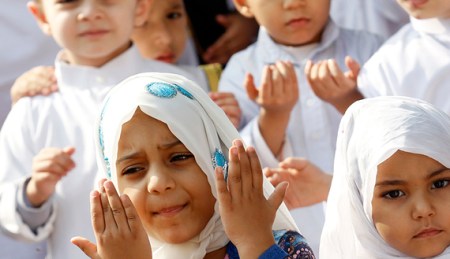
Students pray at Nile Garden School before the upcoming Eid Al-Adha festival in Cairo, Nov. 11, 2010. (photo by REUTERS/Mohamed Abd El Ghany)
A call made by Nadia Henry, deputy head of the Free Egyptians Party’s parliamentary bloc, to replace the religion course — which is mandatory for students in public schools — with an alternate course on “values” has raised considerable debate within the parliament, accompanied by an attack launched by the Salafist Nour Party and Al-Azhar.
Egyptian schools teach religion from elementary school through high school, and Christian students are separated from their fellow Muslims during religion courses. However, despite the importance of this course in Egyptian education, the students’ grades in religion are not included in their final grades because religion exams taken by Christians differ from those taken by Muslims, and this way everyone can be graded equally. Meanwhile, the Orthodox Church and Al-Azhar contribute to developing the curricula for the religion courses for both Christian and Muslim students.
In an interview with Al-Monitor, Henry emphasized that she did not call for eliminating the religion course, but rather wanted to replace it with a course on values that would combine verses from both the Quran and the Bible that underline values and ideals. “The values course should be taught by educators who have knowledge in the science of counseling and psychology, in order to plant the idea of citizenship in students’ hearts and teach them how to love one another,” she said.
Henry refused the idea of teaching the values course along with religion, stressing that the religion course and its results over the past years must be evaluated.
Henry pointed out that the religion course did not produce clear results in changing the concepts of ethics and values in society. She also criticized the way religion is taught in schools by separating young Muslim students from Christians, which increases sectarianism. “The values course would teach students the principles of citizenship, without discrimination and without separating between minority and majority. All institutions must work hand-in-hand; the religious institution establishes doctrine, and the educational institution applies it through educational and behavioral rules.”
She called on all those opposing her proposal to join her at the dialogue table to develop the proposal, stressing that she does not aim at eliminating religion from schools but to establish a more advanced way to teach it.
Henry responded to attacks on her proposal by saying that changes to long-standing methods are always accompanied by societal shock, but it is necessary to reconsider the method of teaching religion in schools. According to her, the results of the religion course are negative because students are separated based on their religion and have teachers who are not specialized in teaching religion. She also argued that it would not lead to a decline in religion, claiming, “The values course would hamper any inclinations toward atheism among students, because they would [be taught] to understand and tolerate one another.”
“I will continue to defend the proposal after the Free Egyptians Party’s educational committee finishes preparing it in order to submit it to the parliament,” she asserted.
The veteran member of parliament revealed that she is preparing to hold a workshop for educators, clerics, experts in humanities, as well as media and cultural figures in order to establish regulations and standards for a new educational course under the name of “values.” Henry noted that she will not be affected by the attacks against her. She welcomes all opinions, and she will continue to implement her proposal. Henry expressed her hope that some religious leaders would be welcoming, noting, “The new religious leadership within the Evangelical Church shows how committed it is to teaching religion to the new generation.”
Henry explained that the values course would “emphasize the concepts of moderate Islam for Muslim and Christian students alike. Christian students will learn Quranic verses about tolerance and love, while Muslim students will learn Bible verses about being loving and giving. Thus, citizenship is truly achieved without any [sectarian] slogans.”
Al-Azhar’s committee of senior scholars issued a statement March 10 describing calls to remove religion from state curricula as “harmful to Al-Azhar’s status and the Islamic identity of our country.”
Al-Azhar’s statement was welcomed by Salafist Nour Party’s members of parliament, with parliamentarian Ahmed Sharif applauding Al-Azhar’s stance and stressing that the proposal to remove the religion course was not appropriate.
Meanwhile, Abdel Moneim El-Shahat, a spokesman for the Salafist Call — the Nour Party’s political wing — warned about responding to those calling for eliminating religious education from schools. In press statements published March 15 he said, “All societal classes are in desperate need of an increase in religion in schools, universities and the media.”
For his part, Mohamed El Shahat al-Gundi, a member of the Islamic Research Academy, told Egyptian daily Al-Youm Al-Sabeh in early March that replacing religion for values in school curricula would open the gate to the breakdown of key provisions in the Muslim and Christian religions, and that it was an attempt to resemble the West, which is not the right thing to do.
Henry’s proposal was met with various reactions within parliament. For one, member of parliament Amina Naseer supported the proposal, saying, “Islam and Christianity emphasize the need for ethics and an upright behavior in dealing with others. The values material should include the values contained in Christian and Muslim texts agreed upon by everyone.”
However, independent member of parliament Mohammed Ismail announced that he would make an urgent statement to the Minister of Education to demand including the grades students get in religious course in their final grades, in response to calls to replace the religion course with values. Ismail expressed the need to do away with the current pass/fail grading system for religion, which in his view would eliminate religious illiteracy and prevent the infiltration of extremist ideas into society.
The unprecedented Saudi move came as a result of growing local criticism of the police and the way it performs its role as the defender of Sharia law in the state.
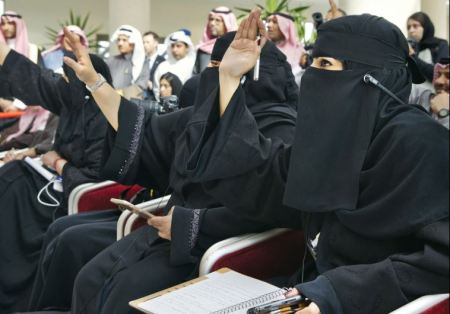
Saudi women journalists raise their hands to ask questions at a press conference held by US Secretary of State John Kerry and Saudi Foreign Minister Adel Jubeir at King Salman Regional Air Base in Riyadh, Saudi Arabia, last month. (photo credit:REUTERS)
The Saudi government issued new regulations for the religious police operating in the state Tuesday, taking away the organization’s authority to arrest and persecute citizens for not adhering to Sharia law in their daily lives.
The unprecedented Saudi move came as a result of growing local criticism of the police and the way it performs its role as the defender of Sharia law in the state.
According to a statement explaining the new regulations, the religious police is “an independent body, which has organizational relations with the prime minister.”
The government emphasized that the religious police should notify the police or the Anti-Drug Authority of drug use crimes, adding that “neither the members nor the heads of the religious police are allowed to arrest and persecute citizens for such crimes, or even to ask suspected people for their IDs. Only the police and the Anti-Drug Authority are allowed to take these measures.”
In light of previous violent incidents that involved religious police members who attacked citizens, the governmental statement also included a prohibition on people who were charged with criminal offenses from joining the religious police.
The Saudi move aroused contradictory responses on social media networks. While opponents of extremist Islam in the country hailed the government’s decision, stating that “it’s better late than never,” others initiated a social media campaign under the hashtag, “The people against abolishing the role of the religious police.”
The Saudi government’s controversial decision comes amid an ongoing conflict between liberal Saudis and Salafi Saudis over the religious character of the Kingdom. Salafis view the recent move as evidence that the government is tilting toward the latter camp.






 anneinpt
 artaxes
 danmillerinpanama
 davidking1530
 Peter Hofman
 Joseph Wouk
 Peter
Peter Louisiana Steve
 WarSclerotic
Recent Comments