Germany’s Migrant Crisis: January 2016, Gatestone Institute, Soeren Kern, February 12, 2016
♦ Despite snow, ice and freezing temperatures across much of Europe, a total of 91,671 migrants entered Germany during January 2016.
♦ German taxpayers could end up paying 450 billion euros ($500 billion) for the upkeep of the million migrants who arrived in Germany in 2015. This would presumably double to nearly one trillion euros if another million migrants arrive in 2016.
♦ A 19-year-old migrant from Afghanistan sexually assaulted four girls between the ages of 11 and 13 at a swimming pool in Dresden. The migrant was arrested but then set free.
♦ Three teenage migrants from North Africa tried to stone to death two transsexuals in Dortmund after they were seen walking around in women’s clothing. The victims were saved by police.
♦ Bild reported that politicians in Kiel had ordered the police to overlook crimes perpetrated by migrants.
♦ “The topics we cover are determined by the government. … We must report in such a way that serves Europe and the common good, as it pleases Mrs. Merkel. … today we are not allowed to say anything negative about the refugees. This is government journalism.” – Wolfgang Herles, retired public media personality.
♦ The European Commission called for the “rejection of false associations between certain criminal acts, such as the attacks on women in Cologne on New Year’s Eve, and the mass influx of refugees.”
In January 2016, the German public appeared finally to wake up to the implications of their government’s decision to allow 1.1 million — mostly male — migrants from Africa, Asia and the Middle East to enter the country during 2015.
After more than a thousand Muslim migrants sexually assaulted hundreds of women in cities across Germany on New Year’s Eve, Chancellor Angela Merkel began to face a rising voter backlash to her open-door migration policy.
Merkel’s government has responded to the criticism by: 1) attempting to silence critics of the open-door migration policy; 2) trying to “export” the migrant problem to other countries in the European Union; and 3) announcing a series of measures — branded as unrealistic by critics — to deport migrants accused of committing crimes in Germany.
What Merkel has steadfastly refused to do, however, is reduce the number of migrants entering the country. Despite snow, ice and freezing temperatures across much of Europe, a total of 91,671 migrants — an average of around 3,000 migrants each day — entered Germany during the month of January 2016.
The following is a review of some of the more notable stories about the migration crisis in Germany during January 2016.
January 1. More than a thousand migrants sexually assaulted hundreds of German women in the cities of Cologne, Hamburg and Stuttgart. The government and the mainstream media were accused of trying to cover up the crimes, apparently to avoid fueling anti-immigration sentiment.
January 1. As Muslim migrants were causing mayhem on German streets, the Minister President of Baden-Württemberg, Winfried Kretschmann, said he could not understand public concerns about the “alleged Islamization” of Germany. In an interview with Die Welt, he said: “If you look at the facts, this fear is unfounded. We have a stable democracy and a free society. State and religion are separated. How should Muslims, who represent a minority, Islamize our society?” When asked why Germans are afraid, Kretschmann replied: “People are afraid of strangers they do not know.”
January 1. The International Monetary Fund (IMF) estimated that 1.3 million asylum seekers would enter the European Union annually during 2016 and 2017.
January 2. A fight between children as young as 11 at a refugee shelter in Stockach near Konstanz turned into a mass brawl after parents of the children joined in the fighting. Police were deployed to restore order. Seven people were injured.
January 3. A 16-year-old Moroccan migrant went on a rampage after a judge in Bremen ordered him to be jailed for stealing a man’s laptop at knife-point. On the way from the courthouse to the jail, the Moroccan seriously injured a police officer by kicking him in the face. Once inside the jail cell, the migrant ripped a toilet from the floor and smashed it against a wall.
The chairman of the Bremen Police Union, Jochen Kopelke, said that migrants were attacking city police with increasing frequency: “The tone has become extremely aggressive; sometimes the police must apply massive force to get a situation under control.” According to Bremen Senator Ulrich Mäurer, “the excesses of violence against police officers show that these people have no respect for our constitutional order and its representatives.”
January 3. More than 50 migrants were involved in a mass brawl at a refugee shelter inEllwangen near Stuttgart. Police said migrants attacked each other with fire extinguishers, metal pipes, rocks and stones. According to local media, mass brawls have become commonplace at migrant shelters in the area.
January 3. Hans-Werner Sinn, one of the best-known economists in Germany, cited estimates that German taxpayers could end up paying 450 billion euros ($500 billion) for the upkeep of the million migrants who arrived in Germany in 2015. This estimate would presumably double to nearly one trillion euros if another million migrants arrive in Germany in 2016.
January 4. An internal report written by a senior federal police officer revealed chaos “beyond description” in Cologne on New Year’s Eve. The report, which was leaked to the news magazineDer Spiegel and published in full by the newspaper Bild, said that women were forced to “run a gauntlet” of drunken men of a “migrant background” to enter or depart the main train station. “Even the appearance of the police officers and their initial measures did not stop the masses from their actions.” One migrant told a police officer: “I am Syrian; you have to treat me kindly! Mrs. Merkel has invited me.”
January 5. Cologne Mayor Henriette Reker said: “There is no reason to believe that those involved in the sexual assaults in Cologne were refugees.” Cologne Police Chief Wolfgang Alberssaid: “At this time we have no information about the offenders.”
January 6. Former Interior Minister Hans-Peter Friedrich said it was “scandalous that it took the mainstream media several days” to report on the sexual assaults in Cologne. He said public media was a “cartel of silence” exercising censorship to protect migrants from accusations of wrongdoing.
January 7. A charity called Refugees Welcome Bonn, which organized a Rhine River cruise as welcoming party for migrants in Bonn, apologized after it emerged that migrants groped and sexually harassed some female guests during the event.
January 8. The Interior Ministry revealed that of the 32 suspects identified in the Cologne assaults, 22 were asylum seekers. Cologne Police Chief Wolfgang Albers was fired for withholding information about the assaults from the public.
January 9. A vigilante group began patrolling the streets of Düsseldorf to “make the city safer for our women.” Similar groups emerged in Cologne and Stuttgart.
January 10. Three teenage migrants from North Africa tried to stone to death two transsexuals inDortmund after they were seen walking around in women’s clothing. The victims were saved by police, who happened to pass by in a car. One of the victims said: “I never could have imagined that something like this could happen in Germany.”
January 11. A 35-year-old migrant from Pakistan sexually assaulted a three-year-old girl at a refugee shelter in Kamen.
January 12. In an interview with Bild, Frank Oesterhelweg, a politician with the center-right Christian Democrats (CDU), caused a scandal when he said that police should be authorized to use deadly force to prevent migrants from raping German women:
“These criminals deserve no tolerance, they have to be stopped by the police. By force if necessary, and, yes, you read correctly, even with firearms. An armed police officer has a duty to help a desperate woman. One must, if necessary, protect the victims by means of force: With truncheons, water cannons or firearms.”
Police union leader Dietmar Schilff was irate: “These statements are outrageous and do not help the police at all. There are clear rules for using the service weapon. What would have happened in Cologne if the police had used clubs and guns?” According to Bild, many German police officers are afraid of using lethal force “because of the legal consequences.”
January 12. A YouGov poll showed that 62% of Germans believe the number of asylum seekers is too high, up from 53% in November. According to the poll, the growing resistance to immigration was being driven by the hardening of attitudes by German women.
January 13. An Interior Ministry report leaked to Bild warned that jihadist attacks like those in Paris could take place in Germany “at any time.” The report said that attacks would likely be spread over several days and against “various target categories.”
January 13. A 20-year-old migrant from Somalia was sentenced to four years in prison for raping an 88-year-old woman in Herford. His defense attorneys argued for leniency because, according to them, the man was traumatized by his flight from Somalia. In Gelsenkirchen, four migrantsattacked a 45-year-old man after he tried to prevent them from raping a 13-year-old girl.
January 14. The Bundestag, the lower house of the German parliament, approved a plan to provide all refugees with identity cards that will contain information such as fingerprints and country of origin. The cards will be linked to a centralized refugee data system. The plan may be too late: the German government has lost track of the whereabouts of hundreds of thousands of migrants who entered the country in 2015.
January 14. Prosecutors in Cologne said they were offering a reward of 10,000 euros ($11,000) for information leading to the arrest or identification of those who committed the sexual assaults and robberies on New Year’s Eve.
January 14. A Bavarian politician sent a bus carrying 31 refugees on a seven-hour journey to Chancellor Angela Merkel’s office in Berlin to protest her open-door refugee policy. Merkel sentthe migrants back to Bavaria.
January 14. City officials in Rheinberg cancelled this year’s carnival celebrations. Local police said that in wake of the sexual assaults in Cologne on New Year’s Eve, they were unable to guarantee the safety of female revelers.
January 15. A 36-year-old migrant sexually assaulted an eight-year-old girl at a public park in Hilden near Solingen. A 31-year-old migrant from Tunisia was arrested for attempting to rape a 30-year-old woman in Chemnitz. A 31-year-old migrant from Morocco appeared in court for raping a 31-year-old woman in Dresden. A migrant sexually assaulted a 42-year-old woman in Mainz. A migrant sexually assaulted a 32-year-old woman in Münchfeld. An African migrant sexually assaulted a 55-year-old woman in Mannheim.
January 15. Male migrants were banned from a public swimming pool in Bornheim, near Bonn, after they were accused of assaulting female patrons at the facility.
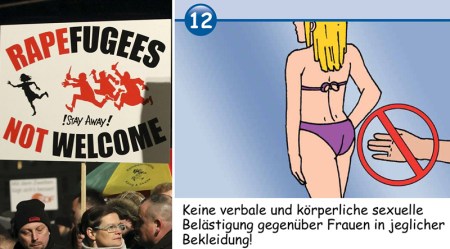 In January, there were thousands of cases of migrants sexually assaulting women in Germany, including many that took place in public pools. The government began to face a rising voter backlash to the open-door migration policy, including public protests (left). In some areas, authorities have distributed cartoon guides, to “educate” migrants that sexual assault is not acceptable (right).
January 15. Finance Minister Wolfgang Schäuble, in an interview with the Süddeutsche Zeitung, signaled his determination to export Germany’s migrant problem by calling for a Europe-wide gas tax to help pay for the cost of hosting millions of migrants. He said:
“If the funds in national budgets and the European budget are not enough, then let us agree, for example, to raise a levy on every liter of gasoline at a certain level. If a country refuses to pay, I am still prepared to do it. Then we will build a coalition of the willing.”
January 16. Norbert Röttgen, chairman of the foreign affairs committee in the German Bundestag and a lawmaker in Angela Merkel’s Christian Democratic Union (CDU), called upon the government to create a Ministry for Migration, Integration and Refugees. He said the migrant crisis had developed into a “primary and permanent task for the state” and is of “decisive importance for the future of our country and Europe.”
January 16. A 19-year-old migrant from Afghanistan sexually assaulted four girls between the ages of 11 and 13 at an indoor swimming pool in Dresden. The migrant was arrested but then set free. A migrant from Syria sexually assaulted a 12-year-old girl in Mudersbach. A 36-year-old migrant sexually assaulted an eight-year-old girl in Mettmann.
January 16. A group of between six and eight African migrants ambushed three people leaving a discotheque in Offenburg. The migrants were ejected from the discotheque after female clients complained that the men were sexually harassing them. After they left, at around 4AM, the migrants attacked them with metal rods, street signs and garbage bins.
January 17. In an interview with Bild am Sonntag, the president of the federal criminal police, Holger Münch, said that the number of crimes in refugee shelters had increased “significantly” since 2015, when the migrant influx began. He said that the migrants mostly responsible were from the Balkans and North Africa, especially Algerians, Tunisians and Moroccans. He added that half the offenses at the refugee shelters were physical assaults, but that there was also a growing number of homicides and sexual crimes.
January 17. In an interview with the Süddeutsche Zeitung, former Bavarian Prime Minister Edmund Stoiber warned that Chancellor Angela Merkel will “destroy Europe” if she refuses to reduce the number of migrants entering Germany.
January 17. Berlin clergyman Gottfried Martens accused German politicians and church leaders of ignoring the persecution of Christians by Muslims in German refugee shelters. He said that the Christians were facing “verbal threats, threats with knives, blows to the face, ripped crucifixes, torn bibles, insults of being an infidel, and denial of access to the kitchen because of uncleanness.”
January 18. A 26-year-old Algerian man was the first person to be arrested in connection with a string of sexual assaults during New Year’s celebrations in Cologne. He was apprehended at a refugee shelter in the nearby town of Kerpen. Cologne’s chief prosecutor, Ulrich Bremer, said that nearly 500 women had come forward with allegations of sexual assault, including three cases of rape.
January 18. A 24-year-old migrant from Sudan was released after being held for questioning at a police station in Hanover. After crossing the street, the man, who receives 300 euros ($335) a month in social welfare benefits, dropped his pants and exposed himself in public and shouted, “Who are you? You cannot do anything to me. Whatever I cannot get from the state, I will steal.”
January 19. Addressing the European Parliament in Strasbourg, European Council President Donald Tusk warned that the European Union had “no more than two months” to get control over the migration crisis or face the collapse of the Schengen passport-free travel zone.
January 19. A poll published by Bild showed that support for Chancellor Angela Merkel’s conservative bloc was down 2.5 points at 32.5%, its lowest result since the 2013 election. The poll showed that support for the anti-immigration Alternative for Germany (AfD) was up 1 point at 12.5%; support for the Social Democrats was up 1 point at 22.5%.
January 19. A 28-year-old migrant from Iran pushed a 20-year-old woman onto the tracks of an oncoming train in Berlin. She later died.
January 20. Bild reported that migrants invaded female changing rooms and showers at two public swimming pools in Leipzig. Migrants, dressed in their street clothes and underwear, also jumped into the swimming pools. According to Bild, the city hall had tried to keep the incidents quiet, but details were leaked to the media.
January 21. More than 200 migrants have sued the German government for delays in processing their asylum applications.
January 22. Facing political pressure over the migrant crisis, Chancellor Angela Merkel met in Berlin with Turkish Prime Minister Ahmet Davutoglu to discuss ways to stem the flow of Syrian and other refugees from Turkish shores. She renewed a pledge to provide Turkey with financial support. In November 2015, EU leaders pledged 3 billion euros ($3.4 billion) to Ankara to help care for an estimated 2.5 million Syrian refugees in Turkey; the deal has been delayed by a dispute among EU member states over who will pay.
January 22. A report by municipal authorities in Zwickau that was leaked to Bild revealed that migrants were defecating in public swimming pools. Security cameras also filmed migrants harassing women in the public sauna and attempting to storm the female dressing room.
January 22. Police in Hanover investigated four nightclub bouncers for allegedly beating an 18-year-old Algerian migrant after he tried to steal the purses of two teenage girls. Two days before the incident, the migrant had been sentenced to one year in juvenile detention for robbery, but he was free to roam the streets until his sentence began.
January 22. A migrant attempted to rape a 16-year-old girl in Feuerbach district of Stuttgart, and in downtown Stuttgart, four migrants sexually assaulted a 23-year-old woman.
January 23. The Süddeutsche Zeitung reported that migrants had attacked women in 12 of Germany’s 16 states on New Year’s Eve. In addition to the attacks Cologne, 195 women filed complaints in Hamburg; 31 in Hesse; 27 in Bavaria; 25 in Baden-Württemberg; 11 in Bremen; and six in Berlin.
January 23. Two migrants sexually assaulted an 18-year-old woman in Wiesbaden, and a 35-year-old migrant sexually assaulted a woman in a restroom on a train in Düsseldorf.
January 23. The Stuttgarter Nachrichten reported that dental work for migrants could end up costing German taxpayers billions of euros.
January 24. An official police report leaked to The Huffington Post showed that Interior Minister Thomas de Maizière was not being truthful when he said that between 100 and 200 migrants are being denied entry into Germany each day. The report stated that since September 14, border police had prevented 7,185 migrants from entering the country — or only about 60 migrants turned away each day.
January 25. A 30-year-old migrant from North African exposed himself to a 19-year-old woman on a public bus in Marburg, and then to passersby at the main train station.
January 26. In an interview with the German public radio, Deutschlandfunk, retired public media personality Wolfgang Herles admitted that public broadcasters receive “instructions from above” when it comes to reporting the news:
“We have the problem that we are too close to the government. The topics we cover are determined by the government. But many of the topics the government wants to prevent us from reporting about are more important than the topics they want us to cover…
“We must report in such a way that serves Europe [the European Union] and the common good, as it pleases Mrs. Merkel. There are written instructions … today we are not allowed to say anything negative about the refugees. This is government journalism, and this leads to a situation in which the public loses their trust in us. This is scandalous.”
Previously, Claudia Zimmermann, a reporter with the public television broadcaster WDR, said that public media outlets in Germany “have been warned to report the news from a pro-government perspective.”
January 26. A 24-year-old man on an evening stroll with his three-month-old baby daughter in the Eißendorf district of Hamburg was approached by two migrants who demanded his wallet and cellphone. When he said he was not carrying any valuables, the migrants attacked him with a knife. Fleeing for his life, the man ran onto a frozen pond and broke through the ice. A passerby heard the man calling for help. The baby, under water for an extended period, was revived by paramedics called to the scene. The baby remains in intensive care; the migrants remain at large.
January 26. A 28-year-old migrant from Algeria applied for asylum in Wesel. Authorities became suspicious because of his proficiency in German. They later determined that he had arrived in Germany in November 2014, rather than, as he claimed, in October 2015. It emerged that he had outstanding warrants for theft, but evaded police by using six different identities.
January 26. The Kieler Nachrichten reported that the proliferation of sexual assaults by migrants has women in the northern city of Kiel afraid to be out at night because the city is too dark. In an effort to save electricity, municipal officials decided to convert all of the city’s street lights to LED bulbs, but they do not provide sufficient light to keep the streets illuminated at night.
January 26. The mayor of Freiburg, Dieter Salomon, ordered police to take a hard line against migrants accused of snatching purses and assaulting women in the city’s discotheques. According to club owners, migrants have been robbing women on the dance floor and raping them in the restrooms. Many of the offenders are allegedly underage migrants from North Africa. Club owners say that the migrants are not afraid of authority: “They know that nothing will happen to them here.”
January 27. A 39-year-old migrant from Afghanistan tried to enter Germany at Simbach, a town on the border of Austria. A background check determined that in May 2000, a German court had sentenced the man to an eight-year prison term for rape. He had been deported to Afghanistan in 2006 with orders never to return.
January 27. The public radio and television channel, Mitteldeutscher Rundfunk, reported that German taxi drivers are profiting from the migrant crisis by taking migrants to doctors’ appointments and asylum interviews. The cab fares are being paid for by German taxpayers. MDR reported on a taxi company in Leipzig that had billed the government for 800 taxi fares for taking migrants to run errands. One taxi driver, for example, drove a migrant family on an 80 km (50 mile) journey for an appointment with migration authorities. The meter was left running while the driver waited for the migrants to return from their meeting. The fare was 309 euros ($344).
January 28. Bild reported that politicians in Kiel had ordered the police to overlook crimes perpetrated by migrants. According to the paper, the police in North Rhine-Westphalia and Lower Saxony have also been instructed to be lenient to criminal migrants.
January 28. A migrant from Sudan sexually assaulted a female police officer in Hanover as she was attempting to arrest him for theft. Public prosecutor Thomas Klinge confirmed the incident. “Such brazen behavior towards a police officer has been unheard of until now,” he said.
January 28. Berlin’s Tempelhof airport, the iconic site of the Berlin Airlift in 1948-49, is set to become the biggest refugee shelter in Germany. In a controversial move to alter the airport’s zoning regulations, Berlin’s municipal government — run by a coalition between the Christian Democratic Union and the Social Democratic Party — voted to build five massive structures to house 7,000 migrants there. Opposition politicians said the government was creating an “immigrant ghetto” in the heart of Berlin.
January 28. Police in Berlin said that a volunteer with the charity group Moabit Hilft hadfabricated a story about a 24-year-old migrant said to have died while waiting for days outside an asylum registration office. The story was allegedly faked in an effort to embarrass the government for its slow response to the migrant crisis.
January 29. The European Commission, the powerful administrative arm of the European Union, said that the sexual assaults in Cologne had nothing to do with the migrant crisis and were simply a matter of public order. A confidential memo leaked to The Telegraph stressed the importance of the Commission’s “continuing role in sounding the voice of reason to defuse tensions and counter populist rhetoric.” The Commission called for “the unconditional rejection of false associations between certain criminal acts, such as the attacks on women in Cologne on New Year’s Eve, and the mass influx of refugees.”
January 29. A public vocational school in the Wilhelmsburg district of Hamburg cancelled plans to host classes for refugees after male migrants sexually harassed dozens of female students at the school.
January 29. The German news magazine Focus published the results of a poll showing that 40% of Germans want Chancellor Angela Merkel to resign because of her migrant policies.
January 30. A gang of migrants on a Munich subway train were filmed attacking two elderly men who tried to stop them from groping a woman. Images show the migrants grabbing two men by the arms and neck and shouting abuse at them. It later emerged that the migrants were from Afghanistan; although they had been denied asylum in Germany four years ago, the German government refused to deport them because Afghanistan is “too dangerous.”
January 31. The Interior Minister of Saxony-Anhalt, Holger Stahlknecht, of the Christian Democrats, announced that he would delay releasing the 2015 crime statistics until March 29, two-and-half weeks after regional elections. The statistics are normally released in February or early March. Rüdiger Erben of the Social Democrats said: “The late release date reinforces my suspicion that the statistics are horrific.”
January 31. ISIS sympathizers defaced more than 40 gravestones at a cemetery in Konstanzwith slogans such as, “Germans out of Syria,” “Christ is Dead” and “Islamic State.”
January 31. A 30-year-old German, originally from Turkmenistan, raped a seven-year-old girl in Kiel. The man kidnapped the girl from a school playground at 11AM, took her to his apartment and, after abusing her, set her free. It later emerged that the man, who is the father of two children, had been accused of sexually assaulting a five-year-old girl at another kindergarten in Kiel on January 18, but the public prosecutors failed to pursue the case due to insufficient evidence. “In hindsight, we regret that decision,” the prosecutors said.
January 31. In an underhanded effort to silence critics of the government’s open door migration policy, Vice Chancellor Sigmar Gabriel called on German intelligence to begin monitoring the Alternative for Germany (AfD), the third-largest party in Germany. The AfD is surging in popularity because of its anti-immigration platform.






 anneinpt
 artaxes
 danmillerinpanama
 davidking1530
 Peter Hofman
 Joseph Wouk
 Peter
Peter Louisiana Steve
 WarSclerotic
Recent Comments