Archive for February 8, 2016

Report: Netanyahu Fears ‘Lame Duck’ Obama May Try to Impose Two-State Solution

February 8, 2016

Report: Netanyahu Fears ‘Lame Duck’ Obama May Try to Impose Two-State Solution

by Aaron Klein

7 Feb 2016

Source: Report: Netanyahu Fears ‘Lame Duck’ Obama May Try to Impose Two-State Solution

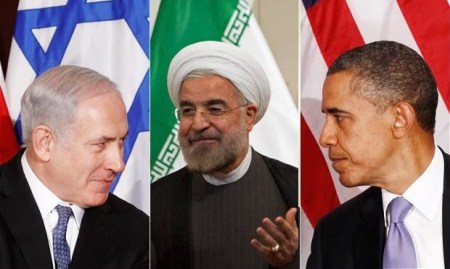
TEL AVIV – Israeli Prime Minister Benjamin Netanyahu is reportedly concerned that the Obama administration may attempt to impose a solution to the Israeli-Palestinian conflict before Obama leaves office.

Citing an Army Radio report on Sunday, the Times of Israel writes that Netanyahu believes Obama may make his move during his “lame duck” period between the American presidential elections and the new president’s inauguration.

His concerns focus on the UN, where rumors have been flying that an upcoming Security Council resolution will define the parameters of a two-state solution based on the 1967 borders, effectively handing the Palestinians the concessions they want from Israel without any reciprocity.  The 1967 borders refer to the West Bank, Gaza Strip and eastern sections of Jerusalem.

Such resolutions are not uncommon at the UN, but the United States has long exercised an “automatic veto” on them, holding that the conflict must be resolved by direct negotiations between the two sides.

The Times also reports that Israeli media has speculated that the UN moves will be coordinated with a renewed push for peace by Secretary of State John Kerry. If the initiative fails, writes the Times, “the Obama administration might try to impose some kind of accord.”

The State Department has denied the reports.

Israeli opposition leader Isaac Herzog appeared to confirm at least party of the report, saying that Kerry – who he met with last week – may make another push for negotiations. If Netanyahu does not respond, he said, “We’ll have an accord imposed upon us.”

Aaron Klein is Breitbart’s Jerusalem bureau chief and senior investigative reporter. He is a New York Times bestselling author and hosts the popular weekend talk radio program, “Aaron Klein Investigative Radio.” Follow him on Twitter @AaronKleinShow. Follow him on Facebook.

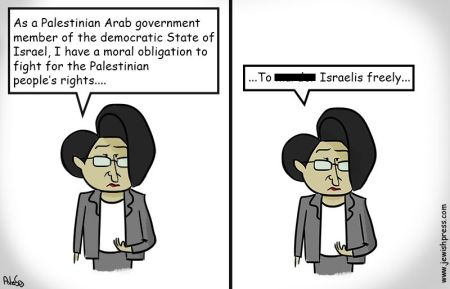
Cartoon of the Day

February 8, 2016

H/t The Jewish Press


Arab MK loyalty

Israeli Arab MK Ahmed Tibi Hosted at White House, State Dept. — Video

February 8, 2016

Israeli Arab MK Ahmed Tibi Hosted at White House, State Dept. — Video, Israel National NewsHana Levi Julian. February 8, 2016

Arab MKArab MK Ahmed Tibi on the Temple Mount with PLO flag. Photo Credit: Channel 2: Taamar Abidat

Israel Joint Arab List MK Ahmed Tibi was hosted for meetings over the past several days in Washington DC by officials at the White House and State Department.

Tibi met with U.S. President Barak Obama’s chief adviser to the Middle East, Robert Malley, and other senior officials at the White House.

The Israeli Arab lawmaker met with U.S. Special Envoy for Israeli-Palestinian Negotiations Frank Lowenstein, and Christopher Henzel, director of the Office of Israel and Palestinian Affairs, at the State Department as well.

“Simultaneously with our struggle within Israel, the Knesset and outside it, it is necessary to spread the word regarding the Arab public’s situation and distress to the international community, including the United States,” Tibi told journalists at a news conference.

He spoke about the “institutionalized discrimination against Arab citizens in all walks of life, including the demolition of homes, the lack of employment and racist legislation.

“Once again I found a lack of knowledge on our social and political situation, and this requires all of us to increase our efforts in the important international forum,” Tibi said.

“There is not a single member of the current Israeli government, including [Prime Minister Benjamin] Netanyahu, who publicly supports the vision of the two states and the establishment of an independent Palestinian state; whereas all the Palestinian ministers support that vision,” he added.

It is especially important for readers to understand exactly who MK Tibi is, and which “struggle” he refers to when he appears in the White House and the State Department to lobby for “his people.”

Tibi — who is currently Deputy Speaker of the Knesset and paid generously with Israeli taxpayer money – was seen at a September 2011 Palestinian Authority event carried on PA TV openly praising Arab terrorists with the symbol of the late PLO Chairman Yasser Arafat (the black-and-white keffiyeh) around his neck. The footage is provided and his remarks are translated by thePalestinian Media Watch (PMW) monitoring organization.


“Nothing is more exalted than those whom Israel dubs ‘terrorists-shahids,’” he said. In local Arab culture, the word – which literally translates as “martyrs” – is used to refer to those who die while trying to murder Israelis. “In the history and struggles of nations, the shahid is the ultimate glory,” Tibi told his audience at that time. “There is no value more August than the Shahada (the act of dying for Allah.) The shahid is the trailblazer, drawing with his blood the path to freedom and liberation. The shahid is the symbol of the homeland.”

While Tibi has been visiting with U.S. officials his party colleagues in Israel were visiting with the families of Arabs who were killed while carrying out terror attacks against Israelis.

This past weekend, Prime Minister Benjamin Netanyahu requested Attorney General Avichai Mandelblit weigh the possibility of taking legal steps against Israeli Arab MKs Hanin Zoabi, Jamal Zahalka and Basel Ghattas of the Joint Arab List in connection with their visit last Tuesday to the families of several Arab terrorists.

Iraqi MP Mish’an Al-Jabouri: I Took Millions of Dollars in Bribes, All Iraqi Politicians Do

February 8, 2016

Iraqi MP Mish’an Al-Jabouri: I Took Millions of Dollars in Bribes, All Iraqi Politicians Do, MEMRI-TV via You Tube, February 7, 2016


According to the blurb beneath the video,

In a TV interview, Iraqi MP Mish’an Al-Jabouri admitted that he had taken millions of dollars in bribes. In a January 26 interview with Al-Etejah TV, MP Al-Jabouri claimed that all Iraqi politicians take bribery and that only a coward would not. He claimed that the entire political echelon is corrupt and responsible for the destruction of the country. Al-Jabouri is a member of the Iraqi Commission of Integrity, tasked with investigating governmental corruption. He refused to disclose names of fellow corrupt politicians for fear that “they will kill me right in the street.”


An Exasperated John Kerry Throws In Towel On Syria: “What Do You Want Me To Do, Go To War With The Russians?!”

February 8, 2016

An Exasperated John Kerry Throws In Towel On Syria: “What Do You Want Me To Do, Go To War With The Russians?!”

Submitted by Tyler Durden on 02/07/2016 23:48 -0500

Source: An Exasperated John Kerry Throws In Towel On Syria: “What Do You Want Me To Do, Go To War With The Russians?!” | Zero Hedge

“Russian and Syrian forces intensified their campaign on rebel-held areas around Aleppo that are still home to around 350,000 people and aid workers have said the city – Syria’s largest before the war – could soon fall.”

Can you spot what’s wrong with that quote, from a Reuters piece out today? Here’s the problem: “could soon fall” implies that Aleppo is on the verge of succumbing to enemy forces. It’s not. It’s already in enemy hands and has been for quite some time. What Reuters should have said is this: “…could soon be liberated.”

While we’ll be the first to admit that Bashar al-Assad isn’t exactly the most benevolent leader in the history of statecraft, you can bet most Syrians wish this war had never started and if you were to ask those stranded in Aleppo what their quality of life is like now, versus what it was like in 2009, we’re fairly certain you’ll discover that residents aren’t particularly enamored with life under the mishmash of rebels that now control the city.

In any event, Russia and Iran have encircled Aleppo and once it “falls” (to quote Reuters) that’s pretty much it for the opposition. Or at least for the “moderate” opposition. And the Saudis and Turks know it.

So does John Kerry, who is desperate to restart stalled peace negotiations in Geneva. The problem for the US and its regional allies is simple: if Russia and Iran wipe out the opposition on the battlefield, there’s no need for peace talks. The Assad government will have been restored and that will be that. ISIS will still be operating in the east, but that’s a problem Moscow and Tehran will solve in short order once the country’s major urban centers are secured.

As we noted on Saturday, Riyadh and Ankara are extremely concerned that the five-year-old effort to oust Assad is about to collapse and indeed, the ground troop trial balloons have already been floated both in Saudi Arabia and in Turkey. For their part, the Russians and the Iranians have indicated their willingness to discuss a ceasefire but according to John Kerry himself, the opposition is now unwilling to come to the table.

Don’t blame me – go and blame your opposition,’” an exasperated Kerry told aid workers on the sidelines of the Syria donor conference in London this week.

America’s top diplomat also said that the country should expect another three months of bombing that would “decimate” the opposition, according to Middle East Eye who also says that Kerry left the aid workers with “the distinct impression” that the US is abandoning efforts to support rebel fighters.

In other words, Washington has come to terms with the fact that there’s only one way out of this now. It’s either go to war with Russia and Iran or admit that this particular effort to bring about regime change in the Mid-East simply isn’t salvageable.

“He said that basically, it was the opposition that didn’t want to negotiate and didn’t want a ceasefire, and they walked away,” a second aid worker told MEE.

“‘What do you want me to do? Go to war with Russia? Is that what you want?’” the aid worker said Kerry told her.

MEE also says the US has completely abandoned the idea that Assad should step down. Now, apparently, Washington just wants Assad to stop using barrel bombs so the US can “sell the story to the public.” “A third source who claims to have served as a liaison between the Syrian and American governments over the past six months said Kerry had passed the message on to Syrian President Bashar al-Assad in October that the US did not want him to be removed,” MEE says. “The source claimed that Kerry said if Assad stopped the barrel bombs, Kerry could ‘sell the story’ to the public, the source said.”

Of course Kerry won’t be able to “sell” that story to the Saudis and the Turks, or to Qatar all of whom are now weighing their oppositions as the US throws in the towel. “Kerry’s mixed messages after the collapse of the Geneva process have put more pressure on Turkey and Saudi Arabia,” MEE concludes. “Both feel extreme unease at the potential collapse of the opposition US-recognised Free Syrian Army.”

And so, as we said earlier this week, it’s do or die time for Riyadh, Ankara, and Doha. Either this proxy war morphs into a real world war in the next two weeks, or Aleppo “falls” to Assad marking a truly humiliating defeat for US foreign policy and, more importantly, for the Saudis’ goal of establishing Sunni hegemony in the Arabian Peninsula.

The only other option is for John Kerry to face the Russians in battle. As is evident from the sources quoted above, Washington clearly does not have the nerve for that.

Iran Infiltrates the West Bank

February 8, 2016

Iran Infiltrates the West Bank

by Khaled Abu Toameh

February 8, 2016 at 5:00 am

Source: Iran Infiltrates the West Bank

  • “The Patient Ones,” Al-Sabireen, are seeking Palestinians as a group to become an Iranian proxy in the region, and redoubling efforts to eliminate the “Zionist entity” and replace it with an Islamist empire.
  • Loosed from its sanction-based constrictions, Iran is now free to underwrite terror throughout the region. This is precisely what is happening in Lebanon, Syria, Yemen, Iraq and the West Bank and Gaza Strip.
  • Iran’s infiltration of the West Bank should serve as a red flag not only for Israel, but also for the U.S. and other Western powers. An Israeli pullout, leading to a Hamas takeover of the West Bank, has been a subject of concern. Now, a growing number of Israelis and Palestinians are wondering if such a vacuum will provide an opening for Iran.

Emboldened by its nuclear deal with the world powers, Iran is already seeking to enfold in its embracing wings the Arab and Islamic region.

Iran’s capacity for intrusions having been starved by years of sanctions. Now, with the lifting of sanctions, Tehran’s appetite for encroachment has been newly whetted — and its bull’s-eye is the West Bank.

Iran has, in fact, been meddling for many years in the internal affairs of the greater region. It has been party to the civil wars in Yemen and Syria, and, through the Shiite Muslims living there, continues actively to undermine the stability of many Gulf states, including Saudi Arabia and Bahrain.

The lives of both the Lebanese and the Palestinians are also subject to the ambitions of Iran, which fills the coffers of groups such as Hezbollah and Islamic Jihad.

Until recently, Iran held pride of place as Hamas’s primary patron in the Gaza Strip. It was thanks to Iran’s support that Palestinian Islamist movement, Hamas, held hostage nearly two million Palestinians living in the Strip. Moreover, this backing enabled Hamas to smuggle all manner of weapons into the Gaza Strip, including rockets and missiles that were aimed and fired at Israel.

But the honeymoon between Iran and Hamas ended a few years ago, when Hamas refused to support the regime of Syrian President Bashar Assad — Tehran’s major ally in the Middle East — against the Syrian opposition. Since then, the Iranians, who have lost confidence in their erstwhile Hamas allies, have been searching among the Palestinians for more loyal friends. And they seem to have found them: Al-Sabireen (“the Patient Ones”).

Al-Sabireen, Iran’s new ally, first popped up in the Gaza Strip, where they recruited hundreds of Palestinians, many of them former members of Hamas and Islamic Jihad. Palestinian sources report that Al-Sabireen has also succeeded in enlisting many disgruntled Fatah activists who feel betrayed by the Palestinian Authority (PA) and its president, Mahmoud Abbas. This sense of betrayal is the fruit of the PA’s failure to pay salaries to its former loyalists. In addition, anti-Israel incitement and indoctrination in mosques, social media and public rhetoric has radicalized Fatah members and driven them into the open arms of Islamist groups.

The Iranian-backed Al-Sabireen is already a headache for Hamas. The two terror groups share a radical ideology and both seek to destroy Israel. Nonetheless, Al-Sabireen considers Hamas “soft” on Israel because it does not wage daily terror attacks against its citizens. The “Patient Ones” are seeking Palestinians as a group to become an Iranian proxy in the region.

Al-Sabireen’s Gaza commander, Ahmed Sharif Al-Sarhi (left), was responsible for a series of shooting attacks on Israel before he was fatally shot in October 2015 by IDF snipers along the border with the Gaza Strip. The Iranians are also believed to have supplied their new terrorist group in the Gaza Strip with Grad and Fajr missiles (right) that are capable of reaching Tel Aviv.

Buoyed by the nuclear deal and the lifting of sanctions against Tehran, Al-Sabireen members are feeling optimistic. The group recently described these developments as a “victory” for all Muslims and proof of their “pride and strength.” Muslims should now unite, they said, in order to stand up to the “world’s arrogance and remove the Zionist entity from the land of Palestine.”

Indeed, Al-Sabireen appears to be redoubling its efforts to eliminate the “Zionist entity” and replace it with an Islamist empire. Toward that goal, the group is now seeking to extend its control beyond the Gaza Strip. The lifting of the sanctions against Iran coincided with reports that Al-Sabireen has infiltrated the West Bank, where it is working to establish terror cells to launch attacks against Israel.

According to Palestinian Authority security sources, Al-Sabireen has already located some West Bank Palestinians who were more than happy to join the group’s jihad against Jews and Israel.

PA security forces recently uncovered a terror cell belonging to Al-Sabireen in Bethlehem and arrested its five members. The suspects received money from the group’s members in the Gaza Strip in order to purchase weapons to attack Israeli soldiers and settlers in the West Bank.

Al-Sabireen is not the only Iranian proxy whose eye is on the West Bank. Last month, in the West Bank city of Tulkarm, Israeli security forces uncovered and broke up a terrorist cell commanded by Hezbollah, which was planning suicide bombings and shooting attacks. The Palestinian members of the cell had been taught by Jawed Nasrallah, the son of Hezbollah chief Hassan Nasrallah, how to carry out suicide bombings, assemble bomb vests, gather intelligence, and set up training camps.

All of this sounds eerily familiar. As it has spread its wings over Al-Sabireen and Hezbollah, Iran has done much the same with its other proxies such as the Houthis in Yemen and members of the Shiite communities in Saudi Arabia and Bahrain, all the while fomenting instability and gaining bases of local power.

Loosed from its sanction-based constrictions, Iran is now free to underwrite terror throughout the region. This is precisely what is happening in Lebanon, Syria, Yemen, Iraq and the West Bank and Gaza Strip.

Iran’s infiltration of the West Bank should serve as a red flag not only for Israel, but also for the U.S. and other Western powers. At the moment, there is little to be done to combat Iran’s presence in the Gaza Strip. But Iran on Israel’s West Bank doorstep is a flag of a different color.

An Israeli pullout, leading to a Hamas takeover of the West Bank, has been a subject of concern. Now, a growing number of Israelis and Palestinians are wondering if such a vacuum will provide an opening for Iran.

The future of the Middle East and Europe would be shockingly different if any Palestinian state were to fall into the hands of Iran’s Islamic extremists and their allies.

The Palestinians and all interested parties might remember that Al-Sabireen is — if nothing else — patient.

Khaled Abu Toameh is an award winning journalist based in Jerusalem.

WATCH: ‘Do we have to hijack your planes again?’ Fatah official asks

February 8, 2016

Do we have to hijack your planes again?’ Fatah official asks Former negotiator Nabil Shaath slams Western indifference to Mideast suffering, says US ‘has never been an honest broker’ in peace talks

By Times of Israel staff February 8, 2016, 4:43 am

Source: WATCH: ‘Do we have to hijack your planes again?’ Fatah official asks | The Times of Israel

Former Palestinian negotiator Nabil Shaath in a February 1 interview with the Palestinian Authority's Awdha TV. (Screen capture/YouTube/MEMRI)

Former Palestinian negotiator Nabil Shaath in a February 1 interview with the Palestinian Authority’s Awdha TV. (Screen capture/YouTube/MEMRI)

ormer Palestinian peace negotiator Nabil Shaath said in an interview earlier this month that he often asks Westerners whether Arabs have to “hijack your planes and destroy your airports again” to make the world take notice of the Palestinian cause.

In a February 1 interview with the Palestinian Authority’s Awdha TV, translated by MEMRI, Shaath slammed American efforts at Israeli-Palestinian peacemaking.

 Asked about a French proposal for an international peace conference, Shaath replied, “Well, anything is better than American control of the negotiations. Anything. The US has never been a reliable honest broker. Never. It is the strategic ally of Israel. Period. Therefore any discussion of a different formula is a positive thing.”

But, he added, “an international conference is not what is needed. What is needed is a smaller framework. Today, at the African Union summit, President [Mahmoud] Abbas reiterated that we want something similar to the 5+1 framework” of six world powers who negotiated the nuclear deal with Iran.

“Like it or not, the US will be part of it. But we want France, Germany, Britain, the EU, Russia, China, Brazil, India. From the Arab countries we want Egypt at least. We want a small international framework.”

Shaath then turned to what he described as Western apathy toward suffering in the Middle East.

“If the Syrian problem had not been exported to Europe through the refugees on the one hand and terrorism on the other, the Europeans would not have cared even if the entire Syrian people had died,” he charged.

“But when all of a sudden there were four million Syrian refugees in Europe, 1.2 million of them in Germany alone, and when this was accompanied by Islamic State operations in France and elsewhere, all these countries began to fear that IS might have infiltrated through the refugees. And this started a debate about racial transformation in Europe with the entrance of non-white, non-European, non-Anglo-Saxon races, like the Syrian refugees, the Africans and others. This is what made the Syrian problem the most pressing from their perspective.”

He added: “I always say to these people, after I tell them about Syria and IS: ‘Do we have to hijack your planes and destroy your airports again to make you care about our cause? Are you waiting for us to cut off your oil supply? You always wait for things to reach boiling point and explode, causing you harm, before you intervene to end the crimes and violations.’”

Shaath served as the PA’s first foreign minister, and has served as a top peace negotiator and an influential member of the Fatah Central Committee.

Obama backtracks on Israel defense package to counter Iran nuclear deal

February 8, 2016

Source: Obama backtracks on Israel defense package to counter Iran nuclear deal

DEBKAfile Exclusive Report February 8, 2016, 10:19 AM (IDT)

US President Barack Obama has retracted on his pledge of an extra defense package to compensate Israel for the damage caused its security by the nuclear deal concluded with Iran last year. 

This flat refusal, reported here by debkafile’s Washington sources, confronted Israeli officials when they met last week with heads of the National Security Council at the White House.

Asked to define its new requirements, Israel asked the administration for an additional $1.9 billion, which would have upped the total to $5 billion per annum for the next five years. The officials explained that Israel’s defense bill had been inflated substantially by the new perils looming from the current Middle East wars, and the windfall Iran had gained from the lifting of sanctions for its advanced ballistic missiles programs and for enhancing its allies’ aggressive capacity, especially that of Hizballah.

Israel is now beset additionally by adverse Russian military operations in southern Syria and looming ISIS threats on multiple fronts, at a time that the Arab states are stuffing their armories with advanced weapons from Russia and China.
The US officials explained that, because of cutbacks in US defense spending, it would not be possible to add a single dollar to Israel’s regular $3.1 billion appropriation. After notifying Prime Minister Binyamin Netanyahu and Defense Minister Moshe Ya’alon of this refusal, the Israeli delegation was advised to reduce its application to $900 million. This too was refused.

The standing $3.1 billion annual US assistance program for Israel expires at the end of 2016. The negotiations taking place currently were to have covered its extension for ten years. That too is in doubt.

In his report to the cabinet meeting Sunday, Jan. 7, the prime minister said that if Israel’s security needs were not met, he would not sign a deal and would prefer to wait for the next US president to take office in January 2017.
Although Netanyahu did not say so explicitly, this issue will no doubt play into the election campaign for the next American president. The prime minister hopes that the leading candidates, whether Democrats or Republican, will be more forthcoming about Israel’s defense needs.
US officials reacted angrily to Netanyahu’s comment, warning that the US budgetary situation would not improve and that Israel would not find a president more committed to its security than Barack Obama.

This is the line customarily taken by the president and Secretary of State John Kerry when issues come up with the Netanyahu government.

IMoshe Ya’alon is due to visit Washington in March for talks with Defense Secretary Ashton Carter and will no doubt try to soften the US refusal.  Our sources report that the Secretary has been advised by the White House not to make any concessions. Towards the end of March, Netanyahu had arranged to attend the conference of the pro-Israeli lobby AIPAC. That is no longer certain. And even if he does go to Washington, there is no telling if he will ask to see the president for a last-ditch bid for the extra military assistance.
Obama is in no mood to change his mind. Administration officials have laid the ground for his position by underestimating the amounts released to Iran by the lifting of sanctions as no more than around $50 billion, whereas Israel, whose concern strong reflects that of Saudi Arabia and the Gulf Emirates, says the real sum on tap for Tehran is double or even triple that amount.

They all confirm that the lion’s sure is going directly into developing Iran’s cutting-edge weaponry.
That Obama administration policies have substantially promoted Iran’s political and military interests and exacerbated its menace to the region is an argument that finds no listeners in the Washington of today, whether it comes from Israel or the Persian Gulf.