Archive for January 22, 2016

Report: Turkey suspects Russia building air base near border with Syria

January 22, 2016

Report: Turkey suspects Russia building air base near border with Syria

January 22, 2016, Friday/ 14:41:44/ TODAY’S ZAMAN

Source: Report: Turkey suspects Russia building air base near border with Syria

 Report: Turkey suspects Russia building air base near border with Syria

Turkish troops and military vehicles are seen on the Turkish-Syrian border near the Syrian town of Qamishli in this May 2015 file photo. (Photo: DHA)

Turkish authorities reportedly have intelligence suggesting that Russia might be preparing to establish an air base close to Turkey’s border with Syria, a step likely to deepen tensions that flared between the two countries after Turkish warplanes downed a Russian fighter jet in November last year, according to a report.

A Russian delegation led by a lieutenant general flew to the northern Syrian town of Qamishli, right across the border from Nusaybin in southeastern Turkey, on Jan. 16, a news report published in the Hürriyet daily said, quoting unnamed security sources.

Qamishli is being controlled by the Democratic Union Party (PYD), a Syrian Kurdish group that is linked to the Kurdistan Workers’ Party (PKK) terrorist group. Ankara opposes PYD efforts to expand its influence in northern Syria, saying it is a terrorist organization that is no different from the Islamic State in Iraq and the Levant (ISIL).

The Russian delegation conducted extensive inspections in and around the airport in Qamishli, according to the sources. The delegation, which included officials from Russian military intelligence, was accompanied by representatives from the PYD.

Turkish sources suspect that the delegation’s visit is a part of Russian plans to renovate the airport in the town so that it can be turned into a base for warplanes and military cargo planes. This would also entail the installation of radars that would be able to closely monitor Turkish military activities in the area.

After reports that Russia deployed troops to YPG-controlled Qamishli, the Turkish military reinforced the Syrian border with additional tanks and armored vehicles and has started to dig trenches on the border as a security measure.

The Turkish armed forces are now digging trenches on the Turkish side of the border opposite an airport in Qamishli. A large minefield lies between Nusaybin, a Turkish border town in the southeastern province of Mardin, and Qamishli in Syria.

The deployment of Russian troops and military experts to conduct examinations in Kurdish-controlled Qamishli has brought tension between the two countries to a dangerous new level, increasing the prospect of an inadvertent encounter in the area.

These events come after media reports yesterday of an agreement between the US and the YPG for the US to use an airfield in the YPG-controlled part of Hasakah province in northeastern Syria. US military experts are now working to expand the airfield so as to deploy American aerial vehicles, including UAVS, for strikes against ISIL.

The recent developments reveal the complicated nature of geopolitics and the rapidly shifting alignments in Syria’s combustible battlefield, with countless numbers of actors seeking to carve out zones of influence for themselves. Syrian Kurds, who have adopted a non-aligned stance in the Syrian civil war, have cultivated close ties with both the US and Russia to further their own interests, which involve establishing a separate political zone for the Kurdish people.

Speaking in a parliamentary session on Thursday, Deputy Prime Minister Tuğrul Türkeş confirmed Russia’s deployment of a small contingent force in Qamishli. But he played down the nature of the development, saying that a small-scale Russian military presence near the Turkish border is not a significant threat to NATO-member Turkey.

Russia’s foray into Syria’s prolonged war created a new conundrum both for Turkey and the US-led international coalition against the Islamic State in Iraq and the Levant (ISIL).

When a Russian bomber jet violated Turkish airspace after two previous incursions, it prompted Turkish air forces to shoot it down. Subsequently a major dispute broke out between the two nations, triggering a series of sanctions imposed by Moscow on Turkish trade goods.

Following the jet crisis Russia deployed cutting-edge S-400 air defense systems to Syria. This was a move meant to keep Turkish air forces out of Syrian airspace, and one which practically ruled out any Turkish contribution to Western coalition air strikes against ISIL targets in Syria. To avoid another incident, the US urged Turkey to suspend all its flights over Syria.

On Thursday, the US-led coalition carried out new air strikes against ISIL targets in Syria. On the same day, according to Turkish military sources, Russian jets pounded Turkmen positions in western Syria and rural Aleppo, in an intensifying campaign to uproot Western-backed moderate Syrian rebel groups, including Turkmen forces, to the dismay and fury of Turkey and the West.

Russia’s selective targeting of moderate groups has complicated the fight against ISIL, leading to renewed accusations from the West and Turkey, who say Moscow intends to destroy non-ISIL opposition groups rather than fighting the extremist ISIL militants.

Moscow denies charges of watering down its fight against ISIL.

Russian Foreign Ministry Spokesperson Maria Zakharova accused Turkey of sending militants to Syria to join terrorist groups such as the “al-Nusra Front.” She went on to claim that the recent Turkish efforts to build a wall are not intended to boost border security, but rather serve as shelter for terrorists and position from which terrorists can cross the border.

Turkey and Russia frequently engage in tit-for-tat accusations and recriminations over each other’s stance in the Syrian conflict, exacerbating the state of discord among them.


Erdoğan says Turkey will not allow Russia to settle north of Syria

January 22, 2016

Erdoğan says Turkey will not allow Russia to settle north of Syria

Source: Erdoğan says Turkey will not allow Russia to settle north of Syria – Daily Sabah

AA Photo

President Recep Tayyip Erdoğan said on Friday that Turkey will not allow Russia to build a base in northern Syria.

President Erdoğan was asked by reporters after the Friday prayer of what he thinks about claims that Russia will build a base in Northern Syria.

Erdoğan said that Turkey is aware that there are around 100 Russian soldiers deployed in northern Syria.

Erdoğan said that the PYD terror organization, which is known to be supported by Russia, is no different than the Daesh terror organization.

“There is no difference between them. We will also talk with Mr. Biden about this issue in detail tomorrow,” Erdoğan said.

He also emphasized that Qatar, Germany, France and the U.K. were part of the issue.

“We will not allow such a thing in northern Syria,” he said.

Erdoğan also touched upon the PKK’s terror attack on an elementary school which happened on early Friday in Turkey’s southeastern Diyarbakır province.

He said that the terror attack on the school showed the vicious plans of the terror organization.

Erdoğan said that the attack was also a response to the 1,128 academics who signed a petition that described security operations against the PKK in the country’s southeast as a “massacre.”

“They [the academics] say ‘This is who we are. We don’t have a problem with this issue. We are with terror’,” Erdoğan said.

“Our only consolation is that none of our children died during the attack,” he concluded.

Rouhani: Nuclear Deal ‘One of Iran’s Greatest Successes’ Against the West

January 22, 2016

Rouhani: Nuclear Deal ‘One of Iran’s Greatest Successes’ Against the West, AlgemeinerDavid Daoud, January 22, 2016

(The next time Obama touts the nuke “deal” as one of his greatest achievements, will he agree with Rouhani?– DM)

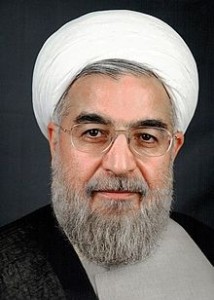
220px-Hassan_Rouhani-214x300Iranian President Hassan Rouhani. Photo: Wikipedia.

Iran’s president has expressed his complete satisfaction with the outcome of the nuclear deal reached between the Islamic Republic and world powers in July, regime-aligned Tasnim News Agency reported on Thursday.

Hassan Rouhani hailed the Joint Comprehensive Plan of Action (JCPOA) – which went into effect on Sunday – as “one of Iran’s greatest successes” against the West. He stressed that Iran had only agreed to the final version of the deal after “30 months of tough talks,” and that Tehran’s negotiators almost walked away three times.

Rouhani said that Iran had made sure the JCPOA would lead to the termination of the United Nations’ nuclear-related sanctions against Tehran, accomplishing the country’s long-term goals and objectives “without exception.”

Islam’s Sexual Abuses in Sweden and the “Cultural Challenge”

January 22, 2016

Islam’s Sexual Abuses in Sweden and the “Cultural Challenge” Front Page MagazineNima Gholam Ali Pour, January 22, 2016

yh (1)

It’s really no big secret how the majority of women are treated in the Middle East and in most of the Muslim world. It is also no big secret what the content of the Qur’an and Sunnah says about women and how these writings are interpreted today by a large portion of the Muslim world. At best, women are treated as second class citizens and as property.

******************

The sexual abuse incidents in Europe have exposed the logical flaws in the Swedish debate about immigration and they also show how unprepared Sweden and Europe are in facing the challenges that have arisen because of the migration crisis.

After women were assaulted by “asylum seekers” in several places in Europe, it emerged that it also had happened in Sweden. However, in Sweden this had happened in August 2015 at the “We are Sthlm”  festival where about 150 girls had been victims of sexual abuse by “refugee youths” from Afghanistan.

The reason that this August 2015 incident was not reported until January 2016, was because one of Sweden’s largest newspaper, Dagens Nyheter, and the Swedish police, who had access to the information, did not report these incidents to the public.

Dagens Nyheter is known as a newspaper that romanticizes immigration and multiculturalism but the actions of the police shocked many in Sweden, because the police are one of the institutions in Sweden that many Swedes have great confidence in. The explanation that the police chief Peter Ågren gave for not reporting the sexual abuses in August 2015 was:

“This is a sore point, sometimes, we do not dare to say how things really are because we believe it will play into the hands of the Sverigedemokraterna (Sweden Democrats). We have to take responsibility for this within the police.”

The fact that a Swedish police chief was making political considerations came as a shock to a country that never had to think about what political views the police have. In Sweden, the general view is that police chiefs who let their political views affect their job are found in other countries, mostly in dictatorships, and not in Sweden. That the police chief wants to disfavor the third largest party in the Swedish parliament just makes the situation even more uncomfortable. It must also be said that Sweden’s national police commissioner, since 2015, Dan Eliasson, holds openly hostile views against the fastest rising party in Sweden. One of the famous tweets of the national police commissioner is that he wants to “vomit” over the party-leader of the Sweden Democrats.

At the same time, the Swedish police’s work with newly arrived migrants is completely classified. It is impossible for Swedes to know about the security situation in the homes where “asylum seekers” are staying, or how many of the newly arrived migrants have broken the law.

But this whole situation also reveals much about the important role of culture in the immigration issue. The migration crisis has not only created huge economic costs. Large parts of Sweden and Europe have learned in a furious pace that all migrants coming into Europe have not become feminists or liberals when they crossed the border. Many migrants have brought their cultural framework which includes a clear “non-European” view of women.

It’s really no big secret how the majority of women are treated in the Middle East and in most of the Muslim world. It is also no big secret what the content of the Qur’an and Sunnah says about women and how these writings are interpreted today by a large portion of the Muslim world. At best, women are treated as second class citizens and as property.

During 2015, 70 percent of the 162,877 asylum seekers in Sweden came from Syria, Afghanistan and Iraq. Additionally, 64 percent of the Syrians, 82 percent of the Afghans and 73 percent of the Iraqis were men. The ordinary Muslim “refugee” to Sweden is a young man, so young Muslim men’s views against women in the Muslim world becomes relevant.

The Muslim countries’ legislation can be easily found on the Internet. There are thousands of books on what role women have in countries like Afghanistan and Iraq and the oppression they are enduring every day. Despite this, many in Sweden are surprised that this kind of sexual abuse has occurred. It is as if the Left in Sweden lacks any knowledge of how other cultures view women in other parts of the world.

One would hope that the fact that so many women have been attacked in Europe by young male asylum seekers would make the Swedish Left wake up. After the sexual abuses in Cologne Kerstin Weigl, the columnist for Sweden’s largest newspaper Aftonbladet, wrote:

“All men know that it is wrong to assault women. Yet it happens. It is done in different ways, based on different conceptions of what is accepted, what a man can allow himself, to get away with. But this is everyday life. And in at least me there is a reflex to avoid drunk Swedish men in group. The crucial difference is that Swedish women know that they can notify the police and be taken seriously.”

Two days after her column, where her message was that Swedish girls will “be taken seriously” by Swedish police, it emerged that the police had covered up sexual abuse against girls because the perpetrators were Muslim “asylum seekers”. The Swedish Left’s response to sexual abuse committed by “asylum seekers” has been to portray all Swedish men as rapists in to get away from the fact that those who were behind the latest sexual abuses have been “asylum seekers”. But it is an assertion that feels strange to the Swedish people, who have never seen similar sexual abuses like those committed by the newly arrived “asylum seekers”.

In addition to the Swedish Left’s lack of understanding that all the migrants who come to Sweden will not become feminists at the border, they have also completely missed the power relationships between cultures. 1.6 billion people are part of the Islamic cultural sphere. Sweden has approximately 9.5 million inhabitants. If someone comes to Sweden from a part of the Muslim world, and ends up in a situation where he/she has to choose between Islam and Sweden, the person will usually choose Islam, because Islam is the stronger party. What the Left in Sweden has missed is that the values of 1.6 billion people ends up being stronger than the values of 9.5 million Swedes.

As Sweden does not have a policy of assimilation and has not had any such policy since 1975, there are not many immigrants that are assimilated in the Swedish society and power relations between the Islamic world and Sweden makes it problematic for Muslims to voluntarily embrace the Swedish culture.

It is not only Swedish women who will face a “cultural challenge” in the coming years that will make their lives more frightening and insecure. Women and children who have immigrated to Sweden and live in accommodations for “asylum seekers” live risky and precarious lives as well. Despite the fact that the Swedish police does not report about the security situation in the accommodations of “asylum seekers”, there has been reports about rape attempts in these accommodations, in Swedish media.

The fact is that if you come into Europe and then migrate through safe countries all the way to Sweden, then you are not really a refugee. A refugee seeks refuge at the first safe country. Having thousands of frustrated young men with a medieval attitude towards women in a country where women have a liberal way of life creates the conditions for a cultural confrontation. We have already seen some of the consequences of such a cultural confrontation in the sexual abuses that occurred in different cities in Europe.

Sweden and Europe will learn that even if democracy, freedom, equality between women and men and human rights are things that are respected in Europe, there are cultural discourses in which these things are not respected. Sweden and Europe will learn in the near future, the hard way, why women do not go out alone on the streets of Kabul.

The difficulties that Europe will face is a consequence of ignorance and arrogance disguised as ideology. There has been an establishment that has had an illusion that people belonging to an expansionist civilization like Islam will come to Europe and then when they’re here, they’ll just embrace European values. The establishment in Europe has believed that young men who have been brought up with a medieval view towards women will suddenly start respecting women. This establishment is now colliding with reality and thus finds itself in an ideological crisis.

The multicultural ideology that gives influence to non-European cultures in European nations is under current circumstances a threat to Europe and the European nations’ identities and freedoms.

Europe and Sweden are compelled to embrace an ideology, because of the massive migration that has taken place, where the society has to stand up and support the national culture and let this culture continue to steer the development of society while having a workable policy of assimilation without empty phrases and political slogans, that can be implemented.

The sexual abuses, carried out by “asylum seekers”, in European cities are a part of a larger crisis that right now is about how women should dress, and how and where women should move, but in the long term it will be about issues that concern the entire European society. If European nations do not firmly confront this Islamic “cultural challenge,” then they will pay a much higher and painful price than they have done so far.

Ya’alon: The conflict might never be resolved

January 22, 2016

Ya’alon: The conflict might never be resolved Defense Minister pessimistic about Israel-Palestinian conflict, says it has no solution so long as the PA incites against Israel.

By Kobi Finkler

First Publish: 1/22/2016, 5:46 AM

Source: Ya’alon: The conflict might never be resolved – Defense/Security – News – Arutz Sheva

Ya’alon at WIZO conference                                               Eli Dassa

The conflict with the Palestinian Arabs will “never be solved” so long as the Palestinian Arabs continue to incite their children against Israel, Defense Minister Moshe Ya’alon said Thursday.

Speaking at the World WIZO conference in Tel Aviv, Ya’alon hailed Israel’s success in stopping mass terrorist attacks, a success which, he claimed, has caused the enemy to change its plans and carry out “lone wolf” attacks.

“Due to our success in preventing mass casualty terrorist attacks, our enemies are employing attacks by individuals. We will defeat this wave of terror as well. Israel has the ability to cope with any challenge and develop security measures to protect against all forms of terrorism,” he stressed.

He then went on to express a pessimistic view of the conflict with the Palestinians.

“As long as the Palestinians educate their children to hate us, to kill us, to admire the martyr – the conflict will never be resolved,” said the Defense Minister, adding, “We must implement a policy of the stick against terrorism and the carrot to Palestinians who simply want to live their lives. We must find a way to live our lives in which most Palestinians do not threaten us and benefit from the Israeli economy. We are here, they are here and we must learn to live together.”

Ya’alon also referred to the Hezbollah terror cell from Tulkarem which was exposed by Israeli security forces and was operating under guidelines received from Juad Nasrallah, son of Hezbollah leader Hassan Nasrallah.

“Hezbollah is indeed operating in Judea and Samaria, as do other terrorist groups such as the Islamic Jihad; they are all metastases of Iran. Hezbollah, via Iran, is trying to lure Palestinians and Israeli Arabs to carry out terror attacks within Israel,” he said.

As for Iran, the Defense Minister said that Iran is the greatest threat to Israel today, repeating comments he made earlier this week.

“While the nuclear program is currently suspended due to the agreement with the international community, within 10-15 years and possibly earlier than that, when they feel comfortable financially, they will continue to develop nuclear weapons,” he warned.

Meanwhile, stressed the Defense Minister, the Iranians are working to arm Hezbollah with missiles and weapons. “They finance Hamas in its jihadist war against Israel, and are also working along the northern border,” he said.

Finally, Ya’alon stressed the importance of Israeli public diplomacy within the international community in order to combat the Palestinian propaganda.

“The Marmara which was sent under the auspices of Turkey was made up of jihadists, European statesmen whom I call naive, and anti-Semites,” said Ya’alon.

“When an Israeli officer ordered the Marmara to retreat, the answer he received was ‘go back to Auschwitz.’ The Marmara is an expression of the spirit among some members of the international community who are acting against Israel. The propaganda war is very difficult because it is driven by widespread anti-Semitism and delegitimization of Israel, and so it is hard to fight it,” he added, noting that the international community does not understand how much it is led astray by the pro-Palestinian propaganda.

“Israel’s public diplomacy war requires each of us to become a warrior on social networks, and to speak up for Israel. I call on you, the women of WIZO, to take part in this fight,” said Ya’alon.

MB Apologists Arrive In U.S. For Anti-Sisi Rallies

January 22, 2016

MB Apologists Arrive In U.S. For Anti-Sisi Rallies, Investigative Project on Terrorism, John Rossomando, January 21, 2016

(Please see also, UK Review of Muslim Brotherhood: Top 13 Quotes. — DM)

Three Muslim Brotherhood supporters who caused a row in Egypt last year after they met with Obama administration officials and members of Congress returned to the U.S. Wednesday, according to the Facebook page of Egyptian Americans for Freedom and Justice (EAFJ).

During their 2015 trip, Brotherhood leader Gamal Heshmat, former Egyptian Judge Waleed Sharaby and Maha Azzam, head of the Egyptian Revolutionary Council (ERC) lobbied State Department and White House officials for help against the government of Egyptian President Abdel Fatal al-Sisi.

The ERC formed in 2014 with the aim of toppling Sisi and bringing the Brotherhood back to power in Egypt. Sisi took power in 2013 after the Egyptian army ousted President Mohamed Morsi, the leader of the Muslim Brotherhood’s Freedom and Justice Party.

Heshmat has a long history of supporting Palestinian terrorists and was photographed in June 2014 with Hamas political chief Khaled Meshaal.

The State Department agreed with the delegation’s position that Sisi had not brought stability to Egypt, and that his removal would pave the way for a transition to democracy, Sharaby told Egypt’s Mekameleen TV in an interview last February. But that has not translated into concrete action to topple Sisi.

1341 (1)

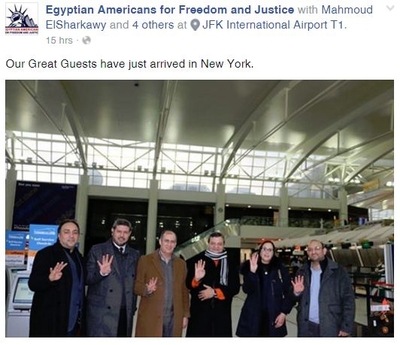
EAFJ leaders Mahmoud El-Sharkawy, Hani Elkadi and Aber Mostafa greeted Heshmat, Sharaby and Azzam at New York’s JFK airport and posed for a picture with them displaying the Brotherhood’s four-fingered Rabaa salute which has become representative among those wanting the Brotherhood’s return to power in Egypt.

The three are scheduled to speak Friday at an event titled “Egyptian Revolution from Sacrifices to Victory” in North Bergen, N.J.

The event is timed to commemorate the Jan. 25 anniversary of dictator Hosni Mubarak’s fall from power in 2011. Heshmat wrote that his group had no plans to meet with Obama administration representatives during this visit, due to their “position biased” toward Sisi’s regime. They hope to speak with some congressmen, academics and others.

El-Sharkawy is a Brotherhood member and serves as liaison with Brotherhood members exiled in Turkey, Egypt’s Al-Bawaba newspaper reported last April.

He frequently reposts Muslim Brotherhood communiqués on his Facebook page. In December, El Sharkawy encouraged “all youth and revolutionaries” to distribute the official page of Brotherhood spokesman Muhammad Muntasir.

1342

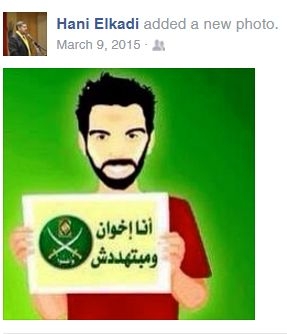
Elkadi seemed to self-identify as a Brotherhood member in a March 9 Facebook post showing an cartoon of a man holding a sign with the Brotherhood logo and the words which translate to, “I am [Muslim] Brotherhood and I’m not threatened.”

Last year, Elkadi, El Sharkawy and Mostafa posted graphics on their Facebook pages seeming to support violence in Egypt.

El Sharkawy and Elkadi posted a Feb. 10 communiqué from the Popular Resistance Movement (PRM) which has launched attacks against Egyptian police and other targets. It features an image of a blood-red map of Egypt with a fist superimposed over it. It claims responsibility for targeting two police cars. “God, martyrs, Revolution,” it said.

Mostafa posted the personal information of a pro-Sisi owner of an Egyptian soccer team with the word “Attaaack!” the same day.

OF Topic ? – Elites Know Global Economy Tanking

January 22, 2016

Elites Know Global Economy Tanking, Hill in Much Deeper Email Trouble, Bizarre US Middle East Policy

By Greg Hunter On January 22, 2016

Source: Elites Know Global Economy Tanking, Hill in Much Deeper Email Trouble, Bizarre US Middle East Policy | Greg Hunter’s USAWatchdog

It appears the declining economy is so obvious that even the elite are admitting the global economy is tanking. At the World Economic Forum in Davos, Switzerland, where the richest people in business and government gather annually, the mood couldn’t be gloomier. Even the headline at USA Today reported this week “CEO’s Pessimism Over Global Economy Rises.” Actually, if you read their story, they soft-pedaled how bad it really is. Only 27% of 1,400 CEOs surveyed think economic growth will improve in 2016. Only 16% of North America CEOs were optimistic things would get better. The quote of the year goes to George Soros when he said, “Yellen may have mistimed liftoff.” Ya think?

Hillary Clinton’s email problems have gone from bad to ‘you are under arrest Mr. Clinton.’ I am joking here. Clinton has not been arrested, but she will be charged for this email/private server fiasco. Why am I doubling down on this prediction? New information was reported this week by the Inspector General for the Intelligence Community that what Mrs. Clinton had on her* private server was “beyond Top Secret.” Inspector General I. Charles McCullough III told the Senate in testimony on Capitol Hill that what was on Clinton’s server was information and messages classified as “special access programs,” or SAP.  It’s reported by multiple intelligence sources that people could die if information was hacked. There is no way Clinton avoids being charged. As I said more than a year ago, Clinton cannot win even if she is not charged. Stick a fork in her she is done. By the way, USA Today did not report the story that came out of Senate hearings—outrageous.

U.S. Middle East policy is so bizarre it defies logic. Five American hostages were traded for seven Iranian prisoners. Good news, right. The AP reported “US-Iran Ties Warming Over Nuclear Deal.” The very next day, the “U.S. Levels New Sanctions on Iran.” USA Today reports this as if it’s another day at the office, not that it’s whack-a-doodle and crazy foreign policy. Secretary of State John Kerry also admitted that part of the $150 billion Iran is going to get, in this deal that is not really a deal because nobody signed it, is going to go to terrorists. Hezbollah, Hamas and who know who else will be getting some badly needed cash to commit terror. Way to go, John Kerry.

Join Greg Hunter as he talks about these stories and more in the Weekly News Wrap-Up.


Watch Video complete

Obama EASES Rules On Visas From Terror Hotspots Despite San Bernardino Attacks

January 22, 2016

Obama EASES Rules On Visas From Terror Hotspots Despite San Bernardino Attacks, Truth Revolt, Caleb Howe, January 21, 2016

(Please see also, Iranians granted leniency as DHS ends visa waivers for terrorism countries. — DM)

visawaiver

Among the many way one can get a waiver is an exception for individuals who traveled to Iran “for legitimate business-related purposes”  after the nuclear deal was signed.

So the new restrictions made Kerry’s new best pals in Iran angry, and they strong-armed us, and the administration gave them what they wanted. Great.

************************

Less than two months after the terror attacks in San Bernardino, which involved one terrorist who was here on a visa waiver, President Obama has made it easier to travel to the United States from terror hotspots around the globe.

Fox News has the story:

The revised requirements announced Thursday pertain to changes passed by Congress in the Visa Waiver Program.

Lawmakers had sought new restrictions to tighten up the program – which allows visa-free travel for residents of eligible countries — in order to prevent Europeans who have joined ISIS from entering the United States. Under the newly passed Visa Waiver Improvement and Terrorist Travel Prevention Act of 2015, nationals of Iraq, Iran, Syria and Sudan as well as other travelers who have visited those countries since Mar. 1, 2011 now must apply for a visa in order to travel to the U.S.

The administration implemented those changes Thursday — but with some changes of its own.

The changes are that they are making it easier to get waivers. Waiver meaning you won’t need a new visa to enter this country, even if you came by way of ISIS zones, as long as you meet certain criteria.

Among the many way one can get a waiver is an exception for individuals who traveled to Iran “for legitimate business-related purposes”  after the nuclear deal was signed.

House Judiciary Committee Chair Bob Goodlatte decried the move, saying “The Obama Administration is essentially rewriting the law by blowing wide open a small window of discretion that Congress gave it for law enforcement and national security reasons,” according to Fox News.

More details are here.

ISIS and other terror groups rely heavily on their unconventional and diffuse pool of resources and recruits. This is why the “lone wolf” definition of terror is sorely in need of update. That they will take advantage of this easing of the rules is hardly speculative. Nor would it be difficult. It’s another example of the Obama administration playing politics with American security.

Which politics?

The new restrictions had previously been criticized by the Iranian government which suggested the U.S. might be violating the nuclear deal by penalizing legitimate business travel to the country.

So the new restrictions made Kerry’s new best pals in Iran angry, and they strong-armed us, and the administration gave them what they wanted. Great.

Libya’s Chaos: Threat to the West

January 22, 2016

Libya’s Chaos: Threat to the West

by Mohamed Chtatou

January 22, 2016 at 5:00 am

Source: Libya’s Chaos: Threat to the West

  • ISIS badly needs Libya for its operations in North Africa: to spread its paramilitary brigades, to organize its terrorist networks and, most importantly, to prepare its political pawns, after the chaos, to take over power.
  • “Over the last four years, Libya has become a key node in the expansion of Islamic radicalism across North Africa… and into Europe. If events in Libya continue on their current path, they will likely haunt the United States and its Western allies for a decade or more.” — Ethan Chorin, Foreign Policy.
  • ISIS taking control of North Africa, the soft underbelly of Europe, would amount to it getting ready to recapture, by terror and force, al-Andalus from the Catholic Christians of Spain.

In 2011 when Libya’s former ruler, Muammar Gaddafi, was murdered by the mob of militiamen, many people believed it was the beginning of a new, free, democratic country. Libya, however, did not become free or democratic. Instead, it became fractured, violent, tribal and divided. Rather than starting a new life, Libya was sliding slowly toward some sort of hell.

Over the years, as violence became a daily casual occurrence, Libya almost became synonymous in the news with disorder, and on its way to becoming yet another failed stated, like Somalia.

In spite of that, hope emerged anew with the attempt of the United Nations to negotiate a national agreement through UNMSIL (United Nations Support Mission in Libya).

In its Resolution 2144 (March 14, 2014), article 6, the UN Security Council tasked the UNMSIL to support Libyan government efforts to:

  • Ensure the transition to democracy;
  • Promote the rule of law and monitor and protect human rights, in accordance with Libya’s international legal obligations;
  • Control unsecured arms and related materiel in Libya and counter their proliferation; and
  • Build governance capacity.

Subsequently, on December 17, 2015, under the leadership of UNMSIL, the different protagonists of the Libyan crisis reached a historic agreement in the Moroccan city of Skhirat.

The agreement did not mean the end of the turmoil in Libya: there are still a lot of splinter groups that are not a part of the accord. They have both the means and the will to stand in the way of peace. There is also the lethal Islamic State (ISIS), present throughout the country with proxy organizations, ready to step in, and for which agreements mean nothing.

Martin Kobler, the Special Representative of the Secretary General of the UN and head of UNMSIL, made it clear that:

“Urgent solutions must be found to bolster the Libyan-led fight against terrorism and in particular the threat of Daesh [ISIS]. The dire humanitarian situation in Benghazi and other areas needs to be addressed as a matter of highest priority, including through the establishment of a dedicated reconstruction fund for Benghazi. The concerns of the Eastern and Southern constituencies should be brought to the forefront. This work must start immediately. The signing of the Libyan Political Agreement is the first step on the path of building a democratic Libyan state based on the principles of human rights and the rule of law.”

No sooner was the agreement concluded than, unsurprisingly, the answer “No” came both from the uninvited marginal groups, as well as ISIS.

When a truck bomb was detonated, leaving 65 people dead, on January 7, 2016 outside a police training center in the western city of Zliten, the message was clear: there will be no peace. No group took credit for the attack.

Libya is divided by tribalism. Many of the armed groups that represent the various tribes of the country could not care less about national unity: they would only lose wealth and power to the increased dominance of the federal government. As a result, they would become insignificant and die out. As long as Libya is in chaos, it benefits them to bear arms.

Other Libyans seem to favor the “Caliphate solution.” Hard-core Islamists want a strict and radical Islam to prevail in the Muslim world through the re-Islamization of society. They believe that by countering the influence of the West, Islam can once again become the most important influence on the international scene and regain its long-lost, Golden Age prominence. They aim to make clear that any UN-brokered accord is a Western-imposed subterfuge to halt the inexorable advance of glorious Islam.

From the time of the Ottoman Empire until the overthrow of Gaddafi, Libya was ruled by heavily-centralized governments that delegated minimal power to the regions. This tight rule insured peace and stability to both the people and to the state. Tribes existed, but had only an honorific role and a cultural existence, no more than that. They were used, at times, as auxiliaries to strengthen the power of the state and, in return, were given economic grants.

When Gaddafi toppled King Idris Senussi in 1969, he consolidated the state and made it all-prominent. He subdued the population through generous cash handouts and a wide array of economic concessions. The population did not have to work; if some did, they held senior positions that did not require great effort. This way, Gaddafi guaranteed to himself total control of the state and the legitimacy of “the Revolution” to get rid of recalcitrant or groups or individuals — as he expeditiously did.

In the aftermath of the “Arab Spring” of 2011 and the ensuing uprising of the Cyrenaica region against the rule of Gaddafi, NATO sided with the revolutionaries of Benghazi to topple him. However, NATO conducted its war operations from the skies, and never fielded any ground forces. In a March 2015 article in Foreign Policy, Ethan Chorin wrote:

“The current situation in Libya is the product of a series of significant mistakes, erroneous assumptions, and myths that date back to NATO intervention in 2011. The United States and its NATO allies made a fundamental mistake in not imposing a robust reconstruction plan on Libya and stabilizing the country before radicalism was able to flourish. Even U.S. President Barack Obama understands that this was a mistake: In an interview last year with the New York Times, he cited lack of a plan for “the day after Qaddafi is gone” as potentially one of his biggest foreign-policy regrets. (The Libyans, of course, share much of the blame too.)”

As Gaddafi’s forces withdrew from various regions, religious and tribal groups moved in and helped themselves to the huge arsenals left behind. With that came the temptation to rule and have access to a share of oil reserves. At the fall of Ghaddafi in October 2011, there were over 300 armed groups, all dreaming of leadership and control.

In May 2014, Libyan General Khalifa Haftar, with support from the U.S., Egypt, UAE and Saudi Arabia, led an army from the east to rid the country of the powerful Islamist groups. His secular-oriented movement, dubbed “Operation Dignity,” in spite of a few limited successes, soon faltered miserably.

In reaction to the establishment of Haftar’s movement, the Islamists, supported by Turkey and Qatar, put together their own front, Fajr Libya (“Libya Dawn”), on July 13, 2014. The declared aim of Fajr Libya was to correct the direction of the revolution and set up a stable government; the undeclared objective was to turn Libya into an Islamist country. Fajr Libya was made up of several Islamist militias, all dreaming of power, wealth and religious consecration:

  • The Muslim Brotherhood
  • Libyan Shield Militia of Misrata with links with the Ikhwane (brotherhood)
  • The Tripoli Brigade, of the famous Islamist leader Belhaj, who had opposed Gaddafi openly
  • The Libya Revolutionaries Operation Room

The Fajr Libya front was, in addition, allied to a large group of heavily armed brigades, each controlling one tribe or region and reflecting the disintegration of Libya into small emirates reminiscent of the taifas in Arab Spain.[1]

During the era of the Barbary pirates, which lasted from the 16th to the 19th century, North Africa developed a taste for piracy, under the religious justification of Jihad al-Bahr (“jihad at sea”) that protected the Dar al-Islam (“domain of Islam”) from the Dar al-Kufr (“domain of infidels”). This religious justification became especially prominent after the fall of Grenada in 1492, and the ensuing efforts to reconquer al-Andalus (Spain) from the Christians. The Barbary pirates’ raids meant easy gains of goods and slaves.

Today, the tribal piracy instinct again seems strong, for various reasons. Among them are:

  • The affirmation of undemocratic tribal and patriarchal power under the cover of Islam;
  • The ability to dispose of the riches of the country directly, by selling oil and benefiting from its revenues without having to pay any taxes to a central government;
  • Undertaking contraband commerce and, most importantly, organizing, unhindered, immigration traffic to Europe.

Many of the Libyan groups and warlords therefore see a national reconciliation as a threat to their power and lucrative business. Many believe that with the Zliten terrorist attack of January 7, the warlords were sending a message to Libyan politicians that their political agreement would not go farther than Skhirat, the Moroccan city where it was signed.

ISIS badly needs Libya for its operations in North Africa: to spread its paramilitary brigades, to organize its terrorist networks and, most importantly, to prepare its political pawns, after the chaos, to take power.

Its taking control of North Africa, the soft underbelly of Europe, would amount to getting ready to recapture, by terror and force, al-Andalus from the Catholic Christians of Spain.

In his Foreign Policy article, Chorin notes that,

“Over the last four years, Libya has become a key node in the expansion of Islamic radicalism across North Africa, West Africa, across the Sahel, and into Europe. Arms and fighters have crossed Libya’s porous borders, feeding radical organizations from al Qaeda in the Islamic Maghreb to Boko Haram and reinforcing radical trends in the heart of the Middle East. If events in Libya continue on their current path, they will likely haunt the United States and its Western allies for a decade or more.”

If Libya is not stabilized in the near future, the whole world will regret it.

Stabilizing Libya would undoubtedly help to fight religious radicalism in West Africa; cut the lifeline of the lethal Boko Haram, active in the whole of West Africa; and impede al-Qaeda, which is threatening the Sahel countries of Burkina Faso, Mali and Niger.

To insure peace and stability for Libya, the UN’s Skhirat Agreement recommended strengthening UNMSIL to be a peace-keeping force. This peace-keeping force must be of, at least, 10,000 elite soldiers with heavy equipment and NATO air support to undertake the pacification of the country, with obviously the help of government forces sympathetic to the Skhirat accord.

This peace-keeping force could be made of the following countries: Spain, Italy, Morocco, Egypt, Jordan, Turkey, Pakistan and Senegal. The problem with any UN peacekeeping force, as seen, for example, with UNIFIL in South Lebanon, is that when the first shot is fired, they run. There also seems to be a tendency among peacekeepers, especially in Africa, to trade food for sex with children.

The Skhirat Agreement recommended the following actions be implemented as soon as possible. This is what the participants agreed to, but all they seem to do is underscore the sanctimonious grandiosity of the UN:

1 – Disarm militias:

Disarm all paramilitary groups by persuasion, incentive or sheer force and make, by law, bearing arms strictly illegal;

Comment: Who should do that?

2 – Train a national army and a police force:

Offer the militias the possibility to integrate the army and police force and be under the rule of law.

Comment: Why would the militias prefer that to having their own familiar honey-pot?

3 – Undertake a cultural study:

There is an urgent necessity to understand the social and cultural make-up of the Libyan society. The Amazigh and Tuareg people must be granted unconditionally their cultural rights.

Comment: Is anyone expecting the warrior tribesmen willingly to go along with that?

4 – Adopt a federal system of government:

Probably the best government system that could befit the numerous needs and the varied wishes and hopes of the Libyan population in political, cultural and religious terms is undeniably the federal system, with which tribal groupings, cultural minorities and religious lodges can, eventually, all identify.

Comment: ISIS and the other groups would probably fight this to the death.

5 – Help the country set up an open and competitive economy:

International economic institutions will need to help Libya restructure its economy, especially now that the price of oil has fallen steeply. Libya is and has always being an oil-producing country where most of the natives never worked.

Comment: This is the problem of so many oil-producing countries in which whoever is in charge does not want to share the spoils.

The problem always seems to be: Who should be doing the hard and dangerous work — the boots on the ground to mop up.

Libya is on the verge of implosion. The Skhirat Agreement, with its good intentions, is not enough. If the armed groups are left on the loose, Libya will effectively be the newest failed state. At present, Libya is a lethal danger to Europe, Africa and the Middle East.

The Skhirat Agreement (left), with its good intentions, is not enough to save Libya from Islamist militias such as Fajr Libya (right).

Dr. Mohamed Chtatou, an author, is a Professor at the University of Mohammed V in Rabat. He is currently a political analyst with Moroccan, Saudi and British media on politics and culture in the Middle East and Islam.


[1] First Taifa period (1009–1106), second Taifa period (1140–1203) and third Taifa period (1232–1287).

Obama Admin Releases Al Qaeda Explosives Expert from Gitmo

January 22, 2016

Obama Admin Releases Al Qaeda Explosives Expert from Gitmo.

BY:
January 21, 2016 5:07 pm

Source: Obama Admin Releases Al Qaeda Explosives Expert from Gitmo – Washington Free Beacon

The Defense Department said Thursday that it has transferred two more prisoners from the Guantanamo Bay detention facility, one of whom admitted to being a member of al Qaeda and developed explosives for the terror group to target U.S. military personnel and civilians.

The Hill first reported the transfer of Tariq Mahmoud Ahmed al-Sawah to his home country of Bosnia. Al-Sawah developed explosives and taught al Qaeda operatives how to use them, according to his file, which was published by the New York Times

“Detainee is an admitted member of al-Qaida who developed special improvised explosive devices (IEDs) for use against U.S. military forces and civilians. These IEDs included the limpet mine to sink U.S. naval vessels and the prototype for the shoe-bomb used in a failed attack on a civilian transatlantic flight,” the Defense Department file read.

“Prior to detention, detainee admitted teaching explosives at the al-Qaida advanced training camp at Tarnak Farm, aka (Abu Ubaydah Camp), where Usama Bin Laden (UBL) personally praised detainee for his ‘good work.’”

The file further noted that al-Sawah is associated with several explosives experts, some of whom are still at large, in addition to senior al Qaeda operatives and individuals behind international terrorist attacks. He also may have possessed “advanced knowledge” of the September 11, 2001, terror attacks on the United States.

The file also labeled al-Sawah a “veteran extremist combatant.” Officials noted that al-Sawah would “possibly reestablish extremist associations” if released, but deemed it unlikely given the extent to which he cooperated with the U.S. government by providing intelligence regarding explosives and al Qaeda’s activities.

Al-Sawah’s release is part of a larger effort by the Obama administration to shutter the military prison at Guantanamo Bay before the president leaves office. Several prisoners have been transferred in recent weeks, whittling the prison population down to less than 100.

Earlier in January, the administration transferred a Guantanamo detainee who previously threatened to cut the throats of Americans upon his release.