Archive for December 28, 2015

State Dept. counts ‘bringing peace’ to Syria as a 2015 win

December 28, 2015

State Dept. counts ‘bringing peace’ to Syria as a 2015 win, Politico, December 28, 2015

(Does that mean that Obama’s America won’t accept any more Syrian refugees and that those already there will be sent home? — DM)

The State Department is counting “bringing peace” to Syria as one of its wins in 2015.

A boastful recap of the State Department’s accomplishments, written by spokesman John Kirby, includes the bold subheadline of “Bringing Peace, Security to Syria” above a more modest entry talking about U.S. aid for those affected by the country’s turmoil and the U.S. push for a political transition from President Bashar Assad.

While Secretary of State John Kerry has played an integral role in the Syrian peace talks, the country remains embroiled in a nasty civil war and terrorized by the Islamic State.

“The United States and many members of the international community have stepped up to aid the Syrian people during their time of need — the United States has led the world in humanitarian aid contributions since the crisis began in 2011,” Kirby said.

Kirby wrote that the Syrians have “borne a heavy load” but that under Kerry’s stewardship the United Nations passed a U.S.-sponsored resolution to create a road map for Syria going forward.

The apparent declaration of a win echoes comments from President Barack Obama, who has been heavily criticized for calling the Islamic State a “JV team” in a January 2014 article and for calling the group’s territorial expansion efforts “contained,” just days before the Paris attacks.

Kirby also explicitly touched on the Islamic State, also called ISIL, saying that the U.S. is “winning [the] fight against violent extremists.”

“Although challenges remain, we have made positive strides over the last year, including in our fight against ISIL,” Kirby said. “This forward progress will only continue as more countries pledge resources to the anti-ISIL effort and as citizens around the world increasingly reject ISIL’s misguided ideology.”

Kirby cited the White House Summit on Countering Violent Extremism, hosted in February, which he called “monumental.”

Other things the State Department is counting as wins: re-establishing ties with Cuba, protecting the Arctic, clinching the Iran nuclear agreement, stopping the Ebola outbreak, committing to U.N. development goals, securing a free trade deal, preserving ocean health, and reaching the climate agreement.

Obama White House Turns To Islamists Who Demonize Terror Investigations

December 28, 2015

Obama White House Turns To Islamists Who Demonize Terror Investigations, Investigative Project on Terrorism, John Rossomando, December 28, 2015

(CAIR is a Muslim Brotherhood affiliate. Please see also, Naming the Muslim Brotherhood a National Security Threat. — DM)

Jihadist attacks in San Bernardino and Paris have Americans on edge. Yet part of the Obama White House’s response to the attacks has been to invite Islamist groups that routinely demonize the FBI and other law-enforcement agencies to the White House to discuss a religious discrimination. “If we’re to succeed in defeating terrorism we must enlist Muslim communities as some of our strongest allies, rather than push them away,” President Obama said in his speech following the San Bernardino attack.

But partnering with such organizations sends the wrong message to the American people, said Zuhdi Jasser, president of the American Islamic Forum for Democracy (AFID).

“I think it says a lot when the president uses those organizations that have an ACLU-type mentality. They should have a seat at the table. That’s fine,” Jasser said.  “But not to include groups, which have completely different focuses about counter-radicalization, counter-Islamism creates this monolithic megaphone for demonization of our government and demonization of America that ends up radicalizing our community.”

A White House spokesperson acknowledged to the Investigative Project on Terrorism that the Dec. 14 meeting on countering anti-Muslim animus included Hassan Shibly, executive director of Council on American Islamic Relations (CAIR) Florida chapter. The same forum – attended by Senior Adviser Valerie Jarrett and Deputy National Security Adviser Ben Rhodes – also included Farhana Khera, president and executive director of Muslim Advocates; Maya Berry, executive director of the Arab-American Institute (AAI); Mohamed Magid, imam of the All Dulles Area Muslim Society (ADAMS); and Hoda Hawa, director of policy and advocacy with the Muslim Public Affairs Council (MPAC) among others.

1323

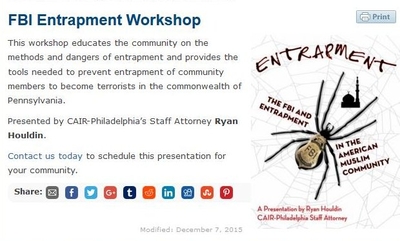
The White House guests, or the organizations they represent, have long histories of criticizing counter-terror investigations. CAIR leads the pack. Its Philadelphia chapter is advertising a workshop, “The FBI and Entrapment in the Muslim Community,” which features a spider with an FBI badge on its back, spinning a web of entrapment around an image of a mosque. The workshop “provides the tools needed to prevent entrapment of community members to become terrorists in the commonwealth of Pennsylvania.”

Since 9/11, CAIR has repeatedly taken the side of defendants accused of financing or plotting attacks, calling their prosecutions a “witch hunt” against the Muslim community.  For example, CAIR denounced the prosecution of Sami Al-Arian, who turned out to be the secretary of the Palestinian Islamic Jihad’s governing board, as “politically motivated” and a result of the “Israelization of American policy and procedures.”

A year ago, CAIR similarly protested the incarceration of Aafia Siddiqui, aka “Lady Al Qaeda” – convicted in 2010 of trying to kill two FBI agents. The protest came after the Islamic State (ISIS) offered to spare the lives of executed American photojournalist James Foley and aid worker Kayla Mueller in exchange for Siddiqui’s release.

CAIR also denounced the December 2001 shutdown of the Holy Land Foundation for Hamas support, saying, “…there has been a shift from a war on terrorism to an attack on Islam.”

Demonizing law enforcement and spreading “the idea that America and Western societies [are] anti-Muslim – the whole Islamophobia mantra is part of the early steps of radicalization so that Muslims get separated out of society,” Jasser said. “These groups certainly aren’t on the violent end of the Islamist continuum, but if there’s a conveyer belt that goes towards radicalization then it certainly starts with this siege and separatist mentality.”

CAIR has used such inflammatory imagery and rhetoric for years, with its San Francisco chapter removing a poster urging Muslims to “Build a Wall of Resistance – Don’t Talk to the FBI” in 2011 after the IPT reported on it.

Later that year, a CAIR-New York official told a Muslim audience that FBI agents would break the law to force them to talk. That includes threats and “blackmail, seriously blackmail; that’s illegal,” Lamis Deek told the audience. “But they’ll do it.”

Jasser blames CAIR and others which spread similar rhetoric for the increased fear of Islam and Muslims in America since 9/11 because they refuse to discuss Islamic extremism and the role Muslims have in fixing the problem.

1324

“This creates a climate where people don’t trust us to be part of the solution,” Jasser said. “People say that if you aren’t part of the solution then you are part of the problem, which creates more fear and distrust.”

Neither Jasser nor the AIFD, which advocates for “liberty and freedom, through the separation of mosque and state,” were invited to the White House meeting. Also shut out were Jasser’s colleagues in the new Muslim Reform Movement, whose members “reject interpretations of Islam that call for any violence, social injustice and politicized Islam” and stand “for secular governance, democracy and liberty. Every individual has the right to publicly express criticism of Islam. Ideas do not have rights. Human beings have rights.”

The White House did not reply to a request for comment about Jasser’s characterization of these groups; however, it previously said it engaged CAIR because of “their work on civil rights issues” despite the group’s Hamas ties.

Former FBI Associate Deputy Director Buck Revell also finds the White House’s choice of Muslim groups troubling.

“It’s a very confusing time and circumstance when you have the White House dealing with people who have fronted for the Muslim Brotherhood and are the spokespeople for Hamas in the United States and you bring them in for a conference at the White House and say they are supposed to speak for the Muslim community in America,” Revell said. “It’s unhelpful to have the White House essentially fronting for groups that want to make it harder to reach the jihadists in our society and in effect flush them out.”

Khera’s group Muslim Advocates has a pending lawsuit against the New York Police Department regarding its surveillance of mosques and other Islamic institutions using undercover police officers and informants.

“One of our key priorities at Muslim Advocates is ending racial and religious profiling by law enforcement,” Khera says in a YouTube video supporting the suit. “We’ve done work to combat profiling by the FBI, by Customs and Border Protection and now more recently we’ve had concerns about the way the New York Police Department – the nation’s largest police department – has been conducting itself.”

Like CAIR, Khera has called the FBI’s sting operations and informants against potential jihadists “entrapment operations” that rope in individuals who might otherwise never engage in terrorist activity.

CAIR’s Shibly also used the entrapment narrative in a June 2014 blog post in which he argued that the “FBI entrapment program targeting the Muslim community” was an example of tyranny. Many other CAIR representatives, such as Michigan director Dawud Walid, previously alleged the FBI has “recruited more so-called extremist Muslims than al-Qaida themselves.”

AAI stops short of embracing the entrapment narrative but labels surveillance programs by the NYPD and other government agencies “unconstitutional, ineffective, and counterproductive.” New York’s Mayor Bill De Blasio disbanded the NYPD unit responsible for infiltrating the city’s mosques and Muslim gathering places looking for potential terrorists in April 2014 under pressure from Muslim groups.

Another group, the Assembly of Muslim Jurists of America (AMJA), which countsMagid as a member, published an article in 2008 written by Hatem al-Haj, a member of its fatwa committee, giving religious justification for not cooperating with authorities. Al-Haj wrote it was “impermissible” for Muslims to work with the FBI because of the “harm they inflict on Muslims.”

However, the Muslim Public Affairs Council (MPAC), which formerly accused the FBI of entrapment, conceded in 2013 that informants can be useful detecting terror cells and keeping them off balance.

“To be fair, informants at times can be effective in counterterrorism investigations even against cellular structures. Because terrorist groups are concerned about their operational security, fear of informants can create and increase tensions within a terrorist cell. As a result, it may generate enough paranoia that a cell may abandon a planned operation,” MPAC said in its 2013 report “Building Bridges to Strengthen America.”

Looking for jihadis before they strike is a bit like looking for a “needle in a haystack,” so sting operations are useful in finding them before it’s too late, according to Revell.  He says such operations can be useful in preventing the next San Bernardino.

“If you don’t find them when they are talking jihad and you have to wait until they take an action then it’s too late to be able to prevent casualties and ensure that the public is safe,” Revell said. “There certainly is knowledge among those looking to do any type of jihadi activity that there is a force out there that is countering them and that they need to try to cover their activities to the greatest extent possible.”

In the past year, the Islamic State (ISIS) has published at least two documents instructing its jihadis how to evade being lured into stings by the FBI or other law-enforcement agencies.  The ISIS manual “Safety and Security guidelines of the Lone Wolf Mujahideen” devotes a chapter to evading FBI stings by testing the weapons they receive prior to using them in an attack.

Khera’s organization stood front and center in 2011 when Muslim groups called on the Obama administration to purge FBI training materials that they deemed offensive.  She complained in a Sept. 15, 2011 letter that counterterrorism materials then being used to train FBI agents about Islam used “woefully misinformed statements about Islam and bigoted stereotypes about Muslims.” Such allegedly misinformed statements included characterizing zakat – the almsgiving tax mandate on all Muslims – as a “funding mechanism for combat” and that “Accommodation and compromise between [Islam and the West] are impermissible and fighting [for Muslims] is obligatory.”

Yet numerous Muslim commentators, including from the Herndon, Va.-based International Institute for Islamic Thought (IIIT), describe zakat as a funding mechanism for jihad. A footnote for Surah 9:60 found in “The Meaning of the Holy Qur’an” published with editorial assistance from IIIT, says that zakat can be usedamong other things to help “(4) those who are struggling and striving in Allah’s Cause by teaching or fighting or in duties assigned to them by the righteous Imam, who are thus unable to earn their ordinary living.”

The AMJA issued a fatwa in August 2011 stating that zakat could be used to “support legitimate Jihad activities.”

Top Muslim Brotherhood ideologue Sheikh Yusuf Qaradawi similarly states in his book,Fiqh of Jihad, that zakat may be spent to finance “the liberation of Muslim land from the domination of the unbelievers,” particularly against Israel and India in Kashmir.

Numerous Islamic charities have been cited or closed down in connection with terrorist financing since the September 11 attacks. Qaradawi’s actions back up his words. In 2008, the U.S. Treasury Department sanctioned the Union of Good, a network of charities headed by Qaradawi, for Hamas fundraising. That same year a federal court jury convicted the founders of the Richardson, Texas-based Holy Land Foundation (HLF) for illegally financing Hamas.

“The government’s policy has inflicted considerable harm,” MPAC’s Salam al-Marayatiwrote in 2001 after federal authorities closed the Benevolence International Fund (BIF). “By effectively shutting down these charities, it has given Americans the false impression that American Muslims are supporting terrorists. It has also given the Muslim world a similarly false impression that America is intolerant of a religious minority.”

Representatives of MPAC, CAIR and Muslim Advocates each condemned the HLF prosecution or its subsequent verdict.

In the end, the White House’s decision to empower these groups sends a mixed message to the American people that it isn’t fully interested in rooting out the causes of jihadist terror and preventing future attacks.

Tehran names Raafat Al-Bakkar as new Hizballah Golan terror ring chief

December 28, 2015

Tehran names Raafat Al-Bakkar as new Hizballah Golan terror ring chief, DEBKAfile, December 28, 2015

NasrallaBagdadi480

Tehran Monday, Dec. 28, further ramped up the tension between its Lebanese proxy Hizballah, whose leader Sunday threatened to avenge the death of Samir Quntar, and Israel, which is conducting a military exercise along its northern borders. Four days after Quntar was assassinated in Damascus, Tehran appointed a successor to carry on building a new terrorist network for striking Israel from the Golan.

This successor is revealed by DEBKAfile’s exclusive sources as a Lebanese called Raafat Al-Bakkar, about whom very little is known. According to our sources, the Iranians spotted Al-Bakkar as promising talent earlier this year, shortly after the Israeli air strike which on Jan. 18 killed Iranian Gen. Ali Dadi and the high-profile Hizballah leader Jihad Moughniyeh. They were caught touring the Golan around Quneitra in search of a site for a terrorist base. Al-Bakkar was sent to Tehran at that time for a course in building and running terrorist networks, and this week he was given charge of the new “National Resistance on the Golan” organization for deep strikes inside Israel.

When Nasrallah boasted Sunday that his jihadists were already on their way to punish Israel, he was looking forward to the arrival of Quntar’s successor.

See DEBKA files’ earlier report from Sunday, Dec. 27.

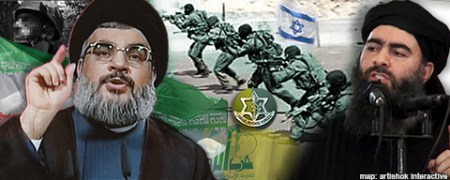
IDF Chief of Staff Lt. Gen. Gady Eisenkott explained why it was necessary to bring forward the launching of the new Commando Brigade by two months, when he addressed the formation ceremony on Sunday, Dec. 27, at the Ein Harod National Park: “The Commando Brigade is more necessary than ever in light of the threats from Hizballah and the Islamic State,” he said, in reference to the boasts heard in the last 48 hours from Hassan Nasrallah and Abu Bakr Al Baghdadi.

The Chief of Staff introduced Col. David Zini as the first commander of the new Brigade.

The ceremony took place shortly after the Hizballah chief Hassan Nasrallah said, “Revenge for the death of Samir Quntar is on the way… The orders have been given and execution is in the hands of resistance fighters on the ground… The Israelis are worried and rightly so – those on the borders [soldiers] and those inside the country…. We shall not let the blood of our Jihadi fighters and brothers to be spilled anywhere in the world,” he said.

DEBKAfile’s military sources report: Analysis of the kinds of threats posed by Hizballah (and ISIS) at this time, which are likely to focus more on terrorism than on tank or infantry border incursions, persuaded IDF leaders of the need for a new framework for bringing under one roof some of the top-notch, highly-trained, experienced, well-armed and determined fighting men who are willing to take on new challenges.

The self-styled Islamic State’s “caliph” Abu Bakr Al-Baghdadi, also devoted special attention to Israel, or rather “the Jews,” in his first audio speech in seven months Saturday, Dec. 26, the day before Nasrallah sounded off. His message was similar to that of his Shiite enemy, albeit in his own inimitable style:

The Islamic State would soon be in Palestine to establish an Islamic state there, he said, “Jews, soon you shall hear from us in Palestine which will become your grave… The Jews thought we had forgotten Palestinian… Not at all, Jews…The pioneers of the jihadist fighters are getting closer every day.”

If and when the Shiite Hizballah and Sunni ISIS make good on their similar but separate threats – or sooner – they will encounter Israel’s new Commando Brigade. Its fighting men are trained for combat in miscellaneous conditions of terrain, day or night, under deep cover. They are equipped with high-tech equipment, most of it classified, for gathering visual and electronic intelligence, communications, photography and targeting. They may either kill terrorists or take them captive.

In a word, these elite troops will hit the enemy in his back yard or at home, and blow the threats heard from Hizballah and ISIS leaders’ back on their own forces.

The 89th Commando Brigade is composed of four battalions:

Duvdevan specializes in operating amidst an Arab population under deep cover for locating and arresting terror suspects.

Egoz is a special kind of infantry battalion, whose commandos operate solo or in very small teams behind enemy lines, especially across the Syrian and Lebanese borders.

Maglan is skilled in the use of weaponry designed for precision operations against high quality enemy targets. These elite fighters go deep inside enemy territory to gather intelligence and use their specialized technology, exclusive for the use of this unit, for devastating assaults.

Rimon members are desert fighters who gained their experience in the terrain of the Gaza Strip and Egypt. Their experience as back-up for operations against drug smugglers is invaluable for urban combat in civilian environments.

Excluded from the new brigade are the separate IDF commando units: Sayeret Matkal, Shayetet 13 (Navy), the Oketz unit which trains dogs for anti-terror work, and Yahalom, of the Engineering Corps.

“Islamophobia” in one State

December 28, 2015

“Islamophobia” in one State, Power LineScott Johnson, December 28, 2015

Minnesota’s Somali community presents a stark challenge to Americans concerned about terrorism. The community is Muslim, large, and protected by an extreme form of ideological conformity that runs from the governor down and permeates the media. In this month’s story on the indicted ISIS wannabe and local ringleader, reporters Dan Browning and Mary Lynn Smith add this editorial observation:

Minnesota is believed to have produced more would-be foreign fighters than any other state, but it also has a Muslim community that’s exceptionally engaged with efforts to counter extremism. Word that another Twin Cities Somali-American was being charged spread quickly Wednesday night in Minneapolis.

“This is deju vu all over again,” said community leader Sadik Warfa. “The safety of this country is a concern for all of us. … We’re hoping this case is the last, and we can all move forward where these kind of things don’t happen.”

But Warfa said he wants to know why Warsame is being charged now: “Did the government get new evidence?”

So far as I can tell, Warfa’s support for law enforcement is invisible. Warfa’s comments to the Star Tribune certainly express no such support, though reporters Browning and Smith seem not to notice. Maybe they need another reporter or two to lend a hand.

Here Warfa warns of a backlash against Minnesota Somalis:

“This sort of thing takes our eyes off the big picture,” said Warfa. “The big picture is really that first of all the 1.7 billion people of Islam cannot be on trial on the actions of a few and we feel like our community, we have been sometimes, really, there is a lot of fear-mongering going on and a lot of, I think, that is backlash we would always be very concerned.”

On a day when GOP candidate Donald Trump called for banning all Muslim immigrants, Warfa praised President Barak Obama’s speech to the nation Sunday night.

“We, as Muslim-American community, are very proud of our President last night,” said Warfa. “The speech he gave to American people when he addressed, because he spoke and said what needed to be said and that is, first of all, we do not want to divide us as Americans. We do not want our neighbors to have suspicion on their fellow Muslim-Americans. I think that is what the terrorists want. They want to divide us.”

Warfa insisted that the real issue is gun violence and the availability of assault weapons.

And here Warfa serves as translator for the mother of one of the indicted ISIS wannabes charged in Minnesota this past April. She protests that he is innocent: “He has not committed any crime,” she said through Warfa. “Why does he have to take a [plea] deal?” She also protests the conditions of his confinement as unduly harsh:

Fadumo Hussein’s son, 20-year-old Guled Omar, is being held in the Ramsey County Jail.

The five co-defendants are scheduled to stand trial on terror charges in February.

Hussein says this is especially difficult for her family because of the loss of Guled’s older brother, Ahmed Ali Omar.

Ahmed Ali Omar has been a fugitive since 2009 and has been charged with fighting for al-Shabaab in Somalia.

Hussein is a single mother of 13 children. Through translator Sadik Warfa, she spoke out Monday against what she says is the harsh treatment of Guled in the Ramsey County Jail.

“He is suffering greatly at this moment,” she said through the interpreter.

Guled Omar’s attorney has written two letters to federal Judge Michael Davis, complaining that his client is the only one of the five defendants being held in solitary confinement and “is not allowed access to television or reading materials.”

“The only thing she can assume is that they are putting him under pressure so he can take the plea deal,” Warfa said.

What a family. The mother is at best a tool. The older brother is absent, probably fighting the jihad with al Shabaab in Somalia. The younger brother sought to augment the ranks of ISIS in Syria with fellow “Minnesotans” and join in himself. And mom has 11 more at home. But we are to suppress rude thoughts and stifle critical comments lest we be found guilty of “Islamophobia” and invited by the governor to move to another state.

While the Somali community’s support for law enforcement is questionable at best, its support for community members charged with supporting terrorist organizations is highly visible. Yet the Star Tribune goes out of its way in a news story on this month’s charges against the former airport employee who recruited here for ISIS to state as a fact that “Muslim community that’s exceptionally engaged with efforts to counter extremism.”

In the Star Tribune column “Islam and Minnesota: Can we hear some straight talk for a change?” I dispute the proposition and invite discussion. In Minnesota, we really need to crack open the Overton Window that applies here.

Please check out the column and leave a comment at the Star Tribune if you might be so inclined.

A year of Taliban gains shows that ‘we haven’t delivered,’ top Afghan official says

December 28, 2015

A year of Taliban gains shows that ‘we haven’t delivered,’ top Afghan official says, Washington PostSudarsan Raghavan, December 27, 2015

As the fighting intensifies, the stakes are growing higher for the United States in its longest war. “I will not allow Helmand to fall,” Campbell told the Afghan officials in the recent meeting with the Afghan National Security Council. “But I can’t make you fight. You’ve got to want it more than we do.”
******************************

As the Afghan convoy entered the battered village, Taliban fighters opened fire. U.S.-trained Afghan policemen poured out of their Humvees and began wildly shooting their AK-47 rifles in every direction.

“The enemy is firing one bullet, and you are responding with dozens!” their commander, Col. Khalil Jawad, screamed into his radio in frustration. “Aim, then fire!”

A minute later, the militants melted away. On this day in early December in the southern province of Helmand, they had delivered their message: The Taliban is back, its fighters showing a battle discipline and initiative far superior to the Afghan security forces trained and equipped by the United States.

In private, top Afghan and American officials have begun to voice increasingly grim assessments of the resurgent Taliban threat, most notably in a previously undisclosed transcript of a late-October meeting of the Afghan National Security Council.

“We have not met the people’s expectations. We haven’t delivered,” Abdullah Abdullah, the country’s chief executive, told the high-level gathering. “Our forces lack discipline. They lack rotation opportunities. We haven’t taken care of our own policemen and soldiers. They continue to absorb enormous casualties.”

[Please refer to map here.]

With control of — or a significant presence in — roughly 30 percent of districts across the nation, according to Western and Afghan officials, the Taliban now holds more territory than in any year since 2001, when the puritanical Islamists were ousted from power after the 9/11 attacks. For now, the top American and Afghan priority is preventing Helmand, largely secured by U.S. Marines and British forces in 2012, from again falling to the insurgency.

As of last month, about 7,000 members of the Afghan security forces had been killed this year, with 12,000 injured, a 26 percent increase over the total number of dead and wounded in all of 2014, said a Western official with access to the most recent NATO statistics. Attrition rates are soaring. Deserters and injured Afghan soldiers say they are fighting a more sophisticated and well-armed insurgency than they have seen in years.

As of last month, about 7,000 members of the Afghan security forces had been killed this year, with 12,000 injured, a 26 percent increase over the total number of dead and wounded in all of 2014, said a Western official with access to the most recent NATO statistics. Attrition rates are soaring. Deserters and injured Afghan soldiers say they are fighting a more sophisticated and well-armed insurgency than they have seen in years.

As Afghan security forces struggle, U.S. Special Operations troops are increasingly being deployed into harm’s way to assist their Afghan counterparts. Since Nov. 4, four members of the U.S.-led coalition have been wounded in Helmand, said U.S. Army Col. Michael Lawhorn, a military spokesman. Officially, U.S. military personnel have a mandate only “to train, advise and assist” Afghan forces.

In the confidential October meeting, Gen. John F. Campbell, the commander of U.S. and allied forces in Afghanistan, told his Afghan counterparts that he was as guilty as they were of “just putting our finger in the dike in Helmand.”

But he was highly critical of Afghan security officials for “not managing” their forces in a way that ensured they got enough training, and for allowing “breakdowns in discipline” in the ranks. “The Taliban are not 10 feet tall,” he said. “You have much more equipment than they do. You’re better trained. It’s all about leadership and accountability.”

Campbell vowed “to fix Helmand.”

“I will use more of my SOF and enablers to buy you more space and time,” he said, referring to Special Operations forces. A senior U.S. defense official, speaking on the condition of anonymity because of military rules, said Campbell’s comments represented “an attempt to encourage the Afghans to take action in Helmand province.”

Progress unraveling

Helmand was a key focus in a major American offensive launched in 2010, after President Obama dispatched a “surge” of 30,000 troops to Afghanistan. Marja was the first place Marines launched operations, and by the end of the surge, in late 2012, the Taliban had been subdued in much of its southern heartland.

Now, the fresh concerns over Helmand arrive at the end of a year in which the Taliban and other insurgent groups, including the Islamic State, have steadily advanced, particularly in the north. They have taken advantage of the end of the U.S. and NATO combat mission, which has left a military and political vacuum, forcing Obama to extend the U.S. role by keeping at least 5,500 U.S. troops here after he leaves office.

A Pakistani military operation has also flushed hundreds of well-trained foreign fighters into Afghanistan, bolstering the Taliban and the Islamic State.

Meanwhile, the government is grappling with its own problems. The economy is crippled; high unemployment and corruption remain entrenched, breeding public resentment. Political infighting, policy disputes and leadership woes have deepened inside the administration of President Ashraf Ghani, who shares power with Abdullah, the chief executive. The cabinet remains incomplete, with no defense minister as the security issues become more serious.

The gains by the Taliban have come amid internal divisions and a leadership crisis triggered by the surprise announcement in the summer that its leader, Mohammad Omar, had been dead for more than two years. The contest for power and territory among Taliban factions, rather than weakening the movement, has spawned more uncertainty and violence.

The group’s infighting has blocked efforts by Ghani to bring the Taliban to peace talks. The insurgents’ new leader, Akhtar Mohammad Mansour, appears determined to prove his mettle and strengthen the Taliban’s bargaining position by escalating attacks, Western diplomats and analysts said. In September, the Taliban briefly seized Kunduz, the first city to fall since the demise of its regime, prompting the U.S. military to dispatch Special Operations troops and stage airstrikes to help the Afghan security forces retake control.

Now, the insurgents are on the doorsteps of several provincial capitals, applying more pressure on urban areas than in any year of the conflict. The clashes in Helmand have reflected the Taliban strategy that led to the takeover of Kunduz — seizing surrounding districts before moving in on the provincial capital. Already, the Taliban are in the enclave of Ba­baji, within the borders of Helmand’s capital, Lashkar Gah.

Helmand, which lies along the Pakistani border, is the source of much of the country’s opium, providing lucrative funding for the insurgents, who also collect “taxes” from the marble mining business. The province is home to the Kajaki Dam, which provides electricity to Helmand and to neighboring Kandahar, the cradle of the Taliban. In some districts, electricity bills are paid to the Taliban.

In the Afghan National Security Council meeting, Rahmatullah Nabil, the nation’s intelligence chief, described the province as “the biggest recruiting tool for the Taliban” and its “primary source of revenue.” Nabil resigned Dec. 10 to protest Ghani’s peace overtures to Pakistan, which is viewed with suspicion by most Afghans for its backing of the Taliban.

Losing control of Helmand

The 21-mile-long road from Lashkar Gah to Marja is peppered with craters from bombs planted by the Taliban. Stores are shuttered; villages are silent. The residents have fled.

A mile from a civil-order police base, built by U.S. Marines for $17 million, a charred, mangled Humvee lies in the middle of the highway. A rocket-propelled grenade tore into it, and the Taliban later set it afire. On a recent day, the base was as far as anyone could go, at least by road: Less than a mile ahead, the Taliban had buried more mines.

“They have destroyed bridges. They have burned our houses,” Ghul Mawla Malang, a tribal elder who leads Marja’s Afghan Local Police (ALP), a U.S.-funded pro-government militia, told top police commanders in a meeting at the base.

A few minutes later, the Taliban fired a few rounds toward the base. The senior officials cut short their visit and left in their Humvees.

If there was one province in Afghanistan that the Taliban should have found impenetrable, it was Helmand. The Afghan army has its entire215th Corps based here, numbering more than 18,000 soldiers. There are also thousands of Afghan police officers. Yet a few hundred Taliban fighters managed to overrun parts of Marja and other districts. Soldiers and police officers fled with little resistance or surrendered to the insurgents.

In Babaji, nine police officers including Abdul Qadim Hemat were unprepared last month when the Taliban fighters attacked their outpost. They were running out of ammunition. And reinforcements they had requested never turned up. “I watched seven comrades killed in front of me,” recalled Hemat, who soon fled along with the remaining officer. Both then deserted.

“We were surrounded, but we didn’t get any help,” Hemat said. “I will not shoot one bullet for the government again.”

In parts of Marja, villagers pine for U.S. troops — and the British forces who were once based here — to return.

“When they were here, Marja was as peaceful as this city,” said Ahmed Jan, who was bringing his 13-year-old nephew to a hospital in Lashkar Gah. A bullet had struck the boy in their village during fighting. “Now, the Taliban are like the government in my village. They drive police vehicles and Humvees, and they have raised their white flag over houses.”

A well-equipped enemy

In an interview, Gen. Mohammed Moeen Faqir, the commander of the 215th Corps, said that “only half of a percent” of his force may have deserted and that new recruits were filling the void. He noted that the police and ALP forces in Helmand were also under his command and that “whenever they needed reinforcements, I sent them.”

But the confidential transcript of the minutes from the National Security Council meeting presents a grimmer picture.

The Afghan army’s chief of staff, Gen. Qadam Shah Shaheem, said that limited reinforcements and new recruits couldn’t make up for force attrition in Helmand, according to the transcript, which was provided to The Washington Post by an official concerned by the insecurity in Helmand.

Some 40 percent of Afghan army vehicles in Helmand are broken, Shaheem said. He described a leadership crisis within the security forces, where “clashing personalities exist between the security pillars,” according to the transcript.

The morale of the security forces was low, said Nabil, the intelligence chief, and some soldiers had complained that they had not been home in two years. Junior commanders, he added, were “openly defying their superiors.” Gen. Mohammad Salem Ehsas, the top ALP commander, said that troops were tired and that there was poor coordination among the various security organs.

Campbell said that only about half the troop positions in the 215th Corps were manned. Western and Afghan officials said that was largely because of desertions, high casualty rates and a lack of new recruits.

“The blame game must stop now,” Campbell said. “If I hear one more policeman complain about the army or vice versa, I will pull my advisers immediately. It’s over. You’re Afghans first. Work together.”

Soldiers and police officers on the front lines say they face an enemy that is well trained and equipped with heavy artillery and machine guns, rockets and mortars — and a seemingly endless supply of ammunition. Taliban snipers now have night-vision scopes on their rifles. And as they have overrun bases, the militants have seized an arsenal of U.S. weaponry provided to the Afghans.

Nabil said the insurgents have night-vision goggles and have captured more than 45 Humvees in Helmand. They also have Russian-made ZSU antiaircraft guns with night capability, an abundant supply of mortars and a communications network that is difficult to infiltrate.

Stakes grow higher

U.S. Special Operations troops arrived in early November at an empty school in Chanjar, a front line about 15 miles west of the provincial capital. The walls of the compound bore the impact of shells the size of baseballs. A group of soldiers and police officers was stationed there. Taliban militants were in houses less than 20 yards away.

“The Americans told us that they wanted to push the Taliban back,” recalled Sgt. Abdul Mohamad. “They were here to give coordinates for an airstrike.”

But the Taliban fired a mortar, the men said, wounding one of the Americans. The Americans quickly left the area, in Nad Ali district, with their injured comrade.

Lawhorn, the U.S. military spokesman, confirmed that a U.S. coalition member was injured in the district Nov. 4.

Brig. Gen. Wilson Shoffner, the U.S. military’s top spokesman, said in an interview that U.S. troops were adhering to their limited mandate of “train, advise and assist” and that their Afghan counterparts were taking the lead.

But Afghans, including senior military officials, no longer even pretend that they can fight the Taliban effectively on their own.

“When the foreigners were here, we had plenty of facilities and equipment,” said 1st Lt. Naseer Ahmad Sahel, 30, a civil-order police company commander who was wounded last month in a firefight in Marja. “There were 100 cameras overlooking Marja alone.”

Faqir, the commander of the 215th Corps, said, “We don’t have the air support that we should have.”

As the fighting intensifies, the stakes are growing higher for the United States in its longest war. “I will not allow Helmand to fall,” Campbell told the Afghan officials in the recent meeting with the Afghan National Security Council. “But I can’t make you fight. You’ve got to want it more than we do.”
Naming the Muslim Brotherhood a National Security Threat

December 28, 2015

Naming the Muslim Brotherhood a National Security Threat, Front Page Magazine, Daniel Greenfield, December 28, 2015

mb

The Muslim Brotherhood is to Islamic terrorism what a virus is to disease. Major terrorist leaders from the Caliph of ISIS to Arafat have the Muslim Brotherhood on their resume. And the current leader of Al Qaeda led a Muslim Brotherhood splinter terror group. But its linkages to Islamic terrorism are only a secondary aspect of the organization whose focus is on Islamizing nations through more subtle means.

Paradoxically the Brotherhood has met with far less success in the Muslim world than in the West. Its greatest victories in the Arab Spring would not have happened without Obama’s backing and its takeovers of Egypt and Tunisia were rolled back by popular uprisings while its efforts in Libya, Syria and Yemen were stymied by armed conflict with other Muslims.

The Muslim Brotherhood is unpopular in Egypt these days. It’s also unpopular with Americans.

In one poll, 61 percent of Americans had an unfavorable view of the Muslim Brotherhood. Only 11 percent had a positive view of the Islamic supremacist organization. Only 5 percent of Americans saw the Muslim Brotherhood’s takeover of Egypt as a positive development.

Unfortunately Obama is at odds with the views of most Americans. The Muslim Brotherhood may have lost power in Cairo, but it still wields a great deal of power in Washington D.C. Brotherhood front groups such as CAIR and ISNA have open access to the media and dominate all discussions about Islam. The MSA dominates American campuses despite its history of terror ties.

As David Horowitz has warned, “The principal institutions of Islam in this country, the Muslim American Society, the Muslim Students Association, the Islamic Society of North America, to name a few — are all fronts for the Muslim Brotherhood.”

But not every country is equally willing to roll over for the Muslim Brotherhood’s hate network.

The Muslim Brotherhood headquarters was in London, but while Washington D.C. panders to the violent Islamic supremacist organization, the UK decided it did not want to host its Jihad. Last year, the British government authorized a report on the Muslim Brotherhood by veteran diplomat Sir John Jenkins. The report has been submitted to parliament and it’s making waves.

The British government report defines “aspects of Muslim Brotherhood ideology and tactics” as “contrary to our national interests and our national security.”  It’s a striking contrast with a White House where the Muslim Brotherhood has its own revolving door and a rogue’s gallery of operatives.

Muslim Brotherhood front groups in the United States have been allowed to dismantle our counterterrorism training and replace it with Islamist propaganda. Even now, Obama pushes Countering Violent Extremism programs that encourage law enforcement to partner with Brotherhood front groups. Secretary of State Kerry urges including the Muslim Brotherhood in the political process.

Meanwhile the UK government has stepped forward to assert that the Muslim Brotherhood is not the solution to terrorism, instead it’s the source of the problem.

The Jenkins report rejects the “moderate” label so often slapped on the hate group by lazy media hacks. Instead it describes the Brotherhood as a clandestine group organized into a “secretive ‘cell’ structure” seeking to create a “Caliphate under sharia law” using a doctrine that allows “the use of extreme violence in the pursuit of the perfect Islamic society”. That ideology inspired “Al Qaida and its offshoots”. The most obvious offshoot to employ this Takfiri approach is ISIS.

It’s quite a contrast from the claim by Obama’s Director of National Intelligence that the Muslim Brotherhood is a “very heterogeneous group, largely secular, which has eschewed violence”.

The British report rejects the idea that the Brotherhood is peaceful. Instead it states that it is prepared to engage in violence, but prefers “incremental change on the grounds of expediency” because it believes that the “political opposition will disappear when the process of Islamisation is complete”.

The Muslim Brotherhood is not moderate or peaceful. It just thinks long term. Its endgame is the same as ISIS. It just has a slower and surer way of getting there. As fellow Islamist dictator Erdogan once said in Turkey, democracy is “a train that takes you to your destination, and then you get off.”

The British report takes a hard look at the Muslim Brotherhood’s support for Hamas and its local organizations in the UK. It notes that, “much about the Muslim Brotherhood in the UK remains secretive, including membership, fund raising and educational programmes” but that its front groups “which have claimed to represent Muslim communities” wield “an influence here which is disproportionate to their size”.

It’s a vital observation that can’t even be voiced in the Senate here, let alone in the media or the White House. It is utterly inconceivable that Obama and Hillary, who have fought wars on behalf of the Brotherhood, would ever be willing to authorize the creation of a similar report on the Brotherhood.

And yet such a report is desperately needed. The Muslim Brotherhood’s front groups have hijacked our foreign policy, involved us in foreign wars, endangered our national security and undermined our ability to fight terrorism. They promote a program of mass Muslim migration while pushing anti-American agendas with the ultimate aim of destroying the Constitution and replacing it with Islamic law.

Changes are already taking places in the UK after the release of the Brotherhood report. The Board of Deputies of the Jewish community distanced itself from the Brotherhood’s Muslim Council of Britain. While the government will not currently ban the Brotherhood, Prime Minister Cameron has stated that “membership of, association with, or influence by the Muslim Brotherhood should be considered as a possible indicator of extremism”. That may sound mild, but it should be contrasted with the position of Democrats and even some Republicans in this country that the Muslim Brotherhood is our best friend.

Prime Minister Cameron warned that the Muslim Brotherhood is “a transnational network, with links in the UK, and national organisations in and outside the Islamic world. The movement is deliberately opaque, and habitually secretive.” He stated that “it has been a rite of passage for some individuals and groups who have gone on to engage in violence and terrorism.” He concluded that aspects of its activities “run counter to British values of democracy, the rule of law, individual liberty, equality and the mutual respect and tolerance of different faiths and beliefs.”

This is a major development not only for the UK, but for the US where any criticism of the Islamic hate network has been banished as Islamophobic. The British finding is an important weapon in our own struggle with the Brotherhood and its collaborators on the left and the right.

Cameron has warned that the UK will keep a close watch to see “whether the views and activities of the Muslim Brotherhood meet the legal test for proscription.” This is a clear warning to the Brotherhood not to abuse the hospitality of the UK or face government action. By taking this step, the UK is joining a diverse group of countries, from Egypt to the UAE to Israel, in confronting the Muslim Brotherhood.

Obama insists that his critics are isolated, but his affinity for the Muslim Brotherhood is one of the elements that isolated his foreign policy even in the Muslim world. Western countries are beginning to wake up to the threat of the Muslim Brotherhood and his CVE policy will one day go down in history as a shameless whitewashing of a violently bigoted organization that has endangered our national security.

The UK has found that the Muslim Brotherhood is a national security threat. It’s time for Republicans and Democrats to start speaking the truth about the Brotherhood.

Headlines Ignore Palestinian Terrorism

December 28, 2015

It’s not so hard to write a headline like “Palestinian Terrorists Kill Israelis.”

Yet for some reason, so many headlines blur the lines between attackers and victims when it comes to Israel.

This vid details how we can FIGHT BACK against this media distortion.

–  JW


IDF Commando Brigade unveiled amid threats from Nasrallah and Al-Baghdadi

December 28, 2015

IDF Commando Brigade unveiled amid threats from Nasrallah and Al-Baghdadi, DEBKAfile, December 27, 2015, December 27, 2015

NasrallaBagdadi480

IDF Chief of Staff Lt. Gen. Gady Eisenkott explained why it was necessary to bring forward the launching of the new Commando Brigade by two months, when he addressed the formation ceremony on Sunday, Dec. 27, at the Ein Harod National Park: “The Commando Brigade is more necessary than ever in light of the threats from Hizballah and the Islamic State,” he said, in reference to the boasts heard in the last 48 hours from Hassan Nasrallah and Abu Bakr Al Baghdadi.

The Chief of Staff introduced Col. David Zini as the first commander of the new Brigade.

The ceremony took place shortly after the Hizballah chief Hassan Nasrallah said, “Revenge for the death of Samir Quntar is on the way… The orders have been given and execution is in the hands of resistance fighters on the ground… The Israelis are worried and rightly so – those on the borders [soldiers] and those inside the country…. We shall not let the blood of our Jihadi fighters and brothers to be spilled anywhere in the world,” he said.

DEBKAfile’s military sources report: Analysis of the kinds of threats posed by Hizballah (and ISIS) at this time, which are likely to focus more on terrorism than on tank or infantry border incursions, persuaded IDF leaders of the need for a new framework for bringing under one roof some of the top-notch, highly-trained, experienced, well-armed and determined fighting men who are willing to take on new challenges.

The self-styled Islamic State’s “caliph” Abu Bakr Al-Baghdadi, also devoted special attention to Israel, or rather “the Jews,” in his first audio speech in seven months Saturday, Dec. 26, the day before Nasrallah sounded off. His message was similar to that of his Shiite enemy, albeit in his own inimitable style:

The Islamic State would soon be in Palestine to establish an Islamic state there, he said, “Jews, soon you shall hear from us in Palestine which will become your grave… The Jews thought we had forgotten Palestinian… Not at all, Jews…The pioneers of the jihadist fighters are getting closer every day.”

If and when the Shiite Hizballah and Sunni ISIS make good on their similar but separate threats – or sooner – they will encounter Israel’s new Commando Brigade. Its fighting men are trained for combat in miscellaneous conditions of terrain, day or night, under deep cover. They are equipped with high-tech equipment, most of it classified, for gathering visual and electronic intelligence, communications, photography and targeting. They may either kill terrorists or take them captive.

In a word, these elite troops will hit the enemy in his back yard or at home, and blow the threats heard from Hizballah and ISIS leaders’ back on their own forces.

The 89th Commando Brigade is composed of four battalions:

Duvdevan specializes in operating amidst an Arab population under deep cover for locating and arresting terror suspects.

Egoz is a special kind of infantry battalion, whose commandos operate solo or in very small teams behind enemy lines, especially across the Syrian and Lebanese borders.

Maglan is skilled in the use of weaponry designed for precision operations against high quality enemy targets. These elite fighters go deep inside enemy territory to gather intelligence and use their specialized technology, exclusive for the use of this unit, for devastating assaults.

Rimon members are desert fighters who gained their experience in the terrain of the Gaza Strip and Egypt. Their experience as back-up for operations against drug smugglers is invaluable for urban combat in civilian environments.

Excluded from the new brigade are the separate IDF commando units: Sayeret Matkal, Shayetet 13 (Navy), the Oketz unit which trains dogs for anti-terror work, and Yahalom, of the Engineering Corps.