Archive for November 1, 2015

Russia warns that Syria war could become a ‘proxy war’

November 1, 2015

Russia warns that Syria war could become a ‘proxy war’ BreitbartJohn J. Xenakis, November 1, 2015

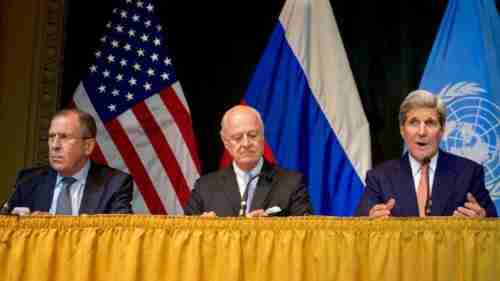
g151031bL-R: Sergei Lavrov, United Nations Special Envoy for Syria Staffan de Mistura, and John Kerry in Vienna on Friday (state.gov)

Russia has poured millions of dollars of heavy weapons into Syria, and is now sending in Russian troops to establish bases there. Recently, Russia launched 27 cruise missiles from the Caspian Sea to targets in Syria. Iran is pouring new troops into Syria. Iran has also given Lebanon’s Hezbollah terrorist group a great deal of money, and Hezbollah has sent thousands of troops into Syria to support Syria’s president Bashar al-Assad.

Al-Assad’s genocidal attacks on innocent Syrian Sunnis, killing hundreds of thousands and forcing millions from their homes, has caused Sunni jihadists from all of the world to fight against al-Assad, Russia, Hezbollah, and Iran in Syria. Along the way, these jihadists formed the so-called Islamic State (IS or ISIS or ISIL or Daesh).

And now, on Friday, Russia’s Foreign Minister Sergei Lavrov made a pronouncement that Barack Obama was going to trigger a “proxy war” in Syria by sending in 50 special operations forces, as we reported yesterday.

You can’t make this stuff up.

Thanks to Iran, Russia, al-Assad and Hezbollah, there are now tens of thousands of foreign troops fighting each other in Syria, with al-Assad in particular supported by massive amounts of foreign weapons.

But somehow, those tens of thousands of foreign fighters don’t make it a “proxy war,” but America’s 50 special forces troops do.

You can’t trust any garbage that comes out of Lavrov’s mouth, or out of al-Assad’s mouth, or out of Vladimir Putin’s mouth, but I listen to BBC, al-Jazeera, FOX, CNN, and other media sources all the time, and I see these news anchors report this crap with a straight face all the time. I don’t know whether it is more sickening to watch those fatuous news anchors, or to watch the fawning Secretary of State John Kerry suck up to Lavrov and Putin, which has happened in issues involving Ukraine, Iran’s nuclear development, and Syria.

All this verbiage is coming out of a meeting in Vienna whose purpose is to find a “political solution” to the Syria problem. With hundreds of thousands of Syrian migrants pouring into Europe, and with hundreds of ISIS militants returning to Russia to fight Putin, there is a lot of pressure to find a “political solution.” But this week’s announcement that Iran will fully enter the war in Syria on the side of the Syrian regime makes any “political solution” farther away than ever. On the contrary, Saudi Arabia and other Gulf countries will never agree to anything like the emerging situation. Actions by Russia and Iran, intervening militarily in Syria, is an emerging disaster, likely triggering a sectarian Sunni versus Shia war throughout the region. BBC and International Business Times and Reuters

Syria’s civil war and Generational Dynamics

In the 12 years that I’ve been doing this, I’ve posted about 4,000 articles with hundreds of Generational Dynamics predictions.

In 2011, when the Syrian civil war began, I said that the war should fizzle within a year or two. Of all the hundreds of Generational Dynamics predictions, this is the one where I’ve clearly been (depending on how you look at it) either wrong or poorly described.

Syria’s last generational crisis war was civil war that climaxed in 1982 with the massacre at Hama. There was a massive uprising of the 400,000 mostly Sunni citizens of Hama against Syria’s president Hafez Assad, the current president’s father. In February, 1982, Assad turned the town to rubble, 40,000 deaths and 100,000 expelled. Hama stands as a defining moment in the Middle East. It is regarded as perhaps the single deadliest act by any Arab government against its own people in the modern Middle East, a shadow that haunts the Assad regime to this day.

(As a related matter, the civil war in Lebanon also climaxed that year, with the bloody massacre at Sabra and Shatila occurring in September 1982. And it occurred as the Iran/Iraq war was ongoing, three years after Iran’s bloody Great Islamic Revolution in 1979. At that time, much of the Mideast was re-fighting World War I and the collapse of the Ottoman Empire, 60 years earlier.)

So, in 2011, I said that the civil war in Syria would fizzle, and could not turn into a crisis civil war. And that’s both wrong and true. There are too many survivors who remember the 1982 slaughter, and do not want to see it repeated. And so there’s been no massive anti-government uprising, as there was in 1982, and Bashar al-Assad’s Shia/Alawite troops have been fighting half-heartedly, with many soldiers defecting or deserting.

But the war did not fizzle.

It should have fizzled in 2011 or 2012, but Hezbollah and Iran starting pouring troops in to support al-Assad. And foreign fighters from around the world arrived to fight al-Assad and to form ISIS. That’s not something that Generational Dynamics could have predicted.

Earlier this year, it looked like al-Assad’s army was near collapse. In July, a desperate al-Assad gave a national speech in which he admitted he was losing. The war should have fizzled this year. But now, Russia and Iran are pouring tens of thousands more troops into Iran to bolster al-Assad. And that also is not something that Generational Dynamics could have predicted.

So the problem for me is: How should I have characterized the situation in 2011? The prediction that it wouldn’t turn into a crisis civil war was correct, but the war did not fizzle, because it turned into a proxy war.

Well, I don’t think there’ll be a next time, but if there is, I’ll try to characterize the situation differently, without simply using the word “fizzle.” NPR (1-Feb-2012)

Generational Dynamics and crisis civil wars

I write about a number of civil wars going on in the world today, so this is a good time to discuss civil wars from the point of view of Generational Dynamics.

Among generational crisis wars, an external war is fundamentally different than a civil war between two ethnic groups. If two ethnic groups have lived together in peace for decades, have intermarried and worked together, and then there is a civil war where one of these ethnic groups tortures, massacres and slaughters their next-door neighbors in the other ethnic group, then the outcome will be fundamentally different than if the same torture and slaughter is rendered by an external group. In either case, the country will spend the Recovery Era setting up rules and institutions designed to prevent any such war from occurring again. But in one case, the country will enter the Awakening era unified, except for generational political differences, and in the other case, the country will be increasingly torn along the same ethnic fault line.

The period following the climax of a crisis war is called the “Recovery Era.” One path that the Recovery Era can take is that the leader of one ethnic group decides that the only way to prevent a new civil war is for him to stay in power, and to respond to peaceful anti-government demonstrations by conducting massive bloody genocide, torture and slaughter of the other ethnic group, in order to maintain the peace. (Dear Reader, I assume you’ve grasped the irony of the last sentence.)

For example, in a July article about Burundi, I described how Burundi’s Hutu president Pierre Nkurunziza was using such violence to quell Tutsi protests, supposedly to avoid a repeat of the 1994 Rwandi-Burundi genocidal war between Hutus and Tutsis.

As another example, in a June article about Zimbabwe, I described how Zimbabwe’s president Robert Mugabe was even worse. His 1984 pacification campaign was known as “Operation Gukurahundi” (The rain that washes away the chaff before the spring rain). During that campaign, accomplished with the help of Mugabe’s 5th Brigade, trained by North Korea, tens of thousands of people, mostly from the Ndebele tribe, were tortured and slaughtered. Later, Mugabe single-handedly destroyed the country’s economy by driving all the white farmers off the farms, resulting in one of the biggest hyperinflation episodes in world history.

That is what Bashar al-Assad is doing in Syria. Fearing a Sunni uprising, like the one in 1982, al-Assad is conducting a massive “peace campaign” by slaughtering and displacing millions of innocent Sunnis. As I wrote above, this should have fizzled in 2011 or 2012, but it’s turned into a proxy war, and it’s a disaster for the Mideast and the world.

But none of the above three examples is a crisis civil war. A crisis war has to come from the people, not from the politicians. So, for example, there’s a massive crisis civil war going on today in Central African Republic (CAR), between the Muslim ex-Seleka militias fighting Christian anti-Balaka militias.

Unlike the previous examples, CAR is in a generational Crisis era. CAR’s last generational crisis war was the 1928-1931 Kongo-Wara Rebellion (“War of the Hoe Handle”), which was a very long time ago, putting CAR today deep into a generational Crisis era, where a new crisis war is increasingly likely. That’s why the CAR is a genuine crisis civil war, and won’t fizzle out. In fact, it won’t end until it has reached some kind of explosive conclusion — of the kind we described in Hama or Sabra and Shatila. ( “2-Oct-15 World View — Violence resurges in Central African Republic crisis war”)

Generational Dynamics and war between Palestinians and Israelis

I’ll discuss one more example — not a civil war, but very similar to a civil war, with the same kinds of issues.

In the last few years, there have been three non-crisis wars between Israelis and Palestinians in Gaza. In each case, the Israelis destroyed Hamas’s infrastructure, ending the war. The war began again each time when Hamas’s infrastructure was rebuilt.

But the point I want to make is that these three non-crisis wars were all directed by politicians. Palestinians attacked when the leadership told them to, and stopped attacking when the leadership told them to stop.

What I have been describing in numerous articles recently is that there is emerging a major, fundamental, historic change.

In the emerging situation, young people today are no longer willing to listen to these leaders. According to the CIA World Fact Book, 20% of Gaza’s population are in the 15-24 age range, and so are 21% of the West Bank — about 200,000 males in each territory, or 400,000 young males total.

On the Israeli side, there are over 600,000 young males in the same age range. There have been unconfirmed reports of young Israelis also disgusted with the leadership. It is possible that, like the young Palestinians, they are willing to take matters into their own hands.

So in this environment, what could happen next? The last three Gaza wars were non-crisis wars, but the next one could be a crisis war between Israelis and Palestinians.

How can a crisis war begin? How about if those 200,000 young male Gazans blow holes in the walls, pour across into Israel and start killing Israeli citizens en masse in their homes and villages? And how about if they are joined by those 200,000 young male Palestinians on the West Bank, who start with the Jewish settlers and continue with the Jews in Jerusalem. And how about if the young Israeli males strike back and start killing Palestinians in their homes and villages?

Israel’s tanks and bombers would not be of much use. You can’t bomb Jerusalem, and you can’t bomb Israeli villages and settlements to kill Palestinians.

That is the difference. That is what a generational crisis war is like. It is not two tanks shooting at each other. It is hand to hand combat in homes, neighborhoods and streets by people armed with sticks and knives. It is what happened in Central African Republic last year, it is what happened in Rwanda in 1994, in Bosnia in 1994, and in Palestine in 1947.

And by the way, that assumes that the bloody mess stays confined to Israel and the Palestinian territories. The Palestinians are likely to be joined by tens or hundreds of thousands from Jordan, Lebanon and Egypt.

The recent widely reported changes in the attitudes and behaviors of young Palestinians is a sign that this kind generational crisis war is coming.
German village of 102 getts 750 illegal Muslim migrants

November 1, 2015

German village of 102 getts 750 illegal Muslim migrants, Front Page Magazine, Daniel Greenfield, November 1, 2015

syrian_refugees (1)

Halloween is scarier in Germany and the Trick or Treaters are much older and much less friendlier. They won’t settle for candy. They want the full Hertz welfare state.

This bucolic, one-street settlement of handsome redbrick farmhouses may for the moment have many more cows than people, but next week it will become one of the fastest growing places in Europe. Not that anyone in Sumte is very excited about it.

In early October, the district government informed Sumte’s mayor, Christian Fabel, by email that his village of 102 people just over the border in what was once Communist East Germany would take in 1,000 asylum seekers.

His wife, the mayor said, assured him it must be a hoax. “It certainly can’t be true” that such a small, isolated place would be asked to accommodate nearly 10 times as many migrants as it had residents, she told him. “She thought it was a joke,” he said.

But it was not. Sumte has become a showcase of the extreme pressures bearing down on Germany as it scrambles to find shelter for what, by the end of the year, could be well over a million people seeking refuge from poverty or wars in Africa, Syria, Iraq, Afghanistan and elsewhere.

The technical term for this is “invasion”. But the Merkel regime was reasonable and cut down 1,000 illegal Muslim migrant invaders… to a mere 750.

In a small concession to the villagers, Alexander Götz, a regional official from Lower Saxony, told them this week that the initial number of refugees, who start arriving on Monday and will be housed in empty office buildings, would be kept to 500, and limited to 750 in all.

Sumte has no shops, no police station, no school. The initial number of arrivals was, in fact, reduced to avoid straining the local sewage system and give time for new pumps to be installed.

“We have zero infrastructure here for so many people,” Mr. Fabel, the mayor, said.

Somehow I think the migrants will not be dependent on the sewage system.

 He said he realized that there was no point in trying to block the plan when, at the initial meeting, he asked Mr. Götz, the regional official in charge of finding places for migrants, whether Sumte had any choice. “You have two options,” he said he was told. “Yes, or yes.”

Isn’t the technical term for that fascism? The New York Times story plays up the Nazi angle, but the local coverage showsa quite different picture.

Citizens have come because they want to vent their frustration. From the hairdresser to bicycle retailers…

“Those are all Muslims, and do not like us,” says a woman in the audience. “I have two daughters, what should I do now?”

Germany: “20 Million Muslims by 2020”

November 1, 2015

Germany: “20 Million Muslims by 2020” The Gatestone InstituteSoeren Kern, November 1, 2015

  • “We are importing Islamic extremism, Arab anti-Semitism, national and ethnic conflicts of other peoples, as well as a different understanding of society and law.” — From a leaked German intelligence document.
  • “We need to be clear that there must be limits and quotas for immigration — we cannot save the whole world.” — Markus Söder, Finance Minister of Bavaria.
  • “The migration crisis has the potential to destabilize governments, countries and the whole European continent. … What we have been facing is not a refugee crisis. This is a migratory movement composed of economic migrants, refugees and also foreign fighters” — Hungarian Prime Minister Viktor Orbán.
  • “Meanwhile, refugees are still heading into Germany — at a rate of around 10,000 a day. … The decade after Ms. Merkel first came to power in 2005 now looks like a blessed period for Germany, in which the country was able to enjoy peace, prosperity and international respect, while keeping the troubles of the world at a safe distance. That golden era is now over.” — Gideon RachmanFinancial Times.

Germany’s Muslim population is set to nearly quadruple to an astonishing 20 million within the next five years, according to a demographic forecast by Bavarian lawmakers.

The German government expects to receive 1.5 million asylum seekers in 2015, and possibly even more in 2016. After factoring in family reunifications — based on the assumption that individuals whose asylum applications are approved will subsequently bring an average of four additional family members to Germany — that number will swell exponentially. This is in addition to the 5.8 million Muslims already living in Germany.

According to the president of the Bavarian Association of Municipalities (Bayerische Gemeindetag), Uwe Brandl, Germany is now on track to have “20 million Muslims by 2020.” The surge in Germany’s Muslim population represents a demographic shift of epic proportions, one that will change the face of Germany forever, “but we are just standing by, watching it happen.”

Addressing an expo in Nuremburg on October 14, Brandl warned that untrammeled migration will entail heavy costs for German taxpayers and may also lead to social unrest. He said:

“A four-member refugee family receives up to 1,200 euros per month in transfer payments. Plus accommodation and meals. Now go to an unemployed German family man who has worked maybe 30 years, and now with his family receives only marginally more. These people are asking us whether we politicians really see this as fair and just.”

Brandl said this also applies to the electronic health card, which provides asylum seekers with the same benefits as Germans who have paid into the health insurance system for many years. To criticize this as unfair has “nothing to do with racism or right-wing extremism.”

Brandl’s concerns are echoed in a leaked intelligence document, which warns that the influx of more than one million migrants from the Muslim world this year will lead to increasing political instability in Germany.

The document — portions of which were published by Die Welt on October 25 — reveals growing alarm within the highest echelons of Germany’s intelligence and security apparatus about the consequences of Chancellor Angela Merkel’s open-door immigration policy.

The so-called non-paper (the author of the document remains anonymous) warns that the “integration of hundreds of thousands of illegal migrants will be impossible given the large numbers involved and the already-existing Muslim parallel societies in Germany.” The document adds:

“We are importing Islamic extremism, Arab anti-Semitism, national and ethnic conflicts of other peoples, as well as a different understanding of society and law. German security agencies are unable to deal with these imported security problems, and the resulting reactions from the German population.”

An unidentified high-ranking security official told Die Welt:

“The high influx of people from other parts of the world will lead to the instability of our country. By allowing this mass migration, we are producing extremists. Mainstream society is radicalizing because the majority does not want migration, which is being forced by the political elites. In the future, many Germans will turn away from the constitutional state.”

The warnings come amid mounting criticism of Merkel, whose September 4 decision to open the door to migrants in Hungary exacerbated the crisis.

The Minister-President of Bavaria, Horst Seehofer, who also heads the Christian Social Union (CSU), the sister party to Merkel’s Christian Democratic Union (CDU), has emerged as one of Merkel’s most vocal critics. “I am convinced that the chancellor has chosen another vision for Germany,” he said. “This has been a mistake that will occupy us for a long time. I see no way of putting the genie back into the bottle,” he added.

In an interview with Bild, Seehofer said:

“We explicitly believe that immigration must be controlled and limited if Germany wants to cope with it. The seriousness of the situation is becoming clearer every day. The population does not want clever sayings or inconclusive site visits. It wants action!”

After months of attacking critics of Merkel’s immigration policies as right-wing xenophobes, Vice Chancellor Sigmar Gabriel and Foreign Minister Frank-Walter Steinmeier conceded that the migration crisis risks tearing German society apart. In a joint essay published by Der Spiegel, the two wrote: “We cannot indefinitely absorb and integrate more than one million refugees each year.”

Bavarian Finance Minister Markus Söder said: “We need to be clear that there must be limits and quotas for immigration — we cannot save the whole world. The refugee influx will not be stopped unless we secure our borders and send a clear signal that not everyone can come to Germany.”

Former Interior Minister Hans-Peter Friedrich (CSU) described Merkel’s immigration policy as an “unprecedented political blunder” that will have “devastating long-term consequences.” He said the job of politics is to think beyond the present and make decisions for the future. In view of the massive flows of migrants into Germany without any police checks, Friedrich concluded: “We have lost control.” He added:

“It is totally irresponsible that tens of thousands of people are flowing into the country uncontrolled and unregistered, and we can only unreliably estimate exactly how many of them are Islamic State fighters or Islamist sleepers. I am convinced that no other country in the world would be so naive and starry-eyed to expose itself to such a risk.”

CDU lawmaker Michael Stübgen said: “The disagreement [with Merkel] is fundamental. Our capacities are exhausted and there is concern that the system will implode if we do not regain control of our borders. But the chancellor disagrees and so the conflict is unsolved.”

On October 21, more than 200 mayors in North-Rhine Westphalia signed an open letter to Merkel, in which they warned they were no longer capable of taking in any more migrants. The letter states:

“We are seriously concerned for our country and the cities and towns we represent. The reason: the massive and mostly uncontrolled flow of migrants to Germany and our cities and towns.

“All available housing possibilities are exhausted, including tents and shipping containers. Managing the migrant shelters is so time intensive that our personnel can no longer attend to other municipal responsibilities.”


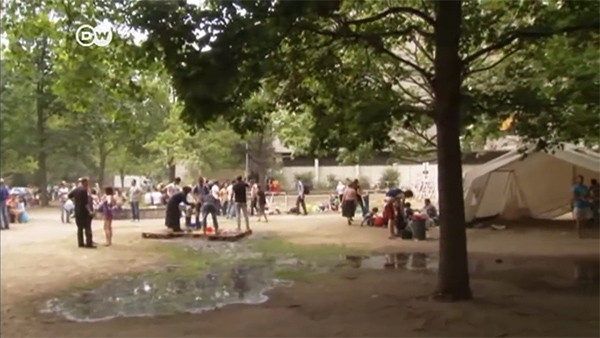
1229 (1)According to a report by German public broadcaster Deutsche Welle, the Berlin refugee center pictured here received up to 2000 applications for asylum per day in August — before the migrant flow increased substantially. (Image source: Deutsche Welle video screenshot)

Speaking at an October 22 gathering of the European People’s Party in Madrid, Hungarian Prime Minister Viktor Orbán warned of the consequences of Merkel’s immigration policies. He said:

“We are in deep trouble. The migration crisis has the potential to destabilize governments, countries and the whole European continent….

“What we have been facing is not a refugee crisis. This is a migratory movement composed of economic migrants, refugees and also foreign fighters. This is an uncontrolled and unregulated process…. I also want to underline that there is an unlimited source of supply of people, after Syria, Iraq, Pakistan, Afghanistan, Africa is now also on the move. The dimension and the volume of the danger is well above our expectations….

“Our moral responsibility is to give back these people their homes and their countries. It can’t be our objective to provide them with a new European life. Right to human dignity and security are basic rights. But neither the German, Austrian nor the Hungarian way of life is a basic right of all people on the Earth. It is only a right of those ones who have contributed to it. Europe is not able to accept everyone who wants a better life. We have to help them to get back their own lives with dignity and we have to send them back to their own countries….

“We cannot avoid speaking about the quality of our democracies. Is it freedom of information and speech when the media usually show women and children while 70% of the migrants are young men and they look like an army? How could it happen that our people feel that their opinion is not being taken into consideration? And we have to address the question of whether our people want what has been happening. Did we get authorization from them to allow millions of migrants to enter our continent? … No, distinguished delegates, we did not.

“We cannot hide the fact that the European left has a clear agenda. They are supportive of migration. They actually import future leftist voters to Europe hiding behind humanism. It is an old trick but I do not understand why we have to accept it. They consider registration and protection of borders as bureaucratic, nationalist and against human rights. They have a dream about the politically constructed world society without religious traditions, without borders, without nations. They attack core values of our European identity: family, nation, subsidiarity and responsibility.”

In an October 26 column for the Financial Times, titled “The End of the Merkel Era is Within Sight,” Gideon Rachman wrote:

“The refugee crisis that has broken over Germany is likely to spell the end of the Merkel era. With the country in line to receive more than a million asylum-seekers this year alone, public anxiety is mounting — and so is criticism of Ms. Merkel, from within her own party. Some of her close political allies acknowledge that it is now distinctly possible that the chancellor will have to leave office, before the next general election in 2017. Even if she sees out a full term, the notion of a fourth Merkel administration, widely discussed a few months ago, now seems improbable…

“The trouble is that Ms. Merkel’s government has clearly lost control of the situation. German officials publicly endorse the chancellor’s declaration that ‘We can do this’. But there is panic just beneath the surface: costs are mounting, social services are creaking, Ms. Merkel’s poll ratings are falling and far-right violence is on the rise.

“As the placid surface of German society is disturbed, so arguments about the positive economic and demographic impact of immigration are losing their impact. Instead, fears about the long-term social and political effect of taking in so many newcomers — particularly from the imploding Middle East — are gaining ground. Meanwhile, refugees are still heading into Germany — at a rate of around 10,000 a day. (By contrast, Britain is volunteering to accept 20,000 Syrian refugees over four years.)…

“Some voters seem to have concluded that Mutti [a German familiar form of ‘mother’] has gone mad — flinging open Germany’s borders to the wretched of the earth…

“The refugee crisis marks a turning point. The decade after Ms. Merkel first came to power in 2005 now looks like a blessed period for Germany, in which the country was able to enjoy peace, prosperity and international respect, while keeping the troubles of the world at a safe distance. That golden era is now over.”

Putin Tells Everyone Exactly Who Created ISIS

November 1, 2015

( A clear and concise statement of Russia’s position regarding the middle east and the US. – JW )


Published on Oct 1, 2015

Here’s something you probably never saw or heard about in the west. This is Putin answering questions regarding ISIS from a US journalist at the Valdai International Discussion Club in late 2014.

Say what you want about Putin… when he’s right, he’s right.

Truthstream Can Be Found Here:
Website: http://TruthstreamMedia.com
FB: http://Facebook.com/TruthstreamMedia
Twitter: @TruthstreamNews
Newsletter: http://eepurl.com/bbxcWX

An absurd new world order

November 1, 2015

An absurd new world order, Israel Hayom, Omer Dostri, November 1, 2015

(Please see also, Supreme Leader Khamenei’s statements reported here: Leader: Negotiation with US on Regional Issues Meaningless

The Americans seek to impose their interests, not to settle problems. They want to impose 60, 70 percent of their demands via negotiations, and practically implement and impose the rest of their objectives illegally. Then what would negotiations mean?

. . . .

While many consider the Joint Comprehensive Plan of Action (JCPOA) a major breakthrough in the improvement of ties between Iran and the West, the Leader has already made it clear that Tehran’s policy toward the US will remain unchanged regardless of the ultimate fate of the JCPOA.

— DM)

Iran’s participation in the talks in Vienna on Friday on the conflict in Syria was a manifestation of new, post-nuclear deal order in both the world as a whole and the Middle East in particular.

In recent decades, the U.S. was the sole superpower in the international arena. However, that has changed during U.S. President Barack Obama’s seven years in office, and now the world is bipolar in nature, if not multipolar. The past year has seen Russia enter the international scene and take an active role, both militarily and diplomatically, in conflicts around the globe.

This is a direct result of American foreign policy in recent years, as the Obama administration sought to pivot from the Middle East to Asia. With this goal in mind, the U.S. has tried to achieve stability in the Middle East by making sure conflicting powers are balanced out with each other.

Iran’s participation in the Vienna talks was the result of this U.S. outlook which views Iran as a stabilizing agent that could serve as a counterbalance to the Sunni axis led by Saudi Arabia, Egypt and Jordan. The White House considers Iran to be geopolitically important and this has helped Iran gradually turn into a regional power.

The clearest expression of this strategic decision by the Obama administration was the nuclear deal reached between six world powers and Iran. The U.S. enabled this deal to be reached by whitewashing Iran’s violations of U.N. Security Council resolutions and it helped open international doors for Iran.

This is how Iran, previously an isolated nation in economic distress, is now accepted with open arms and is being courted by world powers as if it was an epitome of peace and reconciliation. Iran’s international status has been greatly bolstered, despite the fact is has done nothing yet to warrant the trust of world powers. For example, European Union foreign policy chief Federica Mogherini welcomed Iran’s participation in the Vienna talks and British Foreign Secretary Philip Hammond called Iran a “significant and important power in the region.”

The absurdity becomes even clearer when one considers the ballistic missile test Iran conducted on Oct. 12, which the U.S. characterized as a “clear” violation of the U.N. Security Council resolution prohibiting Iran from undertaking any work on ballistic missiles designed to deliver nuclear warheads. Furthermore, American experts said the test was not just a violation of the U.N. Security Council resolution, but also of the nuclear deal itself.

The Obama administration’s foreign policy has intentionally enabled Iran to become a significant player in global arena, while the U.S. overlooks the many resulting contradictions and dangers posed by this policy.

Iran is still committed to the destruction of Israel, continues to undermine stability in the Middle East via support for the rebels in Yemen and the brutal regime of Syrian President Bashar Assad, maintains funding of terrorist organizations such Hezbollah and Islamic jihad and incites anti-Israel violence by Palestinians in Judea and Samaria. Yet world powers — in a display of senselessness and utter detachment from reality — continue to shower Iran with praise, thus contributing to the creation of an absurd new world order.

Leader: Negotiation with US on Regional Issues Meaningless

November 1, 2015

Leader: Negotiation with US on Regional Issues Meaningless, Tasnim News Agency (Iranian), November 1, 2015

139408101241559676429254


While many consider the Joint Comprehensive Plan of Action (JCPOA) a major breakthrough in the improvement of ties between Iran and the West, the Leader has already made it clear that Tehran’s policy toward the US will remain unchanged regardless of the ultimate fate of the JCPOA.

***********************

TEHRAN (Tasnim) – Supreme Leader of the Islamic Revolution Ayatollah Seyed Ali Khamenei dismissed the idea of Iran-US negotiation on regional issues, saying the totally contrasting policies of the two countries and Washington’s attempts to impose its demands make such talks pointless.

In a meeting with the Foreign Ministry staffers in Tehran on Sunday, Ayatollah Khamenei underlined that Iran’s foreign policy is founded upon the Constitution, the long-term interests of the country and the Islamic Republic’s values, and that, consequently, they do not change in different administrations.

Different administrations would affect only the “tactics and executive initiatives” in carrying out the country’s foreign policy strategies, the Leader stressed.

The Supreme Leader then dismissed as a Western illusion the notion that Iran’s foreign policy has undergone a forcible change.

Imam Khamenei further referred to the US policies in West Asia as the root cause of the tense situation across the region, adding, “Unlike the view of certain individuals, the US is the main plank of the region’s problems, not part of a solution to the problems.”

The Leader then called on the Iranian foreign ministry officials, ambassadors and diplomats to stick to the tenets of the Islamic Republic’s foreign policy “firmly, mightily and gloriously”, so that foreigners and their followers inside the country would not pin hopes on a shift in Iran’s foreign policy.

Ayatollah Khamenei referred to Iran’s policies on Palestine, Syria, Iraq, Yemen and Bahrain, saying they differ from those of the US by “180 degrees”.

The root cause of insecurity in the region is Washington’s support for the Zionist regime of Israel and the terrorist groups, the Leader underscored.

Imam Khamenei then categorically dismissed the idea of negotiations with the US on regional issues.

“The Americans seek to impose their interests, not to settle problems. They want to impose 60, 70 percent of their demands via negotiations, and practically implement and impose the rest of their objectives illegally. Then what would negotiations mean?”

Elsewhere, Ayatollah Khamenei lauded Foreign Minister Mohammad Javad Zarif and other diplomats for handling nuclear talks with six world powers well, saying they could very well safeguard the country’s goals in the talks.

Iran and the Group 5+1 (Russia, China, the US, Britain, France and Germany) on July 14 reached a conclusion on a lasting nuclear agreement that would terminate all sanctions imposed on Tehran over its nuclear energy program after coming into force.

While many consider the Joint Comprehensive Plan of Action (JCPOA) a major breakthrough in the improvement of ties between Iran and the West, the Leader has already made it clear that Tehran’s policy toward the US will remain unchanged regardless of the ultimate fate of the JCPOA.

Doomed Russian jet did not issue a distress call: report

November 1, 2015

Doomed Russian jet did not issue a distress call: report, DEBKAfile, November 1, 2015

The Russian passenger plane that crashed in the Sinai Peninsula on Saturday did not send out any distress call, reports said Sunday, meaning that the plane suddenly blew up. A number of Israeli commentators continue to claim, like Egypt, that the pilots reported a technical problem to the Egyptian control tower, and that the plane broke in half during the flight. However, there is no basis to those reports.

The New Cold War: The Russia-Shia Alliance VS the Islamic State

November 1, 2015

The New Cold War: The Russia-Shia Alliance VS the Islamic State, Counter Jihad Report, Brian Fairchild, October 31, 2015

(An excellent summary and analysis of the consequences of the Obama Middle East vacuum. — DM)

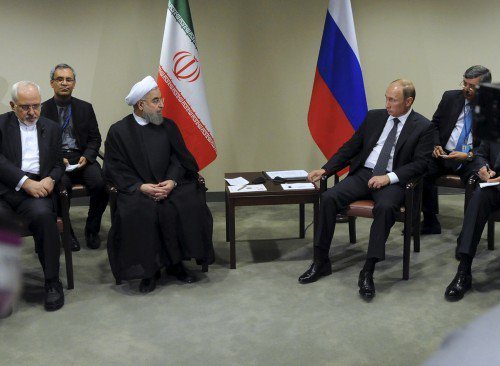
rtx1sy30_iran_russia_un_092015-e1443810243164Russia’s President Vladimir Putin (2nd R) meets with Iran’s President Hassan Rouhani (2nd L) on the sidelines of the United Nations General Assembly in New York, September 28, 2015. REUTERS/Mikhail Klimentyev.

Just one month ago, the US was the only major military player in the Middle East, but that has all changed.  Russia’s aggressive and well-planned military campaign in Syria has tilted the balance of power in the region away from the US and toward Russia and its new Shia-dominated quadrilateral alliance.  As a result, the US plan to effect regime change in Syria is now impossible, but more importantly, US influence in Iraq is steadily diminishing, and thus, the number of options available to American military commanders to degrade the Islamic State are also diminishing.

***********************

The New Cold War:

In late-September 2015 Russia and Iran launched a clandestine strategic military campaign to support Syria’s Bashar al-Assad.  Russia’s bold move took the West by surprise and changed the balance of power in the Middle East in Russia’s favor.  It will go down in history as the milestone depicting Russia’s first aggressive military action outside of its own sphere of influence since the fall of the Soviet Union, and, when viewed from a global strategic perspective, will be remembered as the first clear sign that a New Cold War had erupted between the US and Russia.

Russia’s Middle Eastern campaign is formed around the new “quadrilateral alliance”, which has divided the region into two sectarian blocs:  the Russian-led Shia Muslim alliance, which forms a powerful “Shia Crescent” stretching from Iraq, through Iran and Syria, to Lebanon, and the Sunni Arab bloc led by Saudi Arabia with minimal backing by the United States.

Thus far, Russia’s campaign has been executed seamlessly. Upon entering Syria clandestinely, Russian forces immediately deployed sophisticated surface to air missile defense batteries as well as top-of the-line jet fighters to protect Russian and Syrian forces from the US coalition.  Once air defenses were in place, Moscow began a barrage of airstrikes targeting anti-Assad rebels in order to re-establish and consolidate Assad’s power.  The airstrikes were subsequently integrated with ground operations carried-out by Syrian military units, Iranian Quds forces, Shia militia from Syria and Iraq, and Hezbollah fighters.  There are also credible news reports that Cuban Special Forces have joined the fray for the first time since Cuba’s proxy wars in Angola and central Africa in the 1970’s on behalf of the Soviet Union.

The Russia-Shia Alliance and its Effect on Iraq, Jordan, and the Kurds:

Iraq:

In tandem with its military campaign, Russia launched a diplomatic campaign that has been just as effective.  Iraq is the geographical base for US coalition operations against the Islamic State in Iraq and Syria, but American influence in Iraq has steadily diminished over the past year.

In early October 2015, Iraq secretly established a new Russia-Iran-Syria-Iraq intelligence center in the middle of Baghdad that surprised and angered American military commanders.  Worse, after Russia’s increasingly effective Syrian air campaign, Iraqi Prime Minister Haider al-Abadi called for Russia to begin unilateral airstrikes against the Islamic State in Iraq.  The Pentagon became so alarmed by the possibility that Russia might get a strategic foothold in Iraq that on October 21, 2015, it dispatched Chairman of the Joint Chiefs of Staff General Joseph Dunford to Baghdad to deliver an ultimatum to the Iraqi leadership.  Dunford told the Iraqi Prime Minister and Defense Minister that Iraq had to choose between cooperating with Russia or the US.  Upon his departure from Baghdad, General Dunford told the media that he received assurances that Iraq would not seek Russian assistance, but just three days later, Iraq officially authorized Russian airstrikes in-country.

Jordan:

On that same day, another of America’s most dependable allies, the Kingdom of Jordan, announced its agreement to create a new Russian-Jordanian military coordination center to target the Islamic State and that this center would go well beyond just a formal information exchange.  According to Jordan’s Ambassador to Russia:

  • “This time, we are talking about a specific form of cooperation — a center for military coordination between two countries. Now we will cooperate on a higher level. It will not be just in a format of information exchange: we see a necessity ‘to be on the ground’ as Jordan has a border with Syria”

The Kurds:

Moscow is attempting to undermine US relations with the Kurds.  Since the rise of the Islamic State, the US has sought to provide anti-Islamic State military support to the Kurdish Regional Government (KRG) in northern Iraq via the Iraqi central government, but the Iraqi government has no desire to see the KRG gain additional power in the north so this mission has been largely ineffective.  The US has had a measure of success providing limited support to the Kurdish People’s Protection Units (YPG), but has balked at providing full support because any support whatsoever angers Turkey due to contacts between the YPG and the Kurdish Worker’s Party (PKK), a separatist organization, that seeks to overthrow the Turkish government.  On October 29, 2015, Turkish president Erdogan demonstrated this anger when he vehemently criticized US support for the YPG and stated that Turkey would attack the YPG on the Iraqi side of the border if it attempts to create a separatist Kurdish administrative zone.  Because Turkey is a NATO ally, Turkish threats cause the US significant political and diplomatic problems, but they will not deter Putin from moving to organize and utilize Kurdish forces in pursuit of his goals; in early October, he went out of his way to show disdain for Turkey and NATO by allowing his Syrian-based jets to illegally invade Turkish airspace.

No Kurdish group is happy with the current situation of getting limited support from the United States to fight the Islamic State, but all of them have expressed interest in cooperating with Russia.  Significantly, Sergey Ivanov, the head of the Kremlin administration, specifically urged cooperation between the Syrian Kurdish militia and the US-backed YPG.

The Russia-Shia Alliance and the Islamic State:

The Shia composition of the quadrilateral alliance is extremely significant because it plays directly into the Islamic State narrative.  The Islamic State and the majority of the world’s Muslims are Sunni, but in the heart of the Middle East, the Shia governments of Iran, Iraq, Syria, and Lebanon, with Russian support, dominate, and these countries surround the Islamic State’s new “caliphate” on three sides.  Understanding this strategic disadvantage, the Islamic State knows that it must muster as much international Sunni support as possible to survive, so it carries-out a relentless policy to polarize the international Sunni population against the Shia.

The chance to remove Bashar al-Assad, who represents the Shia Alawite sect, was the primary reason the Islamic State moved to Syria from Iraq, and removing al-Assad from power served as its initial rallying cry to the global Sunni community.  It was this rallying cry that created the dangerous “foreign fighter” phenomenon that subsequently brought more than 30,000 radical Sunni Muslims from around the world to the new caliphate.

The Islamic State repeatedly emphasizes in its official publications and statements its contention that Shia Muslims are not true Muslims and must be eradicated, and, in these communications, it refers to Shia Muslims as “Rafidah” (rejecters).  But of all the Shias in the world, the Islamic State has a particular hatred for the Shia Iranians, who are Persian rather than Arab, and who ruled Islam during the ancient Safavid (Persian) empire, which the Islamic State regards as religiously illegitimate.  It therefore refers to Iranians as the “Safavid Rafidah”.

Moreover, the Islamic State accuses the US and Russia of being modern day “crusaders” who have joined forces with the Iranians to destroy Sunni Islam, a contention made clear on March 12, 2015, when its spokesman Abu Mohamed al-Adnani stated:

  • The Safavid Rāfidah (Shia Iranians) today have entered a new stage in their war against the Sunnis. They have begun to believe that it is within their power to take areas of the Sunnis and control them completely. They no longer want a single Muslim from the Sunnis living in the empire they desire…O Sunnis…if the Islamic State is broken…then there will be no Mecca for you thereafter nor Medina…Sunnis! The Crusader-Safavid (Christian-Iranian) alliance is clear today.  Here is Iran with its Great Satan America dividing the regions and roles amongst each other in the war against Islam and the Sunnis…We warned you before and continue to warn you that the war is a Crusader-Safavid was against Islam, and war against the Sunnis…”

The Shia Alliance and the Saudis:

Saudi Arabia considers itself to be the leader of the world’s Sunni population and the custodian of Islam’s two most holy places:  the mosques of Mecca and Medina where the prophet Muhammad received Allah’s revelations.  Because Iran is the Kingdom’s religious and regional nemesis the Islamic State’s anti-Shia narrative resonates greatly among many Saudis who are increasingly alarmed at Iran’s growing military influence and power.  In a letter signed by 53 Saudi Islamic scholars in early October 2015, the clerics lashed out at Iran, Syria and Russia and echoed the main points made by the Islamic State:

  • “The holy warriors of Syria are defending the whole Islamic nation. Trust them and support them … because if they are defeated, God forbid, it will be the turn of one Sunni country after another”

Saudi King Salman was willing to allow this unofficial letter to be published because it permitted the Saudi government an indirect manner to issue a warning to Iran, but as the Russian-Iran alliance continued to make military gains throughout October, the Kingdom’s anxiety was such that it decided to allow its Foreign Minister to issue the following direct warning to Iran:

  • “We wish that Iran would change its policies and stop meddling in the affairs of other countries in the region, in Lebanon, Syria, Iraq and Yemen…We will make sure that we confront Iran’s actions and shall use all our political, economic and military powers to defend our territory and people…”

Conclusion:

The New Cold War:

Just one month ago, the US was the only major military player in the Middle East, but that has all changed.  Russia’s aggressive and well-planned military campaign in Syria has tilted the balance of power in the region away from the US and toward Russia and its new Shia-dominated quadrilateral alliance.  As a result, the US plan to effect regime change in Syria is now impossible, but more importantly, US influence in Iraq is steadily diminishing, and thus, the number of options available to American military commanders to degrade the Islamic State are also diminishing.

Five days after Iraq rejected General Dunford’s ultimatum and authorized Russian airstrikes in Iraq, Secretary of Defense Ashton Carter ignored this fact in his testimony before the Senate’s Armed Forces Committee when he stated that the United States plans to increase the number of airstrikes in Iraq as well as direct action raids by US special operations forces in Iraq.

Unfortunately, such an increase in US military actions require Iraqi permission, and for the second time in a week, Iraq rejected the United States.  On October 28, 2015, Prime Minister al-Abadi’s spokesman told the media that Iraq has no intention of allowing increased American participation because:

  • “This is an Iraqi affair and the government did not ask the U.S. Department of Defense to be involved in direct operations…”

If Iraq enforces this restriction, and limits the US to only training and arming Iraqi forces while allowing Russia to conduct aggressive operations in-country, the situation could become untenable for the United States, further reducing America’s ability to degrade the Islamic State.

The Islamic State:

Once Russia consolidates Assad rule in Syria, Putin will undoubtedly use the new Russia-Shia alliance to move against the Islamic State.  Because the alliance dominates the geographical terrain on three sides of the “caliphate” and has demonstrated a willingness to engage in unified military air and ground operations, it is likely that Russian airpower and Shia ground forces will succeed in dismantling many Islamic State elements in Syria and Iraq.

Such success by the Russia-Shia alliance, especially if it forces the evacuation of the capital of the Islamic State’s “caliphate” in Raqqa, Syria, will further polarize and enrage radical Sunnis and likely increase the number of foreign fighters from Europe and the Middle East.  It will also likely result in more domestic lone jihad attacks in the US and Russia, a call the Islamic State has already made in its October 13, 2015statement:

  • “…the Islamic State is stronger today than yesterday, while at the same time America is getting weaker and weaker…America today is not just weakened, it has become powerless, forced to ally with Russia and Iran…Islamic youth everywhere, ignite jihad against the Russians and the Americans in their crusaders’ war against Muslims.”

If the Islamic State experiences set-backs and defeats in Syria and Iraq such defeats would likely motivate it to launch mass casualty attacks in the United States and Europe in order to prove to its followers that it remains relevant. Mass casualty attacks in tandem with increased lone jihad attacks would make an already bad domestic security situation, grave.

On October 23, 2015, FBI Director Comey revealed that the FBI is pursuing approximately 900 active cases against Islamic State extremists in the United States and that this number continues to expand.  Comey added that should the number of cases continue to increase, it won’t be long before the FBI lacks the adequate resources to “keep up”.   Europe, too, faces grave security challenges.  A few days after Comey’s revelations, the head of MI5, Britain’s domestic intelligence service, stated that the terror threat in the United Kingdom from the Islamic State and al Qaeda is the highest he has “ever seen”.