Archive for October 2015

Bipartisan consensus: Stop Iran and its missile attacks on Iranian dissidents

October 31, 2015

Bipartisan consensus: Stop Iran and its missile attacks on Iranian dissidents, The Hill, Raymond Tanter, October 31, 2015

Fox News reports a missile attack occurred on Camp Liberty Iraq on October 29; residents include 2,400 members of the Mujahedeen-e-Khalq (MEK). About 80 missiles made holes as deep as 7 feet and wide as 8 feet—including 122 mm Katyushas and those Tehran produced—the NB24 Russian missiles. 

Why is Iran targeting its opposition? Dissidents block the goal of Tehran—to control Baghdad and Damascus where we are fighting the Islamic State of Iraq and Syria (ISIS). Washington’s evolving strategy is DOA on the Hill unless the administration reaches out to the opposition and sees Iran as a threat across the porous border.

How to counter the threat from Iran? Align with others opposing Tehran and the bipartisan congressional coalition sharing that view.

Saudi Arabia’s alignment against Iran includes Israel as a silent partner. Saudis view Tehran and Damascus unfavorably. A potential partner for Riyadh and Washington is the Iranian Resistance that rejects clerical rule in Tehran. All define the threat as Islamist.

Saudi Foreign Minister Adel al-Jubeir asked, Is Iran a “state or a revolution?” If it wants to export its 1979 revolution and revive the Persian Empire “we cannot deal with it.” Israeli Prime Minister Benjamin Netanyahu said in his UN speech on October 1 that shifting alliances in the Middle East drew Arab countries like Saudi Arabia closer to Israel in confronting Iran and ISIL. His speech before the Congress stated that, “Iran’s regime poses a grave threat…to the peace.”

On April 29, the House Foreign Affairs Committee held a hearing, “ISIS: Defining the Enemy.” Maryam Rajavi is President-Elect of the National Council of Resistance of Iran (NCRI), the coalition of which the MEK is the largest unit; she testified from Paris. Her written testimony showed how Tehran is an Islamist epicenter of terrorism to establish an Empire without borders and called for empowering the democratic tolerant Islam she represented.

The Joint Comprehensive Plan of Action (JCPOA), garnered bipartisan criticism on the Hill. At a May 5, 2014 press conference, Senate Committee on Armed Services (SCAC) Chairman John McCain (R-Ariz.) announced completion of markup of National Defense Authorization Act for Fiscal Year 2016. That Act had language to counter Iran’s influence in Iraq and protect the MEK, now in Camp Liberty. An SCAC hearing on Iranian Influence in Iraq and the Case of Camp Liberty focused on resettlement of the MEK from Camp Liberty outside Iraq.

Bipartisan statements by over a dozen senators indicated Secretary Kerry should protect the MEK in Iraq and waive regulations to permit MEK members to enter the USA and contribute to the economy in alignment with our humanitarian values, as stated by several senators and General James Jones, USMC (Ret.), first National Security Advisor to President Barack Obama.

“The U.S. government and military made a commitment to protect thousands of people [MEK] who surrendered their weapons and came under our protection as a result,” McCain said. “Clearly, this commitment has not been sustained.”

Ranking member, Sen. Jack Reed (D-R.I.), expressed a desire to help these oppositionists. “The Iranian dissidents at Camp Liberty are in an increasingly perilous situation, having repeatedly come under attack. These horrific attacks, which have killed more than 100 MEK members since 2009, clearly indicate the threat to this group from Iran and Iranian-backed militia seeking to eliminate and silence these dissidents.” Add about 30 others from the attack on Oct 29, 2015.

McCain described the MEK as a group that received “protected persons” status in 2004 under the Fourth Geneva Convention. Col Wes Martin, former Commander, Forward Operating Base Ashraf until 2006, testified that the United States provided ID cards for each Protected Person under the authority of the American military on behalf of the U.S. Government.

Former Sen. Joe Lieberman (I-Conn.), invited by former colleagues to attend as witness, testified that America would be “disloyal to our…national values if we did not find better ways–overt and covert–to support the democratic opposition to the dictatorial regime in Iran.”

Senators backed the moderate pro-democracy tolerant Islam of the MEK instead of allowing the Islamist regime in Tehran to suppress that organization. With such bipartisan backing, there is enhanced likelihood the MEK can expand the NCRI coalition for regime change from within and broaden its base in Iran given that expectations will be higher in a post-nuclear-agreement Iran.

The way forward: Alignment with those opposing Tehran, congressional allies sharing that view, and prevention of attacks like the missiles on Camp Liberty.

Russian airliner with 224 people aboard believed shot down by missile over central Sinai

October 31, 2015

Source: Russian airliner with 224 people aboard believed shot down by missile over central Sinai

DEBKAfile Special Report October 31, 2015, 12:19 PM (IDT)

 A Russian civilian plane with 217 passengers and 7 crew aboard crashed, and is belived shot down by a missile, over Sinai over Sinai early Saturday morning, Oct. 31, shortly after taking off from the Sinai resort town of Sharm el-Sheikh for St. Petersburg.

Initial reporting on the fate of the plane was confused and is still not completely clear. It was first reported to be missing after contact was lost with Egyptian air control; it was then said to be safely on its way to Russia over Turkey. Russian aviation sources then reported the A321 to be missing over Cypriot air space. Finally, the Egyptian prime minister’s office Egyptian prime minister’s office confirmed that a Russian passenger plane had crashed n central Sinai and a cabinet level crisis committee had been formed to deal with the crash.
The airliner owned by the small airline Kogalymavia disappeared from screen 23 minutes after takeoff from Sharm el-Sheikh. There were many families with children aboard.

debkafile reports:  The first claim by Russian aviation sources that the plane had gone missing over Cyprus was an attempt to draw attention from the likelihood that it was shot down over Sinai, where the former Ansar al-Miqdas, which has renamed itself ISIS-Sinai, maintains its main strongholds.
Moscow is reluctant to admit that the Islamic State may have chosen to retaliate for the buildup of Russian forces in Syria and Russia ari strikes on its bases in Syria.
If the airline was indeed shot down by the Sinai branch of the Islamic State, the Russians are finding that ISIS is fully capable of striking at the least expected place and most vulnerable spot of its enemy.

On board the plane were 17 children, along with 200 adults and seven crew, said aviation authorities. There are no signs of survivors.

Confirming the deliberate attempt at confusion, Moscow and Cairo both stated that the plane had disappeared from the radar 23 minutes after takeoff from Sharm El-Sheikh.

This is refuted by the discovery of the wreckage, a few minutes ago, completely gutted and destroyed, and a short distance away near Bir Al-Hassaneh, in the central Sinai Jabal al-Halal mountain range, where Ansar Beit al-Miqdas terrorists are holed up and which is almost inaccessible to rescue teams.
It is to this stronghold that debkafile reported in recent months that ISIS sent officers, former senior members of Saddam Hussein’s army, to set up a major campaign against the Egyptian army, along with advanced anti-air missile systems smuggled into Sinai and the Gaza Strip from Libya for this campaign.
Israel air force jets no longer carry out low flights in the areas within range of the Islamic groups armed with these missiles.
Updating:

In another attempt to disguise the cause of the disaster, Russian and Egyptian officials now say that the pilot of the Russian plane reported a technical fault after takeoff and asked to be rerouted to Cairo or El-Arish. Russian and Egyptian officials have meanwhile announced they are forming commissions of inquiry to investigate the cause of the tragedy. Official condolences were relayed to the waiting families the airport.

The Sinai branch of the Islamic State has developed a highly competent intelligence-gathering network, debkafile’s sources report, operated by local Bedouin tribesmen who track the slightest movements in the Peninsula. The Egyptian army and the American troops serving at the big the Multinational Force base there are fully aware of the round-the-clock surveillance maintained by the terrorists at Egyptian resorts, using staff at hotels, restaurants and the local airfield as inside informers.
Ansar has never yet harmed the tourist traffic in Sinai. But once ISIS decided to use it to hit back at Russia’s intensified military intervention in the Syrian conflict, the Islamists would not have found it hard to find out when the Russian airliner was due to take off from the Red Sea resort, chart its route north along the western coast of the Gulf of Aqaba up to Dahab and then turn west towards central Sinai and head for the Mediterranean. All the terrorists had to do was to lay a missile ambush for the plane from the Jabal Halal eminence of 876 meters (2,865 ft).

Had the crash been the result of a technical fault, as Moscow and Cairo claim, it would not have been so completely gutted but broken up into large fragments. The total destruction could only have been caused b y an explosion either inside the A321 or a direct missile hit.

NATO Chief: Russia Conducted Several Tests of Illegal Cruise Missile

October 31, 2015

NATO Chief: Russia Conducted Several Tests of Illegal Cruise Missile General defends U.S. tactical nuclear arms upgrade in Europe

BY:
October 30, 2015 3:00 pm

Source: NATO Chief: Russia Conducted Several Tests of Illegal Cruise Missile – Washington Free Beacon

Philip Breedlove

Supreme Allied Commander Europe and Commander of U.S. European Command General Philip M. Breedlove / AP

Russia is continuing to develop a new ground-launched cruise missile in violation of the 1987 Intermediate-range Nuclear Forces Treaty, the general in charge of NATO and the U.S. European Command said Friday.

Air Force Gen. Philip Breedlove, the NATO and Eucom commander, said both the United States and NATO allies are concerned about the new Russian cruise missile that was tested most recently on Sept. 2.

“Sept. 2nd is not the first time that we have seen testing that looks like it violates the INF,” Breedlove said during a meeting with reporters at the Pentagon. “So, the violation is not new, and yes we are concerned.”

Breedlove said the Pentagon has a framework for addressing the treaty breach that was outlined by Defense Secretary Ash Carter earlier this year.

Carter testified that the United States will respond to the INF violation and several options are being reviewed. The options include increasing cruise missile defenses and deploying nuclear-tipped counterforce weapons.

Defense officials have said the State Department and White House have been blocking Pentagon efforts to counter the treaty breach.

The State Department has sought for over a year to coax Moscow into returning to INF treaty compliance but the efforts, through talks with the Russian officials, have been unsuccessful.

Russia has denied violating the treaty and countered U.S. charges by demanding more intelligence about the new cruise missile and by accusing Washington of violating the INF treaty.

The treaty was a centerpiece of Cold War arms control and banned all missiles with ranges of between 300 miles and 3,400 miles.

The recent flight test of what defense officials described as Russia’s new SSC-X-8 ground-launched cruise missile are a further indication of Russian unwillingness to abide by the INF accord.

The White House, according to a senior House Republican on the Armed Services Committee, has been blocking a Joint Staff report assessing the risks to U.S. security posed by the Russian missile violation.

Former Defense Secretary Robert Gates disclosed to Congress last week that Russia sought to pull out of the INF treaty as early as 2007 over concerns that it needs missiles with INF ranges to deal with threats from China and Iran.

Critics of the Obama administration in Congress have said the INF treaty violation, had it been known by Congress, could have led to blocking ratification of the 2010 New START arms accord. That treaty was approved by the Senate with no discussion of Russia’s plans to violate or withdraw from the INF treaty.

China also has a large force of intermediate-range missiles.

Asked about a recent threat by Moscow to withdraw from the INF treaty if the United States modernizes nuclear bombs stored in Europe, Breedlove dismissed the threat as a propaganda ploy.

“As far as withdrawing from the INF, what we hear are threats that are being made in the face of our upgrade, our life extension program to our tactical nuclear weapons in Europe,” Breedlove said.

“We’re not bringing new weapons, we are not bringing more weapons,” he said. “We’re ensuring the safety and the functionality of the weapons that are there. So, I actually believe this is just another way to create dialogue and to try to bring pressure on our alliance.”

Breedlove said the upgrade of B-61 aircraft-delivered bombs has been planned for years and “we are continuing with the upgrade of our weapons.”

“This is about safety and reliability. These are things that you want to have in nuclear weapons. I’m stymied at the concern,” he said.

The NATO commander also disclosed that Moscow conducted saber-rattling military maneuvers, including a staff nuclear exercise after NATO forces conducted a series of military exercises in the Baltic states.

“I think these are clear messages that are sent,” Breedlove said.

On Russian military intervention in Syria, Breedlove said he views the airstrikes in support of the Assad regime as aimed at diverting attention from Russian military action against the Donbas region of eastern Ukraine.

“What I’m concerned about is that folks have taken their eye off of Ukraine a little bit because of what is happening in Syria,” he said. “And that is a technique that I think has been employed here a couple of times. Invade Crimea. Take the world’s eyes off of Crimea by invading Donbas. Take the world’s eyes off of Donbas by getting involved in Syria.”

On European security threats, Breedlove identified an unpredictable Russia and a lack of visibility into the intentions of Russian leader Vladimir Putin, combined with growing Russian military capabilities near Europe, as the reasons for increases in NATO deterrence efforts.

The alliance is currently holding large military exercises aimed at improving readiness, involving some 36,000 troops from 30 nations.

The command recently completed the deployment of a heavy brigade worth of equipment and weapons to bolster defenses.

Without adding troops, military commanders are positioning arms and equipment that could be used by troops that are rapidly deployed in a crisis or conflict. Strengthened European defenses will be focused on protecting the Baltic states of Latvia, Lithuania, and Estonia, as well as Poland, Romania, and Bulgaria.

For naval forces, a fourth Aegis-equipped U.S. warship was recently deployed to Spain and the ships have been conducting freedom of navigation operations in the Black Sea, where Russia has sought to prevent U.S. ships from operating. More naval forces have been requested, the four-star general said.

U.S. intelligence agencies also are increasing efforts to gather intelligence on Russia.

For the Middle East, European command forces are operating out of Turkey’s Incirlik air base in support of air strikes against Islamic State targets.

“Europe isn’t what it was 18 months ago, or even six months ago, and new threats and challenges seemingly emerge every day,” Breedlove said.

Russian aggression continues to be the most important priority.

“Russia’s actions prolong the conditions creating massive scale immigration of refugees that is further worrying our southern allies,” he said. “And the eastern allies continue to be concerned about Russian expansion. These concerns, combined with the flow of foreign fighters, are a strategic challenge for all of Europe.”

Asked about Monday’s unusual flight of two Russian Tu-142 bombers within a mile of the aircraft carrier USS Reagan near Japan, Breedlove said provocative Russian bomber and aircraft flights near Europe have dropped somewhat from a higher rate of bomber and military air intrusions several months ago.

Breedlove attributed the decline in NATO aerial intercepts of Russian aircraft to Moscow’s military operations in Syria, which are taking up military resources.

“I would opine that in the past few weeks or so, it has been a bit more normal, because we have seen a real focus on Syria,” he said of the Russian flights.

“But these actions continue, and they continue all around the periphery of Russia. They are still happening in Europe. And they are still happening in the far east, in Asia.”

Russian airliner carrying 224 people crashes in Sinai

October 31, 2015

Russian airliner carrying 224 people crashes in Sinai Wreckage found of plane that crashed 23 minutes after takeoff from Sharm el-Sheikh; rescuers looking for survivors; all on board were Russian nationals

By Times of Israel staff, AFP and AP

October 31, 2015, 9:31 am

Source: Russian airliner carrying 224 people crashes in Sinai | The Times of Israel

A Russian charter plane crashed early Saturday morning in Egypt’s Sinai Peninsula some 23 minutes after takeoff, with 224 Russian nationals on board.

The office of Egyptian Prime Minister Sharif Ismail confirmed Saturday that a “Russian civilian plane… crashed in the central Sinai.” Ismail canceled a trip to the Sinai city of Ismailia in the wake of the crash, Sky News Arabia said.

A senior aviation official said the plane was a charter flight operated by a Russian company and had on board 217 passengers and seven crew members. There were 17 children on the plane, according to the RT news channel.

A statement from the Ministry of Civil Aviation said military search and rescue teams found the wreckage of the passenger jet in the Hassana area south of the city of Al-Arish, an area in northern Sinai where Egyptian security forces are fighting a burgeoning Islamic militant insurgency led by a local affiliate of the extremist Islamic State group.

“Military planes have discovered the wreckage of the plane… in a mountainous area, and 45 ambulances have been directed to the site to evacuate dead and wounded,” the statement said.

The time lapse between takeoff and losing contact with the aircraft means that the plane was possibly flying at a cruising altitude of some 30,000 feet when it crashed.

Militants in northern Sinai have not to date shot down commercial airliners or fighter-jets.

It is not immediately known whether there were any survivors. Egyptian search and rescue teams at the crash site said they were hoping to find people who were still alive, and reported hearing voices coming from the wreckage, Israel’s Walla website said.

“There is another section of the plane that rescue teams have still be unable to access and we hope to find survivors there. We have heard people crying out from inside the wreckage,” a member of a rescue team told reporters.

The Israel Air Force had helped Egypt to locate the wreckage, the Ynet news website said. Israel also offered further assistance to both Cairo and Moscow.

An official statement carried by Egypt’s MENA news agency said the flight took off from Sharm el-Sheikh, a popular destination for Russian tourists, at 5:51 a.m. local time and disappeared from radar screens 23 minutes after takeoff. It said the plane had been bound for St. Petersburg.

Investigators were looking at human error or a technical problem as a cause of the crash, Channel 10 television said. Security sources in Egypt said that the pilot had reported a technical problem to air traffic control and said he was planning to make an emergency landing. After that, nothing was heard from the plane.

Russian President Vladimir Putin sent his condolences to the families of those on the plane on Saturday, and has ordered an inquiry into the reasons for the crash, the Walla website reported. Egypt’s new prosecutor-general, Nabil Sadek, has also ordered an investigation and dispatched a team to the crash site, Ynet reported.

Earlier in the day, an Egyptian official with the government’s Incidents Committee had told local media that the plane had briefly lost contact and was now safely in Turkish airspace.

 US to Put Boots on the Ground in Syria and Maybe Iraq

October 31, 2015

‘J.V.’ terrorist group makes J.V. U.S. President eat his words.

By: Lori Lowenthal Marcus

Published: October 30th, 2015

Source: The Jewish Press » » US to Put Boots on the Ground in Syria and Maybe Iraq

U.S. President Barack Obama

U.S. President Barack Obama
Photo Credit: WhiteHouse.Gov screen capture


In a startling turnaround – or one might characterize it as a pirouette in ultra-slow-motion – U.S. President Barack Obama authorized the deployment of dozens of Special Operations Forces to Syria. Also announced on Friday, Oct. 30, the U.S. is seriously considering sending Special Operations Forces to Iraq, to assist others fighting on the front lines against ISIS.

And so, this U.S. President who repeatedly swore that this country will not become involved in another military conflict in the Middle East, may be sending U.S. forces to fight in that region.

Try as they might, even the most ardent anti-Israel agitators in the U.S. and elsewhere will have a hard time blaming this military expenditure – in terms of financial outlay and personnel – on Israel.

The failure to recognize ISIS as a serious threat, President Obama disdainfully referred to that barbaric terrorist organization as a junior varsity team in January of 2014, and the endless dithering about how and whether to respond to the civil war in Syria, is why the U.S. now finds itself unable to act other than by sending in American troops.

As Secretary of State John Kerry explained earlier this week, ISIS (he now calls it Daesh) arose out of the chaos which ensued at the onset of the Syrian civil war.

The U.S. had focused its energy on an expensive “train and equip” $500 million strategy to shore up moderate rebels fighting against ISIS. The plug was pulled on that effort this month, after equipment and trained Syrians ended up either fighting with Assad or with ISIS or other terrorist groups.

The latest U.S. response comes late in the game, well after Iran and Russia have spent years and months, respectively, propping up Syrian President Bashar al-Assad, whom the U.S. is committed to sidelining.

In testimony before the Senate Armed Services Committee earlier this week Gen. Joseph Dunford, Jr., Chairman of the Joint Chiefs of Staff acknowledged, “no one is satisfied with our progress to date.”

It may be unfair to refer to a U.S. President in the second term of his presidency as “junior varsity,” but on May, 28, 2014 Obama made a speech at West Point that, in hindsight, might lead one to characterize his military thinking in those terms.

He said then that a,”strategy that involves invading every country that harbors terrorist networks is naïve and unsustainable.”

It was during that speech that Obama announced he would ask Congress for money to train the armies of “vulnerable” nations to carry out operations against extremists.

But now the U.S. is tentatively committed to sending in special forces units into both Syria and Iraq. As it turns out, the previous position of the U.S. was naive and unsustainable.

Picture added by JK

Palestinian Attacks Continue Amid Report Abbas Ordered Shift to West Bank

October 31, 2015

Palestinian Attacks Continue Amid Report Abbas Ordered Shift to West Bank, Investigative Project on Terrorism, October 30, 2015

Palestinian Authority President Mahmoud Abbas issued a directive 11 days ago to cease attacks in Jerusalem in order to increase attacks in the West Bank, emphasizing the areas of Gush Etzion and Hebron, the Jerusalem Post reported.

*****************************

Palestinian violence against Jews continues, as a terrorist stabbed and injured an Israeli man in Jerusalem on Friday, reports the Times of Israel.

Israeli police shot and critically wounded the terrorist; however a second Israeli man was accidentally injured by police gunfire.

The stabbing was the first in Jerusalem since Oct. 17, and comes amid analyses that the Palestinian violence has shifted primarily from the Israeli capital to the West Bank.

Palestinian Authority President Mahmoud Abbas issued a directive 11 days ago to cease attacks in Jerusalem in order to increase attacks in the West Bank, emphasizing the areas of Gush Etzion and Hebron, the Jerusalem Post reported.

The clear difference in Israeli authorities’ ability to prevent attacks in eastern Jerusalem versus the West Bank shows the extent of the PA’s influence over the Palestinians in the capital. However, today’s events show that not all Jerusalem Arabs are heeding to Abbas’ call to divert attacks, suggesting that broader societal Palestinian incitement continues to play a major role in driving violence against Jews.

Meanwhile, two Palestinian attackers attempted to stab Border Police officers at the Tapuah Junction in the West Bank and were subsequently shot by Israeli authorities – one terrorist died as a result.

Palestinians rioted in the West Bank city of Ramallah, leading Israeli police to shoot an assailant who was ready to throw a Molotov cocktail. As Israeli first responders administered first aid to the wounded Palestinian, another Palestinian terrorist approached the medical officers wielding a sharp object. Seeking to prevent another terrorist attack, an Israeli commander in a jeep ordered his driver to approach the terrorist. The driver hit the second Palestinian and moderately wounded him.

These incidents mark more than 60 separate terrorist attacks against Israeli civilians and security personnel in the last month, killing 10 Israelis and injuring dozens more

MEMRI: ‘The Emperor Has No Clothes’

October 30, 2015

MEMRI: ‘The Emperor Has No Clothes,’ Yigal Carmon, October 30, 2015

(Where are the media? In Obama’s pocket as usual. — DM)

25564

This MDB is dedicated to the memory of USAF pilot Captain (ret.) David Ganz, a man of honor and gallantry and a decorated officer, who passed away last week.

What Is The “Iran Nuclear Deal?”

What is mistakenly perceived as an agreement under the title of “Joint Comprehensive Plan of Action” (JCPOA), that was concluded on July 14 in Vienna, and celebrated by the White House as anhistoric agreement,” is neither a contract nor even a real agreement between Iran and the P5+1. It is a set of understandings and disputes compiled into a single document.

For example, the JCPOA states that in the event of Iranian violations, sanctions will be re-imposed (snapback). However, the Iranian position, which rejects all sanctions, is incorporated in the same document. In outlining the snapback of the sanctions, Article 37 also stipulates: “Iran has stated that if sanctions are reinstated in whole or in part, Iran will treat that as grounds to cease performing its commitments under this JCPOA in whole or in part.”[1] This is not merely an Iranian reservation expressed outside of the negotiating room. It is incorporated into the text of this selfsame document – and one that completely contradicts preceding provisions that stipulate otherwise. Since the parties were unable to arrive at an understanding on this issue in two entire years of negotiations, they decided to resolve this major issue by incorporating this disagreement into the document itself.

The JCPOA is best characterized by bangs and whimpers – by bold prohibitions on Iran that peter out in qualifying terms such as “unless,” “except if,” and the like.

Why isn’t the JCPOA a contract? Because Iran would never have signed any contract with the U.S. – “the Great Satan” – whose demise it seeks. Likewise, it would not have signed any contract with any other party to the negotiations, since it views the sanctions imposed on it by United Nations Security Council (UNSC) resolutions and by EU and IAEA reports as grievous injustice. By signing such an agreement, it would retroactively legitimize these wrongs done to it.

As Iranian Supreme Leader Ali Khamenei frequently reiterates, Iran agreed to negotiations mainly to get the sanctions lifted. Therefore, as far as Iran is concerned, the only acceptable name for this enterprise is “Joint Comprehensive Plan of Action” – under which each party commits to particular action. It is a joint plan, not a contract.[2]

Has Iran Fulfilled Its Initial Obligation To Approve The July 14 Vienna JCPOA?

The JCPOA includes a timetable and obligations applying to both sides. Within this time frame, both parties had 90 days from July 14 to secure approval for the agreement from their respective national institutions. By “Adoption Day,” set for October 19, which has come and gone, the agreement was meant to have been approved by both sides. The EU was to have announced the lifting of its sanctions, while President Obama, on behalf of the U.S., was to have announced the lifting of the U.S. executive branch’s sanctions, along with waivers on sanctions imposed by the U.S. legislative branch – that is, suspension, because the president is not authorized to lift them.

Adoption Day was preceded by a farcical UNSC endorsement of the agreement/disagreement, as demanded by Iran. The U.S. volunteered to play errand boy for this undertaking. For its part, the UNSC eschewed discussion on the matter, and passed this historic resolution, No. 2231,[3] on such a weighty historic document in record time – under 30 minutes.

The Western side showed its consent long before October 19; the self-effacing EU member countries did not even bother to discuss the agreement in their national parliaments – and thus confirmed their true status as nonentities. And while the U.S Congress did discuss it seriously, the agreement was allowed to proceed, via a convoluted process that was nonetheless legal and binding.

In Iran, however, following discussion in both its Majlis and its Guardian Council, the JCPOA as concluded and announced on July 14 was not approved. The Majlis ratified something else – a set of recommendations to the government of Iran regarding how it should execute the JCPOA. This hardly constitutes approval of the original document. The Guardian Council, for its part, approved what the Majlis had done; Guardian Council secretary-general Ayatollah Jannati said, on Iranian TV, that his council had approved not the JCPOA but a plan for the government to secure Iran’s interests in executing it.[4] Majlis speaker Ali Larijani said the same thing.[5]

Was this a fulfillment of what Iran was obligated to do under the JCPOA? No! Did the U.S. administration insist that Iran approve the JCPOA, as concluded and announced in Vienna on July 14? No! Does the U.S. realize that Iran’s ultimate authority to approve laws rests with Supreme Leader Khamenei, and that he has not yet approved the JCPOA? NO! Nevertheless, the U.S. and Europe have chosen to regard what Iran has done as approval – so that the peace process will not be halted.

The U.S. and Europe then proceeded to the first post-Adoption Day phase in the JCPOA timetable: The EU announced that its sanctions would be terminated. President Obama announced that the U.S.’s executive sanctions would be lifted and its legislative sanctions waived; this announcement was not for immediate execution, but in fact advance notice that these measures would come into effect by December 15 – provided that the IAEA would report that Iran has fulfilled its obligations under the JCPOA.

What are these obligations that Iran has to fulfill between Adoption Day and December 15 in order to merit this sanctions relief? The Arms Control Association, which supports Iran and the JCPOA, listed them on its website:[6]

*reducing the centrifuges at Natanz from over 16,000 to 5,060 IR-1 machines, which will enrich uranium to 3.67 percent, and removing the associated infrastructure;

*reducing the number of IR-1 machines centrifuges at Fordow to 1,000 (328 will operate) and converting the facility for radioisotope production;

*wrapping up testing on advanced centrifuges machines and removing all advanced centrifuges except one IR-4, IR-5, IR-6, and IR-8 machine for testing with uranium;

*storing all dismantled centrifuges under IAEA seal;

*reducing the stockpile of enriched uranium to less than 300 kilograms;

*removing the core of the Arak reactor and disabling it; and

*instituting the necessary transparency and monitoring mechanisms to implement Iran’s additional protocol and the continuous surveillance of key facilities.

Did Iran hasten to meet these obligations? No! The explanation follows below.

Why Has No One Said A Word About Iran’s Noncompliance?

Since Adoption Day, no one in the West – not the media, not Capitol Hill, not Israel – has spoken up about the fraud of Iran’s alleged “approval” of the JCPOA. Western intelligence agencies and think tanks have also held their tongues. Everyone swallowed the lie, in a spirit of goodwill, in order to allow the JCPOA to proceed, for “peace in our time.”

The Republicans should have remembered their revered leader, Abraham Lincoln, invoked by Barack Obama in 2007 when he announced his presidential candidacy at the spot where Lincoln had done so over 150 years previously. After all, it was Lincoln who said, “You cannot fool all the people all the time.”

The pro-JCPOA political media have, of course, misled the public by reporting that Iran approved the JCPOA. But even the anti-JCPOA media have failed to rebut this lie. Why? Ignorance, unprofessionalism, and hatred for President Obama blinded them. Here is what they likely are thinking: Obama gave in to Iran on everything. Obviously, Iran is going to approve this piece of “absolute Western capitulation.”

However, Iran did not get absolutely everything it demanded, and Obama did not give it absolutely everything it demanded – he held out for a tiny scrap of the U.S.’s initial position, as will be detailed below. That is why Iran would not approve the JCPOA – to Iran, anything less than 100% of what it wants is an injustice.

Why Isn’t Iran Rushing To Fulfill Its Obligations And Get Sanctions Relief By December 15?

At this stage, events have taken an absurd turn. Iran has started dragging its feet. Instead of rushing to carry out all the steps to meet its obligations under the JCPOA, it is idling in neutral. It has little time and much to do by December 15. It must dismantle thousands of centrifuges and transfer them to storage monitored by IAEA cameras. It must ship out 9,000 kg of its enriched uranium to a third country, retaining only 300 kg. It must dismantle and pour cement into the core of the Arak plutonium reactor, and transform the facility into a heavy water reactor. It must notify the IAEA of its voluntary acceptance of the NPT Additional Protocol. And more.

But senior Iranian officials are shifting responsibility for initiating fulfillment of these obligations to one another, sometimes with comical effect. For example, President Hassan Rohani sent a letter to Iranian Atomic Energy Organization head Ali Akbar Salehi instructing him to begin to take the appropriate steps. Salehi confirmed that he had received Rohani’s message, but said that it had not stated when he should start doing so. No one wanted to budge without explicit permission from Supreme Leader Khamenei.[7]

Khamenei Issues Nine New Conditions, Blocks Execution Of JCPOA

Now the big secret is out. Khamenei has not approved the JCPOA. And those who pretend that it has been approved – President Rohani, Foreign Minister and negotiator Javad Zarif, and their associates – have been on borrowed time. While they could lie to the West, to President Obama, to Secretary of State Kerry, and to the EU foreign ministers that they can move ahead, they always knew that Khamenei opposed the JCPOA. Now, at the moment of truth, they feared to proceed.

Indeed, it was logical for Khamenei to allow the Iranian negotiators to play along with the P5+1, to see what they could get at no cost to Iran – since it was well known that President Obama was dying for an agreement. But once Khamenei knew that President Obama is standing firm on the last fragment of the original U.S. position, either unwilling or unable to capitulate any further, Khamenei broke his silence. Stepping in in the final act, Khamenei, deus-ex-machina style, dictated, in a letter to President Rohani, nine new conditions for the JCPOA,and declared that if these were not met Iran would stop the agreement.[8]

Actually, Khamenei had issued an early warning in a September 3 speech,[9] in which he said that all the sanctions must be lifted, not suspended, and that if not, there would either be no agreement or Iran would also only “suspend” its obligations. But President Obama did not yield. He cannot override congressional sanctions; he can only issue a suspension via waiver. Politically too, it might be too far for him to go to break his promise of the JCPOA’s built-in security mechanism – snapback of the sanctions. Obviously, snapback is possible only if the sanctions remain in place under suspension. Therefore, Khamenei, realizing that the sanctions would remain, also kept his promise and blocked the agreement with new conditions, one of which – i.e. the lifting of sanctions rather than suspension – he knows for sure cannot be met.

How Did The American Media Describe Khamenei’s Nine New Conditions?

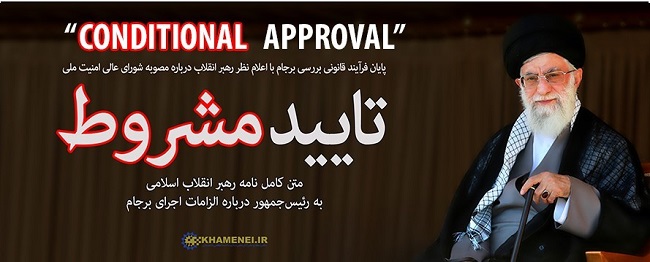
Khamenei’s letter to Rohani with his conditions for the execution of the JCPOA – the publication of which coincided with the days of the Ashura that are of vital religious and national significance in Iran and symbolize steadfastness against the forces of evil – was explicitly termed “conditional approval.” It was labeled thus in red letters, as posted on Khamenei’s website in Persian, tweeted from his Twitter account and posted on his Facebook page in English, and also published in English by the official Islamic Republic of Iran Broadcasting authority IRIB.
25565

But instead of reporting that at this stage, and at present, Khamenei’s approval is not given unless Khamenei’s conditions are met, the American media said that Khamenei had approved the JCPOA. Would these members of the media also consider a purchase concluded if they had not paid for it? The entire American media, without exception, left, right, and center – as well as, apparently, all the U.S. intelligence agencies and think tanks – claimed that Khamenei had approved the agreement. Only two newspapers in the West wondered about the emperor’s new clothes – but even they did not shout “But he hasn’t any clothes on at all!” They said only that he was missing a couple of accessories.

Khamenei had spoken, banning outright any implementation of the JCPOA by Iran until his new conditions are met. The entire Iranian political system is hewing to this line – including President Rohani, Foreign Minister Zarif, Majlis Speaker Larijani, a majority of Majlis members (166), and more (for a full list to date, see Appendix I).

Everyone, that is, except for Ali Akbar Hashemi Rafsanjani, Khamenei’s political rival and head of Iran’s pragmatic camp, who in an interview published this week by MEMRI openly challenged Khamenei and said that Iran should abide by what it undertook in the JCPOA.[10]

But this cannot happen. Khamenei holds the reins.

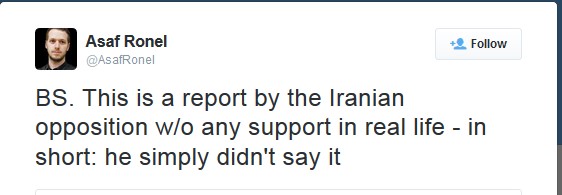
Did the media report on Rafsanjani’s interview? No! But the media in Iran did (see Appendix II). This, however, did not stop the editor of the Israeli daily Haaretz from writing that the interview was faked.
25566

This is a well-known human reaction: When people stand before the complete collapse of what they believe in, they enter a state of denial.

So What Now?

And what is President Obama to do, as everything he has stood for in the Iran deal collapses so ignominiously? On the right, they say he will continue to capitulate. In their ignorance, and in their hatred of him, they fail to realize that he can simply surrender no farther. OK, they say, so the IAEA will provide Obama with the necessary confirmation by December 15 that the Iranians have done their part. But that is impossible as well. What is demanded of Iran is gargantuan in scale, and it would be far more difficult for the IAEA to fake confirmation when the Iranians themselves are declaring loudly that they are not going to do it.

With every passing day, Iran is more and more in violation of the JCPOA. But neither the Republicans nor the Democrats, nor the media, nor anyone else will acknowledge this, for the implications are too devastating. The agreement is no longer in effect. Its clock has stopped.

But the weeks will pass, and the media and politicians will be forced to admit that this is the case. And the last thing they will be willing to do is to force Iran to meet its obligations. Thus, it appears that President Obama’s only option, shameful as it is, is to restart the negotiations with the Iranians and talk with them about their leaders’ new conditions. As is well-known, this administration advocates diplomacy – guaranteeing that there will be no breakthrough any time soon.

This is precisely what will serve President Obama best. All he needs to do is play for time and reach the end of his term with an agreement in hand – albeit virtual – and negotiations in progress – albeit unending. He will pass this situation on to the next administration. The success will be all his, and the failure will be all theirs. The media will zealously guard Obama’s legacy, and his successor, Republican or Democrat, will be too uninformed to protect him or herself from this historic maneuver. And it will serve them right.

Appendix I: Senior Iranian Officials Declare Their Acceptance Of Khamenei’s Instructions On Implementing The JCPOA

On October 10, 2015, Majlis Speaker Ali Larijani  said at a conference on war and peace in Syria: “…The commands of the leader [Khamenei], the decision of the Majlis and the Supreme National Security Council will illuminate the government representatives’ path on implementing the JCPOA… I thank the leader with all my heart.”[11]

President Rohani, responding to the directives letter by the Supreme Leader on carrying out the JCPOA (October 22, 2015): “Your historic letter of October 21, 2015 regarding the approval of decision number 634 of the Supreme National Security Council caused joy within the great Iranian people and warmed the hearts of the public servants in government… The government will obey your criticisms and obligations [that you imposed] and with good intentions will take measures relating to the full implementation of the Supreme National Security Council and the Majlis. We will be fully alert to the performance of the other side’s obligations and in the Supreme National Security Council we will take the necessary decisions to provide a fitting response.”[12]

On October 26, 2015, Foreign Minister Zarif referred in the Majlis to the supreme leader’s letter on carrying out the JCPOA and noted: “I am grateful to the leader for his path-illuminating letter on setting policy in the JCPOA’s implementation. His opinion always lighted the path to the nuclear negotiations team at the foreign ministry. Henceforward, we must make an effort to implement the JCPOA documents in the right way and following the leader’s guidelines.”[13]

On October 27, 2015, Zarif said that the modifications to the nuclear reactor in Arak must be performed after the PMD file has been closed at the IAEA and explained: “we calculated the details of re-planning the reactor following the leader’s guidelines, the decision of the Supreme National Security Council and the Majlis… We will coordinate everything necessary for swapping the uranium stockpiles and this matter will be performed precisely in the way that the leader elaborated and was previously agreed at the Supreme National Security Council and the Majlis nuclear committee.”[14]

In the Majlis, 166 members, constituting a majority, expressed on October 26, 2015 their admiration for the leader for his historic letter in implementing the JCPOA. The letter’s contents read “… For a certainty, the Majlis representatives will act as your stout arms and collaborate with all the supervisory organizations and with the Supreme National Security Council and invest efforts to ensure that after the JCPOA, the enemy will not be able to penetrate our Islamic country even minutely and we will supervise that all violation of promises by the 5+1 group will not remain unanswered.”[15]

Iran’s Judiciary Chief Sadeq Amoli Larijani at an October 26, 2015 conference of senior judicial branch officials said that the letter of conditions that Khamenei published on JCPOA implementation should put an end to debates on the issue. He added: “All groups [within Iran] should treat the leader’s letter as ‘self-explanatory’ and as the axis of unity and from now no they will make progress and think moderately about the future and the next stages of the JCPOA.”[16]

The leader’s representative in the Islamic Revolutionary Guard Corps (IRGC) Ali Saidi said on Wednesday, October 21, 2015: “… The leader is effectively managing the country according to the Koran and custom, the leader sets policy and the others execute it.”[17]

At an October 27, 2015 press conference, the leader’s advisor and the head of the Center for Strategic ResearchAli Akbar Velayati, said: “In the last letter we saw that he criticized the defects and shortcomings in carrying out the JCPOA. I hope that the agreement will be carried out flawlessly in the future. The continued support of the leader for the JCPOA is contingent on the response to the letter that Khamenei wrote the president [Rohani].”[18]

The head of the Majlis nuclear committee, Ebrahim Karkhanehei, referring to the leader’s letter on the JCPOA, said: “This letter produced social calm because in addition to leader the people as well demanded the things that were included in the letter. The most important issue in the letter is the issue of lifting sanctions and the government must seriously handle the matter of lifting the sanctions. In addition to the letter, the leader emphasized many times that if the sanctions are not lifted then there will be no agreement and therefore the US and the EU must fully lift the sanctions.

“The letter from the EU and the American president are not considered a [sufficiently] strong guarantee on the lifting of the sanctions. The Majlis will not be negligent about any clause in the leader’s letter and the government must seriously oversee and handle the sanctions-lifting issue.

“The leader demanded that a professional and  wise team should supervise the sound implementation of the JCPOA and therefore this team must be comprised of at least five people specializing in the legal, nuclear technical political, economic and the sanctions structure issues as well as an expert on security and defense matters.”[19]

An October 25, 2015 Kayhan editorial titled “Giving Interpretations Is Impermissible” wrote: “The leader’s order and the setting of numerous terms for the JCPOA’s implementation is self-explanatory and elaborated a clear path for all arguments and worries, according to religious jurisprudence, the law and the professional perspective. It is obligatory and essential to obey it.. as opposed to some of the impressions, the leader approved the JCPOA’s implementation only following obedience to the terms that may not be damaged and on principle, the leader did not express general approval on the matter.”[20]

Appendix II: Iranian Websites Covering Rafsanjani’s Interview In Inhnews.ir

*IRNA

*ILNA

*Hashemirafsanjani.ir.fa

*Etemaad

*ISNA

*Fars

*Tnews.ir

*Shomaokhabar

*Farsi-news

*Shafaf.ir

*Y. Carmon is president and founder of MEMRI.

Endnotes:

[1] For the complete text of the JCPOA see Eeas.europa.eu/statements-eeas/docs/iran_agreement/iran_joint-comprehensive-plan-of-action_en.pdf

[2] See MEMRI Special Dispatch No. 6151, Khamenei Declares That He Will Not Honor The Agreement If Sanctions Are Merely Suspended And Not Lifted, September 4, 2015; and MEMRI TV Clip #5067 – Iranian Supreme Leader Ali Khamenei: The Americans Must Lift the Sanctions, Not Suspend Them, September 3, 2015.

[3] Unscr.com/en/resolutions/doc/2231.

[4] See MEMRI TV Clip #5114 – Iranian Guardian Council Secretary-General Ahmad Jannati: Khamenei Has Not Approved or Signed the JCPOA, October 16, 2015; and MEMRI TV Clip #5117 – Iranian Guardian Council Spokesman Nejatollah Ebrahimian: The JCPOA Was Not Approved by the Majlis or the Guardian Council, October 18, 2015.

[5] Tasnim (Iran), October 18, 2015.

[6] http://www.armscontrol.org/blog/ArmsControlNow/2015-10-15/The-P5-1-and-Iran-Nuclear-Deal-Alert-October-15

[7] ISNA (Iran), October 18, 2015.

[8] On Khamenei’s nine demands, see MEMRI Inquiry & Analysis No. 1196, Iranian Supreme Leader Khamenei’s Letter Of Guidelines To President Rohani On JCPOA Sets Nine Conditions Nullifying Original Agreement Announced July 14, 2015, October 22, 2015.

[9] See MEMRI Special Dispatch No.  6151, Khamenei Declares That He Will Not Honor The Agreement If Sanctions Are Merely Suspended And Not Lifted , September 4, 2015.

[10] MEMRI Special Report No.43, Breaking Report: Challenging Khamenei, Rafsanjani Demands That Iran Fulfill Its Obligations Under The JCPOA, And Reveals: We Had Nuclear Option In Iran-Iraq War, October 28, 2015.

[11] Mehrnews.com, October 23, 2015.

[12] President.ir/fa/90172

[13] Isna (Iran), October 26, 2015.

[14] Isna (Iran), October 27, 2015.

[15] Mehrnews.com, October 26, 2015.

[16] Nasimonline.(Iran), October 26, 2015.

[17] Snn.(Iran), October 22, 2015.

[18] Isna (Iran), October 27, 2015.

[19] Mehrnews.com, October 26, 2015.

[20] Kayhan (Iran), October 25, 2015.

Hizbullah Sec.-Gen. Nasrallah: The U.S. Supports ISIS, Runs the Entire War in Our Region

October 30, 2015

Hizbullah Sec.-Gen. Nasrallah: The U.S. Supports ISIS, Runs the Entire War in Our Region,Middle East Media Research Institute TV via You Tube, October 29, 2015

(Oh well. — DM)


According to the blurb following the video,

In an October 23 speech at a ceremony marking the ‘Ashura holiday in Beirut, Hizbullah Secretary-General Hassan Nasrallah said that the U.S. “provided ISIS with money, weapons, and aid,” and that “the war raging in our region is actually being led by the US.” The speech aired on the Iranian Al-Alam TV channel.

US Will Deploy Special Operations Forces to Syria

October 30, 2015

US Will Deploy Special Operations Forces to Syria

BY:
October 30, 2015 10:50 am

Source: US Will Deploy Special Operations Forces to Syria – Washington Free Beacon

U.S. forces will soon be on the ground in Syria, a senior Obama administration official said Friday.

NBC News reported that the White House will announce Friday that it is sending U.S. special operations forces into Syria that will be stationed in the northern area of the country.

The special operations forces will work with groups who have been fighting the Islamic State (IS), which could include Kurdish forces and allied groups who fall under the title of “Syrian Democratic Forces.”

The administration will label the decision a “shift” in the U.S. strategy against the terrorist group, not a “change.”

The decision comes just days after Defense Secretary Ash Carter said that the U.S. would engage in “direct action on the ground” on Iraq and Syria in order to combat IS. Earlier this month, the Obama administration ended its $500 million Syrian rebel training program to fight the Islamic State in an acknowledgement of its failure.

Last week, the first U.S. servicemember to die in the fight against IS was killed during a prison raid in Iraq.

US finally approves crucial ‘smart bomb’ sale to Turkey

October 30, 2015

US finally approves crucial ‘smart bomb’ sale to Turkey

Tolga Tanış – WASHINGTON

Source: US finally approves crucial ‘smart bomb’ sale to Turkey – MIDEAST

AFP Photo

AFP Photo

The U.S. has decided to sell Turkey $70 million worth of “smart bombs,” a key item in a set of crucial weapon systems that Washington had been refusing to send to Ankara.

The Pentagon announced on Oct. 29 that the U.S. State Department approved the sale after the Defense Security Cooperation Agency (DSCA), part of the U.S. Department of Defense, told Congress late on Oct. 28 that Joint Direct Attack Munition (JDAM) systems would be sold to Turkey, granting lawmakers 15 days for any block.

The Turkish military attaches great importance to the systems, especially amid the upsurge of clashes between the security forces and outlawed Kurdistan Workers’ Party (PKK) militants. Turkey is also a part of the U.S.-led coalition against the Islamic State of Iraq and the Levant (ISIL) and its İncirlik base is used for strikes against the jihadist group.

ISIL has intensified its focus on Turkey with recent suicide bomb attacks. On Oct. 10 a suicide blast claimed 102 lives in the capital Ankara, almost three months after a suicide attack in the border town Suruç in the southeastern province of Şanlıurfa killed 34 people.

Hürriyet reported on Oct. 8 that U.S. senators Ben Cardin and Bob Corker were vetoing the sale of the smart bomb kits to Turkey, while Corker was also blocking the sale of frigates and congressman Eliot Engel was blocking the sale of military helicopters.

According to a statement by the DSCA, the package to be sold to Turkey includes Mk84, BLU-109 and Mk82 bombs, 900 smart bomb kits, 100 laser kits, 200 warheads and 1,000 capsules.

MK-84, which is ammunition for F-16 jets that constitutes the backbone of the Turkish Air Force fleet, is used in targeting large buildings, factories, bridges, hangars and underground shelters. Mk82 is used against tanks, small buildings and other ground targets. BLU-109 is classified as a “bunker buster.”

“It is vital to the U.S. national interest to assist our NATO ally in developing and maintaining a strong and ready self-defense capability,” the DSCA stated on its website on Oct. 29.

The principal contractors of the deal will be Raytheon Co, the General Atomics Corp., and L-3 Communications Holdings Inc.

Security sources had told Hürriyet before the approval that if the U.S. does not issue permits for smart ammunition sales then Turkey would run out of the military equipment critical in military operations against the PKK.

October/30/2015