MEMRI: ‘The Emperor Has No Clothes,’ Yigal Carmon, October 30, 2015
(Where are the media? In Obama’s pocket as usual. — DM)

This MDB is dedicated to the memory of USAF pilot Captain (ret.) David Ganz, a man of honor and gallantry and a decorated officer, who passed away last week.
What Is The “Iran Nuclear Deal?”
What is mistakenly perceived as an agreement under the title of “Joint Comprehensive Plan of Action” (JCPOA), that was concluded on July 14 in Vienna, and celebrated by the White House as an “historic agreement,” is neither a contract nor even a real agreement between Iran and the P5+1. It is a set of understandings and disputes compiled into a single document.
For example, the JCPOA states that in the event of Iranian violations, sanctions will be re-imposed (snapback). However, the Iranian position, which rejects all sanctions, is incorporated in the same document. In outlining the snapback of the sanctions, Article 37 also stipulates: “Iran has stated that if sanctions are reinstated in whole or in part, Iran will treat that as grounds to cease performing its commitments under this JCPOA in whole or in part.”[1] This is not merely an Iranian reservation expressed outside of the negotiating room. It is incorporated into the text of this selfsame document – and one that completely contradicts preceding provisions that stipulate otherwise. Since the parties were unable to arrive at an understanding on this issue in two entire years of negotiations, they decided to resolve this major issue by incorporating this disagreement into the document itself.
The JCPOA is best characterized by bangs and whimpers – by bold prohibitions on Iran that peter out in qualifying terms such as “unless,” “except if,” and the like.
Why isn’t the JCPOA a contract? Because Iran would never have signed any contract with the U.S. – “the Great Satan” – whose demise it seeks. Likewise, it would not have signed any contract with any other party to the negotiations, since it views the sanctions imposed on it by United Nations Security Council (UNSC) resolutions and by EU and IAEA reports as grievous injustice. By signing such an agreement, it would retroactively legitimize these wrongs done to it.
As Iranian Supreme Leader Ali Khamenei frequently reiterates, Iran agreed to negotiations mainly to get the sanctions lifted. Therefore, as far as Iran is concerned, the only acceptable name for this enterprise is “Joint Comprehensive Plan of Action” – under which each party commits to particular action. It is a joint plan, not a contract.[2]
Has Iran Fulfilled Its Initial Obligation To Approve The July 14 Vienna JCPOA?
The JCPOA includes a timetable and obligations applying to both sides. Within this time frame, both parties had 90 days from July 14 to secure approval for the agreement from their respective national institutions. By “Adoption Day,” set for October 19, which has come and gone, the agreement was meant to have been approved by both sides. The EU was to have announced the lifting of its sanctions, while President Obama, on behalf of the U.S., was to have announced the lifting of the U.S. executive branch’s sanctions, along with waivers on sanctions imposed by the U.S. legislative branch – that is, suspension, because the president is not authorized to lift them.
Adoption Day was preceded by a farcical UNSC endorsement of the agreement/disagreement, as demanded by Iran. The U.S. volunteered to play errand boy for this undertaking. For its part, the UNSC eschewed discussion on the matter, and passed this historic resolution, No. 2231,[3] on such a weighty historic document in record time – under 30 minutes.
The Western side showed its consent long before October 19; the self-effacing EU member countries did not even bother to discuss the agreement in their national parliaments – and thus confirmed their true status as nonentities. And while the U.S Congress did discuss it seriously, the agreement was allowed to proceed, via a convoluted process that was nonetheless legal and binding.
In Iran, however, following discussion in both its Majlis and its Guardian Council, the JCPOA as concluded and announced on July 14 was not approved. The Majlis ratified something else – a set of recommendations to the government of Iran regarding how it should execute the JCPOA. This hardly constitutes approval of the original document. The Guardian Council, for its part, approved what the Majlis had done; Guardian Council secretary-general Ayatollah Jannati said, on Iranian TV, that his council had approved not the JCPOA but a plan for the government to secure Iran’s interests in executing it.[4] Majlis speaker Ali Larijani said the same thing.[5]
Was this a fulfillment of what Iran was obligated to do under the JCPOA? No! Did the U.S. administration insist that Iran approve the JCPOA, as concluded and announced in Vienna on July 14? No! Does the U.S. realize that Iran’s ultimate authority to approve laws rests with Supreme Leader Khamenei, and that he has not yet approved the JCPOA? NO! Nevertheless, the U.S. and Europe have chosen to regard what Iran has done as approval – so that the peace process will not be halted.
The U.S. and Europe then proceeded to the first post-Adoption Day phase in the JCPOA timetable: The EU announced that its sanctions would be terminated. President Obama announced that the U.S.’s executive sanctions would be lifted and its legislative sanctions waived; this announcement was not for immediate execution, but in fact advance notice that these measures would come into effect by December 15 – provided that the IAEA would report that Iran has fulfilled its obligations under the JCPOA.
What are these obligations that Iran has to fulfill between Adoption Day and December 15 in order to merit this sanctions relief? The Arms Control Association, which supports Iran and the JCPOA, listed them on its website:[6]
*reducing the centrifuges at Natanz from over 16,000 to 5,060 IR-1 machines, which will enrich uranium to 3.67 percent, and removing the associated infrastructure;
*reducing the number of IR-1 machines centrifuges at Fordow to 1,000 (328 will operate) and converting the facility for radioisotope production;
*wrapping up testing on advanced centrifuges machines and removing all advanced centrifuges except one IR-4, IR-5, IR-6, and IR-8 machine for testing with uranium;
*storing all dismantled centrifuges under IAEA seal;
*reducing the stockpile of enriched uranium to less than 300 kilograms;
*removing the core of the Arak reactor and disabling it; and
*instituting the necessary transparency and monitoring mechanisms to implement Iran’s additional protocol and the continuous surveillance of key facilities.
Did Iran hasten to meet these obligations? No! The explanation follows below.
Why Has No One Said A Word About Iran’s Noncompliance?
Since Adoption Day, no one in the West – not the media, not Capitol Hill, not Israel – has spoken up about the fraud of Iran’s alleged “approval” of the JCPOA. Western intelligence agencies and think tanks have also held their tongues. Everyone swallowed the lie, in a spirit of goodwill, in order to allow the JCPOA to proceed, for “peace in our time.”
The Republicans should have remembered their revered leader, Abraham Lincoln, invoked by Barack Obama in 2007 when he announced his presidential candidacy at the spot where Lincoln had done so over 150 years previously. After all, it was Lincoln who said, “You cannot fool all the people all the time.”
The pro-JCPOA political media have, of course, misled the public by reporting that Iran approved the JCPOA. But even the anti-JCPOA media have failed to rebut this lie. Why? Ignorance, unprofessionalism, and hatred for President Obama blinded them. Here is what they likely are thinking: Obama gave in to Iran on everything. Obviously, Iran is going to approve this piece of “absolute Western capitulation.”
However, Iran did not get absolutely everything it demanded, and Obama did not give it absolutely everything it demanded – he held out for a tiny scrap of the U.S.’s initial position, as will be detailed below. That is why Iran would not approve the JCPOA – to Iran, anything less than 100% of what it wants is an injustice.
Why Isn’t Iran Rushing To Fulfill Its Obligations And Get Sanctions Relief By December 15?
At this stage, events have taken an absurd turn. Iran has started dragging its feet. Instead of rushing to carry out all the steps to meet its obligations under the JCPOA, it is idling in neutral. It has little time and much to do by December 15. It must dismantle thousands of centrifuges and transfer them to storage monitored by IAEA cameras. It must ship out 9,000 kg of its enriched uranium to a third country, retaining only 300 kg. It must dismantle and pour cement into the core of the Arak plutonium reactor, and transform the facility into a heavy water reactor. It must notify the IAEA of its voluntary acceptance of the NPT Additional Protocol. And more.
But senior Iranian officials are shifting responsibility for initiating fulfillment of these obligations to one another, sometimes with comical effect. For example, President Hassan Rohani sent a letter to Iranian Atomic Energy Organization head Ali Akbar Salehi instructing him to begin to take the appropriate steps. Salehi confirmed that he had received Rohani’s message, but said that it had not stated when he should start doing so. No one wanted to budge without explicit permission from Supreme Leader Khamenei.[7]
Khamenei Issues Nine New Conditions, Blocks Execution Of JCPOA
Now the big secret is out. Khamenei has not approved the JCPOA. And those who pretend that it has been approved – President Rohani, Foreign Minister and negotiator Javad Zarif, and their associates – have been on borrowed time. While they could lie to the West, to President Obama, to Secretary of State Kerry, and to the EU foreign ministers that they can move ahead, they always knew that Khamenei opposed the JCPOA. Now, at the moment of truth, they feared to proceed.
Indeed, it was logical for Khamenei to allow the Iranian negotiators to play along with the P5+1, to see what they could get at no cost to Iran – since it was well known that President Obama was dying for an agreement. But once Khamenei knew that President Obama is standing firm on the last fragment of the original U.S. position, either unwilling or unable to capitulate any further, Khamenei broke his silence. Stepping in in the final act, Khamenei, deus-ex-machina style, dictated, in a letter to President Rohani, nine new conditions for the JCPOA,and declared that if these were not met Iran would stop the agreement.[8]
Actually, Khamenei had issued an early warning in a September 3 speech,[9] in which he said that all the sanctions must be lifted, not suspended, and that if not, there would either be no agreement or Iran would also only “suspend” its obligations. But President Obama did not yield. He cannot override congressional sanctions; he can only issue a suspension via waiver. Politically too, it might be too far for him to go to break his promise of the JCPOA’s built-in security mechanism – snapback of the sanctions. Obviously, snapback is possible only if the sanctions remain in place under suspension. Therefore, Khamenei, realizing that the sanctions would remain, also kept his promise and blocked the agreement with new conditions, one of which – i.e. the lifting of sanctions rather than suspension – he knows for sure cannot be met.
How Did The American Media Describe Khamenei’s Nine New Conditions?
Khamenei’s letter to Rohani with his conditions for the execution of the JCPOA – the publication of which coincided with the days of the Ashura that are of vital religious and national significance in Iran and symbolize steadfastness against the forces of evil – was explicitly termed “conditional approval.” It was labeled thus in red letters, as posted on Khamenei’s website in Persian, tweeted from his Twitter account and posted on his Facebook page in English, and also published in English by the official Islamic Republic of Iran Broadcasting authority IRIB.
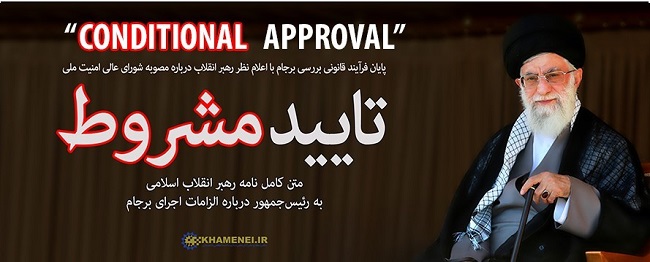
But instead of reporting that at this stage, and at present, Khamenei’s approval is not given unless Khamenei’s conditions are met, the American media said that Khamenei had approved the JCPOA. Would these members of the media also consider a purchase concluded if they had not paid for it? The entire American media, without exception, left, right, and center – as well as, apparently, all the U.S. intelligence agencies and think tanks – claimed that Khamenei had approved the agreement. Only two newspapers in the West wondered about the emperor’s new clothes – but even they did not shout “But he hasn’t any clothes on at all!” They said only that he was missing a couple of accessories.
Khamenei had spoken, banning outright any implementation of the JCPOA by Iran until his new conditions are met. The entire Iranian political system is hewing to this line – including President Rohani, Foreign Minister Zarif, Majlis Speaker Larijani, a majority of Majlis members (166), and more (for a full list to date, see Appendix I).
Everyone, that is, except for Ali Akbar Hashemi Rafsanjani, Khamenei’s political rival and head of Iran’s pragmatic camp, who in an interview published this week by MEMRI openly challenged Khamenei and said that Iran should abide by what it undertook in the JCPOA.[10]
But this cannot happen. Khamenei holds the reins.
Did the media report on Rafsanjani’s interview? No! But the media in Iran did (see Appendix II). This, however, did not stop the editor of the Israeli daily Haaretz from writing that the interview was faked.
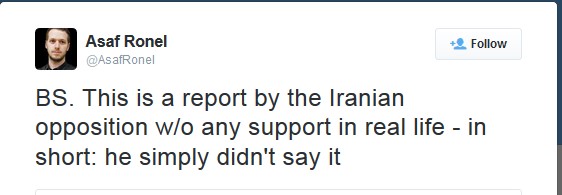
This is a well-known human reaction: When people stand before the complete collapse of what they believe in, they enter a state of denial.
So What Now?
And what is President Obama to do, as everything he has stood for in the Iran deal collapses so ignominiously? On the right, they say he will continue to capitulate. In their ignorance, and in their hatred of him, they fail to realize that he can simply surrender no farther. OK, they say, so the IAEA will provide Obama with the necessary confirmation by December 15 that the Iranians have done their part. But that is impossible as well. What is demanded of Iran is gargantuan in scale, and it would be far more difficult for the IAEA to fake confirmation when the Iranians themselves are declaring loudly that they are not going to do it.
With every passing day, Iran is more and more in violation of the JCPOA. But neither the Republicans nor the Democrats, nor the media, nor anyone else will acknowledge this, for the implications are too devastating. The agreement is no longer in effect. Its clock has stopped.
But the weeks will pass, and the media and politicians will be forced to admit that this is the case. And the last thing they will be willing to do is to force Iran to meet its obligations. Thus, it appears that President Obama’s only option, shameful as it is, is to restart the negotiations with the Iranians and talk with them about their leaders’ new conditions. As is well-known, this administration advocates diplomacy – guaranteeing that there will be no breakthrough any time soon.
This is precisely what will serve President Obama best. All he needs to do is play for time and reach the end of his term with an agreement in hand – albeit virtual – and negotiations in progress – albeit unending. He will pass this situation on to the next administration. The success will be all his, and the failure will be all theirs. The media will zealously guard Obama’s legacy, and his successor, Republican or Democrat, will be too uninformed to protect him or herself from this historic maneuver. And it will serve them right.
Appendix I: Senior Iranian Officials Declare Their Acceptance Of Khamenei’s Instructions On Implementing The JCPOA
On October 10, 2015, Majlis Speaker Ali Larijani said at a conference on war and peace in Syria: “…The commands of the leader [Khamenei], the decision of the Majlis and the Supreme National Security Council will illuminate the government representatives’ path on implementing the JCPOA… I thank the leader with all my heart.”[11]
President Rohani, responding to the directives letter by the Supreme Leader on carrying out the JCPOA (October 22, 2015): “Your historic letter of October 21, 2015 regarding the approval of decision number 634 of the Supreme National Security Council caused joy within the great Iranian people and warmed the hearts of the public servants in government… The government will obey your criticisms and obligations [that you imposed] and with good intentions will take measures relating to the full implementation of the Supreme National Security Council and the Majlis. We will be fully alert to the performance of the other side’s obligations and in the Supreme National Security Council we will take the necessary decisions to provide a fitting response.”[12]
On October 26, 2015, Foreign Minister Zarif referred in the Majlis to the supreme leader’s letter on carrying out the JCPOA and noted: “I am grateful to the leader for his path-illuminating letter on setting policy in the JCPOA’s implementation. His opinion always lighted the path to the nuclear negotiations team at the foreign ministry. Henceforward, we must make an effort to implement the JCPOA documents in the right way and following the leader’s guidelines.”[13]
On October 27, 2015, Zarif said that the modifications to the nuclear reactor in Arak must be performed after the PMD file has been closed at the IAEA and explained: “we calculated the details of re-planning the reactor following the leader’s guidelines, the decision of the Supreme National Security Council and the Majlis… We will coordinate everything necessary for swapping the uranium stockpiles and this matter will be performed precisely in the way that the leader elaborated and was previously agreed at the Supreme National Security Council and the Majlis nuclear committee.”[14]
In the Majlis, 166 members, constituting a majority, expressed on October 26, 2015 their admiration for the leader for his historic letter in implementing the JCPOA. The letter’s contents read “… For a certainty, the Majlis representatives will act as your stout arms and collaborate with all the supervisory organizations and with the Supreme National Security Council and invest efforts to ensure that after the JCPOA, the enemy will not be able to penetrate our Islamic country even minutely and we will supervise that all violation of promises by the 5+1 group will not remain unanswered.”[15]
Iran’s Judiciary Chief Sadeq Amoli Larijani at an October 26, 2015 conference of senior judicial branch officials said that the letter of conditions that Khamenei published on JCPOA implementation should put an end to debates on the issue. He added: “All groups [within Iran] should treat the leader’s letter as ‘self-explanatory’ and as the axis of unity and from now no they will make progress and think moderately about the future and the next stages of the JCPOA.”[16]
The leader’s representative in the Islamic Revolutionary Guard Corps (IRGC) Ali Saidi said on Wednesday, October 21, 2015: “… The leader is effectively managing the country according to the Koran and custom, the leader sets policy and the others execute it.”[17]
At an October 27, 2015 press conference, the leader’s advisor and the head of the Center for Strategic ResearchAli Akbar Velayati, said: “In the last letter we saw that he criticized the defects and shortcomings in carrying out the JCPOA. I hope that the agreement will be carried out flawlessly in the future. The continued support of the leader for the JCPOA is contingent on the response to the letter that Khamenei wrote the president [Rohani].”[18]
The head of the Majlis nuclear committee, Ebrahim Karkhanehei, referring to the leader’s letter on the JCPOA, said: “This letter produced social calm because in addition to leader the people as well demanded the things that were included in the letter. The most important issue in the letter is the issue of lifting sanctions and the government must seriously handle the matter of lifting the sanctions. In addition to the letter, the leader emphasized many times that if the sanctions are not lifted then there will be no agreement and therefore the US and the EU must fully lift the sanctions.
“The letter from the EU and the American president are not considered a [sufficiently] strong guarantee on the lifting of the sanctions. The Majlis will not be negligent about any clause in the leader’s letter and the government must seriously oversee and handle the sanctions-lifting issue.
“The leader demanded that a professional and wise team should supervise the sound implementation of the JCPOA and therefore this team must be comprised of at least five people specializing in the legal, nuclear technical political, economic and the sanctions structure issues as well as an expert on security and defense matters.”[19]
An October 25, 2015 Kayhan editorial titled “Giving Interpretations Is Impermissible” wrote: “The leader’s order and the setting of numerous terms for the JCPOA’s implementation is self-explanatory and elaborated a clear path for all arguments and worries, according to religious jurisprudence, the law and the professional perspective. It is obligatory and essential to obey it.. as opposed to some of the impressions, the leader approved the JCPOA’s implementation only following obedience to the terms that may not be damaged and on principle, the leader did not express general approval on the matter.”[20]
Appendix II: Iranian Websites Covering Rafsanjani’s Interview In Inhnews.ir
*IRNA
*ILNA
*Hashemirafsanjani.ir.fa
*Etemaad
*ISNA
*Fars
*Tnews.ir
*Shomaokhabar
*Farsi-news
*Shafaf.ir
*Y. Carmon is president and founder of MEMRI.
Endnotes:
[1] For the complete text of the JCPOA see Eeas.europa.eu/statements-eeas/docs/iran_agreement/iran_joint-comprehensive-plan-of-action_en.pdf
[2] See MEMRI Special Dispatch No. 6151, Khamenei Declares That He Will Not Honor The Agreement If Sanctions Are Merely Suspended And Not Lifted, September 4, 2015; and MEMRI TV Clip #5067 – Iranian Supreme Leader Ali Khamenei: The Americans Must Lift the Sanctions, Not Suspend Them, September 3, 2015.
[3] Unscr.com/en/resolutions/doc/2231.
[4] See MEMRI TV Clip #5114 – Iranian Guardian Council Secretary-General Ahmad Jannati: Khamenei Has Not Approved or Signed the JCPOA, October 16, 2015; and MEMRI TV Clip #5117 – Iranian Guardian Council Spokesman Nejatollah Ebrahimian: The JCPOA Was Not Approved by the Majlis or the Guardian Council, October 18, 2015.
[5] Tasnim (Iran), October 18, 2015.
[6] http://www.armscontrol.org/blog/ArmsControlNow/2015-10-15/The-P5-1-and-Iran-Nuclear-Deal-Alert-October-15
[7] ISNA (Iran), October 18, 2015.
[8] On Khamenei’s nine demands, see MEMRI Inquiry & Analysis No. 1196, Iranian Supreme Leader Khamenei’s Letter Of Guidelines To President Rohani On JCPOA Sets Nine Conditions Nullifying Original Agreement Announced July 14, 2015, October 22, 2015.
[9] See MEMRI Special Dispatch No. 6151, Khamenei Declares That He Will Not Honor The Agreement If Sanctions Are Merely Suspended And Not Lifted , September 4, 2015.
[10] MEMRI Special Report No.43, Breaking Report: Challenging Khamenei, Rafsanjani Demands That Iran Fulfill Its Obligations Under The JCPOA, And Reveals: We Had Nuclear Option In Iran-Iraq War, October 28, 2015.
[11] Mehrnews.com, October 23, 2015.
[12] President.ir/fa/90172
[13] Isna (Iran), October 26, 2015.
[14] Isna (Iran), October 27, 2015.
[15] Mehrnews.com, October 26, 2015.
[16] Nasimonline.(Iran), October 26, 2015.
[17] Snn.(Iran), October 22, 2015.
[18] Isna (Iran), October 27, 2015.
[19] Mehrnews.com, October 26, 2015.
[20] Kayhan (Iran), October 25, 2015.





 anneinpt
 artaxes
 danmillerinpanama
 davidking1530
 Peter Hofman
 Joseph Wouk
 Peter
Peter Louisiana Steve
 WarSclerotic
Recent Comments