Archive for October 23, 2015

Palestinian terrorism is not random

October 23, 2015

Palestinian terrorism is not random, Israel Hayom, Yoram Ettinger, October 23, 2015

Unlike national liberation movements, Palestinian terrorism has deliberately, institutionally, and systematically targeted Arab and Israeli noncombatants, sometimes hitting combatants.

Palestinian terrorism has haunted Arab societies in Jordan (especially during the 1968-1970 era of PLO terrorism), Lebanon (particularly during the 1971-1982 civil wars), Kuwait (during the 1990 invasion by Saddam Hussein), Iraq (until 2002, as an arm of Saddam Hussein’s ruthless domestic oppression), Syria (until 2012, bolstering Bashar Assad’s regime) and currently in Egypt (collaborating with the Muslim Brotherhood terror organization). Pro-U.S. Arab regimes consider Palestinian terrorism a clear and present danger, never fighting on behalf of Palestinians. Sometimes these regimes launch severe military blows (1970 Black September in Jordan) and expulsions (300,000 expelled from Kuwait), showering them with rhetoric, but not resources.

Since the establishment of the Palestinian Authority in 1993, Palestinian terrorism has afflicted the Arabs of Judea, Samaria and Gaza, denying the Palestinians civil liberties and instituting a corrupt, oppressive reign of horror. It prompted most Christians to flee from Ramallah (home of Palestinian Authority President Mahmoud Abbas’ headquarters), Bethlehem and Beit Jallah. In addition, Muslim emigration from the Palestinian Authority has increased since 2000. While Egypt prevents emigration from Gaza through Sinai, Gaza’s Arabs have emigrated, in increasing numbers, via the Mediterranean. Moreover, Palestinians flow across Jerusalem’s municipal lines, escaping Abbas’ tyranny to receive Israeli residency, social benefits and human rights.

Palestinian terrorists have targeted pro-U.S. Arab regimes and “the arrogant, infidel, Great Satan,” the U.S., joining the ayatollahs in Iran (since the toppling of the shah in 1979), Taliban, al-Qaida, Islamic State and other Islamic terror organizations. Osama bin Laden’s role model and spiritual mentor, Abdullah Azam, was from a village in Samaria.

Palestinian terrorism is a modern-day branch of Islamic terrorism, which has plagued the Middle East — and beyond — since the appearance of Islam in the seventh century. The current intensification of Islamic terrorism throughout the Middle East provides a tailwind to Palestinian terrorism.

Palestinian terrorism has inspired terror cells in Europe, Africa, Asia and the American continent, including sleeper cells in the U.S.

Anti-Jewish Palestinian terrorism has been a Middle East fixture since at least the 1920s, well before the 1948 establishment of Israel and the 1967 return of Jewish communities to Judea and Samaria. It’s well-documented collaboration with Nazi Germany sought to prevent the existence — not reduce the size — of the Jewish state. The political guideline of contemporary Palestinian terrorism, the Palestinian Covenant, was published in 1964, three years before the reunification of Jerusalem.

Palestinian terrorism is nurtured by 23 years of Palestinian hate education in kindergartens, schools, mosques and media — the most effective means of producing terrorists. It was established by Abbas (then Yasser Arafat’s chief deputy) in 1993, highlighting the fundamentals of Islam that serve to intensify Palestinian terrorism: the supremacy of Islam over all other religions; the permanent state of war between the abode of Islam and the abode of the “infidel”; the inadmissibility of “infidel” sovereignty over Waqf lands, which are divinely ordained to Islam; the sublime honor of sacrificing one’s life on behalf of Islam’s war against the “infidel”; and the provisional nature of agreements concluded with “infidels.”

Palestinian terrorism has been encouraged by Abbas’ systematic policy of naming streets, squares, monuments and sport tournaments in honor of terrorists, and extending generous financial assistance to their families.

Palestinian terrorism, an endemic feature in the Middle East, represents writing on the wall, warning us all of the destabilizing, anti-Western, terroristic nature of the proposed Palestinian state. An Israeli withdrawal from the mountain ridge of the Golan Heights would provide a platform for Islamic terrorists to traumatize northern Israel. But an Israeli withdrawal from the mountain ridges of Judea and Samaria would provide Muslim terrorists a platform to topple the Hashemite regime in Jordan and target Tel Aviv, Jerusalem, Ben-Gurion Airport and 80% of Israel’s population and infrastructure.

Palestinian terrorism is fueled by the inherently immoral “moral equivalence” between Israeli counterterrorism and Palestinian terrorism, which grossly misrepresents Middle East reality. It is fueled by foreign aid to the Palestinian Authority, which funds hate education. It is rewarded by calls to negotiate with the Palestinian Authority, while Abbas promotes hate education. It is emboldened by Western pressure for further Israeli concessions and Western denial of Israel’s moral high ground in the physical high ground of Judea and Samaria.

In order to defeat Palestinian terrorism, it is necessary to defy political correctness and shift gears, instead of chasing individual terroristic mosquitoes, the terroristic swamp needs to be drained. A large-scale, disproportionate, pre-emptive military operation needs to be launched throughout Judea and Samaria and Arab neighborhoods in Jerusalem. Any (U.S. and Israeli) direct or indirect contact with and assistance to the Palestinian Authority needs to be conditioned upon an end to hate education. Families and communities of terrorists need to be severely punished for failing to exercise communal responsibility.

To frustrate Palestinian terrorism, which aims to set Israel on a path of retreat, Israel should proclaim a constructive response, expanding Jewish construction in Jerusalem, Judea and Samaria. While it would trigger short-term international pressure, it would yield long-term strategic respect, as documented by the legacy of Prime Ministers David Ben-Gurion, Levi Eshkol, Golda Meir, Menachem Begin and Yitzhak Shamir, who defied much more severe international pressure with slimmer military and commercial resources at their disposal.

‘The mufti planned to build crematorium in Dotan Valley’

October 23, 2015

‘The mufti planned to build crematorium in Dotan Valley’, Israel Hayom, Daniel Siryoti, Erez Linn, October 23, 2015

144559783633038330a_bGrand Mufti Haj Amin al-Husseini with Adolf Hitler in Berlin | Photo credit: AFP

Journalists and historians say Jerusalem Grand Mufti Haj Amin al-Husseini’s contribution to encouraging Hilter to pursue the extermination of Jews in Europe cannot be disregarded • White House: Inflammatory accusations on both sides need to stop.

The controversy over Prime Minister Benjamin Netanyahu’s remarks on Jerusalem Grand Mufti Haj Amin al-Husseini’s role in the extermination of European Jewry has promoted veteran journalist Haviv Kanaan to recall the malicious plan the mufti devised.

Kanaan published an article in Haaretz in 1970 in which he reviewed the senior Muslim clergyman’s actions in 1942, when the Jewish community in then-British Mandate Palestine was preparing for the possibility of a Nazi invasion. Kanaan said that in 1968, while researching his article, he met with Faiz Bay Idrisi, a senior Arab officer in the Mandate Police, who spoke of al-Husseini’s intention to build a crematorium in the northwest Samarian hills.

“Even today, as I recall what I heard from police officials and mufti supporters, chills go through my body,” Idrisi told Kanaan at the time, recalling how in case of a German invasion “Haj Amin Husseini was gearing to enter Jerusalem at the head of the Muslim Arab Legion squadron he’d created for the Third Reich. The mufti’s plan was to build a huge Auschwitz-like crematorium in the Dotan Valley, near Nablus, to which Jews from Palestine, Iraq, Egypt, Yemen, Syria, Lebanon, and North Africa would be imprisoned and exterminated, just like the Jews in the death camps in Europe.”

This should come as no surprise in light of al-Husseini’s known views and actions during the Holocaust, and prior to it.

Haj Amin al-Husseini was born in Jerusalem in 1895 to a wealthy family of landowners. His father also served as the grand mufti of Jerusalem and his uncles headed the Arab Higher Committee in British-Mandate Palestine.

Al-Husseini was appointed grand mufti in 1921. An inflammatory address he gave in August 1929 sparked mass anti-Jewish violence, which resulted in the massacre of dozens of Jews by Arab mobs.

John Chancellor, the British high commissioner at the time, held al-Husseini responsible for the massacres.

Shortly after Hitler’s rise to power, al-Husseini sent a message to the German envoy in Jerusalem, expressing support for the new Nazi regime. He received generous funding from the Nazis in return.

In 1937, al-Husseini was ousted from office. He fled to Lebanon, and from there to Syria, all while maintaining his ties with the Nazi regime. In 1941, the Muslim clergyman arrived in Berlin, where he met with Hitler and the senior Nazi leadership, who assured him that once the Middle East is conquered, “Germany’s sole purpose would be to obliterate the Jewish population occupying the Arab space under the auspices of the British.”

Another voice lending merit to Netanyahu’s remark is author Wolfgang Schwanitz, who penned the book “Nazis, Islamists, and the Making of the Modern Middle East.” Schwanitz also argues that Hitler’s meeting with al-Husseini played a critical role in inspiring the Holocaust.

“It’s a historical fact that the grand mufti was an accomplice in this. … He was the top non-European adviser to Hitler on the process of eliminating Europe’s Jews,” Schwanitz said. “It would be absurd to discount the mufti’s role in encouraging Hitler and other Nazi officials to carry out the final solution.”

Meanwhile, the White House on Thursday addressed the controversial remarks surrounding the mufti’s role in the Holocaust.

“There was no doubt as to who was responsible for the Holocaust, which involved the systematic murder of six million Jews,” said White House Deputy Press Secretary Eric Schultz. “Inflammatory actions and accusations on both sides could fuel the violence even further. This needs to stop.”

Hizballah is creeping up on Israel’s Golan border, relying on Russian military cover

October 23, 2015

Hizballah is creeping up on Israel’s Golan border, relying on Russian military cover, DEBKAfile, October 23, 2015

nasrallah-putin_10.15Hassan Nasrallah believes he has Putin behind him.

Wholly preoccupied with the ferocious Palestinian terror campaign washing over their country, Israelis have scarcely noticed that Hizballah forces, believing they are protected by the Russian military presence in Syria, are creeping toward Israel’s northeastern Golan border. DEBKAfile reports: The Lebanese group thinks it is a step away from changing the military balance on the Golan to Israel’s detriment and gaining its first Syrian jumping-off base against the Jewish state – depending on the Syrian-Hizballah forces winning the fierce battle now raging around Quneitra opposite Israel’s military positions.

For two years, Hizballah, egged on intensely by Iran, has made every effort to plant its forces along the Syrian border with Israel. For Tehran, this objective remains important enough to bring Al Qods Brigades chief, Gen. Qassem Soleiman, on a visit last week to the Syrian army’s 90th Brigade Quneitra base, which is the command post of the battle waged against Syrian rebel forces.

Soleimani, who is commander-in-chief of Iran’s military operations across the Middle East, is acting as military liaison in Syria between Tehran and Moscow.

DEBKAfile’s military sources report that the Iranian general inspected the Quneitra battle lines no more than 1.5-2 km from the Israeli Golan border. He arrived a few days after Revolutionary Guards Col. Nader Hamid, commander of Iranian and Hizballah forces in the region, died there fighting against Syrian rebels.

His death betrayed the fact that not only are Hizballah forces gaining a foothold on the strategic Golan enclave, but with them are Iranian servicemen, officers and troops.

While in Quneitra, the Iranian general also sought to find out whether Col. Hamid really did die in battle or was targeted for assassination by Israel to distance Iranian commanders from its border.

Just 10 months ago, on Jan. 18, Israel drones struck a group of Iranian and Hizballah officers who were secretly scouting the Quneitra region for a new base. Iranian Gen. Ali Mohamad Ali Allah Dadi died in that attack.

But Tehran and Hizballah are again trying their luck. During his visit to Quneitra, Soleimani called up reinforcements to boost the 500 Hizballah fighters in the sector.

Seen from Israel, the Syrian conflict is again bringing enemy forces into dangerous proximity to its border.

The Iranian general and Russian Air Force commanders agree that the drawn-out battle for Quneitra will not be won without Russian air strikes against the rebels holding out there. A decision to extend Russia’s aerial campaign from northern and central Syria to the south would be momentous enough to require President Vladimir Putin’s personal approval.

This decision would, however, cross a strong red line Israel laid down when Binyamin Netanyahu met Putin on Sept. 21 in Moscow and when, last week, a delegation of Russian generals visited Tel Aviv to set up a hot line for coordinating Israeli and Russian air operations over Syria.

Israeli officials made it very clear that Iranian and Hizballah forces would not be permitted to establish a presence opposite the Israeli Golan border and that any Russian air activity over southern Syria and areas close to its borders was unacceptable.

The possibility of Israeli fighter jets being scrambled against Russian aerial intervention in the Quneitra battle was not ruled out.

This state of affairs was fully clarified to Gen. Joseph Dunford, Chairman of the Joint US Chiefs of Staff, when he was taken on a trip this week to the southern Golan under the escort of IDF Chief of Staff Gen. Gady Eisenkot and OC Northern Command Gen. Avivi Kochavi. He visited the command post of Brig. Yaniv Azor, commander of the Bashan Division, which will be called upon for action if the hazard to Israel’s security emanating the Quneitra standoff takes a dangerous turn.

Do Palestinian Lives Matter?

October 23, 2015

Source: Do Palestinian Lives Matter?

Huffington Post

( The view from the American left… – JW )

Lawmakers seem incapable of grasping the fact that Palestinians are suffering, too.

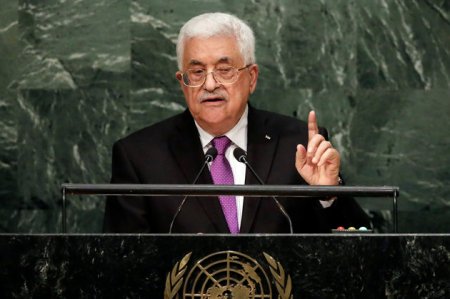
<span class='image-component__caption' itemprop="caption">Palestinian President Mahmoud Abbas addresses the 70th session of the United Nations General Assembly on Sept. 30, 2015.</span> Richard Drew/Associated Press Palestinian President Mahmoud Abbas addresses the 70th session of the United Nations General Assembly on Sept. 30, 2015.

WASHINGTON — It came as no surprise that the House Foreign Affairs Committee meeting on the current wave of violence in Jerusalem and the occupied West Bank was a decidedly one-sided discussion.

In a hearing titled “Words Have Consequences: Palestinian Authority Incitement to Violence,” committee Chairman Ed Royce (R-Calif.) and ranking member Eliot Engel (D-N.Y.) reached a similar conclusion: The current instability is caused by Palestinian leaders encouraging their people to kill Israelis.

Royce cited Palestinian President Mahmoud Abbas’ quote, “We welcome every drop of blood spilled in Jerusalem.” Engel said the past month of stabbings, shootings and vehicular assaults is “the product of years and years of anti-Israel propaganda and indoctrination — some of which has been actively promoted by Palestinian Authority officials and institutions.”

“It’s heartbreaking,” said Engel, “to wake up seemingly every morning to a new report of a stabbing or a shooting of an innocent civilian in Israel.”

But there was no mention of the 21 Palestinians killed by Israeli security forces since Oct. 1, despite having no identifiable connection to terrorist attacks.

Lawmakers did not talk about the Israeli teen who stabbed four Arabs earlier this month in southern Israel because of his belief that “all Arabs are terrorists.”

No one mentioned that between January and July of this year, settler violence caused 42 casualties, according to the United Nations Office for the Coordination of Humanitarian Affairs.

In fact, one of the few lawmakers to mention settlements was Rep. Ileana Ros-Lehtinen (R-Fla.), who accused the international community of applying a “false moral equivalence between the Palestinian Authority and Israel.”

“Some, very lamely, blame settlement activity by Israel as the justification for increased violence, instead of putting the blame where it should be — with the Palestinian Authority, with Abu Mazen,” she said, using another name for Abbas.

The congresswoman’s comments were likely a swipe at Secretary of State John Kerry, who suggested last week that Palestinian frustration over settlement expansion is fueling the violence.

No one in the House Foreign Affairs Committee seemed aware that a senior official at Shin Bet — Israel’s secret service — recently refuted claims that Abbas is inciting Palestinians to attack Israelis. As Haaretz reported earlier this month, the Shin Bet official said that Abbas is “instructing his security forces to prevent terror attacks as much as possible.”

Also absent from Thursday’s debate was any mention of Israeli Prime Minister Benjamin Netanyahu’s speech at the Zionist Congress on Wednesday, where he accused the Palestinian grand mufti of Jerusalem of inspiring Hitler’s decision to exterminate the Jewish people during the Holocaust.

Historians and the Anti-Defamation League have refuted Netanyahu’s version of history. His statement also compelled German Chancellor Angela Merkel to reiterate that Germans were responsible for the Holocaust. Arab-Israeli Knesset member Ayman Odeh accused Netanyahu of “rewriting history in order to incite against the Palestinian people.”

But the House Foreign Affairs Committee members’ omissions aren’t surprising — this was, after all, a hearing to address Palestinian incitement.

Much to the chagrin of several members of the committee, the State Department has avoided assigning blame to either side. “We want to stress publicly and privately the importance of preventing inflammatory rhetoric, accusations, or actions on both sides that can lead to violence,” State Department spokesman John Kirby said on Wednesday.

Report: Israeli aircraft flew over Iran on attack test flight

October 23, 2015

Report: Israeli aircraft flew over Iran on attack test flight The Wall Street Journal reports Israel executed a test flight over Iran in 2012 as part of plan to attack Iran’s nuclear facility in Fordow; US sent a second aircraft carrier to the area fearing an outbreak of war.

Yitzhak Benhorin

Published: 10.23.15, 12:45 / Israel News

Source: Report: Israeli aircraft flew over Iran on attack test flight – Israel News, Ynetnews

Israeli aircraft entered and left Iranian airspace in 2012 as part of a test flight for a possible attack on Iran’s nuclear facility at Fordow, the Wall Street Journal reported Friday

The report stated that “nerves frayed at the White House after senior officials learned Israeli aircraft had flown in and out of Iran in what some believed was a dry run for a commando raid on the site.” As a result, the US sent a second aircraft carrier to the area and put fighter jets on alert.

The newspaper wrote a comprehensive investigative report on the crisis of confidence that developed between the US and Israel under President Barack Obama and Prime Minister Benjamin Netanyahu. As part of the investigation, intelligence officials and analysts that spoke with the newspaper revealed the Israeli flight over Iran.

Iran's Fordow nuclear facility (Photo: AFP)
Iran’s Fordow nuclear facility (Photo: AFP)

One official said that the US monitored Israeli military activity and eavesdropped on Israeli bases in 2012 after they learned about the flight. New information came in every day but US officials said that some of the information was classified and US security agencies were unable to receive the majority of the messages.

The report states that US Air Force analysts came to the conclusion that Israel did not have the necessary armament and aircraft to demolish the Iranian reactors. This conclusion was transferred to the Israelis, who in response gave the Americans an outline of its own plan: transport aircraft would land in Iran with commando teams to blow the front doors of the nuclear plant at Fordow and sabotage it. Pentagon officials thought it was a suicide mission and pressured Israel to give early warning to the United States, but Israel did not commit itself to doing so.

The V-22 Osprey plane-helicopter the Israelis requested from the US (Photo: EPA)

US intelligence agencies intensified their satellite tracking of IAF planes according to the report. They found out that pilots were put on alert to attack on dark nights without moonlight. They tracked the IAF training for combat missions, including examinations of Iran’s air defense system in an attempt to trick it.

The Wall Street Journal (WSJ) which cited senior White House and Pentagon officials, wrote that in 2012 there was a sense that Israel was about to attack and the White House felt that there was an urgent need to promote a diplomatic solution.

The White House, the report noted, decided to leave Prime Minister Netanyahu in the dark regarding secret negotiations that were being conducted by the US with Iran in Oman. The fear was that Netanyahu would leak the existence of the talks and undermine them. Obama’s aides had very little good will towards Netanyahu who was perceived as a supporter of Republican candidate Mitt Romney during the 2012 elections. Obama left a meeting with Netanyahu with a sense that he wanted to attack on the eve of the presidential elections.

The WSJ cited defense sources in Washington who stated that Israeli officials discussed with their US counterparts the possibility of obtaining weapons for a possible attack. Topping the list was the V-22 Osprey, a plane-helicopter which fits in well with the Israeli plan to land commandos. Israeli officials were also interested in the possibility of procuring the Massive Ordnance Penetrator designed by the US to destroy bunkers at the Fordow facility.

Netanyahu wanted “somebody in the administration to show acquiescence, if not approval” for a military strike, said Gary Samore, who was Obama’s top adviser on the Iran nuclear issue during his first term. But the Americans replied that this was a serious error and the administration refused to supply Israel with military equipment required for attack.

The US tried hiding from Israel the first Oman conversations, revealing them only once Hassan Rouhani became president of Iran. Samore believed that it was wrong to leave Israel out of the picture for so long. The State Department’s nuclear expert Robert Einhorn said that it had a negative impact on Israel’s attitude towards the talks.

It was reported that following the incident the US government decided to send a second aircraft carrier to the region and put fighter jets on alert in case an Israeli attack will led to a regional war. However, the government now admits that the exceptional flight over Iran made them draw mistaken conclusions.


PA, Jordan to tell Kerry they want Muslim control over Jewish visits to Temple Mount

October 23, 2015

PA, Jordan to tell Kerry they want Muslim control over Jewish visits to Temple Mount Abbas and King Abdullah to present demand in upcoming talks with secretary in Amman, say restoring authority to Waqf would calm tensions

By Avi Issacharoff

October 23, 2015, 2:35 pm

Source: PA, Jordan to tell Kerry they want Muslim control over Jewish visits to Temple Mount | The Times of Israel

Won’t happen !

US Secretary of State John Kerry (left) meets with Palestinian Authority President Mahmoud Abbas in Amman on November 13, 2014. (AFP/Nicholas Kamm/Pool)

US Secretary of State John Kerry (left) meets with Palestinian Authority President Mahmoud Abbas in Amman on November 13, 2014. (AFP/Nicholas Kamm/Pool)


Jordan and the Palestinian Authority are expected to demand from the US that control over Jewish visits to the Temple Mount in Jerusalem be restored to the Muslim authority that administers the site, Palestinian sources say.

PA President Mahmoud Abbas and Jordan’s King Abdullah II were to raise the issue with Secretary of State John Kerry, who is in the region this weekend, the sources said.

Amman and the PA are seeking to return the running of the Temple Mount — the holiest site in Judaism and third-holiest in Islam — to how it was before the start of the intifada in September 2000, and before the visit of then-opposition Likud leader Ariel Sharon, when the Waqf was responsible for Jewish visitors’ access to the site.

The Jerusalem Islamic Waqf, controlled by Jordan, administers the Islamic sites at the compound, including the Al-Aqsa Mosque and the Dome of the Rock. Sharon’s visit is often said to have been the pretext for the Second Intifada, which broke out just a few weeks later and which saw hundreds of Palestinian suicide bombings that claimed the lives of over a thousand Israelis during a span of five years.

Until 2000, the entry of Jewish visitors to the Temple Mount was coordinated with the Waqf. The site was closed to Jews from 2000 until 2003, as the Second Intifada raged. Since then Israel Police have overseen visits by Jewish visitors. Under Israel’s regulations, imposed after the Old City was captured in the 1967 Six-Day War, Jews are allowed to visit, but not pray on, the Temple Mount.

The demand for Muslim oversight on Jewish access to the Temple Mount was first made by the Palestinian Authority on Thursday. “Israel must restore control of the Temple Mount to the Waqf,” said one official close to Abbas. “This is one of the only measures that can help calm the current situation.”

This Thursday, July 28, 2015 photo shows a group of religious Jews escorted by Israeli police at the Temple Mount in Jerusalem. (AP/Mahmoud Illean)

Palestinian sources also told The Times of Israel that Abbas will tell Kerry during their meeting in Amman on Saturday that he is interested in renewing peace talks with Israel and abiding by previous agreements, but that Jerusalem must first freeze all settlement activity and release the final 26 prisoners it had agreed to free last year as part of a US-brokered concession to Abbas.

Israel had agreed to release a total of 104 security prisoners jailed before the 1993 Oslo Accords in four phases. It went through with three of the four releases, setting free some of the worst orchestrators of terrorism, before talks collapsed in April 2014.

Senior Palestinian officials also told The Times of Israel that Israel had tried to create friction between Jordan and the Palestinian Authority by conveying messages to King Abdullah II warning him that Abbas’s inciting statements endangered Jordanian interests on the Temple Mount.

Abbas is expected to demand deeper American involvement in any renewed political process with Israel, and warn that if Prime Minister Benjamin Netanyahu continues with his current policies, he is dooming the region to more violence and bloodshed.

When asked if they understood that meeting their demands would spell the end of the Netanyahu-led government, the sources said the Israeli prime minister must choose between his government and a willingness to make peace.

The PA’s demands for Waqf control of the Temple Mount come amid a wave of Palestinian terror and violence which has seen 10 Israelis killed in the past month and a half. More than 40 Palestinians have also been killed — about half of them while carrying out attacks, and most of the rest in clashes with Israeli security officials in the West Bank and on the Gaza border.

Israel has accused Abbas and the PA of partial responsibility for the terror surge, with Netanyahu repeatedly castigating Abbas for telling “lies” about purported Israeli plans to change the status quo at the Temple Mount and for inciting violence over the issue. Netanyahu, who has denied any such plans and offered to meet Abbas without preconditions, has also vowed to make no concessions to the Palestinians in response to the current surge in terrorism.

The PA officials said that their security forces have prevented a series of recent attacks on Israeli targets, including stabbings, shootings and the planting of explosives. PA security forces have also been active during Palestinian demonstrations to prevent the use of live fire against IDF soldiers, and intervened when a gunman opened fire on soldiers during a recent protest near the Beit El settlement, they said.

Israeli security officials have acknowledged the value of the ongoing PA security coordination.

On Wednesday, the Prime Minister’s Office denied that Israel has offered to reduce the number of Jewish and non-Muslim visitors to the Temple Mount in an effort to calm tensions at the site and help end the wave of terror attacks. Arab diplomatic officials had told The Times of Israel that this offer was rejected by Palestinian and Jordanian leaders as not going far enough to meet their demands.

ISIS Warns Jews in Hebrew, You’re Next to be Slaughtered [video]

October 23, 2015

ISIS Warns Jews in Hebrew, You’re Next to be Slaughtered

By: JNi.Media

Published: October 23rd, 201

Source: The Jewish Press » » ISIS Warns Jews in Hebrew, You’re Next to be Slaughtered

ISIS released a video in Israeli-Arabic-accented Hebrew, ranting and warning the Jews that Islamic State plans to come to Israel to slaughter and eradicate everyone until no Jews are left in Jerusalem, Israel and the world. They would first overrun Jordan, after which they would overrun Israel from every direction.

ISIS has been focusing a lot of attention on Israel lately, and local ISIS affiliated terror cells have been captured by Israeli security forces. A number of Israeli-Arabs have joined ISIS in Syria and Iraq.

This may be the first time that the Islamist organization has spoken directly to Israelis in Hebrew.

The clip shows a masked soldier wearing a uniform, with a rifle and a dagger, who speaks a fairly modern dialect, with an accent that shifts from heavily Arab, with an unusually soft R for an Arab speaker (which could suggest Israeli upbringing). Like most Arabs, he is unable to pronounce the P sound, and so he says Bashut instead of Pashut (simple), and Bachad’tem instead of Pachad’tem (you feared).

At the beginning of the video, he turns to the camera and says, “This is a serious and clear announcement to all the Jews, the first enemy of the Muslims. To all the Jews who conquered our country, the Muslims. The real war has not started yet, and everything you had before is simply called a child’s play compared to that which is going to happen to you in the near future, inshallah (God willing).”

Speaking of the current wave of terror, he expresses the hope that ISIS will arrive and destroy Israel. He promises the annulment of the Sykes-Picot borders, which, in 1916, divided the dying Ottoman between France and Great Britain. He boasts of having already eliminated the Syrian-Iraqi border, and foretells erasing the Syrian-Jordanian border, too—a direct threat against King Abdullah II of Jordan. He then promises removing the Syrian-Palestinian borders, too, which is a curious promise, because that could mean the end of the dream of Palestinian statehood (under Ottoman rule, Palestine was ruled by a governor who sat in Damascus).

He promises to eventually arrive in Israel to destroy it, to avenge its “crimes,” telling Israelis: “Do whatever you feel like in the meantime, until we get to you, and then we’ll destroy everything ten times over for the crimes your committed. And we promise you that soon there will not be a single Jew in Jerusalem and throughout the country. And we’ll continue on until we eradicate this disease worldwide.”

The above reference to Jews as a worldwide disease suggests the speaker is versed in 19th century anti-Semitic literature, probably in the texts published and distributed by the Saudi government, which rules over a publishing empire dedicated to Jew hatred.

He repeats a theme commonly used by Hamas culture, chiding Jews and Westerners for their love of life, as compared to the Arab Klingon-like infatuation with death and killing. “Look what happened to you,” he slams his Israeli viewers, “a few stabbings and running over by our brothers in Palestine, you fell over on your head and started to fear any driver traveling too fast. You’re even scared of any person who grabs something in his hand. Simply put, that is your level. Think about it even for a second, what will happen to you as soon as—inshallah—tens of thousands from all over the world will be coming to slaughter you and throw you in the trash without a return?”

The speaker is clearly an Israeli Arab, or an Arab from the territories who attended an Israeli educational institute or otherwise lived near Israeli Jews. He is likely the son of a middle class family, he appears poised and secure. His recitation is restrained, meaning that he knows and understands his target audience: excited Hamas videos in Hebrew are usually so over the top, and rife with humiliating pronunciation gaffes, they often go viral as comedy. This one is not for laughs.

“Proxy” War No More: Qatar Threatens Military Intervention In Syria Alongside “Saudi, Turkish Brothers”

October 23, 2015

“Proxy” War No More: Qatar Threatens Military Intervention In Syria Alongside “Saudi, Turkish Brothers”

Submitted by Tyler Durden on 10/22/2015 14:37 -0400

Source: “Proxy” War No More: Qatar Threatens Military Intervention In Syria Alongside “Saudi, Turkish Brothers” | Zero Hedge


Earlier this week, Saudi foreign minister Adel al-Jubeir had the following message for Tehran:

“We wish that Iran would change its policies and stop meddling in the affairs of other countries in the region, in Lebanon, Syria, Iraq and Yemen. We will make sure that we confront Iran’s actions and shall use all our political, economic and military powers to defend our territory and people.”

In short, Riyadh and its allies in Doha and the UAE are uneasy about the fact that the P5+1 nuclear deal is set to effectively remove Iran from the pariah state list just as Tehran is expanding its regional influence via its Shiite militias in Iraq, the ground operation in Syria, and through the Houthis in Yemen.

Thanks to the fact that Tehran has more of an arm’s length relationship with the Houthis than it does with Hezbollah and its proxy armies in Iraq, the Saudis have been able to effectively counter anti-Hadi forces in Yemen without risking a direct conflict with Iran, but make no mistake, Sana’a is not the prize here. Yemen is a side show. The real fight is for the political future of Syria and for control of Iraq once the US finally packs up and leaves for good. Iran is winning on both of those fronts.

Over the last several weeks, we and others have suggested that one should not simply expect Washington, Riyadh, Ankara, and Doha to go gently into that good night in Syria after years of providing support for the various Sunni extremist groups fighting to destabilize the regime. There’s just too much at stake.

As noted on Tuesday, Assad’s ouster would have removed a key Iranian ally and cut off Tehran from Hezbollah. Not only would that outcome pave the way for deals like the Qatar-Turkey natural gas line, it would also cement Sunni control over the region on the way to dissuading Tehran at a time when the lifting of crippling economic sanctions is set to allow the Iranians to shed the pariah state label and return to the international stage not only in terms of energy exports, but in terms of diplomacy as well. Just about the last thing Riyadh wants to see ahead of Iran’s resurgence, is a powergrab on the doorstep of the Arabian peninsula.

Thanks to Washington’s schizophrenic foreign policy, there’s no effective way to counter Iran in Iraq but as Mustafa Alani, the Dubai-based director of National Security and Terrorism Studies at the Gulf Research Center told Bloomberg earlier this week, “The regional powers can give the Russians limited time to see if their intervention can lead to a political settlement — if not, there is going to be a proxy war.”

That’s not entirely accurate. There’s already a proxy war and the dangerous thing about it is that thanks to the fact that Iran is now overtly orchestrating the ground operation, one side of the “SAA vs. rebels” proxy label has been removed. Now it’s “Iran-Russia vs. rebels” which means we’re just one degree of separation away from a direct confrontation between NATO’s regional allies in Riyadh and Doha and the Russia-Iran “nexus.” Here’s Bloomberg with more on the Saudi’s predicament:

Powerful Saudi clerics are calling for a response to the Russian move, even though the kingdom is already bogged down in another war in Yemen. Analysts say the Saudi government will probably speed up the flow of cash and weapons to its allies in the opposition fighting to topple President Bashar al-Assad, who’s also supported by Saudi Arabia’s main rival, Iran.

While the Saudis may seek to direct their aid to “moderate forces” in Syria, “the definition of this word is subject to much debate,” said Theodore Karasik, a Dubai-based political analyst. Sending arms “is dangerous in the medium term because of how easily weapons can fall into the wrong hands,” he said.

And let’s not kid ourselves, there are no “wrong hands” as far as Riyadh and Doha are concerned. Sure, they’d rather not have ISIS running around inside their borders blowing up mosques but then again, those bombings simply provide more political cover for justifying an air campaign in Syria. Back to Bloomberg:

Extremist groups already hold sway over large parts of the country. The Saudis joined U.S.-led operations against Islamic State last year, and since then jihadist attacks in the kingdom have increased, many of them targeting minority Shiite Muslims in the oil-rich eastern province. Meanwhile, Assad accuses the Saudis and other Gulf states of arming rebel groups with ties to al-Qaeda.

Some Saudi thinkers advocate direct military engagement in Syria, just as the kingdom has done in Yemen. Nawaf Obaid, a visiting fellow at Harvard University’s Belfer Center for Science and International Affairs, is one of them.

“The Saudis are going to be forced to lead a coalition of nations in an air campaign against the remnants of Syrian forces, Hezbollah and Iranian fighters to facilitate the collapse of the Assad regime and assist the entry of rebel forces into Damascus,” Obaid wrote in an opinion piece published by CNN on Oct. 4.

And while some still see that outcome as far fetched not only because the Saudis are stretched thin thanks to falling crude prices and the war in Yemen, but because it would be an extraordinarily dangerous escalation, it looks as though Qatar is leaning in a similar direction. Here’s Sputnik:

Qatar who has been a major sponsor of jihadist groups fighting in Syria for years, now is actively considering a direct military intervention in the country, according to its officials.

Throughout Syria’s bloody civil war, the government of Qatar has been an active supporter of anti-government militants, providing arms and financial backing to so called “rebels.” Many of these, like the al-Nusra Front, were directly linked to al-Qaeda. That strategy has, of course, done little to put a dent in terrorist organizations in the region.

But as Russia enters its fourth week of anti-terror airstrikes, Qatar has indicated that it may launch a military campaign of its own.

“Anything that protects the Syrian people and Syria from partition, we will not spare any effort to carry it out with our Saudi and Turkish brothers, no matter what this is,” Qatar’s Foreign Minister Khalid al-Attiyah told CNN on Wednesday, when asked if he supported Saudi Arabia’s position of not ruling out a military option.

“If a military intervention will protect the Syrian people from the brutality of the regime, we will do it,” he added, according to Qatar’s state news agency QNA.

Syrian Deputy Foreign Minister Faisal Mekdad was fast to warn the Middle Eastern monarchy that such a move would be a disastrous mistake with serious consequences.

“If Qatar carries out its threat to militarily intervene in Syria, then we will consider this a direct aggression,” he said, according to al-Mayadeen television. “Our response will be very harsh.”

Let’s just be clear. If Saudi Arabia and Qatar start bombing Iranian forces from the airspace near Russia’s base at Latakia, this will spiral out of control.

Iran simply wouldn’t stand for it and if you think for a second that Moscow is going to let Saudi Arabia fly around in Western Syria and bomb the Iranians, you’ll be in for a big surprise. Of course the first time a Russian jet shoots down a Saudi warplane over Syria, Washington will have no choice but to go to war.

Finally, we’d be remiss if we didn’t point out the absurdity in what’s being suggested here. Qatar and Saudi Arabia are essentially saying that they may be willing to go to war with Russia and Iran on behalf of al-Qaeda if it means facilitating Assad’s ouster. The Western world’s conception of “good guys”/ “bad guys” has officially been turned on its head.

And meanwhile:

Russian President Vladimir Putin’s public approval rating has reached a record 89.9 percent since he ordered his military to begin air strikes in support of Syrian leader Bashar al-Assad, according to a state-run polling center

For Saudis, Countermove Against Putin in Syria Carries Risks

October 23, 2015

For Saudis, Countermove Against Putin in Syria Carries Risks

Glen Carey

October 21, 2015 — 3:00 PM CDT Updated on October 22, 2015 — 7:04 AM CDT

Source: For Saudis, Countermove Against Putin in Syria Carries Risks – Bloomberg Business

Russia’s entry into the Syrian civil war has tilted the balance in favor of the government side, and there’s no risk-free way for Saudi Arabia — a key backer of the rebels — to tilt it back.

Powerful Saudi clerics are calling for a response to the Russian move, even though the kingdom is already bogged down in another war in Yemen. Analysts say the Saudi government will probably speed up the flow of cash and weapons to its allies in the opposition fighting to topple President Bashar al-Assad, who’s also supported by Saudi Arabia’s main rival, Iran.

While the Saudis may seek to direct their aid to “moderate forces” in Syria, “the definition of this word is subject to much debate,” said Theodore Karasik, a Dubai-based political analyst. Sending arms “is dangerous in the medium term because of how easily weapons can fall into the wrong hands,” he said.

Waves of jihadists, most famously Osama Bin Laden, went to Afghanistan to fight Soviet forces after 1979, as the Saudis and U.S. provided them with weapons and cash. The effort succeeded: the Soviet Union was forced to pull out. Yet it ultimately backfired on the Saudis as militants returned home and turned their sights on the ruling family. Oil infrastructure, government officials and foreign workers were targeted. Saudi citizens also made up a majority of the Sept. 11 attackers.

Rebels in Damascus?

There are similar risks in Syria, where extremist groups already hold sway over large parts of the country. The Saudis joined U.S.-led operations against Islamic State last year, and since then jihadist attacks in the kingdom have increased, many of them targeting minority Shiite Muslims in the oil-rich eastern province. Meanwhile, Assad accuses the Saudis and other Gulf states of arming rebel groups with ties to al-Qaeda.

Some Saudi thinkers advocate direct military engagement in Syria, just as the kingdom has done in Yemen. Nawaf Obaid, a visiting fellow at Harvard University’s Belfer Center for Science and International Affairs, is one of them.

“The Saudis are going to be forced to lead a coalition of nations in an air campaign against the remnants of Syrian forces, Hezbollah and Iranian fighters to facilitate the collapse of the Assad regime and assist the entry of rebel forces into Damascus,” Obaid wrote in an opinion piece published by CNN on Oct. 4.

Already Stretched

Most analysts say that’s a far-fetched scenario because Saudi Arabia and its Gulf ally the United Arab Emirates are already stretched in Yemen. They’ve been bombing rebels for more than six months and deployed an expanding ground force, but have only managed to recapture southern regions of the country.

“It’s too soon for the Saudis or the Emiratis to be pivoting around to a different war,” said Yezid Sayigh, a senior associate at the Carnegie Middle East Center in Beirut. “I really don’t think that the Gulf states actually have the ability to take on two active wars at the same time.”

Publicly, Saudi Arabia and Russia, who also compete as the world’s two biggest oil exporters, have tried to play down their differences.

Foreign Minister Adel Al-Jubeir softened the Saudi position on Assad during a visit to Russia on Oct. 11, saying the Syrian leader could leave after a political transition, rather than before. Al-Jubeir also said talks with Putin were “constructive, frank and to the point.”

‘Collision Course’

The Saudi and Russian foreign ministers are set to join their U.S. and Turkish counterparts to discuss Syria at a Vienna meeting on Friday, days after Assad went to Moscow for his first official foreign visit since the war began more than four years ago. Putin called King Salman on Wednesday to discuss “the situation in the region,” the official Saudi Press Agency reported.

“It’s premature to assume that Saudi Arabia and Russia are on a collision course,” said Fahad Nazer, a political analyst at JTG Inc. in Virginia, who once worked at the Saudi Embassy in Washington.

The twin tracks of Saudi policy on Syria — talking to Russia and arming the rebels — are being handled separately by King Salman’s two top lieutenants, according to Bruce Riedel, a senior fellow at the Brookings Institution in Washington and a former U.S. Mideast adviser on the National Security Council.

Mohammed bin Salman, the king’s son and defense minister, is in charge of talks with Russia, and has met Putin twice, including earlier this month in Sochi, “to try to fashion a deal on Syria,” Riedel said.

‘Just Like 80s’

Meanwhile, the heir to the throne and interior minister, Mohammed bin Nayef, who’s closer to the U.S., is in charge of the rebel supply line and “ratcheting it up now just like the 80s,” Riedel said in an e-mail.

Salman himself was directly involved in fundraising for the mujahideen in Afghanistan, Riedel wrote in a Sept. 29 analysis for Brookings. Since ascending the throne in January, he’s taken a more assertive line on regional conflicts.

There are powerful forces in the kingdom pushing him to do the same in Syria. Fifty-five Sunni scholars called for a jihad there, and described Putin’s military involvement as a coalition with Iran “making real war against the Sunni people and their countries,” language that echoed the Afghan conflict.

There are some signs that Saudi rulers may be responding to such pressures. The U.K.-based Syrian Observatory for Human Rights has detected an increase in arms flows to the rebels since Russia intervened, according to its head, Rami Abdurrahman. He wasn’t able to say who was providing them.

While direct confrontation is probably too risky, the Gulf states “can try to make Russia’s life difficult, the way they did in Afghanistan back in the old days,” said Gregory Gause, a professor of international affairs at Texas A&M University. “Of course, the consequences might be supporting people who will eventually turn on the Saudis.”

Lies, lies and whoppers in the Middle East

October 23, 2015

Lies, lies and whoppers in the Middle East, Washington Times, Wesley Pruden, October 22, 2015

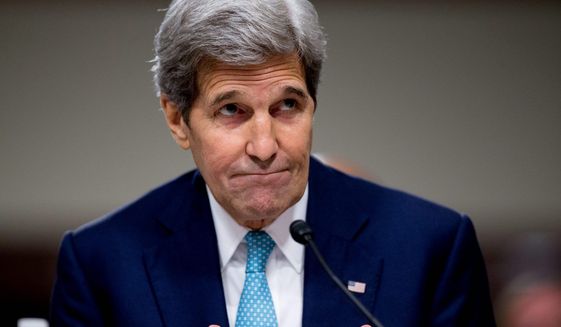
10222015_2015-10-22-19-23-278201_c0-0-1800-1049_s561x327Secretary of State John Kerry. (Associated Press

ANALYSIS/OPINION:

A diplomat, as any deputy assistant associate undersecretary could tell you, is a public servant paid to lie for his country. Lies are the hard currency in the land of the girly men.

The truth is rarely heard above the rattle and din of the teacups in the lounges where the masters of the art gather to collect their strength after a long day’s work in the vineyards of falsification, where Israel usually gets the shaft plunged to the hilt.

The knife has become the weapon of choice in the Palestinian war against Israeli civilians, brandished as if it were a holy scimitar of the avenging Allah. The dean of a university in Gaza characterizes this campaign of the short knives as “military operations,” and urges that it be aimed at women and children.

“The Jews of Palestine are fair game today, even the women,” the dean, Subhi al-Yazji, a learned doctor of Koranic studies, told an interviewer on Hamas television. “Every single Jew in Palestine is a combatant — even the children, breastfed on hatred for the Palestinian people.”

Just who is promoting this villainy launched from the shadows is clear to everyone, but it’s not polite in the well-behaved precincts of the West to say so. But we can be reassured, because John Kerry, the secretary of state and the grand master of moral equivalence, is on the job. He spent four hours Thursday with Israeli Prime Minister Benjamin Netanyahu in Berlin about how to “defuse” the violence. Their conversation was conducted as the knives conducted their own deadly business on the streets.

Before they sat down Mr. Kerry made the ritual condemnation of the assault on the Jews, composed of equal parts blarney and buncombe, and bravely urged an end to “all incitement and violence.” This softly worded admonition by the secretary of State naturally must include the Israelis who have done nothing but offer their Jewish flesh for the Palestinian blade. “There is no question,” said Mr. Netanyahu, “that this wave of attacks is driven directly by incitement by Hamas, incitement from the Islamist movement in Israel and incitement, I am sorry to say, from President Abbas and the Palestinian Authority.”

This was plain and unvarnished, what everybody knows to be true, but for reasons best known to him President Obama and his men (and women) won’t say anything like that. Perhaps they have a fear of cold steel in the ribs, too. What Mr. Kerry offers is this can of diplomatic yah-yah from the archives of claptrap at the State Department:

“I come directly from several hours of conversation with Prime Minister Netanyahu and I would characterize that conversation as one that gave me a cautious measure of optimism that there may be some things that may be in the next couple of days put on the table which would have an impact — I hope. I don’t want to be excessive in stating that, but I am cautiously encouraged.” There are a dozen lies somewhere in that thin treacle of organic gluten-free fat-added diet marshmallow, but only a diplomat could find them.

The moment cries for someone to say something real, and we get that from the secretary of state. And this: “We have to stop the incitement, we have to stop the violence.” Well, duh. He said he had talked to [Mr.] Abbas and Jordan’s King Abdullah, who are trusted to oversee the Temple Mount in Jerusalem, source of the latest Palestinian complaining. Abbas and Abdullah have assured him of their commitment to calm. Of course they do. And if you can’t trust a trusty, as a famous Southern governor caught between two fires once said, who can you trust?

The purveyors of calm work in parallel with the inciters of blood lust. This week a Jordanian teacher, from whom in other places you would expect something more, posted on the Internet a video of his 8-year-old daughter brandishing a knife, held up like a crucifix of the faith, declaring, “I want to stab a Jew.”

Mr. Netanyahu, who has no fear of saying what he thinks, nevertheless caught a little flak this week in Israel for speaking of some of the dark work of those who encouraged Hitler to proceed with the Holocaust. Hitler’s evil was unique, a professor at Hebrew University in Jerusalem told Mr. Netanyahu, and assigning blame to others makes him a Holocaust denier. Such a “dangerous distortion” of history “downplays” the Holocaust, the leader of the opposition in the Knesset told him.

Mr. Netanyahu was speaking a perfectly obvious truth, but we’re not supposed to notice what’s going on. It’s not diplomatic.