Terrorist teen ‘executed by Israel’ said to confess to attack ‘I went there to stab Jews,’ Ahmed Mansara, 13, reportedly tells police from his Israeli hospital bed, a day after Abbas charged Israel killed him in cold blood
Ahmad Manasra, one of two cousins who went on a stabbing frenzy in Jerusalem on October 12, 2015 is seen at the Hadassah Ein Kerem Hospital in Jerusalem on October 15, 2015. Manasra was hit by a car while fleeing from the scene of the attack. (Courtesy)
Ahmed Manasra, a 13-year-old Palestinian boy who allegedly took part in a stabbing spree in which an Israeli his age was critically wounded Monday, and who PA President Mahmoud Abbas claimed was killed in cold blood by Israeli police, reportedly admitted Thursday to carrying out the attack in the Jerusalem neighborhood of Pisgat Zeev.
“I went there to stab Jews,” he told investigators at the Hadassah Hospital where doctors have been treating him for wounds he sustained during the incident, police said.
Manasra said he was motivated to carry out the attack by the Palestinian claim that Israel has been trying to change the status quo on the volatile Temple Mount in Jerusalem. Israel has repeatedly rejected such allegations.
Manasra is accused of seriously injuring a 13-year-old boy and a 25-year-old man.
He said his accomplice, his cousin Hassan Manasra, 15, persuaded him to carry out the attack, the police said. The elder Manasra was shot dead when he lunged at police with a knife, while Ahmed was injured when he was hit by a car while attempting to flee the scene.
“I came with my cousin Hassan,” he reportedly said. “He brought the knives and I agreed to join him.”
Palestinian officials and relatives have claimed the two cousins were not involved in an attack and were unjustly targeted.
“My son cannot stab, he doesn’t know how to hold a knife,” Ahmed Manasra’s father said on Tuesday.
But on Wednesday, police released footage showing the two brandishing knives and chasing a man down the street.
The footage then showed an Israeli boy leaving a store on his bike, apparently before being stabbed by one of the two cousins. The video ends with one of the attackers charging at police before being shot several times.
Amateur video widely circulated on the day of the attack on Palestinian social media sites showed the wounded Ahmed lying on the ground after being struck, his legs splayed and a pool of blood near his head. Bystanders could be heard cursing the boy in Hebrew and yelling at him, “Die!” The images, which made no mention of the stabbing, have enraged many Palestinians.
On Wednesday night Mansara became the focus of international media when Palestinian Authority President Mahmoud Abbas accused Israel of “executing our boys in cold blood, as they did with the boy Ahmed Manasra and other children in Jerusalem and other places.”
The Prime Minister’s Office swiftly issued a statement after the speech, noting Mansara was alive and had initiated a terror attack, and accusing Abbas of spreading “lies and incitement.”
“The boy he is referring to is alive and hospitalized in Hadassah after stabbing an Israeli child who was riding his bicycle,” the statement said.
On Thursday, the Government Press Office released photos and video of Manasra awake and sitting in a bed at the hospital.
In a Thursday press conference, Prime Minister Benjamin Netanyahu used Abbas’s claims of Manasra’s killing to highlight what he termed “continuous Palestinian incitement.”
“The current terror campaign in Israel is a result of continuous Palestinian incitement. First, on the Al-Aqsa Mosque and the outrageous claims that we are changing the status quo there or intend to destroy it, and now we have a new big lie,” he said. “That new big lie is that Israel is executing Palestinians.”
The younger Manasra “was treated by a multidisciplinary team of physicians, especially neurosurgeons” and received the best care available, Professor Yoram Weiss, the director of Jerusalem’s Hadassah Medical Center, said at Netanyahu’s press conference. “Nothing was spared to take of his injury. At this point, he’s awake, he’s conscious, he’s eating, he’s watching TV and he’s stable.”
Fully complicit in the Assad regime’s impressive portfolio of war crimes and crimes against humanity, Iran relies on its client to secure its overland reach into Lebanon. And Russia works to sustain Assad as a rebuke to Washington. All the while, the eastern part of Syria is run by the self-styled Islamic State, or ISIL, itself a criminal enterprise. For the most part, the two titans of crime — the Assad regime and the Islamic State — have been able to live and let live, concentrating their hideous repertoires of violence on civilians and on armed rebels offering a nationalistic alternative to both. The result is widespread and profound hopelessness. Many Syrians are giving up on their beloved Syria. They are voting with their feet.
*********************
I spent early 2011 trying to ease tensions between Syria and its neighbors. I never predicted the brutality that would come from inside.
Now and then I am asked if I had predicted, way back in March 2011 when violence in Syria began, that within a few years a quarter-million people would be dead, half the population homeless and hundreds of thousands of defenseless civilians terrorized, traumatized, tortured and starved. The companion question, more often than not, is if I had forecast the failure of the West to offer any protection at all to Syrian civilians subjected to a systematic campaign of mass homicide. Having first been exposed to Syria as a teenage exchange student, I was expected by questioners to know something about the place. And as a State Department officer, I was assumed to know something about my government.
But no. It took me the better part of eighteen months to comprehend fully the scope of an unfolding humanitarian and political catastrophe. By September 2012, when I resigned my State Department post as adviser on Syrian political transition to Secretary of State Hillary Clinton, I knew that Syria was plunging into an uncharted abyss — a humanitarian abomination of the first order. And I knew that the White House had little appetite for protecting civilians (beyond writing checks for refugee relief) and little interest in even devising a strategy to implement President Barack Obama’s stated desire that Syrian President Bashar Assad step aside. But at the beginning, nothing drawn from my many years of involvement in Syria inspired accurate prophesy.
That Russia’s recent military intervention in Syria has shocked the Obama administration is itself no surprise. For nearly two years, Washington had chased Moscow diplomatically in the belief that the Kremlin’s soothing words about supporting political transition in Syria were truthful. That which was obvious to many — Russia’s desire to perpetuate Assad in office — is now jarringly clear to the administration. That training and equipping anti-Assad rebels to fight anyone but Assad has been dropped like a bad habit by an administration warned not to proceed along these lines is hardly a bolt from the blue.But the White House is not alone in failing to accurately forecast the severity of the Syrian disaster.
The major reason for my lack of foresight: It didn’t have to turn out this way, and I remain mildly surprised that it did. It is not that Syrians were without grievances concerning the way they were being governed. Widespread unemployment, underemployment and opportunity deficits were already prompting those with means among the best and brightest to leave the country. Although the regime’s corruption, incompetence and brutal intolerance of dissent were hardly state secrets, Assad was not universally associated by Syrians with the system’s worst aspects: “If only the president knew” was a phrase one heard often. Some Syria watchers believed that the Arab Spring would visit the country in the form of political cyclone. I did not. I did not think it inevitable that Assad — a computer-savvy individual who knew mass murder could not remain hidden from view in the 21st century — would react to peaceful protest as violently as he did, with no accompanying political outreach. And as Syria began to descend into the hell to which Assad was leading it, I did not realize that the White House would see the problem as essentially a communications challenge: getting Obama on “the right side of history” in terms of his public pronouncements. What the United States would do to try to influence Syria’s direction never enjoyed the same policy priority as what the United States would say.
Back in early 2011, it seemed possible not only to avoid violent upheaval in Syria but to alter the country’s strategic orientation in a way that would counter Iran’s penetration of the Arab world and erase Tehran’s land link to its murderous Hezbollah militia in Lebanon. Much of my State Department time during the two years preceding Syria’s undoing was thus spent shuttling back and forth between Damascus and Jerusalem, trying to build a foundation for a treaty of peace that would separate Syria from Iran and Hezbollah on the issue of Israel.
There was a degree of idealism in my quest, born in the brain of an American teenager many years before. But there was another personal element as well. Long before Hezbollah murdered Mr. Lebanon — Prime Minister Rafik Hariri — in 2005, it had brutally and pathologically tortured to death a friend of mine serving as an unarmed United Nations observer, Marine Lt. Col. Rich Higgins. Peace between Israel and Syria would require Damascus to cut all military ties to Hezbollah. It would require Syria to stop facilitating Iran’s support to Hezbollah. It would set the stage for a Lebanon-Israel peace that would further marginalize Lebanon’s murder incorporated. Peace for its own sake is good. But the prospect of beating Hezbollah and its Iranian master was inspiring. This prospect, more than anything else, motivated the mediation I undertook as a deputy to Special Envoy George Mitchell in the State Department.
Assad, told me in late February 2011 that he would sever all anti-Israel relationships with Iran, Hezbollah and Hamas and abstain from all behavior posing threats to the State of Israel, provided all land lost by Syria to Israel in the 1967 war — all of it — was returned. My conversation with him was detailed in terms of the relationships to be broken and the behavior to be changed. He did not equivocate. He said he had told the Iranians that the recovery of lost territory — the Golan Heights and pieces of the Jordan River Valley — was a matter of paramount Syrian national interest. He knew the price that would have to be paid to retrieve the real estate. He implied that Iran was OK with it. He said very directly he would pay the price in return for a treaty recovering everything.
Israeli Prime Minister Benjamin Netanyahu was interested. He was not at all eager to return real estate to Syria, but he found the idea of prying Syria out of Iran’s grip fascinating. And the negative implications for Hezbollah of Lebanon following Syria’s peace accord with Israel were not lost on him in the least. Although there were still details to define about the meaning of “all” in the context of the real estate to be returned, Netanyahu, too, knew the price that would ultimately have to be paid to achieve what he wanted.
But by mid-April 2011 the emerging deal that had looked promising a month earlier was off the table. By firing on peaceful demonstrators protesting police brutality in the southern Syrian city of Deraa, gunmen of the Syrian security services shredded any claim Assad had to governing legitimately. Indeed, Assad himself — as president of the Syrian Arab Republic and commander in chief of the armed forces — was fully responsible for the shoot-to-kill atrocities. Even so, he told Barbara Walters in a December 2011 ABC TV interview, “They are not my forces, they are military forces belong[ing] to the government . . . I don’t own them, I am the president. I don’t own the country, so they are not my forces.”
Before the shooting began the United States and Israel were willing to assume Assad had sufficient standing within Syria to sign a peace treaty and — with American-Israeli safeguards in place — make good on his security commitments before taking title to demilitarized territories. But when he decided to try to shoot his way out of a challenge that he and his first lady could have resolved personally, peacefully and honorably, it was clear he could no longer speak for Syria on matters of war and peace.
Some of my U.S. government colleagues from bygone days tell me we dodged a bullet: that an uprising against the Assad regime’s arrogance, cluelessness and corruption in the middle of treaty implementation would have caused real trouble. Others believe we were too slow: that a treaty signing in early 2011 could have kept the gale force winds of the Arab Spring from unhinging Syria. I don’t know. I don’t know if Assad or Netanyahu would, in the end, have done a deal. What I do know is that I felt good about where things were in mid-March 2011. What I also know is that by mid-April hope of a treaty was gone, probably never to return in my lifetime.
Assad’s decision to apply lethal violence to something that could have been resolved peacefully was the essence of betrayal. He betrayed his country so thoroughly as to destroy it. Four years on, he reigns in Damascus as a satrap of Iran and a dependent of Moscow. In the end, he solidified Israel’s grip on land lost in 1967 by his defense minister father.
Fully complicit in the Assad regime’s impressive portfolio of war crimes and crimes against humanity, Iran relies on its client to secure its overland reach into Lebanon. And Russia works to sustain Assad as a rebuke to Washington. All the while, the eastern part of Syria is run by the self-styled Islamic State, or ISIL, itself a criminal enterprise. For the most part, the two titans of crime — the Assad regime and the Islamic State — have been able to live and let live, concentrating their hideous repertoires of violence on civilians and on armed rebels offering a nationalistic alternative to both. The result is widespread and profound hopelessness. Many Syrians are giving up on their beloved Syria. They are voting with their feet.
There is no end in sight to this vicious bloodletting. Iran and Russia could stop the gratuitous mass murder but opt not to do so. Moscow now facilitates it with military intervention. The United States could stop it or slow it down significantly without invading and occupying Syria — indeed, without stretching the parameters of military science. But it has adamantly refused to do so. Meanwhile, the minions of the Islamic State loot and destroy the world heritage site of Palmyra while subjecting much of eastern Syria to their own brand of violent rule and internal terror.
Both sides of this debased criminal-terrorist coin need to be addressed urgently. Assad’s barrel bombing of Deraa in the south — where peaceful protests against regime brutality first attracted international notice in March 2011 — along with his bombing of Aleppo and Idlib in the north must be stopped cold. These horrific devices kill the innocent and recruit for the Islamic State: precisely as they are intended to do. Means exist far short of invasion and occupation to make it difficult for Assad regime helicopters to deliver their deadly cargoes. What is required is a clear statement of intent by Obama, one communicated to the Department of Defense, so that options can be produced for presidential decision and execution.
With regard to ISIL, a professional ground combat component provided by regional powers is desperately needed to work with coalition aircraft to sweep this abomination from Syria and permit a governmental alternative to the Assad regime to take root inside Syria. With central and eastern Syria free of both the regime and ISIL, an all-Syrian national stabilization force can be built. Western desires for a negotiated end to the Syrian crisis would be based, under these circumstances, on more than a wish and a hope.
The United States should neither seek nor shy away from confrontation with Russian forces in Syria. Moscow will not like it if its client’s ability to perform mass murder is impeded. Russia will not be pleased if ISIL, its false pretext for military intervention in Syria, is swept from the table. Ideally, Russia will not elect to escort regime aircraft on their mass homicide missions. And it would be difficult for even Russian President Vladimir Putin to articulate outrage if ISIL is crushed militarily. But if Russia seeks out armed confrontation with the United States in Syria, it would be a mistake for Washington to back down. People like Putin will push until they hit steel. And he will not stop in Syria.
Having failed miserably as a prophet in 2011 does not deter me from predicting the following: Obama will bequeath to his successor a problem of gargantuan dimensions if he does not change policy course now. Left to the joint ministrations of Assad and the Islamic State, Syria will continue to hemorrhage terrified, hungry and hurt human beings in all directions while terrorists from around the globe feast on the carcass of an utterly ruined state. Western Europe now reaps a whirlwind of desperate and displaced humanity it thought would be limited to Syria’s immediate neighborhood.
My failure to predict the extent of Syria’s fall was, in large measure, a failure to understand the home team. In August 2011, Barack Obama said Assad should step aside. Believing the president’s words guaranteed decisive follow-up, I told a congressional committee in December 2011 that the regime was a dead man walking. When the president issued his red-line warning, I fearlessly predicted (as a newly private citizen) that crossing the line would bring the Assad regime a debilitating body blow. I still do not understand how such a gap between word and deed could have been permitted. It is an error that transcends Syria.
I want the president to change course, but I fear that Syrians — Syrians who want a civilized republic in which citizenship and consent of the governed dominate — are on their own. I’ve been so wrong so many times. One more time would be great. It would mean saving thousands of innocent lives. It would mean real support for courageous Syrian civil society activists who represent the essence of a revolution against brutality, corruption, sectarianism and unaccountability. It would mean the reclamation of American honor. It would mean preserving my near-perfect record of getting things wrong. It would be a godsend.
US State Department spokesman reiterates Washington’s longstanding position on Israel’s right to self-defense.
WASHINGTON — Israel has a right to defend itself and the United States has not determined its law enforcement has used “excessive force” against Palestinians amid the recent wave of violence sweeping the country, State Department spokesman John Kirby said on Thursday.
Kirby’s comments came one day after he said the State Department had seen credible reports of the use of such force.
“We have never accused Israeli security forces with excessive force with respect to these terrorist attacks,” Kirby said, reiterating Washington’s longstanding position on Israel’s right to self-defense.
The spokesman also said the US does not believe Israeli policy on the Temple Mount (Haram al-Sharif) has changed and welcomes Israel’s continuation of the status quo. The Palestinian Authority continues to question Israel’s designs on the holy site, where non-Muslims are not currently allowed to formally pray.
Earlier in the day at Indiana University, US Secretary of State John Kerry said he condemned the violence, which has claimed the lives of 8 Israelis, over 30 Palestinians and wounded over 80 others over the last 15 days.
“It is important that we all remain deeply concerned about this recent violence,” Kerry said. “We strongly condemn the terrorist attacks against innocent civilians and there is absolutely no justification for these reprehensible attacks. We will continue to support Israel’s right to defend its existence.”
“It is critically important though that calm be restored as soon as possible, and we the administration will continue to stress the importance, politically and privately, of preventing inflammatory rhetoric, accusations or actions that could lead to violence,” he added.
Also on Thursday at a press conference in Jerusalem, Prime Minister Benjamin Netanyahu directly criticized comments Kerry made earlier in the week. At an event at Harvard University, the top US diplomat said that Palestinian frustration over a “massive increase in settlements” had preceded the violence, suggesting to some he was rationalizing the attacks.
The frustration, Netanyahu said, is rooted in a fundamental Palestinian rejection of a Jewish presence in historic Palestine. “They don’t want us here,” he said.
“This is not a result of a massive wave of settlements,” Netanyahu said, “because there’s not been a massive wave of settlements.”
Kirby responded to the back and forth on Thursday.
Kerry “never said that settlements were to blame for the current violence,” Kirby told The Jerusalem Post, adding: “There is no justification” for terrorism.
Speaking to Radio Sputnik on Thursday, Israeli political analyst Avigdor Eskin attempted to explain Israel’s motivations in the war against ISIL.
Commenting on Hamas’s role in the war, Eskin recalled that Hamas is an offshoot of the Muslim Brotherhood, adding that “the Muslim Brotherhood is, in a sense, partially ISIS,” with some of their members “turning to ISIS: It happened in Iraq, it happened in Syria, when certain significant numbers of their people decided to become more radical.”
In the case of Hamas, as you know, this organization was aided largely by Syria and Iran up until a couple of years ago, and their military headquarters were sustained in Damascus…And what they did when the civil war started was to turn their weapons against the government of Syria. Therefore the government of Syria –Assad and Iran today are very unhappy with Hamas –they fight Hamas. And Hamas people in Syria joined ISIS. Therefore, today we cannot separate Hamas from ISIS.”
As far as Israel’s position toward ISIL is concerned, Eskin noted that “Israel is definitely threatened by ISIS, and has helped Yazidis and the Kurds in Iraq since the beginning of the fighting there. Israel was the first to assist them in their fight against ISIS. Thus, Israel has been fighting ISIS in indirect ways since shortly after ISIS came into existence.”
Citing the recent arrests of ISIL-affiliated would-be terrorists in Moscow, Eskin emphasized that today, “everybody is threatened by ISIS. As far as Israel is concerned, the one thing I can say is that the country is trying not to interfere in Syrian affairs, since there are still anti-Israeli sentiments in the Arab world…the involvement of Israel could undermine Russian efforts, so Israel just needs to keep quiet about the situation in Syria. Let Russia and President Assad do the job. But on the other hand, Israel is assisting indirectly by helping the Yazidis and the Kurds to destroy ISIS in Iraq.”
The analyst noted that “one thing is clear: terrorism is terrorism. And it’s important that the West will help Russia, President Assad and Israel instead of criticizing, instead of undermining their efforts and spreading information which is not correct.”
Commenting on the assessment that Israel may actually benefit from the existence of ISIL, Eskin suggested that this was a “disturbed way of thinking,” adding that “ISIS is a group which wants to destroy Israel, and acts against Israel, and from the very beginning supports the idea that Israel should not exist in the Middle East, so how can anyone be benefiting?”
WASHINGTON — The agreement signed last year by the Norway Ministry of Foreign Affairs was explicit: For $5 million, Norway’s partner in Washington would push top officials at the White House, at the Treasury Department and in Congress to double spending on a United States foreign aid program.
But the recipient of the cash was not one of the many Beltway lobbying firms that work every year on behalf of foreign governments.
It was the Center for Global Development, a nonprofit research organization, or think tank, one of many such groups in Washington that lawmakers, government officials and the news media have long relied on to provide independent policy analysis and scholarship.
More than a dozen prominent Washington research groups have received tens of millions of dollars from foreign governments in recent years while pushing United States government officials to adopt policies that often reflect the donors’ priorities, an investigation by The New York Times has found.
The money is increasingly transforming the once-staid think-tank world into a muscular arm of foreign governments’ lobbying in Washington. And it has set off troubling questions about intellectual freedom: Some scholars say they have been pressured to reach conclusions friendly to the government financing the research.
The think tanks do not disclose the terms of the agreements they have reached with foreign governments. And they have not registered with the United States government as representatives of the donor countries, an omission that appears, in some cases, to be a violation of federal law, according to several legal specialists who examined the agreements at the request of The Times.
As a result, policy makers who rely on think tanks are often unaware of the role of foreign governments in funding the research.
Joseph Sandler, a lawyer and expert on the statute that governs Americans lobbying for foreign governments, said the arrangements between the countries and think tanks “opened a whole new window into an aspect of the influence-buying in Washington that has not previously been exposed.”
“It is particularly egregious because with a law firm or lobbying firm, you expect them to be an advocate,” Mr. Sandler added. “Think tanks have this patina of academic neutrality and objectivity, and that is being compromised.”
The arrangements involve Washington’s most influential think tanks, including the Brookings Institution, the Center for Strategic and International Studies, and the Atlantic Council. Each is a major recipient of overseas funds, producing policy papers, hosting forums and organizing private briefings for senior United States government officials that typically align with the foreign governments’ agendas.
Most of the money comes from countries in Europe, the Middle East and elsewhere in Asia, particularly the oil-producing nations of the United Arab Emirates, Qatar and Norway, and takes many forms. The United Arab Emirates, a major supporter of the Center for Strategic and International Studies, quietly provided a donation of more than $1 million to help build the center’s gleaming new glass and steel headquarters not far from the White House. Qatar, the small but wealthy Middle East nation, agreed last year to make a $14.8 million, four-year donation to Brookings, which has helped fund a Brookings affiliate in Qatar and a project on United States relations with the Islamic world.
Some scholars say the donations have led to implicit agreements that the research groups would refrain from criticizing the donor governments.
“If a member of Congress is using the Brookings reports, they should be aware — they are not getting the full story,” said Saleem Ali, who served as a visiting fellow at the Brookings Doha Center in Qatar and who said he had been told during his job interview that he could not take positions critical of the Qatari government in papers. “They may not be getting a false story, but they are not getting the full story.”
In interviews, top executives at the think tanks strongly defended the arrangements, saying the money never compromised the integrity of their organizations’ research. Where their scholars’ views overlapped with those of donors, they said, was coincidence.
“Our business is to influence policy with scholarly, independent research, based on objective criteria, and to be policy-relevant, we need to engage policy makers,” said Martin S. Indyk, vice president and director of the Foreign Policy Program at Brookings, one of the oldest and most prestigious think tanks in Washington.
“Our currency is our credibility,” said Frederick Kempe, chief executive of the Atlantic Council, a fast-growing research center that focuses mainly on international affairs and has accepted donations from at least 25 countries since 2008. “Most of the governments that come to us, they understand we are not lobbyists. We are a different entity, and they work with us for totally different purposes.”
In their contracts and internal documents, however, foreign governments are often explicit about what they expect from the research groups they finance.
“In Washington, it is difficult for a small country to gain access to powerful politicians, bureaucrats and experts,” states an internal report commissioned by the Norwegian Foreign Affairs Ministry assessing its grant making. “Funding powerful think tanks is one way to gain such access, and some think tanks in Washington are openly conveying that they can service only those foreign governments that provide funding.”
The think tanks’ reliance on funds from overseas is driven, in part, by intensifying competition within the field: The number of policy groups has multiplied in recent years, while research grants from the United States government have dwindled.
Foreign officials describe these relationships as pivotal to winning influence on the cluttered Washington stage, where hundreds of nations jockey for attention from the United States government. The arrangements vary: Some countries work directly with think tanks, drawing contracts that define the scope and direction of research. Others donate money to the think tanks, and then pay teams of lobbyists and public relations consultants to push the think tanks to promote the country’s agenda.
“Japan is not necessarily the most interesting subject around the world,” said Masato Otaka, a spokesman for the Japanese Embassy, when asked why Japan donates heavily to American research groups. “We’ve been experiencing some slower growth in the economy. I think our presence is less felt than before.”
The scope of foreign financing for American think tanks is difficult to determine. But since 2011, at least 64 foreign governments, state-controlled entities or government officials have contributed to a group of 28 major United States-based research organizations, according to disclosures by the institutions and government documents. What little information the organizations volunteer about their donors, along with public records and lobbying reports filed with American officials by foreign representatives, indicates a minimum of $92 million in contributions or commitments from overseas government interests over the last four years. The total is certainly more.
After questions from The Times, some of the research groups agreed to provide limited additional information about their relationships with countries overseas. Among them was the Center for Strategic and International Studies, whose research agenda focuses mostly on foreign policy; it agreed last month to release a list of 13 foreign government donors, from Germany to China, though the organization declined to disclose details of its contracts with those nations or actual donation amounts.
Michele Dunne resigned as the head of the Atlantic Council’s center for the Middle East after calling for the suspension of military aid to Egypt in 2013.Credit Global Development Network
In an interview, John J. Hamre, president and chief executive of the center, acknowledged that the organization’s scholars at times advocate causes with the Obama administration and Congress on the topics that donor governments have funded them to study. But Mr. Hamre stressed that he did not view it as lobbying — and said his group is most certainly not a foreign agent.
“I don’t represent anybody,” Mr. Hamre, a former deputy secretary of defense, said. “I never go into the government to say, ‘I really want to talk to you about Morocco or about United Arab Emirates or Japan.’ I have conversations about these places all the time with everybody, and I am never there representing them as a lobbyist to their interests.”
Several legal experts who reviewed the documents, however, said the tightening relationships between United States think tanks and their overseas sponsors could violate the Foreign Agents Registration Act, the 1938 federal law that sought to combat a Nazi propaganda campaign in the United States. The law requires groups that are paid by foreign governments with the intention of influencing public policy to register as “foreign agents” with the Justice Department.
“I am surprised, quite frankly, at how explicit the relationship is between money paid, papers published and policy makers and politicians influenced,” said Amos Jones, a Washington lawyer who has specialized in the foreign agents act, after reviewing transactions between the Norway government and Brookings, the Center for Global Development and other groups.
At least one of the research groups conceded that it may in fact be violating the federal law.
“Yikes,” said Todd Moss, the chief operating officer at the Center for Global Development, after being shown dozens of pages of emails between his organization and the government of Norway, which detail how his group would lobby the White House and Congress on behalf of the Norway government. “We will absolutely seek counsel on this.”
Parallels With Lobbying
The line between scholarly research and lobbying can sometimes be hard to discern.
Last year, Japan began an effort to persuade American officials to accelerate negotiations over a free-trade agreement known as the Trans-Pacific Partnership, one of Japan’s top priorities. The country already had lobbyists on retainer, from the Washington firm of Akin Gump, but decided to embark on a broader campaign.
Akin Gump lobbyists approached several influential members of Congress and their staffs, including aides to Representative Charles Boustany Jr., Republican of Louisiana, and Representative Dave Reichert, Republican of Washington, seeking help in establishing a congressional caucus devoted to the partnership, lobbying records show. After those discussions, in October 2013, the lawmakers established just such a group, the Friends of the Trans-Pacific Partnership.
To bolster the new group’s credibility, Japanese officials sought validation from outside the halls of Congress. Within weeks, they received it from the Center for Strategic and International Studies, to which Japan has been a longtime donor. The center will not say how much money the government has given — or for what exactly — but an examination of its relationship with a state-funded entity called the Japan External Trade Organization provides a glimpse.
In the past four years, the organization has given the center at least $1.1 million for “research and consulting” to promote trade and direct investment between Japan and the United States. The center also houses visiting scholars from within the Japanese government, including Hiroshi Waguri, an executive in the Ministry of Defense, as well as Shinichi Isobe, an executive from the trade organization.
In early December, the center held an event featuring Mr. Boustany and Mr. Reichert, who spoke about the importance of the trade agreement and the steps they were taking to pressure the White House to complete it. In addition, at a Senate Foreign Relations Committee hearing later that month, Matthew P. Goodman, a scholar at the center, testified in favor of the agreement, his language driving home the very message Japan’s lobbyists and their congressional allies were seeking to convey.
The agreement was critical to “success not only for the administration’s regional economic policy but arguably for the entire Asia rebalancing strategy,” Mr. Goodman said.
Mr. Hamre, the center’s president, acknowledged that his organization’s researchers were pushing for the trade deal (it remains pending). But he said their advocacy was rooted in a belief that the agreement was good for the United States economy and the country’s standing in Asia.
Foreign Government Contributions to Nine Think Tanks
Foreign governments and state-controlled or state-financed entities have paid tens of millions of dollars to dozens of American think tanks in recent years, according to a New York Times investigation.
Andrew Schwartz, a spokesman for the center, said that language in the agreements the organization signs with foreign governments gives its scholars final say over the policy positions they take — although he acknowledged those provisions have not been included in all such documents.
“We have to respect their academic and intellectual independence,” Mr. Otaka, the Japanese Embassy spokesman, said in a separate interview. But one Japanese diplomat, who asked not to be named as he was not authorized to discuss the matter, said the country expected favorable treatment in return for donations to think tanks.
“If we put actual money in, we want to have a good result for that money — as it is an investment,” he said.
Qatar and the United Arab Emirates — two nations that host large United States military bases and view a continued American military presence as central to their own national security — have been especially aggressive in their giving to think tanks. The two Persian Gulf monarchies are also engaged in a battle with each other to shape Western opinion, with Qatar arguing that Muslim Brotherhood-style political Islam is the Arab world’s best hope for democracy, and the United Arab Emirates seeking to persuade United States policy makers that the Brotherhood is a dangerous threat to the region’s stability.
The United Arab Emirates, which has become a major supporter of the Center for Strategic and International Studies over the past decade, turned to the think tank in 2007 after an uproar in Congress about the nation’s plan to purchase control of terminals in several United States ports. After lawmakers questioned whether the purchase would be a national security threat to the United States, and the deal was scuttled, the oil-rich nation sought to remake its image in Washington, Mr. Hamre said.
The nation paid the research organization to sponsor a lecture series “to examine the strategic importance” of the gulf region and “identify opportunities for constructive U.S. engagement.” It also paid the center to organize annual trips to the gulf region during which dozens of national security experts from the United States would get private briefings from government officials there.
These and other events gave the United Arab Emirates’ senior diplomats an important platform to press their case. At a round table in Washington in March 2013, Yousef Al Otaiba, the ambassador to the United States, pressed Gen. Martin E. Dempsey, the chairman of the Joint Chiefs of Staff, about whether the United States would remain committed to his country given budget reductions in Washington.
Mr. Dempsey’s reply was quickly posted on the Facebook page of the United Arab Emirates Embassy: The country, he assured Mr. Al Otaiba and others in the crowd, was one of America’s “most credible and capable allies, especially in the gulf region.”
Access to Power
Small countries are finding that they can gain big clout by teaming up with American research organizations. Perhaps the best example is Norway.
As one of the world’s top oil producers, a member of NATO and a player in peace negotiations in spots around the globe, Norway has an interest in a broad range of United States policies.
The country has committed at least $24 million to an array of Washington think tanks over the past four years, according to a tally by The Times, transforming these nonprofits into a powerful but largely hidden arm of the Norway Foreign Affairs Ministry. Documents obtained under that country’s unusually broad open records laws reveal that American research groups, after receiving money from Norway, have advocated in Washington for enhancing Norway’s role in NATO, promoted its plans to expand oil drilling in the Arctic and pushed its climate change agenda.
Norway paid the Center for Global Development, for example, to persuade the United States government to spend more money on combating global warming by slowing the clearing of forests in countries like Indonesia, according to a 2013 project document describing work by the center and a consulting company called Climate Advisers.
Norway is a major funder of forest protection efforts around the world. But while many environmentalists applaud the country’s lobbying for forest protection, some have attacked the programs as self-interested: Slowing deforestation could buy more time for Norway’s oil companies to continue selling fossil fuels on the global market even as Norway and other countries push for new carbon reduction policies. Oilwatch International, an environmental advocacy group, calls forest protection a “scheme whereby polluters use forests and land as supposed sponges for their pollution.”
Kare R. Aas, Norway’s ambassador to the United States, rejected this criticism as ridiculous. As a country whose territory extends into the Arctic, he said, Norway would be among the nations most affected by global warming.
John J. Hamre, the president of the Center for Strategic and International Studies, said that he did not view as lobbying his scholars’ advocacy on topics foreign donors have funded them to study.Credit Drew Angerer for The New York Times
“We want to maintain sustainable living conditions in the North,” Mr. Aas said.
But Norway’s agreement imposed very specific demands on the Center for Global Development. The research organization, in return for Norway’s money, was not simply asked to publish reports on combating climate change. The project documents ask the think tank to persuade Washington officials to double United States spending on global forest protection efforts to $500 million a year.
“Target group: U.S. policy makers,” a progress report reads.
The grant is already paying dividends. The center, crediting the Norwegian government’s funding, helped arrange a November 2013 meeting with Treasury Department officials. Scholars there also succeeded in having language from their Norway-funded research included in a deforestation report prepared by a White House advisory commission, according to an April progress report.
Norway has also funded Arctic research at the Center for Strategic and International Studies, at a time when the country was seeking to expand its oil drilling in the Arctic region.
Mr. Hamre, of the center, said he was invited to Norway about five years ago and given a presentation on the Arctic Circle, known in Norway as the “High North.”
“What the hell is the High North?” he said in an interview, recalling that he was not familiar with the topic until then.
But Norway’s government soon began sending checks to the center for a research program on Arctic policy. By 2009, after the new Norway-supported Arctic program was up and running, it brought Norway officials together with a key member of Congress to discuss the country’s “energy aspirations for the region.”
In a March 2013 report, scholars from the center urged the Obama administration to increase its military presence in the Arctic Circle, to protect energy exploration efforts there and to increase the passage of cargo ships through the region — the exact moves Norway has been advocating.
The Brookings Institution, which also accepted grants from Norway, has sought to help the country gain access to American officials, documents show. One Brookings senior fellow, Bruce Jones, offered in 2010 to reach out to State Department officials to help arrange a meeting with a senior Norway official, according to a government email. The Norway official wished to discuss his country’s role as a “middle power” and vital partner of the United States.
Brookings organized another event in April 2013, in which one of Norway’s top officials on Arctic issues was seated next to the State Department’s senior official on the topic and reiterated the country’s priorities for expanding oil exploration in the Arctic.
William J. Antholis, the managing director at Brookings, said that if his scholars help Norway pursue its foreign policy agenda in Washington, it is only because their rigorous, independent research led them to this position. “The scholars are their own agents,” he said. “They are not agents of these foreign governments.”
But three lawyers who specialize in the law governing Americans’ activities on behalf of foreign governments said that the Center for Global Development and Brookings, in particular, appeared to have taken actions that merited registration as foreign agents of Norway. The activities by the Center for Strategic and International Studies and the Atlantic Council, they added, at least raised questions.
“The Department of Justice needs to be looking at this,” said Joshua Rosenstein, a lawyer at Sandler Reiff.
Ona Dosunmu, Brookings’s general counsel, examining the same documents, said she remained convinced that was a misreading of the law.
A drilling rig in the Barents Sea in 2012. Norway, which as a top oil producer has an interest in United States policy, has committed at least $24 million to Washington think tanks in recent years.Credit Harald Pettersen/Statoil, via Scanpix, via Associated Press
Norway, at least, is grateful for the work Brookings has done. During a speech at Brookings in June, Norway’s foreign minister, Borge Brende, noted that his country’s relationship with the think tank “has been mutually beneficial for moving a lot of important topics.” Just before the speech, in fact, Norway signed an agreement to contribute an additional $4 million to the group.
Limits on Scholars
The tens of millions in donations from foreign interests come with certain expectations, researchers at the organizations said in interviews. Sometimes the foreign donors move aggressively to stifle views contrary to their own.
Michele Dunne served for nearly two decades as a specialist in Middle Eastern affairs at the State Department, including stints in Cairo and Jerusalem, and on the White House National Security Council. In 2011, she was a natural choice to become the founding director of the Atlantic Council’s Rafik Hariri Center for the Middle East, named after the former prime minister of Lebanon, who was assassinated in 2005.
The center was created with a generous donation from Bahaa Hariri, his eldest son, and with the support of the rest of the Hariri family, which has remained active in politics and business in the Middle East. Another son of the former prime minister served as Lebanon’s prime minister from 2009 to 2011.
But by the summer of 2013, when Egypt’s military forcibly removed the country’s democratically elected president, Mohamed Morsi, Ms. Dunne soon realized there were limits to her independence. After she signed a petition and testified before a Senate Foreign Relations Committee urging the United States to suspend military aid to Egypt, calling Mr. Morsi’s ouster a “military coup,” Bahaa Hariri called the Atlantic Council to complain, executives with direct knowledge of the events said.
Ms. Dunne declined to comment on the matter. But four months after the call, Ms. Dunne left the Atlantic Council.
In an interview, Mr. Kempe said he had never taken any action on behalf of Mr. Hariri to try to modify positions that Ms. Dunne or her colleagues took. Ms. Dunne left, he said, in part because she wanted to focus on research, not managing others, as she was doing at the Atlantic Council.
“Differences she may have had with colleagues, management or donors on Middle Eastern issues — inevitable in such a fraught environment where opinions vary widely — don’t touch our fierce defense of individual experts’ intellectual independence,” Mr. Kempe said.
Ms. Dunne was replaced by Francis J. Ricciardone Jr., who served as United States ambassador to Egypt during the rule of Hosni Mubarak, the longtime Egyptian military and political leader forced out of power at the beginning of the Arab Spring. Mr. Ricciardone, a career foreign service officer, had earlier been criticized by conservatives and human rights activists for being too deferential to the Mubarak government.
Scholars at other Washington think tanks, who were granted anonymity to detail confidential internal discussions, described similar experiences that had a chilling effect on their research and ability to make public statements that might offend current or future foreign sponsors. At Brookings, for example, a donor with apparent ties to the Turkish government suspended its support after a scholar there made critical statements about the country, sending a message, one scholar there said.
“It is the self-censorship that really affects us over time,” the scholar said. “But the fund-raising environment is very difficult at the moment, and Brookings keeps growing and it has to support itself.”
The sensitivities are especially important when it comes to the Qatari government — the single biggest foreign donor to Brookings.
Brookings executives cited strict internal policies that they said ensure their scholars’ work is “not influenced by the views of our funders,” in Qatar or in Washington. They also pointed to several reports published at the Brookings Doha Center in recent years that, for example, questioned the Qatari government’s efforts to revamp its education system or criticized the role it has played in supporting militants in Syria.
But in 2012, when a revised agreement was signed between Brookings and the Qatari government, the Qatar Ministry of Foreign Affairs itself praised the agreement on its website, announcing that “the center will assume its role in reflecting the bright image of Qatar in the international media, especially the American ones.” Brookings officials also acknowledged that they have regular meetings with Qatari government officials about the center’s activities and budget, and that the former Qatar prime minister sits on the center’s advisory board.
Mr. Ali, who served as one of the first visiting fellows at the Brookings Doha Center after it opened in 2009, said such a policy, though unwritten, was clear.
“There was a no-go zone when it came to criticizing the Qatari government,” said Mr. Ali, who is now a professor at the University of Queensland in Australia. “It was unsettling for the academics there. But it was the price we had to pay.”
In strongly-worded remarks, Turkey’s Foreign Minister Feridun Sinirlioğlu has recommended Syria’s Democratic Union Party (PYD) watch their step, making clear that any move aimed at Turkey would not remain unreciprocated.
“I call on [PYD leader] Salih Muslim to [use] good sense and to pull himself together. It would not be good for him if he doubts Turkey’s will and determination. Turkey has been fighting against terror and nobody should attempt to test its determination in this fight against terror,” Sinirlioğlu said on Oct. 15 in response to reported remarks by Muslim.
Earlier this week, Prime Minister Ahmet Davutoğlu lashed out at both the United States and Russia for supplying weapons and support to the People’s Protection Units (YPG), the military wing of PYD, in its bid to fight extremist jihadists, raising concerns that the arms could be used against Turkey by the outlawed Kurdistan Workers’ Party (PKK), an affiliate of the PYD.
“At the moment, nobody can assure us that these weapons delivered to the PYD will not go to the PKK. If we find out that these weapons are taken into northern Iraq and used there, we will destroy them wherever they are,” Davutoğlu said on Oct. 12.
In remarks reported by Arbil-based BasNews agency on Oct. 14, Muslim said that Syrian Kurds won’t attack Turkey but they will strongly meet any Turkish assaults.
“The message that we have given to the PYD is clear. If they resort to any move directed at Turkey, the required penalty will be given without hesitation,” Sinirlioğlu said a joint press conference with Saudi Arabia’s Al-Jubeir following their meeting.
In Washington, following Davutoğlu’s warning, U.S. State Department Spokesperson John Kirby said the United States will continue its support for groups that are “proving effective against ISIL [the Islamic State of Iraq and the Levant] in Syria.” His remarks on Oct. 14 were delivered in response to a question regarding U.S. aid to the PYD, which underlined a contradiction between statements by State Department Deputy Spokesperson Mark Toner and Muslim on recipients of U.S. ammunition airdrops.
While Toner argued that the ammunition was provided to Syrian Arabs, Muslim told the Turkish press that the PYD and its allies have been receiving U.S. airdrops.
Sinirlioğlu, meanwhile, didn’t touch upon any statements from Washington.
Lawmakers are accusing Iran of violating the recent nuclear deal due to the Islamic Republic’s test firing of a ballistic missile, which is likely at odds with international agreements barring such activity.
Anger on Capitol Hill is mounting following Iran’s ballistic missile test, with many also expressing frustration at the Obama administration for failing to condemn Iran or threaten repercussions for what they view as a clear violation of the nuclear accord and United Nations resolutions.
“The ink isn’t even dry on President Obama’s nuclear agreement and Iran is already breaking rules,” Sen. David Perdue (R., Ga.) said on Thursday. “This should not come as a surprise to anyone since Iran has cheated on every deal.”
Many are calling for the Obama administration to reimpose sanctions on Iran as punishment for the ballistic missile test. Recent statements by Iranian officials indicate that President Obama will still announce the removal of sanctions at some point next week.
The State Department has made it clear that, like Iran, it does not consider a ballistic missile test to be a violation of the nuclear deal.
Sen. Mark Kirk (R., Ill.), who recently petitioned the administration to clarify its stance on the missile test, said that the United States must hold Iran accountable lest the Islamic Republic believe it can continue to take rogue action.
“There is no doubt they will continue to ignore the international community and behave like a rogue nation even after President Obama’s dangerous deal is put in place,” Kirk said. “Americans expect our nation’s commander in chief to demand adherence to all international agreements, instead of allowing Iran to act aggressively without facing serious consequences.”
Kirk, along with Sen. Kelly Ayotte (R., N.H.), wrote on Wednesday to Obama, asking that his administration explain whether it would take action against Iran.
The senators say Iran cannot be permitted to advance its missile program, which could eventually be used to carry a nuclear weapon.
“This test furthers Iran’s ICBM program. An ICBM is not tangential or unrelated to Iran’s nuclear program,” they wrote. “The sole purpose of an Iranian ICBM is to enable delivery of a nuclear weapon to the United States.”
“[T]his long-range ballistic missile that Iran tested last weekend likely improves Tehran’s ability to target Israel—our closest and most reliable ally in the Middle East,” they continued. “A threat combines hostile intent and capability.”
The test also continues a pattern of illegal behavior by Iran, according to the lawmakers.
“This latest violation of international law demonstrates Tehran’s continued willingness to ignore its obligations,” the lawmakers wrote.
Kirk and Ayotte are asking the administration to say whether it will refrain from waiving sanctions on Iran as a result of the test.
“Why does your administration continue to treat Iran’s ballistic missile program as an issue that is tangential—rather than central—to Iran’s nuclear program?” the lawmakers also ask.
Iranian leaders say that on Monday Obama will announce the lifting of all sanctions on Iran. This would mark a change in the administration’s stance that sanctions should only be suspended, rather than completely eradicated.
US defense chief: we will deter Russia’s ‘malign and destabilizing influence’ Ash Carter says US will not cooperate as long as Russia pursues a ‘misguided strategy’ in Syria but Moscow says it has been rebuffed in calls for consultation
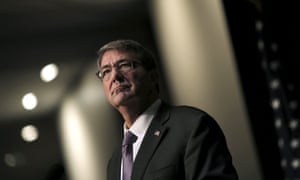
Carter said the US ‘will take all necessary steps’ to counter Russian ‘influence, coercion and aggression’. Photograph: Carlos Barria/Reuters
The US defense chief has vowed to take “all necessary steps” against a resurgent Russia which is challenging a frustrated Washington in eastern Europe and the Middle East.
Ash Carter, the US defense secretary, said the Russian president, Vladimir Putin, had wrapped his country in a “shroud of isolation” which only a drastic change in policy could reverse.
“We will take all necessary steps to deter Russia’s malign and destabilising influence, coercion and aggression,” Carter said, attacking Russian military intervention in Ukraine and Syria.
The speech at a US army convention on Wednesday included some of the strongest language yet by the Obama administration, which came into office determined to “reset” relations with Russia and move them in a more cooperative direction.
Carter said that as long as Russia pursued a “misguided strategy” in Syria to bolster its client Bashar al-Assad, “we have not, and will not, agree to cooperate with Russia”.
Meanwhile, Russia claimed that the United States snubbed its overtures for high-level consultations on Syria, refusing to send a delegation to Moscow or receive a high-ranking Russian delegation.
On Tuesday, Putin said he wanted to send a delegation led by the Russian prime minister, Dmitry Medvedev, to the US. Moscow said the suggestion was first raised during a meeting between Putin and Barack Obama on the sidelines of the UN general assembly last month.
“Literally today, we got an official reply,” the foreign minister, Sergei Lavrov, said on Wednesday. “We have been told that they can’t send a delegation to Moscow and they can’t host a delegation in Washington either.”
Putin’s spokesman, Dmitry Peskov, said on Wednesday evening: “Given the current situation in Syria, refusing dialogue does not help to save the country and region from the Islamic State.”
There was no immediate response to the claim from US officials, though the accusation stands in contrast to two weeks of unresolved requests from the Pentagon to the Russian defence ministry for a clear procedure to avoid midair conflict.
While the US Defense Department last week held out hope for “deconfliction”, three rounds of talks have yet to result in clear rules for US and Russian pilots and their commanders, despite a series of undisclosed proposals and counterproposals. A third video conference made “progress” on Wednesday, and was described as “focused narrowly on the implementation of specific safety procedures” by a Pentagon spokesman, Captain Jeff Davis.
Lavrov said on Wednesday that agreement was close and procedures “should become operational any day now”.
The diplomatic disagreement over the international community’s response to the Syrian war reflects the positions of two distinct coalitions with divergent goals. Russia, Iran and the Syrian regime of the dictator Assad have accelerated a military offensive against Assad’s Syrian enemies.
The pro-Assad coalition is reportedly aiming to retake Aleppo in the coming days, with Russian warplanes supporting Iranian ground forces.
The US and much of the west are focused instead on a relatively slower campaign against the Islamic State, which formally opposes Assad but has turned its attention to consolidating its hold on eastern Syria and north-western Iraq.
On the other hand, when the strategy has failed, Putin has not shied from going it alone, launching the air campaign in Syria just two days after his speech at the UN calling for a coalition, and giving the US just an hour’s notice, via diplomats in Baghdad.
“I believe some of our partners simply have mush for brains,” Putin said, complaining that the US did not appear to have a firm set of goals in Syria.
In the balance for the US is the Iraqi government, which pivots between US and Iranian sponsorship. The Iraqi government of Haider Abadi, installed with the aid of the US last year, has begun flirting with the Russian-Iranian-Assad coalition in frustration with what it considers insufficient US support against Isis.
Iraq now hosts an intelligence fusion centre with Russian, Syrian and Iranian liaisons and reportedly has begun using situational awareness generated from the centre to bomb Isis positions.
Russia has said it would be willing to consider expanding its airstrikes to Iraq but only if it was asked to do so by Iraqi authorities.
The US has made clear it will not participate in the intelligence centre, out of concern that its Russian and Iranian adversaries would gain access to US information; the US maintains its own independent intelligence cell with the Iraqis. The Iraqi defence ministry has provided “assurances that our information will be appropriately protected”, Warren said on 1 October.
Meanwhile Carter said that he did not know if Putin would take “the opportunity to change course”.
“From the Kamchatka peninsula through south Asia, into the Caucasus and around to the Baltics, Russia has continued to wrap itself in a shroud of isolation. And only the Kremlin can decide to change that.”






 anneinpt
 artaxes
 danmillerinpanama
 davidking1530
 Peter Hofman
 Joseph Wouk
 Peter
Peter Louisiana Steve
 WarSclerotic
Recent Comments