Archive for October 9, 2015

Why hasn’t Sisi visited Washington yet?

October 9, 2015

Why hasn’t Sisi visited Washington yet? Al-MonitorMohamed Saied, October 8, 2014

(Obama thinks highly of the Islamist Muslim Brotherhood and rejects President Sisi because he supported the Egyptian masses who sought the overthrow of an increasingly dictatorial President Morsi. Obama’s rejection of Sisi’s Egypt pushed it into an alliance with Russia. Now Obama, et al, claim that alliance as a basis for the continuing hostility toward Sisi. Perhaps it is. Obama, et al, have also complained about Egyptian human rights violations in repressing the Muslim Brotherhood; few similar complaints have been made about far greater Saudi and Iranian human rights violations. Sisi is the only president of a Muslim nation who seeks to promote a more secular and hence moderate Islam, to which the Muslim Brotherhood is hostile. Please see also, Egypt’s secular culture minister ruffles Salafi feathers. — DM)

One of the most important issues that may hinder the return of US-Egyptian relations to their previous state is the strong relationship between Cairo and Moscow; Sisi has met his Russian counterpart Vladimir Putin four times so far, and Egypt is currently considered the most important ally of Moscow in the Middle East.

**********************

CAIRO — Ever since Egyptian President Abdel Fattah al-Sisi took office on June 8, 2014, US-Egyptian relations have been deteriorating. This has been further confirmed by the fact that Sisi has not visited Washington yet despite the shuttle visits he has made abroad.

Differences and conflicts plagued the US-Egyptian relationship during the era of President Gamal Abdel Nasser. These conflicts culminated in the 1967 Six-Day War, when diplomatic relations between the two countries were severed because of the economic and military support by the United States to Israel.

However, these relations started to take a positive turn based on the strengthening of the strategic interests shared between the two countries in the wake of the signing of the Camp David Accords with Israel — the US’ permanent ally — on Sept. 17, 1978, between Egyptian President Anwar Sadat and Israeli Prime Minister Menachem Begin, as per the State Information Service affiliated with the Presidency of the Republic.

Only one meeting was held between Presidents Sisi and Barack Obama on the sidelines of the 69th Session of the UN General Assembly in September 2014 in New York, but other than this the two presidents have been settling for phone calls to discuss the latest developments in the region.

According to The Washington Times, Obama refused to meet with Sisi on the sidelines of the 70th session of the UN General Assembly. Egyptian Foreign Minister Sameh Shoukry attributed this in a press statement on Sept. 24 to the mismatching agendas and schedules of the two presidents, which prevented them from holding individual talks.

According to the US Embassy in Egypt’s reports on the situation in the country following the revolution of June 30, 2013, Washington started a “comprehensive review” of its relations with Egypt on the background of the ouster of former Egyptian President Mohammed Morsi.

On Aug. 15, 2013, following the killing of hundreds of Muslim Brotherhood demonstrators in Al-Nahda Square and Rabia al-Adawiya Square, Obama announced the cancellation of the Bright Star maneuvers, which were launched in 1980 following the signing of the peace treaty between Egypt and Israel and consisted of a joint military exercise between the two countries.

By October 2013, the review of relations put a halt to the deal consisting of delivering arms to Egypt. Also in October 2013, the US administration suspended $260 million that was going to be directly transferred to the Egyptian government along with another $300 million in US loan guarantees.

However, in a telephone call on March 13, Obama told Sisi that the military aid amounting to $1.3 billion would continue.

Meanwhile, Dina Badawi, spokeswoman for the US State Department for the Middle East, expressed concerns in a live interview on the ONtv channel April 2 over the state of rights and freedoms in Egypt, and pointed out that aid is aimed at continuing the democratic track and the political reforms in the country.

Abdel Moneim Said, director of the Regional Centre for Strategic Studies, and Shai Feldman, the Judith and Sidney Swartz director at the Crown Center for Middle East Studies, said in a research paper titled “Resetting US-Egyptian relations,” which was published in March 2014 on the center’s website, that at the root of the downturn in the US-Egyptian relations is the huge gap between the two sides’ narratives regarding the events of June 30, 2013.

One of the most important issues that may hinder the return of US-Egyptian relations to their previous state is the strong relationship between Cairo and Moscow; Sisi has met his Russian counterpart Vladimir Putin four times so far, and Egypt is currently considered the most important ally of Moscow in the Middle East.

The dispute between Russia and the United States is in regard to several issues. Chief among these is the Syrian issue; Moscow launched airstrikes on Sept. 30, sparking criticism on the part of Obama during a press conference Oct. 2. Obama said that Moscow is acting “not out of strength, but out of weakness” in support of the losing party. The president was referring to Syrian President Bashar al-Assad, and he pointed out that Russia should help in reaching a political settlement.

Meanwhile, the Egyptian Foreign Ministry did not issue any statements condemning or supporting such strikes.

In January, spokeswoman for the US State Department Jennifer Psaki said during the daily press brief that a meeting she described as “routine” was held with a delegation of members of the former Egyptian parliament from the dissolved Muslim Brotherhood-affiliated Freedom and Justice Party, on the sidelines of their visit to Washington, which was organized and financed by Georgetown University in Washington.

This meeting raised the ire of the Egyptian political leadership, as well-informed sources told Reuters in June that the Egyptian government summoned the US ambassador in Cairo to express displeasure over visits to Washington by figures of the Muslim Brotherhood, which is banned in Egypt.

Concerning the fact that Egypt did not extend an official invitation to Obama to meet with Sisi, or vice versa, Atef el-Ghomri, former director of the office of the Egyptian Al-Ahram newspaper in Washington and a member of the Egyptian Council for Foreign Affairs, said, “There is an ongoing split within the US decision-making circles over the revolution of June 30, 2013, and the toppling of former President Mohammed Morsi, who belongs to the Muslim Brotherhood.”

Ghomri told Al-Monitor that over the past years, Egypt’s relations have been confined to its foreign relations with Washington as it only took into account its regional and international interests. This deprived Egypt of any international initiatives or insights about various issues. Also, Egypt had to give up its pivotal role in the Middle East as far as the African and Arab countries are concerned. This negatively affected Egypt over time.

“The Egyptian leadership is trying to diversify its foreign relations. It resorted to the Eastern bloc led by Russia, as well as East Asia represented by China and Singapore.” Ghomri added.

Washington is concerned about several files managed by the Egyptian leadership, mainly the human rights and political reforms issues. The United States has been expressing those concerns since the June 30 Revolution, when the Muslim Brotherhood was toppled and replaced by a military president.

Under such circumstances, Cairo had to resort to other countries, while the US-Egyptian relations are expected to witness further tension, especially with the differences in views concerning several international issues, namely Syria, Iran and Libya.

 

Beware Putin and his ‘anti-Hitler coalition’

October 9, 2015

Beware Putin and his ‘anti-Hitler coalition’
By Victor Davis Hanson 10-8-2015 Via Jewish World Review
Victor Davis Hanson, a classicist and military historian, is a senior fellow at the Hoover Institution and a recipient of the 2007 National Humanities Medal.

(This little love affair with the Russians has got some folks jumping into bed with them so fast it would make a prostitute blush. – LS)

Contrary to the principles of American foreign policy of the last 70 years, President Barack Obama and Secretary of State John Kerry tacitly invited Russia to “help” monitor things in the Middle East. Now they are learning that there are lots of Middle East scenarios far worse than the relative quiet Iraq that the Obama administration inherited in January 2009 — and soon abandoned.

Russian President Vladimir Putin liked the American invitation so much that he now has decided to move in permanently. Putin now wants the West to join his new Syria-Iran-Hezbollah-Iraq axis against the Islamic State — or to at least sit back and allow Russia to straighten out the Middle East as it sees fit.

To fight the Islamic State, Putin has called for something similar to the “anti-Hitler coalition” of World War II that once saw the Soviet Union and the West unite to defeat Nazi Germany.
Certainly, the Islamic State, like Nazi Germany, is a savage regime. So far it has grown unchecked at the very center of the Middle East. Yet under the cloak of fighting the Islamic State, Putin has two greater visions.

One, he is intervening to save his client in Syria, strongman Bashar al-Assad — and with him a new Middle East Shiite axis of Iran, Iraq, Syria and Russia. Putin says he wishes to destroy the terrorists of the Islamic State. But for now he is bombing moderate opponents of Assad and bolstering the anti-Western terrorists of Hezbollah and perhaps Hamas as well.

Two, Putin is sending a warning to the oil-exporting Sunni monarchies of the Persian Gulf, who are as rich as they are militarily weak: Russia, not the United States, is the new cop on the Middle Eastern beat.

If oil-rich and nuclear Russia and a soon-to-be-nuclear Iran can bully the Sunni monarchies, Putin’s new cartel may control the spigot of some 75 percent of the world’s daily export of oil.
Putin’s recall of history is as fishy as his proposed coalition. Since he has invoked the “anti-Hitler” alliance of World War II, we would all do well to remember the circumstances that led to the totalitarian Soviet Union of Josef Stalin joining with democracies to defeat Hitler.

Stalin, remember, was originally a de facto ally of Adolf Hitler. Stalin signed a nonaggression pact with Nazi Germany on August 23, 1939. That devil’s agreement greenlighted the start of World War II just over a week later.

Germany invaded neutral Poland on Sept. 1, 1939. It was joined soon after by Russian troops attacking from the east. With a now-friendly Russia at his rear, Hitler was then free to turn westward against the European democracies.

Russia still seems embarrassed by its 1939 sellout. Marshal Stalin would supply the Third Reich for 22 months with key resources that helped Hitler to attack Belgium, Denmark, France, Great Britain, Greece, Holland, Luxembourg, Norway and Yugoslavia.

There is no reason to believe the Soviet Union would ever have flipped to join Great Britain against Nazi Germany had Hitler not double-crossed Stalin and invaded the Soviet Union on June 22, 1941. After all, Stalin’s communist regime had liquidated more than 15 million of its own citizens during 1920s and 1930s, and was a kindred genocidal state to Hitler’s National Socialist Third Reich.

That embarrassing deal with Hitler still haunts Russia. Poland has complained bitterly about absurd statements made by a Russian ambassador who recently claimed that Poland was partly to blame for the outbreak of WWII because it blocked the formation of a coalition against Germany.

Russia’s dalliance with Hitler proved nearly suicidal. Russia lost nearly 30 million soldiers and civilians on the Eastern Front during its four-year struggle against its onetime Nazi partner.

True, the Red Army was responsible for more than two-thirds of the German casualties in WWII and helped to wreck the Wehrmacht. Yet cynical and opportunistic Russia at one time or another cut some sort of friendship deal with every major combatant on both sides of WWII: America, Britain, Germany, Italy and Japan.

Ironically, Stalin kept his word to the Axis alliance of Germany, Italy and Japan far better than he later did to the Allied partners, Britain and the United States, who helped save him. The Western allies provided nearly 20 percent of all Russian wartime resources. Without key Anglo-American resources like aluminum and heavy transport trucks, Russia might well have been knocked out by Hitler.

Yet after the war, Stalin renounced all his prior commitments to hold free and fair elections in those countries liberated from Nazism by the Red Army.

Putin’s sloppy historical perspective on World War II is a window into his soul. And we should be as distrustful of him as our disillusioned forefathers finally were of Stalin’s Soviet Union.

The way to end the murderous rampage of a savage, radical Islamic State is not by joining a Russian-Iranian cartel propping up Shiite terrorists and lapdog dictatorships in the Middle East as it seeks to strong-arm moderate Sunni states and oil-exporting monarchies.

Column One: Abbas must be stopped

October 9, 2015

Column One: Abbas must be stopped, Jerusalem Post, Caroline Glick, October 8, 2015

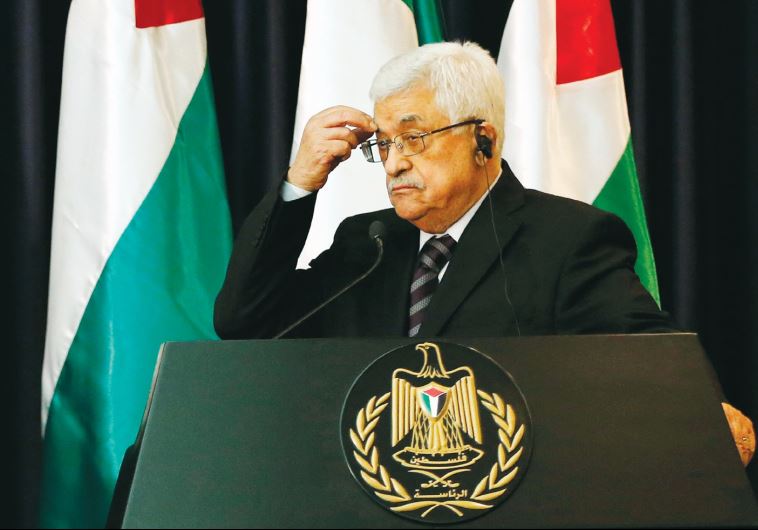
ShowImage (12)PA President Mahmoud Abbas.. (photo credit:AMMAR AWAD / REUTERS)

All the Palestinian terrorist attacks that have been carried out in recent weeks share one common feature. All the terrorists believe that by attacking Jews they are protecting the Temple Mount from destruction.

And why shouldn’t they believe this obscenity? Everywhere they go, every time they turn on their televisions, read the paper, go to school or the mosque they are told that the Jews are destroying al-Aksa Mosque. Al-Aksa, they are told, is in danger. They must take up arms to defend it from the Jews, whatever the cost.

One man stands at the center of this blood libel. The man who propagates this murderous lie and orchestrates the death and mayhem that is its bloody harvest is none other than the West’s favorite Palestinian moderate: PLO chief and Palestinian Authority Chairman Mahmoud Abbas.

On September 16 Abbas gave a speech. It was broadcast on PA television and posted on his Facebook page. In it, he incited the Palestinians to kill Jews. In his words, “Al-Aksa Mosque is ours.

They [the Jews] have no right to desecrate it with their filthy feet. We won’t allow them to do so and we will do everything in our power to defend Jerusalem.”

Abbas added, “We bless every drop of blood spilled for Jerusalem. This is clean and pure blood, blood that was spilled for God. It is Allah’s will that every martyr will go to heaven and every wounded [terrorist] will receive God’s reward.”

Two weeks later, Abbas opened his address before the UN General Assembly with the same lies, threats, and incitement.

Almost exactly a year ago, Abbas spewed the same bile in a speech, with the same murderous consequences. In a speech before Fatah’s executive committee last October, Abbas said, “We must prevent them [the Jews] from entering the holy site in every possible way. This is our holy site, this is our al-Aksa and our church [the Church of the Holy Sepulchre]. They have no right to enter them. They have no right to desecrate them. We must prevent them from entering. We must block them with our bodies to defend our holy sites.”

In subsequent weeks, Abbas’s words were rebroadcast 19 times on Palestinian television.

During that period, Arab terrorists massacred rabbis in prayer at a Jerusalem synagogue, attempted to assassinate human rights activist Yehudah Glick, and murdered Jews standing at light rail stops in the capital.

Eleven Israelis were butchered in that terrorist onslaught.

Then as now, Abbas and his lieutenants not only incited attacks, they incentivized would be perpetrators to kill Jews.

Every year, the same PA that claims perpetual poverty pays more than $100 million to terrorists imprisoned in Israeli jails. Their salaries range between four to seven times the average PA salary, depending on the lethality of the attacks they carried out.

Popular awareness of the financial benefits of terrorist activities has played a critical role in motivating Palestinians to attack Jews. This is made clear by the actions in recent weeks of several of the supposedly “lone wolf” attackers in the hours before they struck. Several of them – like their predecessors in last year’s onslaught – announced their intention to become martyrs to protect al-Aksa from the Jews on their Facebook pages immediately before they carried out their attacks.

Money may be the greatest incentive Abbas and his PA provide for potential terrorists. But it isn’t the only one. There is also the social status they confer on terrorists and their families. Every would-be terrorist knows that if he succeeds in killing Jews, he will be glorified by the Palestinian media and his family will be embraced by the PA establishment – first and foremost by Abbas himself, who has made a habit of meeting with terrorists and their families.

Presently, Israel’s security brass is embroiled in a bitter dispute with our elected leaders regarding the nature of the current terrorist offensive. The dispute bubbled to the surface Wednesday night when the generals used military reporters to criticize Prime Minister Benjamin Netanyahu for blaming Abbas for the violence.

The generals insist that Abbas is a good guy.

He’s trying to calm the situation, they argue, and Israel needs to support him.

From the looks of things, the IDF seems to have the upper hand in this fight. This is the only way to read Netanyahu’s announcement Wednesday night that he is barring government ministers and members of Knesset from visiting the Temple Mount until further notice. Netanyahu’s move is nothing less than a signal that he accepts Abbas’s premise that there is something wrong with Jews exercising their right to visit Judaism’s holiest site.

The generals’ rationale for defending Abbas is fairly straightforward. Throughout the current Palestinian terror onslaught they have continued to cooperate with Abbas-controlled Palestinian security forces in Judea and Samaria.

These forces cooperate with the IDF in seeking out and arresting terrorists from Hamas and other groups that are not subordinate to Abbas. The fact that Abbas has ordered his men to work with the IDF has convinced the generals that he is a positive actor. So as they see it, he must be protected.

In their view, Israel must limit its counterterrorism operations to tactical operations against trigger pullers and their immediate commanders and ignore the overarching cause of the violence.

In behaving in this manner, our security brass is being willfully blind to the fact that Abbas is playing a double game. On the one hand, he orders his forces to be nice to IDF officers in Central Command when they fight terrorist cells from Hamas and other groups not loyal to Abbas, and so wins their appreciation.

But on the other hand, Abbas works with those same terrorist forces, incites them to attack, and rewards them for doing so.

Perhaps the most outrageous aspect of the IDF’s insistence that Abbas is critical to its counterterrorism efforts is that the IDF’s own data demonstrate that Abbas has played an insignificant role in quelling terrorist attacks against Israel.

As Jerusalem Post columnist Evelyn Gordon showed in an article in Commentary this week, according to official data, from 2002 when Palestinian terrorist activities in the areas were at their peak until 2007, when Israel began transferring security control over some Palestinian cities to Abbas’s forces, levels of terrorism went down 97 percent. Even after Israel began permitting Abbas to deploy his security forces to Nablus and Jenin, the IDF has continued to operate at will in these areas, often on a nightly basis.

As Gordon noted, the only place Abbas has exercised sole security control was in Gaza. From September 2005, when Israel removed its military forces from Gaza until Hamas expelled Fatah forces from the areas in June 2007, Abbas’s forces had full control over Gaza. During this time, his forces did nothing to prevent Hamas – and Fatah forces – from attacking Israel with thousands of mortars and rockets. His forces did nothing to prevent the massive transfer of advanced weaponry to Gaza from Egypt and Iran.

True, since his forces were routed in Gaza, Abbas has ordered them to work with the IDF in Judea and Samaria to prevent Hamas from overthrowing him. But at the same time, he continuously seeks to form a unity government with Hamas.

He funds Hamas. He glorifies its terrorists. And he refuses to condemn their attacks against Israel.

Moreover, while ordering his men to help the IDF to protect him from Hamas, he leads the diplomatic war against Israel internationally. The goals of that war are to harm Israel’s economy and deny Israel the right to self-defense.

Our political leadership’s reluctance to stand up to the army is understandable. It is nearly impossible to order the IDF to take action it opposes.

At some point though, the government is going to rein in our insubordinate generals. Fortunately, the government doesn’t need the IDF to deal with Abbas and destroy his capacity to foment and direct attacks against Israel.

Our elected officials have the authority to go after the twin foundations Abbas’s terrorist offensive on their own. Those foundations are the incitement and the financial incentives he uses to motivate Palestinians to attack Jews.

On the financial end, the Knesset should pass two laws to dry up the wells of terrorism financing.

First, the Knesset should pass a law stipulating that all property belonging to terrorists, and all property used by terrorists to plan and carry out attacks, will be seized by the government and transferred to the victims of their attacks.

Moreover, all compensation paid to terrorists and their relatives pursuant to their attacks will be seized by the government and transferred to their victims.

The second law would relate to Israel’s practice – anchored in the Oslo Accords that Abbas revoked last month at the UN – of transferring tax revenues to the PA. The Knesset should pass a law prohibiting those transfers unless the Defense Minister certifies that the PA has ceased all terrorism- related activities including incitement, organization, financing, directing and glorifying terrorist attacks and terrorists.

Until he so certifies, all revenues collected should be used to pay PA debts to Israeli institutions and to compensate victims of Palestinian terrorism.

As for the incitement, the government needs to go to the source of the problem – Abbas’s blood libel regarding Jewish rights to the Temple Mount.

As things stand, Abbas is exacting a price in human lives for his obscene anti-Jewish propaganda about our “filthy feet defiling” the most sacred site in Judaism. By barring elected officials from visiting the Temple Mount, not only is the government failing to exact a price for Abbas’ obscene propaganda. It is rewarding him and so inviting Abbas to expand his rhetorical offensive.

To remedy the situation an opposite approach is required. Rather than bar elected officials from visiting the Temple Mount, Netanyahu should encourage them to do so. Just as he sent a letter to Jordan’s King Abdullah telling him that Israel is preserving the status quo on the Temple Mount, so he should write a similar letter to our lawmakers.

In his letter, Netanyahu should say that in keeping with the status quo, which protects the rights of members of all religions to freely enter the Temple Mount, so he commits the government to protect the rights of all believers of all religions to ascend the Mount.

The Palestinian terrorist onslaught now raging against us is not spontaneous. Abbas has incited it and is directing it. To stop this assault, Israel must finally take action against Abbas and his machinery of war. Anything less can bring us nothing more than a temporary respite in the carnage that Abbas will be free to end whenever he wishes.

Russia Missile Attacks Embarrass Obama, Warn Israel

October 9, 2015

Russia Missile Attacks Embarrass Obama, Warn Israel, American ThinkerJonathan Keiler, October 9, 2015

Beyond heaping yet another humiliation on Obama and signaling American admirals to keep their distance, the missile attack probably also sent a very pointed message to Israel. Israel currently deploys four advanced German-made and Israeli equipped Dolphin submarines, with two more on the way.

******************************

Russia’s October 7 cruise missile bombardment of anti-Assad Syrian rebels from ships stationed nearly 1000 miles away was probably the most expensively ineffectual display of military firepower since Bill Clinton launched a similar strike against al Qaeda in 1998. Clinton’s feckless and spendthrift action was supposedly in retaliation for the embassy bombings in Tanzania and Kenya and succeeded by most accounts in wiping out a few empty tents with several tons of explosives and several million dollars’ worth of advanced ordnance.

It is unlikely that Vladimir Putin’s strike did much damage to Syrian rebels either. But unlike Clinton (and the current Democrat in the White House) Putin doesn’t use force to shirk greater national responsibilities, he uses it to pursue clear strategic objectives. In this case, the Russian decision to launch brand-new Kalibr-NK missiles from the Caspian Sea fleet was clearly intended as yet another poke in the eye to President Obama, and a demonstration of Russian firepower, from diminutive but still dangerous Russian warships.

The 26 missiles were launched by three patrol boats and a frigate (a warship smaller than a destroyer.)  Russian spokesmen claimed all landed within nine feet of their targets, a degree of accuracy probably not needed against dispersed irregular infantry, but necessary to hit opposing warships, like those flying American flags. The Syrian rebels served as live practice targets for the Russian missile crews, who got to shoot off the new and previously unproven (in combat) missile.

Beyond heaping yet another humiliation on Obama and signaling American admirals to keep their distance, the missile attack probably also sent a very pointed message to Israel. Israel currently deploys four advanced German-made and Israeli equipped Dolphin submarines, with two more on the way. Most analysts presume that these advanced boats are intended to penetrate the Persian Gulf in the event of war with Iran, and from their launch cruise missiles in support of Israeli air action.

However, several years ago, in this article I proposed that the Israeli purpose was probably otherwise. Israeli is widely presumed to have equipped the subs with Israeli Popeye turbo cruise missiles with a range similar to that of the Russian Kalibr-NK. With such a weapon, Israeli subs need not make the long and dangerous journey to the Persian Gulf, but could launch from off the coast of Syria, the missiles following a flight plan very similar to those the Russian weapons took (but in reverse) where they could strike targets across northern Iran.

If I could conceive of such a plan, so could Russian intelligence services, which have probably backed this idea with hard, but secret intelligence. The Russian attack is a clear signal to Israel, demonstrating that cruise missiles which can go from the eastern Mediterranean to Iran can go the other way too. It is unlikely that it was a message lost on the Israelis, and more evidence that Russia’s movement in to the Syrian arena is proving disastrous for America and her allies.


Obama Will Violate Law By Implementing Iran Nuclear Deal, Senior Officials Say

October 9, 2015

Obama Will Violate Law By Implementing Iran Nuclear Deal, Senior Officials Say

BY:
October 9, 2015 10:50 am

Source: Obama Will Violate Law By Implementing Iran Nuclear Deal, Senior Officials Say – Washington Free Beacon


Senior U.S. officials have said anonymously that the Obama administration will violate federal law by implementing the Iran nuclear agreement.

A sanctions relief provision included in the deal that directs the U.S. to allow foreign subsidiaries of U.S. businesses “to engage in activities with Iran” if Tehran abides by the deal’s stipulations violates a law signed by President Obama in 2012 that closed this foreign subsidiary loophole.

Fox News reported:

[The law, the Iran Threat Reduction and Syria Human Rights Act (ITRA)] also stipulated, in Section 218, that when it comes to doing business with Iran, … what is prohibited for U.S. parent firms has to be prohibited for foreign subsidiaries, and what is allowed for foreign subsidiaries has to be allowed for U.S. parent firms. What’s more, ITRA contains language, in Section 605, requiring that the terms spelled out in Section 218 shall remain in effect until the president of the United States certifies two things to Congress: first, that Iran has been removed from the State Department’s list of nations that sponsor terrorism, and second, that Iran has ceased the pursuit, acquisition, and development of weapons of mass destruction.

The  Iran Nuclear Agreement Review Act, which Obama signed in May before the nuclear agreement was finalized, holds that “any measure of statutory sanctions relief” provided to Iran in the deal must be “taken consistent with existing statutory requirements for such action.”

As Iran remains on the State Department’s list of countries that sponsor terrorism, the Obama administration would be violating the 2012 law by implementing the nuclear deal and allowing foreign subsidiaries to do business with Iran, the officials concluded.

While the State Department spokesman John Kirby expressed “confidence” Thursday that the administration has the authority to implement the provision of the deal related to foreign subsidiaries, Sen. Ted Cruz (R., Texas), a lawyer, said companies that allow foreign subsidiaries to engage in business with Iran could face criminal prosecution.

Lawmakers have previously accused the president of breaking the law in relation to the nuclear deal. Nearly 100 House Republicans, led by House Majority Leader Kevin McCarthy (R., Calif.), sent a letter to the president in August suggesting he was violating the Iran Nuclear Agreement Review Act by refusing to disclose side deals related to the agreement to Congress as it reviewed the deal.

Obama never released the side deals, but an apparent draft of one of the undisclosed agreements indicated that Iran would be able to use its own experts to inspect the Parchin nuclear site believed to have housed nuclear arms development.

Top Ukraine official backs idea ‘to help ISIS take revenge on Russian soldiers in Syria’

October 9, 2015

Top Ukraine official backs idea ‘to help ISIS take revenge on Russian soldiers in Syria’

Published time: 7 Oct, 2015 08:46

Edited time: 7 Oct, 2015 21:01

Source: Top Ukraine official backs idea ‘to help ISIS take revenge on Russian soldiers in Syria’ — RT News

Anton Gerashchenko, adviser to Ukraine's Interior Minister © Alexandr Maksimenko
Russian prosecutors have charged a prominent Ukrainian politician with inciting terrorism, after he called for Islamic State to attack Russian pilots involved in the campaign against ISIS in Syria.

Anton Gerashchenko, an adviser to Ukrainian Interior Minister Arsen Avakov, shared a message from a Facebook “friend” who wants to help ISIS militants take revenge against Russian forces in Syria “in accordance with Sharia law.”

Gerashchenko said he received a message on Facebook which said that “Russian propaganda channels” and Russian army in almost every report “show off” their military personnel in Syria.

The post, as well as Gerashchenko’s Facebook page, were unavailable for several hours. But later the post, as well as Gerashchenko’s page, reappeared. An image of the post can be viewed, however, thanks to a screenshot.

© Anton Gerashchenko

“I think that their faces [on TV] will be enough, so that Islamic State militants and their supporters in Russia, the majority of whom are in the Caucasus region, could then find them and take revenge [on them] under Sharia law,” the Facebook user wrote to Gerashchenko.

Gerashchenko, who also attached an RT video showing Russian military jets in Syria in his post, seemed to be inspired by the idea. He urged everyone who has any information about Russian servicemen fighting ISIS in Syria to report the data on the volunteer-made Mirotvorec (Peacekeeper) website. For such information, there would be a special section, entitled “Putin’s crimes in Syria and Middle East.”

READ MORE: Personal details of murdered journalist & ex-MP found posted on Ukrainian ‘enemies of state’ database

The majority of Gerashchenko’s Facebook friends supported the idea, calling it “brilliant” and “effective.” However, not everyone got motivated by such a call.

“Anton [Gerashchenko] is already supporting Islamic State?” “Has Ukraine already solved its own problems” “Anton Gerashchenko, are you nuts?” asked users in the comments under the post.

The Mirotvorec (Peacekeeper) website, which is supported by Gerashchenko, posts very thorough data on anyone who oppose the current Kiev authorities – journalists, activists, MPs and, of course, self-defense forces fighting against the government in eastern Ukraine. They are all labeled “terrorists” or “supporters of federalization.”

READ MORE: ‘Do not disturb’: Top Ukrainian official asks to be left alone over missing Russian journalist

The personal information include their addresses, social media account links, a substantial biography and any mentions in the Ukrainian press. It has its own social media account, which frequently tweets cryptic messages of “successful missions.”

Several of those mentioned on the website, with the most high-profile ones like opposition politician Oleg Kalashnikov and opposition journalist Oles Buzina, were killed shortly after their personal details turned up on the website.

Obama administration ends $500mn program to train Syrian rebels

October 9, 2015

Obama administration ends $500mn program to train Syrian rebels – report

Published time: 9 Oct, 2015 11:56

Edited time: 9 Oct, 2015 14:00

Source: Obama administration ends $500mn program to train Syrian rebels – report — RT News


he Obama administration is set to overhaul the Defense Department’s $500 million program to train and equip Syrian rebels, according to Defense Secretary Ashton Carter. The US president is expected to speak on the matter later on Friday.

Carter said during a Friday news conference in London that Washington has been “looking for several weeks at ways to improve” the program.

He added that he “wasn’t satisfied with the early efforts” of the program, and that Washington is looking for “different ways to achieve the same kind of strategic objective.”

“I think you’ll be hearing very shortly from [President Obama] in that regard about the proposals that he has approved and that we are going to go forward with,” Carter said following a meeting with his British counterpart Michael Fallon.

READ MORE: ‘Who are Syrian moderates & where are they?’

Meanwhile, a Pentagon official told The New York Times that the recruitment of so-called moderate Syrian rebels to go through training programs in Jordan, Qatar, Saudi Arabia, and the United Arab Emirates will end.

The official, speaking on condition of anonymity, added that a much smaller training center will be opened in Turkey, where a small number of “enablers” – mostly leaders of opposition groups – will be taught operational maneuvers, such as how to call in airstrikes.

A separate US defense official said on Friday that the training program is not ending, but is simply being refocused. Speaking to reporters on condition of anonymity, the official said that some US training and vetting of Syrian forces would continue, Reuters reported.

Speaking to RT, political analyst Dan Glazebrook said “it was obvious that something was going to have to change…my opinion has always been that this whole business about funding moderate rebels has always been a bit of a fantasy, for a number of reasons.”

“There’s nothing moderate about what they’re being trained to do. There’s nothing moderate about forming a militia and then going and killing as many police and soldiers of a sovereign state as you can. And that’s assuming the best case scenario that they’re only attacking police and soldiers…”

He added that there’s “no great surprise that Russia has achieved more in a week of airstrikes than a 62-power coalition has achieved in a year against ISIS.” 

A top US General told Congress in September that only “four or five” US-trained rebels were still fighting on the ground, with Sen. Jeff Sessions (R-Ga.) calling the program a “total failure.”

White House spokesman Josh Earnest said at the time that the small number “certainly raises legitimate questions about what kinds of changes need to be made to this program.”

Senator John McCain has been a vocal critic of Obama’s campaign against ISIS in Syria.

“One year into this campaign, it seems impossible to assert that [Islamic State] is losing and that we are winning. And if you’re not winning in this kind of warfare, you are losing,” McCain said in September.

It comes just one day after reports of a funding bill which earmarks $600 million to support “appropriately vetted” Syrian rebels fighting against both ISIS and the Assad government.

The $500 million training program has experienced multiple setbacks. The first group of trainees disbanded soon after being sent into combat, with some captured or killed and others fleeing. A second class of troops introduced only a small number of new fighters. The original plan, devised in December 2014, aimed to prepare as many as 5,400 fighters this year, and 15,000 over the next three years.

Two Palestinians killed in clash with IDF along Gaza border

October 9, 2015

Two Palestinians killed in clash with IDF along Gaza border Rioters approach fence separating Israel from coastal Strip, 16 protesters injured; Hamas leader declares ‘intifada’

By Judah Ari Gross

October 9, 2015, 3:06 pm

Source: Two Palestinians killed in clash with IDF along Gaza border | The Times of Israel

The Israeli border fence near Gaza, August 10, 2014 (Tomer Neuberg/Flash90)

The Israeli border fence near Gaza, August 10, 2014 (Tomer Neuberg/Flash90)

DF soldiers shot at Palestinians from the Gaza Strip as they approached the border fence with Israel on Friday, killing two and injuring 16, according to Arabic media reports.

Some 200 Palestinians approached the fence closest to the Nahal Oz Kibbutz in the northern Gaza Strip.

“They began throwing stones and rolling burning tires at Israeli forces,” an army spokesperson said.

IDF troops, who remained on the Israeli side of the border, opened fire at the protesters, who were approximately 150 feet (50 meters) away, in order to break up the protest and push them from the fence, the spokesman said.

Earlier in the day, Hamas’s chief in Gaza on Friday called for additional violence against Israel.

“Gaza will fulfill its role in the Jerusalem intifada and it is more than ready for confrontation,” Ismail Haniyeh said during a sermon for weekly Muslim prayers at a mosque in Gaza City.

“We are calling for the strengthening and increasing of the intifada… It is the only path that will lead to liberation,” he said.

AFP contributed to this report.

Russia Adds 111 Warheads Under Arms Treaty

October 9, 2015

Russia Adds 111 Warheads Under Arms Treaty Moscow warheads above New START treaty limit

BY:
October 9, 2015 4:59 am

Source: Russia Adds 111 Warheads Under Arms Treaty

Russia has now deployed more than 100 nuclear warheads in its strategic arsenal above the limits set by the New START arms treaty limits—two years before it must meet treaty arms reduction goals.

New START nuclear warhead and delivery system numbers made public Oct. 1 reveal that since the 2010 arms accord went into force, Moscow increased the number of deployed nuclear warheads by a total of 111 weapons for a total of 1,648 deployed warheads. That number is 98 warheads above the treaty limit of 1,150 warheads that must be reached by the 2018 deadline of the treaty.

At the same time, U.S. nuclear warheads, missiles, and bombers have fallen sharply and remain below the required levels under the New START pact.

The United States during the same period of the Russian increases cut its deployed nuclear arsenal by 250 warheads.

The Russian increases and U.S. cuts bolster claims by critics who say the arms treaty is one-sided in constraining U.S. forces while the Russians appear to be ignoring the treaty limits as part of a major strategic forces buildup of missiles, submarines, and bombers.

Additionally, nuclear analysts say recent actions and statements suggest Russia may be preparing to jettison the New START treaty.

“Russia may pull out of the New START before it requires any Russians reductions,” said former Pentagon nuclear policymaker Mark Schneider. “Director of the Russian Foreign Ministry’s department of security and disarmament issues, Mikhail Ulyanov, said so in 2014 and 2015.”

U.S. nuclear forces in 2011 included 882 land- and sea-based missiles and bombers, 1,800 deployed nuclear warheads, and 1,124 non-deployed launchers and bombers.

The United States today has 762 ICBMs, submarine-launched missiles and heavy bombers, 1,538 warheads and 898 non-deployed weapons.

For the same categories, Russia added five missiles for a total of 526, and 12 non-deployed launchers and bombers for a total of 877.

The Air Force in August carried out the first showing for Russian nuclear inspectors of a converted nuclear-capable B-52H bomber to a non-nuclear aircraft under the treaty. The bomber exhibition took place in September and thus was not counted in the latest U.S. figures for bomber cuts.

Additionally, the Navy also showed the first nuclear missile submarine with converted launch tubes under the treaty last month.

The United States plans to eliminate 98 launchers and heavy bombers under the treaty to reach the 800 treaty level for launchers and bombers by 2018.

Plans call for converting 30 B-52H bombers and 56 submarine-launched ballistic missile launchers and send 12 B-52Hs to the aircraft bone yard.

“To date, our reductions have been for inactive or weapon systems without a nuclear mission—104 ICBM launch facilities, 51 B-52Gs, and converting B-1s to conventional-only under the treaty,” said one defense official.

By contrast, Russia under Vladimir Putin is embarked on a major strategic nuclear forces buildup that includes new missile submarines, upgrading older missile submarines and adding several new strategic missiles. Moscow, like the U.S. Air Force, is also planning a new bomber.

Additionally, Russia under Putin has announced a new doctrine that places a greater emphasis on nuclear forces.

During the crisis over Russia’s military annexation of Ukraine’s Crimea, Putin made threats to use nuclear forces against the Untied States and NATO if there were intervention to reverse the annexation.

Russian officials also have made nuclear threats against the United States in response to reports that NATO plans to move military forces into Eastern Europe in response to Russian threats.

Rep. Mike Rogers, chairman of the House Armed Services Subcommittee on Strategic Forces, said Russia “is in the business of violating treaties.”

“From the Intermediate range Nuclear Forces Treaty, to the Open Skies Treaty, to other conventional and unconventional arms control agreements—Russia violates any treaty or agreement that puts limits on capabilities that Mr. Putin and his cronies desire,” Rogers said. “Russia’s arguable adherence to the New START Treaty just indicates how bad a deal it is for the United States.”

The nuclear numbers were disclosed by the State Department’s bureau of arms control, verification, and compliance.

Blake Narendra, a State Department spokesperson for the arms control bureau, said officials are aware of the increase in Russian deployed warheads and delivery vehicles. But he sought to play down the buildup.

“The United States and Russia continue to implement the New START Treaty in a business-like manner,” Narendra said. “We fully expect Russia to meet the New START Treaty central limits in accordance with the stipulated timeline of February 2018.”

By that date, Moscow and Washington must reach limits of no more than 700 deployed treaty limited delivery vehicles and 1,550 deployed warheads.

Despite the U.S. cuts, Narendra said “our declared forces show clearly that the United States maintains a capable deterrent force capable of defending our interests and those of our friends and allies.”

The increase in Russian numbers was anticipated as Moscow replaces older weapons, Narendra said, adding “we have known for a long time about Russia’s modernization of its strategic nuclear arsenal.”

The spokesman defended the utility of the treaty despite the Russian buildup that has included unprecedented nuclear threats against NATO. The treaty provides knowledge of numbers and locations of Russian strategic forces “at a time when we need it the most,” he said.

Schneider, now a senior analyst at the National Institute for Public Policy, said Russia is now at the highest level of deployed nuclear warheads since the New START treaty went into force.

“For the last three reporting periods—18 months—Russia has moved from below New START limits in deployed warheads and deployed delivery vehicles to above them,” said Schneider.

“In all three limited categories—deployed warheads, deployed delivery vehicles and deployed and non-deployed delivery vehicles—Russia is above its entry into force numbers from 2011”.

Schneider said a flaw in the treaty counting numbers allowed the Russians to under count bomber weapons so that Russia may have between 400 to 500 more bomber-delivered warheads than the United States.

“The U.S. left may not think this is very important, but the Russians do and it is their finger on the Russian nuclear trigger,” Schneider said.

Adm. William Gortney, commander of the U.S. Northern Command, which is in charge of defending the continental United States, said Russia is qualitatively building up its military forces, with a new doctrine and, in particular, new cruise missiles capable of hitting the United States from Russian airspace.

“They’ve read our play book and they’re putting in force, they’re fielding cruise missiles that are very, very accurate, very long range,” Gortney said Wednesday in remarks to the Atlantic Council, a think tank.

The new missile has been identified by other defense officials as a KH-101 air launched cruise missile that can be armed with either nuclear or conventional warheads.

The missile can reach U.S. infrastructure targets in Canada and the United States from launch points within Russian air space, Gortney said.

Gortney said the Russians have been “messaging” the United States with long-range nuclear-capable bomber flights along U.S. and Canadian borders.

War game scenarios in recent months have included simulated Russian conventional cruise missile strikes on long-range early warning radar in Alaska, he said.

The military blog Russianforces.org said the increase of 66 Russian warheads and nine launchers since March, when the last treaty numbers were released, probably reflects Moscow’s deployment of new submarine-launched Bulava missiles on the new submarine Alexander Nevsky, launched in April.

Army Lt. Col. Martin O’Donnell, a spokesman for the U.S. Strategic Command, said the treaty “continues to enhance security and strategic stability.”

“We fully expect Russia to meet the New START Treaty central limits in accordance with the stipulated timeline of February 2018,” he said.

Thomas Moore, a former professional staff member of the Senate Foreign Relations Committee who specialized in arms control, said he is not surprised the Russians are over treaty limits while the  the United States is below them.

“But I guess we are under it early because ‘business-like’ implementation of the treaty is a way the administration can appear to be doing something, and they have a base of left-wing support which demands we go lower still, and faster,” Moore said.

Russia has been building up its forces steadily, he added.

“Its raid of Kalibr cruise missiles from the Caspian to targets in Syria is another sign that, along with New START warhead numbers, its nuclear-capable systems, strategic warheads, and overall nuclear capability at all ranges and with all types of weapons is building up, not down.”

Turning point? EU Commission head says relations with Russia ‘must be improved,’ US ‘can’t dictate’

October 9, 2015

Turning point? EU Commission head says relations with Russia ‘must be improved,’ US ‘can’t dictate’ Published time: 9 Oct, 2015 04:13 Edited time: 9 Oct, 2015 09:10

Source: Turning point? EU Commission head says relations with Russia ‘must be improved,’ US ‘can’t dictate’ — RT News


European Commission President Jean-Claude Juncker © Vincent Kessler

European Commission President Jean-Claude Juncker © Vincent Kessler / Reuters

Europe must treat Russia with more decency, improve the relationship, and not let EU policies be dictated by Washington, European Commission President Jean-Claude Juncker said in a surprise speech in Germany.

READ MORE: NATO to create new HQs in Hungary & Slovakia, boost response forces – Stoltenberg

It is now critical for the EU to work on its relations with Russia, Juncker said in the southern German town of Passau: “We must make efforts towards a practical relationship with Russia. It is not sexy but that must be the case, we can’t go on like this.”

Moreover, the US needs to keep its influence out of EU relations with other countries, Juncker added.

“Russia must be treated decently … We can’t let our relationship with Russia be dictated by Washington.”

EU-Russia relations have deteriorated since the EU imposed sanctions on Russia for its alleged role in the Ukrainian conflict. The Russian government has unswervingly denied these allegations.

In the meantime, some progress has recently been reported in eastern Ukraine, as the armed forces of the self-proclaimed Lugansk People’s Republic (LNR) have begun withdrawing weapons under 100 mm caliber from the conflict zone. Ukraine’s Joint Staff has also announced the start of a withdrawal of artillery from the region.

The withdrawal of weapons is part of the Minsk agreements, which was agreed upon by the leaders of the Normandy Four, namely France, Germany, Ukraine and Russia, in February. The deal required a ceasefire, a weapons withdrawal, constitutional reforms, legislative recognition of a special status for the unrecognized republics, and release and exchange of prisoners on an all-for-all basis.

READ MORE: Top Ukraine official backs idea ‘to help ISIS take revenge on Russian soldiers in Syria’

However, lasting truce was only reached in late August. Kiev and the self-proclaimed Donetsk and Lugansk republics maintain the armistice has been holding since September 1, although both sides still occasionally accuse each other of violations.

Moscow continues to stress the importance of direct dialogue between Kiev and representatives of the Donetsk and Lugansk People’s Republics.

Russian President Vladimir Putin told CBS’s ‘60 Minutes’ at the end of September that all countries need to respect Ukraine’s sovereignty.

“At no time in the past, now or in the future has or will Russia take any part in actions aimed at overthrowing the legitimate government,” Putin said, adding that Moscow “would like other countries to respect the sovereignty of other states, including Ukraine. Respecting the sovereignty means preventing coups, unconstitutional actions and illegitimate overthrowing of the legitimate government.”

READ MORE: Moscow ready for more sanctions, regardless of Ukraine crisis – Foreign Ministry

EU sanctions against Russia could be renewed at the end of this year, however, even though some European countries have been hit hard by the fall in trade triggered, in part, by Moscow’s counter-sanctions on food imports.

EU sanctions include restrictions on lending to major Russian state-owned banks, as well as defense and oil companies. In addition, Brussels has imposed restrictions on supplying weapons and military equipment to Russia, as well as military technology, dual-use technologies, high-tech equipment, and technologies for oil production. A number of Russian and Ukrainian officials have also been blacklisted by the West.


