Archive for October 8, 2015

Hero Serviceman Spencer Stone Stabbed Repeatedly in Chest, Hospitalized

October 8, 2015

Hero Serviceman Spencer Stone Stabbed Repeatedly in Chest, Hospitalized Stone helped thwart terrorist plot on French train

BY:
October 8, 2015 11:32 am

Source: Hero Serviceman Spencer Stone Stabbed Repeatedly in Chest, Hospitalized – Washington Free Beacon

The Air Force serviceman who helped foil a terrorist plot on a French train this summer was repeatedly stabbed early Thursday morning.

According to the Air Force TimesAirman 1st Class Spencer Stone is being treated at a hospital in the Sacramento area after being stabbed four times in the chest.

“A1C Spencer Stone has been transported to a local hospital, and is currently being treated for injury,” Air Force spokesman Lt. Col. Christopher Karns said. “The incident is currently under investigation by local law enforcement. He is currently in stable condition.”

CBS News reported on Twitter that Stone was in critical condition.

According to a local television station, a stabbing occurred at approximately 12:45A.M. on a street corner in Sacramento. The TV outlet did not name Stone as the victim in its report but said police did not think the victim would survive the attack. Authorities are investigating the incident as a homicide and maintain that the victim has not been identified.

Stone was one of the three Americans who subdued an armed terrorist aboard a train traveling from Amsterdam to Paris in August. The 26-year-old Air Force member was wounded with a knife while foiling the terror plot and sent to the hospital to receive treatment for his injuries.

Stone, National Guardsman Alek Skarlatos, and Sacramento State University student Anthony Sadler all received France’s Legion of Honour award for their heroic actions.

The Palestinians’ New Intifada

October 8, 2015

The Palestinians’ New Intifada, Gatestone InstituteBarry Shaw, October 8, 2015

  • “I saw a mob of 40 to 50 masked Palestinians on the side of the road. They were holding rocks and cinder blocks. … I have no doubt that I would be dead now if I hadn’t used my gun. They were going to kill me.” – Josh Hasten, Oct. 7, 2015.
  • Arab children watch other Arab children on television throw rocks and firebombs, and speaking of knifing and shooting Jews, and they want a part of the action.
  • When Arabs hear from their leaders that Jews are “desecrating” Islamic holy places with their “filthy feet” and plotting to destroy them, it is a code, telling them to go out and attack Jews.

Yesterday, a friend, Josh Hasten, was set upon by a crowd of rock-wielding Palestinians, while he was driving to Jerusalem. “I saw a mob of 40 to 50 masked Palestinians on the side of the road. They were holding rocks and cinder blocks,” Hasten said. “As they approached my car, I took out my gun and fired one round in the air. The shot obviously scared them and they ran up the hill away from the road. I have no doubt that I would be dead now if I hadn’t used my gun. They were going to kill me.”

In Europe and the West, acts of terrorist violence are relatively rare; in Israel, they occur several times a day — on a regular basis.

Last week, Palestinian Authority (PA) President Mahmoud Abbas spoke at the United Nations, highlighting Israeli “crimes,” but without specifying any. He is, apparently, aware of losing control of the Palestinian “street,” which now seems to feel closer to radical elements within Palestinian society — especially since Hamas and Palestinian Islamic Jihad take credit for recent murders in Israel.

Palestinians who commit terrorist attacks are not, as in Europe, radicalized primarily by social media or clerics. They are, rather, radicalized primarily by their own Palestinian Authority or Hamas leadership. Arab children watch other Arab children on television throwing rocks and firebombs, and speaking of knifing and shooting Jews, and they want a part of the action.

Meanwhile, the Israeli government is prevented by international pressure from disbanding these groups or arresting their leaders. The equivalent is as if Britain were plagued by daily terror attacks directed by a leadership based in Birmingham, and with the British government prevented from acting against the source, under pain of condemnation and punishment from the European Union and the United Nations.

The current wave of Arab riots and terrorist attacks has been compared to an “intifada,” an Arabic word meaning “uprising” or “shaking off” — a word used to describe the desire of Palestinian Arabs to drive the Jews out of the land.

The violent demonstrations and riots are initiated and orchestrated by the Palestinian leadership, seemingly concerned about losing the support of their own people. Palestinian leaders have been seeing, in local surveys and student elections, a growing disenchantment with the corrupt and sclerotic Fatah-led Palestinian governance, as well as a growing popularity for Hamas.

Palestinian Authority leaders have also been seeing the rise in popularity of rival groups at the same time as they are being ignored by the world’s media and diplomatic community, who are busy with Iran, Russia, Syria and ISIS.

The current violence has a greater religious component than earlier intifadas.[1] Perhaps seeing that Hamas and Islamic Jihad are strongly Islamic, PA President Mahmoud Abbas latched onto the extremist — albeit totally incorrect — Islamist theme that Jews are trying to destroy Islamic holy places. He thereby ignited a firestorm of competition among radical groups as to which faction could incite the most violence.
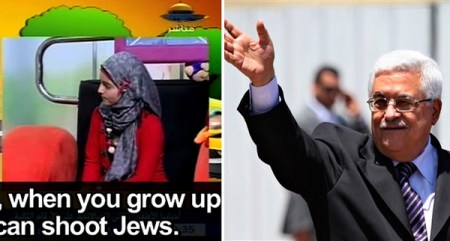
1280Palestinian Authority President Mahmoud Abbas (right) ignited competition among radical groups as to which faction could incite the most violence. Left: official PA media incite Palestinians, from a young age, to murder Jews.

Hamas, ruling in the Gaza Strip, has made no secret of its wish to deepen its influence in the West Bank. This time, it was assisted by the Palestinian Authority, which used the Jewish high holy days as an excuse to accuse Jews praying at the Western Wall, of trying to take over Muslim holy places. The Western Wall, a holy place to Jews, is all that is left of the Jews’ Second Temple, which was destroyed by the Romans in 70 CE.

When Muslims hear from their leaders that Jews are “desecrating” Islamic holy places with their “filthy feet” and plotting to destroy them, it is a code, telling them to go out and attack Jews.

In addition, Muslim women, in organized groups funded by the Islamic Movement in Israel, have been bused to Jerusalem, and paid to abuse, and sometimes use violence, to prevent non-Muslims, mainly Jews, from visiting the Temple Mount. The women punch, kick, spit, and hurl insults at Jews (and often other non-Muslims) who visit or attempt to visit the Temple Mount.

For years, Mahmoud Abbas has been whipping up the Palestinians with claims — all false, as can be seen throughout the Bible — that Jews have no heritage or history in Jerusalem, and therefore have no right to be there. It is a charge he repeats despite a Jewish presence and culture in the land that dates back over 3000 years.

Incitement to violence leads to actual violence. So, on October 3, an impressionable 19-year-old Arab man became a murderer. Muhannad Halabi, before setting out on his killing spree, wrote on his Facebook page, “The Third Intifada has erupted!…Defending the sanctity of Al-Aqsa and its women is out pride and honor… We know only that Jerusalem is undivided and that every part of it is holy.”

This young killer was apparently caught up in the passion of the false claims of Abbas that Jews were defiling Islamic holy places with their “filthy feet,” that he took a knife and entered the Jerusalem’s Old City in search of Jews. There, he attacked a Jewish family that on its way to pray at the Western Wall. He stabbed Aharon Banita, and his wife, Adele. Hearing the screams of the victims, 41-year-old Rabbi Nehemia Lavi, armed with a pistol, ran over to stop the attack. Halabi stabbed and killed Lavi, took his gun, and shot and wounded 2-year-old Matan Banita. Seconds later, security forces arrived and killed Halabi in a shootout. Adele and Matan Banita survived.

During the attack, as the wounded and bleeding Adele Banita ran through the street screaming for help, she was jeered at, spat on, hit and insulted by Arab passersby and local Arab shopkeepers. None of them helped her. She reported later from the hospital that many of them screamed at her to die. The anti-Jewish incitement by Palestinians resulted in the killing of four Jews – simply because they were Jews.

In the minds of radicalized Palestinians, there is no difference between shooting or stabbing women and children, and shooting men.[2]

Many in the Western media fail to portray events in Israel accurately. The most morally tortured headline came from BBC News. Its headline on October 4 read “Palestinian shot dead after Jerusalem attack kills two.” It appeared a clear effort to make readers believe that the Palestinian terrorist was the victim.

Unless the West persuades Abbas to stop the incitement, perhaps by linking financial aid to performance, his intifada will continue to escalate.

__________________________-

[1] In the first “intifada,” from 1987-1993 Arabs attacked primarily Israeli soldiers and police, mainly with rocks and firebombs. The second “intifada” (2000-2005), planned by the late Palestinian Authority President Yasser Arafat, included widespread attacks — suicide bombings, shootings and car bombs — against any and all Israeli targets, mainly civilians.

[2] In 2011, for example, three of the six children from the Fogel family in the village of Itamar were hacked to death in their beds, along with their parents, when Palestinian terrorists broke into their home. It was near Itamar that four small children from the Henkin family miraculously avoided death under a hail of bullets on October 1, when Palestinians murdered their parents (Eitam and Naama Henkin) in a drive-by shooting. The nine-year-old son recited the mourner’s prayer at his parents’ graves the following day.

The Missiles of October, 2015 Edition

October 8, 2015

The Missiles of October, 2015 Edition

Author By Doug Hagmann —

Bio and Archives October 8, 2015

Source: The Missiles of October, 2015 Edition

When the farmer in Iowa plowing his field suddenly and unexpectedly hears a noise and feels the ground shake from missiles being fired from a hidden underground silo in retaliation against Russia, perhaps then Americans will wake up to the litany of lies we’ve been fed by our leaders and a complicit media. Even then, I suspect that most Americans will continue to believe the lies of the U.S. leaders and succumb to revisionist history that has little-to-nothing to do with the truth.

We are at the precipice of World War III, yet the average American has no idea. The average American is oblivious to the fact that America has been captured from within, its leadership is traitorous, and the media complicit in all aspects of seditious criminality. Many of those who might have a level of understanding however, don’t know the real story about how we arrived at this point in time. For both, we have our elected officials in Washington to thank…or to blame… or perhaps congratulate, depending upon which agenda you’re pushing.

In the event you missed the news, twenty-six cruise missiles were fired into Syria by Russian warships yesterday as Syrian ground troops launch an offensive against ISIS and U.S., NATO and Saudi-backed anti-Assad terrorists. Who didn’t see this coming?

Three years ago to the day – October 8, 2012, I wrote Lemmings…On the precipice of World War III, explaining that Barack Hussein Obama, in his capacity as the man selected for the Oval Office, was overseeing a private war in the Middle East at the direction of the Saudis. What was taking place in Syria at that time was the result of the Obama-Clinton parallel CIA/State Department’s “Fast & Furious, Libyan Edition.” To Hillary Clinton’s cackling delight, Gaddafi was deposed and killed, and Libya was being used as a supply depot for weapons funneled to Syria via Turkey and other areas in close proximity. The primary staging area in Libya was Benghazi, and specifically, the CIA complex that was attacked on September 11, 2012.

The actions by this rogue element within the U.S. government, many who are still in power and continue to hold positions of influence, led to the attack on the CIA compound that caused the murder of a U.S. Ambassador and three others. Although the attack was conducted by proxy groups, those groups were acting on behalf of Russia. Accordingly, the United States did not respond, as doing so would have certainly widened the conflict and exposed the largest weapons running operation in the Middle East. Stevens, having a rolodex full of unsavory contacts including those he met while on assignment in Syria, reportedly oversaw a portion of this operation, according to my contacts in the intelligence venue.

To fully understand the perilous situation the Renegade-in-Chief has created for us as a nation, it is critical to understand the truth regarding how we arrived here. That, of course is something that Obama, Clinton and their facilitators cannot have exposed at any cost. To understand Russia’s response in Syria, the current situation must be viewed through the larger lens of past events for accurate historical context, and those events include Benghazi. It is for this reason that the American people will never get the truth about Benghazi or the mysterious Clinton e-mails, as any truthful revelation would expose the criminally traitorous activities of this unlawful administration.

How deep the lies

The lies, however, go much deeper than most reasonable people can comprehend, as we are not dealing with reasonable or rational people. We do not have truth in the media, as all media outlets are controlled by only six corporations that act as chokepoints for truth. The large media conglomerates dutifully report only what they are told to report and nothing more. Included in this pattern of control are those media pundits, including most who are identified as conservative, and most who host talk shows and television panels.

The above, therefore, explains why the background of Barry Soetoro, a/k/a Barack Hussein Obama II, the Renegade-in-Chief was declared “off-limits” to discussion by even those “conservative” pundits. Anyone out of compliance was (and still is) publicly ridiculed. This complete takeover is overtly obvious even in Hollywood, where many night-time talk show hosts often mock and ridicule anyone daring to question the bona-fides and allegiance of the Communist Muslim occupant of the White House.

I stress the above in this report as it is relevant even today, for the events we are watching unfold could have been prevented with a true conservative effort and media pundits who could have chosen to place the fate of their nation over their careers. They chose their paycheck over the truth, and bowed to their corporate handlers as deeply as Obama bowed to his handler, the king of Saudi Arabia.

We have grown to expect as much from the toxic liberal “progressive” Marxists, but find it difficult to accept such from the self-proclaimed conservative media and pundits. Depicted as intellectual talking heads, they never seem to break through the thin veneer of lies that covers the truth. They entertain rather than inform, which appeals to the average, non-thinking American. They offer just enough “us versus them,” play-by-play action of the long-dead partisan paradigm to satisfy those addicted to mainstream news.

What every thinking American needs to understand is that the lies that have been and continue to be perpetuated by those in elected positions emanate from members of both political parties, for most members of both parties have chosen to take their assigned seats at the globalists’ table. It is easy to see how others may have been blackmailed into taking their assigned seats, especially after drinking from the fountain of power and wealth within the beltway. That assertion also applies to certain members of the Supreme Court, a body that has become an activist arm of the globalists.

We did not, however, arrive here overnight. The subjugation of America’s sovereignty was an incremental process. It seems that the tactics of the Fabian Socialists won out over those of the Communists. Their goals are the same, only their approach is different. The ultimate objective is nearly complete, and each of us has a front seat to the next act of this Orwellian play. From Woodrow Wilson to the Clinton cabal to the globalists currently in power, Americans have been led into servitude. Sadly, many Americans are enjoying their servitude, or have no idea that they are being held captive. Feel free to call it Stockholm syndrome, but dare not call it “battered wife syndrome,” for this phrase has been deemed off limits by the thought police.

For those reasons and many more, don’t expect to learn the truth about Benghazi, for the next act of this Orwellian play has already been written. While most Americans could not find Benghazi on a globe, those who could seem to have long forgotten about the attack and its implications. A dutiful and complicit press has made sure of that.

While many quickly dismiss ludicrous explanations concerning the Benghazi attack, including the embarrassingly laughable narrative relating to the anti-Muslim video The Innocence of Muslims, they will often stop there, purposely neglecting the evidence that is highly suggestive of a rogue CIA, Clinton, Obama and Brennan cover-up.  As I detailed in my report of that video, its creation appears to trace back to people and groups close to the CIA. Additionally, the same people and entities whose fingerprints appear on the video also appear to be involved in the breach of the passport office files in 2008. It was that breach that prompted the admission by Obama that he traveled to Pakistan in 1981, and also appears to have played a role in the murder of one of those involved at the periphery of that incident.

Although seemingly tedious and arguably off-topic, it is vital to understand that everything we are presently seeing taking place has been carefully orchestrated. We are not living in a world of coincidence, but one of conspiracy. Laugh if you must, but do so only after you’ve investigated all of the facts. And then, laugh at your own peril.

Three years ago, I wrote that World War III would begin in Syria, not Iran. Admittedly, Iran would play a role, but the flashpoint, Putin’s red line in the sand runs directly through Damascus. It still does, and now over two-dozen sophisticated Russian cruise missiles have served to emphasize and validate my assertions.

Obama’s deliberately destabilizing actions across the Middle East, known as the “Arab Spring,” was planned long ago in the bowels of a Saudi mansion. With the approval of Washington leadership of both parties, including the “gang of eight,” Obama was selected to oversee the operation. Obama is acting on orders from his Saudi and globalist handlers. John Boehner and other Republican leaders provided the necessary cover for Obama to complete his task. He was assisted by the Clinton criminal cabal, and given a pass by a complicit media.

If you look long enough and close enough, the evidence is there. Sadly, there are too few with the intellectual and moral integrity to report it. Or, they have already submitted their reservations for their seats at the globalists’ table.

For those with the temerity to report the truth, there is a solution to deal with you. If you’re not silenced by the restrictions of the soon-to-be-passed Trans-Pacific Partnership Treaty or its Atlantic counterpart, there’s always room for you at one of your local non-existent re-education centers. They’ll even leave the light on for you.

From there, you’ll have a front row seat to the series of final acts of the screenplay of the globalists. The “Missiles of October 2015 edition,” produced and written by the Globalista’s studios, although a bit behind schedule, has been “launched.” Pun intended.

Prepare. Pray.

The Real Reasons Saudi Arabia Hates Iran

October 8, 2015

The Real Reasons Saudi Arabia Hates Iran

Posted on October 7, 2015

by WashingtonsBlog

Source: The Real Reasons Saudi Arabia Hates Iran Washington’s Blog

The Saudis Hate Iran Because It’s Not a Monarchy

Everyone knows that the Saudi Arabia – the center of Sunni Islam – hates Iran because it is the center for the rival Shia Muslim sect.

The Saudis – close U.S. allies – also hate Iran because it is allied with Russia.

But there is a third, little-known reason why the Saudi government hates Iran.

As the Gulf Cooperation Council – the official council for the Arab Gulf States, comprised of the monarchies of Saudi Arabi, Kuwait, Bahrain, the United Arab Emirates, Qatar and Omanwrites:

More than any other single factor, the Iranian Revolution helped to coalesce the security concerns of Saudi Arabia and the other monarchies in the Gulf region. As the largest Arab monarchy, Saudi Arabia was in a position to lead the others toward cooperative efforts. The impact of the Iranian Revolution on Saudi Arabia was manifold. The revolution destroyed the most powerful monarchy in the Gulf area. It was the second revolution to send shock waves throughout the Gulf region, the first being the revolution in Iraq that destroyed the monarchy in 1958. The Iraqi revolution had been followed by deteriorating relations between Riyadh and Baghdad, when the Baathist regime tried to subvert the Gulf monarchies. The Iranian example, however, appeared more menacing. The balance of forces seemed to have changed further against the monarchical regimes in the region because Iran, like Iraq, replaced the monarchy with a republic. Whatever course the new Iranian republic took, its very existence would threaten Saudi Arabia and other Gulf monarchies.

In other words, the Saudi government hates Iran because it is a republic, while Saudi Arabia and the other Gulf states are monarchies.

Indeed, Vijay Prashad – Professor of South Asian History at Trinity College, Connecticut – said today (starting at 33:22) that the Saudis want to crush Iran so that it cannot set an example showing that Muslims can live in a republic without a monarchy.

Prashad points out that the “Saudis made claim that a Muslim country has to be a monarchy”, and Iran’s very existence undermines that claim.

Why does the U.S. support Saudi Arabia and not Iran?

As Lawrence Davidson – author of Islamic Fundamentalism, and professor of history at West Chester University – explains:

Saudi Arabia is a monarchy without representative institutions. Iran, though ideologically authoritarian and possessing the dictatorial office of jurisprudent, is a republic with a parliament and an electoral process. Saudi Arabia strictly forbids female participation in the public realm, whereas Iran leaves some space for women in this regard.

Given these comparisons, it would seem that, in terms of institutions and their potential for “democratic evolution,” the Islamic Republic in Iran has much more to recommend it to the West than does Saudi Arabia.  Why then, one might ask, is the United States so much more hostile to Iran than to Saudi Arabia?

***

For decades, the United States supported the shah’s monarchy in Iran and continued to do so even after it was clear that it was unpopular, corrupt, and oppressive. When the shah was overthrown, the fundamentalists who took power identified the United States with the deposed government. The new Iranian government’s predictable hostility made difficult any reconciliation between the two powers and fueled continued American animosity.

Indeed, the U.S. supports virtually all of the dictatorial monarchies in the Arab Gulf.

And, of course, there is oil and pipelines play a big part.

Postscript:   By way of background, the CIA admits that the U.S. overthrew the moderate, suit-and-tie-wearing, Democratically-elected prime minister of Iran in 1953. He was overthrown because he had nationalized Iran’s oil, which had previously been controlled by BP and other Western oil companies. As part of that action, the CIA admits that it hired Iranians to pose as Communists and stage bombings in Iran in order to turn the country against its prime minister.

If the U.S. hadn’t overthrown the moderate Iranian government, the fundamentalist Mullahs would have never taken over. (Moreover, the U.S. has had a large hand in strengthening radical Islam in the Middle East by supporting radicals to fight the Soviets and others).

Doctors Without Borders Bombing: U.S. Changes Story Four Times in Four Days

October 8, 2015

Doctors Without Borders Bombing: U.S. Changes Story Four Times in Four Days

Claire Bernish

The Anti-Media October 7th, 2015

Source: Doctors Without Borders Bombing: U.S. Changes Story Four Times in Four Days | The Daily Sheeple

After relentlessly bombing a civilian hospital staffed by Médecins Sans Frontières (MSF — Doctors Without Borders) in Kunduz, Northern Afghanistan, the U.S. military did the only thing truly befitting American government — it tried to get away with it.

Saturday’s initial summary involved U.S. troops taking on fire in Kunduz, but — according to officials that day — they had no idea if they’d hit the hospital or not.

After a day to fully concoct recall those events, Sunday’s military brief said the strike occurred in the “vicinity” of the hospital so, sure, maybe it was hit by accident.

Deciding that didn’t quite seem plausible exact enough, General John Campbell, commander of the U.S. and NATO [quasi]-war in Afghanistan, claimed the U.S. had never faced a threat on Saturday but were called to assist Afghan troops in the area.

And then Tuesday, the latest available only because it isn’t yet time for the Wednesday version, Campbell expounded on Monday’s version of events, adding that U.S. forces had both called in and carried out the airstrike at the behest of Afghan forces.

“Today’s statement from General Campbell is just the latest in a long list of confusing accounts from the U.S. military about what happened in Kunduz on Saturday,” said Jason Cone, U.S. Executive Director of Doctors Without Borders. “They are now back to talking about a ‘mistake.’ A mistake that lasted for more than an hour, despite the fact that the location of the hospital was well known to them and that they were informed during the airstrike that it was a hospital being hit. All this confusion just underlies once again the crucial need for an independent investigation into how a major hospital, full of patients and MSF staff, could be repeatedly bombed.”

From the beginning, MSF insisted no gunfire originated in the hospital — a claim the U.S. implied and Afghan officials expressly stated. Crucial in deducing whether the catastrophe — one that left 12 MSF staff and ten patients mortally injured — amounted to a war crime is an examination of events under the microscope of international laws of war.

As becomes quickly apparent, there are a bevy of reasons the U.S. military continues to tidy its explanation of the bombing.

According to the laws of war, direct attacks on such civilian facilities as domiciles, hospitals, places of worship, schools, etc. is prohibited, except in truly definitive cases whose general circumstances involve the military employment of said facility by opposing forces. Here, of course, MSF personnel on scene at the time refute official claims — no matter what those claims involve at any given moment.

Even in those instances, the attacking party is required to give the targeted facility fair warning it will be subject to bombardment. But advanced warning wasn’t given to the hospital in Kunduz, which by some accounts suffered bombardment for a full ninety minutes — including up to 45 minutes after the military was alerted to the ostensible targeting error.

“Any serious violation of the law of armed conflict, such as attacking a hospital that is immune from intentional attack, is a war crime. Hospitals are immune from attack during an armed conflict unless being used by one party to harm the other and then only after a warning that it will be attacked,” explained Mary Ellen O’Connell, professor of international law at Notre Dame.

MSF International President Joanne Liu concurred, saying the decision to “raze to the ground a fully functioning hospital . . . amounts to an admission of a war crime.”

Like ducks in rain, U.S. officials in recent decades have repeatedly repelled charges of war crimes — notwithstanding actual culpability. But the Kunduz hospital bombing — whatever excuse U.S. government chooses to wrap it with — could feasibly be the world’s last straw.

Saudi Sheikh Yahya Al-Jana’ Waxes Lyrical about the Virgins of Paradise

October 8, 2015

Saudi Sheikh Yahya Al-Jana’ Waxes Lyrical about the Virgins of Paradise, Middle East Media Research Institute, October 7, 2015

(This must be either a warning about raping immodest women or a put-down of Viagra. — DM)

According to the blurb following the video,

In a lesson posted on the Internet on September 1, 2015, Saudi Sheik Yahya Al-Jana’ talks about the joys of Paradise, saying that men will have the strength of a hundred men in Paradise and will be busy “tearing hymens,” while the virgins of Paradise, whose breasts are “like pomegranates,” become virgins every time again.

Iran Deal Inside Story: How Obama Got to ‘Yes’ – POLITICO Magazine

October 8, 2015

Source: Iran Deal Inside Story: How Obama Got to ‘Yes’ – POLITICO Magazine

What Netanyahu really thought of Obama, how Susan Rice stymied Israel and other bombshell revelations from Obama’s disillusioned peace negotiator.

October 08, 2015

151007_ross_obamabibi_ap.jpg
AP Photo

On Friday night, November 8, 2013, Israeli Prime Minister Benjamin Netanyahu asked me to come by his residence after sundown for an informal chat. I was in Jerusalem, and he wanted to discuss the talks with the Palestinians and the nuclear negotiations with Iran. As it turned out, I arrived while he was on a secure call with President Barack Obama. When I joined the prime minister after the call, he was as disturbed as I had ever seen him. Earlier in the day, Secretary John Kerry had left Israel to go to Geneva to see whether an interim deal on the Iranian nuclear program could be concluded. The Israelis had been surprised that such a deal was suddenly on the brink of happening. Only a week earlier, Israel’s Iran team was briefed on the status of the talks, but National Security Adviser Susan Rice had not authorized the Israelis to be briefed on the actual state of play in the negotiations.

Now the surprise left them alarmed—and Kerry, who had a good relationship with Netanyahu, had not been able to reassure him about the content of the deal. Netanyahu had publicly stated that if the deal was concluded, it would be a “historic mistake.” The president had called to change the prime minister’s view, in no small part because of the impact that Israel’s position would likely have on congressional attitudes toward the emerging deal.

The call had not worked. I was struck by how alone Netanyahu felt. He believed the United States had given up all its leverage in this deal and the sanctions would now collapse of their own weight, taking all the pressure off the Iranians and freezing the situation. The Iranians would be left as a threshold nuclear state, and Israel would be confronted with unpalatable choices. I challenged his conclusions, saying that the sanctions would not collapse because there was much the United States could do to demonstrate the costs to those businesses that might think of breaking the sanctions regime. He acknowledged that I could be right, but what became apparent is that he interpreted what he heard from the president as a loss of will on his part to keep the pressure up. When I asked him why he drew that conclusion, he said because the president felt politics ruled out the use of force and therefore required a deal.

I told him, “I just don’t believe the president said or meant that. Maybe he was making the point that the war-weariness of our public requires us to demonstrate we made every effort to give diplomacy a chance and this deal gives us the chance to do so.” But the prime minister felt the president was telling him that our domestic reality left him little choice but to do a deal.

I was certain two leaders speaking the same language had talked past each other. I contacted Kerry to let him know that the prime minister had formed an impression about the U.S. position that needed to be corrected. Kerry quickly followed up with a call. But the problem was a White House problem—and not one Kerry could easily correct. Had Tom Donilon still been the national security adviser, he surely would have understood that there was a problem, and he would have immediately spoken to his counterpart. If the impression was not corrected, he would have had Obama make another call.

He had done precisely that in September 2012 when Prime Minister Netanyahu had made public comments, challenging our position on the Iranian nuclear issue. Donilon arranged the call and the air was not only cleared, but there was a meeting of the minds.

By contrast, now there was no call from Susan Rice, there was no follow-up from the president, and the prime minister did not soften his public criticism two weeks later when the actual Joint Plan of Action with Iranian negotiators was concluded. Instead, Rice, reflecting her generally more combative mind-set, would say to Abe Foxman, national director of the Anti-Defamation League, that in reacting to the Joint Plan of Action, Netanyahu’s posture was outrageous. In her view, the Israeli leader did everything but “use ‘the n- word’ in describing the president.”

***

It didn’t have to play out that way. From the outset of his presidency, Obama was focused on establishing what became known as the dual- track approach to Iran and its nuclear program: Be prepared to deal directly with the Iranians but also build our leverage with them. Engagement put pressure on the Iranians in two ways. First, talking to the United States created deep fissures in the Iranian elite. Second, if the Iranians balked at dealing directly with us, it made it far easier for us to mobilize sanctions against them. The hope was to alter Iran’s behavior through negotiations, but if the Iranians would not engage at all, or engaged but would not budge, we would then be able to garner international pressure on them to change course.

Israel was very much a factor in this approach. To forestall Israeli military action against what Israelis perceived as an existential threat, the president understood we needed to show we could apply meaningful pressure on the Iranians that would alter their nuclear program. In his first meetings with Netanyahu, in May 2009, Obama explained the logic of the dual track—which necessarily had to start with the effort at engagement. When Netanyahu asked how much time we would give engagement—clearly fearing that the Iranians might just string us along as they proceeded with their nuclear development—Obama told him that if nothing happened before the end of the first year, we would pivot toward sanctions. To add to the credibility of our pressure on Iran, the president wanted the Israelis to understand that he meant it when he said that “all options are on the table.”

To that end, we briefed the Israelis on the steps we were taking to act militarily—if it came to that— vis-à-vis the Iranian nuclear program. Obama directed the Pentagon early in the administration to make sure he could back up his promise. He told a small group of us that if he decided at some point that force had to be used, he did not want to be told we did not have the necessary military means. But he also did not want the way we prepared that capability to leave him with no choice but to use force. While engagement and possible sanctions were means to affect the Iranians, they were obviously not ends in themselves. The goal was to get the Islamic Republic to roll back its nuclear program, but the administration did not at this time address what it was ultimately prepared to accept in this regard. Defense Secretary Robert Gates sent a memo to the president emphasizing we needed to be clear on our objective. Gates wanted systematic discussions not just on our goals but also on different scenarios related to the eruption of conflict, including if the Israelis were to strike the Iranian nuclear program and the Iranians retaliated, what should the United States do (support the Israelis, not support them, threaten Iran, etc.). Gates’ memo led to a number of highly sensitive discussions among the principals, including some in which the president participated.

More than anything else, these discussions provided impetus for enhancing our presence in the region and led to further deployments of missile defenses and an additional carrier to the Persian Gulf. We would add to our capabilities to be ready for any contingency—and, in time, we would discuss these with the Israelis.

Although we withheld some military and intelligence capabilities that would have made unilateral Israeli military strikes easier, the president’s inclination was to be very responsive to Israeli military and intelligence requests. Here there was no dissonance among the president’s senior advisers. To the extent there was any disagreement, it had to do with the nature of our objective: Should we prevent Iran from acquiring a nuclear weapon or ultimately be prepared to live with it and contain it after the fact? No one minimized the consequences of Iran acquiring nuclear weapons or a nuclear capability. But there was debate over whether we should use force to prevent the Iranians from crossing the threshold if crippling economic sanctions, isolation and diplomatic pressure and negotiations failed to do so. Gates and Mike Mullen, the chairman of the Joint Chiefs, made it clear that we were in two wars in the region and that was quite enough. They were not soft on Iran, but they were not in favor of the use of force if all other means failed to stop the Iranian nuclear weapons pursuit. Clinton as secretary of state, Tom Donilon, deputy secretary of state, Jim Steinberg and I had a different view. But we understood that for coercive diplomacy to succeed—and obviate the need for military strikes— the Iranians had to believe we would use force if diplomacy failed. It was a source of continuing frustration that Gates and Mullen periodically spoke of with the terrible costs of an attack on Iran— whether by us or the Israelis. If the costs were so terrible, why would we ever do it? Why would the Iranians believe the president when he said all options were on the table?

Read more: http://www.politico.com/magazine/story/2015/10/iran-deal-susan-rice-israel-213227#ixzz3o1aInivA

Russia pursues a new Baghdad Pact | Ehud Yaari

October 8, 2015

Source: Russia pursues a new Baghdad Pact | Ehud Yaari | The Blogs | The Times of Israel

Ehud Yaari

President Putin has sent his crack military troops to Syria with a much broader set of objectives in mind than preventing the downfall of President Assad.

The Russians have no illusions that they can put an end to the horrific bloodletting in Syria. They know the country well, especially what remains of its army. They have no intentions of taking the risk of sinking into the civil war quagmire, as President Obama predicted they would, because they are not planning on introducing ground troops to the battlefields there.

In fact, Putin has embarked upon a very ambitious endeavor to turn the page on the painful (for him) expulsion of the Soviet Union from Egypt orchestrated by Dr. Henry Kissinger and executed by President Sadat in the early seventies. Since that point, the Kremlin has been relegated to a secondary role – if any – in the region, restricted to maintaining some degree of influence in countries such as Syria, Libya and Saddam Hussein’s Iraq. However, Putin feels that the void created by the current US administration in the turbulent Middle East clearly invites him to play his hand. Although he probably can invest only limited resources in his new project, bearing in mind Russia’s severe economic difficulties and the steady decline of its military capabilities, Putin is bent on trying to establish a Russian sponsored new version of the old Baghdad Pact as the core anchor of the emerging Middle East.

In 1955, Great Britain – still aspiring to exercise dominant influence in its former empire – enlisted Turkey, Iran, Pakistan, Iraq and Jordan into what was planned to become a solid alliance that would cement the links between the Middle East and the West. The Baghdad Pact encountered stiff Soviet opposition over the years and was finally dissolved in 1979. Now Putin is seeking to forge a similar alliance, although he is not necessarily interested in a formal treaty, consisting of Iran, Iraq and Syria complemented by increasing separate cooperation between Moscow and General Sisi’s Egypt, which publicly supports the Russian intervention in Syria, and the Kurds, who the Russians are urging to attack ISIL’s de facto capital in Raqqa. The Russian planners have even allocated a role for Israel in their effort to redesign the political landscape: They are offering to buy a substantial chunk of Israel’s newly discovered gas fields in the Eastern Mediterranean, largely owned by Noble Energy of Texas, and provide military guarantees against attacks on the offshore installations by Hezbollah, which is already equipped with Russian-made 300 km-range Yakhont surface-to-sea missiles. “Gazpromistan,” as energy experts often refer to Russia, is also proposing to take care of exporting the gas to Europe.

The first move Putin undertook after deploying his front line aircraft to the Bassel Al-Assad air base near Latakia was to offer to expand his air campaign to neighboring Iraq. Whereas in Syria the Russians do not focus on targeting ISIL, they have promised to do so in Iraq and Prime Minister Abadi, disappointed with the American performance so far, is proving receptive. It won’t be long before Putin probes whether the Iraqis would be willing to grant him an airbase in their territory. Tallil Air Base, operated by the Americans until 2011, would be, perhaps, the most likely choice.

Iran is already concluding huge commercial deals with Russia, including for transfer of space technology, and is promised to benefit later on –once sanctions relief takes effect — from expensive arms deals with Russia to modernize its outdated air force and tank fleet. Those in Washington who predicted an era of growing tacit cooperation between the US and Iran following the nuclear deal, mainly in combating ISIL, have to wake up to a reality in which Teheran has chosen closer collaboration with Putin.

Yet the Iranians are also harboring increasing suspicions of Putin’s intentions. They recognize that Moscow is not committed in any way to the longterm preservation of the Assad regime and their priorities in Iraq do not automatically match those of Supreme Leader Ali Khamenei. Assad’s entourage is already expressing concern over Russian references to a possible compromise in Syria and the inauguration of a transitional government. And for their part the Iranians are worried that Putin would prefer at the end of the day to seek an accommodation with whoever arrives next at the White House towards a sort of joint management of the chaotic region. Iran’s Revolutionary Guard Corps, in particular, view the Russians not only as partners (in Syria) but also as competitors for eventual control over the land corridor they dream of establishing between Iran and the Mediterranean coast stretching from the Shiite provinces of Iraq through the Sunni al-Anbar desert province they hope to subdue and on to the Euphrates Valley in Syria and further west.

It goes without saying that Putin is also motivated by the fear of instability amongst the large Muslim communities of the Upper Volga and the Caucasus. He is also concerned about the significant penetration of ISIL into the central Asian Muslim republics. He knows what Obama tends to ignore: the Middle East needs to be handled with care but not to be neglected. Putin is positioning himself to play an influential role in the Middle East, not in order to expand his frontline of tensions with the West but rather in the hope of making a deal by proving that he has acquired a lot of cards in the region. He has in mind some type of parity partnership in overlooking the dangers of an explosive neighborhood. It is to his credit that he is offering a comprehensive strategy for how to confront ISIL and restrain Iran and its proxies. However this strategy is based on allowing Iran to continue its pursuit of hegemonic role, under Russian “adult supervision,” while weakening the US influence throughout the entire area all the way to the Persian Gulf.

The Conventional Wisdom on Putin is Dangerously Wrong

October 8, 2015

The Conventional Wisdom on Putin is Dangerously Wrong It’s not about ‘order’—it’s about empire

BY: Aaron MacLean October 8, 2015 5:00 am

Source: The Conventional Wisdom on Putin is Dangerously Wrong – Washington Free Beacon

 The official Washington line on Vladimir Putin’s military action is as follows: It is a mistake,

The official Washington line on Vladimir Putin’s military action is as follows: It is a mistake, demonstrating Russian weakness, sure to get the Russian military stuck in a “quagmire,” according to President Obama. Josh Earnest, the president’s press secretary, took that observation one further, comparing Putin’s policies to those of the Bush administration (the sickest of White House burns) by arguing the Russians “will not succeed in imposing a military solution” just as the U.S. did not succeed in imposing one in Iraq. Adopting the characteristic snark of his boss, at a later press conference Earnest assessed Putin not to be “playing chess—he’s playing checkers.” Ash Carter, the secretary of defense, weighed in by noting that the Russian strategy was “a backward approach that’s sure to backfire.”

If the Syria deployment is such an obvious mistake, why is Putin doing it? The conventional wisdom has concluded that his actions are driven by fear. The Assad regime, long friendly to Moscow, was about to fall, and Putin takes a dim view of the collapse of sovereign states as a consequence of popular uprisings or foreign interventions. Steven Lee Myers, long time Moscow correspondent for the New York Times, is out with a perfectly timed book assessing Putin’s life and ideology. Applying his broader argument to the case of Syria in the Times, Myers says:

Many have variously interpreted Mr. Putin’s intervention in Syria as a response to domestic pressures caused by an economy faltering with the drop in oil prices and sanctions imposed after Crimea; a desire to change the subject from Ukraine; or a reassertion of Russia’s position in the Middle East.

All are perhaps factors, but at the heart of the airstrikes is Mr. Putin’s defense of the principle that the state is all powerful and should be defended against the hordes, especially those encouraged from abroad. It is a warning about Russia, as much as Syria.

Myers’ argument fits well with the White House’s assessment, and has been echoed in publications friendly to the administration’s policies. You know who else agrees? Vladimir Putin—without the emphasis on fear and the expectation of failure, of course. But in his address last week to the United Nations, Putin made an argument that journalists like Myers have largely taken at face value:

It seems, however, that instead of learning from other people’s mistakes, some prefer to repeat them and continue to export revolutions, only now these are “democratic” revolutions. Just look at the situation in the Middle East and Northern Africa already mentioned by the previous speaker. Of course, political and social problems have been piling up for a long time in this region, and people there wanted change. But what was the actual outcome? Instead of bringing about reforms, aggressive intervention rashly destroyed government institutions and the local way of life. Instead of democracy and progress, there is now violence, poverty, social disasters and total disregard for human rights, including even the right to life.

I’m urged to ask those who created this situation: do you at least realize now what you’ve done?

It is no small irony that the same American politicos and journalists who are quick to accuse their domestic political opponents of acting in bad faith now go to impressive lengths to take the Russian president at his word, and to see him as a man whose actions are, if foolish, at least driven by an understandable sense of self-preservation and a realist’s principled opposition to disorder. Indeed, when there are no cameras around, those friendly to the administration will tell you that Putin’s intervention is actually a great boon to American policy, and that our opposition to Assad has been misguided from the start. This wing of American politics, the members of which seem to believe that they are “realists,” believes that the American presence in the Middle East is at the root of the instability there.

Putin understands this all too well, and much of his UN speech was pitched directly at the consciences of these men and women. It was impossible not to chuckle at the strongman’s chutzpah when, nearing his conclusion, Putin explained his hope to partner with other nations on an “issue that shall affect the future of the entire humankind”—climate change. In his recent 60 Minutes interview with Charlie Rose, Putin parried a question about the rule of law in Russia by invoking American race relations—a tried and true rhetorical gambit of the Soviet era:

How long did it take the democratic process to develop in the United States? Do you believe that everything is perfect now from the point of view of democracy in the United States? If everything was perfect there wouldn’t be the problem of Ferguson. There would be no abuse by the police. But our task is to see all these problems and to respond properly.

Putin understands American liberals better than most of them understand themselves, and lightyears better than they understand him. This is among the reasons their assessment of his motivations is so misleading and incomplete. By presenting his actions as essentially reasonable and defensive in nature, by continuing, humiliation after humiliation, to hope that Putin will one day be their partner, they fail to focus their analysis on the dark core of his beliefs, which are ironically the very traits they believe compromise American conservatism: toxic nationalism and neo-imperialism.

He’s not trying that hard to hide it. Consider the terrifying implications of this remark, also from the Charlie Rose interview:

I indeed said that I believe that the collapse of the USSR was a huge tragedy of the 20th century. You know why? … Because, first of all, in an instant 25 million Russian people found themselves beyond the borders of the Russian state, although they were living within the borders of the Soviet Union. Then, all of a sudden, the USSR collapsed—just overnight, in fact. And it’s turned out that in the former Soviet Republics—25 million Russian people were living. They were living in a single country. And all of a sudden, they turned out to be outside the borders of the country. You see this is a huge problem. First of all, there were everyday problems, the separation of families, social problems, economic problems. You can’t list them all. Do you think it’s normal that 25 million Russian people were abroad all of a sudden? Russia was the biggest divided nation in the world. It’s not a problem? Well, maybe not for you. But it’s a problem for me.

This is not an offhand aside. This is a casus belli, and racialist rhetoric one tends to identify with fascism. It is coming from a man who has invaded two nations in the last decade, has his sights set on NATO, and has just made a big play for dominance in the Middle East, to which Obama is all but certainly going to acquiesce completely. It is true that Putin fears phenomena like the Color Revolutions and the Arab Spring, but it is dangerously wrong to reason further that the man who seized Crimea in a surprise attack has some sort of principled preference for order over chaos. It isn’t order he wants. It’s the return of the Russian Empire.

Obama Admin’s Iran Point Man Promotes Anti-Israel Conspiracy Theories

October 8, 2015

Obama Admin’s Iran Point Man Promotes Anti-Israel Conspiracy Theories, Washington Free Beacon, October 8, 2015

(Surprising? Nope. — DM)

eyrestate__2_Alan Eyre / Twitter

A State Department official closely involved in the Obama administration’s Iran push has been promoting publications from anti-Semitic conspiracy sites and other radical websites that demonize American Jewish groups and Israel, according to sources and documents obtained by the Washington Free Beacon.

Alan Eyre, the State Department’s Persian-language spokesman and a member of the negotiating delegation that struck a nuclear deal with Iran earlier this year, has in recent months disseminated articles that linked American-Jewish skeptics of the deal to shadowy financial networks, sought to soften the image of Iranian terrorists with American blood on their hands, and linked deal criticism to a vast “neoconservative worldview.”

Eyre described the one article, penned by the anti-Israel conspiracy theorist Stephen Walt, as having an “interesting thesis.”

Insiders who spoke to the Free Beacon about Eyre’s private postings pointed to a pattern of partisanship and called it a sign that key officials at the State Department are biased against the state of Israel. Such criticism has dogged the team Obama since the early days of the administration.

Eyre regularly briefed U.S. officials at the negotiating table and was responsible for proofreading draft texts of the recent Iranian nuclear agreement.

While Eyre has a public Facebook page officially sponsored by the State Department, screenshots taken from his private personal account obtained by the Free Beacon include content that insiders described as concerning.

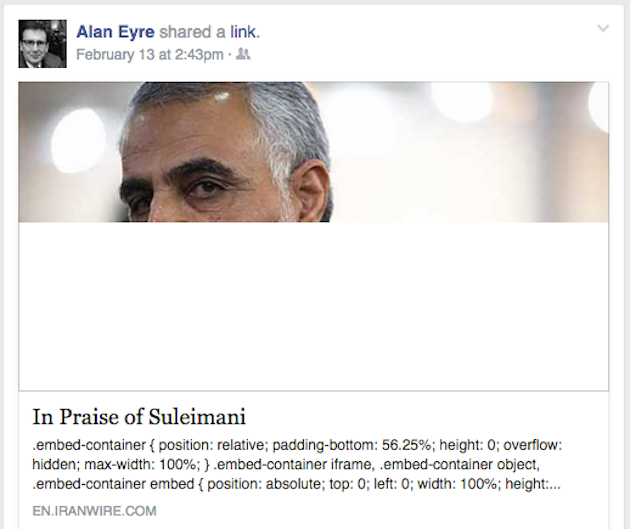
In one Feb. 13 posting, when Iran talks were at a critical stage, Eyre disseminated a link to an article praising Iranian Quds Force Chief Ghassem Suleimani, who is directly responsible for the deaths of Americans abroad.

Image-1

Suleimani, who is listed as a terrorist by the U.S. State Department, will have international sanctions against him waived under the parameters of the nuclear accord.

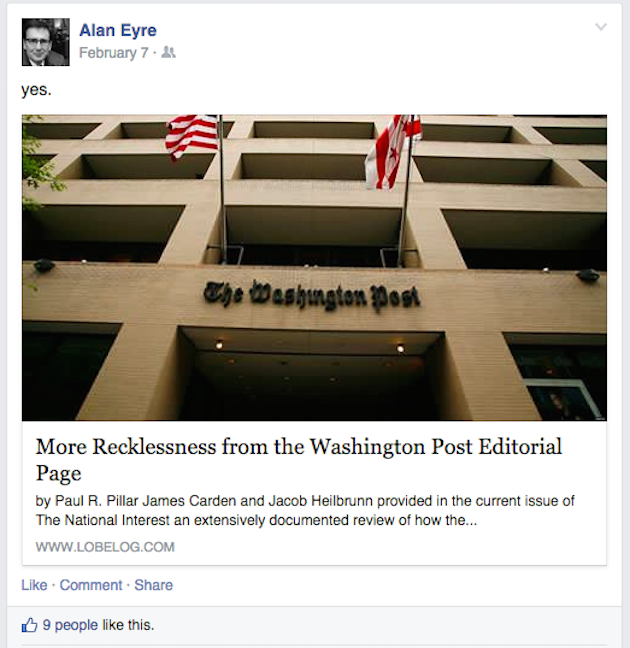
In another posting from Feb. 5, Eyre links to the website LobeBlog, which is viewed by critics as anti-Israel and regularly attacks neoconservative pundits.”

The article Eyre links to, “Who Are the Billionaires Attacking Obama’s Iran Diplomacy,” attacks opponents of the Iranian deal and insinuates that wealthy Jewish donors are behind this push.

The article puts particular emphasis on the Israel Project (TIP), a non-profit advocacy organization run by Josh Block, a longtime Democrat, and claimed that wealthy Jewish individuals were behind a stealth campaign to kill the deal. TIP is portrayed as playing a crucial role in discrediting the deal and convincing lawmakers to take a stance against it.

The article was penned by a former ThinkProgress blogger, Eli Clifton, who was forced out of the Center for American Progress-backed blog following a scandal in which several writers accused Iran deal critics of being “Israel firsters.”

Image-2

In another posting, Eyre links to an article by Stephen Walt, co-author of the book The Israel Lobby, which has been branded by the Anti-Defamation League (ADL) as an “anti-Jewish screed.”

Walt lashes out in the piece at neoconservative critics of the Iran deal, writing that “no one should listen to their advice today.”

Eyre linked to the piece with the comment, “interesting thesis.” He then quoted Walt at length, according to a screenshot:

The real problem is that the neoconservative worldview — one that still informs the thinking of many of the groups and individuals who are most vocal in opposing the Iran deal — is fundamentally flawed. Getting Iraq wrong wasn’t just an unfortunate miscalculation, it happened because their theories of world politics were dubious and their understanding of how the world works was goofy.

Image-3

Eyre also appeared to express disappointment online in March, when Sen. Tom Cotton and 46 other Republican lawmakers penned an open letter to Iran opposing the nuclear talks.

Eyre links to a March 9 Washington Post article by Paul Pillar, an Israel critic who backs boycotts of the Jewish state, titled ‘The misguided, condescending letter from Republican senators to Iran.’ He then opined in the post, “Seriously. Can someone write them a letter telling them that the most fundamental duty of Congress is to pass a budget?”

Image-4

At least one of Eyre’s Facebook friends has quibbled with his postings.

When Eyre linked to a Talking Points Memo article claiming that “49 percent of Republicans don’t believe in evolution,” one critic commented: “This post is total crap. Some 300 people were polled, and the polling criteria were, of course, not specified. This outfit has a deserved reputation as a left-leaning, professionally anti-Republican Flak Tank.”

Eyre dismissed that criticism, responding, “If you are going to fact check every incendiary posting I put up, it is going to detract from the sum total of my facebook-derived frivolity.”

In addition to his postings, Eyre has appeared as a keynote speaker at the National Iranian American Council’s Washington, D.C., conference.

The council, which has been accused as serving as a pro-Tehran lobbying shop, has helped the Obama administration disseminate pro-Iran talking points and champion the deal in the public sphere. Its top officials also have insinuatedthat Jewish lawmakers who oppose the deal have more loyalty to Israel than America.

One senior official at a Washington, D.C., pro-Israel organization expressed disappointment but not surprise at Eyre’s posting.

“The easiest way to explain the State Department’s behavior toward the Middle East is to assume that they don’t like the Israelis very much and they have this romantic fascination with Iran,” the source said. “That’s what you’re seeing here.”

“Of course they can’t admit that out loud, because the American people believe exactly the opposite, so they do it through passive-aggressive Facebook posts and occasional slips of the tongue about how moderate and sophisticated the Iranians are,” the source added.

A State Department spokesman declined to comment on Eyre’s personal postings when contacted by the Free Beacon.

“Alan Eyre is the Department’s Persian Language Spokesperson,” the official said. “In that capacity, he maintains his official page on Facebook here,” the spokesman continued, providing a link to the page.

The Facebook page in question, however, is separate from Eyre’s public-facing personal page referenced by the State Department, which said it had no knowledge of the second page.

“We’re not aware of any such content that you refer to posted on that account,” the official said.

The official did not respond to follow-up requests asking for comment from Eyre on the postings.