Archive for August 2015

More bad news for Obama from Iran about the secret deals

August 4, 2015

More bad news for Obama from Iran about the secret deals, Dan Miller’s Blog, August 4, 2015

(The views expressed in this article are mine and do not necessarily reflect those of Warsclerotic or its other editors. — DM)

An Iranian official recently stated that no International Atomic Energy Agency (IAEA) personnel will be permitted to enter military or missile sites. Another stated that “no country is permitted to know the details of future inspections conducted by the IAEA.” Their statements are probably consistent. There may well be other secret deals we don’t know about and perhaps never will. Meanwhile, Iran is preparing to test long range ballistic missiles “to prove that the missile ban was invalid.”

It's not MY fault.

It’s not MY fault.

I. No IAEA inspections of the sites that matter most

Entry-into-Iran-military-sites-forbidden (1)

In an interview on Al Jazeera TV last week Ali Akbar Velayati, Security Adviser to Iran’s Supreme Leader, stated that

United Nations nuclear inspectors from the International Atomic Energy Agency would not be given access to Tehran’s sensitive military nuclear sites.

. . . .

“First, allow me to emphasize that the issue of the missiles and of Iran’s defensive capabilities were not part of the negotiations to begin with,” Velayati said. [Emphasis added.]

“No matter what pressure is exerted, Iran never has negotiated and never will negotiate with others – America, Europe, or any other country – about the nature and quality of missiles it should manufacture or possess, or about the defensive military equipment that it needs. This is out of the question.” [Emphasis added.]

A video of Mr. Velayati remarks, with translations by the Middle East Media Research Institute (MEMRI), is available here. Since I have been unable to find it on You Tube I have no way to embed it.

Unfortunately, Mr. Velayati is essentially correct. The November 2013 Joint Plan of Action focused almost exclusively on Uranium enrichment, to the exclusion of the “possible military dimensions” of Iran’s military nuclear activities including missile research, development and testing.

II. Details of IAEA inspections will not be disclosed

Reza Najafi, Iran’s ambassador and permanent envoy to the IAEA, stated over the weekend that “no country is permitted to know the details of future inspections conducted by the IAEA.”

Najafi’s statement could mean (a) that no details about inspection methodology will be disclosed, (b) that no details about inspection results will be disclosed or (c) both. If inspection methodologies — who did the inspections as well as when, where and how, are not disclosed, what useful purpose will they serve, other than for Iran? If details of the results of inspections are not disclosed, that will also be the case. How, in either or both cases, will the members of the P5+1 negotiating teams have sufficient information to decide whether to “snap back” sanctions — if doing so is now even possible — or anything else?

III. Even details about inspections of non-military sites will be hidden

Considering Parts I and II together, and assuming that the statements of Iranian officials are reasonably consistent and not mere gaffes, IAEA personnel will be permitted to inspect non-military sites only and hence only to keep tabs on Uranium enrichment; even the details of those inspections will not be disclosed. Is that what Kerry and the other P5+1 negotiators had (pardon the expression) in mind?

IV. Iran says, Ballistic missile testing and development are OK

games

As reported by DEBKAfile,

Shortly before US Secretary of State John Kerry was due in Qatar Monday, Aug. 3, Iran’s highest authorities led by supreme leader Ayatollah Ali Khamenei Sunday launched a public campaign to support Tehran’s noncompliance with the Vienna nuclear accord and UN Security Council Resolution 2231 of July 20, on its ballistic missile program. The campaign was designed by a team from Khamenei’s office, high-ranking ayatollahs and the top echelons of the Revolutionary Guards, including its chief, Gen. Ali Jafari. [Emphasis added.]

It was kicked off with a batch of petitions fired off by the students of nine Tehran universities and Qom religious seminaries to Iran’s chief of staff Maj Gen. Hassan Firouzabadi, demanding immediate tests of long-range ballistic missiles to prove that the missile ban was invalid. [Emphasis added.]

. . . .

The Security Council Resolution, which unanimously endorsed the Joint Comprehensive Plan of Action (Vienna nuclear accord) signed by Iran’s Foreign Minister Mohammed Javad Zarif, called on Iran “not to undertake any activity related to ballistic missiles designed to be capable of delivering nuclear weapons, including launches using such ballistic technology until the date eight years after the JCPOA Adoption Day.” [Emphasis added.]

Tehran retorted that none of its ballistic missiles were designed to deliver nuclear weapons, and so this provision was void. Shortly after its passage, the foreign ministry in Tehran issued an assurance that “…the country’s ballistic missile program and capability is untouched and unrestricted by Resolution 2231.” [Emphasis added.]

This appears to confirm that all of Iran’s ballistic missile sites are off-limits to inspectors.

V. What does Kerry know?

When questioned by members of Congress on the secret deals, Secretary Kerry testified that he had neither seen nor read them but that he had been fully briefed and knew “exactly” what they say. Put charitably, it seems unlikely that he knew that much.

Less charitably, Kerry knew far more than he said and declined to be forthcoming. Now that two Iranian officials have provided highly important information, thus far probably unknown to Congress, will Kerry have additional comments? Not if he can help it.

VI. Conclusions

I wrote early and often about the miserable “deal” about to be entered into by P5+1 under Obama’s dubious leadership. As Iranian officials provide additional information it should be clear — even to the most enthusiastic “deal” supporters — that the “deal” is far worse than earlier thought possible and that the U.S. Congress is obligated to disapprove it and to override any Obama veto, partisan politics notwithstanding.
Qatari Group Accused of Funding Hamas Hires D.C. Lobbyist

August 4, 2015

Qatari Group Accused of Funding Hamas Hires D.C. Lobbyist

Founding member Abd al-Rahman al-Nu’aym funneled millions to al Qaeda in Syria, Iraq

BY:
August 4, 2015 5:00 am

via Qatari Group Accused of Funding Hamas Hires D.C. Lobbyist | Washington Free Beacon.

A Qatar-based charity accused of funding Hamas has hired a lobbyist to represent it in the United States.

The Sheikh Eid Bin Mohammed al-Thani Charitable Foundation, located in Doha, Qatar, recently brought aboard Wendell Belew, a Washington D.C.-based lawyer, to lobby on its behalf. Belew, who will work on issues dealing with “NGO regulations and charity best practices,” previously served as chief counsel of the House Budget Committee.

The foundation was one of 36 organizations banned in Israel in July 2008 for its links to fundraising for Hamas.

“This is a significant step against the global network which assists Hamas in raising funds. The order outlaws a great number of bodies that are active abroad and which are responsible for raising very large sums,” the Israeli ministry of foreign affairs said at the time of the foundation bans.

Abd al-Rahman al-Nu’aymi, a founding member of the organization, was said by U.S. officials in 2013 to have funneled millions of dollars to al Qaeda in Syria and Iraq.

The Department of the Treasury imposed sanctions on Nu’aymi in December 2013 after he was named a specially designated global terrorist for being a “financier and facilitator who has provided money and material support and conveyed communications to al-Qa’ida and its affiliates in Syria, Iraq, Somalia and Yemen for more than a decade.”

Nu’aymi ordered the transfer of $600,000 through an al Qaeda representative in Syria with the intention of transferring at least $50,000 more at a later date, according to the Treasury. Additionally, he oversaw a transfer of $2 million per month to al Qaeda in Iraq for an unspecified period of time.

This is not the first time that Belew has worked on behalf of a group with ties to terrorist organizations.

Belew previously represented the Saudi Arabia-based Al-Haramain Islamic Foundation, an organization that was found to be a significant backer of al Qaeda.

In July 2004, Aqeel Abdulaziz Aqeel al-Aqeel, the foundation’s leader, was put on the United Nations Security Council Special Notice list of terrorists associated with al Qaeda.

In September 2004, the Treasury announced that the foundation’s American branch, which is based out of Oregon, had direct connections with Osama Bin Laden.

The Treasury investigation found “direct links” between the American branch and Osama bin Laden. It also alleged that the foundation had violated tax laws and engaged in other money laundering offenses. Individuals associated with the branch tried to conceal funds intended for Chechnya by omitting the information from their tax returns and instead claimed that the money was intended to purchase a prayer house in Springfield, Mo.

The Al-Haramain Islamic Foundation is now defunct. Wendell Belew could not be reached for comment.

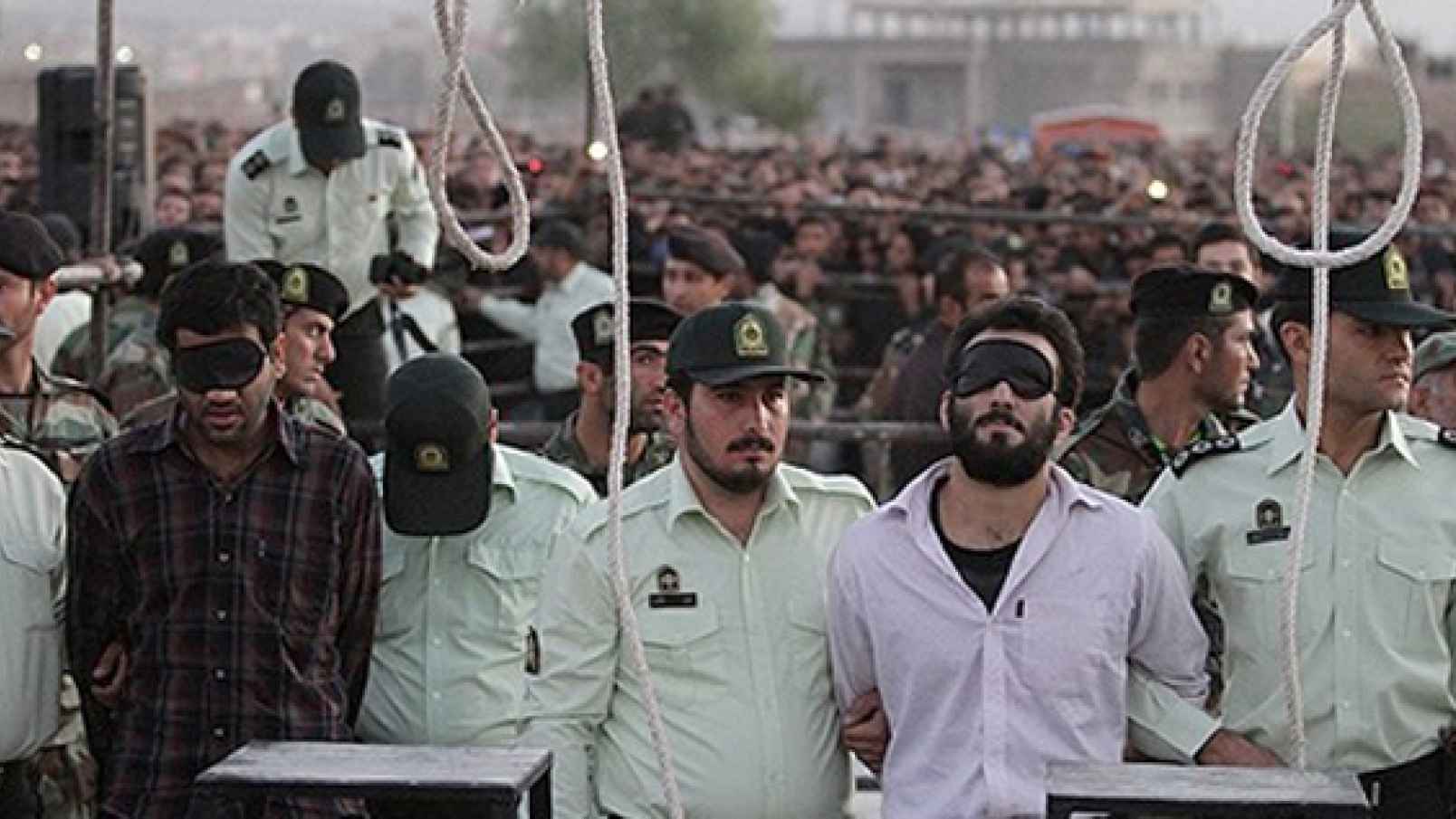
Funding the Mullahs’ exeution spree

August 4, 2015

Funding the Mullahs’ exeution spree, Front Page MagazineDr. Majid Rafizadeh, August 4, 2015

(Yet “progressive” supporters of the “deal” seem not to be bothered — unless an African lion is killed. — DM)

hangings_in_iran_wikimedia_groundreport.com_640_0

Unfortunately, although President Obama is very vocal about defending the nuclear deal, the lifting of economic sanctions on the Ayatollah, the release of over a hundred of billion dollars to the ruling clerics of Iran, he has not issued any serious criticism against the leaders of the Islamic Republic with regards to the execution spree.

***********************

How the Obama administration is facilitating Iran’s unprecedented killing binge.

President Obama is determined to defend the Islamic Republic as a legitimate government that should receive sanctions relief. He has even overstepped his constitutional authority by signing the nuclear deal (a treaty) in the United Nations Security Council without getting the two-third vote of the Senate. He did not give Congress time to review the nuclear deal as he previously promised.

The Obama administration is advocating for a regime that has been on an execution spree on an unprecedented level, according to Amnesty International’s latest report. Since the beginning of this year, the Islamic Republic has executed approximately 700 people.

People being executed are usually not told about their death sentence until the noose is put around their neck and until they reach the gallows. Family members of the victims often do not know about the execution until weeks after.

As Said Boumedouha, deputy director of Amnesty’s Middle East and North Africa program said, “Iran’s staggering execution toll for the first half of this year paints a sinister picture of the machinery of the state carrying out premeditated, judicially-sanctioned killings on a mass scale.” He added, “The use of the death penalty is always abhorrent, but it raises additional concerns in a country like Iran where trials are blatantly unfair.”

I regularly speak with Iranian people living in various cities in Iran including Esfahan, Tehran, Tabriz, and Khorasan in order to obtain a better understanding on the ground. My family lives there too. The words of every one of them (about the current situation in Iran after the nuclear deal was reached) echoes what Zahra, an English teacher in the province of Esfahan, told me. She said, “Any cash given to the these Sheikhs in the government (the clerics) by the powers because of the nuclear deal, will not be distributed to the people. The money will not be used to improve people’s economic standards. The people on top will steal the money, saving it in their bank accounts, or send it to their Arab allies, Bashar Al Assad, Hezbollah, and the Iraqi government. They [Iranian leaders] are also going to increase domestic suppression if they begin seeing the flow of cash.”

If we look at the history of the Islamic Republic closely, we see that when a “reformist” president (Mohammad Khatami) was in power in Iran, the nation witnessed the same increase in executions and suppression. It was one of the worst periods of oppression and crackdowns on civil liberties. In addition, the number of executions normally rises under the so-called “moderates” and “reformists” rules.

When Iranian people feel that they might finally have a better relationships with the West, the ruling establishments ratchets up their imprisonment, torture, suppression and killings in order to show the people who is in charge and in order to impose fear. By using these tactics, they send a clear message that the Islamists are in charge, not the youth.

This staggering number of executions suggests that, as the ruling clerics of the Islamic Republic were gaining global legitimacy due to the nuclear negotiations and “normalizing” relationships with the Obama administration, they have also increased their mass scale killings of their own citizens. At the same time, several American citizens are still spending time in Iran’s prison.

Unfortunately, although President Obama is very vocal about defending the nuclear deal, the lifting of economic sanctions on the Ayatollah, the release of over a hundred of billion dollars to the ruling clerics of Iran, he has not issued any serious criticism against the leaders of the Islamic Republic with regards to the execution spree.

In the Islamic Republic, one can be executed for actions which might not even be a crime or it might be a misdemeanor in other democratic countries. For example, one can be executed for “enmity against Allah” or “corruption on earth.” In addition, a non-Muslim man can be executed for having sex with a Muslim women, but not vice versa. One can be executed or stoned if he/she is married and has sex with an unmarried person. One can also be executed for cursing or using bad words against the prophet.

As the report by Amnesty International described, “They [death sentences] are imposed either for vaguely worded or overly broad offenses, or acts that should not be criminalized at all, let alone attract the death penalty… Trials in Iran are deeply flawed, detainees are often denied access to lawyers, and there are inadequate procedures for appeal, pardon and commutation.”

Boumedouha observed, “For years, Iranian authorities have used the death penalty to spread a climate of fear in a misguided effort to combat drug trafficking, yet there is not a shred of evidence to show that this is an effective method of tackling crime…”

The more the Iranian leaders are empowered and emboldened financially, economically and politically, the more they tighten the noose on all freedoms (including speech, assembly, press, etc.), as well as basic inalienable human rights.

There are currently thousands of innocent people on death row waiting to be unfairly executed in the Islamic Republic. While President Obama finds it urgent to overstep his constitutional authority to quickly sign the nuclear deal with Iran and push for sanctions relief against the ruling clerics, he needs to pay close attention to how the empowerment of the ruling Islamists in Iran is adversely affecting the lives of millions of innocent people.

In Congress, nothing is certain

August 4, 2015

Israel Hayom | In Congress, nothing is certain.

Prof, Abraham Ben-Zvi

Six weeks before Congress is called upon to decide, it has become increasingly clear that the path to approval of the Vienna agreement will be more arduous than expected.

There is considerable doubt that U.S. President Barack Obama — who invested all his prestige and presidential resources in securing, at all costs, a final-status agreement on Iran’s nuclear program — will be able to pass what he views as a cornerstone of his presidential legacy.

The center of the struggle currently raging full force to secure votes from wavering Democratic senators (13 of whom would need to join the Republicans to override a presidential veto) is a direct reflection of the intense debate within the American public on this issue. We should recall that when it comes to voting patterns in the House of Representatives and the Senate, American lawmakers must always remain sensitive and attentive to the swirling political winds, which often set boundaries and red lines for them. After all, if they want to remain in politics, they must reflect the desires and wishes of their constituencies, rather than engage in unilateralism.

If at first it seemed most Americans would come to terms with the Vienna agreement, today — as the contours of the deal are being revealed layer by layer — the picture is changing dramatically over what looks more and more like unconditional capitulation to Iranian dictates. This trend is clearly illustrated in a poll conducted by CNN last week, according to which 52% of the American public oppose the deal, while only 44% support it. In the immediate wake of the deal’s signing, if we recall, the numbers were reversed. Other polls showing that two-thirds of the public believes the deal won’t prevent Iran from developing nuclear weapons illustrate yet another aspect of the mosaic of widely held opinions and beliefs, which, if they come together and gain steam in the coming weeks, will form an unassailable obstacle for the administration ahead of the vote in Congress.

These changing winds, meanwhile, can undoubtedly be traced to the recent hearings before the Senate Foreign Affairs and Defense Committee and its counterpart committee in the House of Representatives, which caused the White House considerable damage. Indeed, during the hearings we learned, among other things, that the deal contains “black boxes” and other confidential clauses that are hidden not only from the public, but also from Congress (and from some senior administration officials). It is no surprise, therefore, that dissenting voices are on the rise. It is also not surprising that pundits — not only from the conservative camp — are today evoking historical precedents that illustrate the common thread of naiveté, over-optimism and purely mystical beliefs held by U.S. leaders in the power of the written word to mold the behavioral patterns of bitter ideological adversaries, such as the former Soviet Union.

Indeed, Obama’s concept of the importance of gestures and unilateral trust-building measures toward Iran is seen today as identical to former President Franklin Delano Roosevelt’s efforts to establish a true partnership with the Stalin’s Soviet Union, based on far-reaching, and bizarre, American concessions (specifically over Poland). In the grand superpower context, this approach of appeasement contributed to the outbreak of the Cold War, and there is nothing to do but wait and see if the 44th president’s appeasement will lead to a disastrous hot war.

In any case, it is abundantly clear that the negative trends in public opinion have already begun trickling through to Capitol Hill. We can see, among other things, that Sen. Chuck Schumer, one of the leaders of the Democratic Party (who has been on the fence since the deal was signed), is now leaning toward rejecting the deal. If he indeed decides to cross the party line, it could provide a tail wind for the other undecided Democrats. Such a development would bring an end to the deal, which for the president is a primary foreign policy objective in terms of his legacy, and cast a large shadow over his presidency’s foreign affairs and defense policies.

What are Israel’s options regarding Iran?

August 4, 2015

Globes English – What are Israel’s options regarding Iran?.

Norman Bailey discusses what Israel can do in the wake of the Iranian nuclear deal.


All right, we now know the following things:

The six powers signed one of the worst deals in history with the Islamic Republic of Iran, which will now have a greased path to develop the capacity to produce nuclear weapons (if it does not already have them); and receive tens of billions of dollar to restore its economy and greatly increase inward investment and petroleum exports, as well as to increase its interference in regional conflicts and its support of terrorist organizations of all sizes and flavors. Finally, it places Israel in a position of serious existential danger over the next few years.

The current administration in Washington, which has another year and a half in office, doesn’t care.

It makes no difference what the US Congress does or does not do. The trade and investment sanctions are gone through a unanimous vote of the UN Security Council and hotel rooms are already in short supply in Tehran due to the massive influx of Western businessmen and government officials looking to pick up some of the newly-released billions. The financial sanctions in the US were imposed by executive order and can be revoked by executive order, as was already done in November of 2013, when $12 billion were released. Even in the unlikely event Congress rejected the deal by a veto-proof majority of both houses, the only effect would be to prevent American firms from feeding at the Iranian trough, already crowded by the French, Germans, Russians, Chinese, etc. etc.

So, where does that leave Israel? What are its options? Please note the parenthetical phrase above about whether Iran already has nuclear weapons. Some of the Western intelligence services believe that recent low-level nuclear tests in North Korea were really Iranian devices. This would make sense. North Korea knows it can produce nuclear weapons and is doing so. It has even announced that it has succeeded in miniaturizing them, which is highly dangerous for the rest of the world. It could be such devices that it was testing. On the other hand, Iran could hardly perform testing on its own territory while proclaiming to the world that it was only developing “peaceful” nuclear power.

In light of all the above, Israel has the following alternatives: (1) It can adopt a wait and see attitude while continuing to perfect its defensive missile shields. That would, however, even if entirely successful, only protect against Iranian nuclear missiles, an attack most unlikely to actually take place, since Iran knows that Israel has its own nuclear arsenal and the means to deliver those weapons. It would do nothing to protect Israel from eventual miniaturized nuclear weapons in the hands of Iranian proxies. (2) Israel could actively prepare for a military attack on Iran following the announcement by that country of a nuclear capability as well as the possibility of a new administration in Washington more favorable to Israel and more hostile to Iran. The success of such an attack would be more than problematical, given the present level of armaments available to Israel. Israel could, alternatively, attack the Iranian physical infrastructure instead of its nuclear facilities, which would, however, invite massive international condemnation, as well as retaliation by Iranian proxies. (3) Israel could continue to develop and perfect its capacity to conduct cyber-attacks on the

Iranian nuclear facilities, even more devastating than the Stuxnet episode. No reason not to do this, but eventual success is not guaranteed and in any case, the Iranians are no slouches at cyber-warfare themselves. (4) Hopefully, along with a new administration in the U.S., try to foment regime change in Tehran, and/or uprisings by the ethnic minorities, which are about half the population of that country. Unfortunately for this alternative, the deluge of dollars which will now descend on Tehran will make it much easier for the mullahs to deflect popular unrest, while maintaining firm political control.

Some aspects of all these alternatives are likely to be pursued by the current or future Israeli governments. None, as we have seen, is particularly promising. Of course, many other factors are involved and Iran could find itself over-extended and in trouble regardless of what Israel does or does not do. Hope springs eternal, as they say, but do not forget that hope was the only scourge of mankind that Pandora was able to retain in her box.

Norman A. Bailey, Ph.D., is Adjunct Professor of Economic Statecraft at The Institute of World Politics, Washington, DC, and teaches at the Center for National Security Studies and Geostrategy, University of Haifa.

Iran, the Munich Comparison, and the Abuse of History

August 4, 2015

Iran, the Munich Comparison, and the Abuse of History

The Iran Deal is not Munich, but the same foolishness of Western leaders is close enough to warn us what happens next. And it will not be good.

by Victor Davis Hanson

August 2, 2015 – 7:30 pm

via Iran, the Munich Comparison, and the Abuse of History | Works and Days.

obama_chamberlain_iran_8-2-15-1

The Iranian deal has called to mind the Munich Agreement of 1938. Then Britain and France signed away the sovereignty of Czechoslovakia, in hopes that Adolf Hitler would be content with absorbing the German-speaking Sudetenland borderlands and cease further territorial acquisitions. But that appeasement only accelerated Nazi atrocities, from Kristallnacht at home to the dismemberment of all Czechoslovakia and, the next year, the invasion of Poland.

Is the Munich disaster a sound analogy for the current proposed agreement with Iran?

The Obama administration and its supporters say no. And they have offered a variety of odd arguments. How can anyone compare the once most powerful state in industrial Europe with the current, relatively isolated, and backward Iran, whose theocracy supposedly poses a far smaller threat than did Adolf Hitler’s Wehrmacht?

But is that assumption really true?

For all the later talk of Blitzkrieg in 1939-40, Hitler in 1938 was fairly weak. He had no model of tank that matched French heavy armor. Combined British and French aircraft production exceeded Germany’s, and in most cases allied planes were as good as German fighters and bombers. By 1940 Britain alone would be producing more fighter aircraft than Germany. In 1938-9, the combined infantry forces of the Western democracies — Britain, France, Denmark, Belgium the Netherlands and Norway — exceeded those of the Wehrmacht.

In the east, the Soviet Union alone fielded far more tanks, planes, guns and men than did Germany in 1938. Czechoslovakia, in the Skoda Works, had one of the most dynamic arms industries in Europe as well as extensive fortifications on the German border. Had the Polish, Czechs, and Russians united and stood firm, Hitler would have either backed down or would have been defeated — at a time when he was vastly outnumbered on his vulnerable Western borders.

The combined British and French fleets alone deployed about ten times more capital ships than did Germany, which never built a single aircraft carrier or deployed a single successful four-engine bomber.

In short, Hitler’s enemies in 1938 collectively enjoyed more military strength than did Germany. What they lacked was cohesion, a common cause, and a willingness to turn their military assets into credible deterrence. Hitler instinctively fathomed such fecklessness. In methodical fashion, he isolated Czechoslovakia, then attacked Poland with the help of the Soviet Union, then gobbled up Denmark and Norway — all in separate and rather distinct campaigns. When he finally invaded France in May 1940, he assumed rightly that his new partner, the Soviets, would keep supplying him with key resources, the British army would not show up in force in the manner they had in World War I — and the Americans would keep completely out it.

In every regard, Hitler brilliantly judged the appeasing mentalities of his far more powerful enemies. Only a horrific war restored a grim reality to Hitler’s Nazis. By late 1943 the Third Reich had been brutally reminded that Britain, the Soviet Union, and the United States really were far more powerful than Germany all along.

Iran now de facto runs Lebanon. It props up what is increasingly a puppet state in Syria and all but controls Iraq, while attempting to take over Yemen and erode Sunni authority in the Gulf. The regional Sunni states — including Egypt, Jordan, the Gulf states, Turkey, and Pakistan — together are collectively far stronger than Iran. But like the Western democracies and their eastern allies in 1938, each nation apparently prefers, in the paraphrase of Churchill, to be eaten last by the crocodile, and thereby eschews collective forceful deterrent action.

The ascendance of ISIS complicates matters. Sunni nations are in the embarrassing position of being threatened by fanatical kindred Arab Sunni terrorists who in turn are often checked by Iranian Shiite expeditionary forces. In the same vein, the Soviet Union once muddied the waters after the destruction of Poland: for a while the democracies found themselves siding with Finland, against an aggressive Russia, even as Hitler stealthily also wished to help the Finns against his newfound partner the Soviet Union.

Iran is as military weak as was the 1938 Third Reich. But like Hitler’s Germany, Iran fancies that its ardor and brinkmanship constitute military assets far more valuable than mere carriers or planes. Like Hitler, the theocracy believes loud bluster and perhaps even feigned insanity offer real advantages against those who are sober, judicious, and intent on avoiding the use of force at all costs. Are “Death to America” and constant threats from Teheran — even as negotiations of the non-proliferation deal were still fluid — all that much different from Hitler’s scoffing that his interlocutors at Munich were “worms”? Acting as if one has nothing to lose is advantageous in geostrategic poker.

Do Iran’s various promises of ending the Jewish state in the 21st century sound all that much more unhinged than Hitler’s crackpot ideas in the mid-1930s of solving the “Jewish question”? The Obama administration has obsessed about American culpability in the 1953 Western overthrow of Mohammad Mossadegh (and in typically ahistorical fashion forgets that mullahs rallied against the Shah-appointed Mossadegh, who had at times cut short elections and coerced the parliament to grant him emergency powers). Is a coup over 60 years ago now reason to overlook Iranian bellicosity — in the fashion that guilty Allied powers once attributed their soft responses to Hitler to unease over the Versailles peace treaty ? Note that in these cases, the Mossadegh affair and Versailles were used by aggressors to leverage Western appeasement.

In 1938 the West was frightened about the specter of slow-moving and near obsolete but quite loud and scary Stuka dive bombers, and puny but nonetheless numerous Panzer Mark I and II tanks. The idea that Hitler’s Germany in 1938 was a military colossus is quite absurd. In contrast, in 2015 the West is rightly afraid of an Iranian nuclear bomb — a single weapon that might allow the Iranians more destructive power than the combined carry weight of all of Hitler’s Luftwaffe bombers of 1938. An otherwise weak Iran in 2020 — but one armed with 4-5 nuclear bombs and short-range missiles capable of reaching most of the Middle East and parts of southern or eastern Europe — could do far more damage to the region than the Germans could to their neighbors in 1938.

The danger of an aggressor is never just the specter of raw power, but instead the insidious messages about using what it has that it sends to more responsible parties. Once Chamberlain and Édouard Daladier backed down at Munich, the Soviets concluded that friendship with Western democracies was as dangerous as enmity to Hitler, and thus flipped their affinities. Other opportunistic Eastern European nations soon realigned with Hitler. So-called neutrals like fair-weather Sweden, Portugal, Spain, Switzerland, and Turkey conducted lucrative trade deals with Hitler and made the necessary adjustments to fit what they saw as an ascendant Third Reich. If the Iranian deal goes through, and if it is perceived as an economic, political, and military boon to the theocracy, then the surrounding and terrified Middle East will likely make the necessary political modifications to allow for Iranian expansionism.

There are other disturbing Iranian parallels to Munich — and to all examples of appeasement from the Greek city-state appeasement of Philip II, to the accommodations of European monarchies to Napoleon’s early rise, to the license given Stalin to absorb Eastern Europe at Yalta. The appeasers always pose as peace-makers and caricature their skeptics as near troglodyte war-mongers.

We are seeing this predictable caricature as well, as the Obama administration keeps insisting that there was no alternative to the deal other than either an apocalyptic nuclear Iran or yet another ill-starred Western preemptive attack in the Middle East — even as sanctions had crippled the Iranian economy to the point that the theocracy in extremis limped to the negotiation table seeking relief.

Today we see a Munich-like arrogance that men of assumed reason and sobriety, by their winning charisma, rare mellifluence, or superior wisdom, can convince Khamenei of the errors of his ways. Western humanists habitually preen that they can demonstrate to authoritarians why their bellicosity is supposedly against their own self interests — as if autocratic aggressors envision risking war, and shorting their own people, as unimaginable evils in comparison with the acquisition of honor, glory and respect that follows from easily bullying neighbors and successfully gobbling up real estate. John Kerry believes that the bomb is not in Iran’s real interest; Iran believes that so far even the idea of a bomb most certainly has proved very much in Iran’s interest.

As the democracies negotiated away Czechoslovakia to Hitler at Munich, the Japanese and Italians had earlier offered the world clear instruction about the wages of appeasement. Their serial aggressions in China and East Africa throughout the late 1930s had sated neither dictatorship, but rather convinced both that there were lots of weak countries that could be safely harvested without incurring a larger war with the West.

While John Kerry ignored the long-term security of Israel and the Sunni states in the Middle East, Vladimir Putin had earlier demonstrated that Ossetia led to the Crimea that led to Eastern Ukraine that may well soon lead to the Baltic states. Failed reset no more wised up John Kerry than Abyssinia or Manchuria had enlightened Neville Chamberlain. Munich’s 1938 hype led to catastrophe in 1939, in a way that the current 2015 self-congratulation may well become frightening in 2016.

The Iran deal is not Munich, but the same naiveté, vanity, and foolishness of Western leaders are close enough to warn us about what happens next. And it will not be good.

Contentions| The Real Goal of the Nuclear Deal: Iran Détente

August 3, 2015

Contentions | The Real Goal of the Nuclear Deal: Iran Détente, Commentary Magazine, August 3, 2015

To listen to President Obama and Secretary of State John Kerry defend their nuclear deal in recent weeks, you’d think the issue at stake is a narrow one that solely concerned whether or not the agreement retards Tehran’s quest for a bomb. The assumption from the administration and its apologists that the deal does this even minimally is a dubious one. But one of the subtexts of the misleading way they have been conducting their end of this debate is their effort to distract both Congress and the public from the broader goals of the pact. While critics of the deal have highlighted Obama’s refusal to make the sanctions relief dependent on an end to support for terrorism, ballistic missile production or the nature of Iranian government, the answers from the administration have been consistent. They want to restrict the discussion to purely technical nuclear issues that can be obfuscated by deceptive claims or to the false choice between the agreement and war. But, to its credit, one of the president’s chief media cheerleaders did highlight the real goals of the administration in an article published on Friday. The New York Times feature titled “Deeper Aspirations Seen in Nuclear Deal With Iran” ought to be required reading for all members of the House and Senate. The choice here isn’t one between a flawed nuclear deal and war, but between Iran détente with a tyrannical, anti-Semitic, aggressive Islamist regime and a reboot of the diplomatic process that has been hijacked by appeasers.

As the Times points out, prior to the announcement of the final, lenient terms of the deal that expires in ten years the administration wasn’t so coy about its real objective:

Before his fight for the deal in Congress, Mr. Obama was far more open about his ultimate goals. In an interview in The Atlantic in March 2014, he said that a nuclear agreement with Iran was a good idea, even if the regime remained unchanged. But an agreement could do far more than that, he said:

“If, on the other hand, they are capable of changing; if, in fact, as a consequence of a deal on their nuclear program those voices and trends inside of Iran are strengthened, and their economy becomes more integrated into the international community, and there’s more travel and greater openness, even if that takes a decade or 15 years or 20 years, then that’s very much an outcome we should desire,” he said. …

And in an interview in December, Mr. Obama even seemed to welcome the rise of a powerful Iran. “They have a path to break through that isolation and they should seize it,” he said. “Because if they do, there’s incredible talent and resources and sophistication inside of — inside of Iran, and it would be a very successful regional power.”

The importance of this context for the discussion of the deal cannot be overemphasized.

The deal ought to be defeated on its own merits because it fails to achieve the administration’s stated objectives about stopping Iran’s nuclear ambitions. All it accomplishes, if it can even be said to do that much, is to delay Iran’s march to a bomb for the period of the agreement while permitting to continue research with a large nuclear infrastructure under a loose inspections regime that makes a mockery of its past promises on all these issues.

But the point on which the administration has been most reluctant to comment is the more than $100 billion in frozen assets that will be released to Tehran. Critics rightly believe this money will, one way or another, help subsidize Iran’s terrorist allies and push for regional hegemony that worries neighboring Arab states as well as Israel, whose existence is threatened by Iran becoming a threshold nuclear state with Western approval.

No rational argument can be mustered against this assertion since the money will be Iran’s to use as it likes and any prohibitions on Iranian adventurism are likely to be even less effective in a post-deal environment than they were prior to it. But if, like President Obama, you believe that Iran is in the process of transforming from a revolutionary threat whose goals are mandated by the extreme religious beliefs and Islamist ideology of its rulers into one eager to be friends with the world, the prospect of a stronger Iran doesn’t trouble you.

That’s why President Obama did not predicate these negotiations on any pledges, even ones that were transparently false, of good behavior from Iran. He claims that insisting on an end to Iranian state sponsorship of terror or forcing it to renounce its goal of eliminating Israel would have prevented him from getting a deal on the nuclear question. But that formulation has it backward. The point of the negotiations was never about the nuclear details, something that was made clear by the astonishing series of concessions that the administration made throughout the talks. In October 2012, during his foreign policy debate with Mitt Romney, Obama pledged that any deal would eliminate Iran’s nuclear program. Now he is advocating for one that leaves it in place under Western sponsorship while rewarding Tehran with the lifting of sanctions.

What Obama always wanted was a deal at any price because he thought it was the pathway to a new entente with Iran that would end the conflict with its Islamist leaders. But while a future in which Iran would no longer be a terror sponsor bent on destroying Israel and dominating the Middle East would be a good thing there is no rational reason to imagine this will happen. Indeed, by strengthening its government the president is ensuring that they will never have to choose between their aggressive goals and economic prosperity.

That’s why rather than being sidetracked into debates about the nuclear details, opponents need to focus on the real goal of the deal: détente with a regime that threatens the U.S. and its allies. The deal fails as a nuclear pact. But it is perhaps an even greater disaster when one realizes that its premise is a naive belief that Islamist tyrants are so enraptured with Obama that they are about to abandon their deeply held beliefs and evil intentions.

Iran: U.S. Banned from Knowing Details of Iran Nuclear Inspection Agreement

August 3, 2015

Iran: U.S. Banned from Knowing Details of Iran Nuclear Inspection Agreement, Washington Free Beacon,  , August 3, 2015

(Mr. Najafi states in the highlighted paragraph that “no country is permitted to know the details of inspections. That likely refers to the P5+1 negotiators as well as to nations other than Iran. Does it refer to the results of the inspections or to how and by whom they were conducted when? Either way, how will the P5+1 negotiators know whether Iran continues to seek nuke weaponization and whether to “snap back” sanctions? If they are told little more than “everything is just peachy,” will that be satisfactory evidence that Iran has not violated the “deal?” Please see also, Iran Openly Refuses UN IAEA Inspectors Access to Military Sites.– DM)

Reza Najafi, Iran’s ambassador and permanent envoy to the IAEA, stated over the weekend that no country is permitted to know the details of future inspections conducted by the IAEA. In addition, no U.S. inspectors will be permitted to enter Iran’s nuclear sites.

**********************

Iran’s ambassador to the International Atomic Energy Agency (IAEA) said the nuclear inspection organization is barred from revealing to the United States any details of deals it has inked with Tehran to inspect its contested nuclear program going forward, according to regional reports.

Recent disclosures by Iran indicate that the recently inked nuclear accord includes a series of side deals on critical inspections regimes that are neither public nor subject to review by the United States.

Reza Najafi, Iran’s ambassador and permanent envoy to the IAEA, stated over the weekend that no country is permitted to know the details of future inspections conducted by the IAEA. In addition, no U.S. inspectors will be permitted to enter Iran’s nuclear sites.

“The provisions of a deal to which the IAEA and a second country are parties are confidential and should not be divulged to any third country, and as Mr. Kerry discussed it in the Congress, even the U.S. government had not been informed about the deal between IAEA and Iran,” Najafi was quoted as saying by Iran’s Mehr News Agency.

Due to the secretive nature of these agreements, IAEA officials vising with lawmakers are barred from revealing to them the details of future inspections.

The revelation has rattled lawmakers on Capitol Hill, several of whom are now rallying colleagues to sign a letter to President Barack Obama protesting these so-called side deals.

Rep. Mike Pompeo (R., Kansas) and at least 35 other lawmakers are circulating a letter to Obama to provide Congress the text of these agreements as is required under U.S. law.

“It has come to our attention that during the recent negotiation of the Joint Comprehensive Plan of Action (JCPOA) with Iran, at least two side deals were made between the International Atomic Energy Agency (IAEA) and Iran,” the letter states, according to a copy obtained by the Washington Free Beacon.

“These side deals, concerning the ‘roadmap for the clarification of past and present outstanding issues regarding Iran’s nuclear programs,’ have not been made available to the United States Congress,” it states. “One deal covers the Parchin military complex and the other covers possible military dimensions (PMDs) of Iran’s nuclear program.”

An informational email being circulated to lawmakers explains, “according to the International Atomic Energy Agency (IAEA) and the Obama Administration, these agreements have been negotiated in secret between the IAEA and Iran.”

Secretary of State John Kerry has personally “stated he has not seen these agreements and the Administration failed to submit these agreements as part of the JPCOA,” the email states.

Under the terms of a bill meant to give Congress a final say over the deal, the Obama administration is required to provide text of all agreements, the lawmakers write to Obama.

“Under the clear language of the Iran Nuclear Agreement Review Act, which you signed into law, members of Congress are entitled to the text of these two side deals,” it states. “Specifically, members have a right to all ‘annexes, appendices, codicils, side agreements, implementing materials, documents, and guidance, technical or other understandings and any related agreements, whether entered into or implemented prior to the agreement or to be entered into or implemented in the future.’”

“Congress’s legal right to these documents creates a corresponding legal obligation for your administration to provide them for our review,” the letter says.

The lawmakers are demanding that the White House “immediately secure” these documents from IAEA “and then provide them to Congress” for review.

Pompeo and Rep. Tom Cotton (R., Ark.) sent a separate letter to Obama administration official last week asking for them to disclose the nature of all secret side agreements with Iran.

Iran’s IAEA ambassador claims the agreements with the IAEA are separate from the actual nuclear accord inked with global powers.

“The Agency would know the nature of confidential documents and Iran have clearly briefed the IAEA on this; we have agreed on implementation of a roadmap which is not a part of the JCPOA, with the implementation already on process even before the Congress could examine and approve the deal,” Najafi was quoted as saying.

One senior congressional source familiar with the effort to obtain further information about the deal told the Free Beacon the Obama administration is not being transparent in the review process.

“On top of all the concessions–from ballistic missiles to conventional arms to a 24-day inspection period–we now learn that additional side deals were struck between the IAEA and Iran,” said a senior congressional source familiar with the effort to obtain further information about the deal.

“The Administration promised a transparent review process that would allow Americans and their elected representatives to assess the deal for themselves, but as it turns out, that was just utter bullsh**,” the source added. “The Administration signed off on an agreement that included a series of Iranian Eastern eggs, including secret deals regarding the possible military dimensions of Tehran’s nuclear program, to which Congress and the public are not privy.”

Obama gives ISIS ally veto power over US air strikes on ISIS

August 3, 2015

Obama gives ISIS ally veto power over US air strikes on ISIS, Front Page Magazine, Daniel Greenfield, August 3, 2015

turkey-2erdoganwhitehouse

The war against the JayVee team that has captured large chunks of Syria, Iraq and Libya is going really well. Secretary of State John Kerry and White House Minister of Information Mohammed Saeed al-Sahaf assure us that the un-Islamic terrorist group whose name must not be mentioned will shortly be crushed.

Meanwhile Obama keeps trying to negotiate with the Taliban, the other group of misogynistic mass-murdering Islamists he had vowed to defeat back in his first term.

The administration is celebrating a coup in finally getting Turkey to get on board and allow the US to use an air force base for air strikes on ISIS. But as Commander Dyer points out, there’s a slight problem.

1.  The Obama administration refuses to define a territorial or operational objective.

2.  U.S. forces aren’t sure whom they’ll be allowed to shoot at.

Well it’s not like we need to know what we’re fighting for or how we’re going to fight. The important thing is that Obama got a crazy Islamist dictator who built himself a billion dollar palace while terrorizing his people to agree to let the US use an air force base.

As long as he gets to decide who we bomb.

The US Air Force could use the Incirlik air force base in Turkey but had to allow Turkish oversight of the targets it would strike in Syria and Iraq from Incirlik.

That is a slight tiny problem because the Turkish regime loves terrorists almost as much as Iran and has a history of secret ties to ISIS.

According to the Guardian on 25 July, a U.S.-led raid on an ISIS compound in May 2015 unearthed a treasure trove of documentation on this connection.  Turkish middlemen have been funding ISIS for months, to the tune of millions of dollars, by buying oil from the guerrillas – implicitly with the knowledge and support of the Turkish government.

The Jerusalem Post reported one Islamic State member said Turkey, a member of NATO, provided funds for the terrorist group.

“Turkey paved the way for us. Had Turkey not shown such understanding for us, the Islamic State would not be in its current place. It [Turkey] showed us affection. Large [numbers] of our mujahedeen received medical treatment in Turkey,” said the man, who was not identified.

The topic of Turkey’s involvement with ISIS remains controversial and has led to a conflict between Turkish law enforcement, which tried to expose government weapons shipments, and the Erdogan regime.

Even Joe Biden said it not long ago, before being forced to apologize.

So Obama has given an ally of ISIS oversight of US air strikes against ISIS. And it gets even more schizophrenic because the US is now involved with the PKK, a Kurdish Marxist liberation group, which Turkey is bombing.

So yes, the war will be won any day. Meanwhile Pakistan will be hosting peace talks with the Taliban. You know, the country which was pretending to be our ally while harboring Osama bin Laden.

Don’t worry. I’m sure the Caliph of ISIS probably isn’t living in a mansion in downtown Istanbul. Yet.

Army is breaking, let down by Washington

August 3, 2015

Army is breaking, let down by Washington, Stars and Stripes, Robert H. Scales, August 2, 2015

(Last year I also wrote a depressing article on the lamentable combat readiness of our military. It’s here at my blog and here at Warsclerotic. The situation has continued to deteriorate. How could Obama’s America help to protect freedom, particularly against an enemy whose name must not be mentioned, without a combat effective military — even if Obama wanted to do it? — DM)

image militaryU.S. paratroopers with the 173rd Airborne Brigade load a M119A2 howitzer at the 7th Army Joint Multinational Training Command’s Grafenwoehr Training Area, Germany, July 28, 2015.
GERTRUD ZACH/U.S. ARMY

Last month, Gen. Ray Odierno, outgoing Army chief of staff, and Gen. Mark Milley, his successor, testified to the difficulties faced by the Army. I’d like to make the same points by telling a story.

When I was a boy, tonsillitis was a dangerous illness. In 1952, it kept me in Tokyo General Hospital for weeks. I shared a cramped ward with dozens of soldiers horribly maimed in Korea. The hospital had only one movie theater. I remember watching a Western sandwiched between bandage- and plaster-wrapped bodies. I remember the antiseptic smells, the cloud of cigarette smoke and the whispers of young men still traumatized by the horrors of the war they had just left.

My dad came from Korea to visit me, and I recall our conversations vividly. At the time he was operations officer for the 2nd Engineer Battalion. He told me how poorly his men were prepared for war. Many had been killed or captured by the North Koreans. During the retreat from the Yalu River, some of his soldiers were in such bad physical shape that they dropped exhausted along the road to wait to be taken captive.

“We have no sergeants, son,” he told me, shaking his head, “and without them we are no longer an Army.”

In the early ’70s, I was the same age as my Korean-era dad. I had just left Vietnam only to face another broken Army. My barracks were at war. I carried a pistol to protect myself from my own soldiers. Many of the soldiers were on hard drugs. The barracks were racial battlegrounds pitting black against white. Again, the Army had broken because the sergeants were gone. By 1971, most were either dead, wounded or had voted with their feet to get away from such a devastated institution.

I visited Baghdad in 2007 as a guest of Gen. David Petraeus. Before the trip I had written a column forecasting another broken Army, but it was clear from what Petraeus showed me that the Army was holding on and fighting well in the dangerous streets of Baghdad. Such a small and overcommitted force should have broken after so many serial deployments to that hateful place. But Petraeus said that his Army was different. It held together because junior leaders were still dedicated to the fight. To this day, I don’t know how they did it.

Sadly, the Army that stayed cohesive in Iraq and Afghanistan even after losing 5,000 dead is now being broken again by an ungrateful, ahistorical and strategically tone-deaf leadership in Washington.

The Obama administration just announced a 40,000 reduction in the Army’s ranks. But the numbers don’t begin to tell the tale. Soldiers stay in the Army because they love to go into the field and train; Defense Secretary Ash Carter recently said that the Army will not have enough money for most soldiers to train above the squad level this year. Soldiers need to fight with new weapons; in the past four years, the Army has canceled 20 major programs, postponed 125 and restructured 124. The Army will not replace its Reagan-era tanks, infantry carriers, artillery and aircraft for at least a generation. Soldiers stay in the ranks because they serve in a unit ready for combat; fewer than a third of the Army’s combat brigades are combat-ready.

And this initial 40,000-soldier reduction is just a start. Most estimates from Congress anticipate that without lifting the budget sequestration that is driving this across-the-board decline, another 40,000 troops will be gone in about two years.

But it’s soldiers who tell the story. After 13 years of war, young leaders are voting with their feet again. As sergeants and young officers depart, the institution is breaking for a third time in my lifetime. The personal tragedies that attended the collapse of a soldier’s spirit in past wars are with us again. Suicide, family abuse, alcohol and drug abuse are becoming increasingly more common.

To be sure, the nation always reduces its military as wars wind down. Other services suffer reductions and shortages. But only the Army breaks. Someone please tell those of us who served why the service that does virtually all the dying and killing in war is the one least rewarded.

My grandson is a great kid. He’s about the same age I was when I was recovering at Tokyo General. Both of his parents served as Army officers, so it’s no wonder that in school he draws pictures of tanks and planes while his second-grade classmates draw pictures of flowers and animals. The other day he drew a tank just for me and labeled it proudly “Abrams Tank!”

Well, sadly, if he follows in our footsteps, one day he may be fighting in an Abrams tank. His tank will be 60 years old by then.

At the moment I’d rather he go to law school.

Robert H. Scales, a retired Army major general, is a former commandant of the U.S. Army War College.


