Archive for August 24, 2015
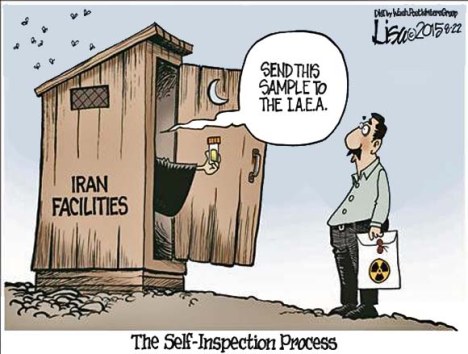
Cartoon of the day
August 24, 2015The Iran deal and the Israeli veto
August 24, 2015The Iran deal and the Israeli veto, Power Line,
(How long can Israel wait? Please see also, Thinking About the Unthinkable: An Israel-Iran Nuclear War and WHY IRAN IS NUCLEAR NOW. — DM)
CNN’s report thus raises this obvious question: Will Israel attack Iran now that the U.S. and its European allies are about to enter a deal that effectively grants Iran the right to become a nuclear power?
***********************
This weekend, CNN reported that in recent years, Israeli leaders planned three attacks on military targets in Iran. CNN bases this story on an audio recording with former Defense Minister (and one-time Prime Minister) Ehud Barak. The recording was leaked to an Israeli television station.
Why didn’t Israel carry through with the planned attacks? In the first case (2010), Israeli military leaders reportedly nixed the idea. The head of the Israeli Defense Force (IDF) simply didn’t believe the planned attack was “operational.”
In the second case (2011), the IDF signed off on an attack. However, two key ministers had doubts that could not be overcome.
In the third case (2012), the attack didn’t come off because of scheduling issues. Supposedly, the planned strike conflicted with a joint military exercise with the United States. The Israeli didn’t want to embarrass Washington by attacking Iran just as it was set to engage in the joint military exercise because this would give the appearance that the Americans were involved. (The explanation in CNN’s report for why the attack wasn’t rescheduled is garbled).
In all three instances, Prime Minister Netanyahu wanted to attack. In all three instances, Barak, who is not a member of Netanyahu’s party, concurred.
In none of these instances does it appear that President Obama’s obvious opposition to an Israeli attack on Iran was the dealbreaker, if CNN’s report is to be believed (though Obama’s views may have contributed to the two ministers getting cold feet in 2011).
CNN’s report thus raises this obvious question: Will Israel attack Iran now that the U.S. and its European allies are about to enter a deal that effectively grants Iran the right to become a nuclear power?
One might think not. The deal has the support of European governments eager to allow their businessmen to take advantage of Iranian markets. Here in the U.S., the deal is unpopular, but Obama considers it the main element of his foreign policy legacy.
There will be hell to pay if Israel upsets these expectations by attacking Iran.
But the more we learn about the farcical nature of this deal, the more Israel’s calculus may tilt in favor of an Israeli attack — if not in 2015 or 2016, then in 2017 when Obama is no longer president. After all, the hell Israel would pay if it attacks Iran must be weighed against the threat of a nuclear Iran. CNN’s report, if accurate, adds plausibility to the view that Israel sees the latter as more hellacious.
In a very real sense, then, the key people evaluating Obama’s deal aren’t U.S. Senators and Representatives, but rather Israeli generals, intelligence chiefs, and ministers. They are the ones who, effectively, can nullify the deal.
It seems to be that with every revelation of a major Obama/IAEA concession to the mullahs, the prospect that Israel will exercise its veto increases.
UK’s Hammond in Tehran: Iran has shown more nuanced approach than in past to Israel conflict
August 24, 2015UK’s Hammond in Tehran: Iran has shown more nuanced approach than in past to Israel conflict
After the British foreign minister opens UK embassy in Tehran he says Islamic Republic would be judged on its actions, not its words.
LONDON – Britain must remain cautious in its relations with Iran, foreign minister Philip Hammond said on Monday, after he reopened the British embassy in Tehran nearly four years after it was stormed by protesters.
While the historic step marks an easing of tense relations between the Islamic Republic and Western powers, Hammond said there was still disagreement on major issues.
“We should tread carefully. There’s a deep legacy of distrust on both sides and we have major areas where we have very substantial policy differences,” he told the BBC shortly before a scheduled meeting with Iranian President Hassan Rouhani.
He said that while both countries agreed on the need to tackle jihadist group Islamic State, there were disagreements on human rights issues.
Hammond said the current Iranian government had displayed a more nuanced approach than its predecessor to a long-running conflict with Israel, adding that Tehran would be judged on its actions, not its words.
“What we’re looking for is behavior from Iran, not only towards Israel but towards other players in the region, that slowly rebuilds their sense that Iran is not a threat to them,” he said.
Hammond told Reuters on Monday that he expected sanctions on Iran could start to be lifted as early as Spring next year.
He said preparatory work should be done ahead of lifting sanctions so investment can start to flow as soon as the measures are removed.
“We could be talking as early as next spring to start to see sanctions lifting off,” Hammond said.
Kurdish oil is another Netanyahu-Obama head-to-head front
August 24, 2015Kurdish oil is another Netanyahu-Obama head-to-head front.
( I’ve watched a number of tankers offload oil here in Eilat this year for the first time since the fall of the Shah. I presumed they were from Kurdistan. This article supports that presumption… – JW )
DEBKAfile Special Report August 24, 2015, 1:08 PM (IDT)

SCF Byrranga tank carries Kurdish oil
That Israel and other nations were buying oil from the Kurdish republic of Iraq had been published before and was no secret. The Financial Times broke its “discovery” Sunday, Aug. 23, just by chance? on the day that Britain and Iran reopened their respective embassies in Tehran and London after a four-year breach resulting from a mob attack on the Tehran embassy.
Even before sanctions were lifted and Tehran had demonstrated its compliance with the nuclear deal signed with the world powers in Vienna on July 14, European ministers were knocking on the door in a quest for financial relations. The Islamic Republic was deemed rehabilitated by the nuclear accord; and the UK saw no reason to lag behind the others. And so Foreign Secretary Philip Hammond was personally in attendance at the ceremonial reopening Sunday of the Tehran embassy.
The FT’s report’s timing fitting in perfectly with the British government’s plans to quickly develop profitable ties with the Islamic Republic in the following arenas:
1. The oil industries in Iran and Iraq. London seeks as large a slice as possible of the $150 billion worth of oil and gas contracts on offer by Tehran.
2. The Islamic Republic was also meant to infer from the FT report that British intelligence resources and its powerful media were available as tools for beating Israel out on the world’s energy markets.
3. Britain’s foreign policy is grounded in accentuating its common interests with Washington. The Obama administration may pose as a champion of Masoud Barzani, President of the autonomous Kurdish Republic of northern Iraq. His peshmerga army has after all distinguished itself in its dogged fight against the Islamic State. But in practice, things are different: the US administration, to meet the wishes of Tehran and Baghdad, consistently withholds from the Kurds the heavy weapons they need to rout ISIS.
The pejorative depiction of Israel’s purchase of Kurdish oil was meant to gain London points – not just with Iran and Iraq, but also with the Obama White House.
In serving this purpose, The Financial Times found no editorial need to fill in the pertinent Middle East background of the trade.
Exactly a year ago, debkafile discovered and reported that Kurdish oil was being delivered to Israel. Several media discovered an American warship that was described at the time as stalking the United Kalvyrta tanker which carried a million barrels of Kurdish oil. The warship planned to prevent the oil being unloaded at any port, since Washington viewed the cargo as the legal property of the Iraqi government – not the KRG which had put it up for sale. Had the oil reached its purchasers, it would have been nearly impossible to cut off Kurdistan’s export trade to clients outside Iraq.
This American step was part and parcel of the US negotiating tactics for a nuclear accord, then at one of their critical moments. The Obama administration was anxious to show Tehran how closely the US would play ball with Iran and Shiite-dominated Iraq on the vital issue of oil, once the nuclear accord was in the bag.
But the episode did not pan out as expected.
This is what happened: “The partially full Kamari tanker carrying Kurdish crude oil disappeared from satellite tracking north of Egypt’s Sinai Peninsula. Two days later, the empty vessel reappeared near Israel.”
No one in the trade doubted for a moment that the vanishing oil had been unloaded at an Israeli port.
In reporting this at the time, a debkafile map traced the freight’s route from the Turkish port of Ceyhan, the terminus of the oil pipeline from the Kurdish-controlled oilfields of Kirkuk, to the Israeli port of Ashkelon.
That was the missing background of the Financial Times story, which led up to its conclusion that Kurdish oil accounts for 77 percent of Israel’s consumption, totalling around a quarter of a million bpd. Between May and August this year, the Haifa refineries are said to have handled 19 million barrels of oil sourced to Kurdistan.
Since all matters relating to energy are made in Prime Minister Binyamin Netanyahu’s office, it stands to reason that the decision to buy oil from the KRG came from the top.
Netanyahu’s readiness to go head to head with the Obama administration on this issue hat two motives:
First, Kurdish oil was cheap. Irbil denies undercutting the market, but debkafile’s sources report that it was willing to do so in the case of Israel.
Second, the Netanyahu government and the Obama administration don’t see to eye to eye not just on nuclear Iran, but on Middle East policy in general – and the autonomous Kurdish republic of Iraq, in particular. The prime minister intended for Barzani to use this oil revenue to buy the arms he needs to fight ISIS to the finish.
At the time of this decision, crude had soared past $100 on the world market, and Islamic State forces were advancing on the Kurdish capital of Irbil. Washington may have countenanced Mosul’s fall to jihadist forces, but Israel was determined to prevent the fall of friendly Irbil.
This week, as Netanyahu marked the first 100 days of his fourth term as prime minister, his critics described him as weak and lacking in accomplishments. The Kurdish enterprise was one of several cases in which he quietly took a strong initiative.




 anneinpt
 artaxes
 danmillerinpanama
 davidking1530
 Peter Hofman
 Joseph Wouk
 Peter
Peter Louisiana Steve
 WarSclerotic
Recent Comments