Archive for July 2015

Op-Ed: Obama’s Deception Set Off a New Era

July 22, 2015

Op-Ed: Obama’s Deception Set Off a New Era, Israel National News, Dr. Joe Tuzara, July 22, 2015

Not surprising, the Obama administration considers both the US and Israel to be key threats to peace in the world.

**********************

President Barack Obama’s strange self-delusion for Iran to become a more “formidable regional power” has already triggered an undeclared new era for nuclear proliferation in the Middle East.

Despite this established ignominy of an emboldened Iran strengthened by Obama’s naive policies at the expense of Israel and Sunni Arab allies, the White House suggestion that they “sought to pursue diplomacy to prevent Iran from obtaining a nuclear weapon that could set off a nuclear arms race” is based on fantasy.

Whichever way they try to spin it, Obama’s rhetoric that the deal “cut off every pathway to nuclear weapons, prevented a nuclear arms race in the Middle East” doesn’t match reality.

The deal explicitly acknowledges that Iran is gaining benefits no other state would gain under the Non-Proliferation Treaty (NPT). In terms of its nuclear development, instead of dismantling Iran’s nuclear program, that program is now protected.

Such a deal, one that allows a leading state sponsor of terror to retain the ability to develop nuclear weapons, threaten Israel, continue their hegemonic ambitions and support for terrorism is a historic nadir of the Obama presidency.

As Obama’s secret letter to Ayatollah Khamenei makes clear, securing the deal simply legitimizes Tehran, a de facto regional US ally standing on the threshold of a nuclear weapon.

It is a shame that the Obama administration’s total capitulations were made in areas that were supposed to prevent Iran from acquiring nuclear weapons. The fake Iran deal does confirm Israeli and Sunni Arab Muslims fears that they can no longer depend on the Obama administration to protect their vital national security interests.

Even worse, Obama had given up on its stated goals of preventing Iran from obtaining a nuclear weapon and his dumb promise to fight a bad deal while underwriting the expansion of Iranian hegemony unquestionably was not just only reckless but cynical.

As it turned out, “détente” with Iran is the main goal of the Obama’s pretend diplomacy. In essence, Obama’s “appeasement” is not diplomacy and his secret back-channel negotiations with the fanatical, corrupt and Machiavellian terrorist regime is treason.

The moment Obama become an advocate for the “Islamic State of Iran” that enjoys the benefits of no real verification regime and no real consequences for serial violations of UN nuclear weapons resolutions, he has lost all credibility to govern our great nation. Similarly, when Obama negotiated away Israel’s existence, he became the real enemy of Israel.

Not surprising, the Obama administration considers both the US and Israel to be key threats to peace in the world. Given that Obama has done all it can to [prevent an Israeli preemptive strike, from leaking Israeli attack scenarios to denying Israel air space over Iraq, the fact that he] coordinated with the Iranian regime –and attempted to cut off weapons shipments to Israel in the midst of its war with Iranian proxy terror group Hamas, his statements about the strength of this deal carry no weight at all.

On the other hand, Obama’s flawed perspective and deception on a grand scale significantly risks the collapse of 50 year US alliance structure in the Middle East, contravenes 70 years of US nonproliferation policy and endangers 45 years of a landmark international treaty (NPT) whose objective is to prevent the spread of nuclear weapons and weapons technology.

Quite unfortunately, the Iran deal set a dangerous precedent that allows rogue states and radical fundamentalist elements in particularly issuing veiled threats to quickly go nuclear. With Iran getting active on the borders of Egypt and Saudi Arabia, those regimes would be foolhardy not to attempt to develop a nuclear capacity –especially given that Obama has shown there are no detriments to doing so.

Equally disturbing, Obama has given all the Sunni Arab Gulf countries the pathways to build civilian nuclear energy programs with possible military dimensions.

Ironically, Obama has created a major void allowing an opening for many potential benefits, that it holds for Russia. In the last six months, Russia has struck three significant nuclear deals with long-time US Middle East allies: Egypt, Jordan and Saudi Arabia.

An unnamed sources told the Al Arabiya TV network that Saudi Arabia and Russia agreed to build 16 nuclear reactors that Russia would play a significant role in operating. France became the first country to sign feasibility studies to build two nuclear reactors in Saudi Arabia potentially worth more than $10 billion.

Now we all know that Sunni Arabs will not sit idly as the world’s largest state-sponsor of terror becomes a nuclear-threshold state. The regional powers know this. Saudi Arabia has already said it will “match the nuclear capabilities Iran is allowed to maintain,” and it is an open secret that the Saudis have a nuke on the shelf in Pakistan.

The Center for Strategic and International Studies (CSIS) also noted that “the Arab Gulf states have acquired and are acquiring some of the most advanced and effective weapons in the world.”

One of many unintended outcomes of the nuclear talks is the emergence of covert Saudi and Gulf State alliance with their former archenemy, Israel. The Saudis and the Israelis have had five “secret” meetings to discuss common defense and intelligence issues related to Obama’s policy of strengthening Iran economically while permitting the terror state to become a potential nuclear power with a breakout capacity that is unknowable.

Tehran’s shocking nuclear bravado aside, the Middle East is going to experience another historic moment with the visit of Saudi Prince Talal bin Waleed  to Israel in what could be the most significant move toward peace between the Arabs and Israelis since Egypt’s Anwar Sadat’s iconic trip to Israel.

Saudi Prince Talal denounced the growing waves of anti-Semitism in the region and praised Israel as the region’s sole democratic entity. Calling for Muslims in the Middle East “to desist from their absurd hostility toward the Jewish people,” the prince went on to announce that Saudi King Salman bin Abdulaziz Al Saud has instructed him to open a direct dialogue with Israel’s intellectuals in pursuit of amicable ties with all of Israel’s Arab neighbors.

Amid the despair in the region generated by Obama’s Iran policy, this could be the most promising breakthrough  toward peace between Arabs and Israelis.

In arrogantly thinking he alone could decide the future of the Middle East, Obama has unleashed the unintended consequences that frequently shape great events: in this instance for the betterment of all the peoples of the Middle East but ultimately to the detriment of America’s interests.

Now, the moment of decision had finally come, Israelis must accept the risks and unintended consequences of preventive war rather than wait until Iran’s nuclear bombs are built.

Either way, for as long as the highly imperfect Iranian accords have not been ratified or rejected by Congress, a preemptive strike of Iran’s nuclear facilities is not an option.

Unless, Iran’s magical collaboration with the Obama administration ends up restocking its Iranian proxies with sophisticated radars and weapons from Russia, China and the United States, or facing the imminent threat of a nuclear attack- Israel will not hesitate  to deploy the “Samson option”.

And as long as the imminent proxy wars in the Golan Heights, Sinai Peninsula, Gaza or Lebanon remain conventional, Israel’s response would remain reciprocally non-nuclear.
 

House Republican: Obama Administration Won’t Release Full Iran Deal to Congress

July 22, 2015

House Republican: Obama Administration Won’t Release Full Iran Deal to Congress, National Review, Joel Gehrke, July 21, 2015

President Obama won’t allow Congress to review two key aspects of the Iranian Nuclear deal, Republican lawmakers learned from international partners last week. Under the terms of the Joint Comprehensive Plan of Action (JCPOA), the International Atomic Energy Agency would negotiate separately with Iran about the inspection of a facility long-suspected of being used to research long-range ballistic missiles and nuclear weapons.

“The Obama administration has failed to make public separate side deals that have been struck for the ‘inspection’ of one of the most important nuclear sites—the Parchin military complex,” said Representative Mike Pompeo (R., Kan.) in a statement Tuesday. “Not only does this violate the Iran Nuclear Agreement Review Act, it is asking Congress to agree to a deal that it cannot review.” The IAEA has been trying to gain access to the Parchin site since 2005, but Iran has refused, even as it apparently demolished various parts of the complex. “The hardliners do not want to grant any concessions unless Iran is suitably rewarded,” International Institute for Strategic Studies director Mark Fitzpatrick told the BBC in 2014, after reports emerged of explosions at the base.

The terms of the current agreement wouldn’t allow Congress to review any concessions the IAEA makes to get into the site. “Even members of Congress who are sympathetic to this deal cannot and must not accept a deal we aren’t even aware of,” said Pompeo. The IAEA will also separately negotiate “how the IAEA and Iran will resolve outstanding issues on possible military dimensions of Iran’s nuclear program,” according to a release from Pompeo’s office. Senator Tom Cotton (R., Ark.) and Pompeo, who serves on the House Intelligence Committee, learned of the arrangement while meeting with the IAEA in Vienna, Austria last week. “That we are only now discovering that parts of this dangerous agreement are being kept secret begs the question of what other elements may also be secret and entirely free from public scrutiny,” Cotton said in a statement to the press.

Iran becomes more aggressive after Obama’s ‘historic’ nuclear deal

July 22, 2015

Iran becomes more aggressive after Obama’s ‘historic’ nuclear deal, American ThinkerAmir Basiri, July 22, 2015

The lack of interest of the U.S. and the UN in addressing this issue sends a bad signal to Tehran, one that implies the international community has let its guard down and Iran is free to increase its transgression at its leisure.  In particular, the U.S. government is both morally and legally responsible to take action in this regard and prevent another disaster from coming to pass.  But on the broader scale, the idleness of the Obama can have dire implications on its own efforts to rein in Iran’s nuclear and terrorist venturing.

**********************

The massive giveaways to Iran in the nuclear deal it struck with the P5+1 on July 14 were premised on the false assumption that concessions would render Tehran more docile.  U.S. President Barack Obama has spoken on several accounts on how economic regrowth would convince the Iranian regime to shift away from its nuclear and regional ambition and to become a more constructive actor in the region and across the globe.  But there are already indications that the mullahs ruling Iran are becoming bolder in their regional venturing and meddling in neighboring countries, with the first signs appearing in Iraq.

According to the National Council of Resistance of Iran, simultaneous with the declaration of the Joint Comprehensive Plan of Action (JCPoA) in Vienna, elements of the Iranian regime in the Iraqi government ratcheted up repressive measures against Camp Liberty, an obsolete U.S. military compound in the adjacency of the Baghdad International Airport which houses thousands of Iranian refugees.

The residents of the camp, members of the Iranian opposition group People’s Mojahedin Organization of Iran (PMOI/MeK), have been living under harsh, prison-like conditions by the orders of Faleh al-Fayyadh, National Security Advisor to the Iraqi Prime Minister, a holdover from the cabinet of former Prime Minister Nouri al-Maliki, a staunch ally of the Iranian regime.

While temperatures in Iraq are soaring at around 50 degrees Celsius (122 deg. Fahrenheit), Iraqi security forces are preventing the entrance of vital necessities into the camp, including food, fuel, medical, and logistical supplies.  Given the camp’s worn infrastructure and lack of facilities for storage, the blockade is threatening to trigger a humanitarian crisis in the camp as life in the camp will soon come to a halt.  It is noteworthy that the forces ostensibly in charge of the camp’s protection are deeply affiliated with the Iranian regime and are responsible for a number of attacks and massacres against the residents.

In 2013, similar measures undertaken by Iraqi forces eventually culminated into the mass-slaughter of 52 of the camp’s residents, an operation carried out by special forces under the strict orders and control of the Iraqi Prime Ministry Office and in coordination with the Iranian embassy in Baghdad.  There is grave concern that a similar atrocity will occur if quick action is not taken to prevent further violation of the rights of the residents.

The residents of Camp Liberty have been recognized as “persons of concern” by the UNHCR, the UN refugee agency, and designated as “protected persons” under the Fourth Geneva Convention by U.S. forces after the 2003 invasion of Iraq.  Yet the U.S. embassy in Baghdad and the UN (which happen to be the only bodies that have direct access to the camp aside from the Iraqi government) are effectively sitting out the disaster while it develops and while Iran-backed forces tighten the noose around the camp.

The intensification of persecution of Camp Liberty takes place in the backdrop of increased Iranian influence in Iraq as Tehran moves to strengthen its proxy militia units and expand its influence over Iraqi soil and politics, an endeavor that has driven a wedge through the sectarian divide plaguing the country and has effectively deadlocked the U.S.-led effort to roll back the advances of the Islamic State, an extremist group that has rampaged through Iraq and Syria in the past year.  Regrettably, the Obama administration is taking the issue lightly and is giving tacit approval to Iranian meddling in Iraq.

The MeK was the first party to sound the alarm on Iran’s covert nuclear program in 2002 — the focus of a standoff between Tehran and the international community which has lasted to this day — and has since been the source pertinent information regarding secret aspects of Iran’s nuclear and regional ambitions.  The plots being carried out against the group are a worrying sign of Tehran might be trying to neutralize the opposition in order to pave its way for cheating on the nuclear accord without fear of being exposed.

The lack of interest of the U.S. and the UN in addressing this issue sends a bad signal to Tehran, one that implies the international community has let its guard down and Iran is free to increase its transgression at its leisure.  In particular, the U.S. government is both morally and legally responsible to take action in this regard and prevent another disaster from coming to pass.  But on the broader scale, the idleness of the Obama can have dire implications on its own efforts to rein in Iran’s nuclear and terrorist venturing.


Iran buys 100 Russian refueling aircraft for its air force to reach any point in the Mid East

July 22, 2015

Iran buys 100 Russian refueling aircraft for its air force to reach any point in the Mid East, DEBKAfile, July 22, 2015

IL78_MKI-IRAN_B_7.2015Russian IL78 MKI tanker aircraft sold to Iran

The Secretary of State can expect some really hard questions during his trip on exactly how the Vienna accord makes the region safer, when Iran’s first act after signing is to arm itself with a fleet of Russian in-flight fuel tankers to expand and strengthen its range and power for aerial aggression.

*********************

In defiance of the international arms embargo, Iran last week placed an order with Moscow for a huge fleet of 100 Russian IL78 MKI tanker aircraft (NATO: Midas) for refueling its air force in mid-flight, thereby extending its range to 7,300 km. This is reported exclusively by DEBKAfile from its military and intelligence sources. The transaction runs contrary to the terms of the nuclear accord the six world powers and Iran signed in Vienna earlier this month.

These tanker planes can simultaneously refuel six to eight warplanes. Their acquisition brings Israel, 1.200km away – as well the rest of the Middle East – within easy range of Iranian aerial bombardment. It also puts Iran’s air force ahead of Israel’s in terms of the quantity and range of its refueling capacity.

Whereas opponents of the Vienna deal have warned that Tehran will spend the billions of dollars released by sanctions relief as a bonanza for fueling its campaigns of terror in the region, it turns out that Iran’s first post-accord purchase is a heavy investment in the rearmament and upgrade of its armed forces’ aggressive capabilities.

The Israeli air force is familiar with the Russian airborne tanker from its use by the Indian air force with which Israel has close ties of cooperation. Its military engineers have also upgraded the Russian fuel tankers in service with the Uzbekistan air force.

Tuesday, July 21, DEBKAfile uncovered some of the tactics and escape clauses Iran has had built into its nuclear accord with the world powers for circumventing its provisions and commitments. The purchase of Russian refueling craft is a concrete example of this kind of evasion. Because the accord confirms the arms embargo in force until 2020, both Moscow and Tehran can maintain that the Russian aircraft industry will not be able to produce 100 new planes before the five years are up, and so the transaction is not a violation.

The huge Iranian-Russian military transaction therefore stands as the first palpable test of the Vienna accord, depending on whether US President Barack Obama or his Secretary of State John Kerry decides to make an issue of it. If they just let it go, it will set a precedent for the arms embargo clause of the nuclear accord to start unraveling.

Also Tuesday, Kerry gave an interview to the Al Arabia TV to prepare the way for his mission to the Gulf region on Aug. 3, which is to ease its rulers’ extreme unease over the ramifications of the nuclear accord. He asserted strongly to the interviewer: “I am not going to go through in great detail all the ways in which this agreement, in fact, makes the Gulf States and the region safer.”

The Secretary of State can expect some really hard questions during his trip on exactly how the Vienna accord makes the region safer, when Iran’s first act after signing is to arm itself with a fleet of Russian in-flight fuel tankers to expand and strengthen its range and power for aerial aggression.

After EU labeling of West Bank goods, paper proposes banking steps on Israel

July 22, 2015

After EU labeling of West Bank goods, paper proposes banking steps on Israel

via After EU labeling of West Bank goods, paper proposes banking steps on Israel – Arab-Israeli Conflict – Jerusalem Post.


The European Union agreed this week to push ahead with labeling Israeli goods made in settlements in the  West Bank, a move that has alarmed the Israeli government; but now there are proposals to go much further, including targeting Israeli banks.

In a paper to be published on Wednesday, the European Council on Foreign Relations, whose proposals frequently inform EU policy-making, argues that the EU is in breach of its own laws and must move much more firmly to distinguish its dealings with Israel from Israel’s activities in the West Bank and east Jerusalem.

European diplomats have long said that labeling is only the first in a series of steps the EU could take against Israel over its settlements policy, one that in financial terms is expected to have a relatively minor impact on the Israeli economy.

But the new proposals would go much deeper and further, reaching into banking, loans and mortgages, qualifications earned in settlement institutions and the tax-exempt status of European charities that deal with Israeli settlements.

“Under its own regulations and principles, Europe cannot legally escape from its duty to differentiate between Israel and its activities in the… Palestinian territories,” says the report, titled ‘EU Differentiation and Israeli Settlements’.

The authors argue that by pushing much further to separate the EU’s dealings with Israel from the settlements, it will force Israel to decide what sort of relationship it wants with Europe and in turn encourage it to return to talks with the Palestinians on a two-state solution to the conflict.

FINANCIAL SQUEEZE

The most significant proposal is on banking, where large Israeli institutions have daily dealings with major European banks, while also providing loans and financing to Israeli businesses and individuals based in the settlements.

Under European Commission guidelines from 2013, EU- and member-state-funded lending cannot be provided to Israeli entities operating in the West Bank.

With the British government holding a controlling stake in some banks following the financial crisis, that would in theory prevent those banks providing financing to Israeli counterparts that have dealings in the settlements.

“Do day-to-day dealings between European and Israeli banks comply with the EU requirement not to provide material support to the occupation?” the report asks, saying it is an issue that EU member states have yet to resolve.

The issue extends into loans and mortgages. An Israeli with dual European citizenship should, in theory, not be able to use a settlement property as collateral for a European loan since Israeli-issued property deeds are not recognized.

Another area in which the EU may be in violation of its own rules relates to European charities that are tax-exempt while using funds to support activities in the settlements, which the EU regards as illegal under international law.

And the report questions whether Europe should accept qualifications from academic, medical and other Israeli institutions based in the West Bank given that it does not recognize Israel’s sovereignty over the territory.

Likewise, there is a question mark over whether the EU should be dealing with Israeli institutions – such as the Ministry of Justice and the national police headquarters – which are based in east Jerusalem.

The Israeli government has described Europe’s steps on labeling as discriminatory and wrong-headed, suggesting they are akin to the Boycott, Divestment and Sanctions (BDS) movement, which Israel regards as anti-Semitic.

Prime Minister Benjamin Netanyahu raised his concerns about labeling in a meeting with the EU’s foreign policy chief, Federica Mogherini in May. Mogherini raised the issue of the EU further differentiating its dealing with Israel.

Mattia Toaldo, one of the authors of the ECFR paper, said the EU needed to explain more clearly the legal obligation the EU faces when it comes to differentiation, making a sharp distinction with the BDS campaign. And the ultimate aim, he said, should be to urge Israel towards a two-state solution.

“Differentiation is a legal prerequisite for the EU in order to avoid violating its own laws,” he said. “You have to do it legally and by the book, but it is also beneficial to the peace process because it changes the calculations by the Israelis.”

John Kerry is “disturbed” that Iran remains Iran

July 22, 2015

John Kerry is “disturbed” that Iran remains Iran, Power LinePaul Mirengoff, July 21, 2015

To view Khamenei’s statements on Iran’s regional policy as disturbing is like being disturbed by feeding habits of sharks. What’s disturbing here is the combination of naivety and wishful thinking that led the Obama administration to reach this agreement with Iran.

***********************

Towards the end of the nuclear negotiations with Iran, the mullahs’ negotiators talked about the possibility of cooperating strategically with the U.S. on regional matters, in the event the sides reached a deal. Even “Supreme Leader” Ali Khamenei joined in, declaring that “if the other side avoids its ambiguity in the talks, it’ll be an experience showing it’s possible to negotiate with them on other issues.”

This was an enticing prospect to dangle before Barack Obama. For him, the hope of U.S.-Iran cooperation on “other issues” has always been a major incentive for reaching a deal.

But now that the deal has been reached, the mullahs have changed their tune. Last Friday, Khamenei threw cold water on the idea of cooperating with the U.S., making it clear that Iran will continue to be our deadly adversary. Khamenei stated:

Our policy toward the arrogant U.S. government won’t change at all. We have no negotiations with America about various global and regional issues. We have no negotiations on bilateral issues.

We will always support the oppressed Palestinian nation, Yemen, Syrian government and people, Iraq, and oppressed Bahraini people, and also the honest fighters of Lebanon and Palestine.

Khamenei also reiterated Iran’s support for Hezbollah:

Americans can support the child-killing Zionist government, and call Hezbollah terrorist? How can one interact, negotiate, or come to an agreement with such a policy?

The instinct of the liberal foreign policy establishment in cases like this is to dismiss such talk as being for domestic political consumption. But John Kerry knows the Iranian regime is serious and, fearful of being made to look like an idiot when Iran makes good on Khamenei’s promises, he declined to take the liberal default position.

Instead, though raising the possibility that the statement might not reflect policy, Kerry stated: “I don’t know how to interpret it at this point in time, except to take it at face value, that that’s his policy.”

It’s encouraging to see Kerry taking what the “Supreme Leader” says at face value. Unfortunately, it’s also late in the day.

Kerry went on to state that if Khamenei’s statement really is Iran’s policy, “it’s very disturbing, it’s very troubling.”

It is, to be sure. But Kerry acts like Khamenei’s statement came out of the blue. Absurd!

As noted, Iran forbore to some extent on such pronouncements as the parties to the nuclear negotiations closed in on an agreement. But how could Kerry have believed that this obvious negotiating tactic reflected a change in Iran’s fundamental regional aims?

To view Khamenei’s statements on Iran’s regional policy as disturbing is like being disturbed by feeding habits of sharks. What’s disturbing here is the combination of naivety and wishful thinking that led the Obama administration to reach this agreement with Iran.

State Department Tries to Depict Lifting Arms Embargo On Iran as a ‘Win’ For U.S. in Nuclear Deal

July 22, 2015

State Department Tries to Depict Lifting Arms Embargo On Iran as a ‘Win’ For U.S. in Nuclear Deal

BY:
July 21, 2015 3:39 pm

via State Department Tries to Depict Lifting Arms Embargo On Iran as a ‘Win’ For U.S. in Nuclear Deal | Washington Free Beacon.

State Department spokesman John Kirby depicted the arms embargo lift on Iran in the nuclear deal as a victory for the United States Tuesday.

Last week, President Obama announced that a nuclear agreement had been reached with Iran.

As written in the agreement, Iran is allowed to continue uranium enrichment and maintain 6,000 centrifuges. In exchange, the U.S. and the U.N. will lift economic sanctions over time, remove a conventional weapons embargo after five years, and remove a ban on the research and development of ballistic missile technology after eight years.

The agreement said other restrictions on Iran’s nuclear program would last ten years. After ten years, Iran would be free to develop nuclear weapons.

Associated Press reporter Matt Lee asked Kirby, “Can you think of one instance in which what you ended up with was better than what you were seeking?”

“Well I think remember the–on the arms embargo and the–and the missile program sanctions, under the U.N. Security Council resolutions which put those sanctions in place and drove Iran to the negotiating table, it was always understood that all of those sanctions would be lifted at once when Iran complied with their requirements under Lausanne,” Kirby said.

Kirby also said the arms embargo and the ban on ballistic missile technology would have been lifted immediately if it were not for the United States, which held out for a five-year ban and an eight-year ban.

A 2010 U.N. Security Council resolution put a ban for member countries to sell conventional arms such as tanks, missile launchers, and fighter jets. Kirby continued to defend these victories by saying they were only enacted to get Iran to negotiations.

“But the U.N. Security Council resolutions, which put those sanctions on did so with the intent of driving Iran to the negotiating table, specifically over their nuclear program,” Kirby said. “So it was always understood by all the members of the P5- plus-1 members, that as a part of–to have a deal, without the sanctions relief, all of them, there would be no deal.”

Lee said that previous U.N. Security Council resolutions called for stricter restrictions on Iran’s nuclear program.

“But the problem that exists there is that those U.N. Security Council resolutions to which you refer, which have now been superseded by yesterday’s resolution, are stronger,” Lee said. “They call for Iran to suspend or halt enrichment altogether. So, when you say that well, Russia and China wanted the arms embargo and ballistic missile stuff to go immediately, they wouldn’t have gone immediately, because Iran wasn’t in compliance with the terms of the previous resolutions.”

Some Congressional Democrats do not share the Obama administration’s view that the embargo on arms is lifted as a victory.

“But you’d say that those are two things that you exceeded your expectations?” Lee asked.

“Yes, that’s one example, and if you need more, I’m happy to provide that for you,” Kirby said.

The Obama administration will not be able to claim these numerous issues as “victories.”

Iran Deal: Europe’s Chief Negotiator Sympathized with Iran

July 21, 2015

Iran Deal: Europe’s Chief Negotiator Sympathized with Iran, Gatestone InstituteGeorge Igler, July 21, 2015

  • “Islam belongs in Europe… I am not afraid to say that political Islam should be part of the picture.” — Federica Mogherini.
  • Under the treaties establishing the EU, there are no democratic checks on figures such as Mogherini or on the enormous power they wield.
  • “It was Hamas’s strategy, not illegal Israeli action — as this report shamefully alleges without a shred of evidence — that was the reason why over 1,000 civilians died in Gaza.” — Col. Richard Kemp.
  • As a result of the border policies imposed by Mogherini, ISIS’s scheme to augment such a migrant flow with jihadists is now being accomplished.
  • Mogherini, the official responsible for the EU’s borders represents a sheltered elite, convinced that the solution to problems in the Middle East and North Africa is importing their populations into Europe.

Given the capitulation to Iran’s geopolitical ambitions represented by the agreement reached in Vienna on July 14, a spotlight is likely to fall on the pivotal role played by Europe’s chief diplomat.

Few guessed that while stating the “security of the world” was at stake during negotiations with the Islamic Republic of Iran, Federica Mogherini also felt “political Islam” should be a part of Europe’s future.

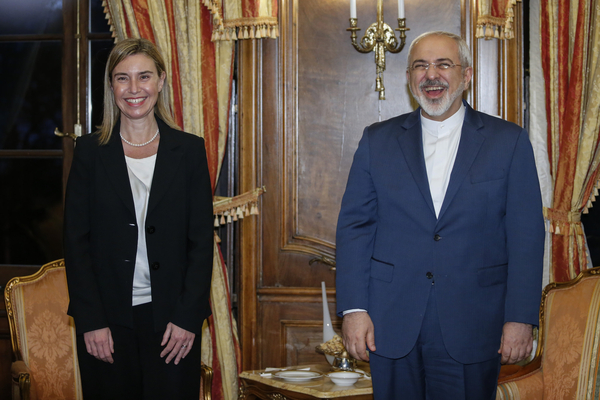
1163Not funny. Federica Mogherini (left) represented the European Union in nuclear negotiations with the Islamic Republic of Iran, a millenarian Shi’ite theocracy that calls for the annihilation of America and Israel. At right, Iran’s foreign minister, Javad Zarif. (Image source: European Union)

The European Union’s unelected High Representative for Foreign Affairs and Security Policy made her pro-Islamist remarks in a speech delivered last month in Brussels.

While heading up Europe’s combined delegation in the Austrian capital, and purportedly tasked with staving off Iran’s nuclear capabilities, Mogherini, a former member of the Italian Communist Youth Federation, also took to tweeting in Arabic.

The assertions made by Mogherini to the Islam in Europe conference, before she left for Vienna, reveal the thinking of a key figure behind the dangerous concessions given to Iran as a result of its continued intransigence and the West’s continued surrender to it.

It should therefore surprise no one that Syria’s President Assad has congratulated Ayatollah Ali Khamenei on his “great victory” in negotiations from which the Jewish state — which had the most to lose based on Iran’s constant threats to obliterate it — was excluded.

As talks progressed, the Supreme Leader of Iran was pictured trampling on an Israeli flag, with the accompanying caption on Khamenei’s official website reading: “The Zionist regime is condemned to vanish.”

Mogherini first gained notoriety after her statement to the United Nations Security Council on May 11, during which she dismissed pushbacks against the flood of migrants illegally crossing the Mediterranean.

As a consequence of the border policies of the European Commission, of which Mogherini is also Vice-President, the number of immigrants pouring into Europe by land has now exceeded those crossing by sea.

Local authorities in Hungary are struggling to cope with refugee camps filled with rioting migrants shouting “Allahu Akbar!” (Arabic for “Allah is Greater!”).

There seems no recognition of the generosity of a nation that is exhausting its resources to give Muslims asylum from conflict.

The speech given by Mogherini in Brussels on June 24 demonstrates why she believes that the growing migration crisis her actions have orchestrated should be welcomed:

“Islam holds a place in our Western societies. Islam belongs in Europe. It holds a place in Europe’s history, in our culture, in our food and — what matters most — in Europe’s present and future. Like it or not, this is the reality.”

She continued:

“We need to show some humble respect for diversity. Diversity is the core feature of our European history, and it is our strength. … We need to understand diversity, understand complexity. … For this reason I am not afraid to say that political Islam should be part of the picture.”

Under the treaties establishing the EU, there are no democratic checks on figures such as Mogherini or on the enormous power they wield. Only representatives elected to the European Parliament can quiz members of the European Commission.

There is also no democratic way for MEPs to repeal any of the laws applied across the EU, authored by the commission’s bureaucrats, or to fire any of its officials.

Regrettably, Mogherini’s speech chose not to delve into which aspects of the “diversity” represented by “political Islam” Europe should embrace: The subhuman status afforded to non-Muslims such as Christians and Jews, perhaps; or the death sentence faced by Muslims who seek to leave Islam or reform it? Or maybe the codified inferiority of females, or the view that democracy, made by man and not Allah is illegitimate, or that it is permissible to counter free speech with violence?

Mogherini’s speech in Brussels — added to the July 3 vote at the UN Human Rights Council (UNHRC) of several European nations in favor of a resolution condemning Israel for war crimes — also highlight a grim reality when viewed in the context of the West’s concessions to Iran.

While political leaders in Europe seek to placate their Muslim populations, Israel is faced with even fewer reliable allies on the world stage as the prospect of a nuclear Iran looms larger.

The UNHRC’s resolution targeting Israel had been prompted by a UNHRC report into last year’s Gaza conflict, during which the Israeli Defense Force had sought to protect the country’s population against constant and indiscriminate rocket attacks.

In an address on June 29, Britain’s Col. Richard Kemp urged the UNHRC to deal with the reality of events in Gaza last summer:

“Hamas sought to cause large numbers of casualties among their own people, in order to bring international condemnation against Israel, especially from the United Nations. … It was Hamas’s strategy, not illegal Israeli action as this report shamefully alleges without a shred of evidence, that was the reason why over 1,000 civilians died in Gaza.”

With only the US voting against the resulting “anti-Israeli manifesto” it was nevertheless endorsed by European nations including France, Germany, the UK, Ireland, and the Netherlands.

As a consequence of several international treaties, these countries and 23 others have unified executive authority on issues of foreign policy into the institutions of the European Union.

To those arguing with the EU’s head of security policy that, “more Muslims in Europe will be the end of Europe,” Mogherini has a curt answer:

“These people are not just mistaken about Muslims: these people are mistaken about Europe – that is my core message – they have no clue what Europe and the European identity are.”

Claiming that “Islam is a victim,” Mogherini went on to stress that the “caliphate” declared last year by ISIS under the name of the Islamic State, represents “an unprecedented attempt to pervert Islam.”

Led by “caliph” Abu Bakr al-Baghdadi, in February ISIS announced its intention to export 500,000 migrants to Europe to create chaos. As his nom de guerre suggests, the PhD in Islamic Studies possessed by Dr. Ibrahim al-Badri comes from the city where the Koran was compiled.

Federica Mogherini’s claim to have a better grasp of political Islam stems from an undergraduate paper she once authored on the subject.

As a result of the border policies imposed by Mogherini, the president of the EU’s judicial cooperation agency, Michèle Coninsx, confirmed on July 6 that ISIS’s scheme to augment such a migrant flow with jihadists is now being accomplished.

It is hard not to conclude that the official responsible for the EU’s borders represents a sheltered elite, convinced that the solution to problems in the Middle East and North Africa is importing their populations into Europe.

Using an Arabic euphemism to describe the Islamic State, Mogherini’s speech concluded:

“Western media like to refer to Da’esh with the word ‘medieval’. This does not help much to understand the real nature of the threat we are facing. Da’esh is something completely new.”

The EU’s chief representative to the talks in Vienna could have done with visiting the museum located on the city’s Karlsplatz. There can be found the following demand for surrender, issued against the Viennese, which post-dates the medieval period by two centuries:

“We order you to wait for us at your residences in the city so we can decapitate you. It will be a pleasure for me to publicly establish my religion and to pursue your crucified god. I will put your sacred priests to the plough and rape your nuns. Forsake your religion or else I will give the order to consume you with fire.”

It was authored by the Muslim caliph reigning in 1683.

When it comes to political Islam, Federica Mogherini is evidently incapable of differentiating between behaviors that are “completely new,” and those that form an established pattern.

That failure makes the diplomatic surrender to the Islamic Republic of Iran, being portrayed by President Obama as a path to a “more hopeful world,” easier to comprehend.

The West’s negotiations were conducted with a millenarian Shi’ite theocracy that calls for the annihilation of America and Israel.

Speaking of the Iran deal (4)

July 21, 2015

Speaking of the Iran deal (4), Power LineScott Johnson, July 21, 2015

Omri Ceren writes to draw attention to Bill Gertz’s Free Beacon article on the ludicrous inspections regime established under the deal with Iran. Omni writes:

Last April – in the immediate days after the Lausanne framework was announced – Obama administration officials assured reporters that it was a good deal because the verification regime would include anytime/anywhere inspections [a][b][c]. Then there was a range of hearings and forums held in early June – which was the lead-up to Vienna – at which IAEA veterans, nuclear experts, and top US intelligence officials confirmed that indeed anytime/anywhere access to suspicious sites was a minimum prerequisite to verifying a deal with Iran [d][e][f][g]).

Then the Vienna talks began and it became clear that the administration would cave to Iranian intransigence on verification. White House validators started trying to convince reporters that technology could be a substitute for robust access [h][i].

Then the talks ended and it was confirmed that Iran will be allowed to block IAEA inspectors for 24 days at a time. The administration is doubling down on the technology talking point and making it mostly about “environmental sampling.” White House communications staffers have begun using the phrase as their two-word answer to any questions about the collapse on inspections. Energy Secretary Moniz repeated it over and over again on last weekend’s Sunday talk shows [j]. White House validators got the hint and have begun invoking it as well yesterday [k]. The argument is that the IAEA’s technology is so good that – even though they have almost a month to destroy evidence – the Iranians could never “sanitize” a site so well that the IAEA couldn’t detect nuclear activity.

There are a couple of reasons why that argument doesn’t hold up.

(1) Diplomatic – Even if the IAEA could detect that *some* kind of nuclear activity had occurred in a sanitized site, the Iranians will have destroyed enough evidence to prevent the agency from determining *what* kind of activity occurred. The goal of verification is not just detection but detection to a sufficient degree that a diplomatic response can be justified. No country is going to be confident enough to blow up the deal without the IAEA being certain that significant cheating had occurred, and being able to explain what it was.

(2) Scientific – It’s just not true. The IAEA’s technology is not good enough. A month isn’t enough time for the Iranians to dismantle a big site like Natanz, but that’s not where they’ll cheat. They’ll cheat in smaller facilities that can be easily dismantled and scrubbed in a couple of weeks. Olli Heinonen – who is the former Deputy Director General of the IAEA, and who worked at the agency for 27 years, and who sat atop its verification shop as head of the Department of Safeguards – explained to reporters today that the Iranians could assemble all the parts they needed for a nuclear bomb in a building that’s just 239 square yards [full article linked above]. And unlike a facility like Natanz, small buildings can in fact be sanitized in 24 days:

Much of this equipment is very easy to move… So you can take it out over the night… and then there is this dispute settlement time which is 24 days – you will use that to sanitize the place, make new floors, new tiles on the wall, paint the ceiling and take out the ventilation… This [nuclear] equipment can be taken out in one or two nights. How long will it take for you to renovate your home? It doesn’t take three weeks… Secretary Kerry has said if there is big installation, 24 days is enough… But there are certain activities where unfortunately in my view, it’s not enough.

This isn’t a theoretical debate. In 2003 the Iranians delayed access to the Kalaye Electric Company for two weeks and completely scrubbed it. They pulled the same trick with the Lashkar Abad laser uranium enrichment plant.

It’s just not true that they can’t dismantle a covert facility in 24 days, and even if it was true they could still dismantle enough to ensure that no country would be confident enough to call them out for cheating.

[a] https://youtu.be/ObV5motay7E?t=1m18s
[b] http://www.timesofisrael.com/top-obama-adviser-dismisses-idea-that-better-iran-deal-is-possible/
[c] http://www.bloomberg.com/politics/articles/2015-04-20/inspectors-need-full-access-in-any-iran-nuclear-deal-moniz-says
[d] http://www.foreign.senate.gov/imo/media/doc/062515_Albright_Testimony.pdf
[e] http://www.foreign.senate.gov/imo/media/doc/062515_Albright_Testimony.pdf
[f] http://taskforceoniran.org/transcripts/Looming_Deadline_Event.pdf
[g] http://docs.house.gov/meetings/FA/FA13/20150610/103582/HHRG-114-FA13-Wstate-FlynnM-20150610.pdf
[h] http://www.nytimes.com/2015/07/07/world/middleeast/nuclear-inspectors-await-chance-to-use-modern-tools-in-iran.html
[i] http://www.thedailybeast.com/articles/2015/07/06/the-spy-tech-that-will-keep-iran-in-line.html
[j] http://www.powerlineblog.com/archives/2015/07/speaking-of-the-iran-deal-2.php
[k] http://www.msnbc.com/msnbc/qa-hans-blix-iran-deal-remarkably-far-reaching

‘US freed top Iranian scientist as part of secret talks ahead of Geneva deal’

July 21, 2015

US freed top Iranian scientist as part of secret talks ahead of Geneva deal’

Mojtaba Atarodi, arrested in California for attempting to acquire equipment for Iran’s military-nuclear programs, was released in April as part of back channel talks, Times of Israel told. The contacts, mediated in Oman for years by close colleague of the Sultan, have seen a series of US-Iran prisoner releases, and there may be more to come

By Mitch Ginsburg November 29, 2013, 9:02 pm

via ‘US freed top Iranian scientist as part of secret talks ahead of Geneva deal’ | The Times of Israel.


Iranian scientist Mojtaba Atarodi speaks to journalists, upon his arrival at the Imam Khomeini airport outside Tehran, Iran, Saturday, April 27 (photo credit: AP/Vahid Salemi)

Iranian scientist Mojtaba Atarodi speaks to journalists, upon his arrival at the Imam Khomeini airport outside Tehran, Iran, Saturday, April 27 (photo credit: AP/Vahid Salemi)

The secret back channel of negotiations between Iran and the United States, which led to this month’s interim deal in Geneva on Iran’s rogue nuclear program, has also seen a series of prisoner releases by both sides, which have played a central role in bridging the distance between the two nations, the Times of Israel has been told.

In the most dramatic of those releases, the US in April released a top Iranian scientist, Mojtaba Atarodi, who had been arrested in 2011 for attempting to acquire equipment that could be used for Iran’s military-nuclear programs.

American and Iranian officials have been meeting secretly in Oman on and off for years, according to a respected Israeli intelligence analyst, Ronen Solomon. And in the past three years as a consequence of those talks, Iran released three American prisoners, all via Oman, and the US responded in kind. Then, most critically, in April, when the back channel was reactivated in advance of the Geneva P5+1 meetings, the US released a fourth Iranian prisoner, high-ranking Iranian scientist Atarodi, who was arrested in California on charges that remain sealed but relate to his attempt to acquire what are known as dual-use technologies, or equipment that could be used for Iran’s military-nuclear programs. Iran has not reciprocated for that latest release.

Solomon, an independent intelligence analyst (who in 2009 revealed the crucial role played by German Federal Intelligence Service officer Gerhard Conrad in the negotiations that led to the 2011 Gilad Shalit Israel-Hamas prisoner deal), has been following the US-Iran meetings in Oman for years. Detailing what he termed the “unwritten prisoner exchange deals” agreed over the years in Oman by the US and Iran, Solomon told The Times of Israel that “It’s clear what the Iranians got” with the release of top scientist Atarodi in April. “What’s unclear is what the US got.”

The history of these deals, though, he said, would suggest that in the coming months Iran will release at least one of three US citizens who are currently believed to be in Iranian custody. One of these three is former FBI agent Robert Levinson.

Undated photo of retired-FBI agent Robert Levinson (photo credit: AP/Levinson Family)

Solomon told The Times of Israel that the interlocutor in the Oman talks is a man named Salem Ben Nasser al Ismaily, who is the executive president of the Omani Center for Investment Promotion and Export Development and a close confidant of the Omani leader Sultan Qaboos bin Said.

Omani interlocutor Salem Ben Nasser al Ismaily (photo credit: Channel 2 screenshot)

Educated in the US and the UK and fluent in English, Ismaily has authored two books. “Messengers of Monotheism: A Common Heritage of Christians, Jews and Muslims” and “A Cup of Coffee: A Westerner’s Guide to Business in the Gulf States.”

The latter tells the fictional tale of John Wilkinson, a successful American businessman who fails in all of his business endeavors in the Gulf until he meets Sultan, who explains to him, according to the book’s promotional literature, how to forgo his hard-charging Western style and “surrender to very different values rooted in ancient tribal customs and traditions.” Those mores have been central to the murky prisoner swaps surrounding the nuclear negotiations, Solomon said.

Iranian President Hasan Rouhani, right, shakes hands with Omani Sultan Qaboos during an official arrival ceremony, in Tehran, Iran, Aug. 25, 2013. (photo credit: AP/Iranian Presidency Office, Hojjat Sepahvand)

Solomon said he identified Ismaily’s role back in September 2010, when Sarah Shourd, an American who apparently inadvertently crossed into Iran while hiking near the Iraqi border, was released, for what were called humanitarian reasons. She was delivered into Ismaily’s hands in Oman and from there was flown to the US — the first release in the series of deals brokered in Oman. One year later, in September 2011, her fiancé and fellow hiker, Shane Bauer, was set free along with their friend, Josh Fattal. The two men were also received at Muscat’s Seeb military airport by Ismaily before being flown back to the US.

Former Iranian hostages Shane Bauer, left, Sarah Shourd, center, and Josh Fattal (photo credit: AP/Press TV)

The US began reciprocating in August 2012, Solomon said. It freed Shahrzad Mir Gholikhan, an Iranian convicted on three counts of weapons trafficking. Next Nosratollah Tajik, a former Iranian ambassador to Jordan — who, like Gholikhan, had been initially apprehended abroad trying to buy night-vision goggles from US agents — was freed after the US opted not to follow up an extradition request it had submitted to the British. Then, in January 2013, Amir Hossein Seirafi was released, also via Oman, having been arrested in Frankfurt and convicted in the US of trying to buy specialized vacuum pumps that could be used in the Iranian nuclear program.

Finally, in April, came the release of Mojtaba Atarodi.

The facts of his case are still shrouded. On December 7, 2011, Atarodi, a faculty member at the prestigious Sharif University of Technology (SUT) in Tehran — a US-educated electrical engineer with a heart condition, a green card and a brother living in the US — arrived at LAX and was arrested by US federal officials.

He appeared twice in US federal court in San Francisco and was incarcerated at a federal facility in Dublin, California and then kept under house arrest. The US government cloaked the contents of his indictment and released no statement upon his release. His lawyer, Matthew David Kohn, told The Times of Israel he would like to discuss the case further but that first he had to “make some inquiries” to see what he was allowed to reveal.

In January, shortly after Atarodi’s arrest, his colleagues wrote a letter to the journal Nature, protesting his detention. “We believe holding a distinguished 55-year-old professor in custody is a historical mistake and not commensurate with the image that America strives to extend throughout the world as a bastion of free scientific exchange among schools and academic institutions,” they said.

Solomon, who compiled a profile of Atarodi, believes that the scientist, prior to his arrest, played an important role in Iran’s missile and nuclear programs. Atarodi, he said, has co-authored more than 30 technical articles, mostly related to micro-electric engineering and, in 2011, won the Khwarizmi award for the design of a microchip receiver for digital photos. “That same technology,” he said, “can be used for missile guidance and the analysis of nuclear tests.”

Solomon further noted that the then-Iranian defense minister and former commander of the revolutionary guards, Ahmad Vahidi, attended the prize ceremony and that Professor Massoud Ali-Mahmoudi, an Iranian physics professor who was assassinated in 2010, was an earlier recipient of the prize.

“There is no doubt in my mind that Atarodi came to the US at the behest of the logistics wing of the IRGC [the Iranian Revolutionary Guard Corps],” Solomon said.

On April 26 Atarodi was flown from the US to Seeb military airbase in Oman, where he met with Ismaily, and onward to Iran. “The release of someone who holds that sort of information and has advanced strategic projects in Iran is a prize,” Solomon said. The US, said Solomon, must have already received something in return or will do so in the future.

Thus far, US-Iran prisoner swaps have been conducted in a manner utterly distinct from the old Cold War rituals, in which, as was the case with Prisoner of Zion Natan Sharansky, spies or prisoners from either side of the Iron Curtain walked across Berlin’s old Glienicke Bridge toward their respective home countries. Instead, with Iran claiming it knows nothing about the whereabouts of former FBI agent Levinson, for instance, and the US eager to show that it will not barter with hostage-takers, the deals have taken the form of a delayed quid pro quo.

There are currently three US nationals — Levinson, Saeed Abedini, and Amir Hekmati — still believed to be held in Iran.

US President Barak Obama raised the issue of the imprisoned Americans in his historic September phone call to Iranian President Hassan Rouhani. Obama’s Deputy National Security Advisor, Tony Blinken, told CNN that aside from the nuclear program it was the only other issue that was brought up in the call.

The interim deal in Geneva did not include any reference to prisoner dealings. Richard Haas, president of the Council on Foreign Relations, told CNN, “you’ve got to decide how much you’re going to try to accomplish, and just tackling all the dimensions of the nuclear agreement is ambition enough.” A spokeswoman for the National Security Council added that the “talks focused exclusively on nuclear issues.”

The omission prompted the chief counsel of the American Center for Law and Justice, Jay Sekulow, who is representing Pastor Saeed Abedini’s wife Naghmeh, to charge Obama and US Secretary of State John Kerry with turning their backs on an American citizen. On the center’s website, he called the decision “outrageous and a betrayal” and said it sends the message that “Americans are expendable.”

Abedini, who was born in Iran and later converted to Christianity, was arrested earlier this year in Iran for what would seem was strictly Christian charity work and sentenced to eight years in prison. He was recently transferred from Evin Prison, a notorious jail for political prisoners in Tehran, Sukelow wrote in a letter to Kerry, “to the even more notorious and brutal Rajai Shahr Prison in Karaj.”

Amir Hekmati, a 31-year-old former Marine from Flint, Michigan, who allegedly obtained permission to visit his grandmother in Iran in 2011, was charged with espionage and sentenced to death in 2012. In September, Hekmati managed to smuggle a letter out of prison. Published in the Guardian, it contended that his filmed admission of guilt had been coerced and that his arrest “is part of a propaganda and hostage-taking effort by Iranian intelligence to secure the release of Iranians abroad being held on security-related charges.”

Amir Hekmati, a former U.S. Marine held in Iran over the past two years on accusations of spying for the CIA. (photo credit: Hekmati family/FreeAmir.org)

Levinson, a 65-year-old veteran of the FBI, was last seen on March 9, 2007, on Kish Island, Iran. According to Solomon, Levinson was stationed in Dubai at the time as part of a US task force comprised of former officers operating in the United Arab Emirates, training officials there to combat weapons trafficking, and was tempted to come to Kish for a meeting.

The last person he is known to have had contact with, and with whom he shared a room the night before his abduction, according to a Reuters article from 2007, is Dawud Salahuddin, an American convert to Islam, who is wanted in the US for murder. According to a New Yorker profile of the Long Island-born Salahuddin, he showed up at the home of Ali Akbar Tabatabai’s Bethseda, Maryland door in July 1980, dressed as a mailman, and shot Tabatabai, a Shah supporter, three times in the abdomen, killing him. From there he fled to Canada and on to Switzerland and Iran.

Salahuddin has indicated that Levinson had come to Kish to meet with him.

In September, Rouhani denied any knowledge of Levinson’s whereabouts. In an interview with CNN’s Christiane Amanpour, he said that, “We don’t know where he is, who he is. He is an American who has disappeared. We have no news of him.”

This is highly doubtful. In 2010 and 2011 Levinson’s family received a video and photographs respectively of him in captivity. In January of this year the AP reported that “despite years of denials,” many US security officials now believe that “Iran’s intelligence service was almost certainly behind the 54-second video and five photographs of Levinson that were emailed anonymously to his family.” The photos and the videos traced back to different addresses in Afghanistan and Pakistan, suggesting, perhaps, that Levinson, the longest-held hostage in US history, was imprisoned in Balochistan, a desert region spanning the borders of Iran, Pakistan and Afghanistan.

On Tuesday, Levinson’s son Dan wrote a column in the Washington Post calling Rouhani and Foreign Minister Javad Zarif “well-respected men committed to the goodwill of all human beings, regardless of their nationality.”

Several hours later, White House Spokesman Jay Carney published a statement saying that the US government welcomes the assistance “of our international partners” in attempting to bring Levinson home and, he added, “we respectfully ask the Government of the Islamic Republic of Iran to assist us in securing Mr. Levinson’s health, welfare, and safe return.”

As was the case with the Geneva negotiations, and as is likely happening with the upcoming round of talks regarding Syria, there is good reason to believe, and in this case to hope, that the movements played out under the spotlights of the international stage have been choreographed well in advance, perhaps in the sea-side city of Muscat, under the careful tutelage of Salem Ben Nasser al Ismaily.


Added by me