‘All evidence suggests Iran already has nuclear warheads’
By Garth Kant, April 2, 2015 Via World Net Daily (Note: published four months ago!)

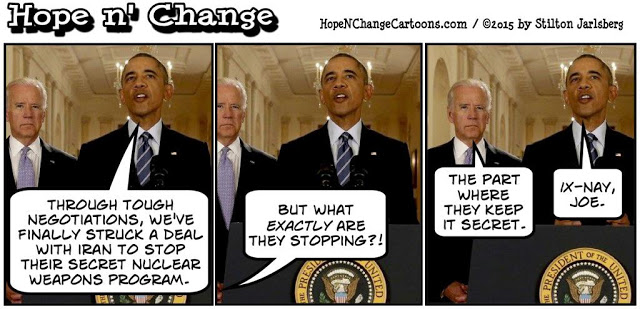
The Three Stooges…or are they? [Source: Unknown]
(Does Iran have the bomb? Seems pretty important given all that’s transpired lately. It they do, that would be a real game changer and everyone’s credibility would be on the line. Regardless, even the source of this article could come under question. Still, it makes a lot of sense. Why wouldn’t they have the bomb at this point? – LS)
Analyst: Obama administration almost certainly knows and is ‘fine’ with it
WASHINGTON – On a day when Iran and Western powers announced they had reached a framework of a deal, a highly informed and keen-eyed analyst believes the Obama administration wasn’t actually trying to stop Iran from obtaining nuclear weapons.
In fact, just the opposite.
“If Iran wanted to be nuclear, that was fine with this administration. I really think that’s their policy,” said Middle East specialist Clare Lopez of the Center for Security Policy.
Lopez described the talks with Iran talks as a diplomatic kabuki dance intended to cover up the awful truth: Iran already has what it wants.
“All the evidence suggests Iran already has nuclear warheads,” she told WND.
Worse yet, she said the Obama administration almost certainly knows that.
“IAEA (International Atomic Energy Agency) reporting over recent years indicates at a minimum they strongly suspect that Iran already has built nuclear warheads. It’s certainly known that Iran has long range ICBMs (intercontinental ballistic missiles.)”
“The only thing I don’t think we know for sure is whether the Iranians have been able to marry the nuclear warheads to missiles, which is a technically difficult thing to do,” said the woman whose analytical acumen was honed by 20 years as a CIA field operative.
The New York Times described the framework deal announced Thursday as a “surprisingly specific and comprehensive general understanding about the next steps in limiting Tehran’s nuclear program.”
But it doesn’t appear the parties agree upon what they agreed to, because after the announcement, Iran immediately accused the U.S. of lying about what was in the agreement.
Chief Iranian negotiator Mohammad Javad Zarif told reporters the agreement would allow Iran to keep operating its nuclear program.
“We will continue enriching; we will continue research and development,” and not close any facilities, Zarif said.
He also crowed that essentially all economic sanctions against Iran will be removed after the deal is signed, by the deadline of June 30.
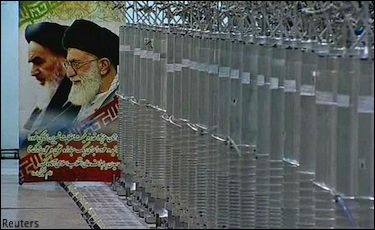
The proposed deal would also allow Iran to keep operating 6,000 centrifuges capable of producing enriched uranium, a fuel for nuclear weapons. After 15 years, Iran would be free to produce as much fuel as it wishes.
What do YOU think? Is America taking Islam seriously enough? Sound off in today’s WND poll!
Israeli Prime Minister Benjamin Netanyahu had a stark assessment of the agreement, tweeting, “A deal based on this framework would threaten the survival of Israel.”
Nonetheless, President Obama claimed the deal “cuts off every pathway” for Iran to develop a nuclear weapon. And, he insisted, “If Iran cheats, the world will know it.”
But from what Lopez surmises, whatever is in the deal is largely irrelevant, because Iran basically already has what it wants.
WND asked Lopez, if Iran already has warheads, did it buy or build them?
“I think they built them,” she said. “I don’t see how not, after this many years of working closely with other countries’ programs.”
So, if the objective wasn’t to prevent Iran from getting the bomb, why was the Obama administration so desperate to get a deal?
“To sort of rack up a political win,” said Lopez. “It’s for appearances. A political notch in the gun belt. But it’s not real. I mean, they know it’s not real.”
The administration’s eagerness for a deal was expressed as far back as January 2013, when national security council staffer Ben Rhodes told liberal activists it was as important to the president as Obamacare, saying, “This is probably the biggest thing President Obama will do in his second term on foreign policy. This is health care for us, just to put it in context.”
That zeal for a deal has made the rest of the world wary.
“What bothers me is it looks like the administration is so hungry for a deal just to have a deal so they can say they have a deal,” House Speaker John Boehner said Thursday, before the deal was announced and upon returning from a trip to Israel and five other countries in the Middle East. “The rest of the world wants something real out of this.”
“And we’re in these talks with the people who describe us as Satan, like we’re going to come to some agreement with the Iranians, while they’re spreading terror all over the Middle East,” he added.
Lopez told WND, “I’m not sure if architects of this policy agenda, including the president, actually understand the history of Islamic jihad and what it’s done in, and to, the world – especially the non-Muslim world, much of which was forcibly subjugated to Islamic rule over the centuries. Or else, how could they possibly follow such a policy?”
She also warned that the administration may not fully recognize Iran is so dangerous because it is not seeking peaceful coexistence; ultimately, it is seeking world domination and has not shied from expressing that openly.
“According to its own constitution, it is dedicated to jihad and a global Islamic government under Shariah. Its ideology says it can accelerate the return of the 12th Imam by instigating Armageddon: a frightening thought about a regime driving for a nuclear bomb.”
Lopez noted a distinct peculiarity to keep in mind when negotiating with Iran: “Islamic law obligates Muslims to lie to non-Muslims. Why on earth would anyone expect Iran, a jihad and Shariah state, to negotiate with Westerners in good faith?”
Lopez does see “a tremendous naivete about what jihad and Shariah really mean” on the part of the Obama administration.
She detects “an apparent trust that if the U.S. adopts a more accommodating attitude, well, then so will the Iranians. I’m not sure how Ivy League graduates could be so ignorant of world history. I cannot imagine they’d want to inflict the legacy of Islamic jihad on anyone if they knew what it has meant historically.”
The Washington Post reported another possible motivation for Obama to strike a deal, almost any deal, with Iran: personal pride.
“The negotiations are also personal for the president. Obama was dismissed as dangerously naive in 2007 by then-candidate Hillary Rodham Clinton for suggesting that he would engage in ‘aggressive personal diplomacy’ with Iran,” reported the paper Wednesday.
“There’s a determination to prove the Republicans wrong, and to prove the world wrong,” Julianne Smith, a former deputy national security adviser to Vice President Biden, told the Post.
Lopez enumerated four more reasons why she believed the president pushed so hard for a deal:
•Obama has decided to remove U.S. power and influence from the Middle East and North Africa.
•He has a worldview that sees America as influence for ill in the world; therefore, he must diminish that influence wherever and however possible.
•He has a worldview that sees Islam as suppressed and oppressed by Western (colonial) powers and the U.S. as the inheritor of that oppressive role.
•He has a desire to “rectify” what is viewed as “injustice” suffered by Islam at the hands of the West and has decided that best way to do that is for the U.S. to withdraw and allow and empower Islam to rise back up again to what is seen as its “rightful” place in the world.
Why does Lopez believe the evidence suggests Iran already has built nuclear warheads? Because so much of that evidence has been publicly available for so long.
In 2004, the AP reported an Iranian opposition group revealed that the regime had bought blueprints for a nuclear bomb from the same black-market network that provided Libya such diagrams, and that it was continuing to enrich uranium despite a commitment to suspend that effort.
The National Council of Resistance of Iran, or NCRI, said the diagram was provided by Abdul Qadeer Khan, the Pakistani head of the network linked to nuclear programs in both Iran and Libya.
The NCRI has a long record of providing accurate information on Iran’s nuclear weapons program.
On Aug. 15, 2002, the exiled group revealed that Iran was building two secret nuclear sites: a uranium enrichment plant at Natanz and a heavy water production plant in Arak.
In 2005, the New York Times reported senior U.S. intelligence officials provided the IEAE with the contents of “stolen Iranian laptop containing more than a thousand pages of Iranian computer simulations and accounts of experiments – studies for crucial features of a nuclear warhead.”
NPR reported that in 2006 nuclear bomb blueprints were discovered “on computers belonging to three Swiss businessmen under investigation for their ties to the smuggling ring directed by Khan,” according to former U.N. weapons inspector David Albright.
The information was made public in 2008, by which time Khan was under “house arrest for having sold nuclear secrets to Libya and other countries.”
The Guardian reported in 2006 the U.S. had evidence that Iran was designing “a crude nuclear bomb, like the one dropped on Nagasaki in 1945.”
The U.S. said bomb blueprints were “found on a laptop belonging to an Iranian nuclear engineer, and obtained by the CIA in 2004.”
Lopez said if “you read between the lines” of its report back in November 2011, it was clear that even the IAEA believed Iran had been working on a nuclear warhead as well as the explosive triggers for initiating the implosion sequence.
“So, yes, they’ve had the information how to build a warhead for a long time. They’ve had expert assistance from, at a minimum, North Korea and Pakistan,” she said. “They’re documented by the IAEA as having engaged in activities related to warhead development. There are satellite images from Parchin of what are believed to be ‘containers’ in which warhead triggers were tested. And Iranian officials have been reported present in North Korea during nuclear tests.”
Parchin is one of the sites where Iran does not permit IAEA inspectors to go.
Secretary of State John Kerry said Thursday that, under the deal, Iran would allow the IEAE to inspect anywhere it wants.
But, before the deal was announced, Lopez warned, “The whole inspection thing is kind of voluntary. The IEAE submits a request to tell the Iranians where they want to go and they can comply or not.”
Lopez described the Iranians’ transparency and honesty about its program as nonexistent. And, she noted, Iran has always avoided compliance with the international obligations it has already agreed to.
“Every single facility that we know about, publicly, in their nuclear weapons program was revealed by someone other than Iran. As a signatory to the NPT (Non-Proliferation Treaty) they are responsible for reporting to the IEAE all of their facilities and opening them up to inspection. They have never, ever volunteered admission of a single one. It all came from satellite photos, intelligence services or the Iranian opposition.”
Since satellite photography showed the structures at Parchin were designed for the testing of the explosive charges used to detonate nuclear warheads, Lopez said it begged the question: “On what do you test these explosive triggers, if you don’t have a warhead?”
Lopez said the Iranians were conducting research and development on nuclear warheads at Lavizan, the existence of which was revealed by the NCRI in 2002.
“Once it was exposed, the Iranians razed it to the ground. Leveled all the buildings, every tree, bush, and blade of grass and carted it off to I-don’t-I-know-where, and then they turned the place into a city park with picnic benches and tennis courts. This is how they act.”
Lopez said the key threshold for the Iranians is perfecting a delivery system for a warhead.
“I don’t know if they’ve married it to a missile. Until it’s on top of a missile it’s not deliverable, at least, in the usual way.”
She described Iran’s missiles as an enormous problem the West is ignoring at its own peril.
“Iran’s ICBMs are not even on the table for discussion. They are explicitly excluded from these talks.”
Furthermore, “The Pentagon has open-source reporting available now for at least two-to-three years that Iran’s ICBMs would be able to reach the continental U.S. this year, 2015. It has the range to hit the US, I don’t know about accuracy. They’ve got solid rocket-propellant fuel, all the things that help a missile increase its range.”
So, it all boils down to whether they can marry the warhead to the rocket?
“Yes.”
When they accomplish that, can they both attack Israel and launch an EMP attack over the United States?
“Yes. All they need is one missile to attack America. It wouldn’t even have to be an inter-continental missile. It could be a ‘Scud in a bucket.’ They could put a shorter range missile on a fishing trawler, park it outside the international water boundary, and send it over Kansas.”
Former CIA Director James Woolsey wrote in the Wall Street Journal in August of a study that concluded an electromagnetic pulse, or EMP, attack, which could knock out America’s electrical grid with a single nuclear explosion over the nation’s heartland, would kill up to 90 percent of the U.S. population within a year, due to starvation, disease and societal breakdown.
In other words, a single nuclear bomb would give Iran the ability to inflict an apocalypse upon the United States, and effectively destroy it, with merely the flip of a switch.
“There’s an open-source report about an Iranian military document that showed their military doctrine explicitly calls for the use of an EMP weapon against the United States. That doesn’t mean they have the capability already but they are thinking about it,” warned Lopez.
“We’re dealing with a regime that not only was responsible, in part, for collaboration in the 9/11 attacks, which has attacked, killed and tortured our people for 36 years, but is also a regime with an ideology that has a messianic and apocalyptic theology that envisions an Armageddon to bring on the end times according to their beliefs. It is also an eschatology that is absolutely imbued with Jew hatred. So, why on earth, should we negotiate with a regime like that? Knowing that, ever since the beginning, they have never negotiated in good faith. Ever.”
She clarified how different this was than negotiating with the Soviets during the Cold War because they were just as concerned about their own survival as were Americans, unlike the mullahs in Tehran.
The Cold War doctrine of deterrence relied upon the belief that neither side would launch an attack if it was assured the other side would launch an equally devastating counter-attack.
The theory was that “mutually assured destruction,” or MAD, guaranteed neither side would launch an attack because it would also be committing suicide.
However, that theory does not necessarily apply to Iran.
Lopez recalled the words of Mideast scholar Bernard Lewis that, when it comes to the apocalypse-seeking mullahs of Iran, “Mutually assured destruction is not a deterrent factor, but rather an inducement.
“And that’s how they think,” lamented Lopez. “They think they’re going to bring back the 12th imam to launch the end times, by bringing Armageddon on Earth.”
The analyst also described a number of other problems with the administration’s negotiations with Iran.
First, the U.N. Security Council has passed six resolutions demanding that Iran halt all nuclear enrichment, period.
Before the plan was announced, she observed, “All we know about the talks is what’s leaked; we don’t have an official version, but we are given to understand that our side is ready to concede that Iran may continue enriching.”
That proved to be true when it was reported the deal will allow Iran to keep running 6,000 centrifuges, and, after 15 years, as many as it wishes.
She noted the Joint Plan of Action agreed to by world powers and Iran in 2013 said very explicitly it’s envisioned that Iran will continue to enrich.
“Right there, they’ve flouted six U.N. resolutions,” she said. “Iran has 19,000 centrifuges for enriching uranium that they’ve admitted to. Only about 10,000 are hooked up and operating. The others are not attached yet. The deal will reportedly let Iran run 6,000 centrifuges, and the remainder do not have to be destroyed. All they have to do is say they unhooked them. So they don’t have to destroy any centrifuges. They don’t have to remove any centrifuges. They just have to say they unplugged them.”
Another major problem, Lopez pointed out, is that Iran already has quite a stockpile of enriched uranium, a key ingredient to a nuclear weapon.
“They diluted some of it into a less-readily accessible form, but they kept it all,” she said. “It only takes a week or two to reverse that process and get back up to enriched uranium.”
WND mentioned that Israeli Prime Minister has pointed out that any Iranian enrichment capability was an unacceptable danger. And WND recently reported that former U.N. Ambassador John Bolton was amazed the U.S. had moved from an original position, 15 years ago, of insisting Iran have no enrichment capabilities, to negotiating over how much enrichment capability the terrorist state could have.
“How do you, in negotiations, all of a sudden decide you’re going to overturn six U.N. Security Council resolutions?” asked Lopez, both rhetorically and incredulously. “What authority do they have to do that?”
And one more major problem cited by Lopez: “The Iranians reportedly are permitted to continue working on more advanced generations of centrifuges. They are developing newer centrifuges that can make more enriched uranium, faster.”
WND then pointed to yet another problem: reports that Iran is outsourcing much of its nuclear program, so that any deal struck with the West wouldn’t even cover much of the mullahs’ effort to become a nuclear power.
On Sunday, Gordon Chang wrote in the Daily Beast a description of the vast breadth of Iranian outsourcing.
North Korea and Iran announced a technical cooperation pact in September of 2012, and one month later, “Iran began stationing personnel at a military base in North Korea, in a mountainous area close to the Chinese border. The Iranians, from the Ministry of Defense and associated firms, reportedly are working on both missiles and nuclear weapons.”
“Mohsen Fakhrizadeh, thought to be Tehran’s chief nuclear scientist, was almost certainly in North Korea at Punggye-ri in February 2013 to witness Pyongyang’s third atomic test. Reports put Iranian technicians on hand at the site for the first two detonations as well.”
Chang also reported the North Koreans have also sold Iran material for bomb cores, “perhaps even weapons-grade uranium.”
Additionally, “Hundreds of North Koreans have worked at about 10 nuclear and missile facilities in Iran.”
Indications are China is cooperating with the two countries.
“There have been continual reports of transfers by Chinese enterprises to Iran in violation of international treaties and U.N. rules. Chinese entities have been implicated in shipments of maraging steel, ring-shaped magnets, and valves and vacuum gauges, all apparently headed to Iran’s atom facilities. In March 2011, police in Port Klang seized two containers from a ship bound to Iran from China.”
Chang’s conclusion about Iranian outsourcing was alarming: “[T]hey will be one day away from a bomb – the flight time from Pyongyang to Tehran – not one year as American and other policymakers hope.”
Lopez told WND, “I would say the Daily Beast story is accurate. That is my understanding of how things have been for many, many years. A working relationship between Iran and North Korea makes sense to them.”
Why?
“Iran has the world breathing down its neck. North Korea has taken itself out of the nuclear non-proliferation treaty, but Iran is still a signatory. The Iranians and North Koreans have been working together for many, many years on warheads and on missiles.”
If this information is so publicly known, why would State Department spokeswoman Marie Harf dismiss as “bizarre” reports from top analysts that Iran was likely hiding key nuclear-related assets in North Korea, and that the two regimes were transferring enriched uranium and ballistic missile technology back and forth?
“I think it is known inside the State Department, and certainly inside the INR (Bureau of Intelligence and Research), their research branch, a small division within the department that’s part of the intelligence community. They for sure know about this. Whether Marie Harf knows, maybe not.”
So, then Secretary of State John Kerry and the other negotiators know about the vast Iranian outsourcing, too?
“Of course he does! At his level, he would have to know.”
So, if the administration is not disclosing so much information about what Iran is doing behind the scenes, WND asked Lopez, would Obama would ever utilize the military option to destroy the country’s nuclear program?
“No.”
Does Israel have a viable military option?
“Yes.”
She referred to multiple reports in February that Saudi Arabia had leaked word it would let Israel fly over its airspace to attack Iran if necessary.
But does Israel have the ability to take out Iran’s radar and air defenses and reach Iranian facilities located deep underground without U.S. bunker-buster bombs?
Lopez referred to the book “A Time to Attack” by Georgetown professor and former Pentagon strategist Matthew Kroenig, which, she said, described how “Israel by itself cannot knock out Iran’s entire program or bring down the regime, the only sure way to stop the program. But if the Israelis took out four key facilities they could buy time, at least one or two years.”
As for reaching buried sites, Lopez said bunker-buster bombs might not be needed if Israel were to drop “multiple bombs down the same hole.”
Besides, they don’t need to destroy the facilities: merely collapsing the entrance of a site “would turn it into a sarcophagus.”
That, she said, would cripple Iran’s program for a while.
Would that be worth the risk of massive Iranian retaliation and a full-scale regional war?
“I think it depends on the Israeli assessment of how close they are to deliverable nuclear weapons capability. Everything depends on that assessment. If Israel thinks Iran is close, they have to go,” concluded the analyst.
“They can’t wait.”






 anneinpt
 artaxes
 danmillerinpanama
 davidking1530
 Peter Hofman
 Joseph Wouk
 Peter
Peter Louisiana Steve
 WarSclerotic
Recent Comments