Archive for July 15, 2015

World’s Greatest Generation Still Doing Great Things

July 15, 2015

Jewish peer organising rescue mission for Christians in Syria and Iraq

By Rosa Doherty, July 14, 2015 Via The Jewish Chronicle


Debt repaid many times over. [Source: Unknown]

(We are so blessed to still have these folks in our midst. – LS)

Lord Weidenfeld is funding a rescue mission of up to 2,000 Christian families from Syria and Iraq.

Weidenfeld’s Safe Havens Fund flew 150 Syrian Christians who were fleeing Daesh (sometimes known as Isis) to Warsaw on Friday to seek refuge in Poland.

But the project has faced criticism over Lord Weidenfeld’s decision not to include Muslims in the rescue effort.

The United States refused to take part and other countries made claims of discrimination.

Funding was also given by other Jewish philanthropists and charitable groups such as the JNF, and aims to offer 12 to 18 months of support to the refugees.

Lord Weidenfeld defended the project and said: “I can’t save the world, but there is a very specific possibility on the Jewish and Christian side.

“Let others do what they like for the Muslims.”

The publisher, who co-founded Weidenfeld and Nicolson in 1948, was rescued from Nazi-occupied Austria thanks to the generosity of members of the Plymouth Brethren, a Christian group, which took him in, fed and clothed him.

He said: “I had a debt to repay. It applies to so many of the young people who were on the Kindertransports. It was Quakers and other Christian denominations who brought those children to England.

“It was a very high-minded operation and we Jews should also be thankful and do something for the endangered Christians.”

The peer paid for the privately chartered plane to carry the first batch of refugees with the agreement of the Polish government and the Assad regime in Syria.

Lord Weidenfeld, 95, told the Times: “The primary objective is to bring the Christians to safe haven. Isis is unprecedented in its primitive savagery compared with the more sophisticated Nazis.

“When it comes to pure lust for horror and sadism, they are unprecedented. There never was such scum as these people.

“My main concern is — and this is terribly important for me as a member of the generation that can look back to the time before World War Two — the lack of will to defend oneself; to get boots on the ground and to get rid of these people. The lack of desire to fight the enemy, to slay the dragon in his lair.

“I am appalled by the lack of action. The brave Kurds have shown in the battle for Kobani that you can defeat them. In a disunited world, the road is wide open for the terrorists.”

He said that he hoped to mirror the work done by Sir Nicholas Winton, who helped 669 children escape from Nazi persecution.

Christians are among the religious groups who have been murdered in Daesh attacks, along with Druze, the Yazidi sect, Alawites and Shia Muslims.

There were 1.1 million Christians in Syria in 2011, but in March a report from the European Parliament said that 700,000 had fled since the start of the conflict.

‘Terrible’ Iran deal makes Israeli strike inevitable

July 15, 2015

‘Terrible’ Iran deal makes Israeli strike inevitable, BreitbartJoel B. Pollak, July 14, 2015

GettyImages-451830874-640x480

The nuclear deal reached with Iran on Tuesday is clouded by uncertainty about whether the Iranian regime will live up to its relatively weak commitments. One outcome is almost certain, however: Israel will launch a pre-emptive strike against Iran, hoping to weaken the regime and stop, or slow, its nuclear program.

Israel will attack–possibly by year’s end–because there is no other way to disrupt Iran’s advance to regional hegemony, which will become unstoppable once the deal’s provisions–especially the non-nuclear provisions–begin to take effect.

Despite what the Obama administration and its media supporters are saying, there is almost no doubt that the Iran deal, should it survive Congress, will enable Iran to become a nuclear power.

President Barack Obama himself admitted as much in April, when he defended the provisional deal signed in Lausanne by admitting it allowed Iran to reach “breakout” shortly after the ten-year (now eight-year) expiration date. The only question is whether Iran will move that date forward and risk the meager diplomatic consequences of breaking the deal.

There are Israeli analysts–a minority–who believe that Israel can live in the shadow of a nuclear-armed Iran, at least for a while. After all, Israel has developed a lethal “second-strike” capacity, in the form of nuclear missiles aboard Dolphin-class submarines programmed to target Iran. That leaves the Iranian regime to weigh the odds of surviving an Israeli counterattack versus the chances of causing the end of the world as they know it. From a fanatical religious perspective, it is a win-win scenario–but cooler, or less pious, heads may prevail.

The problem is that the Iran deal goes so much further than the nuclear issue alone. The Iranians shrewdly bargained for a host of late concessions: an end to the international arms embargo, the lifting of a ban on ballistic missile technology, and an accelerated schedule of sanctions relief that will pour over $100 billion into depleted Iranian coffers. The regime knew that Obama would not walk away–that he had committed his political career to a deal, and he was already dismissing all other alternatives, severely undermining his own leverage.

Israel just might find a way to live with a nuclear Iran, but it cannot live with a nuclear Iran and an array of turbo-charged Iranian proxies on its borders.

Iran has already renewed its support for Palestinian terror groups in Gaza, and the U.S. has quietly allowed Iranian-backed Hezbollah to regroup in Lebanon, even as it has been weakened by losses in the Syrian civil war. Flush with cash, armed with advanced new weapons, and perhaps equipped with nuclear contaminants, these groups will pose an ever-greater threat to Israel’s security–and soon.

That is why the alternative that Israeli Prime Minister Benjamin Netanyahu presented to Congress–and he did present an alternative to the present deal, though Obama pretended not to notice–included three provisions: “first, stop its aggression against its neighbors in the Middle East; second, stop supporting terrorism around the world; and third, stop threatening to annihilate my country, Israel–the one and only Jewish state.” None of those referred directly to the Iranian nuclear program. Obama ignored Netanyahu’s suggestions and forged ahead.

An Israeli strike might not stop the Iranian nuclear program. But it could stall that program, and create a renewed sense of vulnerability around the regime, which was near collapse as recently as 2009. Israel could also make Iran pay a direct cost for arming Hezbollah, Hamas, and other terror groups–a cost historically borne by the civilians of southern Lebanon or Gaza. It could project a conventional deterrent that would affect Iran here and now, as opposed to a nuclear deterrent whose effect might only be felt after an atomic exchange (i.e. not at all).

For Israel, the costs of such an attack on Iran–even a successful one–could be severe. It would be condemned and isolated internationally. It might suffer thousands of rocket attacks from Lebanon and Gaza. It may lose thousands of soldiers and civilians in a ground war.

Obviously the consequences will be less damaging–or more bearable–if the pre-emptive strike is successful. The reason Israelis are willing to take the risk at all is twofold. First, they have done it before (Iraq 1981; Syria 2007). Second, the alternative–thanks to the Iran deal–looks far worse.

The Obama administration has done all it can to prevent an Israeli pre-emptive strike, from leaking Israeli attack scenarios to denying Israel air space over Iraq. As a result, the only realistic bombing plans–whether Israel targets Iran’s nuclear and political installations directly, or detonates an electromagnetic pulse (EMP) over the country–involve a Doolittle Raid-style attack from which Israel’s pilots will not expect to return, or a landing in Saudi Arabia. The latter was once a non-starter, but–ironically–Obama’s overtures to Iran have made it possible.

The Saudis are expected to respond to the Iran deal by seeking nuclear weapons of their own. But the monarchy could also strike an alliance with Israel–perhaps even a grand bargain.

The Saudis could give Israel landing rights, logistical support, and intelligence. In return, Israel could accept Saudi Arabia’s proposal for a Palestinian state roughly along the “1967 lines”–plus Saudi control of Jerusalem’s Muslim holy sites, which would cement the royal family’s legitimacy. (Ironically, Obama, by provoking war, would enable Arab-Israeli peace.)

The clock is ticking, however. Before the Iran deal, it was thought that Israel could only carry out a pre-emptive strike in the time period before Iran actually became a nuclear power. Now, the deadlines are even shorter, and more complex.

Israel would need to attack before Russian S-300 surface-to-air missiles, already sold to Iran, can be delivered and activated. It would also need to attack while Hezbollah and Hamas are still weak, war-weary and cash-strapped–i.e. before sanctions relief delivers billions to Iran’s regional war and terror efforts.

Israel must also be wary of attacking too soon. It will not attack in the next ten days, for example, because they coincide with a religious period of mourning for historic defeats. It would also make little sense for Israel to attack while Congress is debating the Iran deal.

But Israel will attack before it loses the option. It will do so because the purpose of Israeli statehood is to enable Jews to defend themselves, and not rely on the help or mercy of others.

Obama wants to build a new legacy, but Netanyahu has inherited an old legacy–one he cannot ignore.

The Hydra has Many Heads

July 15, 2015

Nuke Deal Helps Qasem Soleimani, The Top Iranian General With ‘American Blood on His Hands’

by Shane Harris 14 Jul 2015 Via The Daily Beast


Stay scared my friends.[Source: AP]

(A lot of wounded Marines would love to even the score with this snake. – LS)

John Kerry denied it. So did Iran’s foreign minister. But the world’s most notorious spymaster stands to benefit—big time—from the accord with Tehran.

Among the big winners in the agreement to curtail Iran’s nuclear program, count a notorious and shadowy Iranian general who helped Shiite militias in Iraq kill American soldiers and who has come to the rescue of Syrian dictator Bashar al-Assad.

You’ll find his name, Qasem Soleimani, buried in an annex (PDF) of the unremittingly dense Joint Comprehensive Plan of Action, along with some of his colleagues from the senior ranks of the Iranian Revolutionary Guard Corps, as well as its various divisions and corporate fronts. They’ll all be granted some sanctions relief as part of the U.S.-brokered deal to curtail Iran’s development of a nuclear weapon.

That Soleimani—who runs Iran’s elite paramilitary and covert operations group, the Quds Force—was even on the list appeared to catch some U.S. officials by surprise. A senior administration official briefing reporters on Tuesday morning didn’t have a ready response when asked when and why Soleimani was added. Secretary of State John Kerry reportedly denied that the 58-year-old general was on the list to be freed from the sanctions yoke. Iranian foreign minister Javad Zarif, agreed, saying Soleimani—whom the U.S. accused in 2011 of plotting to launch a terrorist attack in the United States—had been confused with someone else with a similar name.

They were all wrong—or maybe didn’t want to be right. Soleimani is, in fact, on the list, a Treasury Department official later confirmed to The Daily Beast. And his presence definitely surprised some powerful lawmakers, who are already sharpening their knives for a filleting of the Iran deal.

“He’s got American blood on his hands,” Sen. John Cornyn said of Soleimani. “I’m not sympathetic to lifting sanctions on him, that’s for sure.”

“Soleimani is the guy that sent the copper-tipped IEDs into Iraq,” said Senate Armed Services Committee Chairman John McCain, referring to powerful improvised explosive devices, which Marine Corps Commandant Gen. Joseph Dunford testified last week were responsible for the deaths of 500 soldiers and Marines. “That is really unbelievable,” McCain said when asked about Soleimani’s name showing up in the bowels of the Iran nuclear deal.

And Soleimani is not alone. The man whom retired general and ex-CIA director David Petraeus once called “truly evil” is joined in the get-out-of-sancitons club by other military officers, including a Revolutionary Guard Corps general, Mohammad Reza Naqdi, who said that “erasing Israel off the map” should still be Iran’s objective, even if the country’s isn’t allowed to build a nuke.

Joining him are Brigadier General Mostafa Mohammad Najjar, a former interior minister and minister of defense who also advocated attacking Israel; Brigadier General Mohammad Naderi, who runs Iran’s Aerospace Industries Organization (also getting sanctions relief); and Brigadier General Hossein Salami, who said Iran’s quest for modern weapons was guided not by military strategy, but by religion.

There are plenty more where they came from. But why bother counting? The entire Quds Force, the Revolutionary Guard’s Air Force, and the Al-Ghadir Missile Command are also getting sanctions relief in the years to come—presuming that Iran hasn’t reneged on its commitments by then or a future U.S. president hasn’t tried to roll back the deal, as Republican contenders Scott Walker, Marco Rubio, and Rick Perry have all said they’d do if elected.

This international rogues gallery of spies, soldiers, and anti-Semites were thrown into the deal like ingredients in a stew. Who put them there is still unclear. But Kerry’s apparent misunderstanding aside, U.S. officials would have negotiated every name on the list, making it almost impossible that Soleimani was snuck in by surprise.

There are hundreds of companies, government entities, and individuals slated to get sanctions relief. “Presumably, in the beginning, the Iranians put a list across the table and said, ‘We want these people off the sanctions list,’” Zachary Goldman, a former senior official in the Treasury Department’s Office of Terrorism and Financial Intelligence, told The Daily Beast.

Goldman, who helped develop Iran sanctions policy, said that an array of U.S. government departments review such proposals, just as they do when deciding whether to impose sanctions. Obama administration officials were certainly aware of who was on the final list of the Iran agreement, Goldman added.

Sanctions relief is the very heart of the nuclear deal, but you need a panel of experts to explain how it works. Annex II, and its corresponding “attachments,” describe the international choreography by which Iran submits to a series of inspections of its nuclear facilities by United Nations experts and, in return, the United States and the European Union lift one set of sanctions after another.

There are two “phases” in which sanctions are removed. The first should come relatively soon—probably in the next few months—after Iran makes good on its commitments and the inspectors give the thumbs up. Then the Europeans and the Americans lift a raft of sanctions, mostly on companies that have had some connection to Iran’s nuclear weapons program.

Next comes phase two. That’s much later—as many as eight years from now. And this is the round where Soleimani and his IRGC buddies finally get their big day. But only the Europeans will be helping them out.

Why? The Obama administration has opted only to lift only nuclear-related sanctions, because, it says, the Iran deal is strictly limited to the country’s nuclear program, not its status as a leading sponsor of global terrorism or its abysmal human rights record. Granting concessions to Soleimani, who is accused of helping to kill American soldiers, propping up a brutal dictator who gassed his own people, and conspiring to blow up a Saudi Arabian official in a popular Washington, DC, restaurant frequented by U.S. politicians, would eviscerate the Obama administration’s entire premise in the Iran negotiations.

Why the Europeans felt fine giving Soleimani a hand is still unclear. But even those who will be unshackled from U.S. sanctions are hardly free of terrorist ties. “Some of them are also involved in terrorist activities or human rights abuses, and yet they’ve only been hit for their proliferation activities,” Matthew Levitt, the Director of the Stein Program on Counterterrorism and Intelligence at the Washington Institute, told The Daily Beast. Like them, Soleimani will have his reward, regardless of who’s giving it to him. He and his fellow generals “will almost definitely be able to open bank accounts in Europe,” Levitt noted.

Plenty of financial penalties will remain in place. But Obama officials are sensitive to any lightening of Soleimani’s load.

“His designation under U.S. sanctions will in no way be impacted by the Joint Comprehensive Plan of Action reached today,” the Treasury Official said. She added that “secondary sanctions remain in place on the U.S. side,” which means that anyone or any company doing business with Soleimani can also be penalized.

Even if sanctions aren’t lifted on Soleimani and the Iranian military establishment right away, however, they will undoubtedly reap some short-term benefit. Iran has billions in frozen assets that, once thawed, the regime could pour into military adventures and terrorist plots.

“We are of course aware and concerned that, despite the massive domestic spending needs facing Iran, some of the resulting sanctions relief could be used by Iran to fund destabilizing actions,” a State Department official recently told The Daily Beast.

Such is the price of a deal. Whether the United States comes to regret paying it, we’ll find out. Maybe in eight years.

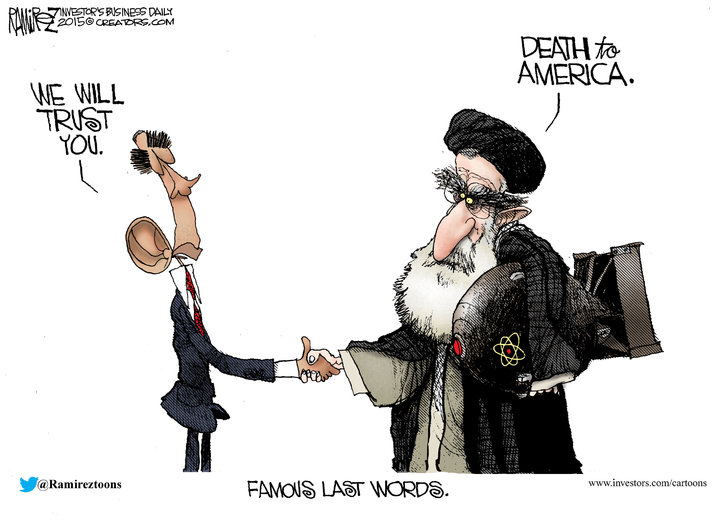
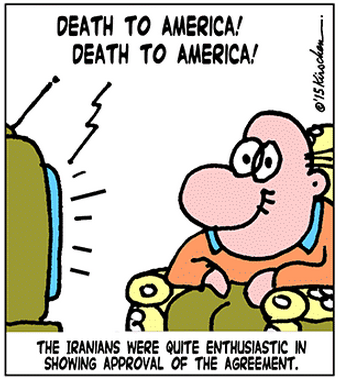
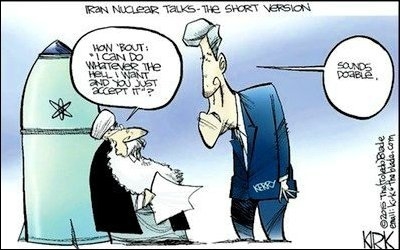
Cartoons of the day

July 15, 2015

H/t Joopklepzeiker

IRAN-OABMA
 
screenshot_139

H/t Middle East Forum

1498


Dershowitz: Does this deal prevent Iran from developing a nuclear weapon?

July 15, 2015

Dershowitz: Does this deal prevent Iran from developing a nuclear weapon? – Middle East – Jerusalem Post.

There is an enormous difference between a deal that merely delays Iran’s development of a nuclear arsenal for a period of years and a deal that prevents Iran from ever developing a nuclear arsenal.

Does the proposed deal with Iran actually prevent the Mullah’s from ever developing a nuclear weapon? Or does it merely delay them for a period of years? That is the key question that has not yet been clearly answered.

In his statement on the deal, US President Barack Obama seemed to suggest that Iran will never be allowed to develop a nuclear weapon. He said that this “long-term deal with Iran… will prevent it from obtaining a nuclear weapon.” He then repeated this assurance: “because of this deal, the international community will be able to verify that the Islamic Republic of Iran will not be able to develop a nuclear weapon.” These seemingly categorical statements were intended to assure the world that Obama would keep his earlier promise that Iran will never be allowed to develop nuclear weapons.

But is that what the deal itself does? Or, as stated by its critics, does it actually assure that Iran will be allowed to develop a nuclear arsenal after a short delay of several years? That is the key question that the Obama administration has refused to answer directly. It must do so before Congress can be asked to buy a pig in a poke for the American people.

There is an enormous difference between a deal that merely delays Iran’s development of a nuclear arsenal for a period of years and a deal that prevents Iran from ever developing a nuclear arsenal. Prime Minister Benjamin Netanyahu and many other critics of this deal describe it as merely a delay, while the Obama administration seems to be suggesting by its rhetoric that the deal will prevent Iran from ever obtaining a nuclear weapon.

The devil is not so much in the details as in the broad outlines of this deal and its understanding by the parties. Does it or does it not allow Iran to develop nuclear weapons after a relatively short moratorium? Iran certainly seems to believe that it does, Israel certainly believes that it does, and many in Congress—both Republicans and Democrats– seem to believe that it does. But the President seems to be telling the American public and the world that these critics are wrong: that Iran will never be allowed to develop a nuclear weapon under this deal. Yet, just a few months ago, he seemed more cautious and candid in discussing his “fear” that “in year 13, 14, 15, they have advanced centrifuges that enrich uranium fairly rapidly, and at that point the breakout times would have shrunk almost down to zero.” He also said that we have assurances of a yearlong breakout time “for at least well over a decade,” implying that after that indeterminate time frame, the assurances will no longer be in place. Obama’s statement, despite its confusing and ambiguous context, has raised deep concerns among critics of the deal. Moreover, the text of the deal includes time frames of eight-and-a-half years, 10 years and 15 years, which also generates confusion at a time when clarify is essential.

So which is it? Congress has a right to know, and so do the American people. Is it a postponement for an uncertain number of years – eight-and-a-half years, 10, 13, 14, 15—of Iran’s ability to develop a nuclear weapon? Or is it an assurance that “Iran will not be able to develop a nuclear weapon?”

The Obama administration insists that this is not a “treaty,” but rather a “deal.” A deal is a contract, and for a contract to be valid there must be a “meeting of the minds.” But has there been a meeting of the minds over the central issue of whether this deal allows Iran to develop a nuclear weapon after a moratorium whose precise time frame is unclear? And if there has been a meeting of the minds over this issue, what exactly is it?

Certainly the words of the Iranians are not the same as the words of Obama. Whose words accurately represent the meaning of the contract we are being asked to sign?

The time has now come to be crystal clear about the meaning of this deal. If it is intended to prevent Iran from ever developing nuclear weapons, the President must say so in the clearest of terms and he must get the Iranians to express agreement with that interpretation. Ambiguity may be a virtue at the beginning of a negotiation, but it is a vice in interpreting and implementing a deal with such high stakes.

Recall that former US President Bill Clinton made similar assurances with regard to North Korea back in 1994 – as the accompanying chart shows. But within a few short years of signing a deal that he assured us would require the dismantling of North Korea’s nuclear program, that country tested its first nuclear weapon. It now has a nuclear arsenal. How can we be sure that Iran will not act in a similar fashion?

The deal with Iran has been aptly characterized as a “leap of faith,” “a bet” and a “roll of the dice” by David Sanger in a news analysis for the New York Times. The gamble is that by the time the most restrictive provisions of the deal expire, Iran will be a different country with more reasonable leaders. But can the world and especially the nations most at risk from an Iranian nuclear arsenal, depend on faith, bets and dice, when they know that the last time the nuclear dice were rolled, they came up snake-eyes for America and its allies when North Korea ended up with nuclear weapons.

The burden of persuasion is now on the Obama administration to demonstrate that Obama was accurately describing the deal when he said that it will “prevent” Iran from “obtaining a nuclear weapon.” It is a heavy burden that will be – and should be – difficult to satisfy.

Alan M. Dershowitz is Professor Emeritus at the Harvard Law School and author of Taking the Stand: My Life in the Law.

Nuclear deal pushes Israel aside in Washington, raises Iran to leading US partner and ally

July 15, 2015

Nuclear deal pushes Israel aside in Washington, raises Iran to leading US partner and ally, DEBKAfile, July 15, 2015

Benjamin_Netanyahu-Iran_14.7.15Binyamin Netanyahu: Powers gambled on our future

Israeli Prime Minister Binyamin Netanyahu bitterly accused the “leading international powers of gambling our collective future on a deal with the foremost sponsor of international terrorism” – roundly condemning all six world powers who signed the nuclear deal with Iran in Vienna Tuesday, July 14.

President Barack Obama topped the list. Netanyahu pointed out that the president had determined on a deal with Iran at any price before he took office, which is true. Therefore, it had nothing to do with the poor relations between himself and the US President, he said in answer to critics. It was now time for Israeli leaders to set aside differences and pull together, he said. Opposition leader, the Zionist Union’s Yitzhak Herzog, agreed and said he was enlisting for the necessary effort on behalf of Israeli security. Tuesday night he received an update on the situation from the prime minister.

The special security cabinet meeting, called to discuss the ramifications of the nuclear deal, hours after it was signed, unanimously rejected it and declared “this deal does not commit Israel.”

Unfortunately, Israel was never asked for its commitment, any more than the other Middle East powers directly affected by it. The cabinet statement was therefore no more than a meaningless expression of futility, a sensation shared equally by Saudi King Salman and Egyptian President Abdel-Fatteh El-Sisi, in the face of the iron wall Obama and Secretary of State John Kerry have built for Iran in the region.

Both unceremoniously ditched Israel and its Arab neighbors in order to join hands with Iran. By this reshuffle of allies, Washington has created a new geopolitical reality in the region at the expense of its equilibrium.

The US Congress has 60 days to review the nuclear accord and reach a decision. But if Netanyahu had had any hopes of swinging the Senate around to voting down the veto President Obama promised to impose to mullify its rejection, that hope swiftly vanished in thin air. Leading presidential contender Hillary Clinton announced that if she wins the 2016 election she would abide in full by the nuclear accord Obama signed with Iran. This announcement assured Obama of a Senate majority.

The dead end reached by Netanyahu on this issue also symbolizes the end of Israeli’s special standing in Washington as “America’s leading Middle East ally.”

Iran has stepped into this position. There is little point in Israel knocking on the White House door to renew the old understanding and sympathy, as advised by former prime minister Ehud Barak and others. It does not matter who sits in the prime minister’s office in Jerusalem, as matters stand now, he/she will find themselves on the wrong side of that door.

Defense Secretary Ashton Carter will visit Israel next week. But that is only an attempt to soften the blow.

This does not mean that the Obama administration will totally abandon Israel, only that it will no longer enjoy favored status compared with other Middle East nations. By ditching the Arab world, Obama equally dumped the Palestinian issue. This has some advantages for the Netanyahu government, but is not the end of the world for the Palestinians. They, like Arab governments, have the option of seeking an understanding with Tehran, whereas that door is shut tight against Israel.

In this situation, Israel’s quiet understandings with a number of Arab leaders directed at forming a bloc to counter the US-Iran alliance, have no immediate future. When the earth shakes in a major upheaval, each individual is out to save himself and has no time to look around for allies.

In some ways, the Netanyahu government may find relief in being released from the political and strategic constraints bound up in the relationship with the Obama administration, and find the freedom to be more pragmatic and independent in its policy-making.

After all, Israel still has the strongest army and the most vibrant economy in the Middle East. Its leaders must learn to use those huge assets wisely and independently of the Obama administration.

Megyn Kelly on the catastrophic Iran deal

July 15, 2015

▶ Megyn Kelly on the catastrophic Iran deal – YouTube.


Key Nuclear Installations Missing from Iran Deal

July 15, 2015

Key Nuclear Installations Missing from Iran Deal, Israel National News, Ari Yashar, July 15, 2015

Parchin site(1)Suspicious activity at Parchin (illustration)Reuters

As experts got a chance to examine the details of the 159-page Iran nuclear deal signed Tuesday, they warned that it ignores various key aspects of the Islamic regime’s nuclear program, and that the lifting of arms sanctions may pave Iran’s path to nuclear-capable missiles.

A glaring omission is seen in the absolute lack of any reference to the highly covert Parchin military base located southeast of Tehran, which is suspected of being the center of Iran’s secret nuclear weapons program, according to the International Atomic Energy Agency (IAEA).

Iran has admitted to testing exploding bridge wire nuclear detonators at the site, and reports tied the Parchin base to Iran’s nuclear program following a mysterious explosion at the site last October.

IAEA reports in November 2011 pointed to nuclear weapons development previously conducted at the site, and a 2012 IAEA report likewise confirmed explosives containment vessels were at the site and likely used to test nuclear detonations. Satellite photos have shown Iran has been modifying the site, possibly expanding the tests and covering up their existence.

Iran has repeatedly refused IAEA requests to inspect Parchin. IAEA chief Yukiya Amano announced on Tuesday that in addition to the nuclear deal, a “road map” agreement was sealed, by which Iran will disclose military aspects of its nuclear program by October 15.After this, Amano will write an assessment of Iran’s claimed disclosures by December 15 “with a view to closing the issue.”

Amano said the agreement would include a visit to Parchin, but it remains to be seen how much time Iran will have to prepare for such a visit and possibly hide evidence of nuclear tests; Iranian officials rejected last-minute reports that inspections would be allowed at all covert sites.

IAEA roadmap: putting the cart in front of the horse

Thomas Moore, an arms control specialist and staff member of the SenateForeign Relations Committee, told Washington Free Beacon that the IAEA “road map” should have taken place before the nuclear deal, and not after it.

“The IAEA’s resolution of the possible military dimensions of Iran’s nuclear program should precede the deal, not by months but by as much time as it takes to verify the absence of Iran’s (past military work), including the full historical picture of its program. And the deal does not do that,” said Moore.

Not only does the deal not directly address military aspects of Iran’s nuclear program, critics warn it contains several loopholes that will greatly limit its effectiveness in stopping Iran’s march to a nuclear weapon.

For one, the agreement calls for Iran’s “voluntary” compliance with the terms of the deal in several places, instead of implementing mandatory steps Iran must fulfill. It also outlines a convoluted bureaucratic process to confront Iranian violations, reports Washington Free Beacon.

What’s more, a section of the deal may allow Iran to avoid revealing its past nuclear weapons testing, stating that Iran “may propose to the IAEA alternative means of resolving the IAEA’s concerns that enable the IAEA to verify the absence of undeclared nuclear materials and activities or activities inconsistent with the JCPOA (Joint Comprehensive Plan of Action) at the location in question.”

The deal also includes removing a large number of sanctions, including those targeting Parchin Chemical Industries (PCI), which operates sites at the Parchin base and is thought to be highly involved in the covert nuclear weapons program.

“Iran can get its first bombs in weeks”

Aside from Parchin, experts were alarmed to see that the nuclear deal does not directly impose limits on or even reference the Russian-made Bushehr nuclear power plant, which they warn can produce enough plutonium for a large number of atomic weapons.

Henry Sokolski, director of the Nonproliferation Policy Education Center, told Washington Free Beacon that Bushehr’s exclusion from the deal was a mistake.

“That reactor can produce enough plutonium for dozens of bombs per year,” warned Sokolski. “Iran could remove the fuel from the reactor and use a small, cheap reprocessing plant to extract plutonium, and get its first bombs in a matter of weeks.”

Regarding plutonium, after 15 years the deal stipulates that Iran will be able to “engage in producing or acquiring plutonium or uranium metals or their alloys,” and likewise conduct research and development “on plutonium or uranium (or their alloys) metallurgy, or casting, forming, or machining plutonium or uranium metal.”

At the Natanz nuclear facility, a limitation on 5,060 centrifuges in 30 cascade units will cease in ten years, and after 15 years Iran will be able to enrich uranium over 3.67% – a 20% enrichment is needed to build nuclear weapons. In eight years, Iran can start producing up to 200 partial advanced centrifuges each year, and two years later it can construct complete advanced centrifuges.

Sokolski warned that “ultimately, this is a gamble on Iran not wanting to make bombs. If they really don’t, the deal will work. If they do, the fine print won’t stop them.”

Nuclear-capable missile sanctions lifted

In addition to the details on Iran’s nuclear program, experts warn there are pitfalls in how the deal approaches – or ignores – Iran’s nuclear-capable missile program. Notably the deal avoids addressing Iran’s ICBM (intercontinental ballistic missile) program.

It also removes sanctions against Iran’s Al Ghadir missile command based in Tehran, which has been leading the development of missiles capable of delivering a nuclear warhead, and is thought to hold operational control of Iran’s missiles.

A UN conventional arms embargo on Iran will end in five years due to the deal, and sanctions against selling ballistic missiles to Iran will likewise expire in eight years. However, it is possible that China and Russia will covertly sell arms to Iran before those dates, as they have done in the past.

Fred Fleitz, who has formerly served as a CIA analyst, State Department arms control official, and House Intelligence Committee staff member, told Washington Free Beacon that these facets of the deal will allow Iran to arm itself freely.

“Language on lifting conventional arms and missile embargoes is very weak,” stated Fleitz.

“The IAEA simply has to certify that Iran isn’t currently engaged in nuclear weapons work to lift these embargoes early. The IAEA will be hard pressed to find evidence of this and will probably issue a report allowing these embargoes to be lifted early,” he concluded.

Netanyahu on Iran deal: The more you read it, the worse it gets

July 15, 2015

Netanyahu on Iran deal: The more you read it, the worse it gets | The Times of Israel.

Inspections clause is farcical, sanctions snap-back clause is incomprehensible, and a major Iranian terror chief, Qassem Soleimani, has been removed from the terror list, PM protests

July 15, 2015, 3:50 pm Prime Minister Benjamin Netanyahu speaks to the Knesset during a ceremony to swear in the new government, May 14. 2015. (Knesset spokesperson)

Prime Minister Benjamin Netanyahu speaks to the Knesset during a ceremony to swear in the new government, May 14. 2015. (Knesset spokesperson)

Prime Minister Benjamin Netanyahu said Wednesday that perusal of the previous day’s nuclear deal with Iran yields a picture that grows ever bleaker.

The agreement is “filled with absurdities,” Netanyahu said, scolding world leaders for caving in to Iran’s “charm offensive” and crediting Israel with leading the fight against an Iranian bomb.

He called on the Knesset to present a united front in the fight against the “bad in every respect” pact. “The agreement that was signed in Vienna is not the final word. We will continue to fight,” Netanyahu pledged.

Iran and the world powers signed an agreement Tuesday in Vienna that mandates the Islamic Republic scale back some of its nuclear capabilities in exchange for a rollback of economic sanctions.

“When we examine this agreement — which is bad in every aspect — when we read this agreement, the picture becomes more bleak and we discover it’s filled with absurdities,” Netanyahu said.

“For example, the agreement gives Iran 24 days’ [notice] before an inspection; it’s like they offer the service free of charge that produces drugs a 24-hour warning before performing a search,” he said.

Chief of the Quds Force of Iran's Revolutionary Guard, Qassem Soleimani, attends a meeting of the commanders of the Revolutionary Guard in Tehran, Iran, September 17, 2013. (photo credit: AP/Office of the Iranian Supreme Leader, File)

“In addition, the sanction snap-back mechanism is so complicated and serpentine that one needs a PhD to understand it. One clause creates a huge incentive to invest in Iran because it says that the reinstatement of sanctions will not apply to agreements that have [already taken place]. Another section includes the people that were removed from the sanctions list, one of them being Qassem Soleimani, head of Iran’s global terror arm. It is absurd, terror [meets] nuclear [power],” he said, referring to the commander of Iran’s elite Quds force.

According to Netanyahu, Western leaders were too easily beguiled by the Iranian regime, and if not for Israel’s efforts, Tehran would already possess a bomb.

“There is a willingness in the West to accept despotic regimes and seek peace at any price. Not all of them have internalized the lessons of history. Even today, the powers are won over by a charm offensive. I am not saying that we are in 1938 for two reasons; firstly, back then, no precedent existed for what was to occur, while today that [precedent] exists; secondly, today we have a state, while then we didn’t, and its purpose is to to act against those that threaten it,” Netanyahu said.

“If not for the efforts made by Israel, Iran would have already had the ability to arm itself with nuclear bombs. We exposed the Iranian issue on the international stage. We led the implementation of biting sanctions that brought Iran to the negotiating table. We set before Iran a red line on the issue of uranium enrichment which it has not yet crossed,” he said.

“One who speaks truth about this agreement is the president of Iran, who said that Iran has achieved all its objectives,” Netanyahu said, referring to President Hassan Rouhani who said Tuesday following the deal that “all the four objectives have been achieved.”

“We are not committed to this agreement and will continue to oppose it. For existential [threats] there is no coalition or opposition. We need a united front to ensure our survival,” Netanyahu said.

Maybe They Just . . . Forgot To?

July 15, 2015

Maybe They Just . . . Forgot To? National Review, Patrick Brennan, July 14, 2015

(Here’s a video of  Mr. Rhodes explaining that we never sought anywhere, anytime inspections:


Unfortunately, as I observed here, the November “Joint plan of action” did not contemplate investigation of Iran’s military sites,  possible military uses or development of nukes, other than by limiting uranium enrichment. — DM)


In April:

Secretary of Energy Ernest Moniz on Iran nuke inspections: “We expect to have anywhere, anytime access.” April 20 ’15 http://www.bloomberg.com/politics/articles/2015-04-20/inspectors-need-full-access-in-any-iran-nuclear-deal-moniz-says 

Ben @rhodes44 told the Israeli people today on TV that framework agreement w/ Iran has snap inspections. “Anywhere, any time”. Quite a claim