Archive for May 2015

Exclusive: Iranian embassy blown up in Damascus: Nusra Front suspected

May 21, 2015

Exclusive: Iranian embassy blown up in Damascus: Nusra Front suspected.

DEBKAfile Exclusive Report May 21, 2015, 1:11 AM (IDT)
Iranian embassy in Damascus - before bomb blast

Iranian embassy in Damascus – before bomb blast

A mighty explosion struck the Iranian embassy in Damascus Wednesday night, May 20, debkafile’s exclusive intelligence and counter-terrorism sources reveal. First reports are of “heavy casualties” and serious damage to the embassy compound. The Iranian and Syrian governments have clamped a curtain of secrecy down over the disaster, although the thunder of the explosion and rush of special forces and relief teams to the scene in the Syrian capital could not be concealed.

debkafile’s sources add: The explosion has initially been attributed to the Syrian arm of al Qaeda, Jabhat al-Nusra. A day earlier, Tuesday, Ali Akbar Velayati, senior adviser to Iran’s supreme leader Ayatollah Ali Khamenei was known to be present at the embassy building in Damascus. It is not known whether he was still there when the explosion occurred or had meanwhile departed for Tehran.

The Iranian embassy is a pivotal point for the Syrian conflict. As the Revolutionary Guards general staff center, it is the venue for the joint Iranian-Syrian military and logistic decisions taken in the conduct of the war. It also served as the Iranian command center for its operations in Lebanon, including military liaison with the Lebanese Hizballah, whose forces are fighting with Bashar Assad’s army in Syria. From there, Al Qods Brigades chief Gen. Qassem Soleimani issued his war directives when he was present in the Syrian capital.
The embassy building was therefore one of the most heavily fortified and guarded premises in the Syrian capital.
Its destruction by a bomb explosion came on the heels Wednesday of the fall of the ancient city of Palmyra to the Islamic State – the second devastating blow for the Assad regime and its backers in a single day. The fate of its rare heritage sites is not the only concern. With Palmyra ((Tadmor – est. pop. 120,000), the Islamic State also gained access to important military sites, including the biggest Syrian air force base.

The disaster may be compared to the ISIS conquest in January of the northern Syrian town of Raqqa, today the Islamists’ headquarters in the country. Palmyra is the second major Arab city to fall to the group this week after the Iraqi town of Ramadi on Sunday.

For Iran, the loss of Palmyra is a major setback in the sense that it removes from Syrian military control the main air base where Iranian flights delivered war materiel for the Syrian army and Hizballah day by day.

Once Again, Iran Blinks First

May 20, 2015

UN Says Iranian Ship With Yemen Aid Heading to Djibouti
UNITED NATIONS — May 20, 2015, 12:56 PM ET Via AP


(Wise decision on the part of Iran. – LS)

The United Nations says an Iranian ship with humanitarian supplies for Yemen is heading to Djibouti where the U.N. has its hub for the distribution of aid to the conflict-torn country.

U.N. deputy spokesman Farhan Haq said Wednesday the U.N. received word from the Iranian government that the ship “will proceed to Djibouti.” It was originally reported to be heading to Yemen’s Hodeida port.

Haq said given concerns about the situation on the ground in Yemen, Secretary-General Ban Ki-moon has urged all countries and organizations to arrange aid deliveries with the U.N. to Djibouti for onward distribution in Yemen.

Earlier Wednesday, Iran’s Deputy Foreign Minister Hossein Amir Abdollahian told the semi-official ISNA news agency that the vessel Nejat, or Rescue, will travel to Yemen in “full coordination with the U.N.”

The Pope and the Palestinians

May 20, 2015

The Pope and the Palestinians, Front Page Magazine, May 20, 2015

(The article also deal with Islam in general, as to which the Pope’s fantasies reflect those of the Obama Administration and others. — DM)

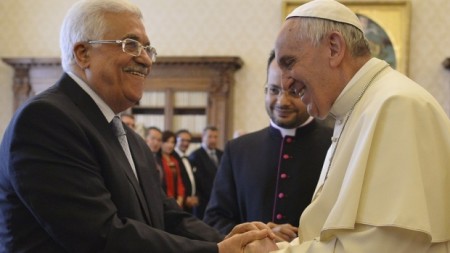
francis-and-abbas-450x253

Perhaps the ultimate expression of this faith in Islam was Pope Francis’ assertion in Evangelii Gaudium that “authentic Islam and the proper reading of the Koran are opposed to every form of violence.”

**************************

Contrary to reports in the mainstream press, Pope Francis did not call Palestinian Authority leader Mahmoud Abbas “an angel of peace.” The correct translation of the pope’s words is “I have thought of you: that you could be an angel of peace.”

Why, then, was it so easy to believe the initial reports? Perhaps because the initial reports seemed to align with previous papal overtures to Palestinian leaders. Pope Francis had previously called Abbas a “man of peace,” he has shown sympathy for Palestinian grievances, and other popes have given the appearance of lending legitimacy to the Palestinian cause. For example, Pope John Paul II is reported to have received PLO leader Yasser Arafat on twelve different occasions.

Arafat was a terrorist. One would think that the Vatican would have wanted to limit its contacts with him. The same goes for Abbas. He has repeatedly honored and praised Palestinian “martyrs” who have slaughtered innocent Jews. There is evidence that he helped fund the 1972 operation that killed eleven Israeli athletes at the Munich Olympic Games. Why is he accorded such a cordial reception at the Vatican?

Although the Church has often declared its spiritual bond with Jews, it has had a less harmonious relationship with the nation where approximately half the world’s Jews now reside. The Vatican was the last Western government to accord diplomatic recognition to the State of Israel (in 1993). In addition, on several occasions, prominent prelates have likened Israel to King Herod, the murderer of innocents; and others have accused Israel of being an apartheid state. Meanwhile, Catholic NGOs such as Pax Christi and Trocaire have been major players in the boycott, divest, and sanctions campaign against Israel.

Of course, the BDS campaign directly impinges on Israeli security. So do the calls by numerous Christian leaders to tear down the security barrier that divides Israel from the West Bank. On his trip to the Holy Land a year ago, Pope Francis allowed himself to be photographed in prayer at a section of the wall where a large graffiti message compared Bethlehem to the Warsaw Ghetto. In a naïve gesture of solidarity with Palestinians, the pope was unwittingly lending credence to the idea that the Israelis could be compared to the Nazi occupiers of Poland.

The wall was constructed to prevent suicide attacks against Israeli citizens. It’s estimated that its construction has saved thousands of lives. To suggest that the wall is offensive, as many Christians have done, is to suggest that Jewish lives don’t matter. Moreover, such judgments betray an entirely lopsided view of the situation. Take the Gaza conflict. The Catholic hierarchy typically had little to say about the daily rocket barrages launched against Israeli citizens from Gaza, but it was quick to condemn Israel on those occasions when it finally retaliated. In a similar vein, Fouad Twal, the Latin Patriarch of Jerusalem, blamed last year’s Gaza war on the Israeli embargo which, he said, had turned Gaza into “a factory of desperate people, designed to easily turn into extremists.”

In short, many Catholic leaders have shown a tendency to blame Israel for defending itself. The implication, of course, is that there would be no need for defense if Israel would only go to the peace table and make the concessions demanded of it by the Palestinians. The Vatican’s recent recognition of the “State of Palestine” reflects this naïve view of the situation. The supposition is that the Palestinians only want to be left in peace, whereas there is abundant evidence that the deepest desire of Palestinian leaders is for the extermination of Israel. Have Vatican officials never seen the photos of Abbas holding up a map of Palestine that encompasses all of the territory currently known as Israel? Are they unaware that he has personally called for a Palestine that is Judenrein? Didn’t they notice that when Israel gambled on disengaging from the Gaza Strip in 2005, Gaza soon turned into a terrorist state governed by an obsession to destroy Israel?

From the Israeli point of view, the call to cooperate with the Palestinian “peace” agenda is a call to cooperate in its own demise. Whenever I hear a UN representative or a Vatican spokesman call for peace talks between Israel and Palestine, I think of that scene from Goldfinger in which James Bond is about to be sliced in two by a laser beam. “Do you expect me to talk?” he asks. “No, Mr. Bond,” replies Goldfinger, “I expect you to die.” The Vatican hasn’t yet grasped the point that the Palestinian leadership doesn’t want the Israelis to talk, it wants them to die.

By words and by actions, the Vatican continues to suggest that there is a moral equivalence between Israel and the Palestinian Authority. This policy not only does a disservice to Jews, it also does a disservice to Catholics and other Christians. The main effect of the moral equivalence stance is to sow confusion among Catholics at a time when they need to be clear and unconfused—clear about Islam, that is. The Vatican policy toward Palestine reflects it overall stance toward the Islamic world. In other words, let’s overlook the dark side—the terrorism, the anti-Semitism, the oppression of Christians and other minorities—and let’s put the best face on the Mohammedan faith. For the sake of peace. And also for the sake of maintaining the threadbare narrative that Islam is a close cousin of Catholicism and, therefore, a religion of peace. Perhaps the ultimate expression of this faith in Islam was Pope Francis’ assertion in Evangelii Gaudium that “authentic Islam and the proper reading of the Koran are opposed to every form of violence.”

How well has this policy worked? Not very. Catholics and other Christians who lived in Muslim lands and who took seriously the Catholic version of “this has nothing to do with Islam” soon found that the tiny minority of misunderstanders were legion and had murder on their minds. Many found out too late. Years of indoctrination in the myth of Islam’s pacific nature had left them unprepared for the violence. Not that the Church was the only culprit. The secular opinion-makers had been preaching the same gospel. The irony is that the Church wants Israel to adopt the same policy of make-believe about Islam that has contributed to the death and displacement of millions of Christians.

The policy requires an almost total denial of facts. In the case of the Arab-Israeli crisis it means ignoring the terrorist ties of the Palestinian government, its unity coalition with Hamas, the massive state-sponsored indoctrination of Palestinian children, and the oft-stated goal of eliminating Israel. Ironically, it also necessitates that one ignore the ongoing persecution of Christians in the Palestinian territories.

The Palestinian leaders do a good job of hijacking Christian themes and imagery in order to gull Christians into thinking that they are, indeed, brothers in Christ. Thus, Palestinians have milked the massacre-of-the-innocents meme for all its worth. They also like to claim that Jesus was the first Palestinian. Another favorite theme is that the Palestinian people are the “new Jesus” who is being crucified by the Israelis.

Many in the Catholic hierarchy seem to fall for the ruse, but the steady exodus of Christians from the Palestinian territories tells a different story. The overall population of Christians in the Palestinian areas has declined from 15 percent in 1950 to 2 percent today. After the Palestinian Authority took control over Bethlehem in 1995, the Christian population there declined by half. In the Gaza Strip, only a few hundred Christians remain. That’s because Christians in Palestine, like Christians in most Muslim-majority societies, are treated as second-class citizens—subject to rape, intimidation, and legalized theft.

Meanwhile, the Christian population of Israel continues to grow. Palestinian Christians want to live there and so do persecuted Christians in other parts of the Middle East. Despite years of propaganda to the contrary, they have come to realize that Israel is a safe haven in a world of Islamic chaos.

Do Christians who migrate to Israel know something that the Vatican doesn’t know? The facts are there for everyone to see, but not everyone sees them. Why do Catholic leaders persist in assigning moral equivalence when there is no moral equivalence? Normally, a belief in moral equivalence grows out of a relativistic outlook. But presumably we can rule that out in the case of Catholic prelates. A more likely cause of their moral neutrality is a misapplication of the principle of “judge not.” Christians today are highly conscious of the sins of Western civilization and are therefore reluctant to judge those who lie outside it—in this case, Muslims. However, the principle is meant to apply to judgments about the state of an individual’s soul, not his behavior. And it was never meant to apply to withholding judgments about ideologies and belief systems.

The reluctance to see the mote in the other’s eye can eventually slide over into willful blindness. There are numerous warnings in the New Testament about spiritual blindness and they apply to those within the Church as well as to those without. The big danger for Church leaders is not that they will be seen as judgmental in the eyes of the world, but that they will be seen as foolishly naïve in the eyes of history.

“First comes Saturday, then comes Sunday” is a well-known slogan in the Middle East. It means that after the Islamists finish with the Jews, they will come after the Christians. The fate of the Saturday people and the Sunday people is intertwined. And the fate of both is put in jeopardy when Christian leaders insist on holding on to a fantasy-based picture of Islam.

Promises are Made to be Broken and Lies are Meant to be Kept

May 20, 2015

US, Israel said to discuss ‘compensation’ in wake of emerging Iran deal


(While increasing U.S. military aid to Israel is a good thing, tying it to a bum deal is not. If I had a say, I would take the deal and get all I can in terms of military hardware and technology. Afterall, bad deals never last, including one with Iran and including Obama’s term in office. – LS)

Additional F-35 jets, anti-missile defense batteries reportedly part of package to win Israel’s quiet acceptance of nuclear accord, Israeli media reports.

Israel and the US were reportedly holding preliminary and unofficial talks over a “compensation” package for Jerusalem that would include the delivery of advanced weapons in exchange for the Netanyahu government’s quiet acceptance of the emerging nuclear deal with Iran.

The package could include an increase of the amount of F-35 fighter jets the US was set to supply Israel with and additional batteries for Israel’s anti-missile defense systems, according to reports in both Haaretz(Hebrew) and Yediot Ahronoth this week.

A senior Obama administration official told Yediot that “the White House is willing to pay a hefty price to get some quiet from the Israelis at this point. We are surprised the demand has not been made.”

But the newspaper also quoted an unnamed Israeli source as conveying a more ambivalent stance about the reported talks.

“If we come with demands at this point, it would mean that we have given up our objections to the deal, and now it is just a matter of at what price. If Israel believes that the deal is bad for its security, it cannot appear as someone who gave up in the end,” the paper quoted the source as saying.

According to the reports in both Haaretz and Yediot, the US-Israel talks revolved around enhancing a previously negotiated deal to supply Israel with 33 F-35 aircraft, the first batch of which was expected next year. The total number of jets could go up to 50, Haaretz reported.

Israel was also said to be asking for more Iron Dome batteries, additional assistance with the Arrow 3 missile system developed jointly by the US and Israel, and possibly, for the purchase of technological systems for intelligence gathering.

Earlier this month, the US House of Representatives Armed Services Committee approved $474 million for Israel’s anti-missile systems.

Included in the US-Israel cooperative missile defense funds is $41.4 million for the short-range Iron Dome rocket defense system, $165 million for David’s Sling, another short-range system, and the longer-range Arrow-3 missile defense programs, as well as $267.6 million in research and development funds.

Israel has been a very vocal opponent of the nuclear deal the US-led P5+1 world powers are negotiating with Iran ahead of the June 30 deadline for an agreement. Prime Minister Benjamin Netanyahu has warned that the deal paves the way for Iran to acquire nuclear weapons and that Israel’s very survival would be at stake.

“We oppose this deal and we are not the only ones,” Netanyahu said on Sunday, noting that regional Arab, largely Sunni Muslim states are also skeptical of the deal. “It is both necessary and possible to achieve a better deal because extremists cannot be allowed to achieve their aims, not in Iran, not in Yemen and not in Jerusalem.”

Arab states of the Gulf fear a nuclear deal could be a harbinger of closer US ties with their Shiite arch-foe Iran, a country they also see as fueling conflicts in Yemen, Syria and Iraq.

US President Barack Obama tried to reassure America’s Gulf allies at a Camp David summit last week that engaging with Iran would not come at their expense. These states were also reportedly negotiating their own “compensation packages” involving advanced equipment and weaponry from the US to counter the perceived Iranian threat.


As talks resume, Iran vows no inspection of military sites

May 20, 2015

As talks resume, Iran vows no inspection of military sites | The Times of Israel.

Supreme leader says he won’t allow Iranian scientists to be ‘interrogated’ by foreigners

May 20, 2015, 1:47 pm
Iran's Supreme Leader Ayatollah Ali Khamenei (screen capture: YouTube/PressTVGlobalNews)

Iran’s Supreme Leader Ayatollah Ali Khamenei (screen capture: YouTube/PressTVGlobalNews)

Iran’s supreme leader Ayatollah Ali Khamenei on Wednesday ruled out allowing nuclear inspectors to visit military sites or to question scientists, state media reported.

“We have already said that we will not allow any inspections of military sites by foreigners,” the official IRNA news agency quoted him as saying.

“They also say that we must allow interviews with nuclear scientists. This is interrogation. I will not allow foreigners to come and talk to scientists who have advanced the science to this level,” Khamenei said.

Other Iranian officials have repeatedly claimed that inspectors would not be given freedom of access to nuclear facilities — directly contradicting US officials who tout comprehensive inspections as being a key element of a final deal.

Khamenei’s statements came as experts from Iran and six world powers prepared to launch a new round of negotiations focused on reaching a deal that curbs Iran’s nuclear program.

Diplomats said ahead of Wednesday’s meeting that progress is being made but significant gaps remain on a main document and technical annexes ahead of an end-of-June deadline.

Iran’s team is led by Deputy Foreign Minister Abbas Araqchi. EU official Helga Schmidt is heading the other side. Senior officials from the US, Russia, China, Britain, France and Germany may join in later.

The deal aims for strict limits on Iranian nuclear capabilities that could be used to make weapons. Tehran denies any interest in such arms but is negotiating for a lifting of sanctions.

The diplomats demanded anonymity because they are not authorized to discuss the talks.

A framework agreement — reached at the beginning of April and set to be finalized by June 30 — called for a scaling back of Iran’s uranium enrichment program along with comprehensive inspections of its nuclear facilities to ensure it is not developing atomic weapons. In return, Iran demanded that global sanctions that have crippled its economy be lifted.

A fact sheet on the framework accord issued by the State Department at the time said Iran would be required to grant the UN nuclear agency access to any “suspicious sites.”

Iran has questioned that and other language in the fact sheet, notably that sanctions would only be lifted after the International Atomic Energy Agency has verified Tehran’s compliance. Iran’s leaders have said the sanctions should be lifted on the first day of the implementation of the accord.

Less than a week after the framework agreement was reached, Iranian Defense minister Brigadier General Hossein Dehgan made it clear that international inspectors would not be granted access to the state’s military sites under the terms of the deal.

“No such agreement has been reached and basically, visiting military centers are among the red lines and no visit to these centers will be allowed,” Dehgan said, according to Iranian media reports quoting a Defense Ministry statement.

Later that month Gen. Hossein Salami, deputy commander of Iran’s Revolutionary Guard also said that inspectors would be barred from military sites under any nuclear agreement and that allowing such check ups would be tantamount to “selling out.”

Those opposing the deal, including Prime Minister Benjamin Netanyahu and other top Israeli officials, have criticized the terms of the framework agreement for not completely removing Iran’s ability to enrich uranium or to work towards producing a nuclear weapon.

This is What American Soldiers Fought and Died For?

May 19, 2015

Iraqi troops retreat from Ramadi as Isis militants move in – video
Via The Guardian 5-19-2015 Source: Reuters

CLICK HERE FOR VIDEO

(To say something like ‘what a waste’ is a huge understatement. That sort of comment must be reserved for going into Iraq in the first place. – LS)

Iraqi government forces retreat from Ramadi as Isis militants claim control of the city on Sunday. Iraqi military vehicles are shown driving away from the city. Up to 500 people, Iraqi civilians and soldiers, have been killed in the battle for the city, and 8,000 have fled their homes. One woman describes the situation on the streets of Ramadi as chaotic and violent. On Monday, Iraqi militias were belatedly attempting to push back against Islamic State forces in Anbar province.

Next challenge for US after Ramadi defeat: Iranian ship nears Yemeni shore

May 19, 2015

Next challenge for US after Ramadi defeat: Iranian ship nears Yemeni shore, DEBKAfile, May 19, 2015

Iran_Shahed_21.5.15Iranian aid vessel with “medical relief” personnel

DEBKAfile’s analysts strongly doubt that the USS Theodore Roosevelt carrier and strike force, which have been monitoring the Iranian flotilla’s movements, will be ordered to intervene against the Iranian ships reaching the Yemeni port.

Tehran, for its part has threatened to treat any such inspections as an act of war.

********************

Tuesday, May 19, two days after Ramadi’s fall to the Islamic State landed a major blow to Baghdad and US strategy in the region, 10,000 troops – more than half American – ended a large US-led military exercise in Jordan that was designed to practice tactics for countering ISIS. Taking part surprisingly in the two-week exercise was a heavy US nuclear-capable B-52H bomber, which flew in from the United States, crossing through Israeli air space and returning to home base when it was over.

This was the first time in the 12 years since the US invasion of Iraq that a B-52H, which can deliver nuclear weapons and bunker buster bombers, has appeared in Middle East skies for any military mission.

East of Jordan, as some 25,000 refugees from Ramadi slept in the open, the Islamist conquerors began moving on their next target, the Habbaniyah air base some 70 km west of Baghdad. Its fall would cut Baghdad off from northern and eastern Iraq and place it under siege from three directions – north, east and west.

Most Arab members have dropped out of the US-led coalition committed to fighting the Islamist terrorists in Iraq and Syria. This has left the US Air Force to bear the brunt of the aerial campaign. Its average of 19 air strikes a day is far too few to have any real effect on ISIS’s battle momentum. It certainly did not stop the long columns of black-clad Islamist fighters swarming on Ramadi from all directions in hundreds of tanks, APCs and minivans armed with heavy machine guns, and taking control of the capital of Iraq’s largest province, Anbar.

Western intelligence from the Ramadi region offered disturbing accounts of thousands of fully-armed ISIS fighters springing up apparently from nowhere to descend on the city, with no one able to see where they came from and no air action to scatter them before they entered the city.

After the Ramadi defeat, the Obama administration’s next major test in the region comes from an Iranian cargo vessel heading, accompanied by two warships, for the Yemeni Red Sea port of Hodeida and scheduled to dock Thursday, May 21. According to Tehran, the ship will unload 2,500 tons of humanitarian aid for Yemen, and the hundreds of passengers who disembark are Red Crescent medical relief workers.

The Saudi, US and Egyptian fleets have imposed a sea and air blockade on Yemen to prevent Iran provding the Yemeni Houthi rebels with fresh arms. Saudi and other regional intelligence agencies are convinced that the “paramedics” are in fact Revolutionary Guards officers and instructors in disguise, sent to strengthen the Houthi revolt.

Washington, Riyadh and Cairo have all vowed to stop the Iranian flotilla from putting into port in Yemen and said that its vessels will be forced to submit to inspections to make sure no illicit weapons are aboard and to confirm the passengers’ identities.

Tehran, for its part has threatened to treat any such inspections as an act of war.

Deputy Revolutionary Guards Commander Gen. Masoud Jazayeri put it plainly when he said: “I am distinctly stating that the patience of Iran has limits. If the Iranian aid ship is prevented from reaching Yemen then they, Saudi Arabians and United States, should expect action from us.”

DEBKAfile’s analysts strongly doubt that the USS Theodore Roosevelt carrier and strike force, which have been monitoring the Iranian flotilla’s movements, will be ordered to intervene against the Iranian ships reaching the Yemeni port. It is not a good moment for President Barack Obama to upset Tehran when he is in dire need of the Iraqi Shiite militias controlled by Iran to stand up to ISIS before its columns reach Baghdad.

Without the US, it is hard to see Saudi and Egyptian warships directly engaging an Iranian naval force and risking a major military conflagration.

Therefore, just as the B-52H came and went without action to impede ISIS’s creep closer to Baghdad, the Roosevelt is not likely to halt Iranian warships before they reach Yemen.

Documents: Feds Knew Benghazi Attack Planned in Advance

May 19, 2015

Documents: Feds Knew Benghazi Attack Planned in Advance, Washington Free Beacon, May 18, 2015

(Please see also, Arab military chiefs approve Egyptian-led intervention in Libya — DM)


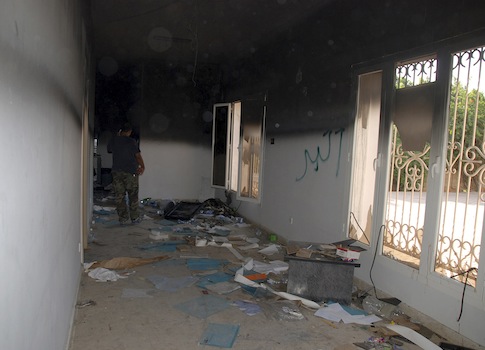
Gutted U.S. consulate in Libya / AP

Documents obtained by Judicial Watch from their May 2014 Freedom of Information Act (FOIA) lawsuits filed against the State Department and the Department of Defense revealed that the Obama administration knew about the attacks on the U.S. Consulate in Benghazi at least 10 days before the attack.

The documents also revealed that the DOD immediately reported the attacks on the consulate.

The documents included an August 2012 analysis predicting the failure of President Obama’s policy of a regime change in Syria as well as a warning about the rise of the Islamic State. The documents also included a confirmation that United States was aware of an arms shipment from Benghazi to Syria.

One of the documents from the DOD’s Defense Intelligence Agency dated September 12, 2012, the day after the attacks in Benghazi, lays out the details of the attack on the consulate and assesses that it was carefully planned by the terrorist group “Brigades of the Captive Omar Abdul Rahman.”

The group is known to have connections to the Muslim Brotherhood as well as  to al Qaeda. Rahman is serving a life sentence in prison for his role in the 1993 bombing of the World Trade Center.

The group’s goal was to “kill as many Americans as possible,” according to the documents, which were sent to Secretary of State Hillary Clinton, Defense Secretary Leon Panetta, the Joint Chiefs of Staff, and the National Security Council.

An October 2012 DOD document contained the first official document that the Obama administration knew of the shipment of weapons from the Benghazi to rebel forces in Syria.

Weapons from the former Libya military stockpiles were shipped from the port of Benghazi, Libya to the Port of Banias and the Port of Borj Islam, Syria. The weapons shipped during late-August 2012 were Sniper rifles, RPG’s, and 125 mm and 155 mm howitzers missiles.

During the immediate aftermath of, and following the uncertainty caused by, the downfall of the (Qaddafi) regime in October 2011 and up until early September of 2012, weapons from the former Libya military stockpiles located in Benghazi, Libya were shipped from the port of Benghazi, Libya to the ports of Banias and the Port of Borj Islam, Syria. The Syrian ports were chosen due to the small amount of cargo traffic transiting these two ports. The ships used to transport the weapons were medium-sized and able to hold 10 or less shipping containers of cargo.

The heavily redacted document did not reveal which weapons were sent to Syria

The DIA consistently warned of the deterioration of the situation in Iraq and warned that it creates an ideal situation for Al Qaeda to return to Mosul and Ramadi, according to an August 2012 report. During this time the U.S. was monitoring weapons flows from Libya to Syria. The agency warned of dire consequences but blocked out what most of what those consequences were.

The State Department produced a single document from a separate lawsuit that Judicial Watch had filed against the department. The document was created by Hillary Clinton’s office the morning after the attacks on the consulate in Benghazi and was sent throughout the State Department.

Neither the State Department nor Hillary Clinton have turned over any documents in regards to Benghazi or her personal email account that was used during her as well as other top aides during her time as Secretary of State.

Judicial Watch has filed multiple FOIA requests and has waited over two years for the documents that they have received.

“These documents show that the Benghazi cover-up has continued for years and is only unraveling through our independent lawsuits,” said Tom Fitton, president of Judicial Watch. “The Benghazi scandal just got a whole lot worse for Barack Obama and Hillary Clinton.”

Arab military chiefs approve Egyptian-led intervention in Libya

May 19, 2015

Arab military chiefs approve Egyptian-led intervention in Libya, DEBKAfile, May 19, 2015

(Obama will be displeased. — DM)

Arab military chiefs held an unpublicized meeting in Cairo Monday to confirm coordinated plans for Egyptian-led regional intervention into the eastern Libya region of Cyrenaica to drive out the armed extremists, who have kept the country locked in chaos since Muammar Qaddafi’s ouster, and install a stable government in the region;s capital of Benghazi. The meeting was attended by the chiefs of staff of Egypt, Jordan, Saudi Arabia, UAE, Kuwait, Bahrain, Sudan and the Libyan Tobruk government. Talks are ongoing with France and Libya to take part in the operation. Both have a direct interest in putting a stop to the ungoverned flow of African refugee migrants to Europe through Libya, which is being used by Islamic State terrorists to infiltrate Europe. France will be asked for logistic support and special forces for the Libyan operation and Italy to provide naval support. Egyptian President Abdel-Fatteh El-Sisi is seeking  early military action cut down the fast-expanding ISIS threat to his country, the region and southern Europe.

How the Islamic Republic Is Manipulating the U.S.

May 19, 2015

How the Islamic Republic Is Manipulating the U.S., Front Page Magazine, May 19, 2015

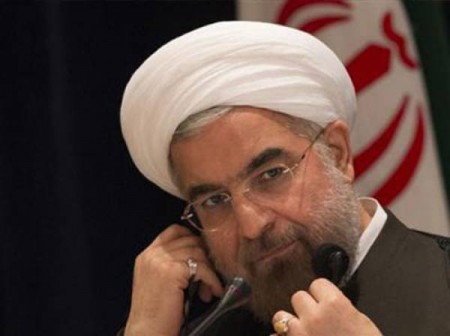
iran-s-rouhani-phones-pm-nawaz-after-soldier-s-killing-1395854702-4802-450x336

Rouhani and the moderate camp have persuaded Ayatollah Ali Khamenei that superficial diplomatic ties with the Obama administration will, in fact, empower the Islamic Republic, further its hegemonic ambitions, and raise Tehran’s economic status without the need for the Iranian leaders to give up on their revolutionary principles, anti-Americanism and anti-Semitism.

****************

There is a crucial Machiavellian (but not a strategic) tactical shift in the Islamic Republic’s foreign policy and its pursuit of regional preeminence.

First of all, Iranian leaders have realized that by superficially showing the Obama administration that the Islamic Republic is willing to restore diplomatic ties with his administration, they can in fact further advance their ideological and national interests.

Second, knowing that President Obama is desperate for a “historic” nuclear deal and the establishment of diplomatic ties with the Islamic Republic, Iranian leaders have played the role very well by attempting to satisfy President Obama’s empty goals.

Third, the ruling clerics of the Islamic Republic became cognizant of the fact that dealing with the Obama administration does not necessarily mean that they have to give up anything with respect to its domestic suppression, revolutionary Islamist principles, human rights abuses, regional hegemonic ambitions, anti-Americanism, hatred towards Israel, and foreign policy objectives.

The tactical shift, currently, is to satisfy President Obama’s personal and shallow objectives by allowing him to project that he is making historic moves (such speaking on the phone with the Iranian leaders), while simultaneously pursuing their own ideological objectives.

For example, most recently, Rouhani and the Obama administration agreed on opening new diplomatic offices in Tehran and Washington. For President Obama, opening diplomatic offices can be viewed as another “historic move” cited in his records or on his Wikipedia page. From the perspective of Iranian leaders, it is a crucial pillar for the advancement of Iran’s foreign policy and ideological objectives in the region without pressure from the US.

To pursue their objectives more efficiently, Iranian leaders have agreed to meet frequently with the diplomats at the highest level of the Obama administration, “negotiating,” and having some of their interactions publicly televised on American and Western media. In addition, the American and the Iranian flags are repeatedly shown next to each other in the high level meetings.

These moves, in fact, give legitimacy to the theocratic regime to further its ambitions.

The president was also delighted to make another “historic move” by speaking on the phone with his Iranian counterpart, President Hassan Rouhani. (One would wonder what a great accomplishment it is to pick up a phone and call another president.)

Washington and Tehran broke diplomatic ties in 1979. After the hostage crisis, high American officials and diplomats have not set foot on the Iranian soil due to Iran’s continuous violation of international norms and anti-Americanism.

Nevertheless, President Obama and Secretary of State John Kerry have decided to turn a blind eye on Iran’s egregious human rights abuses, aggressiveness and violations of international laws.

In another shallow move, Kerry claimed to be proud to set foot on Iranian “territory.” He met with Iran’s Foreign Minister, Mohammad Javad Zarif, at the residence of the Iranian ambassador to the United Nations, Gholamali Khoshroo, in New York.

Instead of attempting to change the behavior of the Ayatollahs and their revolutionary principles, President Obama and Kerry are satisfied with these superficial “historic moves.”

Since Iran’s political establishments and policies are driven, not solely by national and geopolitical interests, but also by ideological Islamist (Shiite) principles, hardliners and the office of the Supreme Leader will always view a real rapprochement with the US as taboo.

Restoring full diplomatic ties can also be analyzed as betraying the revolutionary principles of the Islamic Republic, which were based on anti-Americanism, as well as their opposition to Western models of socio-political and socio-economic landscapes.

From the perspective of Iran’s Supreme Leader, Ayatollah Ali Khamenei — who has the final say in foreign policy decisions — genuine diplomatic ties with the US will lead to the empowerment of Iranian civil society and secular factions. From the prism of the senior cadre of the IRGC, relationships with the American government might lead to the opening of the Iranian market, endangering the economic monopoly of IRGC institutions.

On the other hand, Rouhani and his technocrat team, who share the same objectives with the hardliners and want to preserve the interests of the Islamic Republic, came to the realizations that satisfying President Obama’s superficial and shallow objectives of “historic moves,” can indeed assist them in advancing their ambitions.

In conclusion, similar to the ongoing nuclear negotiations, Rouhani and the moderate camp have persuaded Ayatollah Ali Khamenei that superficial diplomatic ties with the Obama administration will, in fact, empower the Islamic Republic, further its hegemonic ambitions, and raise Tehran’s economic status without the need for the Iranian leaders to give up on their revolutionary principles, anti-Americanism and anti-Semitism.