Archive for May 2015

ISIS Wins No Matter What Happens Next

May 28, 2015

ISIS Wins No Matter What Happens Next, The Daily BeastMichael Weiss, May 28, 2015

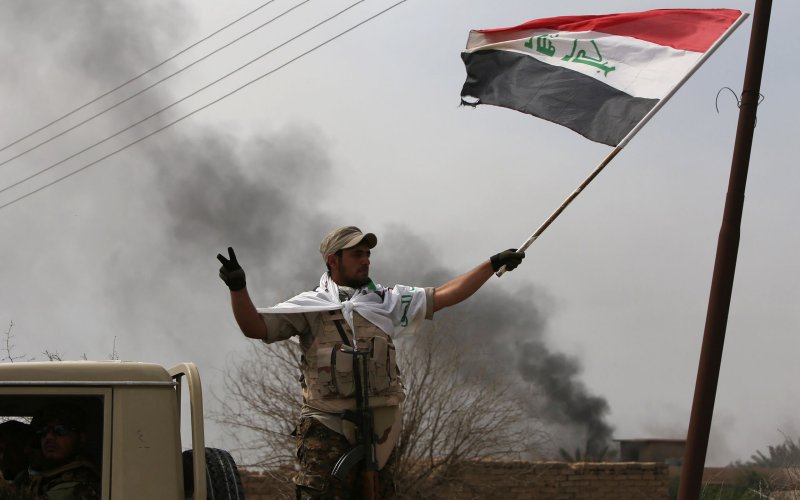
1432804506635.cachedAhmad Al-Rubaye/AFP/Getty

Usama al-Nujaifi, one of Iraq’s vice presidents and the former parliamentary speaker, pointed out that recent missteps by the militias has squandered incipient good will for Sunni reconciliation. Yesterday, during a parliamentary session, the Sunni governor of Diyala province was fired—and replaced with a Shia. “This is a real threat and a very negative message to Iraqis. This is considered a break to the rules and it contradicts what has been agreed,” Nujaifi said. “The majority in Diyala are Sunnis.”

**********************

The latest planned attack on the terror army could be playing right into their hands.

The Obama administration is being slammed from all sides for its failing strategy against ISIS—and rightly so. But amid all the scorn, one question has yet to be asked about the resiliency of the terror army, which, actually goes to the heart of its decade-old war doctrine. Namely: does ISIS actually win even when it loses?

This isn’t an academic issue. America’s allies in the ISIS war are gearing up for a major counteroffensive against the extremist group. That assault that could very well play right into ISIS’ hands.

Having superimposed its self-styled “caliphate” over a good third of Iraq’s territory, in control of two provincial capitals, ISIS is today in strongest position it has ever been for fomenting the kind of sectarian conflagration its founding father, Abu Musab al-Zarqawi, envisioned as far back as 2004.

Zarqawi’s end-game was simple: by waging merciless atrocities against Iraq’s Shia majority population (and any Sunnis seen to be conspiring with it), Zarqawi’s jihadists would have only to stand back and watch as radicalized Shia militias, many of whose members also served in various Iraqi government and security roles, conducted their own retaliatory campaigns against the country’s Sunni minority. Internecine conflict would have the knock-on effect of driving Sunnis desperately into the jihadist fold, whether or not they sympathized with the ideology of al-Qaeda in Iraq, Zarqawi’s franchise and the earliest incarnation of what we now call the Islamic State.

Indeed, in the mid-2000s, the Jordanian jihadist nearly got what he wished for by waging spectacular terror attacks against Shia civilians and holy sites, such as the Golden Mosque in Samarra, a strategy which quickened devolved Iraq’s violence from a primarily anti-American insurgency into all-out civil war. The only stopgap for a truly apocalyptic or nation-destroying result was the presence of nearly 200,000 U.S. and coalition troops. Today, however, absent such a foreign and independent military presence, the main actors left in Iraq are the same extremists —Shia militias and ISIS.

This fact was only driven home last week after thousands of U.S.-trained Iraqi Security Force personnel, including the elite counterterrorist Golden Division, fled from Ramadi, allowing the city fall to a numerically modest contingent of ISIS jihadists. Having been initially instructed by Iraq’s Prime Minister Haider al-Abadi to refrain from defending the city (no doubt at the prompting of Washington) the Hashd al-Shaabi, the umbrella organization for these Shia militias, now say they are prepping a massive counteroffensive to retake Ramadi. It promises to be a drawn-out and highly fraught counteroffensive, pitting paramilitaries—which have been accused of war crimes and atrocities by Human Rights Watch, Amnesty International and United Nations Human Rights Commission—against genocidal ISIS militants.

Many Iraqis fear, with good reason, that this counteroffensive will also extend to Sunni civilians who will now be branded “collaborators” of ISIS, as they have in previous Hashd-led operations. The result: torture, extrajudicial killing, and ethnic cleansing. Nothing would better serve the ISIS narrative or legitimate its claim to be the last custodian and safeguard of Sunni Muslims in the Middle East. Such an outcome might even precede the eventual disintegration of the modern state of Iraq into warring ethno-religious enclaves. That this was ISIS’s plan all along adds yet another grim paragraph to the obituary of American-hatched adventurism in the Middle East.

True, Hashd al-Shaabi has routed ISIS elsewhere before, namely in Amerli and Jurf al-Sakhar and Tikrit. In the aftermath, the militia was accused of committing human rights abuses, but those accusations didn’t tear the country apart.

The difference with Ramadi, however, is one of both scale and symbolism. This city of close to 200,000 is dead center in the Sunni heartland of Iraq, where ISIS has the home advantage. Ramadi was also, not coincidentally, the cynosure of the so-called “Anbar Awakening,” which saw hundreds of thousands of Sunni tribesmen rise up against ISIS’s predecessor, al-Qaeda in Iraq, in a cautious but fruitful partnership with American soldiers in the mid-2000s, a grassroots counterinsurgency whose gains were then solidified by the “surge” orchestrated by U.S. commander General David Petraeus. This time, absent any American combat forces, there are Shia Islamists who have never before tread into Ramadi. Many Iraqis dread the consequences.

“Iraq is not unified,” Iraq’s former Deputy Prime Minister Rafe Essawi, a senior Sunni political leader originally from Anbar, told The Daily Beast. “50 percent of the country belongs either to Kurds or ISIS, and 50 percent belongs to the Shia militias backed by Iran. We said too many times to our friends the Americans that we do not need to see the militias in Ramadi because this will lead to sectarian conflict.”

Yet the Americans have little on offer by way of an alternative. U.S. training efforts are still months off from fielding military units able to join the fight. With Iraq’s future resting on them, Hashd is seen as the only ready bulwark against further ISIS encroachments, though its conduct in Anbar may paradoxically purge the province of ISIS’s hard power while underwriting its soft version.

The Ramadi offensive hardly got off to a promising start. On Tuesday, Hashd spokesmen announced that the name for their Anbar offensive was, “Labeyk Ya Hussein,” a slogan roughly translated as “At your service, Hussein,” in tribute to a venerated Shia religious figure. The connotations were therefore of holy war — not exactly the multi-sectarian, pan-Iraqi message Baghdad has preferred to telegraph to international audiences.

On Wednesday, in response to criticism from U.S. officials and some Iraqi leaders—including demagogic Shiite cleric Muqtada al-Sadr (who has fallen out with Iran and has since platformed himself as a nationalist politician)—the operation’s name was changed to to more universal: “Labeyk Ya Iraq.” But the public relations rethink has not addressed underling concerns about the Hashd’s intentions, nor allayed Sunni anxieties.

“I think the careful examiner of the facts on the ground will see de facto borders are being drawn whether by design or by circumstance,” said one former Iraqi official who spoke to The Daily Beast on the condition of anonymity. “The militias have effectively cleared the Baghdad belts to the south of Sunnis, and with the Ramadi operation I expect the same will happen westward but it will entail a lot more fighting and possibly much more instability.”

This is because the war for the future Iraq isn’t being waged first and foremost by Iraqis but by their self-interested next-door neighbor, Iran, led by its elite Revolutionary Guards Corps-Quds Force, a U.S.-designated terrorist entity in its own right.

Iraq’s sectarian division, whereby Sunnis have been forced out of Shia-controlled areas under the auspices of fighting ISIS, reflects the fact that the Hashd operates more according to Tehran’s geo-strategic and ideological interests, the former official said. “I feel that Iran and some of its erstwhile allies have reached a realization that they have lost a significant ally in Syria and therefore need to buffer the ‘Shia’ zones in Iraq to protect them while paying lip service to the notion of a unified state.”

It certainly does not help matters that America’s unacknowledged ally in the anti-ISIS coalition is the IRGC-QF, whose commander, Major General Qassem Suleimani, not only blamed U.S. incompetence for the fall of Ramadi this week but labeled the United States an “accomplice” of the jihadists—a conspiratorial view of ISIS’s secret patronage widely shared amongst the Hashd rank-and-file.

The scenario described by Essawi and the ex-official is more common among the Sunni political class that either Washington or Baghdad care to acknowledge. Whether it is credible will depend on how the Hashd conducts itself on hostile terrain and whether it can break with precedence of collective punishment. If the militias act as a nationalist reserve army, under the command and control of Haider al-Abadi—something the White House has insisted as a precondition of U.S. air support—then they may be able to recruit Sunnis to their efforts, or at least earn their respect and admiration.

Essawi argues that Hashd has so far relied on coercion rather than a savvy hearts-and-minds approach for winning over Sunnis. “The Sunni tribes used to be against ISIS after [their] crimes,” he said. “Definitely there are some local supporters of ISIS, but the tribes generally speaking —almost all of them — are committed to fight. It is the government that refuses to strengthen them. So some very weak tribes have been coerced into accepting this bad choice: it’s either Hashd al-Shaabi or ISIS.”

Saleh al-Mutlaq, a Sunni deputy prime minister under Abadi, disagreed.

He emphasized that the Hashd should henceforth operate under the Iraqi flag rather than the host of competing standards their constituent militias currently brandish (including those bearing the images of Iranian ayatollahs Khomeini and Khamenei). But Mutlaq is hopeful of greater Sunni support for the Hashd. He pointed out that there are currently volunteer camps established near Ramadi to incorporate Sunnis volunteers and Iraqi policemen who fled the city into the broader counteroffensive.

“The government will give them training and weapons,” a statement issued by Mutlaq’s office read, without offering specifics. As for Shia sloganeering deemed alienating the Anbari support base, he doesn’t think this has had too dire an impact. “The Sunnis were conflicted about the intervention from the Hashd al-Shaabi because they were worried about reprisal attacks. But the Hashd is less harmful than ISIS. At least, these people are Iraqis and we can deal with them later on, but we can’t with ISIS.”

Nevertheless, Mutlaq wonders just what form a pro-government success may take and what happens the day after ISIS is routed from Ramadi. “His concern is whether Ramadi will undergo demographic changes,” his office said. “Will Sunnis be forced to relocate to others areas and will there will be any revenge attacks and conflicts between the Hashd and the tribes?”

Usama al-Nujaifi, one of Iraq’s vice presidents and the former parliamentary speaker, pointed out that recent missteps by the militias has squandered incipient good will for Sunni reconciliation. Yesterday, during a parliamentary session, the Sunni governor of Diyala province was fired—and replaced with a Shia. “This is a real threat and a very negative message to Iraqis. This is considered a break to the rules and it contradicts what has been agreed,” Nujaifi said. “The majority in Diyala are Sunnis.”

ISIS is counting on such political heavy-handedness to indemnify its own savagery. “It is that enemy, composed of Shiites joined by Sunni agents, who are the real danger with which we are confronted, for it is our fellow citizens, who know us better than anyone,” Zarqawi wrote in a 2004 letter, correctly foreseeing that the U.S. military occupation would be fleeting and incidental to the future of Iraq.

In other words, he wanted the Shia militias, principally the Badr Corps — now first among equals in the Hashd— to commit anti-Sunni atrocities as payback for Zarqawi’s own scorched-earth war against the Shia. “If we manage to draw them onto the terrain of partisan war, it will be possible to tear the Sunnis away from their heedlessness, for they will feel the weight of the imminence of danger and the devastating threat of death wielded by these Sabeans.”

If Iraq does fall apart, it will have been because Zarqawi’s apocalyptic plan got realized a decade after his death.
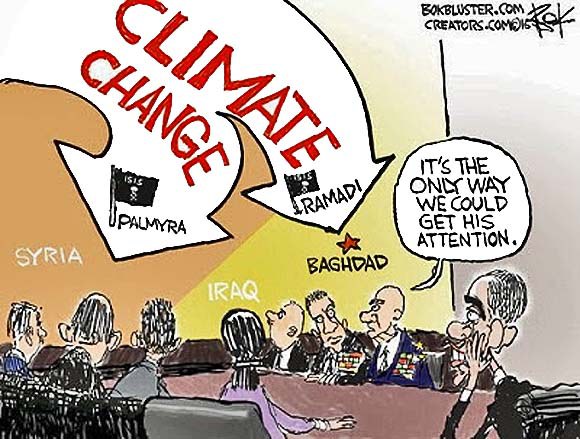
Cartoon of the day

May 28, 2015

H/t Vermont Loon Watch.

attack1

Islam Inspires Bikers

May 28, 2015

Bikers Taking HUGE Stand Against Muslims, And They’re NOT Happy About It

Posted on May 28, 2015 by Sean Brown Via Mad World News

(American Spring…almost there. – LS)

A group of Arizona bikers have had enough of radical Muslims, so they decided they’re going to do something about it, but as you can imagine, they’re not being too well received.

On Friday, May 29 in Phoenix, Jon Ritzheimer will lead a group of bikers to the Islamic Community Center for the “Freedom of Speech Rally Round 2,” according to 12News. The event is a “PEACEFUL protest in front of the Islamic Community Center in Phoenix,” and it is intended to draw attention to the violent core of Islam, Ritzheimer said.

Bikers Taking HUGE Stand Against Muslims, And They’re NOT Happy About It

“I want this to be about pushing out the truth about Islam,” said Ritzheimer. “I’ve read the Koran three times… the ones flying the planes into the tower, those are Muslims following the book as it is written.”

“This is in response to the recent attack in Texas where 2 armed terrorist, with ties to ISIS, attempted Jihad,” a Facebook page created for the protest stated. “Everyone is encouraged to bring American Flags and any message that you would like to send to the known acquaintances of the 2 gunmen.”

Ritzheimer calls on others “to utilize there [sic] second amendment right at this event just incase our first amendment comes under the much anticipated attack,” and he warned that the mosque is “a known place that the 2 terrorist [sic] frequented.” For those unaware, Ritzheimer is referencing the two jihadists, Nadir Soofi and Elton Simpson, who opened fire at the free speech event in Garland, Texas. Both were shot and killed by police before they were able to take anybody’s lives.

Bikers Taking HUGE Stand Against Muslims, And They’re NOT Happy About It

The group plans to gather in a nearby Denny’s parking lot, where they plan a “Muhammad cartoon contest,” then depart to the Islamic center with the images in hand at 6:15, the same time Muslims attend for prayer, the Bridge Initiative reported. But as would be expected, members of the mosque don’t appear to have the same type of enthusiasm as Ritzheimer for calling out the radical sects of their religion.

The Islamic center’s president, Usama Shami, said he was notified by the police and FBI about the event, and that while he respects others’ right to free speech, he doesn’t think the demonstration is appropriate.

“Everybody has a right to be a bigot. Everybody has a right to be a racist. Everybody has a right to be an idiot,” Shami said. He also said that he’s encouraging members of the mosque to attend prayer as scheduled.

Bikers Taking HUGE Stand Against Muslims, And They’re NOT Happy About It

“It will be the same as every Friday evening and we’re going to tell our members what we’ve told them before: not to engage them,” said Shami. “They’re not looking for an intellectual conversation. They’re looking to stir up controversy and we’re not going to be a part of it.”

 As of this writing, 153 people have committed to joining the event this Friday, and that number appears to be slowly growing.

Filling the Vacuum in Syria

May 28, 2015

Filling the Vacuum in Syria, The Gatestone InstituteYaakov Lappin, May 28,2015

  • The idea that, because Sunni and Shi’ite elements are locked in battle with one another today, they will not pose a threat to international security tomorrow, is little more than wishful thinking.
  • The increased Iranian-Hezbollah presence needs to be closely watched.
  • A policy of turning a blind eye to the Iran-led axis, including Syria’s Assad regime, appears to be doing more harm than good.

As the regime of Bashar Assad continues steadily to lose ground in Syria; and as Assad’s allies, Iran and Hezbollah, deploy in growing numbers to Syrian battlegrounds to try to stop the Assad regime’s collapse, the future of this war-torn, chaotic land looks set to be dominated by radical Sunni and Shi’ite forces.

The presence of fundamentalist Shi’ite and Sunni forces fighting a sectarian-religious war to the death is a sign of things to come for the region: when states break down, militant entities enter to seize control. The idea that, because Sunni and Shi’ite elements are locked in battle with one another today, they will not pose a threat to international security tomorrow, is little more than wishful thinking.

The increased presence of the radicals in Syria will have a direct impact on international security, even though the West seems more fixated on looking only at threats posed by the Islamic State (ISIS), and disregards the possibly greater threat posed by the Iranian-led axis. It is Iran that is at the center of the same axis, so prominent in entangling Syria.

The threat from ISIS in Syria and Iraq to the West is obvious: Its successful campaigns and expanding transnational territory is set to become an enormous base of jihadist international terrorist activity, a launching pad for overseas attacks, and the basis for a propaganda recruitment campaign.

It has already become a magnet for European Muslim volunteers. Their return to their homes as battle-hardened jihadists poses a clear danger to those states’ national security.

Yet the threat from the Iranian-led axis, highly active in Syria, is more severe. With Iran, a threshold nuclear regional power, as its sponsor, this axis plans to subvert and topple stable Sunni governments in the Middle East and attack Israel. Iran’s axis also has its sights set on eventually sabotaging the international order, to promote Iran’s “Islamic revolution.”

This is the axis upon which the Assad regime has become utterly dependent for its continued survival.

Today, the radical, caliphate-seeking Sunni organization, ISIS, controls half of Syria, while hardline Lebanese Shi’ite Hezbollah units can be found everywhere in Syria, together with their sponsors, Iran’s Islamic Revolutionary Guards Corps (IRGC) personnel, fighting together with the Assad regime’s beleaguered and worn-out military forces.

The increased Iranian-Hezbollah presence needs to be closely watched. According to international media reports, an IRGC-Hezbollah convoy in southern Syria, made up of senior operatives involved in the setting up of a base designed to launch attacks on the Golan Heights, was struck and destroyed by Israel earlier this year. The Hashemite Kingdom of Jordan too hasreason to be concerned.

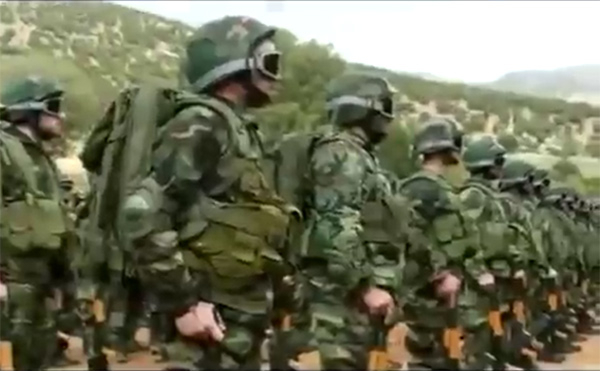
1088Lebanese Shi’ite Hezbollah fighters are deeply involved in Syria’s civil war. (Image source: Hezbollah propaganda video)

Syria has become a region into which weapons, some highly advanced, flow in ever greater numbers, allowing Hezbollah to acquire guided missiles, and allowing ISIS and the Al-Nusra Front to add to their growing stockpile of weaponry.

Other rebel organizations, some sponsored by Saudi Arabia, Turkey, and Qatar, are also wielding influence in Syria. These groups represent an effort by Sunni states to exert their own influence there.

Despite all the efforts to support it, the Assad regime suffered another recent setback when ISIS seized the ancient city Palmyra in recent days, making an ISIS advance on Damascus more feasible. To the west, near the Lebanese border, Al-Qaeda’s branch in Syria, the Al-Nursa Front, also made gains. It threatened to enter Lebanon, prompting Hezbollah to launch a counter-offensive to take back those areas.

These developments provide a blueprint for the future of Syria: A permanently divided territory, where conquests and counter-offensives continue to rage, and the scene of an ongoing humanitarian catastrophe, producing waves of millions of refugees that could destabilize Syria’s neighbors. Syria is set to remain a land controlled by warring sectarian factions, some of whom plan to spread their destructive influence far beyond Syria.

Events in Syria have shown that the notion that air power can somehow stop ISIS’s advance is a fantasy. More importantly, they have also illustrated that Washington’s policy of cooperation with Iran in a possible “grand bargain” to stabilize the region, while failing to take a firmer stance against the civilian-slaughtering Assad regime, is equally fruitless.

A policy of turning a blind eye to the Iran-led axis, including Syria’s Assad regime, appears to be doing more harm than good.

Hezbollah Prepares

May 28, 2015

Hezbollah Prepares, Power LineScott Johnson, May 28, 2015

[T]he Israelis will have to mobilize massive force to shorten the duration of a future war. One of the things they’ll do is immediately is move to eliminate as much of Hezbollah’s vast arsenal as possible. Hezbollah is counting on the resulting deaths of their human shields – and they’ve guaranteed to that the body count will be significant – to turn Israel into an international pariah.

************************

There is so much bad news coming out of the Middle East that it is hard to keep up. Omri Ceren writes from The Israel Project to fill us in on a preview of coming attractions featuring the proxy forces of President Obama’s Iranian friends. Where precisely does Hezbollah fit in Obama’s vision of Iran as a friendly regional power? Too bad Jeffrey Goldberg didn’t riddle Obama that particular question.

This is Omri’s email message verbatim, complete with the URLs of footnoted stories. I thought that readers who have found Omri’s reports helpful might find this of interest as well:

Variations of this story have been bouncing around for the last few weeks. Two weeks ago there were major recent pieces in the NYT and AP articles, where journalists got to look at IDF aerial photography showing that Hezbollah has moved the vast majority of its military infrastructure into Shiite villages [1][2]. They’ve taken their arsenal – 100,000+ rockets including Burkan rockets with half-ton warheads, ballistic missiles including Scud-Ds that can hit all of Israel, supersonic advanced anti-ship cruise missiles, anti-aircraft assets, drones and mini drones, tunnels, etc. – and embedded it across hundreds of villianges and probably thousands of homes.

The Syrian war has been good for Hezbollah in that respect. They’ve cleaned out Assad’s depots and brought the goods back to Lebanon.

The Israelis can’t afford a war of attrition with Hezbollah. The Iran-backed terror group has the ability to saturation bomb Israeli civilians with 1,500 projectiles a day, every day, for over two months. They will try to bring down Tel Aviv’s skyscrapers with ballistic missiles. They will try to fly suicide drones into Israel’s nuclear reactor. They will try to detonate Israel’s off-shore energy infrastructure. They will try to destroy Israeli military and civilian runways. And – mainly but not exclusively through their tunnels – they will try to overrun Israeli towns and drag away women and children as hostages. Israeli casualties would range in the thousands to tens of thousands.

And so the Israelis will have to mobilize massive force to shorten the duration of a future war. One of the things they’ll do is immediately is move to eliminate as much of Hezbollah’s vast arsenal as possible. Hezbollah is counting on the resulting deaths of their human shields – and they’ve guaranteed to that the body count will be significant – to turn Israel into an international pariah. But the Israelis can’t let Hezbollah level their entire country with indiscriminate rocket fire and advanced missiles, just because no one in Lebanon is willing or able to expel the group from Shiite villages.

This weekend’s round of stories actually came from Hezbollah’s side. As-Safir – a Lebanese daily and a major Hezbollah mouthpiece – published a series of puff pieces about how Hezbollah has turned all of southern Lebanon into a vast military complex. I’ve pasted the full AP/TOI write-up at the bottom [omitted here, [a href=”http://www.timesofisrael.com/hezbollah-flaunts-advanced-tunnel-network-on-israeli-border/”>this is the story], but it’s what you’d expect:

According to the reports, based on a tour of Hezbollah facilities given to the newspaper, the group has built a sprawling underground array of tunnels, bunkers and surveillance outposts along the border with Israel, which it is manning at peak readiness for battle. The tunnels are said to be highly-advanced, with durable concrete, a 24-hour power supply via underground generators, a ventilation system to prevent damp from damaging military equipment and a web of secondary escape shafts in case of attack. The tunnels are said to be housing tens of thousands of rockets ready for launch, themselves wrapped in protective materials in order to preserve them.

None of this is new. In early 2013 veteran Israeli war correspondent Ron Ben-Yishai did a deep dive into Hezbollah military posture [3]. He revealed among other things that Hezbollah had given away thousands of homes to poor Shiite families, on the condition “that at least one rocket launcher would be placed in one of the house’s rooms or in the basement, along with a number of rockets, which will be fired at predetermined targets in Israel when the order is given.” Then in 2014 air force chief Major-General Amir Eshel gave a speech outlining how Hezbollah has embedded its military assets in “thousands” of residential buildings, emphasizing that Israel would have no choice but to target that infrastructure in a war. Reuters picked up the speech under the headline “Hoping to deter Hezbollah, Israel threatens Lebanese civilians” [4].

But there’s a lot of chatter in the Middle East about a summer war between Israel and Lebanon, so you’re seeing a new round of stories about what it might look like. On one hand the Israelis and Hezbollah are saying the same thing: all of southern Lebanon is now one big military compound. But only the Israelis are pointing out that Hezbollah has made sure that in that compound there are tens of thousands of civilians.

[1] http://www.nytimes.com/2015/05/13/world/middleeast/israel-says-hezbollah-positions-put-lebanese-at-risk.html
[2] http://hosted.ap.org/dynamic/stories/M/ML_ISRAEL_HEZBOLLAH?SITE=AP&SECTION=HOME&TEMPLATE=DEFAULT&CTIME=2015-05-13-14-10-05
[3] http://www.ynetnews.com/articles/0,7340,L-4343397,00.html
[4] http://www.reuters.com/article/2014/01/29/us-israel-lebanon-hezbollah-idUSBREA0S1PS20140129

Hezbollah Goes Viral

May 28, 2015

IRAN RISING: TEHRAN USING HEZBOLLAH IN LATIN AMERICAN ‘CULTURAL CENTERS’ TO INFILTRATE WEST

by JORDAN SCHACHTEL AND EDWIN MORA 27 May 2015 Via Breitbart

(U.S. President James Monroe must be turning over in his grave these days. – LS)

The rapidly growing number of Shiite cultural centers in Latin America have provided the Islamic Republic of Iran with a means to expand its covert recruitment operations throughout the western hemisphere, leading military officials and experts to provide Breitbart News with statements that directly contradict the Obama administration’s narrative that Iran’s influence in the region is “waning.”

Breitbart News interviewed military and intelligence officials, policy experts, members of Congress, and a former White House official for this report, all of whom warned about the threat posed by Iran’s continuing encroachment into Latin America.

Iran is infiltrating Latin America thanks largely to Hezbollah, a Shiite terrorist group that has sworn loyalty to Iranian Ayatollah Ali Khamenei, showing overt preference to the Tehran dictator over its host-state Lebanon. Hezbollah, along with Iran’s Revolutionary Guard Corps (IRGC), have provided the on-the-ground support needed for the proliferation of Iran’s Khomeinist ideology.

Breitbart News’ sources have unanimously refuted the assessment of Obama’s State Department, which has claimed that “Iranian influence in Latin America and the Caribbean is waning.”

A U.S. military official told Breitbart News that the estimated 80-plus Shiite cultural centers backed by Iran are continuously multiplying, and are currently being operated by Hezbollah and Tehran’s Revolutionary Guards-Quds Force.

Hezbollah provides operational and logistical support “for Iran’s covert activities in the region to include coordination and collaboration with Lebanese [Hezbollah’s] external operations arm the Islamic Jihad Organization” through Shiite Islamic centers dubbed “cultural centers,” the official told Breitbart News, contradicting the narrative put forth by the State Department.

Such centers can be found throughout Latin America, according to the official.

“Iranian cultural centers open possibilities for Iran to introduce members of its Revolutionary Guard-Qods Forces (IRGC-QF) to a pool of potential recruits within the centers population of Lebanese Shi’a Muslims and local converts to Shia Islam,” added the defense official.

David Shedd, the former director of the Defense Intelligence Agency (DIA), echoed the U.S. military officials comments, telling Breitbart News via email that “the cultural centers may be used as platforms for truly nefarious purposes by the Iranian regime.”

“Iran has expanded its ‘cultural centers’ presence in locations such as Quito [in Ecuador] and Caracas [in Venezuela] where there is a strong anti-US government sentiment,” Shedd, currently a visiting distinguished fellow at the Heritage Foundation, told Breitbart News.

“Iran’s overall expanded presence in the Western Hemisphere is troubling,” the former DIA director added. “The expanded presence in any capacity in the Latin American region should give the U.S. pause given the profound differences between U.S. values and those of a regime in Tehran that supports terrorism as an officially sanctioned tool of national power.”

Shedd warned that Hezbollah, which he described as the most prominent global terrorist group in Latin America, likely has “sleeper cells” in various countries in the Western Hemisphere.

“Hezbollah sympathizers also appear to have a presence in the tri-border area of Paraguay, Argentina, and Brazil where they are involved in black market commercial activities,” he noted.

The Tri-Border region in South America includes Paraguay, Argentina, and Brazil. According to the Treasury Department, the Galeria Page shopping mall in Paraguay– at the heart of the tri-border– serves as central headquarters and a fundraising source for Hezbollah members in the region.

Members of Congress have also sounded the alarm about Tehran’s growing influence in Latin America.

Rep. Ryan Zinke (R-MT), a member of the House Armed Services, said that Iran’s presence was evident when he visited Quito, Ecuador. The congressman described it as a place where anti-American sentiment is strong and jihadist figures appear next to Latin American heroes.

Rep. Jeff Duncan (R-SC), the chairman of the House Foreign Relations Subcommittee, has been warning against the presence and activity of Iran and its ally Hezbollah in Latin America, holding multiple congressional hearings on the issue, visiting the region, and sponsoring legislation — the Countering Iran in the Western Hemisphere Act of 2012.

Chairman Duncan told Breitbart News that Iran and its proxy Hezbollah “use many tools to deepen their influence in the region, including diplomatic missions and cultural centers; ties with terrorist organizations and criminal groups; training Latin American youth in Tehran; and exploiting loose border security policies and free trade zones to smuggle contraband.”

Rep. Duncan accused the Obama administration of not paying enough attention to the Iranian threat in Latin America, saying during a March 18 congressional hearing, “I believe this negligence is misguided and dangerous.”

Duncan is not the only one who disagrees with how the Obama administration is dealing the presence of Iran in the Western Hemisphere.

Bud McFarlane, who served as National Security Advisor for President Ronald Reagan, told Breitbart News that Iran continues to expand its influence operations throughout the region, tailoring its message to the Spanish-speaking world. He explained:

Iran’s existing network of agents in place, including members of the Revolutionary Guard Corps (IRGC), function through Iranian cultural centers where they seek to recruit candidates for conversion to Shia Islam and carry out other clandestine, subversive activities. They also carry out what amounts to a form of brainwashing by encouraging teenagers to access Islamoriente.com, which features links to Iranian television for Spanish speakers, anti-American propaganda, essays on reasons to convert to Islam, chat rooms and a personal message from the supreme leader of Iran.

Iran’s propaganda and influence operations can be witnessed throughout the globe, not just in Latin America.

Dr. Michael Rubin, an Iran expert and scholar at the American Enterprise Institute (AEI), told Breitbart News:

The Iranian use of Hezbullah and Lebanese expatriate populations is actually neither new nor limited to South America. In the aftermath of the 1992 ‘Mykonos Cafe’ assassinations in Berlin, German police captured both Iranian and Hezbollah operatives, the latter of which represented sleeper cells in Germany.

Rubin added that Hezbollah must not be seen as an independent actor, but as a tool of the Iranian regime. He explained:

Hezbollah is a proxy founded and controlled by Iran. Talk of Hezbollah as having evolved to become Lebanese nationalist first and foremost is nonsense. I’ve been in Hezbollah bunkers in southern Lebanon. Pictures are worth a thousand words, and it’s telling that Hezbollah terrorists bunk down under photos of Khomeini and Khamenei. Current Supreme Leader Ali Khamenei remains Hezbollah’s religious source of emulation. Any notion that Hezbollah was anything other than an Qods Force proxy should have been put to rest in 2008, when they turned their guns on fellow Lebanese in the center of Beirut, or when they supported the worst atrocities in Syria since 2011.

But even with the overwhelming evidence that Iran’s influence in Latin America is expanding exponentially, the Obama administration has thus far refused to recognize its deep penetration of the Western Hemisphere.

The State Department, which falls under the purview of the Obama White House, has recently stated that the “Iranian influence in Latin America and the Caribbean is waning.”

But it appears as if other executive branch agencies are sending conflicting messages about Iran in Latin America.

In October 2014, the Government Accountability Office (GAO), which serves as the investigative arm of Congress, noted a discrepancy in the assessments provided by the agencies.

Although the State Department claims that key government agencies — including the Defense Department, the Department of Homeland Security, the Department of Justice — agree with its position, the GAO revealed that U.S. Southern Command (Southcom), which oversees most of Latin America and the Caribbean, does not agree that Iran’s influence is “waning.”

Turkish Prime Minister: “We will march to liberate Jerusalem”

May 28, 2015

Turkish Prime Minister: “We will march to liberate Jerusalem”

During the inauguration of the 55th airport in Hakkari Province, Turkish Prime Minister Ahmet Davutoglu and Turkish President Recep Tayyip Erdogan called for the re-establishment of the Ottoman Empire.

May 28, 2015, 04:07PM | Rachel Avraham

via Israel News – Turkish Prime Minister: “We will march to liberate Jerusalem” – JerusalemOnline.

Clear ?

Erdogan

Erdogan Photo Credit: Reuters/Channel 2


According to a report published by Palestinian dissident Walid Shoebat, Turkish President Recep Tayyip Erdogan and Turkish Prime Minister Ahmet Davutoglu spoke during the inauguration ceremony of the country’s 55th airport in Hakkari Province.  The airport is named the Selahaddin Eyyubi Airport after Saladin of the Ayyubi dynasty, the Muslim ruler of Kurdish origin that conquered Jerusalem and was a great enemy of the Christian Crusaders especially Richard the Lionheart.  During the ceremony, both Turkish leaders spoke of their desire to conquer Jerusalem and to re-establish the Ottoman Empire.

“By Allah’s will, Jerusalem belongs to the Kurds, the Turks, the Arabs, and to all Muslims,” Davutoglu declared.  “And as our forefathers fought side by side at Gallipoli and just as our forefathers went together to liberate Jerusalem with Saladin, we will march on the same path to liberate Jerusalem.  The Turkish government does not differentiate from East to West.  We intend to put together all of the regions of our nations and we will bring these regions back together.”

Erdogan’s speech was even more grandiose.   He proclaimed himself to be the reincarnation of Saladin, who will kick whom he perceives to be the modern day crusaders out of Jerusalem by uniting the Muslim world behind him by hinting at the re-establishment of the Ottoman Empire: “I am sure that the great commander Saladin is bringing together all of the peoples of the Middle East into the one army that defeated the Crusaders.  Saladin is currently witnessing what we are doing here spiritually.  I was in his spiritual presence and I am addressing him here in Hakkari with the mighty men, be it eastern, brave south-eastern, valiant Anatolian in Old Turkey.”

“Jerusalem is for the Muslims and not for Israel,” Erdogan added.  “Why should we continue to be friends with those that stomped their boots on the Temple Mount?  They insist that we have to be friends?  I say, we will not.”   Erdogan promised to follow in Saladin’s footsteps: “They all promise you O Saladin, if you united the brothers in the Middle East, so will we.  Saladin said ‘Jerusalem is not for the Crusaders.’  Saladin witnessed this.  Allah witnesses this.  One people, one flag, one nation and one state!”

Muslim Scholars: Israel Is ‘Root Cause’ of All Islamic Nations’ Failures

May 28, 2015

Muslim Scholars: Israel Is ‘Root Cause’ of All Islamic Nations’ Failures

by Jordan Schachtel

27 May 2015 Washington, DC

via Muslim Scholars: Israel Is ‘Root Cause’ of All Islamic Nations’ Failures – Breitbart.

AP/Ahmed Gomaa

Muslim clerics gathered in Beirut on Wednesday to kick off the Khomeinist International Union of Resistance conference, where “scholars” discussed how to stand up against the “cancerous tumor of Israel,” according to reports from Lebanese and Iranian media outlets.

Radical Iranian cleric Mohsen Araki said that destroying Israel and “countering the arrogant world” should be the two main priorities for “resistance clerics,” reports Iran’s state-run Taghrib News.

Araki, who once served as Iranian dictator Ali Khamenei’s representative in London, continued with his speech. “Standing against the arrogant world and its representative in the region, the cancerous tumor of Israel, is a must which should be shouldered by resistance clerics and leaders,” he said, according to the state-media report.

Al Manar, a media outlet closely affiliated with the Lebanese terror group Hezbollah, said that scholars “praised the achievements” of the Iran-allied Assad regime in Syria.

Hezbollah Deputy Secretary General Naim Qassem told the audience that Syria’s successes on the battlefield – with the help of Hezbollah and Iran – are “a pure success which will be followed by others, Allah willing.” When asked whether criticism of his terrorist group was legitimate, the Hezbollah leader said that such criticism only “serves the Israeli scheme,” Al Manar reported.

Qassem, as Hezbollah’s second-in-command, has regularly reminded observers that his organization’s chief goal is to seek the destruction of Israel. He has argued that Islamic law allows for Hezbollah jihadists to carry out suicide attacks against Israel.

Iran’s state-run Press TV reports that the Muslim scholars all agreed that Israel is a “root cause of economic, political and cultural problems facing Muslim nations in recent decades.”

The Muslim “academics” unanimously agreed that “confronting the Tel Aviv regime” is a “top priority of Islamic resistance movements.” The clerics promised to support “the resistance” (Hezbollah, Hamas, and other jihadist terrorist groups) in their mission to destroy Israel, according to the report.

Al Jazeera Poll: 81% of Arabs Support ISIS

May 27, 2015

Al Jazeera Poll: 81% of Arabs Support ISIS, Truth RevoltBradford Thomas, May 26, 2015

isis_15

An online survey conducted by the Al Jazeera Arabic television channel has found that a huge majority—over 80 percent—of respondents support the Islamic State’s military campaigns. 

Breitbart News provides a summary of the findings of AlJazeera’s “shock poll“:

In a recent survey conducted by AlJazeera.net, the website for the Al Jazeera Arabic television channel, respondents overwhelmingly support the Islamic State terrorist group, with 81% voting “YES” on whether they approved of ISIS’s conquests in the region.

The poll, which asked in Arabic, “Do you support the organizing victories of the Islamic State in Iraq and Syria (ISIS)?” has generated over 38,000 responses thus far, with only 19% of respondents voting “NO” to supporting ISIS.

Last week the Islamic State achieved one of its more significant victories in recent months, seizing control of the city of Ramadi from the ineffectual Iraqi forces. The fall of the strategically important city has heightened pressure on the Obama administration over what is being increasingly perceived as its failing strategy to combat the radical militant group. Meanwhile, the popularity of ISIS—not just in the region, but among sympathetic radical circles worldwide—appears to be only expanding, in part due to the group’s aggressive social media campaign.

Assad pulls air force out of Deir ez-Zour, the third Syrian air base surrendered to ISIS

May 27, 2015

Assad pulls air force out of Deir ez-Zour, the third Syrian air base surrendered to ISIS, DEBKAfile, May 27, 2015

ISIS__fighting__between_Homs_and_Palmyra_27.5.15ISIS in combat between Homs and Palmyra

Just a week after losing the big Palmyra air base to the Islamic State – and with it large stocks of ammo and military equipment – Syrian military and air units Wednesday, May 27, began pulling out of the big air base at Deir ez-Zour. This was Bashar Assad’s last military stronghold in eastern Syria and the last air facility for enabling fighter-bombers to strike ISIS forces in northeastern Syria and the western Iraqi province of Anbar.

His surrender of the Deir ez-Zour base is evidence that the Syrian president has run out of fighting strength for defending both his front lines and his air bases. He is also too tied down to be able to transfer reinforcements from front to front. He is therefore pulling in the remnants of his army from across the country for the defense of the capital, Damascus.

DEBKAfile’s military sources report that the Islamic State now has in its sights the Syrian army’s biggest air facility, T4 Airbase, which is located on the fast highway linking Homs with Damascus 140 km away.

It is home base for the bulk of the air force’s fighters and bombers. In its hangars are an estimated 32 MiG-25 fighters, as well as smaller numbers of MiG-25PDS interceptors, designed for combat with the Israeli air force, MiG-25RBT bombers-cum-surveillance planes; MiG-25PU trainers, which are routinely used to strike rebel forces in crowded built-up areas, and advanced MiG-29SM fighter jets.

Stationed there too are 20 advanced Su-24M2 bombers, the strategic backbone of the Syrian air force.

T4 Airbase also holds the largest Syrian stocks of guided bombs, air-to-air and air-to-ground missiles.

In the last few hours, air crews have been frantically removing these warplanes from T4 and distributing them among smaller bases in central Syria, at the cost of their operational effectiveness.

In the space of a week, therefore, Bashar Assad has lost three of his major air bases, including Palmyra, where Iranian and Russian air freights had been landing regularly with fresh supplies of ordnance and spare parts for his army.

Our military experts say that this bonanza frees ISIS to cut off the eastern, northern and central regions from the capital, and deprive the Syrian and Hizballah units battling for control of the Qalamoun Mts of air support against rebel and Islamist forces.

If they manage to take T4 as well, the Islamists will be able to prevent US jets from taking off for strikes against them in Syria, or bombing the their forces which have seized long stretches of the fast highway from Homs to Damascus.