Freedom is just another word, May 6, 2015
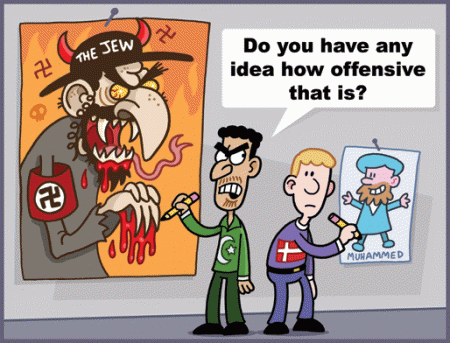
Freedom is just another word, May 6, 2015
Why Obama Will Just Keep Making the Middle East Worse, Front Page Magazine, Daniel Greenfield, May 6, 2015
In its own perverse way, Iran is becoming a client state of America. But it’s a client state that, like the Palestinian Authority with Israel, is actively trying to destroy us. The lesson from that failed effort was that you can’t use terrorists to stabilize territory. All that terrorists can do is destabilize it even more.
****************
A few years ago it was the Muslim Brotherhood. These days it’s Iran. Next week it may be ISIS or Al Qaeda. Obama stands with the worst elements in the Middle East. That’s always been his philosophy.
If the left had a foreign policy, it would be, “The squeaky wheel gets the grease.” But the wheel is a sword and it’s lubricated with blood. The squeakiest wheels and the bloodiest swords get the most grease from the State Department because they hate us the most. And hating us the most means that somewhere along the way we must have hurt them the worst. They hate us, therefore we’re guilty.
The squeaky wheel runs on blood and on American guilt. The worse they are, the guiltier we must be. Instead of reinforcing the moderates, whose shortage of ravening hatred suggests that they don’t have any legitimate complaints about us worth listening to, the left seeks out the extremes of extremists.
When he wasn’t vowing to lower the oceans, abolish taxes on seniors or heal up race relations, Obama was campaigning on fixing our alliances with our allies. But that’s not what he really had in mind.
Any old Joe can ally with allies. It takes a real Barack to ally with enemies.
Our allies were the problem, so he started shedding them. The least crazy Muslims went first. Then Israel. Now he’s down to deciding which enemies will be his allies and he sits on a golf course, like that little girl in the LBJ ad, picking petals off a daisy trying to choose between Iran and the Muslim Brotherhood. Meanwhile the nuclear countdown is building from one to a mushroom cloud.
Allying with moderates is out of the question. Egypt is fighting terrorists, but its moderate government forced out the Muslim Brotherhood, ruining Obama’s best appeasement effort not directed at Russia. Even the Saudis, who stone people to death like it’s a national sport, have become too sensible for him.
Obama won’t have anything to do with moderates. If they aren’t screaming, banging flabby fists on the table and threatening a nuclear war every Wednesday, they aren’t aggrieved enough to be the root cause of our problems in the region. And there’s no point in wasting our time and goodwill on them.
Animated by American guilt, the left’s foreign policy obsessively seeks to mollify the angriest and most violent enemies in the region. And that poisoned foreign policy philosophy of American appeasement leaves him with few other options.
The left insists that the conventional approach of upholding allies just reinforces a hegemony which makes us more hated. The only way to get to the root of the problem, their way, is to find those who hate us the most, apologize and work through their issues with us.
Instead of building a hegemony of allies, Obama has built up a hegemony of enemies.
But rewarding the angriest and most violent enemies in the region has made the Middle East unstable. Instead of fixing the violence and instability in the region, Obama has made it that much worse.
A policy that is inherently opposed to moderates will either end up destroying the stable countries in the region or destabilize them by involving them in regional wars. Obama’s foreign policy is hostile to moderates because it sidelines them as being incapable of resolving the problems in the region.
If you aren’t the problem, then to Obama and the left, you can’t be the solution.
The emphasis on stabilizing the region by enlisting the aid of the violent and the unstable is a dead end. It rewards exactly the sort of behavior that it claims to want to discourage while punishing the stable behavior it claims to want to encourage.
The left’s foreign policy in the region is a Pavlovian experiment for creating more terrorists and cutting down the list of countries that aren’t expansionistic or involved in terrorism.
Obama talks about stabilizing the Middle East, but you can’t fix a hole by making a bigger hole and you can’t put out a fire by pouring gasoline on it, and gasoline and holes are all he has to work with. By making the violent and angry the focus of his outreach efforts, he has made violence and anger into the unstable pivot of the region. The future of the region now belongs to the angry and the violent.
Jimmy Carter tried to stabilize Iran and the region by aiding the Ayatollah. Instead of stabilizing anything, a revolutionary Shiite Iran became a loose cannon that not only threatened the United States, but dragged the rest of the region into its wars. From the Iran-Iraq war to terrorism in Lebanon and all the way to Al Qaeda looking for some experts to teach its terrorists how to hijack a lot of planes, the peanut farmer’s crop was a harvest of wars and bombings that killed a lot of Americans and even more locals.
Obama picked up where Carter left off. And the problems are bigger, but basically the same. The difference is that Obama had the leisure and disregard for national security to move the same foreign policy philosophy into destructive testing mode. America’s traditional alliances have collapsed. The rest of the region is handling problems on its own with Obama stuck trying to lobby the Saudis or Israel on behalf of Iran. When the Saudis bomb the Shiite Houthi terrorists in Yemen, the Iranians run to Obama. When the Israelis urge sanctions on Iran, the Iranians run to Obama to fix the problem for them.
In its own perverse way, Iran is becoming a client state of America. But it’s a client state that, like the Palestinian Authority with Israel, is actively trying to destroy us. The lesson from that failed effort was that you can’t use terrorists to stabilize territory. All that terrorists can do is destabilize it even more.
But the lessons of that failed peace process were never learned and attempts to use terrorists to stabilize entire countries continued.
Obama is still attempting to negotiate with the Taliban to stabilize Afghanistan. Negotiations with Iran to stabilize the region are going so well that every Sunni Muslim country that can afford it is rushing off to get its own nuclear program started.
There’s no telling how stable the Middle East will be once it has more nuclear nations than existed in the entire world a generation ago; probably even more unstable than the atomic structure of Plutonium.
The only thing Obama can keep doing is making the Middle East worse because it’s the only possible outcome of his foreign policy. American guilt requires perpetual atonement and the only people we can get it from are tearing apart the Middle East and the world.
ISIS POSTS WARNING: ‘We Have 71 Trained Soldiers in 15 States’ – NAMES 5 TARGETS
Posted by Jim Hoft on Tuesday, May 5, 2015, 8:59 PM Via Gateway Pundit

(What’s the matter ISIS? You can’t take a joke? – LS)
ISIS released a new online threat today on JustPasteIt.
The terrorist group says they will murder Pamela Geller and kill anyone who shields her.
The terrorists also say they have 71 fighters in 15 different states and they 23 have signed up already for missions like the failed Sunday attack in Garland, Texas.
Via Sooper Mexican:
Bismillah Ar Rahman Ar Raheem
“The New Era”
To our brothers and sisters fighting for the Sake of Allah, we make dua for you and ask Allah to guide your bullets, terrify your enemies, and establish you in the Land. As our noble brother in the Phillipines said in his bayah, “This is the Golden Era, everyone who believes… is running for Shaheed”.
The attack by the Islamic State in America is only the beginning of our efforts to establish a wiliyah in the heart of our enemy. Our aim was the khanzeer Pamela Geller and to show her that we don’t care what land she hides in or what sky shields her; we will send all our Lions to achieve her slaughter. This will heal the hearts of our brothers and disperse the ones behind her. To those who protect her: this will be your only warning of housing this woman and her circus show. Everyone who houses her events, gives her a platform to spill her filth are legitimate targets. We have been watching closely who was present at this event and the shooter of our brothers. We knew that the target was protected. Our intention was to show how easy we give our lives for the Sake of Allah.
We have 71 trained soldiers in 15 different states ready at our word to attack any target we desire. Out of the 71 trained soldiers 23 have signed up for missions like Sunday, We are increasing in number bithnillah. Of the 15 states, 5 we will name… Virginia, Maryland, Illinois, California, and Michigan. The disbelievers who shot our brothers think that you killed someone untrained, nay, they gave you their bodies in plain view because we were watching.
The next six months will be interesting, To our Amir Al Mu’mineen make dua for us and continue your reign, May Allah enoble your face.
May Allah send His peace and blessings upon our Prophet Muhummad and all those who follow until the last Day.
–
Abu Ibrahim Al Ameriki
The threat was posted by Abu Al Ameriki.
Iran leader puts kibosh on talks under ‘US threat of attack’ | The Times of Israel.
Ayatollah Ali Khamenei reacts angrily to what he says were two US officials warning they could strike Iran’s nuclear program

Iran’s supreme leader warned Wednesday that his country will not sit down for further talks about its nuclear program when it is being threatened with military action, citing comments from two unnamed US officials.
Ayatollah Ali Khamenei also urged Iranian negotiators to not suffer “humiliation” or retreat beyond the “red lines” of national interest, hours after officials in Brussels and Tehran said they would resume talks next week to nail down a definitive accord on Iran’s nuclear program.
Speaking to teachers as Iran marked its national teacher’s day, Khamenei said that negotiating under threat is “unacceptable.”
“How dare US officials threaten Iran militarily?” Khamenei asked. “Recently two US officials threatened to take military action against Iran. What does negotiation mean under ghost of a threat?”
“Negotiation under threat is meaningless and the Iranian nation does not tolerate negotiation under the shadow of threat,” he said, according to the semi-official Fars news agency.
“First of all, you can’t do a damn thing,” he added. “Secondly, as I had already stated during the term of the former US president, the era of hit and run is long gone and the Iranian nation will not let go anyone intending to make an aggression.”
Although media reports did not make it clear to which US officials the Iranian leader was referring, last month The Washington Post reported that Sen. Tom Cotton (R-Ark.) called for a limited military strike on Iran’s nuclear facilities similar to the four-day bombing campaign of Operation Desert Fox in 1998 against Iraq for failing to comply with United Nations Security Council resolutions.
He may have also been referring to US Secretary of State John Kerry, who referenced the idea that the US could still strike at Iran in an interview with Israel’s Channel 10 which aired on Sunday.
In the interview, Kerry mentioned a 30,000-pound bunker-buster bomb designed to be able to penetrate Iranian nuclear facilities hidden deep underground.
“I say to every Israeli that today we have the ability to stop [the Iranians] if they decided to move quickly to a bomb. And I absolutely guarantee that in the future we will have the ability to know what they are doing, so that we can still stop them if they decided to move to a bomb,” Kerry said.
In further comments posted to Khamenei’s personal Twitter account, he claimed that the US is also under pressure to see the talks reach an agreement and called on Iranian officials to not back down on key issues.
The defiant Khamenei also claimed that “many Western officials secretly confirm Iran’s grandeur and power” and admire the country for it’s resistance to international pressure and sanctions applied over its controversial nuclear program.
Negotiations between Iran and six world powers — the US, Britain, France, Russia, China and Germany — were scheduled to resume on May 12 in Vienna, the European Union and Tehran said Tuesday.
EU negotiator Helga Schmid and her Iranian counterparts Abbas Araqhchi and Majid Takht Ravanchi “will resume their work on 12 May in Vienna,” the EU diplomatic service said in a statement.
The political leaders of the other world powers involved in the negotiations will join the talks on May 15, the statement said.
Iran’s Deputy Foreign Minister Abbas Araghchi, speaking on state television in Tehran, confirmed the plans.
“We will resume negotiations next Tuesday up to Friday when the G5+1 (global powers) will join us and we will arrive at some conclusions,” said Araqhchi, who is part of an Iranian team currently taking part in expert-level talks in New York, on the margins of a UN disarmament summit.
Iran and the G5+1 — the five permanent members of the UN Security Council plus Germany — want to turn a framework accord reached in Switzerland on April 2 into a full agreement by June 30.
US top diplomat John Kerry met his Iranian counterpart Mohammad Javad Zarif in New York on Monday hoping to push forward the tough nuclear negotiations as they reach the final phase.
Lower-level negotiations resumed last week in Vienna after the April 2 breakthrough in Lausanne, but little has trickled out about the discussions.
Following a marathon of negotiations in Switzerland, Iran agreed on April 2 to what US President Barack Obama called a “historic understanding… which, if fully implemented, will prevent (Iran) from obtaining a nuclear weapon.”
Under the agreed parameters, Iran, which denies seeking the atomic bomb, is set to scale down its nuclear program for 10 to 15 years or more, and allow closer UN inspections.
In return, the United States and five other major powers committed to lift certain sanctions that have caused the Islamic republic of 75 million people major economic pain by strangling its oil exports and financial system.
However, Israeli officials, led by Prime Minister Benjamin Netanyahu, have harshly criticized the framework agreement as leaving Iran with the ability to develop nuclear weapons in the future.
Obama’s New Answers on Iran Fall Flat – Bloomberg View.
Top Obama administration officials have released new details about how they would lift most sanctions against Iran. Those are unnerving some experts, who doubt the administration’s claims about the sanctions will hold up.
In speeches last week to a conference at the Washington Institute for Near East Policy, Treasury Secretary Jack Lew and Vice President Joe Biden revealed new details about the end of most sanctions against Iran if a nuclear deal is reached. The officials also claimed that most of the sanctions, including multilateral sanctions, could be snapped back into place if Iran cheated, and they argued that giving Iran tens of billions of dollars in cash won’t dramatically increase Iran’s spending on terrorism and other nefarious activities.
Lew spoke to a private meeting of Washington Institute members last Wednesday, after which Treasury posted his remarks. He said that President Obama planned to use his own authority to suspend sanctions against Iran’s oil, banking and trade sectors after Iran complied with the initial parts of the deal and that Congress wouldn’t actually be asked to lift sanctions during his presidency.
“Only after many years of compliance would we ask Congress to vote to terminate sanctions, and only Congress can terminate legislative sanctions,” he said.
Lew said this suspension, rather than a legislative repeal of sanctions, would allow the administration to quickly reinstate U.S. sanctions if Iran is caught cheating. He also said that United Nations sanctions would be able to snap back easily and no single nation would be able to stop that.
“We have made it abundantly clear that if Iran breaks its commitment, it will face once again the full force of the multilateral sanctions regime,” he said. “The snapback would not be vulnerable to a veto by an individual P5 member, including China and Russia.”
That explanation directly conflicts with what Iranian Foreign Minister Javad Zarif told an audience at New York University earlier that day. Zarif said that UN sanctions would be lifted within days of an agreement being signed and that all sanctions would be permanently lifted, including Congressional sanctions, once Iran met its initial obligations.
Treasury officials told me that Lew’s statements were in line with previous administration explanations about how sanctions would be suspended and potentially put back into place later. But the Washington Institute’s Matt Levitt, a former Treasury official who moderated the April 29 event with Lew, said that once sanctions are suspended, especially the multilateral sanctions, there’s no easy way to put them back into place.
“No one should be fooled into thinking there will be any automaticity here,” he said. “If we thought Iran was cheating, the debate then moves to whether there was in fact a violation. You can see a situation where Russia and China will dispute whether there is in fact a violation.”
Levitt and other experts also noted that Lew said the sanctions on one specific part of the Iranian regime, the Quds Force of the Iranian Revolutionary Guard Corps, will stay in place. Treasury considers it linked to terrorism.
Lew didn’t say anything about the rest of the Revolutionary Guard, which is sanctioned for both proliferation and human rights violations and controls as much of a third of the Iranian economy through shell companies in mining, banking and oil. It stands accused of directing huge amounts of illicit activity around the region.
“Lew is signaling that the administration is planning on delisting IRCG banks, energy companies and shipping companies, and perhaps the entire IRGC,” said Mark Dubowitz, executive director of the Foundation for Defense of Democracies.
Hagar Chemali, a Treasury spokeswoman, told me Lew was not stating directly that the entire IRGC would be free from sanctions if a nuclear deal were signed.
“As we have stated numerous times, sanctions related to Iran’s support for terrorism, human rights and other destabilizing behavior will remain in force,” she said. “It would be a mistake to pre-judge any other potential future actions.”
Several experts said that in order for Iran to receive the sanctions relief it seeks as part of a deal, most if not all of the IRGC sanctions would have to go. That could allow for a huge expansion of the group’s influence and activities.
“Isolating the Quds force from the rest of the IRGC ignores the fact that there is a vast IRGC infrastructure that has been involved in human rights violations, proliferation, and terrorism,” said Jonathan Schanzer of the Foundation for Defense of Democracies. “It leaves the IRGC with a great deal of room to maneuver.”
The exact amount of money Iran would receive after a deal is signed is also in dispute, but Lew said not to worry about that either: Iran has between $100 billion and $140 billion of oil revenue frozen in foreign banks. $30 billion to $50 billion could be released to Iran right after signing a deal, according to Congressional officials who have been briefed on the negotiations. But Lew said Iran was likely to spend that cash on domestic needs and not on terrorism or support for violence.
“President Rouhani was elected on a platform of economic revitalization, and Iranians are demanding proof that engagement with the international community will produce tangible economic benefits,” Lew said. “As a result, Iran is expected to use new revenues chiefly to address those needs, including by shoring up its budget, building infrastructure, maintaining the stability of the rial, and attracting imports.”
Lew also said that Iran has lost so much money to the sanctions, it would take the Iranian government years to recoup those losses. Levitt disagreed and said that the Iranian economy doesn’t have to recoup losses like a business would.
“It’s a cute argument, but it misses the point,” said Levitt. “I don’t think the argument is going to sway people in the region, particularly the Gulf states, who are very worried about the near-term release of significant amounts of money that will empower Iran to do all sorts of things.”
Dubowitz sees the same risk: “When you give bad people bad money, they use it for bad things.”
Biden, in his April 30 speech at the Washington Institute, made a more emotional argument for the deal, praising the administration’s work to build up sanctions against Iran and the progress of the negotiations so far.
“It’s true that Iran could try to cheat, whether there’s a deal or not,” he said. “Now they didn’t cheat under the interim deal — the Joint Plan of Action — as many were certain they would.”
That record of good behavior is debatable. Iran stands accused of violating the interim deal in a number of ways and also reportedly violated other parts of the existing sanctions regime, including by expanding an illicit nuclear procurement network that operates through two blacklisted firms.
Under the deal being discussed, Biden said, Iran would allow inspectors to visit “not only declared nuclear facilities, but undeclared sites where suspicious, clandestine work is suspected.” He said the the international community would have “the ability to challenge suspect locations.”
Experts following the talks say the Iranians have ruled out any access to military sites, which makes Biden’s pitch a little weak.
“Having the ability to ‘challenge’ suspect sites is not the same thing as getting access to them, which is the key thing,” particularly when the Iranians have taken military installations off the table, said Eliot Cohen, who served as State Department Counselor during the George W. Bush administration.
The speeches by Lew and Biden constituted the administration’s most assertive effort to date to detail their thinking about how sanctions will be lifted. The two officials seemed to be eager to get ahead of any and all the criticisms they are anticipating. But they did not. Unless the nuclear talks shift significantly before the June 30 deadline, the administration will continue to face questions it can’t answer.
Israel Hayom | Charlie Hebdo: How the tables turn.
Zalman Shoval
Last January, in the first days following the massacre committed by Muslim terrorists at the Paris office of French satirical magazine Charlie Hebdo and the Jewish supermarket Hyper Cacher, many people across the globe took to the streets to protest against the atrocities and to champion freedom of expression, carrying signs that said they, too, were Charlie Hebdo.
A few short months later, however, the tables began to turn, and in a perfect Orwellian twist the murderers are now being described by segments of the “enlightened” masses as victims, while the people they murdered are being portrayed as responsible for the fate which befell them.
In New York, the annual PEN World Voices festival for international literature commenced this week, and organizers decided to grant this year’s Freedom of Expression Courage Award to Charlie Hebdo — a worthy and logical decision in my view. The magazine’s editor and one of his employees, who were lucky not to be in the office on the day of the massacre, were invited to New York to receive the award. Five American and British authors, however, announced they would boycott the event, and over 100 Western intellectuals expressed their displeasure over the choice.
While many of the objectors labored to camouflage their true views with allegedly liberal explanations, such as discomfort over the magazine’s “cultural intolerance” (author Rachel Kushner), their carefully chosen words weren’t enough to conceal an inclination toward intellectually identifying with the killers’ motivations.
Others expressed their criticism more bluntly. Take for example novelist Peter Carey, who accused PEN of “blindness to the cultural arrogance of the French nation, which does not recognize its moral obligation to a large and disempowered segment of their population [in other words, the Muslim minority].”
In an article that appeared in The New Yorker after the attack last January, author Teju Cole accused the magazine of reinforcing pre-existing anti-Islamic and anti-Arab sentiments in Western society. Another writer, Francine Prose, has equated Charlie Hebdo to neo-Nazis.
In the eyes of these authors and those in agreement with them, the Muslims in France are oppressed and discriminated against, and therefore it is possible to justify, in their opinion, violent acts against a magazine that has aimed “specifically for racist and Islamophobic provocations” (Cole).
Standing to challenge the aforementioned group of peace-loving writers, incidentally, was British-Indian author Salman Rushdie, himself a Muslim, who has been persecuted by Muslim radicals ever since his book “The Satanic Verses” was published in 1988. On April 27, after the authors announced their withdrawal from the PEN gala, Rushdie posted the following message on his Twitter account: “The award will be given. PEN is holding firm. Just 6 pussies. Six Authors in Search of a bit of Character.”
Meanwhile, in an article appearing in the Financial Times on April 30, senior British editor Robert Shrimsely pointed to the hypocrisy and dishonesty of the authors spearheading the campaign against Charlie Hebdo and the PEN awards committee.
It appears, however, that neither cowardice nor hypocrisy lie at the heart of objecting to granting Charlie Hebdo the award. It is rather a tendency shared by a considerable portion of the global Left to ideologically identify with those who plot to destroy the Western and democratic value system of which they are a part. This distortion of the radical Islamist threat is also fostered by Western leaders, among them U.S. President Barack Obama, who refuse to call this monstrous child by name and shy away from acknowledging the one true reason behind the acts perpetrated by Islamist terrorist groups — which is the fundamentalist Islamist ideology they all share.
We must not, of course, blame these authors for the shooting attack in Texas on Monday, in which two terrorists opened fire outside a contest for cartoon depictions of the Prophet Muhammad. But the aforementioned authors’ lack of solidarity with the Charlie Hebdo victims undoubtedly could encourage other terrorist attacks.
Israel Hayom | A lot of noise, signifying nothing.
Richard Baehr
The next deadline for an agreement between the P5+1 nations and Iran over its nuclear program is June 30. As with prior deadlines, the next one can be extended a few days to iron out “final” details as occurred with the prior March 31 deadline, or rolled over a few more months if significant gaps remain.
This was what occurred with earlier rounds of the talks, and may well describe what occurred after the last round of talks concluded, despite the happy talk from both sides as they left Switzerland. In any case, the actions of the Obama administration, the U.S. Congress, and Iran in the five weeks since the last round of talks ended, make it fairly clear that the dynamic in place since the talks began has not been fundamentally altered.
This dynamic includes the following:
1. Concessions by the P5+1: The concessions are largely from the P5+1, not Iran. Sometimes the concessions come in stages — where initially they are not admitted, but only become obvious further down the road in an extended period of negotiations. Of particular interest in this regard is what the two sides have said about sanctions relief for Iran, and access to over $100 billion in oil revenues, now withheld from the country. Access to this cash is, of course, the principal reward to Iran for making any changes to its current nuclear program. The United States has stated publicly that sanctions relief would be gradual, and tied to specific performance by Iran in mothballing or decommissioning aspects of its nuclear program, and satisfying the new supposedly tougher inspections regime. When the Iranian leadership declared in early April that this was not the case, and sanctions relief was to be immediate, with an estimated $50 billion released pretty much upon inking the deal, President Barack Obama retreated and seemed to be agreeable to this interpretation. He stated to reporters that sanctions disagreement could be “creatively addressed” in future negotiations, but no one need worry, since there were sanctions “snapbacks” that would occur quickly to reinstate sanctions if Iran regressed from its commitments. Of course, Iran would already have $50 billion in hand, perhaps more, and Obama’s assurances on snapbacks do not appear to have incorporated the views on this issue of some of the other P5+1 members, which have veto authority at the United Nations Security Council, such as Vladimir Putin’s Russia or China. In essence, inspectors would have to do their work and point out violations. Then nations such as Russia and China would have to accept that the inspectors were correct, and that there had been significant violations of the agreement. Finally the Security Council would have to vote to restore the sanctions in some form. The description of this process as a “snapback,” suggesting any kind of immediacy or high likelihood of success, seems, as a result, largely unwarranted. Again, these snapbacks were what Obama proposed as providing security that Iran would not cheat after first releasing an enormous amount of money to the country for having done little more than sign an agreement. The Americans’ deal sheet that was released by Secretary of State John Kerry after the Lausanne talks concluded, and which the Iranians claimed were a fiction in some areas, appear to have largely been an American spin in those areas where disagreements remained, or an attempt to hide concessions already made or yet to be made. This was especially the case in regard to sanctions relief. Despite some attempts to put the deal in the best light as a true compromise with roughly equal concessions by both sides, the American deal sheet, which indicated that sanctions relief would match performance by Iran, appears to be inaccurate.
From that fact sheet:
”Sanctions:
“• Iran will receive sanctions relief, if it verifiably abides by its commitments.
”• U.S. and E.U. nuclear-related sanctions will be suspended after the IAEA has verified that Iran has taken all of its key nuclear-related steps. If at any time Iran fails to fulfill its commitments, these sanctions will snap back into place.
“• The architecture of U.S. nuclear-related sanctions on Iran will be retained for much of the duration of the deal and allow for snapback of sanctions in the event of significant nonperformance.
“• All past U.N. Security Council resolutions on the Iran nuclear issue will be lifted simultaneous with the completion, by Iran, of nuclear-related actions addressing all key concerns (enrichment, Fordo, Arak, PMD, and transparency).”
The administration’s latest admissions now indicate that lack of performance might at best bring some sanctions back (assuming Russia and China are willing) but will not delay initial sanctions relief.
2. Iranian public statements and behavior: If Obama’s seeming obsession with reaching a nuclear deal with Iran is consummated, the real question is whether Iran has in any way become a changed nation after a few years of talking with “the great Satan,” the nation that Iranians have clamored for “death to” for 36 years. So far, there is no evidence of any kind that Iran seems willing to join the ”community of nations,” and become less of a belligerent on the world stage. While the talks have been going on, Iran has stepped up its military involvement in Syria, Iraq, and Yemen, and most recently has seized a foreign ship belonging to theMarshall Islands. Iranian leaders have also made clear that their military programs are off limits to nuclear inspectors. With tens of billions of dollars in sanctions relief, Iran’s ability to further project its power in the region, and arm Israel’s enemies Hezbollah and Hamas, will only be elevated. As mentioned earlier, Iran has also issued its own interpretation of what was agreed to in the recently concluded round of negotiations, and it includes a lot fewer Iranian concessions than the Americans have claimed even apart from sanctions relief.
3. Congressional action: The Senate Foreign Relations Committee has passed unanimously the Corker-Menendez bill, which provides for a quick review by Congress of the Iran deal after it is finalized. Some regarded this as a big victory for Congress, since the president had fought congressional review, arguing this was not a treaty but an executive action or agreement. It is highly likely that the Congress will pass the current version of the bill, and it will be signed by the president. Where conflict may emerge is if a final deal is signed with the Iranians, and it is submitted to Congress. Assume a majority in Congress oppose the deal. For sure, the president will veto that action. An override of this veto in Congress would require a 2/3 vote in each house: 67 votes in the Senate and 290 in the House of Representatives. In the 2014 midterms, Republicans won 54 Senate seats, and 247 house seats. Assuming all current house vacancies are filled by the party that had held these seats in January, and that all Republicans voted to override a presidential veto (not a certainty by any means), Republicans would need 13 Democrats in the Senate and 43 in the House to succeed in the veto override. The chances of this occurring are not good. If the Iran deal were viewed as a treaty, then the president would need 67 votes in the Senate for ratification. Now Obama only has to hold 34 members of his party in the Senate. There are a lot of games being played with congressional action on this bill. A series of recent public opinion polls show that the president’s loud and aggressive campaign against Prime Minister Netanyahu’s speech to Congress, including implied threats of hostility at the U.N., antagonized a sizable number of normally reliably Democratic Jewish voters. With a presidential election 18 months away, and Democrats anxious to regain the Senate this cycle, many party members are looking for a way to show solidarity with Israel, after 60 Democrats in the Senate and House rudely boycotted the prime minister’s speech to Congress. Voting for the Corker-Menendez bill is an easy way to do that — since it only enables Congress to get a shot at reviewing the deal, but does not commit any Democrat to in fact oppose the deal when it is reviewed, or vote to override the president of his own party if a veto is cast by Obama. Jewish organizations such as the American Israel Public Affairs Committee, which preach the gospel of bipartisanship, are also anxious to show that the bonds between Democrats and Israel have not been broken. As a result, efforts to strengthen the Corker-Menendez bill to give it more teeth, includingamendments from Florida Senator Marco Rubio and Arkansas Senator Tom Cotton, were opposed by Democrats and some Republicans as well, ostensibly fearing that any change in the language of the bill would generate a presidential veto, killing Republican efforts to get any kind of congressional review and Democratic efforts to fake that the party is still largely pro-Israel. In other words, there is a saleable picture of congressional behavior attached to a fairly weak bill. But this is viewed as better than no bill due to a presidential veto or loss of Democratic support.
It does not take a forecaster with Nate Silver’s skills to predict where this is going. A deal is likely to be signed. The U.S. Congress will not be able to stop it. Iran will continue to behave as Iran has behaved. And over time, sooner or later, Iran will have its nuclear weapons.
Sudan Claims it Shot Down Israeli Drone – Defense/Security – News – Arutz Sheva.

The Sudanese army claimed it shot down an Israeli drone, after Arab media reported on Wednesday that Israeli war planes struck sites around the Sudanese capital of Khartoum, destroying weapons sites apparently destined for Hamas terrorists in Gaza.
The London-based Arabic-language Al-Araby Al-Jadeed and other Arab news sources reported the strikes, saying they hit a factory producing long-range Scud missiles, a rocket storage site, as well as a convoy that was leaving the military site in Omdurman to the north of Khartoum.
Witnesses reported hearing explosions and secondary explosions, apparently from the weapons detonating in the strike. There are no clear indications regarding the scope of the damage and whether there are any dead.
The report claimed that foreign jets were behind the incident and indicated Israel had conducted the strike, although no official sources in Sudan or outside of it gave confirmation to the appraisal in the report.
However, a spokesperson for the Sudanese army denied that military sites were hit in airstrikes, with military sources saying a flying object resembling a plane or rocket was shot at by an anti-aircraft unit in the area, according to the Lebanese paper Charles Ayoub.
Later on Wednesday the Sudanese army claimed it had shot down an Israeli drone.
The Lebanese Al Meyadeen, considered to be close to the Iran-backed Hezbollah terrorist organization, reported that the Sudanese army had announced shooting down an Israeli drone in the region of Wadi Seidna, to the north of Khartoum. Wadi Seidna houses an army airbase.
Not the first such report
Sudan has been a key route for smuggling weapons originating in Iran and destined for Hamas in Gaza.
Israel has not yet responded to the report.
This is not the first time Israel has been reported as having struck in Sudan. Last July, Arab media reported Israel bombed an Iranian long-range missile shipment meant for Hamas being stored in a Sudanese military base north of Khartoum.
Last March, IDF forces seized the Klos C in waters off the shores of Sudan, which was smuggling a massive weapons shipment from Iran to Hamas. The IDF said the weapons cargo was likely to be offloaded in Sudan and smuggled to Gaza through the Sinai.
And back in October 2012, Sudan claimed that Israeli airstrikes caused an explosion and fire at a military factory south of Khartoum, killing two people.
Israel refused all comment on Sudan’s accusation about the factory blast, though a top Israeli defense official said Sudan “serves as a route for the transfer, via Egyptian territory, of Iranian weapons to Hamas and Islamic Jihad terrorists.”
Iranian warships regularly dock in Port Sudan, in what Khartoum describes as “routine” visits.




 anneinpt
 artaxes
 danmillerinpanama
 davidking1530
 Peter Hofman
 Joseph Wouk
 Peter
Peter Louisiana Steve
 WarSclerotic
Recent Comments