Archive for April 2015

ISIS attacks Ramadi: It’s way worse than we’re being told

April 17, 2015

ISIS attacks Ramadi: It’s way worse than we’re being told, Alanbwest.com, Allen West, April 17, 2015
dfre-300x180

[T]ens of thousands are fleeing Ramadi, the largest city in Anbar province of some half a million — the city lies 100 miles from Baghdad. And ISIS has also launched an attack on the major oil refinery city of Baiji, just north of Tikrit. Could it be that ISIS conducted a very well planned and executed deception plan to make Iraqi Security Forces and their Iranian allies focus on Tikrit, while they focused their offensive operations elsewhere? If so, it’s a brilliant operational level ruse.

But there is an even more important question — how did ISIS do this without any detection? How did they reposition their force — in open desert — and no one saw it? This is a direct reflection of the intelligence failure of the so-called Obama coalition.

***********************

One of the best lessons I learned in my years of service in the military is a quote often share with y’all: “the enemy has a vote.”

You can try and sell the American people — and others — a politicized line such as “al-Qaida has been decimated and destroyed” or “we have reached the framework of a deal with Iran” or “ISIS is not Islamic,” but the bad guys are not affected by empty rhetoric.

And here we go again with the Obama administration and the conflagration against Islamic terrorism. We’ve been told that ISIS has stalled. Their recruiting is low and they’re demoralized – by the way, what is up with the Ohio man just arrested after returning from Syria and training with ISIS?

The Daily Beast, not exactly a conservative outlet, reports, “ISIS is reportedly marching on the key Iraqi city of Ramadi—upending the momentum the U.S.-led military coalition seemed to have just days ago, and threatening to shatter an already delicate recent power shift that both the U.S. and Iraq hoped to exploit.

“Until Wednesday’s reports about Ramadi both U.S. and Iraqi officials were examining what effects ISIS’s recent losses could have in future battles. The officials were even talking about where they would take down ISIS next. During his visit to Washington, Iraqi Prime Minister Haider al Abadi suggested in an interview Wednesday with reporters that his troops could move on both Anbar Province—where Ramadi in the local capital—and the oil-rich city of Baiji.

But that was before, according to residents, three cities near Ramadi fell into ISIS hands. Hours later, area security forces reportedly asked for more support from the central government to retain control of the city. Pentagon officials stopped short of saying the city was on the brink of falling. But they didn’t sound confident it would hold, either.

“The situation in Ramadi remains fluid and, as with earlier assessments, the security situation in the city is contested. The ISF [Iraqi Security Forces] continue to conduct clearing operations against ISIL-held areas in the city and in the surrounding areas of Al Anbar province,” U.S. Central Command spokesman Army Major Curt Kellogg said in a statement, using the government’s preferred acronym for ISIS. The coalition continues to coordinate with ISF forces and provide operational support as requested.”

The truth is, tens of thousands are fleeing Ramadi, the largest city in Anbar province of some half a million — the city lies 100 miles from Baghdad. And ISIS has also launched an attack on the major oil refinery city of Baiji, just north of Tikrit. Could it be that ISIS conducted a very well planned and executed deception plan to make Iraqi Security Forces and their Iranian allies focus on Tikrit, while they focused their offensive operations elsewhere? If so, it’s a brilliant operational level ruse.

But there is an even more important question — how did ISIS do this without any detection? How did they reposition their force — in open desert — and no one saw it? This is a direct reflection of the intelligence failure of the so-called Obama coalition.

However, let me digress for a moment and consider the effect this is having on those brave and courageous men and women who just a decade ago bled, sacrificed, lost limbs, and died in order to drive the enemy out of Ramadi.

Can you imagine what it is doing to them to hear this news — of course it appears that President Obama cares little. His campaign promise was more important than acknowledging the enemy has a vote. His defiance would not allow him to admit that he was wrong and that our men and women who DID serve with honor and distinction defeated the enemy, al-Qaida in Iraq. The emotional scars run deep, and sadly the person inflicting the damage and reopening wounds resides at 1600 Pennsylvania Avenue.

During a Senate Armed Services hearing Chairman John McCain, a former combat fighter pilot, asked an astonishing question — which those of us in the know, knew. How many total sorties have been flown since last August when we announced the air campaign against ISIS? The answer is approximately 12,000. How many of these sorties have dropped weapons (munitions)? The answer was 3,000. When queried, the new Secretary of Defense, Ash Carter, explained that the problem is that we don’t have G-FACs (Ground- Forward Air Controllers) on the ground. As well, it appears we don’t have intelligence gathering capability. ISIS is not being pushed back. They are on the offense, and how can that be happening?

Not only in Iraq, but in Yemen, where President Obama stated last September that this was a shining example of success. Al-Qaida in the Arabian Peninsula (AQAP) has taken over a vital airfield, port, and oil facility. And if you haven’t been paying attention, Americans are fleeing the country by whatever means they can find. Right now they are escaping on boats to Dijbouti. For those of you who aren’t aware, the U.S. Marine Corps always has a regional force afloat called a Marine Expeditionary Unit (Special Operations Capable) — MEU(SOC). One of their mission sets is called NEO – Non Combatant Evacuation Order — which is where they coordinate with the local embassy to extricate Americans from a hostile country. Remember, ARG/MEU (Amphibious Ready Group/Marine Expeditionary Unit) was sitting off the coast of Yemen, but the Obama administration ordered our embassy evacuated as the Marines destroyed their weapons and flew out on Oman Air.

I know, you’re saying, why should I care? You think I’m just complaining and running my mouth. I believe the same was said of one Winston Churchill whilst the people of England were embracing Neville Chamberlain. The point is that the enemy is being emboldened and domestic prosperity means nothing when planes fly into buildings. The redistribution of wealth will mean little when someone shouts “Allahu Akhbar” and guns down American troops in America. Income inequality will not be a pressing issue if another woman is beheaded at her workplace by an Islamist — and it’s just dismissed.

We are suffering from the sickness of soundbite mentality and as the Taliban says, “you may have watches but we have the time.”

We have an administration that is lying to us and refuses to confront a very threatening enemy. The last time such a maniacal threat was disregarded — well, millions lost their lives. I pray that a catastrophic event does not have to occur to wake us up — but it seems we are on that road. This is not about bravado, it is about making a stand to defeat Islamo-fascism and its spawn, terrorism and jihadism. And let us not forget that meanwhile Vladimir Putin lurks in the dark places and China slowly extends its regional hegemony.

Remember, peace through strength.
Two More Iraqi Cities At Risk Of Falling Into ISIS Control – John McCain – America’s Newsroom

April 17, 2015

Two More Iraqi Cities At Risk Of Falling Into ISIS Control – John McCain – America’s Newsroom, via You Tube, April 17, 2015


Arab world: Egypt’s dangerous stalemate

April 17, 2015

Arab world: Egypt’s dangerous stalemate, Jerusalem Post, Zvi Mazel, April 17, 2015

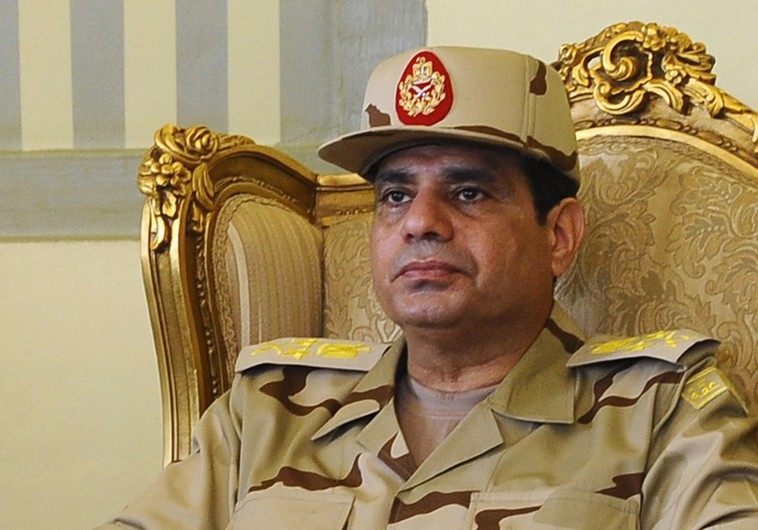
Egypt's Defense Minister Abdel Fattah al-Sisi is seen during a news conference in Cairo on the release of seven members of the Egyptian security forces kidnapped by Islamist militants in SinaiAbdul Fattah Sisi. (photo credit:REUTERS)

Vainly did the Egyptian president try to convince the US-led coalition against Islamic State to extend its activities to the whole Middle East. But US President Barack Obama is unwilling to acknowledge that there is a regional and international dimension to the movement.

*****************

Egyptian President Abdel Fattah al-Sisi is fighting for his country’s survival – and his own.

Islamic terrorism is not abating, hampering vital efforts to bring a better life to the people through a revitalized economy and political stability. Sisi knows he has to show results soon to prevent Egypt from slipping back into anarchy and chaos.

Despite the army’s all-out effort to defeat Islamist insurgency in Sinai, there is no end in sight. F-16 fighter planes and Apache helicopters have joined the campaign, security forces have killed or wounded hundreds of terrorists, destroying their haunts and their training groups – but more keep coming.

Ansar Bayt al-Maqdis gunmen, who have pledged allegiance to Islamic State, continue making daring raids against police stations and other security targets, leading to loss of life and heavy damage.

In one instance on April 14, the commander of the central police station of El-Arish was wounded in a raid; the assailants were able to escape.

For all intents and purposes the situation has reached a stalemate, though the army has managed to contain the terrorists in the northern part of the Sinai Peninsula, preventing them from extending their activities to the south and to the Suez Canal – where they could have inflicted untold damage to economic and security infrastructure, and severely undermined public morale.

However, there are still sporadic terrorist attacks in Cairo and other parts of the country.

Bombs explode, killing and maiming; power lines are blasted. A number of terrorist groups are involved, from Ansar Bayt al-Maqdis and the so-called Soldiers of Egypt to the ever-present Muslim Brotherhood; many of their members have been arrested, their leaders sentenced to death – though no one has been executed yet – but they keep on demonstrating against the regime (though in diminishing numbers).

In Yemen, Iranian-backed Houthi tribes are poised to take over the strategic Red Sea straits, threatening free passage to the Suez Canal – a reminder, if one was needed, of the fact that Islamic terrorism knows no border.

Vainly did the Egyptian president try to convince the US-led coalition against Islamic State to extend its activities to the whole Middle East. But US President Barack Obama is unwilling to acknowledge that there is a regional and international dimension to the movement.

The fact remains that Islamic State dispatches terrorists and weapons to Ansar Bayt al-Maqdis in the Sinai Peninsula from Libya, where there is an unlimited supply of both. No matter how many guerrillas are intercepted or killed by the Egyptian army, more are coming through the vast mountainous and desert region, along the 1,200-km border between the two countries.

Then there is Gaza, where terrorists can find refuge, regroup and train, and where new weapons can be tested.

Cairo is desperately trying to cut off the peninsula from the Strip. The Rafah crossing is closed most of the time, and when it opens it is under the strict supervision of Egyptian authorities. More than 2,000 contraband tunnels have been destroyed and a 1-km.-deep sanitized zone has been installed; thousands of families have been uprooted.

They have been compensated but resentment is high, and the move has prompted widespread condemnation by human rights associations.

Against this backdrop, the regime is weighing extending the zone to 5 km. and making the digging of contraband tunnels punishable by life imprisonment. A court in Cairo has forbidden Hamas activities in Egypt, and another has declared Hamas a terrorist organization; however, the central government is appealing that decision for the sake of its ongoing dialogue with Gaza’s leaders on the Palestinian issue.

The Iranian-Houthi threat has led Sisi to call for the creation of a rapid-response Arab unit, as Saudi Arabia has rallied neighboring states to form a coalition against the rebels in Yemen – who are threatening its border in the south, and were about to take control of the strategic port of Aden.

Though the creation of a united Arab unit was decided at a summit in Sharm e-Sheikh last month, implementation will not be easy. A number of states such as Lebanon and Iraq have warned they would not allow any infringement to their sovereignty; some Gulf states and Jordan have been more forthcoming, and meetings between army commanders are scheduled.

The problem is that these countries are not keen to risk their troops in a ground operation in neighboring states. Armies are the traditional bulwark of Arab regimes; a failed intervention outside their borders could cause their downfall. Nevertheless, since the West is largely indifferent to what is happening, Sisi and his Gulf allies have no choice but to unite against the common threat of Islamic terrorism, be it Sunni or Shi’ite.

On the home front, Sisi has launched a series of impressive projects – a new canal parallel to the old one to enable simultaneous crossing in both directions, thereby doubling receipts; an industrial, commercial and tourist zone between the two canals; 3,000 km of modern roads. Perhaps his most ambitious project is the creation of a new administrative capital city east of Cairo, at an estimated cost of $45 billion. Arab states have rallied to his side, pledging billions of dollars at a special economic summit last month; international groups have indicated their interest in some of the projects – a significant victory for the embattled president.

But Egypt’s endemic problems – population explosion, illiteracy leading to widespread unemployment and enduring poverty, as well as corruption on an epic scale – are not making Sisi’s task easier.

He is also calling to reform Islam by purging it of its extremist discourse, and has already instructed the Education Ministry to eliminate extremist content such as the call to jihad and attacks on other religions.

Meanwhile, the political situation is still unclear and elections are repeatedly postponed, allegedly because of ambiguities in the election law.

The fact is that the president has not been able to secure a large enough block to ensure his electoral victory, while the Muslim Brotherhood – though banned – and other Islamic parties can still muster a sizable vote.

Can Sisi win all his battles? How long will the Egyptian people wait for some much-needed economic results? Egypt is going it alone, still waiting for the West to understand that Cairo remains its best ally against the rising tide of terrorism now lapping at its shores.

Blog: Obama plans to hand over F-16s to Iranian-infiltrated Iraq government

April 17, 2015

Obama plans to hand over F-16s to Iranian-infiltrated Iraq government

By Thomas Lifson

April 17, 2015

via Blog: Obama plans to hand over F-16s to Iranian-infiltrated Iraq government.

Last year, the US government delayed the delivery of 36 F-16 fighter aircraft to Iraq, as ISIS threatened to take over the Balad air base where they would be located. But in the wake of Tuesday’s White House visit of Iraqi PM Haider al-Abadi, it appears that the deliveries are back on track. Max Boot, writing in Commentary, expresses justifiable doubt as tp the wisdom of handing over advanced fighters to a nation under the thumb of, and infiltrated by Iran:

The reality is that Abadi is far from the most powerful man in Iraq, a title that probably belongs rightfully to Gen. Qassem Suleimani, head of Iran’s Quds Force (snip)

…the government of Iraq is heavily infiltrated by Iranian agents. Does it really make safe under those circumstances to deliver to Iraq three dozen high-performance fighter aircraft? I, for one, am worried that the fighters could eventually wind up in Iranian hands, buttressing an Iranian Air Force that until now has had to rely on aging F-14 fighters from the 1970s and even F-4s and F-5s from the 1960s. Granted, F-16s aren’t top of the line aircraft anymore—they are outclassed by F-22s and F-35s—but as a matter of policy and law the U.S. does not sell arms to hostile states or to states that might transfer them to hostile states.

Paging the House and Senate Armed Services Committees! Congress needs to get involved in this issue urgently to assess whether it makes sense to continue with the F-16 transfer to Iraq—and, if it doesn’t, to block the sale before Gen. Suleimani’s boys are using F-16s to drop bombs on the heads of American or Israeli soldiers.

Hat tip: Less Smith, The Weekly Standard

Cartoon of the day

April 16, 2015
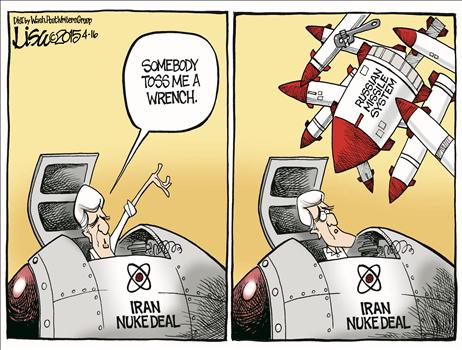
Kerry Missiles

Holocaust Remembrance Day – Tel Aviv; April 16th 2015

April 16, 2015

(May God bless and protect the good people of Israel. – LS)


LIVE: International March of the Living at Auschwitz

April 16, 2015

EXCLUSIVE: Iranian Parliament Releases “Factsheet” for Revision of Lausanne Statement

April 15, 2015

EXCLUSIVE: Iranian Parliament Releases “Factsheet” for Revision of Lausanne Statement, FARS News Agency (Iranian), April 15, 2015

(Note: all bold print and italics are in the original. Iran now insists on a five year term for an agreement and the immediate lifting of all sanctions, among other things. — DM)

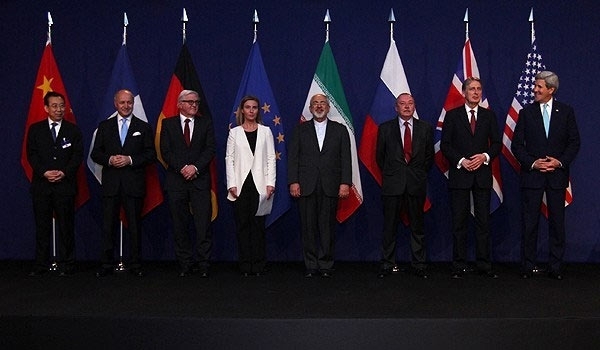
13940114000003_PhotoI
TEHRAN (FNA)- The Iranian parliament’s Nuclear Committee on Wednesday released a factsheet to declare the revisions needed to be made in the Lausanne statement that was issued by Tehran and the world powers as a framework understanding at the end of their nuclear talks in Switzerland earlier this month.

The factsheet which was presented by Head of the Nuclear Committee Ebrahim Karkhaneyee on Wednesday stresses the necessity for respecting the redlines and guidelines specified by Supreme Leader of the Islamic Revolution Ayatollah Seyed Ali Khamenei, making Iran’s decisions and undertakings reversible to enable the country to resume its nuclear operations in case of the other side’s non-commitment to its undertakings, and immediate termination of all sanctions in a single step and on the first day of the implementation of the final agreement.

The factsheet also necessitates commitment of both sides to their undertakings based on the Geneva agreement, a fair and reasonable balance between the gives and takes, taking good care not to impair the country’s security and military boundaries and national interests, providing 190,000 SWUs (Separative Work Units) of nuclear fuel enrichment capability needed by Iran to produce fuel for the Bushehr nuclear power plant immediately after the end of contract with Russia, safeguarding the nuclear achievements, actual operation of all nuclear facilities of Iran not in words, but in action, continued Research and Development (R&D) works and scientific and technological progress in Iran and immediate application of R&D findings in the country’s industrial-scale uranium enrichment cycle.

The factsheet urges operation of 10,000 centrifuge machines at Natanz and Fordo, a maximum 5-year-long duration for the deal and for Iran’s nuclear limitations, replacement of the current centrifuges with the latest generation of home-made centrifuge machines at the end of the five-year period.

Enrichment Program:

The period for the Join Comprehensive Plan of Action (JCPOA) should be limited to five years, in which about 10,000 active centrifuges operating at Natanz and Fordo now will continue nuclear fuel production by enriching uranium  below the 5% grade.

The UF6 enriched reserves which are under the supervision of the International Atomic Energy Agency (IAEA) should be kept at Fordo nuclear plant and will be turned into nuclear fuel complex based on the existing capabilities.

During the five-year period, the Islamic Republic of Iran will continue to keep the excess centrifuges installed at Natanz and Fordo or will gradually dismantle them, and at the end of the 5-year period, it will replace all the existing centrifuges, including the active or inactive ones, with the new generation of (IR-N) centrifuge machines with the help of the new spaces and infrastructures which will have been already prepared and will use them without any limitation.

Justification:

Based on the Geneva agreement, the period for the final step should merely include a single period which has been considered as to be five years in the present factsheet. But in the Lausanne statement, different periods of 10, 20, 25 years and higher have been considered.

Given the Geneva agreement, the amount of enrichment should be specified based on the country’s practical needs and the number of 10,000 centrifuges has also been specified on this basis.

The 5-year period in this factsheet has been has been specified with respect to the date when Iran’s nuclear fuel contract with Russia for the Bushehr nuclear power plant will end; hence, the rules and limitations for the components of the enrichment cycle should be set in such a way that the Islamic Republic of Iran will be able to supply the fuel needed for the power plant after the end of the contract with Russia.

Operation of 10,000 centrifuges and developing and having a 10-ton enriched uranium stockpile will enable the Islamic Republic of Iran to supply the fuel needed for the Bushehr power plant in the year when the fuel supply contract with Russia (28-30 tons) ends.

Fordo installations:

Fordo nuclear facility will remain an enrichment and nuclear Research and Development (R&D) center. 4 enrichment cascades with 656 centrifuges will continue operation and production of fuel for purity levels lower than 5% by maintaining the current chain arrangements.

If the country would need 20%-degree (enriched) uranium, the nuclear fuel production line for purity levels lower than 5% will be altered to enrich uranium to the 20%-grade after connecting the centrifuge cascades to each other again.

Justification:

Based on the above, Fordo will remain an actual and active center, and the Islamic Republic of Iran will maintain its capability to reverse its decision and restore the 20%-grade enrichment.

Research and Development (R&D):

In a bid to use R&D findings in the country’s industrial-scale enrichment chain, R&D should be planned in a way that the necessary possibilities and infrastructures will be provided for replacing the first generation of centrifuges with the latest generation of centrifuge machines (IR-N) when the Joint Comprehensive Plan of Action comes to an end after 5 years.

The R&D program should undergo no limitation before it comes into use for industrial-scale operation.

Justification:

Accordingly, the advanced centrifuges will enter the chain of nuclear fuel production without any restriction at the end of the 5-year deal.

Arak Heavy Water Reactor:

Given the Group 5+1 countries’ mere concern about the plutonium existing in the spent nuclear fuel (SNF) of the Arak 40-MW heavy water reactor, the fuel used by the reactor will be sent abroad.

The G5+1 states will be committed to cooperate and take the necessary measures for relevant international licensing and permissions.

Justification:

Given the SNF export abroad, the insistence of the G5+1, specially the US, on redesigning the said reactor is merely a pretext and doesn’t have any scientific rationale.

What is more important than the heavy water nature of Arak reactor is the core of the reactor which is due to be taken out and then be redesigned and renovated. Such a move is irreversible in nature, and thus means crossing the specified redlines.

Supervision and Inspection:

Supervision and inspections of the Islamic Republic of Iran’s nuclear program should be carried out within the framework of the the Non-Proliferation Treaty (NPT) safeguards agreements.

Justification:

Once done, the principle stated by the Supreme Leader of the Islamic Revolution – that security and military sanctities and boundaries shouldn’t be violated and that the inspections should be carried out at conventional levels similar to all other countries – will be respected and materialized. Given the Islamic Republic of Iran’s opposition to the world arrogance, endorsing and implementing the Additional Protocol will provide the world arrogance (a term normally used for the US and its western allies) with legal grounds to stage their preplanned plots against the Islamic Republic of Iran.

Sanctions:

Concurrently with the start of the JCPOA, all the US and EU sanctions will be terminated and Iran will start fulfilling its undertakings based on the verification of the IAEA.

The UN Security Council sanctions resolution against Iran will be annulled and all nuclear-related sanctions will be terminated and the Islamic Republic of Iran’s case will be normalized.

The G5+1 countries, the EU and the UNSC will avoid imposition of new nuclear-related sanctions against Iran.

Justification:

By terminating all sanctions in a single step right at the start of the implementation of the final comprehensive agreement, the Supreme Leader’s statement that termination of sanctions is part of the agreement and not its result will be materialized.

Based on the Geneva agreement, after the implementation of the JCPOA, all UNSC, US and EU sanctions should be terminated and no new (UNSC) resolution would be needed in this regard; Hence, terminating the UNSC sanctions will close the case and no new resolution which would pave the ground for new plots will be issued.

International cooperation:

The Islamic Republic of Iran’s nuclear cooperation with the world states, including the G5+1 members, in areas of building nuclear power plants, research reactors, nuclear fuel production, nuclear safety medicine and nuclear agriculture, etc. will be possible and will improve. Based on the JCPOA, Iran will be provided with access to the global market, trade and finance and technical know-how and energy.

Reversibility:

In case of the two sides’ non-commitment to their undertakings, there will be a possibility for reversing all measures.

Justification:

Based on the aforementioned proposal, the Islamic Republic of Iran will be provided with reversible measures at the lowest level of damage and, therefore, the G5+1’s commitment to its undertakings will be in fair balance (with those of Iran).

Duration of the JCPOA:

After the end of the five-year period and the JCPOA exercise, all restrictions will be lifted and based on the Geneva agreement, the case with the Islamic Republic of Iran’s nuclear program will be similar to that of the other NPT member states.

The Iranian Parliament factsheet for a revision to the Lausanne agreement came after the US released a factsheet different from the joint statement issued by Iran’s Foreign Minister Mohammad Javad Zarif and Federica Mogherini, the High Representative of the European Union for Foreign Affairs and head of the G5+1 in nuclear talks with Iran, at the end of the latest round of Iran-world powers nuclear talks in Switzerland on April 2, known as the Lausanne statement.

The US factsheet that was released only a few hours after the Lausanne framework understanding caused fury in Iran, encouraging many to raise deep doubt about the results of the talks and US accountability and trustworthiness.

In only a few weeks, a bipartisan bill was also presented to the Congress for vote that would give the US legislature oversight of a final deal, a move seen by many across the globe, including both Iran and the US, as furthering impediments to the endorsement of a final deal between Iran and the sextet.

Senate Foreign Relations Committee Chairman Senator Bob Corker, who wrote the bill, said the White House had agreed to go along with the bill only after it was clear there was strong Democratic support. The legislation was passed unanimously by the committee and is expected to pass the full Senate and then the House of Representatives.

“That change occurred only when they saw how many senators were going to vote for this,” Corker said.

Bipartisan support for the bill had grown in recent weeks to near the 67 votes needed to override any presidential veto. But senators from Obama’s Democratic Party did succeed in adding amendments to water down the bill, making it more palatable to the White House.

Congress defeats WH on Iran. Bob Corker- New bi-partisan hero on hill

April 15, 2015

Congress defeats WH on Iran. Bob Corker- New bi-partisan hero on hill – YouTube.

David Ignatius:  “WH leaves Kerry looking like ‘beached whale”

Congress will now have a say in the U.S.-Iran nuclear deal after a unanimous vote Tuesday in the Senate Foreign Relations Committee. The Morning Joe panel discusses the vote.

Israel approves of the bill as passed.


Obama’s One-Man Nuclear Deal – WSJ

April 15, 2015

Obama’s One-Man Nuclear Deal – WSJ.

Congress will get a vote but the President still has a free hand.

President Obama says he wants Congress to play a role in approving a nuclear deal with Iran, but his every action suggests the opposite. After months of resistance, the White House said Tuesday the President would finally sign a bill requiring a Senate vote on any deal—and why not since it still gives him nearly a free hand.

Modern Presidents have typically sought a Congressional majority vote, and usually a two-thirds majority, to ratify a major nuclear agreement. Mr. Obama has maneuvered to make Congress irrelevant, though bipartisan majorities passed the economic sanctions that even he now concedes drove Iran to the negotiating table.

The Republican Congress has been trying to reclaim a modest role in foreign affairs over Mr. Obama’s furious resistance. And on Tuesday afternoon the Senate Foreign Relations Committee unanimously passed a measure that authorizes Congress to vote on an Iran deal within 30 days of Mr. Obama submitting it for review.

Opinion Journal Video

Baker & Hostetler Partner David Rivkin on the Senate Foreign Relation Committee’s attempt to reassert influence over President Obama’s nuclear deal with Iran. Photo credit: Associate Press.

As late as Tuesday morning, Secretary of State John Kerry was still railing in private against the bill. But the White House finally conceded when passage with a veto-proof majority seemed inevitable. The bill will now pass easily on the floor, and if Mr. Obama’s follows his form, he will soon talk about the bill as if it was his idea.

Mr. Obama can still do whatever he wants on Iran as long as he maintains Democratic support. A majority could offer a resolution of disapproval, but that could be filibustered by Democrats and vetoed by the President. As few as 41 Senate Democrats could thus vote to prevent it from ever getting to President Obama’s desk—and 34 could sustain a veto. Mr. Obama could then declare that Congress had its say and “approved” the Iran deal even if a majority in the House and Senate voted to oppose it.

Foreign Relations Chairman Bob Corker deserves credit for trying, but in the end he had to agree to Democratic changes watering down the measure if he wanted 67 votes to override an Obama veto. Twice the Tennessee Republican delayed a vote in deference to Democrats, though his bill merely requires a vote after the negotiations are over.

His latest concessions shorten the review period to 30 days, which Mr. Obama wanted, perhaps to mollify the mullahs in Tehran who want sanctions lifted immediately. After 52 days Mr. Obama could unilaterally ease sanctions without Congressional approval. Mr. Obama has said that under the “framework” accord sanctions relief is intended to be gradual. But don’t be surprised if his final concession to Ayatollah Khamenei is to lift sanctions after 52 days.

Mr. Corker also removed a requirement that the Administration certify to Congress that Iran is no longer supporting terrorism. This sends an especially bad signal to Iran that Congress agrees with Mr. Obama that the nuclear deal is divorced from its behavior as a rogue state. One of Mr. Obama’s least plausible justifications for the nuclear deal is that it would help to make Iran a “normal” nation. But if Tehran is still sponsoring terrorism around the world, how can it be trusted as a nuclear partner?

***

Our own view of all this is closer to that of Wisconsin Senator Ron Johnson, who spoke for (but didn’t offer) an amendment in committee Tuesday to require that Mr. Obama submit the Iran nuclear deal as a treaty. Under the Constitution, ratification would require an affirmative vote by two-thirds of the Senate.

Committing the U.S. to a deal of this magnitude—concerning proliferation of the world’s most destructive weapons—should require treaty ratification. Previous Presidents from JFK to Nixon to Reagan and George H.W. Bush submitted nuclear pacts as treaties. Even Mr. Obama submitted the U.S.-Russian New Start accord as a treaty.

The Founders required two-thirds approval on treaties because they wanted major national commitments overseas to have a national political consensus. Mr. Obama should want the same kind of consensus on Iran.

But instead he is giving more authority over American commitments to the United Nations than to the U.S. Congress. By making the accord an executive agreement as opposed to a treaty, and perhaps relying on a filibuster or veto to overcome Congressional opposition, he’s turning the deal into a one-man presidential compact with Iran. This will make it vulnerable to being rejected by the next President, as some of the GOP candidates are already promising.

The case for the Corker bill is that at least it guarantees some debate and a vote in Congress on an Iran deal. Mr. Obama can probably do what he wants anyway, but the Iranians are on notice that the United States isn’t run by a single Supreme Leader.