Archive for April 10, 2015

Iran Sitting on Nuclear Weapons and ICBMs Makes Our World Safer According to the Administration

April 10, 2015

Iran Sitting on Nuclear Weapons and ICBMs Makes Our World Safer According to the Administration
by Sara Noble April 10, 2015 Via the Independent Sentinel


(An ICBM breakout this year? I imagine the payload is not far behind. – LS)

The so-called nuclear agreement told Tehran they could: keep their underground Fordow fuel enrichment plant; they didn’t have to dismantle their Arak plutonium facility; they had the right to enrich uranium; and the centrifuges spinning are fine as well. Iran is now insisting that sanctions must be immediately canceled and the inspections are to be limited with no oversight of military dimensions.

The nuclear agreement is not an agreement at all.

One should always be suspicious of miraculous last-minute deals. It was more likely a tactic employed to keep the talks going without congressional interference.

More important than what is in the agreement, is what is not.

Since 2014, we have known that Iran is close to developing ICBMs, yet President Obama has sought to dismantle or disrupt U.S. ICBM systems and has not included ICBMs in the current nuclear talks with Iran. In fact, the deal is leaving in place enough nuclear capability for Iran to put nuclear warheads of some ICBMs even before the sunset clause is reached.

Why is Iran building them? You don’t build ICBMs in order to deliver insignificant explosives. Their only purpose is to carry nuclear warheads. Iran does not need an ICBM to hit Tel Aviv. Intercontinental missiles are for reaching other continents like North America.

The nuclear agreement is the end of nonproliferation. Iran is a rogue state that is illegally enriching with our blessing. The arms race has already begun in fragile countries with paper governments and transitory values.

President Obama’s alleged goal was nonproliferation to give us a safer world, but among the many mistakes he is making with the nuclear agreement is ignoring Iran’s missile development.

The 2014 Annual Report on Military Power of Iran stated that “Iran could have an ICBM capability by 2015,” said Rep. Mike Rogers (R., Ala.), chairman of the House Armed Services strategic forces subcommittee last July when the report became public.

“We have known this [Iran’s interest in developing ICBMs] since well before the Obama administration,” Rogers said. “This unchanging fact is one of the reasons I have been and continue to be concerned about the administration’s efforts to dismantle our missile defenses.”

Rogers said that suggestions that somehow the danger of Iran’s developing long-range missile capabilities has diminished, or that the Pentagon report has altered U.S. intelligence assessments “is untrue.”

Lt. Gen. Michael Flynn, former head of the Defense Intelligence Agency confirmed that Iran is close to having ICBM capability.

James Clapper, the director of national intelligence, told the Senate Select Committee on Intelligence, Jan. 29, 2014, that “Iran would choose a ballistic missile as its preferred method of delivering nuclear weapons.”

There is some dispute over the year, but whether or not Iranian ICBMs will be ready this year or five years from now, there is no question that Iran is developing a robust missile program.

The concern that they will have ICBMs by 2015 appears to be jumping the gun but it’s not far off.

Iran is developing ballistic missiles with a range of up to 6,000 kilometers, capable of holding parts of the American homeland at risk but it might not come for five years or more.

According to the Center for Nonproliferation Studies, such capability is still only aspirational because as scientist David Wright points out, building ICBMs is tricky. In fact, it is unlikely that Iran would be capable of fielding an ICBM until 2020 at the earliest and even then its missiles would be “too large and cumbersome to be placed on a mobile platform.”

Iran currently has the largest and most diverse ballistic missile arsenal in the Middle East. Israel has more capable ballistic missiles, but fewer in number and type.

Iran is currently reliant on foreign suppliers for key ingredients and components which have not been readily forthcoming from Russia and China up until now, but Iran will come into large sums of money when the sanctions are removed. They are quickly becoming a powerful and dominant force in the region. Iran has also just forged a partnership with Russia.

Iran’s space program, which includes the successful launch of a small, crude satellite into low earth orbit using the Safir carrier rocket, proves the country’s growing ambitions and technical prowess.

Iran has an expanding nuclear and missile program representing Iran’s ultimate goals of attacking what it calls “the little Satan” (Israel) and “the great Satan” (the United States).

In a video obtained by Israel in January of this year, a new and previously hidden missile and launch site in Iran was at first thought to be capable of sending a rocket into space or launching an ICBM.

While this idea has been debunked as a misreading of satellite imagery by outfits such as Janes 360, the same publication said the facility is not yet complete. They also advised that while Iran claims they do not need missiles with a longer range than what they currently have, there are indications that they continue to work on long-range rockets.

Jane’s has seen a surge of activity at the Bid Ganeh missile development facility and Iran has invested significant resources into building a new launch facility near Shahrud that “could test longer-range, solid-fuel missiles”.

Sen. Bob Menendez, D-N.J., recently made a stunning comment at a Senate Foreign Relations Committee hearing on Iran.

“The more I hear from the administration and its quotes, the more it sounds like talking points that come straight out of Tehran,” the Democratic lawmaker said.

He has been an outspoken critic of Obama’s approach with Iran and Cuba. He is now under indictment on corruption charges. While the investigation into his dealings has been ongoing for two years, the timing of the indictment is curious.

Republican Sen. Bob Corker, R-Tenn., told Jerusalem news agencies he can’t understand why the president promises to veto upcoming congressional legislation about Iran even before it’s been written.

“For Congress not to have the ability to weigh in on this, which has such geo-political importance and where Congress has played such an important role, is ridiculous and candidly irresponsible for Congress not to play a role,” Corker said.

Wouldn’t we all like to know the answer to that and as to why ICBMs are being ignored. It appears that Obama only intends to kick the can down the road to the next president while setting up a more dangerous chessboard on which to play. We should keep in mind that Iranians invented the game of chess and they lie.

The people behind the Obama platform, fully support a policy of appeasement and say things like this.

This is why our Constitution has safeguards to prevent one man from ruling alone. Hypothetically and using an extreme but not impossible example, one man alone could be a fool, a subversive, or a madman. Unfortunately, Congress has been rendered near-useless and there is a wide opening for fatal mistakes.

President Obama thinks ignoring Iran’s ICBM aspirations and their sitting on nuclear weapons makes for a safer world.

We have already appeased evil leaders, ignoring reality, sacrificing allies, and it hasn’t worked. It can’t work, it will never work.

Andrew Klavan: Obama’s Clown-Car Diplomacy

April 10, 2015

Andrew Klavan: Obama’s Clown-Car Diplomacy, Truth Revolt via You Tube, April 10, 2015


The Fable of the Bees

April 10, 2015

The Fable of the Bees, Washington Free Beacon, April 10, 2015

(Please see also, 28 Times Obama Said He’d Prevent Iran from Getting a Nuclear Weapon | SUPERcuts! #184 — DM)

Barack Obama,

Complacency is an understandable response to peace and security. Some problems do go away if you leave them alone. But the world is not the Rose Garden, and the consequences of nuclear attack or nuclear war would be far worse than bug bites. Sometimes it’s right to worry, it’s right to be afraid, it’s right to have the flyswatter nearby. The hornets will strike, and when they do it will be more painful if we have let our guard down.

*********************

A beautiful day: warm, sunny. A garden in bloom filled with the laughter of children. Frolic beneath the whitewashed façade of a stately and classic old house. A friendly man in dress shirt and trousers reads aloud. Then: screams.

The young ones listening to the man are terrified. Bees have been spotted. The kids are afraid. The man, a father of two, projects calm. He pauses from his book—Where the Wild Things Are—and says, “It’s okay guys. Bees are good. They won’t land on you. They won’t sting you. They’ll be okay.”

Doesn’t work. The bees are buzzing, menacing. A few of the kids cry out. The man changes his strategy. He admonishes the children. “Hold on, hold on, you guys are wild things,” he says. “You’re not supposed to be afraid of bees.” Laughter from parents, normalcy restored. The man resumes his tale.

An amusing interruption of an otherwise placid White House Easter Egg Roll? Undoubtedly. But some in the press said more was going on, that this encounter between the innocents, President Obama, and the swarm held a more profound significance.

“‘Bees are good,’ Obama says as children scream,” read the Politico headline. “Perhaps no president in history has made a stronger case for protecting pollinators than Barack Obama,” wrote the Washington Post. “Obama trying to reassure children about bees is a perfect metaphor for his foreign policy,” pronounced a writer for Vox.com, who most recently confused New Hampshire with Vermont.

I say Vox.com is right. “Bees won’t sting you” is an apt slogan for Obama’s attitude toward the world. But I say too that his attitude is patronizing, unrealistic, dangerous. Bees do sting. And kill. And the real wasps of the world, the terrorists and criminals and psychopaths and autocrats, with their knives and box-cutters and bombs and guns and tanks and missiles and rockets and ICBMS—they sting, they hurt, they kill even more. They won’t be “okay.”

“If you stay calm and more or less ignore the bee,” writes Vox.com, “the odds are that things will be fine.” Sure, someone one day will be hurt, even die. “But panicking at every bee sighting would be counterproductive.” In the real world of states and ideologies and nuclear proliferation, “America’s superpower status should make us willing to embark on new diplomatic initiatives and avoid counterproductive panics over minor issues.”

We have here all of the components of the liberal mindset: the threat deflation, the technocratic elitism, the preoccupation with the behavior of the stronger party vis-à-vis the weaker one, the depersonalization of non-Western actors, whose ideas and motives and ambitions and emotions are justified or ignored or explained away.

Bees aren’t dangerous and, Obama says, “Iran understands that they cannot fight us.” John Kerry tells Congress, “We are actually living in a period of less daily threat to Americans and to people in the world,” as a Caliphate is proclaimed in Mesopotamia, as Russia threatens nuclear war, devours Ukraine, and buzzes NATO allies, as jihadist attacks spread, as China builds a system of artificial islandsto expand its regional power.

Worried? Settle down. You’re being irrational, inflating threats, acting out like a spoiled and ignorant brat. Liberals know better. We have this situation under control. Leave it to us—and do not, if you are a member of Congress, try to interfere. It’s America that must not panic but exercise restraint, to bind itself in a thousand petty contracts and agreements, in corrupt institutions, to guarantee that we don’t act rashly, aggressively, or alone.

What most concerns liberals is not the barbarism of our enemies but our conduct toward them. Not the habits of the bee but the decorum of the children. For who can control bees? They behave instinctively. And who can influence Putin? He’s encircled, stuck in the last century. The Iranians? We burned them pretty badly with that whole Mossadegh thing. Terrorism? We can pursue the terrorists, for sure, and we can apprehend them or kill them. They’re not warriors but criminals, and the grievances and furies that drive them can’t be suppressed through force alone. They have to burn themselves out.

Comforting thoughts. And especially attractive to Americans, who are protected by two great oceans, who exist in an unacknowledged confederation with our northern neighbor and whose biggest challenge with the citizens of our southern one is that they all seem to want to move here. Insanely rich, we are anxious over having too much to eat, over the consequences of increasing longevity. We Democrats prefer commerce to conflict, domestic affairs to international ones. We can afford not to panic. Or so it seems.

But try telling an Israeli that bees won’t sting. A Syrian. A Kurd. A Ukrainian. A Nigerian, or a Kenyan. You most likely will be laughed at. Revealed as naïve. Explain to the Saudis and Jordanians and Egyptians, to the Poles and Lithuanians, to the Japanese and South Koreans that America is engaging with rogue regimes because to respond to them in the traditional postwar manner would be “counterproductive.” Our allies will laugh.

Complacency is an understandable response to peace and security. Some problems do go away if you leave them alone. But the world is not the Rose Garden, and the consequences of nuclear attack or nuclear war would be far worse than bug bites. Sometimes it’s right to worry, it’s right to be afraid, it’s right to have the flyswatter nearby. The hornets will strike, and when they do it will be more painful if we have let our guard down.

In which case there will be only one option.

Call pest control.

28 Times Obama Said He’d Prevent Iran from Getting a Nuclear Weapon | SUPERcuts! #184

April 10, 2015

28 Times Obama Said He’d Prevent Iran from Getting a Nuclear Weapon | SUPERcuts! #184, via You Tube, April 9, 2015


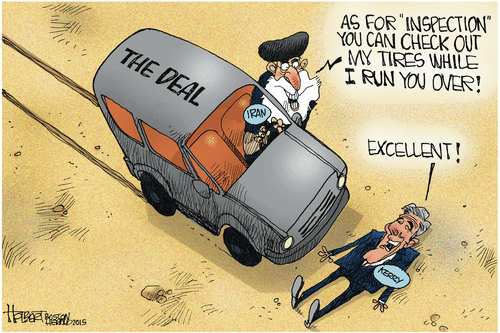
Cartoon of the day

April 10, 2015

Via You Viewed Editorial, April 10, 2015

Iran inspections

Iran, Saudi Arabia in tense buildup opposite Yemen’s Gulf of Aden shore: US air tankers refueling Saudi jets

April 10, 2015

Iran, Saudi Arabia in tense buildup opposite Yemen’s Gulf of Aden shore: US air tankers refueling Saudi jets

DEBKA file Exclusive Report April 10, 2015, 8:30 AM (IDT)

via Iran, Saudi Arabia in tense buildup opposite Yemen’s Gulf of Aden shore: US air tankers refueling Saudi jets.


Saudi-Iranian saber-rattling over Yemen has reached a dangerous peak, Thursday, April 9, the Saudi army spokesman, Brig. Gen. Ahmad Al-Assiri, warned: “Iranian ships have the right to be present in international waters, but won’t be allowed to enter Yemeni territorial waters.”

This was Riyadh’s rapid-fire riposte for the Iranian decision to deploy its navy’s 34th Flotilla, consisting of the Alborz destroyer and the Bushehr helicopter carrier warship, in the Gulf of Aden opposite the Yemeni coast.

The Saudi general noted that Iran had not evacuated any of its citizens from Yemen because, he said, “they are all involved in training and arming the Houthis.”
Soon after launching their air offensive in late March against the Iranian-backed Houthi rebels and forces loyal to ousted president Ali Saleh, the Saudis took control of the country’s airspace to prevent the landing of airlifted Iranian supplies for the Houthis. Russian flights were also barred later from landing in the embattled country.
Gen. Al-Assiri then issued Saudi Arabia’s bluntest threat yet: “Those Iranians planning to remain in the country would face the same fate as the Houthis and their supporters,” he said.

Clearly, the Iranian Revolutionary Guards personnel were being trapped in a Saudi vice: Unable to leave Yemen, on the one hand, they were threatened with death if caught, on the other.
Tehran decided to send its most effective naval force to the Gulf of Aden when it realized that Riyadh would not heed its warnings to back off Yemen. Its presence substantiated the threat of direct Iranian intervention in the Yemeni conflict should harm come to the elite IRGC force aiding the rebels.
The Bushehr helicopter carrier made its maiden voyage to Port Sudan at the end of 2012. Shortly after that, on Dec. 8 of that year, debkafile first revealed is features:

The new 13,000-ton vessel carries 12 Iranian strike helicopters, a crew of 200 and has a range of 8,000 nautical miles that reaches the US coast. There are five landing spots on its decks and four parking spots, as well as SM-1 and SAM anti-air missiles and 40-mm Fath-40 AAA anti-air cannon. Tehran invested $800 million in its first helicopter carrier.

If Tehran is not scared off by the Saudi threat and does order the Bushehr to sail into Yemeni territorial waters, its guns and missiles would be in range there to strike targets in neighboring Saudi Arabia to the north. Tehran could justify this attack by Yemeni President Abd Rabbo Mansour Hadi having been granted asylum in the oil kingdom.

However, the Saudi Air Force would also be on hand close by over Yemen to retaliate by bombing the Iranian Bushehr and other warships to chase them away from the Yemeni coast, if not to sink them.

Our sources predict that this naval-air collision would likely be limited in extent. After peaking to a dangerous crisis, the clash would most probably be contained before it escalated into a full-blown war between Saudi Arabia and Iran.
The Obama administration’s backing for the Saudi Arabian intervention in support of the internationally recognized Yemen president Hadi was intended to keep Iran in check.

On Tuesday, April 7, US Deputy Secretary of State Antony Blinken arrived in Riyadh and stated: “Saudi Arabia is sending a strong message to the Houthis and their allies that they cannot overrun Yemen by force.  As part of that effort, we have expedited weapons deliveries, we have increased our intelligence sharing, and we have established a joint coordination planning cell in the Saudi operation center.”
He was sending a clear message to Tehran backed up by solid US assistance

1.  Tehran was being warned not to make the mistake of assuming that its understandings with Washington over Iran’s regional promotion included license for aggression against Saudi Arabia.
2.  Tehran was notified that the Saudi operational chiefs would henceforth receive ongoing intelligence gathered by a US military satellite over the region through their joint coordination center in Riyadh. This intelligence would also cover the movements of Iranian warships in the Gulf of Aden and the Red Sea.

3. Further details of vital US aid came through Thursday, April 9, from Pentagon spokesman Army Col. Steve Warren. He announced that the US Air Force had begun an aerial refueling mission for “the Saudi Arabian-led mission engaged in air strikes on Shiite Houthi rebels in Yemen.” In its first task Wednesday, a US KC-135 Stratotanker refueled a Saudi Air Force F-15 Eagle and a UAE F-16 Fighting Falcon.

Warren said that the US Central Command aimed to fly one tanker mission a day in support of the Saudi-led alliance, but it would not enter Yemeni airspace to perform it.
Nonetheless, a potential sea-cum-air clash of arms between Saudi Arabia and Iran off the shores of Yemen cannot be ruled out, especially after Riyadh ratcheted up the tension Friday with a ban imposed on Iranian flights carrying pilgrims to Mecca.
It would not be the first firefight to be triggered by the Yemeni conflict. Earlier this week, Egyptian and Iranian warships exchanged fire in the tussle for control over the strategic Bab el-Mandeb Strait. The episode ended with the Iranian ships being ordered directed from Tehran to break off contact and distance themselves from the Egyptian craft. The Iranian Navy commander Rear Adm. Habibollah Sayyari later denied reports appearing in the Gulf media that Egyptian warships had forced Iranian naval vessels to retreat and quit the Gulf of Aden.
The incendiary tension around the Gulf of Aden and rising fear of a Saudi-Iranian military engagement has raised enough alarm for the US, French and British fleets with a naval presence in the Gulf to go on a state of preparedness.


