Archive for April 8, 2015

Humor?| Obama to Israel: I have your back

April 8, 2015

(The views expressed in this article are either mine or those of my guest author. They do not necessarily reflect those of Warsclerotic or its other editors. — DM)

The Most Revereddd Mohamed Allah-scimitar

The Most Revereddd Mohamed Allah-scimitar

This is a post by my (imaginary) guest author, the Most Reverend Mohamed Allah-scimitar, President Obama’s chief foreign policy adviser on Islamic relations with Christians and Jews. But first, some related observations:

Iran continues to reject as lies Obama’s statements about the April 2nd P5+1 nuke “deal,” and states that it “could build bomb today” but won’t because of Ayatollah Khamenei’s (non-existent) fatwa. Understandably, Israel is becoming increasingly concerned about her future existence. Obama’s claims that He has her back and that she therefore need not worry about anyone (else) who tries to “mess with Israel.” His assurances have provided scant comfort.

Cartoon_Israel_BB_KnifeInBack

Here’s are the comforting(?) words of the Most Reverend Mohamed Allah-scimitar.

***********************

Lord Obama has Israel’s back almost to the same extent that He has the Obama Nation’s back and will protect her if necessary. For Israel to maintain, and even improve, her weapons minimizing destruction (WMDs) is an unacceptable insult to Him and to all for which He stands.

ObamaWillStandWithMuslims (2)

Obama salute

During Israel’s “Protective Edge” war against peaceful Palestinians in Gaza, Israel shamelessly shifted the odds disproportionately in her own favor by using the Iron Dome to thwart efforts to destroy her major cities. She provided not even one Iron Dome to the Palestinians! Since that time, she has improved the Iron Dome and developed other WMDs less dependent upon lengthy trajectory tracking of missiles and perhaps even mortar rounds. Racist to the core, she has no regard for social justice, equality and the sad plight she has imposed on the Palestinians. Indeed, they are forced to rely on funds (“tens of millions of dollars”) from Iran to help rebuild Tunnels for Peace (TFP) and resupply their stocks of Missiles for Peace (MFP).

Now that Israel claims that peaceful Iranian nuclear weapons are an existential threat, she is doubtless looking for — and probably finding — ways to escape their consequences as well. Doing so is risible because Lord Obama has explained patiently — even as He would to a backward child — that it is unnecessary. He has her back, as He always had and always will.

Nobody except Obama had dare mess with Israel! Not even Netanyahu! Hence, there is no need for Iran to recognize Israel’s speciously claimed right to continue to exist, which would require fundamental changes in Iran. For Israel to insist on it is a fundamental misjudgment.

Lord Obama is able and willing to act, if necessary, to demonstrate the firmness of His resolve. Indeed, it has already been rumored that He may dispatch His own beloved mother in law from her happy home in the White House to live with Prime Minister Netanyahu in Occupied Palestine. If so, she will be accompanied by a suitable contingent of unarmed Organizing for Action volunteers. Recognizing, however, that more may be required, Lord Obama has been negotiating with Iran to provide the unjustly impoverished Palestinians not only free electrical power but also medically useful radioactive isotopes as well as others for other peaceful purposes. Despite the petty squabbles between the Palestinian Authority and Hamas, Iran will treat them equally.

Israel should and will cease to exist but, with Lord Obama in the picture, Iran should not be a concern.

**************************

There is no P5+1 “deal” and it seems unlikely that there ever will be, no matter how many contortions Obama and Kerry attempt. A deal like the one described in Obama’s talking points would be bad enough. However, Iran has rejected His talking points, has stated that it could build nukes now if it so desired and that the only impediment is a (non-existent) fatwa issued by the Supreme Leader. The Iranian foreign minister has been quoted as saying that

Iran will begin using its latest generation IR-8 centrifuges as soon as its nuclear deal with the world powers goes into effect, Iran’s foreign minister and nuclear chief told members of parliament on Tuesday, according to Iran’s semi-official FARS news agency. [Emphasis added.]

If accurate, the report makes a mockery of the world powers’ much-hailed framework agreement with Iran, since such a move clearly breaches the US-published terms of the deal, and would dramatically accelerate Iran’s potential progress to the bomb.

Iran’s military sites are, of course, off limits to inspections according to Iran’s Defense Minister. Meanwhile, the Supreme Leader continues to lead “death to America” chants and Iranian television continues to entertain its viewers with simulations of nuclear attacks on Israel.


More recently,

[T]he Islamic Republic has announced a new documentary film which will celebrate the life of Qods Force Commander Qassem Soleimani. It’s bad enough lionizing a master terrorist responsible for the deaths of hundreds of Americans in Iraq and Afghanistan. But the description of the film is even more telling: The film Commander will depict Iran’s and Soleimani’s strategic approach to destroy not only the Islamic State but also “the Zionist regime.” Importantly, the article describing the film was published after agreement on a nuclear framework between the P5+1 and Iran. [Emphasis added.]

Iran Announces Film to Celebrate Israel’s Coming Destruction

April 8, 2015

Contentions

Iran Announces Film to Celebrate Israel’s Coming Destruction

Michael Rubin | @mrubin1971 04.08.2015 – 11:30 AM

via Iran Announces Film to Celebrate Israel’s Coming Destruction – Commentary Magazine Commentary Magazine.


President Barack Obama has dismissed arguments that U.S. negotiators should demand that Iran recognize Israel and Israel’s right to exist as part of any final agreement. To do so would be too difficult, the president argues, and not relevant to the narrow goal at hand which is simply to strike an accord to constrain Iran’s nuclear breakout ability for a decade or so. Perhaps no statement better illustrates the moral and cultural equivalence that infuses President Obama and Secretary of State John Kerry.

It is akin to saying North Korea seeks South Korea’s destruction and it would be too complicated to impede Pyongyang’s murderous intent. Russian President Vladimir Putin has expansionist intent? Well, let’s not let his imperialist ambitions toward the Baltics, Poland, and the rest of Ukraine get in the way of our diplomacy.

The Iranian regime’s character isn’t some inconvenient detail; it is the central problem. And as if to underline the problem, the Islamic Republic has announced a new documentary film which will celebrate the life of Qods Force Commander Qassem Soleimani. It’s bad enough lionizing a master terrorist responsible for the deaths of hundreds of Americans in Iraq and Afghanistan. But the description of the film is even more telling: The film Commander will depict Iran’s and Soleimani’s strategic approach to destroy not only the Islamic State but also “the Zionist regime.” Importantly, the article describing the film was published after agreement on a nuclear framework between the P5+1 and Iran. Let’s hope that with their willful naivete, Obama and Secretary of State John Kerry don’t get credit for small but important bit roles.

Iran: Military Sites Off-Limits to Inspectors

April 8, 2015

Contentions

Iran: Military Sites Off-Limits to Inspectors

Michael Rubin | @mrubin1971 04.08.2015 – 12:30 PM

via Iran: Military Sites Off-Limits to Inspectors – Commentary Magazine Commentary Magazine.

President Barack Obama called the framework agreement Secretary of State John Kerry and other representatives of the P5+1 reached in Lausanne “historic.” Alas, as time passes and more is learned about the agreement and Iran’s understanding of it, the more it does seem to be “historic,” but for all the wrong reasons.

One of the key concerns of the international community and the International Atomic Energy Agency has been “possible military dimensions” of Iran’s nuclear program (see the annex to this IAEA report for a listing of these). Much of the work Iran conducted on military dimensions of a nuclear program occurred in Islamic Revolutionary Guard Corps facilities and on their bases.

Iranian Defense Minister Hossein Dehqan today said that the Lausanne Framework does not commit Iran to provide international inspectors access to such military facilities. From Fars News:

Iranian Minister of Defense and Armed Forces Logistics Brigadier General Hossein Dehqan has rejected reports on inspection of the country’s military facilities being included in the recent deal achieved by Iran and the world powers (P5+1) in Switzerland’s Lausanne on April 2, Fars news agency reported on April 8. According to Fars, commenting on “domestic media highlighting such baseless claims by foreign media about the Lausanne agreement,” Dehqan said, “Such actions do not serve national interests, but in fact set the ground for enemy’s excessive demands… The Supreme Leader’s, the government’s approach and the determination of the Islamic Republic of Iran’s nuclear negotiating team together do not allow the other party to impose anything on the Iranian nation.” Referring to “false claims by foreign media outlets such as the Guardian newspaper” on inspection of the country’s military facilities being a part of the Lausanne statement, Dehqan stressed: “There is no such agreement. Basically, inspection of military facilities is a red line and no inspection of any kind from such facilities would be accepted.”

So the Iranian government now contradicts President Obama’s announcement and the State Department fact-sheet with regard to when sanctions will be lifted, centrifuges, enrichment, and even plutonium. Now let’s add inspections and possible military dimensions to the list. Obama is right. The Lausanne agreement is historic. It will be studied by generations of diplomats who will use it to illustrate American naïveté, Iranian duplicity, and the dangers of not actually gaining agreements in writing.


Iran sends battleships to Yemen amid standoff with Saudis

April 8, 2015

Iran sends battleships to Yemen amid standoff with Saudis

Move comes as Sunni coalition converges on Tehran-backed Shiite rebels who conquered much of the country

By AP and Times of Israel staff April 8, 2015, 7:18 pm

via Iran sends battleships to Yemen amid standoff with Saudis | The Times of Israel.


An Iranian navy vessel launches a missile during a drill in the Sea of Oman, in January 2012. (photo credit: AP/ISNA, Amir Kholousi)

An Iranian navy vessel launches a missile during a drill in the Sea of Oman, in January 2012. (photo credit: AP/ISNA, Amir Kholousi)


Iran dispatched a naval destroyer and another vessel Wednesday to waters near Yemen, ratcheting up tensions with Saudi Arabia, which is leading a coalition to quash a Shiite rebellion. The rebels, back by Iran, have deposed the US-backed Sunni leader and captured large swaths of territory in the embattled country in recent months.

Iran’s Chief of the Judiciary Sadeq Amoli Larijani warned Saudi Arabia to stop its “aggression” against Yemen or wait for “dire consequences.

“This blatant aggression of a government which claims [to be leading] Islam, against the Muslim people of another country who want to decide their fate will not remain unanswered,” Larijani told the Fars News Agency, referring to Saudi Arabia.

“When naive individual decisions are made in a country that doesn’t have the least experience of democracy, has no parliament and no elections — the result will be the aggression of a state that claims to be the leader of Islam to another Muslim nation,” he said.

Iran’s English-language state broadcaster Press TV quoted Rear Adm. Habibollah Sayyari as saying the ships would be part of an anti-piracy campaign “safeguarding naval routes for vessels in the region.”

The maneuver comes amid an intense Saudi-led Gulf Arab air campaign targeting the Yemeni rebels, known as Houthis, who come from a Shiite sect. Critics say Shiite power Iran backs the Houthis, though both the Islamic Republic and the rebels deny any direct military assistance.

Speaking a day earlier in the Saudi capital, Riyadh, US Deputy Secretary of State Antony Blinken blamed the violence in Yemen on the Houthis and on forces loyal to former president Ali Abdullah Saleh, saying that the US is committed to defending Saudi Arabia.

“We have expedited weapons deliveries, we have increased our intelligence sharing, and we have established a joint coordination and planning cell in the Saudi operations center,” he said in a statement to reporters after meeting with Saudi royals and Yemen’s President Abed Rabbo Mansour Hadi, who fled his country amid rebel advances.

Intelligence sharing includes making available raw aerial imagery the coalition could use to better strike anti-Hadi forces, said a US defense official who was not authorized to comment publicly. Blinken said the US and the six-nation Gulf Cooperation Council must coordinate closely and press all parties to seek a political solution.

The Gulf Arab-backed air campaign supporting Hadi, which began on March 26, has so far failed to stop the Houthis’ advance on Aden, Yemen’s second-largest city, which was declared the provisional capital by Hadi before he fled.

The US says that the chaos has allowed the local al-Qaeda branch, which it considers the world’s most dangerous wing of the group, to make “great gains” on the ground, prompting Washington to rethink how it prevents it from launching attacks in the West.

Speaking from Tokyo, Defense Secretary Ash Carter said the collapse of the central government in Yemen makes it harder to conduct counterterrorism operations against al-Qaeda, which has ambitions to strike Western targets, including the United States. Regarding the weapons deliveries, he said it involved “some resupply of equipment and munitions” to Saudi Arabia.

The World Health Organization warned Tuesday of an unfolding humanitarian crisis, saying at least 560 people, including dozens of children, have been killed, mostly in the air campaign and ground battles. The aid group said that over 1,700 people have been wounded and another 100,000 have fled their homes as fighting has intensified over the past three weeks.

The first boat carrying medical aid to Yemen since the coalition began bombing arrived in the southern port city of Aden on Wednesday, international humanitarian organization Doctors Without Borders said.

The group’s head of mission in Yemen, Marie-Elisabeth Ingres, said the ship carried some 2.5 tons of supplies from Djibouti for its hospital in Aden.

The group is concerned about how it will transport the supplies and wounded people given the chaos in Aden’s streets, where the situation continues to deteriorate and combat intensifies overnight.

“We have street fighting, snipers, tanks in the street, roads cut and areas not accessible, and electricity, water and fuel cuts,” she said. “Last night the different groups were fighting around the hospital. It lasted all night into the morning and continues now, so all our employees were forced to sleep at the hospital.”

Tons of desperately needed aid awaits clearance to be flown into Yemen, including a Red Cross shipment with 17 tons of medical supplies from Jordan, which emergency workers hope can be flown into the Yemeni capital, Sana’a, on Wednesday. Another 35 tons of supplies were also ready for shipment.

Also Wednesday, Human Rights Watch cited witnesses as saying that Houthi forces fired into crowds of demonstrators in the cities of Taiz and Torba the day before the bombing campaign began, killing at least 7 people and wounding over 80 others. The New York-based group called on Houthi authorities to investigate the incidents.

“Yemen’s spiraling conflict is causing a calamitous breakdown in law and order,” said Joe Stork, deputy Middle East and North Africa director at Human Rights Watch. “Security forces in control, whatever side they are on, have responsibilities to uphold and protect people’s rights and to take action against their members who commit abuses

Hezbollah Chief Likes Nuke Deal: Iran Can Fund Terror Groups

April 8, 2015

Hezbollah Chief Commends Nuke Deal for Helping Iran Fund Terror Groups

by Jordan Schachtel7 Apr 2015Washington, D.C

via Hezbollah Chief Likes Nuke Deal: Iran Can Fund Terror Groups.


Hezbollah leader Hassan Nasrallah said that his forces are readying for war against Israel in an interview with Syrian state-television on Monday.

“The nations in the region must prepare to make sacrifices in any future conflict with Israel,” said the Iran-backed terror chief.

Nasrallah was encouraged by the basic framework agreed upon by the P5+1 World Powers (United States, Russia, China, France, Germany, UK) and the Iranian regime. He said that the deal will allow for a “stronger and wealthier Iran” regime that will “stand by its allies [Hezbollah], and especially the Palestinian resistance [Hamas], more than at any other time in history.”

“Iran will become richer and wealthier and will also become more influential,” said Nasrallah. “There is no doubt that an agreement will have repercussions on the region,” he added.

In the interview, Nasrallah pointed to Israel and Saudi Arabia’s condemnation of the deal as evidence that it would immensely benefit Tehran.

Analysts believe that both Hamas and Hezbollah– which are U.S.-designated terrorist groups– continue to receive the majority of their funding and armaments from the Islamic Republic of Iran.

Over the weekend, it was reported that Iran has disbursed tens of millions of dollars into Gaza to help recreate Hamas’s vast terror network, which includes remaking its underground tunnels and restoring its missile stockpiles.

In January, an Israeli strike killed senior Hezbollah commander Jihad Mughniyeh, whose deceased father had been deemed responsible for taking countless American lives. The strike, which took place near the Israel-Syria border in the Golan Heights, also reportedly killed multiple Iranian commanders. Just two weeks later, Hezbollah militants attacked an IDF position and killed two Israeli soldiers. Since January, there have been no major flare-ups between Israel and the Iranian terror-proxy.

‘Iran to publish facts document to counter American lies’

April 8, 2015

‘Iran to publish facts document to counter American lies’, Israel Hayom, April 8, 2015

Iran could build bomb today but isn’t doing so because of ayatollah’s religious decree, not because of sanctions, Iranian FM reportedly tells parliament • “We made significant achievements in exchange for unimportant concessions,” says Iranian lawmaker.

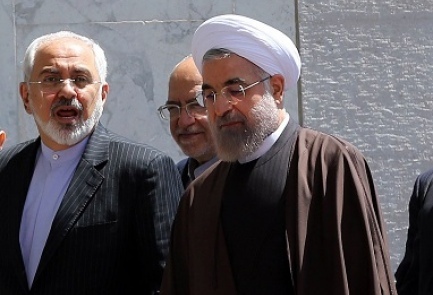
142848211618964843a_bIran’s Foreign Minister Mohammad Javad Zarif (left) with Iranian President Hassan Rouhani | Photo credit: AFP

Iran could build a nuclear bomb today if it wanted and is only refraining from doing so because of a fatwa (religious decree) issued by Ayatollah Ali Khamenei, not because of international sanctions, Iran’s Foreign Minister Mohammad Javad Zarif reportedly said on Tuesday during a closed hearing at the Iranian parliament, Majlis.

According to one of the participants, Zarif said the country’s foreign ministry would soon publish a “document of facts” about the nuclear deal with world powers.

“Zarif told us that his office hadn’t intended on releasing such a document, but reversed its decision because of the Americans’ lies,” said Iranian lawmaker Hussain Naqvi al-Hussaini.

Another Iranian parliamentarian, Gholamali Jafarzadeh Imenabadi, said Zarif told the parliament that Iran is not going to permit online cameras for inspection purposes at nuclear facilities. The reason for the decision, allegedly conveyed by Zarif, was because cameras have supposedly been used in the past to help assassinate Iranian nuclear scientists.

Also in attendance was Ali Akbar Salehi, the head of Iran’s Atomic Energy Organization, who presented the Majlis with the technical aspects of the framework deal. Salehi, who participated in the negotiations in Lausanne, reportedly told his audience that world powers consented to enter negotiations with Iran because they had no other choice.

“We made significant achievements in exchange for unimportant concessions,” said Iranian lawmaker Nozar Shafi.

Meanwhile, Zarif and Iranian President Hassan Rouhani have reportedly garnered the support of Revolutionary Guard commander Mohammad Ali Jafari, who demanded immediate sanctions relief in exchange for a deal.

Iran’s supreme leader, Khamenei, did not voice his opposition to the deal, widely interpreted as silent consent. With that, some 200 Iranian hardliners protested in Tehran against the framework deal.

Assad looses ISIS against Palestinians trapped in Yarmouk camp – a sinister new partnership

April 8, 2015

Assad looses ISIS against Palestinians trapped in Yarmouk camp – a sinister new partnership, DEBKAfile, April 8, 2015

Yarmouk_Palestinian_camp__Damascus_5.4.15The Yarmouk Palestinian camp in Damascus in April 2015

Obama’s rapprochement with Iran and its Middle East allies has produced an incredibly sinister new twist in the Syrian war as it enters its fifth year. The atrocity-ridden conflict finds 16,000 Palestinians trapped in horrible conditions in the Yarmouk refugee camp of Damascus and beset by two enemies: the Islamic State and the President Bashar Assad’s army.

The world has been shown three players in the vicious Yarmouk contest: The Islamic State of Iraq and the Levant, whose jihadis are slashing through the refugee camp and massacring its Palestinian inmaes, the second player, and the Syrian army, the third, which appears to be fighting to keep the Islamists from reaching central Damascus. The camp lies 8.5 km from Assad’s presidential palace.

The Islamists are usually presented as fighting to settle a score with the camp’s inmates, because the Hamas majority is aligned with Iran and Hizballah, ISIS’s deadliest foes.

But even this evil scenario is not crazy enough to cover the new patchwork of alliances revealed here by DEBKAfile’s military and intelligence sources.

Syrian troops were actually directed by Assad to open the roads to Damascus and give the Islamists a free path to their Palestinian victims. This saved ISIS the need to detach substantial strength from other fronts for its Yarmouk operation.

ISIS is winning its cheapest victory yet as a result of a secret understanding reached by the Syrian president with the Islamists’ leader Abu Bakr al-Baghdadi, which evolved from their covert partnership in the oil and gas fields of eastern Syria.

When Al Baghdadi captured 90 percent of those fields last year, Assad was short of military strength to dislodge the invaders without diluting the forces fighting on more important strategic fronts, such as Damascus, the capital, Deraa in the South and Aleppo in the north. So the Syrian ruler cold-bloodedly negotiated an understanding with the ISIS caliph on four points:

1. The Syrian army and air force would abstain from attacking ISIS positions and also refrain from any effort to recapture the fields.

2. ISIS would pump out the oil and gas and transfer these products to Damascus, which would then use its distribution facilities to sell the fuel on the black market after retaining a portion for domestic consumption.

3.  Damascus and the Islamists would share out the revenue between them. Last year, ISIS was earning $2-4 million a day, an income which went far toward bankrolling the terrorist group’s war operations.

4.  Syrian power stations would keep Islamist bases supplied with electricity.

The Syrian ruler then decided, our sources report, to build on this alliance as an opportunity for another move: The outsourcing of some of his war challenges. The plan was for Assad to control from afar the action conducted by the jihadis without having to put Syrian boots on the ground.

The Yarmouk operation was the first tryout of Assad’s battlefield ties with the Islamists.

The Syrian ruler had three goals in mind when he targeted the Palestinians:

(a) To show his closest allies Iran and Hizballah that he was not totally reliant on them for war support, but retained a free hand to fight on without them.

(b) To punish the Palestinian Hamas, which rules the Yarmouk camp, for withholding its support from his regime during the entire civil war.

Hamas needed to understand that the group’s reconciliation with Tehran and Hizballah did not count as absolution in Damascus. Assad had a separate accounting of his own with the Palestinian extremists.

(c)  Assad gained a new lease of life from Washington’s turnabout toward recognizing the legitimacy of his presidency (signaled by US Secretary of State John Kerry’s acceptance of Bashar Assad as part of any peace moves for Syria). He also exploited US acceptance of Iran’s expansionist designs in the region as a point in his favor.

The Syrian ruler decided he felt confident enough to make the Palestinians his high card in his games with Israel, Jordan and the Palestinian Authority in Ramallah. Assad wanted them all to understand that he was riding high enough to control the fate of the Palestinians: It was up to him to decide whether to save them or throw them to the wolves – which he did by letting ISIS loose against them.


Iran news report: Tehran will start using fastest centrifuges on day deal takes effect

April 8, 2015

Iran news report: Tehran will start using fastest centrifuges on day deal takes effect, Times of Israel, April 8, 2015

FARS agency quotes Zarif, Salehi telling MPs they’ll inject gas into IR-8 centrifuges, a breach of US-published framework terms that would make a mockery of deal.

Iran will begin using its latest generation IR-8 centrifuges as soon as its nuclear deal with the world powers goes into effect, Iran’s foreign minister and nuclear chief told members of parliament on Tuesday, according to Iran’s semi-official FARS news agency.

If accurate, the report makes a mockery of the world powers’ much-hailed framework agreement with Iran, since such a move clearly breaches the US-published terms of the deal, and would dramatically accelerate Iran’s potential progress to the bomb.

Iran has said that its IR-8 centrifuges enrich uranium 20 times faster than the IR-1 centrifuges it currently uses.

According to the FARS report, “Iran’s foreign minister and nuclear chief both told a closed-door session of the parliament on Tuesday that the country would inject UF6 gas into the latest generation of its centrifuge machines as soon as a final nuclear deal goes into effect by Tehran and the six world powers.”

It said that Foreign Minister Mohammad Javad Zarif and Atomic Energy Organization of Iran (AEOI) head Ali Akbar Salehi made the promise when they briefed legislators on the framework agreement, and claimed the move was permitted under the terms of the deal.

“The AEOI chief and the foreign minister presented hopeful remarks about nuclear technology R&D which, they said, have been agreed upon during the talks (with the six world powers), and informed that gas will be injected into IR8 (centrifuge machines) with the start of the (implementation of the) agreement,” FARS quoted Javad Karimi Qoddousi, a member of the parliament’s National Security and Foreign Policy Commission, as saying.

Qoddousi said the Iranian Foreign Ministry plans to release a fact sheet presenting Iran’s version of the framework understandings in the next few days. “Those issues that have stirred serious concern among the Iranians will be revised and released in this fact sheet,” he said.

Earlier Tuesday, Israel Radio reported that Zarif told the lawmakers that Iran was capable of producing an atomic bomb at any given moment, but will refrain from doing so due to religious Islamic injunctions against such a move.

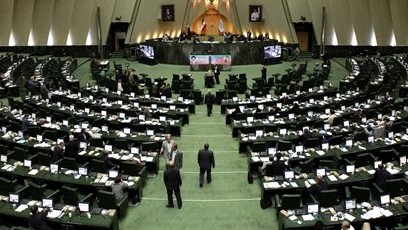
Iranian parliament1A general view of Iran’s parliament in Tehran, Aug. 28, 2013 (photo credit: AP/Ebrahim Noroozi)

Major differences have emerged between the P5+1 powers and Iran over what was agreed in the framework deal.

“Parameters” detailed by the US leave no doubt whatsoever, however, that the use of anything other than the most basic, first generation IR-1 centrifuges is barred for 10 years, and that even R&D on advanced centrifuges will be severely constrained.

“Iran will only enrich uranium at the Natanz facility, with only 5,060 IR-1 first-generation centrifuges for ten years,” the US parameters state. “Iran has agreed to only enrich uranium using its first generation (IR-1 models) centrifuges at Natanz for ten years, removing its more advanced centrifuges… Iran will not use its IR-2, IR-4, IR-5, IR-6, or IR-8 models to produce enriched uranium for at least ten years,” the US document adds. “For ten years, enrichment and enrichment research and development will be limited to ensure a breakout timeline of at least 1 year. Beyond 10 years, Iran will abide by its enrichment and enrichment R&D plan submitted to the IAEA, and pursuant to the JCPOA, under the Additional Protocol resulting in certain limitations on enrichment capacity.”

A French fact-sheet seen by The Times of Israel takes a similar position. It provides for Iran to gradually introduce the use of IR-2 and IR-4 centrifuges to enrich uranium after 12 years. It does not provide for the use of IR-8 centrifuges. The French fact sheet does specify that Iran will be allowed to continue R&D work on the advanced IR-4, IR-5, IR-6 and IR-8 centrifuges.

A document issued by the Iranian Foreign Ministry on Friday also does not assert an Iranian right to use IR-8 centrifuges. Its only reference to the IR-8 is as follows: “According to the reached solutions, Iran will continue its research and development on advanced machines and will continue the initiation and completion phases of the research and development process of IR-4, IR-5, IR-6, and IR-8 centrifuges during the 10-year period of the Comprehensive Plan for Joint Action.”


Obama: In future, Iran could build nuclear bomb almost immediately

April 8, 2015

‘Obama: In future, Iran could build nuclear bomb almost immediately’
Yoni Hersch, Eli Leon, Israel Hayom Staff and News Agencies


(At what point do they breakout? Is having a fully functional nuclear device minus the ‘fuse’ considered on the verge of a breakout? If so, then merely inserting the ‘fuse’ only takes a few minutes. Think about it. – LS)

U.S. President Barack Obama: In years 13, 14 and 15 of nuclear deal with Iran, the breakout times would be shrunk almost to zero • House Speaker John Boehner: It is clear that the deal with Iran is a direct threat to global peace and security.

U.S. President Barack Obama is persisting with his effort to rally support for the framework nuclear agreement reached between six world powers and Iran last week, but on Tuesday he admitted that Iran could have the capability to build a nuclear bomb almost immediately after the first 13 years of the deal, if it is finalized.

Under the framework for a final deal, Iran would be kept at least a year away from a nuclear bomb for the first decade, Obama said, as he pressed ahead in his campaign to sell the deal to skeptics. Pushing back on criticism that the deal allows Iran to keep enriching uranium, Obama told NPR that enrichment is not the prime concern, because Iran will be capped for a decade at 300 kilograms — not enough to convert to a stockpile of weapons-grade material.

“What is a more relevant fear would be that in year 13, 14, 15, they have advanced centrifuges that enrich uranium fairly rapidly, and at that point, the breakout times would have shrunk almost down to zero,” Obama said.

Yet Obama insisted that the world would have better insight into Iran’s capabilities because of extensive inspections in the earlier years of the deal.

“The option of a future president to take action if in fact they try to obtain a nuclear weapon is undiminished,” Obama said.

In response to Obama, International Relations, Intelligence and Strategic Affairs Minister Yuval Steinitz said, “If [Obama] says we have insurance here for 10 years, I say we don’t have insurance here for even one or two years, unless the loopholes are closed, and only then could it become a more reasonable agreement.”
Republican House Speaker John Boehner also criticized Obama’s statements, saying, “President Obama himself today confirmed exactly what critics of the deal have argued: his ‘deal’ would pave the way for a nuclear-armed Iran in the near future. The Iranian regime has consistently taken a long view on its regional — indeed global — ambitions of exporting its revolution. After multiple evasions of international inspections to date, no one should believe that the proposed inspections and verification are bullet-proof. It is clear that this ‘deal’ is a direct threat to peace and security of the region and the world.”

In the NPR interview, Obama was asked about Prime Minister Benjamin Netanyahu’s demand that any final nuclear deal with Iran include an explicit Iranian commitment to Israel’s right to exist.

“Well, let me say this — it’s not that the idea of Iran recognizing Israel is unreasonable,” Obama replied. “It’s completely reasonable and that’s U.S. policy. And I’ve been very forceful in saying that our differences with Iran don’t change if we make sure that they don’t have a nuclear weapon — they’re still going to be financing Hezbollah, they’re still supporting Assad dropping barrel bombs on children, they are still sending arms to the Houthis in Yemen that have helped destabilize the country. There are obvious differences in how we are approaching fighting ISIL in Iraq, despite the fact that there’s a common enemy there.

“So there’s still going to be a whole host of differences between us and Iran, and one of the most profound ones is the vile, anti-Semitic statements that have often come out of the highest levels of the Iranian regime. But the notion that we would condition Iran not getting nuclear weapons, in a verifiable deal, on Iran recognizing Israel is really akin to saying that we won’t sign a deal unless the nature of the Iranian regime completely transforms. And that is, I think, a fundamental misjudgment.

“I want to return to this point. We want Iran not to have nuclear weapons precisely because we can’t bank on the nature of the regime changing. That’s exactly why we don’t want to have nuclear weapons. If suddenly Iran transformed itself into Germany or Sweden or France, there would be a different set of conversations about their nuclear infrastructure.

“So, you know, the key here is not to somehow expect that Iran changes — although it is something that may end up being an important by-product of this deal — but rather it is to make sure that we have a verifiable deal that takes off the table what would be a game-changer for them if in fact they possess nuclear weapons.”

Directly addressing the citizens of Israel, Obama said, “What I would say to the Israeli people is, you are right to be suspicious of Iran; there’s no reason why you should let your guard down with respect to Iran. We have to make sure that Israel has the capabilities to protect itself not only from Iran, but also proxies like Hezbollah. But ultimately, Iran is deterrable, and it is deterrable not just because of Israel’s superior military and intelligence capabilities, but also because you got a really strong ally in the United States of America.”

Meanwhile, Central Intelligence Agency Director John Brennan said Tuesday that opponents of the framework nuclear agreement with Iran are being “disingenuous” when they say the deal could still allow Iran to build nuclear weapons.

Speaking to an audience of students and faculty at Harvard University, Brennan said the framework deal was likely the most realistic one that could be reached. “The individuals who say that this deal provides a pathway for Iran to a bomb are being wholly disingenuous, in my view, if they know the facts and understand what is required for a program,” Brennan said. “I certainly am pleasantly surprised that the Iranians have agreed to so much here.”

Brennan, who has headed the CIA since 2013, said he understood that some critics of the deal were wary that even with a final nuclear deal, Iran would have still the ability “to cause more trouble” in the Middle East.

“That’s a legitimate issue, concern and argument, but that’s why I say what they shouldn’t be doing is trying to pull apart this deal … that’s as solid as you’re going to get,” Brennan said. “You’re not going to get the Iranians to just totally dismantle everything and say, ‘OK, we’re not going to pursue any type of nuclear capability from a peaceful perspective.”

Brennan claimed it was a hopeful sign that the Iranian regime had been willing to engage in eight days of talks in Switzerland, noting that Iranian President Hassan Rouhani had “much greater reasonableness.”

(Now that is complete and utter BS – LS)