Archive for March 1, 2015

Sleeper Cell Documentary: Radical Islamic Camps in America

March 1, 2015

Sleeper Cell Documentary: Radical Islamic Camps in America, Counter Jihad ReportRyan Mauro, March 1, 2015

(“Islamophobia” or rational concern? Somehow, it seems unlikely that “jobs for jihadists” will deal satisfactorily with the problem. Thanks again to Counter Jihad Report, one of the few sites to deal adequately with such threats.– DM)


This Blaze TV episode of “For the Record” aired February 19, 2014 and is largely based on the research of Ryan Mauro of the Clarion Project. It exposes the network of Muslims of the Americas, a branch of the Pakistani group Jamaat ul-Fuqra, across the U.S. It is headquartered at “Islamberg,” New York.

Read about Mauro’s identification of an ul-Fuqra jihadist enclave in Texas:

Exclusive: Islamist Terror Enclave Discovered in Texas
The discovery led a dozen North American Muslim groups and Rep. Louie Gohmert (R-TX) to call on the State Department to list ul-Fuqra as a Foreign Terrorist Organization:

Muslims Join Clarion’s Call for ul-Fuqra to be Foreign Terrorist Org.
Texas Congressman: Terror Enclave Discovery ‘Appalling’

US Senator Feinstein slams ‘arrogant’ Benjamin Netanyahu: ‘He doesn’t speak for me’

March 1, 2015

US Senator Feinstein slams ‘arrogant’ Benjamin Netanyahu: ‘He doesn’t speak for me’ – Israel News – Jerusalem Post.

California senator gave an interview to CNN on Sunday ahead of Netanyahu’s controversial speech before Congress.

Dianne Feinstein on April 3, 2014.

Diane Feinstein, the Democratic senator from California, told CNN on Sunday that Prime Minister Benjamin Netanyahu’s contention that he is speaking for all Jews in lobbying against an agreement between the US and Iran is “arrogant.”

Netanyahu, upon boarding a plane to Washington for what his office says will be a historic address to Congress, said Sunday that he is going as an “emissary of all the citizens of Israel, even those who don’t agree with me, and the entire Jewish people.”

Netanyahu, whose speech has triggered a great deal of friction with the White House said, “I am greatly concerned about the security of the citizens of Israel and I will do what is necessary in order to ensure our future.”

“He doesn’t speak for me on this,” Feinstein told CNN’s State of the Union. “I think it’s a rather arrogant statement. I think the Jewish community is like any other community. There are different points of view. I think that arrogance does not befit, Israel, candidly.”

The senator said that she will attend Netanyahu’s speech, even though some of her Democratic colleagues plan to stay away in protest to what they feel is the Israeli premier’s overt undermining of President Barack Obama and his administration.

“I intend to go, and I’ll listen respectfully,” she said. “I don’t intend to jump up and down.”

US Secretary of State John Kerry pressed the case on Sunday for completing nuclear diplomacy with Iran despite Israeli opposition, saying the United States deserves the benefit of the doubt on getting a deal that would prevent any need for military action to curb Tehran’s atomic ambitions.

Two days before Netanyahu is due to address the US Congress to warn against an Iran deal, Kerry delivered a stout defense of talks that are entering a critical phase with a key March 31 deadline looming.

Kerry said he hoped Netanyahu’s speech does not turn into “some great political football” but said the Israeli leader is “welcome to speak in the United States, obviously.”

Six powers – the United States, Russia, China, Britain, France and Germany – are negotiating with Iran toward an agreement to restrain Tehran’s nuclear program in exchange for easing economic sanctions. Netanyahu has spoken scathingly about a possible deal and says a nuclear-armed Iran would pose an existential threat to the Jewish state.

Netanyahu was invited to speak by Republican congressional leaders, but they did not inform President Barack Obama’s administration about the speech in advance. Signs are growing that the speech could damage Israel’s country’s broad alliance with the United States.

In an interview with the ABC program “This Week,” Kerry said of the Iran negotiations: “It is better to do this by diplomacy than to have to do a strategy militarily which you would have to repeat over and over again and which everybody believes ought to be after you have exhausted all the diplomatic remedies.”

Kerry said he could not promise that a deal can be reached, but said that “we are going to test whether or not diplomacy can prevent this weapon from being created.”

“We have said again and again, no deal is better than a bad deal. We’re not going to make a bad deal,” Kerry said.

Kerry, who said he spoke with Netanyahu on Saturday, is heading to Switzerland and is due to meet with Iranian Foreign Minister Mohammad Javad Zarif this week just as the Israeli leader comes to Washington.

“Our hope is diplomacy can work,” Kerry added. “… Given our success on the interim agreement, I believe we deserve the benefit of the doubt to find out whether or not we can get a similarly good agreement with respect to the future.”

Reuters contributed to this report.

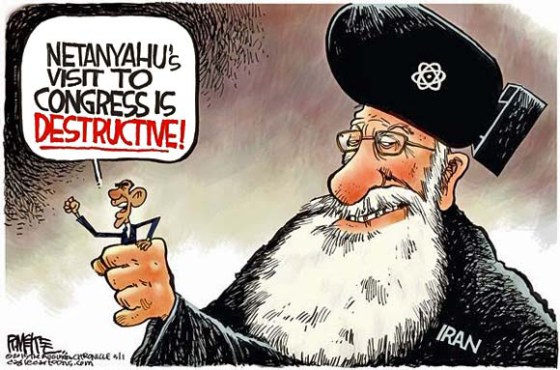
Cartoon of the day

March 1, 2015

(Tip of the hat to Vermont Loon Watch. – DM)

Destructive

Bring Back the Bush Doctrine—with One Addition

March 1, 2015

Bring Back the Bush Doctrine—with One Addition, National Review Online, Andrew C. McCarthy, February 28, 2015

Our enemies are not driven by American foreign policy, our friendship with Israel, our detention of jihadists at Gitmo, or the supposed “arrogance” our current president likes to apologize for. Those are all pretexts for aggression.

Our enemies are driven by an ideology, Islamic supremacism, that is rooted in a classical interpretation of sharia — Islamic law. Islamic supremacism is rabidly anti-American, anti-Western, and anti-Semitic. It rejects the fundamental premise of our liberty: that people are free to govern themselves, rather than be ruled by a totalitarian legal code that suffocates liberty and brutally discriminates against non-Muslims and apostates. And sharia is an actual war on women — denying them equal rights under the law, subjecting them to unthinkable abuse, and reducing them in many ways to chattel.

****************

There is a path to victory in the fight against radical Islam, and our next president should embrace it.

What should be our strategy against ISIS? We ask the question without ever considering Iran. What concessions about centrifuges and spent fuel should we demand to prevent Iran from becoming a nuclear power? We ask the question never linking the mullahs’ weapons ambitions with its sponsorship of the global jihad . . . the only reason we dread a nuclear Iran. What should be the national-defense strategy of the United States against radical Islam, the most immediate and thoroughgoing security and cultural threat we face today?

I had the good fortune to be asked to participate in a CPAC panel Friday on defending America against rogue states. With 2016 hopefuls crowding the halls, it got me to thinking: What should we hope to hear from Republicans who want to be the party’s standard-bearer?

It is often said that we lack a strategy for defeating our enemies. Actually, we have had a strategy for 14 years, ever since the fleeting moment of clarity right after the 9/11 attacks.

That strategy is called the Bush Doctrine, and it remains the only one that has any chance of working . . . at least if we add a small but crucial addendum — one that should have been obvious enough back in 2001, and that hard lessons of history have now made inescapable.

The Bush Doctrine has become the source of copious rebuke. On the left, that’s because of that four-letter word (hint: It’s not “Doctrine”). On the right, there have been plenty of catcalls, too. The reaction, however, has been against what the Bush Doctrine evolved into, not against the Bush Doctrine as it was first announced.

The unadorned Bush Doctrine had two straightforward parts. First, because violent jihadists launch attacks against the United States when they have safe havens from which to plot and train, we must hunt down those terrorists wherever on earth they operate. Second, the nations of the world must be put to a choice: You are with us or you are with the terrorists. Period — no middle ground. If you are with the terrorists, you will be regarded, as they are regarded, as an enemy of the United States.

Before we get to that aforementioned addendum, it is important to remember why the Bush Doctrine was so necessary. For the nine years before it, we were living with the Clinton Doctrine.

That is the doctrine President Obama came to office promising to move us back to — and has he ever. It is the doctrine under which the enemy strikes us with bombs and weaponized jumbo jets, and we respond with subpoenas and indictments. It is the doctrine under which our enemies say, “allahu akbar! Death to America!” and we respond, “Gee, you know America has been arrogant. We can see why you’re so upset.”

The Clinton Doctrine — the one the Democrats will be running on in 2016, perhaps with its namesake leading the way — is the one that gave us a series of ever more audacious attacks through the 1990s: the 1993 World Trade Center bombing; a plot to bomb New York City landmarks such as the Lincoln and Holland Tunnels; a plot to blow American airliners out of the sky over the Pacific; the 1996 Khobar Towers bombing, in which Iran and al-Qaeda teamed up to kill 19 American airmen; the 1998 bombings of our embassies in Kenya and Tanzania that killed over 200 innocent people; detonating a bomb next to our destroyer, the U.S.S. Cole, in October 2000, killing 17 members of the U.S. Navy; and finally, the 9/11 atrocities, killing nearly 3,000 of our citizens.

And what has gradually restoring the Clinton Doctrine gotten us? While President Obama pleads for a deal that will inevitably make Iran a nuclear power, the mullahs continue to back anti-American terrorists and conduct military exercises in which they practice blowing up American ships. The Iraq so many Americans gave their lives for is now an extension of Iran. Afghanistan is being returned to the Taliban, which the president empowers by releasing its commanders. Libya is now a failed state where jihadists murder Americans with impunity and frolic in the former American embassy. Al-Qaeda is expanding through northern Africa, now a bigger, more potent threat than it was on the eve of 9/11. And yet it may pale compared with its breakaway faction, the Islamic State, which now controls more territory than Great Britain, as it decapitates, incinerates, and rapes its way to a global caliphate.

But Obama tells us there’s good news: Yemen is a success . . . or at least it was until it was recently overrun by an Iran-backed militia — oops. Well, we have indicted exactly one of the scores of terrorists who attacked our embassy at Benghazi. He got his Miranda warnings, of course, and he’ll be getting his civilian trial any month now. Hopefully, we’ll do better than Obama’s civilian trial of Ahmed Ghailani, the bomber of our embassies who was acquitted on 284 out of 285 counts.

Is it any wonder we’re losing?

Largely, it is because we’re worried about the wrong things — like whether we can sweep the enemy off its feet with enough Islamophilic, blame-America-first rhetoric. In reality, our enemies could not care less whether we — the infidel West — think their literalist, scripturally based belief system is a “perversion” of Islam. Radical Islam hears only one message from America: strength or weakness. The Clinton Doctrine is weakness cubed.

The Bush Doctrine, by contrast, is the path to victory — if we get that one addendum right.

It is this: Our enemies are not driven by American foreign policy, our friendship with Israel, our detention of jihadists at Gitmo, or the supposed “arrogance” our current president likes to apologize for. Those are all pretexts for aggression.

Our enemies are driven by an ideology, Islamic supremacism, that is rooted in a classical interpretation of sharia — Islamic law. Islamic supremacism is rabidly anti-American, anti-Western, and anti-Semitic. It rejects the fundamental premise of our liberty: that people are free to govern themselves, rather than be ruled by a totalitarian legal code that suffocates liberty and brutally discriminates against non-Muslims and apostates. And sharia is an actual war on women — denying them equal rights under the law, subjecting them to unthinkable abuse, and reducing them in many ways to chattel.

In the “you are with us or you are with the terrorists” view of national security, any Muslim nation, organization, or individual that adheres to Islamic supremacism is on the wrong side. Failing to come to terms with that brute fact is where the Bush Doctrine went awry.

Sharia and Western democracy cannot coexist. They are antithetical to each other. So insists Sheikh Yussuf Qaradawi, the Muslim Brotherhood jurist who is the world’s most influential Islamic scholar. It may be the only thing we should agree with him about.

The Bush Doctrine was allowed to evolve from an American national-security strategy to an illusion that our national security would be strengthened by promoting a chimera — sharia democracy. We put the lives of our best young men and women in harm’s way in the service of a dubious experiment: that we could build stable Islamic democracies that would be reliable American allies against jihadist terror.

Perhaps the worst thing about this experiment is not its inevitable failure. It is the sapping of America’s will that it has caused. Defeating our jihadist enemies is going to require a will to win, because the enemy’s will is strong — the jihadists truly believe Allah has already helped them vanquish the Soviet empire, and that we are next.

The American people vigorously support military operations that are essential to our defense. They support a vigorous war to defeat violent jihadists and their support networks. They understand that we cannot cede our enemies safe havens and nuclear weapons.

They do not support the notion that promoting our national security obliges us to move into hostile Islamic countries for a decade or three to civilize them. That’s not our job. Worse, when Americans become convinced that Washington — ever more remote from the public — thinks it is our job, they will not support military action, even action that is vital to protecting our nation. They will not trust the government to defeat our enemies without becoming entangled in Islam’s endless internal strife.

Understanding Islamic supremacism so we can distinguish allies from those hostile to us will restore the Bush Doctrine. And let’s not be cowed by the critics: Nothing I’ve said means endless war, or that we have to invade or occupy every country. But it does mean we should be using all our assets — not just military but intelligence, law-enforcement, financial, and diplomatic — to undermine regimes that support sharia supremacism. Cutting off that jihadist life-line is the path to victory — just as maintaining a strong military that is allowed to show it means business, that is not hamstrung by irresponsible rules of engagement, is the best way to ensure we won’t have to use it too often.

In Iran, where sharia is the law of the land, they persecute non-Muslims and apostates just like ISIS does. In Saudi Arabia, where sharia is the law of the land, they behead their prisoners just like ISIS does. A candidate who cannot tell liberty’s friends from liberty’s enemies is not fit to be commander-in-chief.

Obama Must Explain Why the Iran Deal Isn’t North Korea Redux

March 1, 2015

Obama Must Explain Why the Iran Deal Isn’t North Korea Redux, Commentary Magazine, March 1, 2015

(There are additional parallels. North Korea and Iran have comparable views of human rights, both make loud and frequent noises about obliterating their perceived enemies and both have allies willing if not anxious to sneak around sanctions. There are also differences. Iran is far more powerful than North Korea was or is and Iran’s intention to dominate the Middle East transcends North Korea’s desire to “unify” with South Korea on North Korea’s terms. Iranian governance is based on Islam, an unfortunately powerful world religion seeking world domination. North Korean governance is based on the “religion of Kim,” supreme internally but otherwise of little significance elsewhere. Iran also presents a greater danger to the U.S. than North Korea did. However, Obama won’t explain why the Iran deal isn’t “North Korea redux” because he quite likely neither knows nor cares and because it is. — DM)

The State Department has never conducted a lessons learned exercise about what went wrong with the North Korea deal. Perhaps it’s time. Diplomatic responsibility and national security demand it.

**********************

As the Obama administration rushes into a nuclear deal with Iran, it pays to remember the last time the United States struck a deal with a rogue regime in order to constrain that state’s nuclear program and the aftermath of that supposed success.

Bill Clinton had been president barely a month when North Korea announced that it would no longer allow International Atomic Energy Agency (IAEA) inspections, followed shortly thereafter by an announcement that it would withdraw from the NPT altogether within a matter of months. If Kim Il-sung expected Washington to flinch, he was right. The State Department aimed to keep North Korea within the NPT at almost any price. Chief U.S. negotiator Robert Gallucci and his aides explained in their book Going Critical, “If North Korea could walk away from the treaty’s obligations with impunity at the very moment its nuclear program appeared poised for weapons production, it would have dealt a devastating blow from which the treaty might never recover.” Unwilling to take any path that could lead to military action, Clinton’s team sought to talk Pyongyang away from nuclear defiance, no matter that talking and the inevitable concessions that followed legitimized Pyongyang’s brinkmanship.

As with President Obama relieving Iran of the burden of six United Nations Security Council resolutions which demanded a complete cessation of enrichment, Clinton’s willingness to negotiate North Korea’s nuclear compliance was itself a concession. After all, the 1953 Armistice required Pyongyang to reveal all military facilities and, in case of dispute, enable the Military Armistice Commission to determine the purpose of suspect facilities. By making weaker frameworks the new baseline, Clinton let North Korea off the hook before talks even began.

Just as Israeli (and Saudi and Emirati and Egyptian and Kuwaiti and Bahraini) leaders express frustration with the Obama administration regarding its naiveté and unwillingness to consult, so too did South Korea at the time chafe at Clinton’s arrogance. South Korean President Kim Young Sam complained to journalists that North Korea was leading America on and manipulating negotiators “to buy time.” And in a pattern that repeats today with regard to Iran, the IAEA held firmer to the demand that North Korea submit to real inspections than did Washington. The issue came to a head in September 1993 after the State Department pressured the IAEA to compromise on limited inspections.

In the face of Pyongyang’s defiance, Clinton was also wary that coercion could be a slippery slope to war. Just as President Obama and Secretary of Defense Chuck Hagel instructed U.S. forces in the Persian Gulf not to stand firm but rather to retreat if probed or pushed by Iran, Clinton sought to mollify Pyongyang, for example cancelling the joint U.S.–South Korea military exercise in 1994. Adding insult to injury, the Clinton administration criticized the South Korean government for being unwilling to compromise. Indeed, everything the Obama administration has done with regard to Israel over the past year—with the exception, perhaps, of the classless chickensh-t comment—was ripped right from the Clinton playbook two decades before when the White House sought to silence Seoul.

There followed months of baseless optimism in Washington, followed by disappointment quickly supplanted by denial. At one point, when it looked like Kim Il-sung’s intransigence might actually lead to war, former President Jimmy Carter visited Pyongyang and, whether cleared to or not, made concessions which diffused the situation. It was the diplomatic equivalent of Obama’s voided redlines. Nightlinehost Ted Koppel observed on May 18, 1994, “this administration is becoming notorious … for making threats and then backing down.”

On July 8, 1994, a heart attack felled Kim Il-sung. Kim Jong-il, his eldest son, took over. Negotiations progressed quickly. Gallucci and his team promised an escalating series of incentives—reactors, fuel oil, and other economic assistance. They kicked inspections of North Korea’s suspect plutonium sites years down the line.

What had begun as North Korean intransigence had netted Pyongyang billions of dollars in aid; it would go down in history as the largest reward for cheating and reneging on agreements until Obama granted Iran $11 billion in sanctions relief just for coming to the table. Columnist William Safire traced the steps of concessions on North Korea. “Mr. Clinton’s opening position was that untrustworthy North Korea must not be allowed to become a nuclear power,” he observed, but Clinton “soon trimmed that to say it must not possess nuclear bombs, and stoutly threatened sanctions if North Korea did not permit inspections of nuclear facilities at Yongbyon, where the CIA and KGB agree nuclear devices have been developed. But as a result of Clinton’s Very Good Deal Indeed, IAEA inspectors are denied entry to those plants for five years.” And Sen. John McCain, for his part, lamented that Clinton “has extended carrot after carrot, concession after concession, and pursued a policy of appeasement based … on the ill-founded belief that North Koreans really just wanted to be part of the community of nations.” Again, the parallels between Clinton’s and Obama’s assumptions about the desire of enemies to reform were consistent.

Clinton wasn’t going to broker any criticism of what he believed was a legacy-defining diplomatic triumph, all the more so when the criticism came from abroad. On October 7, 1994, South Korean President Kim Young Sam blasted Clinton’s deal with the North, saying, “If the United States wants to settle with a half-baked compromise and the media wants to describe it as a good agreement, they can. But I think it would bring more danger and peril.” There was nothing wrong with trying to resolve the problem through dialogue, he acknowledged, but the South Koreans knew very well how the North operated. “We have spoken with North Korea more than 400 times. It didn’t get us anywhere. They are not sincere,” Kim said. His outburst drew Clinton’s ire. He became the Netanyahu of his day. Meanwhile, the U.S. and North Korea signed the Agreed Framework. Gallucci and his team were “exhilarated.” They later bragged they “had overcome numerous obstacles in the negotiations with the North; survived the intense, sometimes strained collaboration with Seoul and the International Atomic Energy Agency; and marshaled and sustained an often unwieldy international coalition in opposition to the nuclear challenge, all under close and often critical scrutiny at home.”

Today, by some estimates, North Korea is well on its way to having 100 nuclear weapons and is steadily developing the ballistic capability to deliver them. Iran’s nuclear negotiators have cited North Korea’s negotiating strategy as a model to emulate rather than an example to condemn. Meanwhile, Obama has relied on many of the same negotiators to advance his deal with Iran.

The State Department has never conducted a lessons learned exercise about what went wrong with the North Korea deal. Perhaps it’s time. Diplomatic responsibility and national security demand it.

Desert Fantasy Or Dark Reality? Kuwaiti Paper Says Obama Threatened To Fire On Israeli Jets Attacking Iran

March 1, 2015

The Jewish Press » » Desert Fantasy Or Dark Reality? Kuwaiti Paper Says Obama Threatened To Fire On Israeli Jets Attacking Iran.

The Israeli decision came, according to al-Jarida, in response to U.S. and Iran secret talks—behind Israel’s back—over Iran’s nuclear program.
.
Photo Credit: Ofer Zidon/Flash90

Published on Jewish Business News

By Ilan Shavit

Kuwaiti newspaper Al-Jarida reported Saturday that President Barack Obama blocked an Israeli air force attack on Iran’s nuclear facilities in 2014, Ma’an reported.

Al-Jarida quoted “well-placed” sources that said Prime Minister Benjamin Netanyahu had decided to carry out air strikes against Iran’s nuclear program after consultations with minister of defense Moshe Ya’alon, foreign minister Avigdor Liberman and the IDF brass.

The decision came, according to al-Jarida, in response to U.S. and Iran secret talks—behind Israel’s back—over Iran’s nuclear program.

According to the report, Netanyahu et al agreed after four nights of deliberations (not 1,000 nights, mind you) to assign IDF chief of staff Benny Gantz the preparation of an attack against Iran’s nuclear facilities.

The same sources said Gantz prepared the plan, for which Israeli fighter jets trained over several weeks, including test flights in Iran’s airspace, after breaking through its radar.

However, goes the Al-Jarida report, a certain Israeli minister “who has good ties with the U.S. administration,” revealed Netanyahu’s plans to Secretary of State John Kerry, and, as a result, Obama threatened to shoot down those pesky Israeli jets before they could reach their targets in Iran.

As a result, Netanyahu had to abort the operation and since then relations between Israel and the United States have been declining, concludes the report.

The rest is history.


