Archive for January 29, 2015

Hezbollah Attack Seen as Effort by Iran to ‘Expand into the Golan Heights’

January 29, 2015

Hezbollah Attack Seen as Effort by Iran to ‘Expand into the Golan Heights’
by TheTower.org Staff 01.29.15 10:14 am


(They are in for a surprise if they think Israel will let them take the high ground. – LS)

Hezbollah operatives fired Kornet anti-tank missiles at an Israeli army patrol along the Israel-Lebanon border on Wednesday, killing two Israeli soldiers, wounding seven, and prompting Israeli retaliatory artillery fire on southern Lebanon. A Spanish peacekeeper of the United Nations Interim Force in Lebanon (UNIFIL) was killed in the exchange of fire. Mortars were launched into northern Israel from southern Lebanon for over an hour after the initial attack.

Hezbollah leader Hassan Nasrallah declared on January 15 that Hezbollah would “enter into Galilee and…go even beyond the Galilee.” There was a reported Israeli airstrike on January 18, which killed six Hezbollah members and several personnel from Iran’s Islamic Revolutionary Guard Corps (IRGC), including senior commanders.

On Tuesday, at least two rockets were fired at the northern Golan Heights from Syria, in an attack attributed by the IDF to Hezbollah. IDF artillery fired on Syrian military targets and the Israeli Air Force (IAF) launched overnight air strikes on artillery positions of the Syrian military.

Hezbollah took responsibility for Wednesday’s attack, claiming that it was carried out by the “righteous martyrs of Quneitra.”

Some analysts have suggested that the attack was not just retaliation for the January 18 airstrike, but rather is part of a broader strategic shift by Hezbollah, as it attempts to build a terror infrastructure in the Golan Heights. Tony Badran, a Research Fellow at the Foundation for Defense of Democracies, said in a conference call hosted by The Israel Project (audio link) on Wednesday that Hezbollah’s attacks are indicative of a broader “Iranian effort to expand into the Golan Heights.”

Doing so, Iran and Hezbollah hope, would allow Hezbollah to “target Israel from the Golan Heights while avoiding devastation in Lebanon.” Hezbollah views the Shebaa Farms, the area in which Wednesday’s attack occurred, and the Golan as “a singular theater of operations.”

By responding sharply, Israel is demonstrating that “the buck stops here” and that “Iran will not be allowed to set up shop in the Golan Heights.”

The Israel Project is publisher of The Tower.

[Photo: Associated Press / YouTube]

Iran Targets Netanyahu Children for Assassination

January 29, 2015

Iran Targets Netanyahu Children for Assassination
BY: Adam Kredo January 29, 2015 5:00 am Via The Washington Free Beacon


(A new low for Tehran and their surrogates. – LS)

IRGC-tied site urges ‘hunt’ after Hezbollah strike

Iran is encouraging its terror allies to pursue the assassination of Israeli Prime Minister Benjamin Netanyahu’s children by publishing personal information about them, including photographs of the kids lined up in crosshairs, and declaring, “We must await the hunt of Hezbollah.”

The publication of the personal information and biographies of Netanyahu’s children follows an Israeli airstrike last week that killed several key Hezbollah leaders and an Iranian commander affiliated with the country’s hardline Revolutionary Guard Corps (IRGC).

Iranian military leaders affiliated with the IRGC threatened in recent days harsh retaliation for the strike and promised to amp up support for Hezbollah as well as Palestinian terrorist organizations.

The information was originally published in Farsi by an Iranian website affiliated with the IRGC and quickly republished by Iran’s state-controlled Fars News Agency.

In addition to biographical details and pictures of Netanyahu’s children, the Iranians provided details about the families of former prime ministers Ehud Olmert and Ariel Sharon.

Regional experts with knowledge of the IRGC said this type of public threat is meant to intimidate the Israelis and act as a deterrent against possible military action.

“Here, we have organized a list of prominent Israeli Aghazadehs,” or children, according to the original post by the hardline Iranian website Mashregh, which has since removed the article. The Fars reproduction is still available online in Farsi.

Netanyahu’s children are acceptable targets for assassination due to their affiliation with top Israeli leaders, according to the article, which is titled, “The file of the Zionist Children.”

“It is worth mentioning that these excellences of Zionism were not directly involved in the war against the forces of resistance and they have not taken up arms, and some [even] by account of their own words are against Zionist radicalism,” the post states, according to an independent translation of the Farsi.

“However, they have three years of mandatory service in the army of this regime in their records,” it states. “At any rate, acquaintance with the lives of these persons and their traits provides for a more realistic understanding of the social and political issues of the regime in Israel.”

In bright red letters, an order is then issued: “We must await the hunt of Hezbollah.”

Following this, the article contains detailed biographies and pictures of Netanyahu’s children, Avner and Yair. Similar profiles of Olmert’s son, Shaul, and Sharon’s children, Gilad and Omri, also are provided.

Behnam Ben Taleblu, an Iran expert at the Foundation for Defense of Democracies (FDD), said that while extreme, this type of tactic is common for Iran.

“Mashregh News has chosen to explicitly demonstrate that deterrent power in a sickening retaliatory fashion, weighing the perceived benefits of some of the assassinations from the perspective of the ‘resistance,’” Taleblu said.

“In a not-so-subtle manner, the article attempts to force a linkage between the reported ‘mandatory military service’ of the children and becoming a target,” he said. “The question now becomes, will Hezbollah or Iran choose to escalate from this appalling form of psychological warfare?”

Iran’s move to assist with the assassination of these high-profile kids jibes with statements made over the last week by IRGC leaders in the wake of Israel’s deadly airstrike.

“The experience of the past shows that the resistance current will give a crushing response to the Zionist regime’s terrorist moves with revolutionary determination and in due time and place,” Ali Shamkhani, the secretary of Iran’s Supreme National Security Council (SNSC), was quoted as saying last week.

Other top military leaders promised to hit Israel with “devastating thunderbolts” and work for the “collapse of the Zionist regime.”

“The IRGC will remain steadfast on the path to the collapse of the Zionist regime of Israel through its continued support for the Lebanese and Palestinian combatants, but this time its supports will be on a scale larger than its supports during the 33-day and 51-day wars against the Israeli army,” Maj. Gen. Mohammad Ali Jafari, an IRGC commander, was quoted as saying last week.

The IRGC also issued a statement on Wednesday celebrating a terror attack by Hezbollah on Israeli soldiers that left two dead and at least seven more seriously wounded.

“We will stand by the resistance against the Zionists,” the IRGC was quoted as saying in a tweet by the Lebanese news outlet Naharnet.

These numerous statements indicate that while Iran backs reprisals on Israel, it is hesitant to take its own action, according to FDD’s Taleblu.

“All the outpouring and statements by Iran’s political and military elite is meant to establish the deterrent power of the Islamic Republic,” he said. “Such power is designed to instill the fear of reprisal, without having to bear the costs of engaging in one.”

Andrew Klavan: Attack of the But-Heads!

January 29, 2015

Andrew Klavan: Attack of the But-Heads! Truth Revolt via You Tube, January 29, 2015


Yazidis ask Israel for help

January 29, 2015

Yazidis ask Israel for help, Al-MonitorJacky Hugi, January 28, 2015

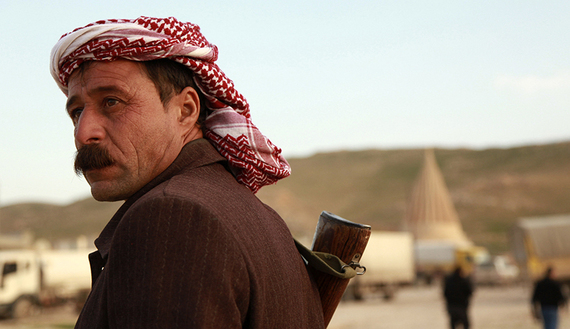
A man from the minority Yazidi sect stands guard at Mount Sinjar, in the town of SinjarA man from the minority Yazidi sect stands guard at Mount Sinjar, in the town of Sinjar, Dec. 20, 2014. (photo by REUTERS/Ari Jalal)

[I]t is an unusual overture of friendship for the government of Prime Minister Benjamin   Netanyahu, and it will be interesting to see if and how Israel takes up the gauntlet. Given the sensitivity of the matter, it is quite uncertain whether anyone will hear about it.

******************

“They have already killed many of us. What do we have to fear?” Lt. Col. Lukman Ibrahim responded when I asked him if he was afraid to openly communicate with an Israeli in a recent long-distance phone conversation from Tel Aviv to Sinjar, in northwestern Iraq, near the Syrian border. Ibrahim, a Yazidi militia officer, is hoping to obtain military aid from the State of Israel.

“The Arab countries do not recognize us, nor do they recognize you,” he said. “They are telling us that we are infidels. Why should we be afraid to talk to you, when even neighboring Arab countries have become our enemies? We regard you as a friendly state, with an opportunity for relations on the basis of neutrality and respect. We do not want more than that.”

Ibrahim, a journalist by profession, serves as an assistant to Marwan Elias Badl, one of the senior field commanders of the Sinjar Protection Forces, the Yazidi militia established ad hoc in August 2014 to halt the Islamic State (IS) onslaught against Yazidi population centers west of Mosul. The militia numbers some 12,000 fighters, most of them untrained, ordinary men who rushed to take up arms to thwart IS’ designs. A few of them are rank-and-file fighters, while some are officers with the Kurdish peshmerga. According to internal estimates, the IS militants killed thousands in their pogrom against the Yazidis. About 5,000 Yazidis are still being held by IS.

The Yazidis have no formal relations with Israel, nor an organized leadership. Yet they need aid, in particular military assistance, and they have chosen to make a public plea for help. “We appeal to the Israeli government and its leader to step in and help this nation, which loves the Jewish people,” said Ibrahim. “We would be most grateful for the establishment of military ties — for instance, the training of fighters and the formation of joint teams. We are well aware of the circumstances the Israelis are in, and of the suffering they have endured at the hands of the Arabs ever since the establishment of their state. We, too, are suffering on account of them.”

When asked what kind of weapons they needed, Ibrahim cited protective measures. “We are not acting against anyone,” he clarified. “And we do not covet other people’s land. We just want to protect ourselves. For example, [we need] armored [Humvees], machine guns and light weapons.”

Contact with Israel is a dirty business in this neighborhood, military contact all the more so. Be that as it may, in a reality where all levees have been breached and the worst appears to have already befallen the Yazidis, what could they possibly lose by seeking a rapport with Jerusalem?

The conversation with Ibrahim was not the only call with Sinjar. Majdal Rasho, a native of Sinjar, had settled in Germany and built his life there. He married and had a family, making a living as a manufacturing supervisor at a chocolate plant. In his spare time, he served as a photographer for TV stations broadcasting in the Kurdish language. He returned to Sinjar as a fighter, but also in his capacity as a video photographer for German TV networks.

“What I have seen here, I just can’t describe,” he said by phone from a battle zone. “Our people had no choice but to flee. We are not Arabs, nor are we Muslims. We see ourselves as sharing a fate with the Israelis, who went through similar pogroms. Those besieged on the mountain approached me and asked, ‘Maybe our Israeli brethren could lend a hand?’”

Yazidism is a religion with no more than a million followers. Its adherents are centered around Mosul and the Sinjar mountain range, in northern Iraq. Their largest diaspora in the West is in Germany, estimated to number some 100,000.

A common destiny with the Jews is a recurring theme in the Yazidis’ discourse. “What happened to us is the biggest genocide since the Holocaust of the Jews in Europe,” said Dr. Mirza Dinnay, a pediatrician based in Germany. “In the Holocaust, the goal was to annihilate an entire people, the Jews. IS has a similar plan — to exterminate an entire people, the Yazidis. No such extermination process had taken place in the past 500 years, with the exception of the Holocaust and what came to pass in Sinjar.”

Dinnay left Germany for Sinjar at the outbreak of the pogrom, leading a delegation of human rights activists. During one of the aid flights arranged by the Iraqi air force, a helicopter carrying food supplies and medication to the besieged Yazidis crashed. Some of the passengers aboard, among them Dinnay, were injured.

The communication between the Yazidis and the Israeli media has been coordinated by Idan Barir, 34, a researcher at the Tel Aviv University Yavetz School of Historical Studies. In the months since IS’ offensive against Yazidi population centers, Barir has become Israel’s top expert on the Yazidis, thanks to his extensive connections with members of the Yazidi community.

“I can think of a range of activities that Israel is experienced in that would not undermine the world order,” Barir told Al-Monitor. “For example, providing military assistance to the Yazidi forces in Sinjar who are crying out for cooperation and aid; setting up a field hospital for medical and psychological treatment of the casualties among the displaced in northern Iraq — not only Yazidis, by the way; sending humanitarian aid to displaced Yazidis in the refugee camps in Iraqi Kurdistan; absorption of a symbolic number of displaced Yazidis in Israel, with preference given to humanitarian, whether medical or mental, cases; incorporation of young Yazidis into military service in Israel; and support of civil initiatives aimed at strengthening and deepening ties between Israelis and Yazidis. It all depends on the decision made by the Israeli government, on its determination and goodwill.”

So far, Israel has not officially responded to such calls, which have yet to be fully formulated and have only recently began over the last few days. In fact, no formal request has come from the Yazidis for asylum as refugees. Barir is currently trying to find a way to reach decision-makers in Israel to pass on the messages from his faraway friends. Without a doubt, it is an unusual overture of friendship for the government of Prime Minister Benjamin Netanyahu, and it will be interesting to see if and how Israel takes up the gauntlet. Given the sensitivity of the matter, it is quite uncertain whether anyone will hear about it.

“It is a moral obligation to ring every bell and to do everything possible to stop the Yazidi tragedy,” said Attorney Zvi Hauser, the former Cabinet secretary in the most recent Netanyahu government (2009-13). “It is inconceivable that in the 21st century, someone’s attempt to eliminate an entire people, because of its faith and religion, is met with indifference.”

Hauser is the first senior figure in Israel who agreed to comment on the Yazidis’ call for help. As a private person, he refrained from reference to the Yazidis’ request for military aid, taking care to say nothing that might be interpreted as a promise. He believes, however, that Israel should favorably consider the Yazidis’ calls.

“The Yazidi narrative is evocative of ours. We, too, went through 2,000 years of existence without sovereignty, in the course of which we faced extermination schemes,” Hauser said. “Israel is a sovereign state, formed by an ethnic minority. It is the national manifestation of an ancient civilization. It would thus be appropriate to examine ways to establish relations and forge an alliance with them, if only to ensure a pluralistic Middle East. This issue has a universal aspect, as well. The development of human civilization is contingent on the diversity and multiplicity of [ethnic] groups and nations. Hence, the extinction of one of these would hurt not only the Yazidis, but also the entire fabric of human life.”


How to lose friends and empower radicals: the peace prize president’s more dangerous world

January 29, 2015

How to lose friends and empower radicals: the peace prize president’s more dangerous world, Breitbart,  Dr. Sebastian Gorka, January 29, 2015

(Please see the video at the link. — DM)

obama-binoculars-AP-640x480AP Photo/Susan Walsh

Since 2008, the world has become a significantly more dangerous place. In every region, new threats have emerged or old ones have reasserted them. The scorecard is clear: the bad guys are winning and America’s interests are being undermined daily.

As a nation, America has yet to recover from the experience of September 11th, 2001. Public opinion on our national response to the attacks against the World Trade Center, the Pentagon, and Flight 93 is today divided. On one side we have the “Bush lied, People Died!” crowd who portray President George W. Bush’s response in terms of a conspiracy, despite the fact that we now know Saddam Hussein indeed possessed thousands of WMD warheads (and had used them in the past).

On the other, we have conservatives who are themselves split between the unsophisticated isolationists/non-interventionists who believe that an American withdrawal from the world will make us safe, and the quietly resurgent neoconservatives who see in the rise of ISIS/The Islamic State a justification for more foreign engagements.

For a moment, let us put Operations Enduring Freedom (Afghanistan), and Operations Iraqi Freedom (OIF), to one side. Instead, let us take an unemotional snap-shot of the global geostrategic situation to see whether the administration whose head was awarded a Nobel Peace Prize during his first year in office has indeed make the world a safer and more peaceful place.

Europe: During most of the last century, American security was tied directly to the continent of Europe. Whether is was the generational genocide of World War One, the racial genocide of WWII, or the class-based totalitarianism of the Cold War, Europe was the source of strategic, and at times existential, threats to America.

During the first Obama Administration, Secretary of State Hilary Clinton declared a “Pivot to Asia” which would deemphasize Europe’s importance and see Washington focus more on our Pacific partners than on old Atlantic Allies.

Since that announcement, an emboldened Vladimir Putin has seen fit to break an almost 70-year-old international taboo by using force to redraw national borders with his annexation of Crimea. This includes, incredibly, the shooting down of a civilian jet-liner by forces armed by Moscow.

At the same time, we have seen the European Union become evermore centralizing and undemocratic as untenable economic and fiscal policies are propped up by a Brussels bureaucracy in the name of “broader and deeper union.” This has naturally led to two types of responses: the unprecedented success of a paleo-conservative backlash,f best typified by the insurgent victories of UKIP in Great Britain, as well the reverse: Utopian socialist populists such as the victorious Syriza party of Greece.

Then there are Europe’s ties to the Global Jihadist Movement. The recent slaughter in Paris, the beheading of a British serviceman on the streets of the UK, and Spanish and Belgian terror-related arrests all attest to the failure of the current international campaign against Islamist terrorism.

The flawed immigration policies of many EU nations have also facilitated the establishment of literally hundreds of ethnic and religious enclaves across the continent where integration is seen as a bad thing and where radical talent spotters for groups such as Al Qaeda and ISIS/IS identify, indoctrinate and recruit murderers such as the Charlie Hebdo killers, as well as thousands of fighters for The Islamic State.

This has led to a grass-roots response from Europeans afraid of the future survival of their countries embodied in the ever-broadening PEGIDA movement that Breitbart London has covered in great detail. The failure of multiculturalist immigration policies has not only encouraged the enclave phenomenon, but is also clearly linked to the disturbing rise of anti-Semitism on the continent which has led to unprecedented numbers of European jews deciding to leave the nations of their birth for good.

If we include Turkey in our European snapshot, the situation is even worse, as we have seen the one viable example of a secular Muslim state slip even deeper into the corruption-ridden maelstrom of Islamic fundamentalism under the Erdogan government which is either incapable or unwilling to prevent Turkey becoming a pre-deployment site for jihadist fighters traveling into Syria and Iraq. All this from a formal NATO ally of the US.

Asia: The much-vaunted Pivot to Asia has clearly not worked. China has, over the last several years, openly challenged the post-Cold War peace in the region with a commitment to its own military build-up coupled with a concerted campaign of intimidation against its smaller and weaker neighbors.

While challenging and intimidating our regional partners, China has continued to grow economically at such a rate that the nation which was once universally ridiculed as the maker of plastic toys for McDonalds Happy Meals has now surpassed the US economy in terms of gross output.  At the same time, China is waging a covert war against America in the cyber domain, stealing not only state secrets for use in developing its new weapons systems, but also billions of dollars worth of intellectual property and commercial secrets from American businesses. See the remarkable report from Mandiant on scale of the threat.

North Korea has also used the internet to assault American interests as the Sony hacking attack attests, while Washington has proven totally ineffective in undermining the world’s last truly fully-fledged Stalinist regime, or its regionally destabilizing nuclear weapons capabilities.

Africa: A giant continent, with threats as bad as they were in 2008, or in several cases much worse. The Global Jihadist Movement continues to consolidate its control in Nigeria through the horrific attacks of Boko Haram, the group made famous for the kidnapping of the girls from Chibok, an attack which is just one part of a vast campaign targeting Christians and anyone who does not want to live under a theocratically run system based upon sharia and 7th century interpretation of the Koran.

In addition to the insurgent-like threat of Boko Haram, we have also witnessed horrific hit and run terrorist tactics used by other African jihadists, as in the Westgate Mall attack in Nairobi by Al Shabaab. At the same time, China proceeds to build its vast network of economic interests in the continent in ways that far outstrip American geostrategic investment in Africa.

Australasia: Of course, the Pivot to Asia should have pleased our Antipodean allies. But the concrete consequences of the declarations and speeches by Secretary Clinton and the White House have amounted to little more than the deployment of a handful of US Marines from Camp Pendleton to Australia. Instead of the security situation improving, Australia faced its own Jihadist attack just before Christmas last year as a self-styled imam took hostages and brought the violent jihad so familiar to New York, London, Madrid, and Paris, to the streets of Sydney.

The Americas: Canada likewise became a direct victim of the Global Jihadist Movement after a spate of attacks against its armed forces and even its parliament which was only stopped when a brave sergeant-at-arms applied deadly force in the face of a rampaging jihadi.

Those who like illicit quality cigars may be celebrating the White House’s “normalization” of relations with Communist Cuba, but if statements by the Castro regime are to be credited as expressing Havana’s true intentions, then the deal was good for the dictatorship and bad for America. And despite the US government’s historic decision, conditions inside Cuba have remained the same, or in many case deteriorated, with last year seeing record-breaking numbers of political arrests on the island nation. And Cuba’s anti-democratic influence is a problem for the region, not just its wretched population, with Raul Castro’s secret police providing aid and expertise in the oppression of dissidentsto the government of Venezuela.

The Middle East and North Africa: Leaving the worst for last we have, of course, the Middle East, and North Africa. The highs hopes for the Arab Spring turned very rapidly into a “Christian Winter” and a victory for the fundamentalist and anti-Democratic forces of the Muslim Brotherhood. One after another, one-man authoritarian regimes fell to Islamist MB governments, or collapsed into deadly civil wars which are still being fought in places like Syria and Libya. Throughout the region, proto-democrats and vulnerable minorities, especially ancient Christian communities, have been targeted for death or persecution, or have been forced to flee.

The one ray of hope, the people’s revolt in Egypt against the Brotherhood government of Mohammad Morsi, which led to his being ousted by a secular military, was rejected by the US administration as a coup, despite the fact that General, now President, Sisi, has been fighting his own war against Jihadi fundamentalists since he was the Chief of the Egyptian Armed Forces.

And now Yemen, which was lauded just a few months ago by President Obama as the poster-child of his successful counterterrorism strategy, has collapsed under insurgent attacks and the resignation of the government in Sanaa.

Then there is Iran, which, much like Cuba, has squeezed concession after concession out of the administration without either stopping its acquisition of nuclear weapons capability, or curtailing its support of Shiite terrorist fighters in either Iraq or Syria.

I said I would leave Afghanistan and Iraq of our the equation, but nevertheless, it is important to recognize that this is a new jihadist threat that is even more dangerous than Al Qaeda. ISIS, the Islamic State, is today a full-fledged insurgency, one that in four dimensions is much more of a threat that [Sic] Al Qaeda ever was.

The Islamic State is more than a terrorist group, it now functions as a quasi-state and controls territory equivalent to the size of the UK. It is the richest non-state threat group in human history. It has an incredibly sophisticated understanding of information warfare and how to use social media as a propaganda platform, and lastly – and relatedly – it has recruited ten of thousands of young Muslim men from around the world, including Europe and the US, to fight for the new Caliphate of Abu Bakr al Baghdadi. Bin Laden dreamt of being this powerful. The Islamic State has turned his dream into a horrific reality.

There is not one area of the world of import to America in which we have either not lost friends, or failed to help our allies to defend themselves against the common enemies that threaten us all. Whatever your politics, or whomever you favor for the next Commander-in-Chief of the United States, one thing is certain: without resolute American leadership the world can become, and now is, a much more dangerous place.

Obama targets Netanyahu, Iran targets Israel

January 29, 2015

Obama targets Netanyahu, Iran targets Israel, Israel Hayom, Richard Baehr, January 29, 2015

Obama will tell himself and anyone who wants to ‎hear that he has brought Iran back into the community of nations. ‎Obama, after all, is a rare man. How many others can make 118 ‎self-referential mentions in a half hour talk, as Obama did in India ‎this week?

Is it any wonder ‎why someone who stands for something, say a country’s security, ‎as Netanyahu does, gets under the skin of a man who is primarily ‎concerned with little more than his own greatness, and whose ‎presidency, in a word, has been a “selfie”?‎

**********************

There is a bit of difference between Iran and U.S. President Barack Obama when it comes to ‎Israel. Iran has never been reticent that its goal is to eliminate the State of Israel, ‎and Israelis too while they are it. Iran’s proxy terror army of Hezbollah ‎contributed their part on Wednesday, killing two Israeli soldiers and wounding seven with anti-tank ‎fire from southern Lebanon directed at an Israeli convoy. Obama seems more ‎interested, at least in the next two months, in eliminating one Israeli — namely, Prime ‎Minister Benjamin Netanyahu. ‎

It has been a remarkable two weeks in U.S.-Israel relations. The president ‎delivered his State of the Union address, in which he argued for staying the course ‎with negotiations with Iran over its nuclear program, overselling what has already ‎been achieved, as well as what might be achieved. He also threatened to veto new ‎sanctions legislation that might be passed by Congress, where some have called for ‎tougher sanctions to be applied to Iran if a satisfactory deal were not struck ‎between the P5+1 and the Iranians by June 30. Obama argued that passing such a ‎measure now would be a sign of bad faith and drive the Iranians from the ‎negotiating table. It was, of course, an odd prediction, since one area in which the ‎Iranians have shown remarkable consistency has been in negotiating with ‎European powers, or the now expanded negotiating group for over 10 years, ‎always without a satisfactory outcome. The Iranians seem to like being seen as ‎negotiating while their nuclear program advances.‎

Fact checkers awarded Obama a bunch of “pinocchios” for his latest effort, suggesting he was all ‎but lying on the matter. No, the Iranians have not dismantled any centrifuges (they ‎have more running than before), they have not removed any fissile material from ‎the country for safekeeping, they have not allowed inspections on demand, they ‎have not disabled their Arak heavy-water reactor, they have not agreed to end any ‎missile program they are working on for delivery of a nuclear bomb. ‎

‎”Our diplomacy is at work with respect to Iran,” Obama said, ‎‎”where, for the first time in a decade, we’ve halted the progress of ‎its nuclear program and reduced its stockpile of nuclear material.”

James Robbins, a senior fellow in national security affairs at the ‎American Foreign Policy Council, begged to disagree:‎

‎”But has Iran’s stockpile shrunk? Under a deal concluded last ‎November, Iran halted work on the most dangerous material, 20 ‎percent refined uranium. However, Iran is still making lower-grade ‎uranium. According to a report from the International Atomic ‎Energy Agency last November, Iran’s stockpiles of low-enriched ‎uranium gas and 5 percent enriched uranium were both growing. ‎Also, the agency cautioned that their figures only covered ‎‎’declared sites,’ the nuclear facilities Iran has publicly ‎acknowledged and allowed to be inspected.”‎

In the days after his address to Congress, the president repeated ‎his threats about vetoing new sanctions legislation, when meeting ‎with Democratic senators, several of whom, along with a few ‎Republican colleagues, had been lobbied on the matter by Britain’s ‎visiting Prime Minister David Cameron. The president upped the ‎ante, accusing Democratic Senator Robert Menendez of New ‎Jersey, a leader in the attempt to pass new sanctions, of not ‎thinking long-term, but just trying to make his donors (could ‎Obama have meant Jewish donors?) happy.

The idea of a foreign leader directly lobbying members of ‎Congress on an issue like the Iranian sanctions bill took on a new ‎life when House Speaker John Boehner invited Netanyahu to ‎address a joint session of Congress on the Iranian issue on ‎February 11. The White House predictably blew its lid, accusing ‎Boehner of breaking established protocol for such an invitation. (It ‎should have been coordinated with the White House.) The usual ‎Obama water carriers like Jeffrey Goldberg were quick to lambaste ‎Netanyahu for stage managing the invitation so as to embarrass ‎Obama, and in the process threaten U.S.-Israel relations. As Joel ‎Pollak describes Goldberg’s argument:‎

‎”In his most recent Atlantic column, he claims, for example, ‎that Obama worked ‘in tandem’ with Netanyahu to promote ‎sanctions on Iran: ‘Netanyahu traveled the world arguing for ‎stringent sanctions, and Obama did much the same.’‎

“That is simply factually untrue. Obama resisted Iran sanctions ‎for months, defying even a unanimous vote in the Democrat-‎controlled Senate. Not only was Israel frustrated, and ‎Congress, but Europe as well, which accused Obama of re-‎inventing the wheel, resetting diplomacy that had started ‎under (gasp) George W. Bush.‎

“In fact, Obama pushed the world towards a more lenient ‎position on Iran, allowing nuclear enrichment in defiance of ‎U.N. Security Council resolutions.”

And then there is this doozy:‎

‎”It is Netanyahu’s job, Goldberg says, as ‘the junior partner in ‎the Israel-U.S. relationship,’ to make concessions.”‎

When it comes to negotiating with Iran, Netanyahu does not ‎sit at the table with the Iranians, but Obama’s representatives ‎do. And it is U.S. negotiators who have been making ‎concessions month after month since the talks began, in what ‎appears to be a desperate attempt to salvage some deal they ‎can broadcast as having achieved a minimal set of objectives. ‎That objective has now been reduced to providing some ‎minimum breakout time for Iran to achieve nuclear weapons ‎capability if they ditch the deal. What will the West do in that ‎time if Iran moves towards the bomb? It is pretty clear, any ‎military response from Obama is out of the question.‎

The administration has further demonstrated its unhappiness ‎about Netanyahu’s impudence in scheming with ‎Boehner, by announcing that neither the president nor his secretary of state will meet with Netanyahu when he visits ‎Washington, a date now moved back three weeks to overlap ‎his visit to the annual American Israel Public Affairs Committee policy conference. The excuse, ‎couched in a diplomatic smokescreen, is that it would be ‎improper for the president to meet with a candidate for office ‎abroad so close to the time of that country’s election. That ‎would be equivalent to electioneering and interference in the ‎other country’s race. Presumably when President Bill Clinton ‎met with Israeli Prime Minister Shimon Peres just weeks ‎before his election contest with Netanyahu in 1996, at a time ‎when Israeli prime ministers were elected in a head-to-head ‎battle, electioneering was the furthest thing from Clinton’s ‎mind. ‎

The Obama team may not meet with Netanyahu when he ‎visits, but an experienced Obama campaign team from 2012 ‎is now in Israel working to defeat Netanyahu. That, in and ‎of itself, is nothing new for Israeli elections. Experienced ‎American campaign teams have aided Israeli candidates from ‎the Left and Right in recent decades. What is new is that the ‎current anti-Netanyahu campaign includes a State ‎Department funded group:‎

‎”U.S.-based activist group OneVoice International has partnered ‎with V15, an ‘independent grass-roots movement’ in Israel that is ‎actively opposing Netanyahu’s party in the upcoming elections, ‎Haaretz reported on Monday. Former national field director for Obama’s 2012 re-election campaign Jeremy Bird is also ‎reportedly involved in the effort.‎

“OneVoice development and grants officer Christina Taler said the ‎group would be working with V15 on voter registration and get-out-‎the-vote efforts but would not engage in overtly partisan activities. ‎She said OneVoice and V15 are still formalizing the partnership.”‎

Obama’s team has gone further to poison the waters for ‎Netanyahu, planting a story in Haaretz that the Mossad was ‎opposed to new sanctions legislation, a charge they publicly ‎rebutted.‎

The Goldberg article was designed to deliver a message that Israel ‎has two important objectives now — to keep Iran from going nuclear ‎‎(for which their best hope of course is to count on Obama to do the ‎job for them in negotiations), and second, to keep American close ‎and happy with Israel’s behavior. Netanyahu, according to Goldberg, is ‎killing the good vibes that presumably must have existed during the ‎Obama years by his recent behavior.‎

There is an alternative interpretation for what is going on. Obama is ‎really not terribly bothered by a nuclear Iran. A bad deal that looks ‎like it delays Iran’s entry to the nuclear club is therefore not a bad ‎option. It also allows Obama to check off one more box on his ‎achievements list before his formal request to have his likeness ‎carved into Mount Rushmore. Pakistan has a bomb. Israel has the ‎bomb. Why not Iran, the leading Shiite nation? Iran, after all, is now ‎our strategic partner, fighting with us to battle ISIS in Iraq. ‎

The latest evidence that Obama is now on the Iranian team is the ‎New York Times editorial calling for accepting that having Assad ‎hang on in Syria is the least bad result, so backing a non-ISIS ‎Syrian rebel team is a bad idea. The New York Times editorial ‎page is little more than a conveyance tool for White House ‎messaging at this point, and so this is now clearly Obama’s ‎posture. How can we fight alongside Iran in Iraq, but support a side ‎that is fighting Iran’s ally Assad in Syria?

Meanwhile, Hezbollah is stepping up its activities in the Golan. The ‎Iranian goal appears to be to establish a base in Syria where Israel ‎can be targeted by the Lebanese group, without getting an Israeli ‎response in Lebanon itself. What is clear is that Hezbollah and Iran ‎have Israel in their sights. If Iran gets the bomb, the retaliation ‎options for Israel when Hezbollah pressure is applied, will be much ‎more limited. There is no certainty that Iran subscribes to the ‎mutually assured destruction deterrence club.‎

But not to worry. Obama will tell himself and anyone who wants to ‎hear that he has brought Iran back into the community of nations. ‎Obama, after all, is a rare man. How many others can make 118 ‎self-referential mentions in a half hour talk, as Obama did in India ‎this week?

Is it any wonder ‎why someone who stands for something, say a country’s security, ‎as Netanyahu does, gets under the skin of a man who is primarily ‎concerned with little more than his own greatness, and whose ‎presidency, in a word, has been a “selfie”?‎

Netanyahu: Iran’s hand was behind the Hizballah attack from Lebanon

January 29, 2015

Netanyahu: Iran’s hand was behind the Hizballah attack from Lebanon
DEBKAfile January 29, 2015

( Be strong and courageous. Don’t fear or tremble before them, because the LORD your God will be the one who keeps on walking with you—he won’t leave you or abandon you. – Deut. 31:6 –  JW )


(Bibi sounds the alarm once again. – LS)

The day after two Israeli soldiers were killed in a Hizballah attack from Mt Dov, PM Binyamin Netanyahu accused Iran of its orchestration without elaborating. In that country, even “moderates” speak of destroying Israel and the Jewish people, he said Thursday at a ceremony commemorating the late prime minister Ariel Sharon.

“I am committed to the struggle against a nuclear-armed Iran. For years, I have mustered support among all those who care about Israel’s future.” Netanyahu went on to say: “There is still time to stop the ayatollahs gaining weapons of mass destruction. We are not afraid to stand up and fight the dangerous nuclear agreement taking shape between the world powers and Iran, or speaking out against it. “

He reiterated: “Israel will never accept an accord of appeasement that permits Iran to continue its race for a nuclear bomb. We reserve the right to do everything in our power to stop the extremist regime in Tehran from arming itself with a nuclear bomb.”