Archive for December 2014

Over 7,000 Iranian Revolutionary Guards in Iraq to compensate for Maliki’s ouster not to fight ISIS

December 28, 2014

(Interesting if accurate. A few sometimes reliable sources are cited, but without links. — DM)

Original posted by Dan Miller

Over 7,000 Iranian Revolutionary Guards in Iraq to compensate for Maliki’s ouster not to fight ISIS, National Council of Resistance of Iran, December 26, 2014

suleimani-ameriQassem Suleimani and Hadi al-Ameri head of Badr Organization

The objective of mullahs in dispatching revolutionary guards and strengthening militias is not to fight ISIS but to compensate for the decisive blow of Nouri al-Maliki’s ouster and to consolidate dominion of velayat-e faqih caliphate over Iraq

NCRI – The Iranian Resistance warns of the escalating presence of the criminal revolutionary guards of the terrorist Qods Force (QF) in Iraq that is a blatant breach of UN Security Council resolutions and underscores that their objective is not to fight ISIS, but to compensate for the heavy blow caused by Maliki’s ouster and to consolidate the velayat-e faqih caliphate in Iraq.

The slaughter and forced migration, along with aggression against the Iraqi people, in particular the Sunnis, and ridding them of their property by the revolutionary guards and their affiliated militias under the pretext of fighting ISIS has endangered peace and security throughout the region and fuels the machine of extremism and terrorism in the whole region.

1. According to Resistance’s information from inside the regime, the number of revolutionary guards of the QF now reaches 7000 in Iraq. A large number of them have been stationed in Baghdad, Diyala and Salah ad-Din provinces and the cities of Samarra, Karbala, Najaf, Khaneqain, Sa’adiyah and Jaloula. A great number of commanders and experts from the revolutionary guards accompany the terrorist militias in various areas of Iraq. Regime’ fighter jets have been flying in Iraq since early November and are currently carrying out military missions in Diyala and Salah ad-Din provinces.

2. The extent of this meddling is such that mullahs’ Defense Minister Dehqan stated on December 20: “In the realm of weapons and equipment, usually their governments (Iraq and Syria) purchase from us and in the realms of training and advising we are serving the armies and resistance forces of Syria, Lebanon and Iraq.” He added: The presence of Qasem Soleimani in Iraq “is to offer advice, guidance and training… the people who have gone there are to advise and offer training to help out with organizing and training and to offer advice on operational plans”.

3. The clerical regime and the QF that had brought Iraq under their hidden occupation in a step by step manner since 12 years ago, had taken over all aspects of that country through their proxy prime minister. Subsequent to the initiation of the popular uprising against Maliki in January 2013, they broadened their interference to suppress the uprising and to strengthen their hand in Iraq.

4. Since January 2014 that Maliki initiated the Anbar conflict and suffered a severe defeat in the hands of the people and tribes of that region, the Iranian regime felt imperiled and thus the presence of the QF in Iraq took on new dimensions. Mohammad Hejazi, Deputy for Logistics in regime’s General Command Headquarters of the Armed Forces, announced that the clerical regime is prepared to offer Iraq equipment and consultation (IRNA News Agency – January 5, 2014).

5. In February 2014, a number of QF commanders who had participated in the slaughter of the Syrian people went to Iraq to pass on their experiences in trainings to the Iraqi forces. Intimately and directly they transferred their experience in Iran and Syria to Ali Qaidan, the at the time Commander of the Army, and Fadhil Barwari, the Commander of the Golden (Dirty) Division. They primarily order to Maliki to establish a Basij-like force. They noted that they had initiated the civil defense in Syria which is capable of saving Assad’s regime; the classical army is designed to fight an external war and is useless in guerrilla warfare.

6. During this period, the QF beefed up the terrorist militia groups under its command such as Asa’ib Ahl al-Haq, Kata’ib Hezbollah and Badr Corps and dispatched them to Anbar Province, especially to Ramadi and Garmeh regions. Their first task was to pump morale into Maliki’s military. Since March 2014, 15-day training courses were arranged for these militias in Iran; the same thing that the regime had initiated two years ago for the mercenaries who were dispatched to Syria.

7. In March 2014, the QF sent some trainers from the Lebanese Hezbollah to Iraq to organize and train the militias and concurrently sent all types of weapons and equipment in an attempt to organize a powerful force capable of preserving the power in the hands of Maliki and Iranian regime’s elements.

8. Since late March 2014, the militias who had been equipped and organized in orderly units and were accompanied by QF commanders were deployed in battlefields and specific defensive lines were trusted to them. The Garmeh region until Zaidan and Baghdad Beltway from Taramiyah to Abu Ghoraib was given to Asa’ib militias; Fallujah and Baghdad Beltway from south of the airport to Yousefiyah was given to the Kata’ib terrorist group; and the Badr forces were deployed to the west of Fallujah and Ramadi. A division composed of the militias was organized to be deployed in Baghdad’s Beltway from Taramiyah to Madaen, west of Baghdad. Maliki and the QF jointly provided their equipment. Special equipment, bombs and missiles were transferred to Najaf and Baghdad through air transport with coordination by Hadi Ameri, Iraq’s at the time Minister of Transportation, to be transferred subsequently to these forces.

9. During this period, the commanders of the QF were placed in active liaison and direct coordination with Maliki’s army and police commanders and a joint Tactical Operating Center (TOC) was set up in Anbar. IRGC Brigadier General Iraj Masjedi, Qasem Soleimani’s “supreme advisor”, and a number of other commanders of the QF were deployed in Iraq. In addition, “Esmail Qa’ani Akbarnejad”, Deputy to Qasem Soleimani, regularly travelled to Iraq to supervise the situation.

10. Following the disintegration of Maliki’s army on June 10 and as Ninawa and Salah ad-Din slipped from his hands, the QF dispatched its command system to Iraq in a matter of hours. In the early days of this development, over 2000 seasoned revolutionary guards entered Iraq who were primarily tasked to Baghdad’s Beltway. Others were deployed in Diyala. Concurrently, people from IRGC Air Force were deployed in Diyala, Salah ad-Din and Kurdistan to collect information and direct drones. The number of revolutionary guards continues to rise and has now reached 7000.

11. At this stage, Soleimani used Abu Mehdi Mohandess, the known terrorist, as his Deputy of Operations in Iraq and commander of the militias and formed a special TOC for coordinating the militias in Baghdad. The military and security responsibility for Diyala was given to Hadi Ameri, Maliki’s Minister of Transportation. These two are both in the list of 32000 employees of IRGC in Iraq. This is the list that the Iranian Resistance exposed back in 2006.

12. To compensate for the sidelining of Maliki and regain former status, the clerical regime ramped up the presence of the QF in August and the presence of Qasem Soleimani increased, especially in battlefields such as Amerli, Jarf al-Sakhar, Sa’adiyah and Jaloula. In order to build up the morale of its defeated mercenaries, regime’s Farsi and Arabic speaking media staged a noisy propaganda campaign about the presence of Soleimani and the IRGC in Iraq.

13. During this period, organizing the “popular Basij” forces was left to the militias and the QF. In an interview with al-Iraqiya state TV on December 22, Maliki’s National Security Advisor Faleh Fayad stipulated that there are a number of “Iranian advisors” within the “popular Basij” forces.

14. The objective of IRGC and the militias is not to fight ISIS, but to exploit on the present situation and consolidate their grip on Iraq. That is why the massacres, aggressions, forced migration of populations, and ridding the Sunnis of their property that have been ongoing by these forces since 2003 took on unprecedented dimensions in the recent months. In an interview on December 1st with the official website of Kurdish Democratic Party (KDP), Sheik Jafar, KDP’s official in Khaneqain, said: “The actions of Shia militias is like ISIS or even worse. They are experts in killing, burning and looting. They have disrupted 90% of Sa’adiyah and looted and burned all its places… Their objective is to expand their rule and influence… They rarely use the Iraqi flag and mostly hoist a flag that carries the emblem of the Islamic Republic of Iran… They have initiated purging of all Sunnis and kill people anywhere they can… These forces blew up people’s homes under the pretext of neutralizing mines and explosives.”

15. In a shocking report on December 15, the Al-Jazeera TV unveiled the bombing of Sunni areas and forcible displacement of the Sunnis in Iraq including in Diyala and Salah ad-Din and especially in Samarra, various districts of Baghdad and its suburbs such as Mahmoudiyah, Arab Jabour, Jarf-al-Sakhar, Yousefiyah, Latifiyah, Abu Ghraib, Taji and Moshahedeh by the militias affiliated with the QF. The number of forcibly displaced people in Baghdad reaches one million. A resident of Jarf-al-Sakhar testified, “Militias burn homes, arrest the youth, and kill them in undisclosed locations… No Sunni family is left in Jarf-al-Sakhar. They arrest young and old men, forcibly displace the families, and kill them… We are witnessing the beginning of an Iranian caliphate just as ISIS has announced its caliphate.”

16. On 14 October 2014, in a detailed report titled “Absolute impunity, Militia rule in Iraq”, Amnesty International underscored the affiliation of the militias to the Iranian regime and wrote:
• The growing power of Shi’a militias has contributed to an overall deterioration in security and an atmosphere of lawlessness.
• Shi’a militias are ruthlessly targeting Sunni civilians on a sectarian basis under the guise of fighting terrorism, in an apparent bid to punish Sunnis for the rise of the IS and for its heinous crimes.
• Scores of unidentified bodies have been discovered across the country handcuffed and with gunshot wounds to the head, indicating a pattern of deliberate execution-style killings.
• Militia members, numbering tens of thousands, wear military uniforms, but they operate outside any legal framework and without any official oversight.
• By granting its blessing to militias who routinely commit such abhorrent abuses, the Iraqi government is sanctioning war crimes and fuelling a dangerous cycle of sectarian violence that is tearing the country apart.
• Successive Iraqi governments have displayed a callous disregard for fundamental human rights principles. The new government must now change course and put in place effective mechanisms to investigate abuses by Shi’a militias and Iraqi forces and hold accountable those responsible.

17. On 18 September 2014, the Foreign Policy website in an article titled “Iraq’s Shiite militias are becoming as great a danger as the Islamic State” wrote: “These groups, many of which have deep ideological and organizational links to Iran… are actively recruiting — drawing potential soldiers away from the Iraqi army and police and bringing fighters into highly ideological, anti-American, and rabidly sectarian organizations. Many of these trainees are not simply being used to push back Sunni jihadists, but in many cases form a rear guard used to control districts that are supposedly under Baghdad’s control…In early June, Shiite militias, along with Iraqi security forces, reportedly executed around 255 prisoners, including children…The growth of these pro-Iranian Shiite militias, and many more like them, helps demonstrate Iran’s goals for the domination of Shiite Iraq. These groups not only benefit from Iran’s patronage and organizational capabilities — they also all march to Tehran’s ideological tune. They are loyal to Iran’s Supreme Leader Ayatollah Khamenei and Iran’s ideology of absolute wilayat-e faqih.”

18. On September 16, New York Times wrote: “‘We break into an area and kill the ones who are threatening people,’ said one 18-year-old fighter with Asaib Ahl al-Haq… insisting that their militia commanders had been given authority by Iraqi security officials… This militia was once a leading killer of American troops … Alla Maki, a Sunni lawmaker said that under former Prime Minister Nuri Kamal al-Maliki, Asaib Ahl al-Haq was ‘encouraged to do dirty jobs like killing Sunnis, and they were allowed to operate freely. Now the international community are all being inspired by the removal of Maliki personally, but the policy is still going on’… So far, though, there is no sign of any official attempts to investigate even the most publicized allegations of extrajudicial killings of Sunnis by Asaib Ahl al-Haq.”
‘How to Stab a Jew’ Going Viral on Palestinian Authority Social Media

December 27, 2014

‘How to Stab a Jew’ Going Viral on Palestinian Authority Social Media, The Jewish PressTzvi Ben-Gedalyahu, December 27, 2014

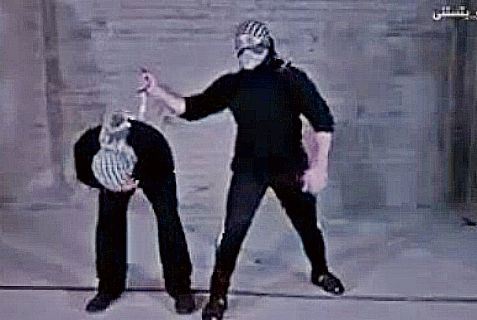
stabbing-lesson-screenshotA clip from”How to Stab a Jew,” the latest hit on Arab social media. Photo Credit: Screenshot

All of Israel is paying a heavy price, the price of life, by a decade of conducting “negotiations” with the Palestinian Authority while it has incited an entire generation to hate Jews and the murder them.

****************

The “resisters of occupation in the occupied West Bank and Jerusalem” are spreading on Arab social media a frightening video demonstrating tactics on how to stab a Jew to death quickly and efficiently.

The 1 minute and 13 second-video, as seen below, shows the “teacher” calmly walking up to a “victim,” stabbing him, and walking away.

One of the tactics appears to imitate the Islamic State method of beheading.

The guide to killing Jews teaches that after stabbing the victim, the knife should be twisted to maximize wounds and cause death.

The Palestinian Authority and anti-Israel Arabs in Jerusalem do not need terrorist cells when “resisters” use social media to reach hundreds of thousands of Arabs in Jerusalem as well as in Judea, Gaza and Samaria, with a simple post on social media.

Israel needs to find the source of whoever posted this video and arrest him or them.

All of Israel is paying a heavy price, the price of life, by a decade of conducting “negotiations” with the Palestinian Authority while it has incited an entire generation to hate Jews and the murder them.

Until the Palestinian Authority halts all incitement, and until Mahmoud Abbas starts condemning terrorists in Arabic as well as in English, and until the Obama administration understands that Israel means what it says, the government needs to stop all contact with Ramallah.

Arab stabbing attacks on Jews have increased significantly this year, and every Israeli is a potential victim when “resisters” educate every Arab to be a murderer.

The Destruction of the Middle East

December 27, 2014

The Destruction of the Middle East, The Gatestone InstituteDenis MacEoin, December 27, 2014

We must learn to speak the truth, especially in high places. In the tenth century, Islam abandoned reason and rational pursuits in favor of revelation and revealed law that could not be challenged. Ethics were defined by what Allah said was good or evil in Sharia law. Islam has remained frozen ever since. We cannot go on patronizing this, and nodding acceptance that Muslims know best. Very few grasp the quandary in which non-extremist Muslims, like their ancestors, are captured. Western rationalism, Western ethics, and Western standards of peace and justice need to remain, or the world we know could be trampled underfoot by men and women who prefer death to co-existence, and fundamentalism to tolerance.

****************

The heritage of centuries has been wiped out in little more than a year.

Eventually the need to wipe out all traces of unbelief becomes obsessive. At one time, for instance, Egyptian law demanded that any house found to contain a copy of The Apology of al-Kindi (a book containing a polemical dialogue between a Muslim and a Christian) would be demolished along with 40 houses around it.

Ethics were defined by what Allah said was good or evil in Sharia law. The Islamic State’s behaviour is solidly rooted in Islamic ideology, law and practice. It is only when this fundamental fact is grasped that we will be able to address what confronts us.

There are many wise and sensible Muslims who favour a shift to a more updated way of thinking. It is their mosques and shrines that are being crushed; it is their heritage. Today, such Muslims use the freedoms bestowed on them in the West to write, network and debate their opposition to fundamentalist interpretation of Islam by the Islamic State and other supporters of murder and destruction.

We are living through ferocious times. Stories about the self-proclaimed Islamic State [ISIS/ISIL/Da’esh] abound in the media, in what has now become a daily round of beheadings, suicide bombings, and general mayhem from Nigeria to Malaysia. It seems that wherever there is a Muslim country, there is extreme violence. But one part of the Islamic State narrative has received less attention than the gruesome rounds of killings: the continuing onslaughts on cities such as Mosul, Aleppo, Raqqa and Kobani. The Islamic State and related movements have rampaged across parts of Iraq and Syria, destroying the entire heritage of ancient regions, demolishing historic churches, synagogues, mosques, Sufi and Shi’i shrines, and major archaeological sites. All this vandalism is driven by a relentless passion to enforce religious purity on the regions they now control.

Around the world, art historians, antiquities experts, and archaeologists scarcely dare open their e-mails every day, fearing loss of another irreplaceable site. Physical destruction in the Islamic realms has now reached proportions of the Mongol invasions of the thirteenth century.

In Mosul, the Islamic State set out on an operation of “cultural and historical cleansing” across the city. The group deploys a unit called the Kata’ib Taswiyya, or settlement battalions, who are ordered to identify sites for culling. The unit razes to the ground any mosques, churches or, invariably, shrines that have been built over tombs; such places may attract devotees to pray in them, thereby creating polytheism — in Islam one of the crimes most censured. In addition, the painting or sculpting of the human form is anathema; if man was created in God’s image, to represent man is to presume to know God and therefore to diminish Him.

Graveyards are flattened, headstones are bulldozed, and statues of cultural significance to the people of Mosul are destroyed.

As we face the Islamic State and all the rapidly expanding jihadist movements in the Middle East and beyond, we are starting to recognize that airstrikes have only limited results. If we are to contain or defeat the adversaries in our midst, we have to understand their motivation, their psychology, and their sense of rootedness.

Politicians who proclaim that Islam is a religion of peace do us a disservice; Islam has never been at peace with the world around it. The Islamic State’s behavior is solidly rooted in Islamic ideology, law and practice. Only when this fundamental fact is grasped will we be able to address what confronts us. It is time that not only active jihadists, but their ideological sponsors in Salafi, Wahhabi, Mawdudist, and other classical and modern interpretations of Islam, be discussed openly before they do more harm. They and we do not have the leisure to wait until the oil money runs out and leaves the Saudis or Qataris weak.

We must learn to speak the truth, especially in high places. In the tenth century, Islam abandoned reason and rational pursuits in favor of revelation and revealed law that could not be challenged. Ethics were defined by what Allah said was good or evil in Sharia law. Islam has remained frozen ever since. We cannot go on patronizing this, and nodding acceptance that Muslims know best. Very few grasp the quandary in which non-extremist Muslims, like their ancestors, are captured. Western rationalism, Western ethics, and Western standards of peace and justice need to remain, or the world we know could be trampled underfoot by men and women who prefer death to co-existence, and fundamentalism to tolerance.

There are many wise and sensible Muslims who favour a shift to a more updated way of thinking. Many cannot openly declare their thoughts for fear of reprisals and even execution; others are faithful Muslims who see a desperate need for a valid reinterpretation of their religion.

Today, such Muslims use the freedoms bestowed on them in the West to write, network, and debate their thoughts about the fundamentalist interpretation of Islam by the Islamic State, other Salafis, Wahhabis, Mawdudists, and all other clerics and extremist supporters of murder and destruction. It is their mosques and shrines and ancient monuments that are being crushed; it is their heritage — as much as that of Jews, Christians, Yazidis and Baha’is — that is being wiped from the pages of history.

Losses so far include:

The statues of Mulla ‘Uthman al-Mawsili (1845-1923), a famous musician and poet, of a woman carrying an urn, and of Abu Tammam (788-845), author of the celebrated Hamasa, one of the greatest literary compilations ever made in Arabic.

  • The destruction of the greatly venerated tomb of ‘Ali ibn al-Athir al-Jazari (1160-1233), a major landmark that had stood in the centre of Mosul for centuries. Ibn al-Athir is celebrated as the author of The Complete History, one of the most important histories of Islam ever written.
  • The Islamic State’s destruction of the Tomb of Yunus (Jonah) Mosque, which was blown to pieces along with all its contents. Even before the explosion, fighters took sledgehammers to ancient tombstones in the building. The mosque was of importance not just to the Muslims of the city, but as a place of pilgrimage for Jews and Christians. St. George’s Monastery church, one of the oldest in the region, has also gone forever.
  • In Kirkuk, the Islamic State has destroyed the tomb of the Prophet Daniel, and in Nineveh, the ancient ruins of which lie across the River Tigris from Mosul, sprawl damaged archaeological ruins.
  • In Mosul, the 13th-century shrine of Imam Awn al-Din — with a stunning vaulted ceiling, designed to resemble a honeycomb, inside a pyramid-shaped tower on the banks of the Tigris, and among the city’s most precious sites — was one of the very few structures to have survived the devastation of the 13th-century Mongol invasion On July 25, 2014, members of the Islamic State reduced it to rubble.
  • In Tikrit, the city’s most famous and most beautiful church of St. Ahoadamah, known as the Green Church, dating from the 7th century, has been erased from history.
  • In Syria, the Jabhat al-Nusra’s destruction of the Deir el-Zour Armenian Church, that stood as a memorial to the 1.5 million slaughtered in the Armenian genocide in Turkey, was blown up.
  • In Mali, much of UNESCO’s World Heritage Site of Timbuktu (Mali) was destroyed during the battles of Gao and Timbuktu, fought between the National Movement for the Liberation of Azawad and the Islamist Movement for Oneness and Jihad in West Africa between June 26 and 27, 2012. Afterwards, the Islamist group Ansar Dine went on a rampage identical to that of the Islamic State. An official for the group, Abou Dardar, boasted that “not a single mausoleum will remain in Timbuktu.”
  • Sufi shrines have been pulverized in Egypt, Libya, Mali, Pakistan, Iran, Somalia, Sudan, Tunisia, Morocco, India, and the Balkans.
  • In Bahrain, 43 Shi’i mosques and tens of other religious structures have been destroyed and damaged by the ruling Sunni government there.
  • Across Syria and Iraq, ancient archaeological sites have been wrecked. They were not just the heritage of those countries, they were central to our understanding of the ancient world, where human civilization first developed in city-states. Apamea, with its famous colonnade and beautiful mosaic, capital of the Seleucid empire, was a major center of Roman rule in the Levant, a leading city in Byzantine Syria, and at one time among the best-preserved archaeological sites in the region. Today, it looks like the face of the moon. Its devastation, the work of demolition done by looters using heavy earth-moving machines, took a mere four or five months.
  • In eastern Syria, one of the world’s richest archaeological remains, Dura-Europos, the “Pompeii of the Syrian Desert,” was obliterated. Remarkable finds had been brought to light: temples, wall decorations, inscriptions, military equipment, and tombs. It had been home to a third-century painted synagogue as well as to the oldest example in the world of a Christian house-church, which contained the earliest depictions of Jesus Christ ever found, dating back to 235 AD. The Islamic State looted the site and, as elsewhere, has apparently sold its treasure on the black market of the antiquities trade, presumably using the proceeds to inflate their already swollen coffers for the promotion of jihad.
  • Both Shi’i and Sufi shrines and mosques have fallen afoul of the Islamic State’s fanaticism. Jewish sites have been targeted so extensively that UNESCO has held a special session on threats posed to them. UNESCO’s Director-General Irina Bokova has described the Islamic State’s activities in this respect as “a form of cultural cleansing.” Many other Jewish sites were also destroyed or under threat from Islamist entities in Libya, where an ancient Jewish heritage was all but wiped out under the regime of Mu’ammar Qadhafi, and where what is left is succumbing to fresh attacks.
  • 855Locals survey the hill of rubble that resulted from the destruction of the Tomb of Yunus (Jonah), in Mosul, Iraq. The Islamic State blew up the tomb and mosque on July 24, 2014.

    The Islamic State, however, does not restrict its demolition to Christian, Jewish or pagan sites. Its members have also evidently culled what may be thought of as their own heritage. In Tikrit, theydemolished the country’s oldest Islamic site, the Arba’in (Forty) Shrine and mosque, where forty of the companions (Salaf) of the Prophet were buried.

    In this, there is desperate irony, for the form of Islam followed by the Islamic State is Salafism, based on imitating the ways of Muhammad and his companions.

    The heritage of centuries has been wiped out in little more than a year. There will be many who argue that this devastation is, at root, the fault of the West; that its colonization, imperial ambitions, and general interference have forced the people of the Middle East to rise up against Europe and America, and find their only solution in the creation of an Islamic state where Shari’a law will dominate and justice prevail. Nothing could be farther from the truth. Syria was never a French colony, but a mandate territory between 1922 and 1936 — fourteen years. Lebanon was a mandate territory from 1922 to 1943 — twenty-one years. Iraq was a British mandate from 1922 to 1932 — ten years. All were colonies of the Muslim Ottoman empire for centuries: Iraq between 1543 and 1918, Syria from 1516 to 1918, and were, before that, colonies of earlier Islamic empires from the Umayyads to the Abbasids to the Mamluks — and so on.

    This alone exposes the reality, that the actions of groups such as the Islamic State have their true roots in Islam itself. The Prophet and his companions fought jihad wars and destroyed pagan idols as well as places they may have been concerned would become centers for cults. During the Arab conquests, many religious centers were destroyed, notably in India, where temples were looted and razed, and whole towns ruined by the Ghaznavids and Timurids.

    Eventually the need to wipe out all traces of unbelief became more or less obsessive. At one time, for instance, Egyptian law demanded that any house found to contain a copy of The Apology of al-Kindi (a book containing a polemical dialogue between a Muslim and a Christian) would be demolished, along with forty houses around it.[1]

    In more recent times, in 1802, during the first of the three Saudi states, Wahhabi armies attacked the major Shi’i religious town of Karbala in Ottoman Iraq, where they killed 5,000 inhabitants and destroyed the shrines of Muhammad’s son-in-law ‘Ali (the first Shi’i imam and the fourth Sunni caliph) and his son Husayn, the prophet’s grandson. The following year, Wahhabi forces under the leadership of the first Saudi ruler, ‘Abd al-‘Aziz, entered Mecca, where they destroyed tombs and shrines, and in the process, removed much of the city’s history — as is being repeated today in Mecca and Medina.

    Between 1913 and 1927, extremist Wahhabi forces, known as the Ikhwan, rampaged through the Arabian peninsula, much as members of the Islamic State do now, killing and destroying anyone and anything they deem contrary to the Puritanism of their creed, which extremists interpret as preaching the annihilation of all that is not Islam.

    Today, the Mecca and Medina of the first and second centuries of the Islamic faith have been all but wrecked, not by the Islamic State or any other radical entity, but by the Wahhabi Saudi government. Over the past two decades, major historical sites in Mecca and Medina, all related to the lifetime of the Prophet and shortly after, have been destroyed or disfigured to the point where neither city is recognizable save for the Ka’ba and the Grand Mosque in Mecca, and the Prophet’s Mosque in Medina.

    Although much has been done to accommodate the increasing millions of pilgrims who go there for the hajj pilgrimage, most of the demolition appears to relate to a Wahhabi and Salafi fear that pilgrims may pray at the graves of Muhammad’s companions, at the house where he was born, or at other buildings associated with the first era of Islam. There seems to be an insistence that anything that might compromise God’s oneness must be eradicated, and this concern may have prompted the country’s rulers to destroy them.

    The vast Jannat al-Baqi cemetery, which holds so many remains of Muhammad’s family, close companions and the earliest Muslim saints, has been levelled, and all domes and mausoleums turned to dust. That act followed earlier levelings by Wahhabis in 1206 and the Ikhwan in 1925. Those included the graves of the martyrs of the Battle of Uhud and that of Hamza, the prophet’s uncle and most beloved supporter. So too the Mosque of Fatima (Muhammad’s daughter), the Mosque of the Manaratayn (the twin minarets), and the cupola that marked the burial place of the prophet’s incisor tooth.

    In Medina as well, the home of Muhammad’s Ethiopian wife, Maryam, where his son Ibrahim was born, has been paved over.

    In Mecca, the house of his first wife, Khadija, the first person to whom he divulged his mission, has been turned into public toilets. In 1998, the grave of the prophet’s mother, Amina bint Wahb, was bulldozed in Abwa, after which gasoline was poured on it. There is much more.[2]

    Destruction of the sacred places of rival faiths or denominations is nothing new; it has happened throughout history. Henry VIII wrecked Catholic abbeys and monasteries; their ruins still pepper the English countryside. The destruction of the Babri Mosque in Ayodhya by Hindus in 1992 led to two thousand deaths. The Roman demolition of Judaism’s Second Temple marks a watershed in world history and is central to the current conflict in the Holy Land. But the most consistent use of elimination through the centuries has been the Muslim war on non-Muslims. Despite much controversy, it has been claimed that over 2000 Hindu, Jain and Buddhist temples and holy places were destroyed by Muslim conquerors in India. Churches and synagogues have been demolished or converted into mosques in many places.

    When Jordan controlled East Jerusalem between 1948 and 1967, all but one of the Old City’s synagogues was reduced to rubble or converted into stables and chicken coops; the main Jewish cemetery was desecrated, and Jewish homes destroyed.

    Today, in Iran, the Islamic regime has demolished all the holy sites and graveyards of an indigenous faith, the Baha’i religion.

    If the depredations of the Islamic State are to have any meaning in the end, perhaps it will be because they will have shown how right the non-extremist Muslims are in calling for a deep change within Islam.


    [1] Robert Reilly, The Closing of the Muslim Mind, Wilmington, 2010, p. 36.

    [2] Websites where readers can read of these destructions at length include: Irfan Ahmed, “The Destruction of the Holy Sites in Mecca and Medina,” Islamica Magazine; Laith Abou-Ragheb, “Dr. Sami Angawi on Wahhabi Desecration of Mecca: Developers and Purists Erase Mecca’s History,” Center for Islamic Pluralism/Reuters, 12 July 2005; Ziauddin Sardar, ” The Destruction of Mecca,” The New York Times, 30 September 2014; Carla Power, “Saudi Arabia Bulldozes Over Its Heritage,” Time, 14 November, 2014; Jerome Taylor, “Medina: Saudis take a bulldozer to Islam’s history,” The Independent, 26 October 2012; Jerome Taylor, “The photos Saudi Arabia doesn’t want seen – and proof Islam’s most holy relics are being demolished in Mecca,” The Independent, 11 December 2014.

    Meshaal on point of relocating Hamas’ political headquarters from Doha to Tehran

    December 27, 2014

    Original posted by Dan Miller

    Meshaal on point of relocating Hamas’ political headquarters from Doha to Tehran, DEBKAfile, December 27, 2014

    Khaled_Mashaal_12.14Hamas’ Khaled Meshaal heads for new exile

    Hamas’ political leader Khaled Meshaak, forced to quit his old headquarters in Damascus after abandoning his longtime host Bashar Assad and finding sanctuary in Doha – is again being hounded from pillar to post.

    A deal struck this week between Egypt and Qatar could result in the Hamas leader settling in the Iranian capital. This would afford Tehran a foothold in the Gaza Strip, its second Mediterranean outpost after Lebanon on the Israeli border.

    The Egyptian-Qatar deal, revealed here by DEBKAfile’s Middle East sources, covers the future of the Muslim Brotherhood, the nemesis of Egyptian President Abdel-Fatteh El-Sisis, and its offspring, the Palestinian Hamas, which rules the Gaza Strip. Their memorandum of understanding was concluded Wednesday, Dec. 24, in Cairo by a delegation of Qatari intelligence chiefs and the new Egyptian director of intelligence Gen. Khaled Fawzi. They spent most of the day hammering out its six points, which are listed here:

    1.  Qatar withdraws its support from all Brotherhood operations against Egypt and Saudi Arabia;

    2.  This point applies equally to any Hamas activity that may be interpreted as inimical to Egypt;

    3.  Qatar’s assistance to Hamas will be limited to “civilian” projects (such as repairing war damage in Gaza), which too will be subject to President El-Sisi’s approval;

    4. Given the close cooperation maintained at present between the Egyptian president and Israeli Prime Minister Binyamin Netanyahu on affairs relating to Gaza, Israel will implicitly have the right to disqualify certain Palestinian projects in the enclave;

    5.  Qatar is to shut down the anti-Egyptian propaganda channel run by its Al Jazeera television station;

    6.  The emirate is not required to sever all its ties with the Muslim Brotherhood and Hamas, just to keep them under control as its “strategic reserve.”

    It is extremely hard to conceive of these two radical Islamist organizations bowing to the restrictions placed on their operations under the Egyptian-Qatari deal.

    Brotherhood leaders have exited Doha and made arrangements to establish residence and a new center of operations in London, U.K.  Khaled Meshaal, after he was denied permission by Turkish President Tayyip Erdogan to set up shop in Istanbul, is on the point of a decision to relocate his offices in Tehran. Iran would thus gain a proxy foothold in the Gaza Strip, its second outpost on the Mediterranean after the first was provided by Hizballah in Lebanon. If Meshaal decided to settle in Tehran, Iran would acquire a handy springboard for action against Egypt and southern Israel.

    Forgive us our formatting problems…

    December 27, 2014


    They are actually WordPress’ problems which we are unable to rectify.

    When this has happened in the past it has taken less than 24 hrs for them to straighten it out..

    Till then, please bear with us…

    JW


    Mashaal: ‘A strong Turkey means a strong Palestine’

    December 27, 2014

    Mashaal: ‘A strong Turkey means a strong Palestine’In address to ruling party supporters,

    Hamas leader praises Erdogan, Davutoglu; crowd shouts ‘down with Israel’

    By Ricky Ben-David December 27, 2014, 4:15 pm

    via Mashaal: ‘A strong Turkey means a strong Palestine’ | The Times of Israel.


    Hamas chief Khaled Mashaal answers AFP journalists' questions during an interview in the Qatari capital of Doha, on August 10, 2014. (photo credit: AFP/al-Watan Doha/Karim Jaafar)

    Hamas chief Khaled Mashaal answers AFP journalists’ questions during an interview in the Qatari capital of Doha, on August 10, 2014. (photo credit: AFP/al-Watan Doha/Karim Jaafar)

    xiled Hamas leader Khaled Mashaal hailed Turkey’s leaders Saturday in Konya province in central Anatolia during a surprise speech to officials and supporters of the ruling AK party, saying he hoped to “liberate Palestine and Jerusalem” with them.

    Mashaal congratulated the people of Turkey for “for having [Prime Minister Ahmet] Davutoğlu and President Recep Tayyip Erdoğan” as heads of state, adding that “a strong Turkey means a strong Palestine … Inshallah, God is with us and with you on the road to victory.”

    “Inshallah we will liberate Palestine and Jerusalem again in the future,” Mashaal said.

    The Hamas leader was introduced to the crowd gathered for the annual event by Davutoglu himself. His speech was frequently interrupted by supporters shouting “down with Israel!” and “God is great.”

    “A democratic, stable and developed Turkey is a source of power for all Muslims,” Mashaal went on, adding “I greet all the brave people who claim Jerusalem … Our flag is the symbol of all the oppressed in the world.”

    Mashaal often shows up at the ruling party’s events. He also attended the AKP’s congress in 2012 when President Recep Tayyip Erdogan was serving as prime minister.

    Davutoglu, in his speech Saturday said Turkey’s red flag featuring a crescent with a star was a “symbol of the innocent in the world.”

    “God is witness … we will make this red flag a symbol of the innocent. This red flag will fly side by side with the flags of Palestine, free Syria and all other innocents’ flags anywhere in the world,” he told the congress.

    Turkey and Hamas have seen a rapid rapprochement as Israel’s ties with Ankara continued to deteriorate. The AK party has had close ties with Hamas since its rise in 2001, led by Davutoglu and Erdogan. The two have been known for their frequent outbursts against Israel over the years.

    In August during Israel’s Operation Protective Edge, Erdogan accused Israel of being “more barbaric than Hitler.” Israel launched the campaign on July 8 to stop rocket fire from Gaza and destroy tunnels dug under the border by Hamas for attack purposes.

    Jerusalem has also accused Turkey of allowing Hamas to operate on its soil, a charge Ankara strongly denies.

    Last month, Israel appealed to the NATO coalition — of which Turkey is a member – and to the US leadership to take steps against Ankara for enabling Hamas terrorists to operate and plan terror attacks against Israelis from its territory.

    Israel has alleged on several recent occasions that Hamas cells operating in the West Bank and planning major terror attacks were doing so under the guidance and leadership of Hamas’s Saleh al-Arouri, who was deported from the West Bank to Turkey in 2010, while Ankara turns a blind eye to his actions.

    Last month, the Shin Bet security service said members of a Hamas terror ring in the West Bank, run from the organization’s headquarters in Turkey, sought to carry out an array of major attacks, including on Jerusalem’s main soccer stadium and its light rail line.

    Arouri, they said, built up and funded the network, and has effectively established a Hamas command post in Turkey which is leading terror efforts in the West Bank. Arouri is reportedly aided by dozens of operatives, some of whom were deported by Israel in the wake of the Gilad Shalit prisoner deal in 2011.

    The officials accused Turkey as well as Qatar — the current home of Hamas leader Khaled Mashaal — of enabling Hamas to operate freely within their territories to carry out attacks against Israel and undermine the Palestinian Authority.

    In October, Defense Minister Moshe Ya’alon said Hamas had two command centers: one in the Gaza Strip, which has been ruled by the Islamist group since 2007, and one in Turkey.

    Israel’s ties with Turkey became strained after Israel’s Operation Cast Lead in Gaza in 2008-2009, but nosedived in May 2010 when the Mavi Marmara ferry was boarded by Israeli commandos as it attempted to break the naval blockade of the Gaza Strip. In the ensuing melee, after the Israeli soldiers were attacked with iron bars and wooden bats, troops opened fire and nine Turkish activists were killed; 10 Israeli soldiers were injured.

    AFP and Times of Israel staff contributed to this report.

    Report: Nasrallah is pushing for Hamas reconciliation with Syria and Iran

    December 27, 2014

    Report: Nasrallah is pushing for Hamas reconciliation with Syria and Iran

    via Report: Nasrallah is pushing for Hamas reconciliation with Syria and Iran – Arab-Israeli Conflict – Jerusalem Post.


    Hamas has urged the urged Hezbollah to withdraw its forces from Syria, where they are battling for Syrian President Bashar Assad.

    Hassan Nasrallah

    hezbollah chief Hassan Nasrallah.. (photo credit:REUTERS)

    Hezbollah’s leader Hassan Nasrallah is reportedly mediating between Hamas on the one hand and Iran and Syria on the other in order to patch up the alliance that has been damaged due to the war in Syria.

    The reconciliation efforts were reported on Saturday in the Lebanese newspaper As-Safir.

    According to a senior official, Nasrallah is playing a key role in the mediation effort which is also being encouraged by Tehran, that is planning to invite Hamas Political Bureau Chief Khaled Mashaal to the Iranian capital.

    Possible signs of the mediation could also be seen from Gaza, where in a ceremony earlier this month marking 27 years since the founding of the Islamist movement, Abu Ubaida the spokesman for the Kassam Brigades, the armed wing of Hamas, recognized Iran’s role in supporting the Palestinian resistance.

    Hamas has urged Hezbollah to withdraw its forces from Syria, where they are battling for Syrian President Bashar Assad, and focus on fighting Israel instead. Iran is Syria and Hezbollah’s strongest regional ally.

    The Islamist group which controls the Gaza Strip, was once an Assad ally, but in 2012 it endorsed the revolt against him in a shift that at the time deprived the Syrian leader of an important Sunni Muslim supporter in the Arab world.

    “We call on Hezbollah to take its forces out of Syria and to keep their weapons directed against the Zionist enemy,” Moussa Abu Marzouk, a Cairo-based Hamas leader, said on his Facebook page last year.

    Before the rift overt the war in Syria, Hamas and Hezbollah, were two long-time allies who have each fought against Israel and advocate its destruction.

    Hamas’s leaders in exile were once based in Damascus but left, mainly for Egypt and Qatar, in 2012 as the civil war escalated.

    Reuters contributed to this report.  

    Thawing U.S. ties: Cuba today, Iran tomorrow?

    December 26, 2014

    Thawing U.S. ties: Cuba today, Iran tomorrow? Al Arabiya NewsMajid Rafizadeh, December 26, 2014

    (Please see also Obama’s Worst Lie About his Dirty Castro Deal is in his First Sentence.

    Obama Cuba negotiations

    Also, Obama’s need for a legacy consistent with his ideology trumps all else, including Iran’s abysmal human rights record, its theocratic government, its support for terrorism, its hatred for Israel and desire to eliminate her, its duplicity in its P5+1 negotiations and its insistence on getting (or keeping) nukes. True, removal of statutorily based sanctions would require congressional action. However, Obama has little interest in avoiding constitutional irregularities. No congressional approval was granted for the “temporary suspension” of sanctions and laws inconsistent with Obama’s desires can be and are waived. Litigation over the de facto removal of sanctions by executive order would take many years.– DM)

    After almost 53 years of Cold War between the U.S. and Cuba, the transformation of ties between these two adversaries has sparked a considerable amount of debate with respect to the normalization of ties with other longstanding rivals. The possibility of resolving other diplomatic imbroglios, specifically the revival of diplomatic ties between the U.S. and Iran is a case that comes to mind.

    Some Iranians showed their excitement on Twitter with regards to the Cuban deal. Some showed hope that their government will be next and they could soon see an American embassy in Tehran. However, others thought that an Iran-U.S. deal is an idealistic and unreachable dream.

    Indeed, any normalization of diplomatic relationships between the Islamic Republic and the U.S. will likely have significant positive impacts on both nations, leading to a critical strategic and geopolitical shift in the Middle Eastern political chessboard. Currently, both countries have some shared strategic and geopolitical objectives in Iraq and Syria particularly when it comes to fighting ISIS.

    A possible Iranian deal will remove the economic sanctions on the Islamic Republic, assisting Tehran to achieve its highest economic potential in exports, imports and wealth. The tourist industry would be revived in Iran, with many European and Americans fond of visiting thousands of years old historical sites in Esfahan Shiraz, Hamadan, and other provinces. Normalization of diplomatic ties will lead to the flow of (primarily) European companies to do business with the Islamic Republic. In addition, as Iranian youth have shown to be in favor of American brands and products, American manufactures will find a share in Iran’s market as well. Further, U.S. airplane companies will begin cooperation with Iranian airlines.

    As many people are pondering on the likelihood of a deal similar to the recent Cuba agreement with Iran, the question is whether the executive order to lift the embargo on the Islamic Republic and conducting back channel diplomacy to fully open ties with Tehran is possible?

    Iran’s file is more complicated and multilayered

    There are some partial similarities between the Obama administration’s method to initiate a deal with Raul Castro’s government and the way it has recently approached the Islamic Republic. The major commonalities are the back channel diplomacy and talks.

    Similar to the Cuban deal, the Obama administration has conducted back channel talks with Iranian politicians with respect to Iran’s nuclear program. In addition, President Obama sent a clandestine letter to Iran’s Supreme Leader Ayatollah Ali Khamenei highlighting some of the shared strategic, national and geopolitical interests that both nations have in the Middle East.

    Nevertheless, these commonalities in diplomatic approaches have led some scholars, politicians, and policy analysts to jump to the conclusion that the same deal should be applicable to the case of Iran because such an approach was possible with Cuba and the embargo on Cuba was lifted.

    But, not too fast.

    Iran’s file is much more complicated, multifaceted and multilayered than the Cuban case. While Cuba is a small island close to the state of Florida with a population of approximately 11 million, Iran, with a population of over 80 million, is located in the complex geopolitical chessboard of the Middle East, and entangled among mixture of alliances and enmities in the oil rich region.

    Second of all, from Washington’s perspective, Cuba has hardly been a serious threat to American strategic, geopolitical, or economic interests. On the other hand, the Islamic Republic has been a major player in scuttling U.S. foreign policy objectives and opposing its allies (including Israel) in the Middle East.

    Third, several crucial regional developments are viewed from the prism of a zero-sum game for both Iranian and American officials. Iranian leaders are less likely to accept any compromises on their top foreign policy priorities, such as: keeping President Bashar al-Assad in power, withdrawing its financial, advisory, intelligence, and military support to the Iraqi and Syrian government, and assisting formidable proxies such as Hezbollah.

    Fourth, there was no international consensus on the U.S. embargo and economic sanctions against the Cuban government. As a result, President Obama can issue an executive order to lift the embargo. Many European countries were doing business with the Cuban government and the United Nations repeatedly condemned U.S. sanctions. On the other hand, the four rounds of economic sanctions on Tehran came with the approval of the U.N. Security Council. Unlike Cuba, many regional and global powers are dubious about Iran’s nuclear and regional hegemonic ambitions.

    Fifth, several developments in Iran, such as revelations of clandestine nuclear sites, the possibility of testing exploding detonators for nuclear weapons in Parchin military site, and the military dimension of Tehran’s nuclear program, have led to regional and international strain.

    Finally, and more fundamentally, unlike Castro, Khamenei has shown no interest in fully normalizing diplomatic ties with the United States. For example, the Obama administration received no positive response from Khamenei through its diplomacy. In addition, there is no official public debate among Iranian politicians, across various spectrums of Iran’s political system, of even allowing the opening of an American embassy in Tehran. The U.S. domestic opposition to normalize ties with Iran, particularly from the Republicans, is much higher in comparison to the Cuban case. Although the Obama administration has taken some back channel steps to negotiate with the Islamic Republic, Iran’s supreme leader has not responded with signs of willingness to normalize relationships and he has been clear in not trusting the “Great Satan. “

    The signal that Iranian leaders received from the Cuban deal is not what the Western media depicts- that Iran is optimistic about normalizing ties with the U.S.. The message that Tehran received was that the Islamic Republic has to persist in its policies and that economic sanctions will ultimately fail. As foreign ministry spokeswoman Marzieh Akfham articulated: “The defense by the Cuban government and people of their revolutionary ideals over the past 50 years shows that policies of isolation and sanctions imposed by the major powers against the wishes of independent nations are ineffective.”


    Is there a solution?

    December 26, 2014

    Is there a solution? Israel Hayom, Dror Eydar, December 26, 2014

    (For European nations, America and others, abortive efforts to bring “peace” among Israel and warring Islamic factions provide welcome distractions from difficulties elsewhere which are even less tractable and more damaging to them. — DM)

    [N]ot even a utopian-style peace treaty will end the fight against Israel that is being waged by Europe and the global left wing (and here as well, to some degree). The dozens of organizations that have been established to take away the Jews’ right to their own land (for some reason, these groups are known as “human-rights organizations”; after all, you know, we Jews have no human rights) will no longer show any interest in the cruel dictatorship that they helped set up next door. Instead, they will aim their heavy artillery against Israeli society, which they will accuse of racism for being an exclusive state for the Jewish ethnic group instead of a “state of all its citizens,” which is actually code for “a state of all its nationalities.”

    *****************

    1. The upcoming elections have plunged Israel into a wartime atmosphere, and a good deal of blame is being thrown about. Each side, instead of looking to its own misdeeds, is making accusations against the other. They are not saying, “We have sinned,” but rather, “You have sinned.”

    Here, too, the accusations are meant to generate shallow headlines rather than addressing deep issues. This is a big mistake. Despite the piles of mud and refuse that are customarily dumped onto the average Israeli, the average Israeli is generally well aware of what is going on. They understand ideology and vision.

    On the political plane, one gets the impression that the discourse, at least on the Left, is still stuck in the 1980s, before the great experiments that the Oslo Accords brought upon us — before Hamas, before Islamic State, before the Middle East fell to pieces. What can Tzipi Livni accomplish with the Palestinians that she hasn’t done over the past two years, when she was in charge of the talks with them? Did she bring any sort of agreement to the government that it turned down? If so, let her tell us.

    But she knows that there is nobody to talk to on the other side. They never had the slightest desire to end the conflict with the Jews. I would be glad to hear any Arab leader name his final demands — the ones for which, if they were fulfilled, he would sign on the dotted line that the conflict was over and state that he had no further claims. Are there any volunteers?

    We have not even mentioned Jerusalem or the refugees or recognition of Israel as a Jewish state. The demand that our neighbors recognize Israel as the national home of the Jewish people was not for us, but for them. That is the litmus test of the integrity of their intentions. Do they recognize the right of Jews to any part of the historical Land of Israel? We know that any Arab leader who grants such recognition can expect an uncomfortable death.

    That is the reason for the effort to anchor the Jewish nature of the State of Israel in a Basic Law. It is because not even a utopian-style peace treaty will end the fight against Israel that is being waged by Europe and the global left wing (and here as well, to some degree). The dozens of organizations that have been established to take away the Jews’ right to their own land (for some reason, these groups are known as “human-rights organizations”; after all, you know, we Jews have no human rights) will no longer show any interest in the cruel dictatorship that they helped set up next door. Instead, they will aim their heavy artillery against Israeli society, which they will accuse of racism for being an exclusive state for the Jewish ethnic group instead of a “state of all its citizens,” which is actually code for “a state of all its nationalities.”

    2. As we look on, Europe is falling like a ripe fruit at the feet of the radical Islam sweeping over it. The more terrorism conquers the streets of Europe, the greater the Europeans’ desire will be to pay the terrorists a ransom in exchange for being left in peace, unmolested. As history has taught us, the ransom will be the Jews. The ludicrous statements by the European parliaments about recognizing the Palestinian state show the blindness of a society in decline that lost its basic instincts long ago. The Europeans care nothing about the Palestinians, whom they have doomed to a life of misery and suffering under oppressive regimes that are among the worst in the world, where there is no such thing as basic human rights.

    The Palestinians are the last thing that the Europeans care about, just as they care nothing about the atrocities being perpetrated in Syria, Iraq or Africa. The Europeans are recognizing the Palestinian state not because they have any desire to improve our neighbors’ situation, but because they have a problem with the Jews. They always did.

    Ironically, the return to Zion made the Jewish problem worse because it gave the Jews an independent political living space — which the Europeans find completely unacceptable. That is also the reason why there are dozens of European organizations in this region, and why they funnel hundreds of millions of euros supposedly to help the Palestinians, but actually in efforts to undermine the legitimacy of the Jewish state. The “peace process” is just one more tool in that mechanism.

    3. The talk of a “diplomatic agreement” is also a media ransom, lip-service paid by politicians who seek the sponsorship of the media party. Avigdor Lieberman is quite familiar with this work.

    “We must reach a diplomatic agreement,” he said in a “closed-door conference,” and received flattering headlines right away. “What is going on today is that they are doing nothing; there is a status quo. The initiative must be a comprehensive regional agreement.”

    Have we not heard those empty phrases a thousand times already? Have we not tried to reach a political agreement in all kinds of ways? Has Prime Minister Benjamin Netanyahu not gotten into trouble with his own camp over it? Did he not freeze construction in Judea and Samaria for ten months? And, before him, did Ehud Olmert not offer our neighbors what even Lieberman (I hope) would never dare offer?

    And what about the two Yisrael Beytenu princes, Uzi Landau and Yair Shamir? Where are they? Why are they not responding to their party chairman’s heretical statements? After all, were they not the ones who gave Lieberman the stamp of approval to be a right-wing party? More evidence of Lieberman’s desertion to the Left is his use of the well-known leftist scare tactic terminology: “a political tsunami.” But what burst out this week was more of a police tsunami against the members of Yisrael Beytenu. Now that the leader has adopted the Orwellian language of peace and speaks the language of the media party, maybe they will cut him some slack.

    4. In the end, the dispute between most of the Right and most of the Left boils down to one question: Do we believe the Palestinians or not? Palestinian Authority President Mahmoud Abbas has declared many times that he will never recognize Israel as a Jewish state, and he specifically named 6 million, with all its symbolism, as the number of Palestinians who expect their demand for the right of return to be fulfilled. Abbas is currently being kept alive by the Israeli army, which is protecting him as they would a delicate flower from attacks by the street, which supports Hamas. This does not stop the Palestinians from going all over the world, accusing us of every possible atrocity.

    The purpose of their action is to gain the maximum amount of territory at the minimum price — actually, for no price at all — but not to establish a tiny statelet. The past hundred years have taught us that what unites Arab-Palestinians is not the desire to improve their own living conditions, but to destroy the Jews’ lives. What more has to happen for us to believe what they say? In the meantime, they are sticking close to us so that we will protect them against Islamic State.

    5. So what is the solution? First, whoever said that there was a solution? Second, if we tried and did not succeed, maybe we ought to leave something for future generations to accomplish. You do not really believe the well-known chorus of lamentation that things are bad here and that the country is “stuck.”

    We have succeeded quite well, thank God, considering the fact that only one of our hands is engaged in construction, development and cultural work, since the other is busy with self-defense. Where were we just 70 years ago, in 1944 — and where are we now? Let us put things in perspective.

    Sanction Relief Empowering the Mullahs, Not Citizens

    December 26, 2014

    Sanction Relief Empowering the Mullahs, Not Citizens, Front Page Magazine, December 26, 2014

    (Surprise! And to which P5+1 nations, and to which entities within them, might the benefits of sanctions relief authorizing increased trade between the them and Iran go? — DM)

    iran_2677161b-450x350

    Four major institutions are benefiting mostly from the economic sanctions relief: Iran’s military-industrial complex, the Office of the Supreme Leader, Ayatollah Ali Khamenei, a few top business figures who are connected with the government, and the Iranian Revolutionary Guard Corps (IRGC), through either legal and illegal imports and exports.

    ******************

    There has always been an argument claiming that economic sanctions normally do not yield any result due to the notion that economic sanctions do not target the ruling elite and governmental official, but the ordinary people. This argument is partially accurate.

    Nevertheless, we need to remember that some targeted economic sanctions against the Islamic Republic (particularly the sanctions in oil and gas sectors and financial and bank institutions) did endanger the hold on power of the ruling cleric in Iran, particularly the Supreme Leader, Ayatollah Ali Khamenei. That was the primary reason behind pushing the Iranian politicians to come to the negotiation table in nuclear talks.

    On the other hand, the other side of the argument is that if economic sanctions are lifted, the major beneficiaries would be the ordinary people and the civilians. This argument would be accurate if the political and economic system of the given state is democratic, allows open opportunities for all, encourages the private sector, allows transparency, and holds those corrupt officials who commit illegal economic dealings accountable.

    The Iranian political and economic system is devoid of the aforementioned standards. In fact, in states which the political system is mainly authoritarian or theocratic, and the economic system is monopolized by few people at top and is state controlled, any increase of wealth or flow of money will inevitably strengthening the ruling elite rather than the ordinary people.

    To substantiate this argument, let us take a look on the ground in the Islamic Republic after the sanctions relief.

    At the beginning, a majority of Iranian people were hoping that economic sanctions relief would alleviate their suffering, improve their standards of living, and push many families above the poverty line. Almost a year has passed since the Iranian government has been receiving sanctions relief.

    After the interim nuclear deal and extension of the negotiations between the six world powers (known as the P5+1: China, France, Germany, Russia, the United Kingdom, and the United States) and the Islamic Republic, the Iranian government had received an estimated $7 billion.  Iran continues to receive approximately $700 million every month under the extension deal.

    In addition, there has been some sanction suspension with respects to some of Iran’s major industries, including Iran’s auto sector, gold and precious metals, as well as Iran’s petrochemical exports. The Iranian currency, the rial, has appreciated due to the sanctions relief, Iran’s oil and non-oil exports have increased, its economy is showing signs of stabilization, Tehran’s stock exchange has soared and Iran’s exports and business dealings with several countries have ratcheted up.

    The suspension of sanctions has definitely given both psychological and financial support to the Iranian government.  But the real question is how this money is being spent and which institutions benefit primarily from this sanctions relief. Are ordinary people benefiting from these sanctions relief and flow of money?

    Nevertheless, some Iranian civilians have begun to believe that even economic sanctions relief or even the lifting of the whole economic sanctions regime from the Iranian government are not going to assist civilians, their financial day-to-day activities, or bring concrete changes on the ground.

    Four major institutions are benefiting mostly from the economic sanctions relief: Iran’s military-industrial complex, the Office of the Supreme Leader, Ayatollah Ali Khamenei, a few top business figures who are connected with the government, and the Iranian Revolutionary Guard Corps (IRGC), through either legal and illegal imports and exports.

    For example, the IRGC controls and owns a considerable amount of shares in the aforementioned industries which have witnessed sanctions relief. In the petrochemical industry, The IRGC military-industrial complex owns Zagros Petrochemicals; 40% of Pars Petrochemical Company, part of Arak Petrochemicals; 25% of Kermanshah Petrochemicals; as well as 19% of the shares of Maroun Petrochemicals.

    This phenomenon of the monopolization of the economy applies in other sectors of Iran’s economy as well.  When it comes to Iran’s economic system, the Supreme Leader and IRGC do have a considerable amount of control and shares in almost all industries including financial institutions and banks, the transportation industry, automobile manufacturing, mining, commerce, and oil and gas sectors.

    As a result, these types of sanctions relief will mostly benefit the ruling elite, primarily the Supreme Leader and Iran’s military-industrial complex, IRGC. Iranian people will hardly observe any benefits from this economic sanctions relief or lifting of economic sanctions.

    It appears that the easing of sanctions are strengthening the ruling elite without any sign of redistribution of wealth. This is predominantly due to the fact Iran’s economic system is a state and military controlled system, it lacks transparency, as well as the reality that it is crippled with widespread corruption by the ruling elite and few on top.

    If the intention of economic sanctions relief is to assist the Iranian people and alleviate their suffering, there ought to be more efficient approaches to develop some types of targeted sanctions relief (for example, being directed at Iran’s educational system, health care, etc.) which aim at empowering Iranian civilians and primarily the middle class.