Posted tagged ‘Yemen’

Pakistani defense chief due in Riyadh, airlifts troops for Saudi Yemen war. Aden landings imminent

March 30, 2015

Pakistani defense chief due in Riyadh, airlifts troops for Saudi Yemen war. Aden landings imminent, DEBKAfile, March 30, 2015

pakistani_special_forces_30.3.15Pakistani Special Forces fighter

The US-led world powers and Iran Monday, March 30, entered the last tense hours for a nuclear deal as though Lausanne was on a different planet from the Middle East, where the Yemen war, in which Iran is deeply involved, abruptly scooped up a power outside the region, Pakistan.

A high-level meeting chaired by Prime Minister Nawaz Sharif in Islamabad on Monday reaffirmed Pakistan’s “firm commitment to supporting the sovereignty and territorial integrity of Saudi Arabia.” Among those attending were Chief of Army Staff (COAS) General Raheel Sharif, Advisor on National Security and Foreign Affairs Sartaj Aziz and Defense Minister Khawaja Asif. The Defense minister leads a Pakistani military delegation arriving in Riyadh Tuesday.

The Islamabad communiqués did not specify the types of military support Pakistan has pledged to its Saudi ally.

DEBKAfile’s Intelligence sources report that the Pakistani army is preparing to airlift a large force of several brigades up to a complete division to Saudi Arabia.

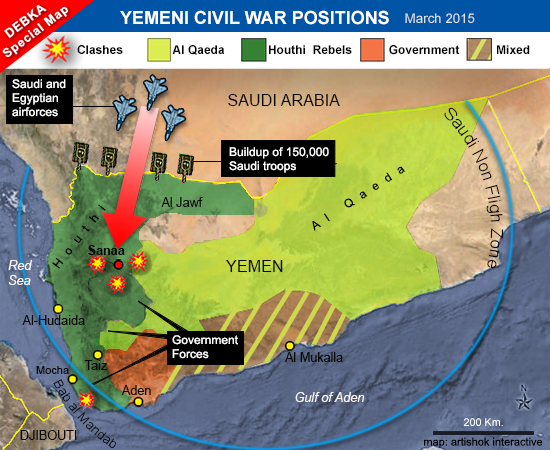
Our military sources note that Pakistan’s decision to intervene in the war against “Shiite Muslim Houthi rebels” presages the Yemen conflict’s expansion to ground and sea operations after four days of heavy Saudi air raids.

The Pakistani brigades would relieve the substantial Saudi ground forces strung out along the kingdom’s 1,000-kilometer-long southern border with Yemen, and free them up for action against the Houthis.  Pakistani troops would also be available for ensuring security at Saudi oil fields and terminal, as they have in the past.

Riyadh fears that bands of terrorists trained by Iran, some of them Houthis, might infiltrate the kingdom and target its oil infrastructure.

DEBKAfile sources report that, after the Saudi air bombardment broke the back of the Houthi-controlled Yemeni Air Force aircraft and its missile resources Sunday, a task completed Sunday,the fourth day of its intervention, Saudi and allied Gulf and Egyptian forces are preparing to land marines in the big Yemeni Red Sea port of Aden. They aim to stabilize the battle lines and prevent the town’s fall to the rebels.

But despite the gains made by the Saudi Air Force, Houthi forces are still advancing on Aden, and have come as far as artillery range from the city and its airport.  Egypt forces intervened Monday to check the advance, Its offshore warships and incoming jets blasted the Houthi columns as they closed in on the city.

Once Aden is secured, the Yemeni president Abd-Rabbu Mansour Hadi, who fled the city on the eve of the Saudi operation, can return and start re-assembling his tattered regime. A restored and functioning legitimate government is essential for the conduct of the coming stages of the war to crush the revolt, but also envisages an exit line:  negotiations for the conflict’s termination.

Why ‘Operation: Decisive Storm’ is Iran’s worst nightmare

March 29, 2015

Why ‘Operation: Decisive Storm’ is Iran’s worst nightmare, Al ArabiyaMajid Rafizadeh, March 28, 2015

(Al Arabiya is Saudi owned. — DM)

[B]y the U.S. being so concentrated on a nuclear deal and President Obama being so focused on leaving behind a historic legacy regarding a nuclear deal with Iran, the unintended consequences of such an inefficient foreign policy are being ignored and overshadowed. Although the U.S. has military bases in the region, it has evidently chosen to ignore Iran’s military expansion.

********************

Often, scholars and politicians have made the argument that regional powers in the Middle East are opposed to a nuclear deal between Iran and the six world powers due to the nuclear technicalities of the deal or restoring relationships between Tehran and the U.S. Nevertheless, this premise fails to shed light on the underlying concerns, nuances and intricacies of such a nuclear deal as well as Iran’s multi-front role in the region.

The underlying regional concerns are not primarily linked to the potential reaching of a final nuclear deal with the Islamic Republic or easing of ties between the West and Tehran. At the end of the day, regional powers would welcome and be satisfied with a nuclear deal that can ratchet down regional tension, eliminate the possibility of the Islamic Republic to become a nuclear state, and prevent a nuclear arms race.

But what is most worrying is the expanding empire of the Islamic Republic across the Arab world from Beirut to Baghdad, and from Sanaa to Damascus, as the nuclear talks reach the final stages and as no political will exists among the world powers to cease Iran’s military expansion.

Establishing another proxy in Yemen

Iran’s Quds forces have long being linked to the Houthis. The Islamic Republic continues to fund and provide military support to the Houthis (by smuggling weapons such as AK-47s, surface-to-air missiles as well as rocket-propelled grenades) in order to establish another proxy in the Arab world.

Iran’s long-term strategic and geopolitical objectives in Yemen are clear. The Islamic Republic’s attempt to have a robust foothold near the border of Saudi Arabia, as well as in the Gulf Peninsula, will tip the balance of power in favor of Tehran.

By empowering the Houthis, Tehran would ensure that Saudi Arabia is experiencing grave national security concerns, the possibility of conflict spill-over, and internal instability. In addition, by influencing Yemeni politics through the Houthis, Iranian leaders can pressure Saudi Arabia to accept Iran’s political, strategic and economic dominance in Iraq, Syria, and Lebanon as well.

The latest advancement of the Houthis supported the interests of the Islamic Republic until recently. There was a need for robust action against Iran’s hegemonic ambitions. Nevertheless, the West was resistant to act.

From geopolitical, strategic and humanitarian perspective, the robust military action, Operation Decisive Storm, is a calculated and intelligent move to send a strong signal to the Islamic Republic that its interference in another Arab state will not be overlooked. In other words, Arab states do not have to wait for the West to act against Iran’s covert activities and support for Shiite loyalist-militias in the region.

The tightening grip over another Arab capital

As the nuclear talks between Britain, China, France, Russia and the United States – the five permanent members of the Security Council – plus Germany (P5+1) and the Islamic Republic appear to show progress towards a final agreement to curb Iran’s nuclear ambitions, the world powers (specifically the United States) have chosen to turn a blind eye on Iran’s military expansion in the Arab states, and particularly in Yemen.

Iran’s long term strategic and geopolitical agenda should not be overlooked. Iranian leaders’ hegemonic ambition is to consolidate and strengthen its grip on the Arab states, and to have control over Arab capitals from Beirut to Baghdad and from Sanaa to Damascus.

The Islamic Republic’s ambitions to expand its empire during the nuclear talks and regional insecurities are carried out through several platforms. Central figures, such as Quds Force commander General Qassem Soleimani, hardliners such as Ali Reza Zakani, Tehran’s representative in the Iranian parliament and a close figure to the Iranian supreme Leader Ayatollah Ali Khamenei, and the Supreme Leader himself, play a crucial role in fulfilling Iran’s regional hegemonic ambitions.

Iranian leaders are not even concerned about repercussions from boasting about their grip over Arab capitals. Zakani recently bragged about having control over Arab capitals, “Three Arab capitals have today ended up in the hands of Iran and belong to the Islamic Iranian revolution”. He added that Sanaa will soon be under the grip on the Islamic Republic as well. According to him, most of Yemen’s territories will soon be under the power of the Shiite group, the Houthis, supported by the Islamic Republic.

The second platform that the Islamic Republic utilizes is sponsoring, financing, equipping, training and advising loyalist and heterodox Shiite groups across the region. The number of these militia groups is on the rise and they operate as a pawn to serve the geopolitical, strategic, economic, ideological and national interests of the ruling clerics.

America’s lack of political willingness to act

As the Islamic Republic creates such Shiite groups across the region to “protect” Arab capitals, Tehran centralizes its power across the region. In addition, after the creation of new Shiite groups, the elimination of these proxies will not be a simple task, for they will be ingrained in the socio-political and socio-economic fabric of the society.

In addition, these loyalist militia groups are game changers in the region, tipping the balance of power further in favor of the Islamic Republic and its regional hegemonic ambitions.

The expansion of Iran’s military and loyalist-militia groups in the region transcends Tehran’s political ambitions. The ideological tenet of this expansion and of Tehran’s overall growing regional empire (under the banner of Popular Mobilization Forces: an umbrella institution of Shiite armed groups) are crucial facets to analyze.

More fundamentally, as the final nuclear deal approaches, and as Tehran witnesses the weakness of Washington and other powers when deciding to overlook Iran’s militaristic and imperialistic activities in the region, Tehran has become more emboldened and vocal when it comes to its military expansion.

Iranian leaders boast about their role in Arab states projecting Tehran as a savior for the Arab world. As Zakani stated, according to Iran’s Rasa new agency “had Hajj Qassem Soleimani not intervened in Iraq, Baghdad would have fallen, and the same applies to Syria; without the will of Iran, Syria would have fallen”.

Nevertheless, by the U.S. being so concentrated on a nuclear deal and President Obama being so focused on leaving behind a historic legacy regarding a nuclear deal with Iran, the unintended consequences of such an inefficient foreign policy are being ignored and overshadowed. Although the U.S. has military bases in the region, it has evidently chosen to ignore Iran’s military expansion.

The concerns of regional countries about the nuclear deal is not solely linked to the nuclear technicalities of the deal or Iran-West rapprochement, but are primarily related to Iran’s growing empire as well as the consequences of such a nuclear deal leading Tehran to apply more assertive and expansionist foreign policy in the region.

Regional robust actions such as Operation Decisive Storm are sometimes required in order to set limits to Iran’s hegemonic, imperialistic objectives, and interference in other Arab states’ affairs, as well as in order to prevent the destabilizing effects emanating from the growing militia rebels sponsored by the Islamic Republic.

Column One: Managing Obama’s war against Israel

March 27, 2015

Column One: Managing Obama’s war against Israel, Jerusalem Post, Caroline Glick, March 26, 2015

ShowImageUS President Barack Obama meets with Prime Minister Benjamin Netanyahu at the White House, October 1, 2014. (photo credit:REUTERS)

As Max Boot explained Wednesday in The Wall Street Journal, the administration’s animosity toward Israel is a function of Obama’s twin strategic aims, both evident since he entered office: realigning US policy in the Middle East toward Iran and away from its traditional allies Israel and the Sunni Arab states, and ending the US’s strategic alliance with Israel.

Obama has reached a point in his presidency where he is prepared to give full expression to his plan to end the US’s strategic alliance with Israel.

He thinks that doing so is both an end to itself and a means of succeeding in his bid to achieve a rapprochement with Iran.

*********************

On Wednesday the Jerusalem Municipality announced it is shelving plans to build 1,500 apartments in the Har Homa neighborhood. Officials gave no explanation for its sudden move. But none was needed.

Obviously the construction of apartments for Jews in Jerusalem was blocked in the hopes of appeasing US President Barack Obama.

But is there any reason to believe he can be appeased? Today the White House is issuing condemnations of Israel faster than the UN.

To determine how to handle what is happening, we need to understand the nature of what is happening.

First we need to understand that the administration’s hostility has little to do with Israel’s actions.

As Max Boot explained Wednesday in The Wall Street Journal, the administration’s animosity toward Israel is a function of Obama’s twin strategic aims, both evident since he entered office: realigning US policy in the Middle East toward Iran and away from its traditional allies Israel and the Sunni Arab states, and ending the US’s strategic alliance with Israel.

Over the past six years we have seen how Obama has consistently, but gradually, taken steps to advance these two goals. Toward Iran, he has demonstrated an unflappable determination to accommodate the terrorism supporting, nuclear proliferating, human rights repressing and empire building mullahs.

Beginning last November, as the deadline for nuclear talks between the US and its partners and Tehran approached, Obama’s attempts to accommodate Tehran escalated steeply.

Obama has thrown caution to the winds in a last-ditch effort to convince Iranian dictator Ali Khamenei to sign a deal with him. Last month the administration published a top secret report on Israel’s nuclear installations. Last week, Obama’s director of national intelligence James Clapper published an annual terrorism threat assessment that failed to mention either Iran or Hezbollah as threats.

And this week, the administration accused Israel of spying on its talks with Iran in order to tell members of Congress the details of the nuclear deal that Obama and his advisers have been trying to hide from them.

In the regional context, the administration has had nothing to say in the face of Iran’s takeover of the Bab el-Mandeb Strait and the Gulf of Aden this week. With its Houthi-proxy now in charge of the strategic waterway, and with its own control over the Straits of Hormuz, Iran is poised to exercise naval control over the two choke points of access to Arab oil.

The administration is assisting Iranian Shi’ite proxies in their battle to defeat Islamic State forces in the Iraqi city of Tikrit. It has said nothing about the Shi’ite massacres of Sunnis that come under their control.

Parallel to its endless patience for Tehran, the Obama administration has been treating Israel with bristling and ever-escalating hostility. This hostility has been manifested among other things through strategic leaks of highly classified information, implementing an arms embargo on weapons exports to Israel in time of war, ending a 40-year agreement to provide Israel with fuel in times of emergency, blaming Israel for the absence of peace, expressing tolerance and understanding for Palestinian terrorism, providing indirect support for Europe’s economic war against Israel, and providing indirect support for the BDS movement by constantly accusing Israel of ill intentions and dishonesty.

Then there is the UN. Since he first entered office, Obama has been threatening to withhold support for Israel at the UN. To date, the administration has vetoed one anti-Israel resolution at the UN Security Council and convinced the Palestinians not to submit another one for a vote.

In the months that preceded these actions, the administration exploited Israel’s vulnerability to extort massive concessions to the Palestinians.

Obama forced Benjamin Netanyahu to announce his support for Palestinian statehood in September 2009. He used the UN threat to coerce Netanyahu to agree to negotiations based on the 1949 armistice lines, to deny Jews their property rights in Jerusalem, Judea and Samaria, and to release scores of terrorist murderers from prison.

Following the nationalist camp’s victory in last week’s election, Obama brought to a head the crisis in relations he instigated. He has done so for two reasons.

First, next week is the deadline for signing a nuclear agreement with Iran. Obama views Netanyahu as the prospective deal’s most articulate and effective opponent.

As Obama sees it, Netanyahu threatens his nuclear diplomacy with Iran because he has a unique ability to communicate his concerns about the deal to US lawmakers and the American people, and mobilize them to join him in opposing Obama’s actions. The letters sent by 47 senators to the Iranian regime explaining the constitutional limitations on presidential power to conclude treaties without Senate approval, like the letter to Obama from 367 House members expressing grave and urgent concerns about the substance of the deal he seeks to conclude, are evidence of Netanyahu’s success.

The second reason Obama has gone to war against Israel is because he views the results of last week’s election as an opportunity to market his anti-Israel and pro-Iranian positions to the American public.

If Netanyahu can convince Americans to oppose Obama on Iran, Obama believes that by accusing Netanyahu of destroying chances for peace and calling him a racist, Obama will be able to win sufficient public support for his anti-Israel policies to intimidate pro-Israel Democratic lawmakers into accepting his pro-Iranian policies.

To this end, Obama has announced that the threat that he will abandon Israel at the UN has now become a certainty. There is no peace process, Obama says, because Netanyahu had the temerity to point out that there is no way for Israel to risk the transformation of Judea and Samaria into a new terror base. As a consequence, he has all but made it official that he is abandoning the peace process and joining the anti-Israel bandwagon at the UN.

Given Obama’s decision to abandon support for a negotiated peace between Israel and the Palestinians, modes of appeasement aimed at showing Israel’s good faith, such as Jewish building freezes, are no longer relevant. Scrapping plans to build apartments in Jewish neighborhoods like Har Homa will make no difference.

Obama has reached a point in his presidency where he is prepared to give full expression to his plan to end the US’s strategic alliance with Israel.

He thinks that doing so is both an end to itself and a means of succeeding in his bid to achieve a rapprochement with Iran.

Given this dismal reality, Israel needs to develop ways to minimize the damage Obama can cause.

Israel needs to oppose Obama’s policies while preserving its relations with its US supporters, including its Democratic supporters. Doing so will ensure that it is in a position to renew its alliance with the US immediately after Obama leaves office.

With regards to Iran, such a policy requires Israel to act with the US’s spurned Arab allies to check Iran’s expansionism and nuclear progress. It also requires Israel to galvanize strong opposition to Obama’s goal of replacing Israel with Iran as America’s chief ally in the Middle East and enabling it to develop nuclear weapons.

As for the Palestinians, Israel needs to view Obama’s abandonment of the peace process as an opportunity to improve our diplomatic position by resetting our relations with the Palestinians. Since 1993, Israel has been entrapped by the chimerical promise of a “two-state solution.”

By late 2000, the majority of Israelis had recognized that there is no way to achieve the two-state solution. There is no way to make peace with the PLO. But due to successive governments’ aversion to risking a crisis in relations with Washington, no one dared abandon the failed two-state strategy.

Now, with Obama himself declaring the peace process dead and replacing it with a policy of pure hostility toward Israel, Israel has nothing to gain from upholding a policy that blames it for the absence of peace.

No matter how loudly Netanyahu declares his allegiance to the establishment of a Palestinian state in Israel’s heartland, Obama will keep castigating him and Israel as the destroyer of peace.

The prevailing, 23-year-old view among our leadership posits that if we abandon the two-state model, we will lose American support, particularly liberal American support. But the truth is more complicated.

Inspired by the White House and the Israeli Left, pro-Israel Democrats now have difficulty believing Netanyahu’s statements of support for the establishment of a Palestinians state. But those who truly uphold liberal values of human rights can be convinced of the rightness of Israel’s conviction that peace is currently impossible and as a consequence, the two-state model must be put on the back burner.

We can maintain support among Republicans and Democrats alike if we present an alternative policy that makes sense in the absence of an option for the two-state model.

Such a policy is the Israeli sovereignty model. If the government adopts a policy of applying Israeli sovereignty over Judea and Samaria in whole – as I recommend in my book The Israeli Solution: A One- State Plan for Peace in the Middle East, or in part, in Area C, as Economy Minister Naftali Bennett recommends, our leaders will be able to defend their actions before the American people, including pro-Israel Democrats.

Israel must base its policy of sovereignty on two principles. First, this is a liberal policy that will ensure the civil rights of Palestinians and Israelis alike, and improve the Palestinians’ standard of living.

Second, such a policy is not necessarily a longterm or permanent “solution,” but it is a stable equilibrium for now.

Just as Israel’s decision to apply its laws to united Jerusalem and the Golan Heights in the past didn’t prevent it from conducting negotiations regarding the possible transfer of control over the areas to the Palestinians and Syrians, respectively, so an administrative decision to apply Israeli law to all or parts of Judea and Samaria will not block the path for negotiations with the Palestinians when regional and internal Palestinian conditions render them practicable.

The sovereignty policy is both liberal and strategically viable. If the government adopts it, the move will rebuild Israel’s credibility and preserve Israel’s standing on both sides of the aisle in Washington.

Never before has Israel had to deal with such an openly hostile US administration. Indeed, until 2009, the very notion that a day would come when an American president would prefer an alliance with Khamenei’s Iran to its traditional alliances with Israel and the Sunni Arab states was never even considered. But here we are.

Our current situation is unpleasant. But it isn’t the end of the world. We aren’t helpless. If we act wisely, we can stem Iran’s nuclear and regional advance. If we act boldly, we can preserve our alliance with the US while adopting a policy toward the Palestinians that for the first time in decades will advance our interests and our liberal values on the world stage.

Obama Admin Threatens U.S. Allies for Disagreeing with Iran Nuke Deal

March 27, 2015

Obama Admin Threatens U.S. Allies for Disagreeing with Iran Nuke Deal, Washington Free Beacon, March 27, 2015

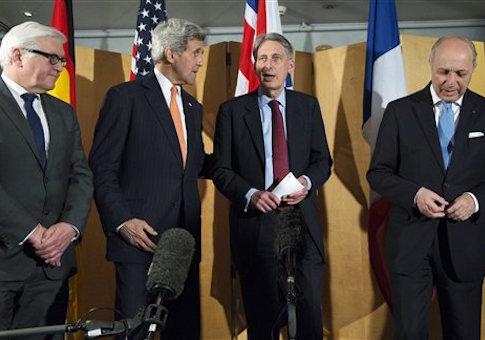
Iran Nuclear TalksFrom left, German Foreign Minister Frank Walter Steinmeier, U.S. Secretary of State John Kerry, British Foreign Secretary Philip Hammond and French Foreign Minister Laurent Fabius talk after Hammond made a statement about their meeting regarding recent negotiations with Iran over Iran’s nuclear program in London, England, Saturday, March 21 / AP

LAUSANNE, Switzerland—Efforts by the Obama administration to stem criticism of its diplomacy with Iran have included threats to nations involved in the talks, including U.S. allies, according to Western sources familiar with White House efforts to quell fears it will permit Iran to retain aspects of its nuclear weapons program.

A series of conversations between top American and French officials, including between President Obama and French President Francois Hollande, have seen Americans engage in behavior described as bullying by sources who spoke to the Washington Free Beacon.

The disagreement over France’s cautious position in regard to Iran threatens to erode U.S. relations with Paris, sources said.

Tension between Washington and Paris comes amid frustration by other U.S. allies, such as Saudi Arabia and Israel. The White House responded to this criticism by engaging in public campaigns analysts worry will endanger American interests.

Western policy analysts who spoke to the Free Beacon, including some with close ties to the French political establishment, were dismayed over what they saw as the White House’s willingness to sacrifice its relationship with Paris as talks with Iran reach their final stages.

A recent phone call between Obama and Hollande was reported as tense as the leaders disagreed over the White House’s accommodation of Iranian red lines.

Amid these tensions, U.S. Ambassador to France Jane Hartley met with her French counterpart, Gerard Araud, Monday to discuss a range of issues.

Benjamin Haddad, who has advised senior French political figures on foreign policy issues, said leaders in Paris have not been shy about highlighting disagreements they have with the White House.

“Fance, like other European countries, has negotiated for more than 10 years and endured most of the sanctions’ burden,” said Haddad, a research fellow at the Hudson Institute.

“The French want a deal, but they see no rush and repeat that Iranians need a deal more than we do, and that we shouldn’t fix artificial deadlines that put more pressure on us than Iran.”

One source in Europe close to the ongoing diplomacy said the United States has begun to adopt a “harsh” stance toward its allies in Paris.

“There have been very harsh expressions of displeasure by the Americans toward French officials for raising substantive concerns about key elements of what the White House and State Department negotiators are willing to concede to Iran,” said the source, who spoke on condition of anonymity. “That is because the clarifications expose just how weak the Americans’ deal is shaping up to be.”

“The meeting between the French ambassador in Washington and the president’s envoy to Paris—not a diplomat but a big fundraiser for his campaigns—comes amid these very harsh words that were spoken privately about the ambassador’s recent comments on the seeming American desperation for a deal, and the tough words that President Obama had for President Hollande in their phone call.”

Strategic differences remain between the United States and its allies over how a final deal should look, the source said. The French remain opposed to a recent range of concessions made by the Obama administration.

“We may agree that denying Iran a nuclear weapon ability is the goal, but apparently the view of what one can leave Iran and assure that is very different,” the source said.

“Clearly these are the differences that must be discussed. I don’t see France suddenly deciding that America is right and French objections to weakness are wrong, nor that silence is preferable to transparency.”

Haddad said the French are hesitant to rush into an agreement.

“The French want a robust deal with clear guarantees on issues like [research and development] and inspections to ensure that Iranians won’t be able to reduce breakout time during the duration of the agreement (also an issue of discussion), or just after thanks to research conducted during the period,” he said. “That is also why they disagreed on lifting sanctions.”

He also said the French “don’t trust Iran and believe an ambiguous deal would lead to regional proliferation.”

Another Western source familiar with the talks said the White House is sacrificing longstanding alliances to cement a contentious deal with Iran before Obama’s term in office ends.

“The President could be hammering out the best deal in the history of diplomacy, and it still wouldn’t be worth sacrificing our alliances with France, Israel, and Saudi Arabia—key partners in Europe, the eastern Mediterranean, and the Gulf,” the source said. “But he’s blowing up our alliances to secure a deal that paves Iran’s way to a bomb.”

A State Department spokesperson declined to comment on the issue.

Meanwhile, talks between the United States and Iran reached a critical juncture Thursday, as Secretary of State John Kerry met with his Iranian counterpoint to hash out differences over key points concerning Iran’s nuclear program.

The sides are hoping to reach a framework agreement by March 31 amid reports that Iran is demanding Saudi Arabia immediately halt airstrikes in Yemen, where Iran-aligned forces are working to bring down the Western-backed government.

The issue could complicate the talks as the United States attempts to balance its regional alliance with Iran in Iraq against competing interests with traditional allies in Saudi Arabia.

U.S. negotiators have reportedly softened their stance in recent days on a range of issues relating to Iran’s continued production of nuclear materials. One of Iran’s nuclear sites in Fordow could continue to operate, according to the Associated Press.

Saudi Arabia puppet of US, Israel: Houthi leader

March 26, 2015

Saudi Arabia puppet of US, Israel: Houthi leader, Press TV (Iranian), March 26, 2015

(The positions of Obama’s friends in Iran. How soon will he bow, apologize and make more concessions to Iran to atone for his sins? — DM)

bbc72135-d3b0-4924-91b3-4c85d14cbc21Tribal gunmen loyal to the Houthis Ansarullah shout slogans against Saudi Arabia during a gathering in the capital Sana’a on March 26, 2015.

The leader of Yemen’s Houthi fighters has heaped scorn on Saudi Arabia for conducing unjust and heinous attacks on Yemeni people, saying the Arab kingdom is serving as a puppet for the United States and the Israeli regime.

Abdul-Malik al-Houthi made the remarks in a televised address on Thursday in reaction to Saudi Arabia’s “unjustified” deadly attacks targeting Yemeni people in the capital, Sana’a.

Saudi Arabia is a puppet at the disposal of superpowers, the Houthi leader said, adding that Riyadh is putting in action the US-Israeli conspiracy in Yemen.

He noted that the US-Israeli plot in Yemen aims to break up the chaotic country and deprive people of security and freedom.

Al-Houthi said the Saudi invasion of Yemen came after their agents, including al-Qaeda terrorists and the ISIL Takfiri terrorists, failed to execute their plots in Yemen.

He said the “criminal” attacks uncovered the “tyrannical” nature of the Saudi regime.

Al-Houthi warned that Saudi Arabia would face consequences should it push ahead with its aggression against Yemen, saying, “We will confront the criminal forces and their tools in the country.”

“You think you can kill Yemeni people, but this is because of your stupidity,” he said. “This unjustified aggression shows the hostility and arrogance of this regime. The attacks are reflecting the inhumanity of the aggressor.”

Al-Houthi said the “aggressors” should keep in mind that the Yemeni people are “committed to defending their country and revolution” by relying on God.

On Thursday, Saudi warplanes carried out fresh airstrikes against Yemen, hitting the northern cities of Sa’ada and Ta’izz in the south.

Airstrikes also targeted arms depots in the Malaheez region in Sa’ada near the border with Saudi Arabia.

Saudi warplanes started bombing the positions of the Ansarullah fighters and launched attacks against the Sana’a International Airport and the Dulaimi airbase early on Thursday.

Despite Riyadh’s claims that it is attacking Ansarullah positions, Saudi warplanes have flattened a number of homes near the Sana’a airport. Based on early reports, the Saudi airstrikes on Yemen have so far claimed the lives of 18 civilians with more deaths feared, Yemeni sources said.

The Saudi invasion of Yemen has drawn condemnation from many countries such as Iran, Russia, Iraq and Syria, as well as the Lebanese resistance movement, Hezbollah.

The blatant invasion of Yemen’s sovereignty by the Saudi government comes against a backdrop of total silence on the part of international bodies, especially the United Nations. The world body has so far failed to show any reaction whatsoever to the violation of the sovereignty of one of its members by Riyadh.

Gulf states, abandoned against Iran

March 26, 2015

Gulf states, abandoned against Iran, Israel Hayom, Dr. Reuven Berko, March 26, 2015

(At least the Gulf States are awakening. That’s a good start. — DM)

The West’s weakness and apathy toward Iran and the perilous predicament it has created in Yemen again prove the flimsy nature of those security and defense treaties. This lesson justifies Israel’s approach, which is based on the ability to defend itself on its own. In the meantime, following the Houthi takeover, Saudi Arabia has decided to deploy a massive military force along the border with Yemen. The first shot is in the chamber and the finger is already on the trigger.

**********************

Shiite Iran’s increasing involvement in Iraq, Syria and Lebanon, while exploiting the Shiite elements of the population in those target countries, is causing a great deal of concern among leaders of Arab Gulf states. The trauma of Iran’s attempt to topple the regime in Bahrain, where most of the population is Shiite, under the claim that Bahrain is Iran’s 14th province, is still fresh in their minds. The Iranian goal of using Bahrain as a bridgehead from which to spread across the Arabian Peninsula is still in play, despite Iran’s first effort being blocked in March 2011, when some 1,000 Saudi troops and 500 policemen from the United Arab Emirates entered Bahrain to save its regime.

Ever since Saddam Hussein’s sudden invasion of Kuwait, the Gulf states — Saudi Arabia, Oman, Kuwait, Qatar, Bahrain and the UAE — realized the need for a type of “Al Jazeera defense force” to pose a strategic deterrent against Iranian machinations on the peninsula. Their effort has not been a success. Through its latest intervention, via the mobilization of Shiite Houthi tribesmen to capture key targets in Yemen, including the primary port cities and airports in the south of the country leading to control of the Gulf of Aden, Iran is clearly reiterating its ambition of acquiring the straits of Hormuz and Bab el-Mandeb, which will allow Iran to paralyze the Red Sea and Persian Gulf waterways.

Arab stagnation combined with the West turning a blind eye to this Iranian aggression, alongside the willingness of Western powers to sign a deal allowing Iran to acquire a nuclear bomb, is causing sleepless nights among those Arab leaders who are again pushing the need to upgrade the capabilities of the “Al Jazeera defense force.”

Considering the lack of trust in the West and Yemen’s expected fall to the Houthis, the leaders of the Arab Gulf states are again working, feverishly, to build the military capability to curb Iran. As early as December 2009, with the goal of protecting the integrity of Arab territories situated in the Arabian Peninsula, the Arab League decided to establish a massive, unified, heavily funded, rapid-reaction military force comprising hundreds of thousands of troops and naval capabilities, capable of posing a deterrent and striking a decisive blow on the battlefield. Morocco and Jordan were also added to this coalition, as strategic depth, but the initiative ultimately failed to gain traction.

The recent gathering of these partner states in Riyadh gave birth to a multitude of agreements, including support and aid to Egypt, which is considered the strongest true military force in the Sunni Arab Middle East. Additionally, Saudi Arabia has lobbied for Pakistani support in the aftermath of Yemen’s inevitable fall, or worse, when Iran completes its nuclearization with American consent.

As the West falls victim to the fraud peddled by Mohammad Javad Zarif, Iran’s foreign minister, the Arabs (and Israel) have no illusions about Iran’s true intentions. Even as the Bahrain crisis was unfolding, the threats issued by many of Iran’s highest-ranking defense establishment officials — whether in the regime, the military or the Shura (parliament) — reflected the hostile nature of Iran’s foreign policy, and removed any doubt in the minds of neighboring Arab leaders.

Many of the Gulf states with signed security and defense pacts with the West, namely the United States, are currently feeling abandoned. Ever since the events in Bahrain, and to a greater degree following the recent developments in Yemen, the realization is growing in the Gulf that Iran’s aggressive goals and ambitions regarding the Arabian Peninsula have not changed and that they must take care of themselves.

The Arabs have recently come to the realization that not only will they not receive aid from the West in their hour of need, but that the West is forging a deal with Iran at their expense — a deal that will pose the greatest threat to their security. The situation that has been created provides an opportunity for Israel, even if clandestinely, to play a part in the geostrategic plans being formulated by states in the region, and which could help lead to an agreeable deal on the Palestinian issue — which is rather secondary in the current pan-Arab context.

The West’s weakness and apathy toward Iran and the perilous predicament it has created in Yemen again prove the flimsy nature of those security and defense treaties. This lesson justifies Israel’s approach, which is based on the ability to defend itself on its own. In the meantime, following the Houthi takeover, Saudi Arabia has decided to deploy a massive military force along the border with Yemen. The first shot is in the chamber and the finger is already on the trigger.

Egypt seizes Bab el Mandeb ahead of Iran. Saudis bomb Iran-backed Yemeni Houthis. US launches air strikes over Tikrit

March 26, 2015

Egypt seizes Bab el Mandeb ahead of Iran. Saudis bomb Iran-backed Yemeni Houthis. US launches air strikes over Tikrit, DEBKAfile, March 26, 2015

Yemen3_1

The separate operations in Yemen and Iraq attested to the widening breach between the Sunni Arab camp and the Obama administration and the former’s resolve to thwart US strategy for buying a nuclear deal with Tehran by empowering Iran to attain the rank of leading Middle East power.

**********************

In a surprise step, Egyptian marine naval and marine forces Thursday morning, March 26, seized control of the strategic Bab El-Mandeb Straits to foil Tehran’s plans to grab this important energy shipping gateway between the Red Sea, the Gulf of Aden and the Suez Canal, DEBKAfile’s military sources report from the Gulf. Egypt disguised the raid as a counter-piracy operation. It rounded off the Saudi-led air strikes launched the same morning against Iran-backed Houthi rebels in Yemen. These operations signaled the start of a major Sunni Arab revolt against Iran’s approaching takeover of Yemen, through its Houthi proxy, and advances in other strategic positions in the Middle East, with Washington’s support.

Thursday morning too, the US launched the US launched its first air strikes against Islamic State positions in the Iraqi city of Tikrit, rallying to the aid of the Iranian-commanded Iraqi operation, which had failed to dislodge the jihadis in two weeks of fighting.

The separate operations in Yemen and Iraq attested to the widening breach between the Sunni Arab camp and the Obama administration and the former’s resolve to thwart US strategy for buying a nuclear deal with Tehran by empowering Iran to attain the rank of leading Middle East power.

DEBKAfile reported earlier Thursday morning:

Iran’s Revolutionary Guards (IRGC) are now leading war action in four Mid East arenas: Syria, Iraq, Yemen and Lebanon, while building Shiite “popular” armies deferring to Tehran in three: Syria, Iraq and Yemen.

The formal announcements coming from Riyadh and Washington attempted to gloss over the open breach. The Saudis Wednesday indicated that their military buildup on the Yemeni was “purely defensive,” while Washington subsequently declared support for the Saudi-Gulf-Egyptian air strikes after they began.

According to our Washington sources, President Obama decided Wednesday to accede to the Iraqi premier Haider al-Abadi’s request for air support to de-stall the Tikrit operation against ISIS. Iran’s Al Qods Brigades chief, Gen. Qassem Soleimani, who commanded the operation from the start has departed the scene.

Nothing has been said to indicate whether the Iranian forces, including Revolutionary Guards officers, remain in the area. It appears that the Obama administration prefers as little as possible to be mentioned about US-Iranian battlefield coordination in Iraq versus the Islamists, especially since it was not exactly a big success. At the same time, US air strikes launched to support ground forces are bound to be coordinated with their commanders, who in this case happen to be mostly Iranian. In the last two weeks of the Tikrit operation, liaison between the US and Iranian military in Iraq was routed through the office of the Iraqi Prime Minister in Baghdad.

Early Thursday, Riyadh reported that the Saudi Royal Air Force had taken out Houthi air defenses, destroyed numerous Houthi fighter planes and were imposing a wide no-fly zone over Yemen.

Egypt is providing political and military support for Saudi-GCC operation against Houthi fighters in Yemen, the Egyptian state news agency said Thursday. Egypt’s Foreign Ministry was quoted as saying this support could involve Egyptian air, naval and ground forces, if necessary.

DEBKAfile’s military sources add: The Saudis declared Yemeni air space a no-fly zone to achieve to goals: (1) To deny the Yemeni forces advancing on the key port city of Aden access to air cover which would undoubtedly have been forthcoming from mutinous elements of the Yemeni air force. Without it, the rebel advance would be severely hobbled, and, (2) to prevent Iranian warplanes from landing at Yemeni air bases with deliveries of military equipment and ammunition their Houthi proxies.

Gulf sources disclose that Saudi Arabia has placed 100 warplanes and 150,000 troops with heavy weapons at the disposal of the operation against Iran’s Yemeni proxy, the Zaydi Houthis, as well as pressing into service Pakistani, Moroccan and Jordanian military units. This force is a sign that Riyadh intends of following up its air action with a ground invasion across the border into Yemen to crush the revolt in its backyard.

Developing…

Saudi Arabia launches airstrikes in Yemen, ambassador says

March 26, 2015

Saudi Arabia launches airstrikes in Yemen, ambassador says, Fox News, March 26, 2015

(Meanwhile, as Iranian supported Houthis take over much of Yemen, the U.S. is providing airstrikes in Tikrit to assist Iran and helping Iran to establish itself as a nuclear power. Please see also, US air force bombs Tikrit to aid Iran-led operation against ISIS. Saudi, Egyptian bombers strike Iran-backed Houthi rebels in Yemen. — DM)

032515_shep_Yemen2_640Iran-backed rebels bring Yemen to brink of civil war

Saudi Arabia launched airstrikes against the Houthi rebels in Yemen early Thursday, one day after the U.S.-backed Yemeni president was driven out of the country.

President Obama has authorized the provision of logistical and intelligence support to the military operations, National Security Council spokesperson Bernadette Meehan said late Wednesday night. She added that while U.S. forces were not taking direct military action in Yemen, Washington was establishing a Joint Planning Cell with Saudi Arabia to coordinate U.S. military and intelligence support.

Saudi Ambassador Adel al-Jubeir said the operations began at 7 p.m. Eastern time.

He said the Houthis, widely believed to be backed by Iran, “have always chosen the path of violence.” He declined to say whether the Saudi campaign involved U.S. intelligence assistance.

Al-Jubeir made the announcement at a rare news conference by the Sunni kingdom.

He said the Saudis “will do anything necessary” to protect the people of Yemen and “the legitimate government of Yemen.”

A Yemeni official earlier Wednesday would not say where Yemeni President Abed Rabbo Mansour Hadi fled to, but did tell Fox News: “He is safe. That’s all I can say at this point.”

Hadi’s departure marks a dramatic turn in Yemen’s turmoil and means a decisive collapse of what was left of his rule, which the United States and Gulf allies had hoped could stabilize the chronically chaotic nation and fight Al Qaeda’s branch here after the 2011 ouster of longtime autocrat Ali Abdullah Saleh.

Over the past year, the Shiite rebels known as Houthis, who are believed to be supported by Iran, have battled their way out of their northern strongholds, overwhelmed the capital, Sanaa, seized province after province in the north and worked their way south. Their advance has been boosted by units of the military and security forces that remained loyal to Saleh, who allied with the rebels.

With Hadi gone, there remains resistance to the Houthis scattered around the country, whether from Sunni tribesmen, local militias, pro-Hadi military units or Al Qaeda fighters.

Hadi and his aides left Aden after 3:30 p.m. on two boats, security and port officials told The Associated Press. He is scheduled to attend an Arab summit in Egypt on the weekend, where Arab allies are scheduled to discuss formation of a joint Arab force that could pave the way for military intervention against Houthis.

His flight came after Houthis and Saleh loyalists advanced against Hadi’s allies on multiple fronts. Military officials said militias and military units loyal to Hadi had “fragmented,” speeding the rebel advance. The officials spoke on condition of anonymity because they were not authorized to speak to reporters

Earlier in the day, the rebels seized a key air base where U.S. troops and Europeans had advised the country in its fight against Al Qaeda militants. The base is only 60 kilometers (35 miles) away from Aden.

In the province of Lahj, adjoining Aden, the rebels captured Hadi’s defense minister, Maj. Gen. Mahmoud al-Subaihi, and his top aide on Wednesday and subsequently transferred them to the capital, Sanaa. Yemen’s state TV, controlled by the Houthis, announced a bounty of nearly $100,000 for Hadi’s capture.

Hadi then fled his presidential palace, and soon after warplanes targeted presidential forces guarding it. No casualties were reported. By midday, Aden’s airport fell into hands of Saleh’s forces after intense clashes with pro-Hadi militias.

Aden was tense Wednesday, with schools, government offices, shops and restaurants largely closed. Inside the few remaining opened cafes, men watched the news on television. With the fall of the city appearing imminent, looters went through two abandoned army camps, one in Aden and the other nearby, taking weapons and ammunition.

The takeover of Aden, the country’s economic hub, would mark the collapse of what is left of Hadi’s grip on power. After the Houthis overran Sanaa in September, he had remained in office, but then was put under house arrest. He fled the capital earlier in March with remnants of his government and declared Aden his temporarty capital.

Yemen’s Foreign Minister Riad Yassin told Dubai-based Al-Arabiya TV satellite news network that he officially made a request to the Arab League on Wednesday to send a military force to intervene against the Houthis. Depicting the Houthis as a proxy of Shiite Iran, a rival to Sunni Gulf countries, he warned of an Iranian “takeover” of Yemen. The Houthis deny they are backed by Iran.

Mohammed Abdel-Salam, a spokesman for the Houthis, said their forces were not aiming to “occupy” the south. “They will be in Aden in few hours,” Abdel-Salam told the rebels’ satellite Al-Masirah news channel.

Earlier, Al-Masirah reported that the Houthis and allied fighters had “secured” the al-Annad air base, the country’s largest. It claimed the base had been looted by both Al Qaeda fighters and troops loyal to Hadi.

The U.S. recently evacuated some 100 soldiers, including Special Forces commandos, from the base after Al Qaeda briefly seized a nearby city. Britain also evacuated soldiers.

The base was crucial in the U.S. drone campaign against Al Qaeda in the Arabian Peninsula, which Washington considers to be the most dangerous offshoot of the terror group. And American and European military advisers there also assisted Hadi’s government in its fight against Al Qaeda’s branch, which holds territory in eastern Yemen and has claimed the attack on the French satirical magazine Charlie Hebdo in Paris.

U.S. operations against the militants have been scaled back dramatically amid Yemen’s chaos. U.S. officials have said CIA drone strikes will continue in the country, though there will be fewer of them. The agency’s ability to collect intelligence on the ground in Yemen, while not completely gone, is also much diminished.

The Houthis, in the aftermath of massive suicide bombings in Sanaa last week that killed at least 137 people, ordered a general mobilization and their leader, Abdel-Malik al-Houthi, vowed to send his forces to the south to fight Al Qaeda and militant groups.

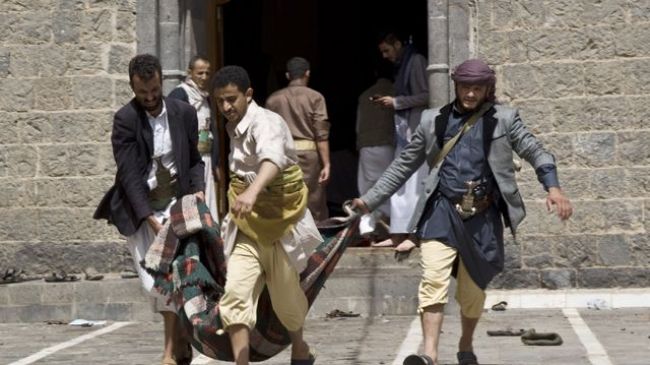
In Sanaa, dozens of coffins were lined up for a mass funeral of the victims Wednesday. Among the victims was a top Shiite cleric. Yemen’s Islamic State-linked militants have claimed responsibility for the attack.

The Houthis seized the capital, Sanaa, in September and have since been advancing south along with Saleh’s loyalists. On Tuesday, they fired bullets and tear gas to disperse thousands of protesters in the city of Taiz, known as the gateway to southern Yemen. Six demonstrators were killed and scores more were wounded, officials said.

The Houthis also battled militias loyal to Hadi in the city of al-Dhalea, adjacent to Taiz, Yemen’s third-largest city. Taiz is also the birthplace of its 2011 Arab Spring-inspired uprising that forced Saleh to hand over power to Hadi in a deal brokered by the U.N. and Gulf countries.

Hadi on Tuesday asked the U.N. Security Council to authorize a military intervention “to protect Yemen and to deter the Houthi aggression” in Aden and the rest of the south. In his letter, Hadi said he also has asked members of the six-nation Gulf Cooperation Council and the Arab League for immediate help.

Saudi Arabia warned that “if the Houthi coup does not end peacefully, we will take the necessary measures for this crisis to protect the region.”

Iran’s advances create alarm in Saudi Arabia and the Gulf

March 14, 2015

Iran’s advances create alarm in Saudi Arabia and the Gulf, the Guardian,  March 13, 2015

Arabs believe Baghdad, Damascus, Beirut and Sana’a are in effect under Iranian control – and power may shift further if US sanctions are eased.

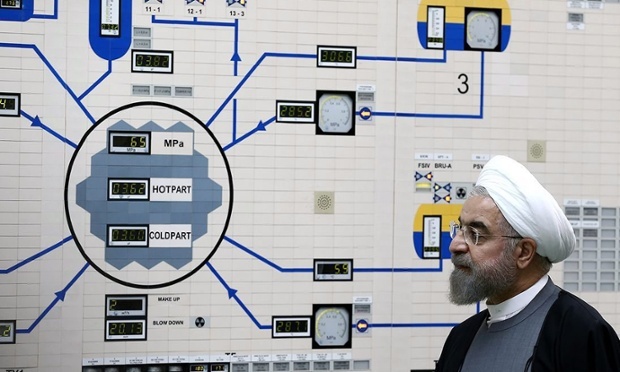
c0ac3569-93da-4ae8-8b51-29dc6991ee13-620x372 Hassan Rouhani, the Iranian president, visiting Bushehr nuclear power plant in southern Iran this year. Photograph: Presidential official handout/EPA

Iran’s great advantage, suggests Emile Hokayem, an analyst, is its commitment and competence, in Syria and beyond. “The expertise, experience and strategic patience it deployed in support of the Syrian regime to a great extent facilitated Assad’s recovery from serious setbacks in 2012. In contrast, the war in Syria has exposed not only the political and operational limitations of the Gulf states, but also the rivalries among them.”

*********************

The commanders of Iran’s Islamic Revolutionary Guard Corps (IRGC) have been working overtime recently, flaunting their achievements across the Middle East and flexing muscles as international negotiations over the country’s nuclear programme enter their critical and perhaps final phase.

On Wednesday it was the turn of Major-General Mohammad Ali Jafari, the IRGC’s most senior officer. “The Islamic revolution is advancing with good speed, its example being the ever-increasing export of the revolution,” he declared. “Not only Palestine and Lebanon acknowledge the influential role of the Islamic Republic but so do the people of Iraq and Syria. They appreciate the nation of Iran.”

Last month a similarly boastful message was delivered by General Qassem Suleimani, who leads the IRGC’s elite Quds force — and who is regularly photographed leading the fightback of Iraqi Shia miltias against the Sunni jihadis of the Islamic State (Isis) as well as against western and Arab-backed rebels fighting Bashar al-Assad in southern Syria. “Imperialists and Zionists have admitted defeat at the hands of the Islamic Republic and the resistance movement,” Suleimani said.

Iran’s advances are fuelling alarm in Saudi Arabia and the Gulf, where Tehran has been a strategic rival since the days of the Shah, and which now, it is said with dismay, in effect controls four Arab capitals – Baghdad, Damascus and Beirut and in the last month Sana’a in Yemen – which is uncomfortably close to home.

Iran’s regional position has certainly improved. Its high-profile role fighting Isis in Iraq, Assad’s retention of control in Syria with the help of its Lebanese ally Hezbollah, and the Houthi rebel takeover in Yemen have all been deeply discomfiting for the Saudis. Anti-government protests in Shia-majority Bahrain are also often blamed on Tehran — though that ignores the domestic roots of the unrest.

In Riyadh King Salman has dropped his preoccupation with the Muslim Brotherhood in favour of building a united Sunni Arab front to confront the Iranians, diplomats say, though translating that strategy into action is another matter. The message from Saudi Arabia and the United Arab Emirates is that whatever the outcome of the nuclear talks, Iran is bent on expanding its power and influence. “The Iranians have scored major victories but only where there are Shia minorities,” a senior Gulf official told the Guardian. “Our concern is that the nuclear issue will become a tool of their foreign policy.”

Arab alarm is shared by Israel. Binyamin Netanyahu used identical arguments in his recent speech to the US Congress, timed to influence next week’s nuclear endgame in Geneva. “The Saudis will be incredibly worried that we are getting close to a point where the Iranians will be players because of the nuclear issue and the way the Americans have effectively ended up on the same side as the Iranians in Iraq,” said one veteran Saudi-watcher. “But the noise they are making is in inverse proportion to their ability to do anything about it.”

Arab governments are not reassured by the promises of John Kerry, the US secretary of state, that Washington is not seeking a “grand bargain” with Tehran that will allow it to “destabilise” the Middle East, bolstered by the easing of economic sanctions. Saud Al Faisal, the Saudi foreign minister, warned of Tehran’s “hegemonic” ambitions as the IRGC supported the military operation to retake the Iraqi town of Tikrit from Isis. In Gulf capitals Hassan Rouhani, the emollient Iranian president, is seen as less important than the hardline supreme leader, Ayatollah Ali Khamenei.

It is hard to disentangle propaganda from reality. But independent analysts argue that Iran is inflating its gains for both foreign and domestic consumption. “If you listen to Suleimani there is a degree of exaggeration,” argues Ali Ansari of St Andrews University. “It’s rhetorical reassurance. He is saying to Iranians: ‘We are powerful and and everyone is worried about this’ – partly to make the point that they are not really under pressure. People outside can see what Iran’s strengths and weaknesses are. But there is this belief that you need to negotiate from a position of strength and that if you are weak you will be trampled on.”

Iran-watcher Hossein Rassam also detects a domestic calculation in the IRGC statements. “Critics of Rouhani’s policy of rapprochement with the international community inside Iran can turn to the supreme leader and say there wasn’t really much need for that softer tone because now we have more bargaining chips in our hands. Iran is the only power in the region which can actually fight Isis and the west needs us for that.”

Meir Litvak, an Israeli expert on Iran, sees both genuine belief and posturing in Tehran’s stance. “The Iranians believe they have been able to save the Assad regime from total collapse and there is at least stalemate in Syria,” he said. “That means they have been able to maintain the link with Hezbollah and maybe open a second front by proxy against Israel on the Golan Heights. The Houthi rebellion in Yemen was initially a genuinely domestic affair but the Iranian regime saw it as an opportunity. And it has become a bonus for it – even if they are not that active inYemen. But if the Saudis are scared that’s a plus for the Iranians.”

Arab diplomatic sources say they expect to see an IRGC and Hezbollah presence in Yemen, helped by a new agreement on regular flights between Tehran and Sana’a.

Iran’s role in Bahrain, where the Shia majority remains locked in confrontation with the Saudi-backed Sunni monarchy, is more about scoring propaganda points than material support – despite claims in Manama about Iran’s sinister role.

Still, in the heartlands of Iranian influence, Iraq and Syria, there have been significant costs as well as benefits, including the deaths of two senior IRGC commanders. Continuing sanctions and low oil prices – seen in Tehran as a deliberate strategy by the Saudis – have also made it harder to shell out billions of dollars to subsidise the Assad regime.

Iran’s great advantage, suggests Emile Hokayem, an analyst, is its commitment and competence, in Syria and beyond. “The expertise, experience and strategic patience it deployed in support of the Syrian regime to a great extent facilitated Assad’s recovery from serious setbacks in 2012. In contrast, the war in Syria has exposed not only the political and operational limitations of the Gulf states, but also the rivalries among them.”

Obama’s foreign policy successes in Yemen

February 11, 2015

(Here are two You Tube videos, posted today, dealing with the evacuation of the U.S. embassy in Yemen and the situation there in general. Please compare and contrast. Obama hasn’t said much recently about his foreign policy successes there. Perhaps, as the State Dept. spokesperson says, the current situation in Yemen has nothing to do with Islam the United States.– DM)

CNN: Iran-Backed Rebels Seized U.S. Military Equipment As Embassy in Yemen Was Abandoned, CNN via You Tube, February 11, 2015


State Dept: U.S. Not ‘Being Run Out of Town’ Despite Abandoning 3rd US Embassy in Middle East, Washington Free Beacon via You Tube, February 11, 2015